Enterprise
Auto Added by WPeMatico
Auto Added by WPeMatico
Seismic has been helping companies create and manage their sales and marketing collateral since 2010. Today the company announced a $100 million Series E investment on a $1 billion valuation.
The round was led by Lightspeed Venture Partners and T. Rowe Price. Existing investors General Atlantic, JMI Equity and Jackson Square Ventures also participated in the round. The company has now raised $179 million since inception.
What is attracting this level of investment is Seismic’s sales enablement tools, a kind of content management for sales and marketing. “What we’re trying to do with our technology is to help marketers who are striving to create the right content to help the sellers, and help sellers navigate all of the content out there and put together the right pieces and the right materials that are going to help them move the sales cycle along,” Seismic CEO and co-founder Doug Winter explained.
The inclusion of an investor like T. Rowe Price often is a signal of IPO ambitions, and Winter acknowledged the connection, while pointing out that T. Rowe Price is also a customer. “We do have a goal to be public-ready as a company that we are aiming for. We are the leader of the space, and we do feel like striving to be a public company and to be the first one in our space to go public. It’s a goal we are going to push for,” Winter told TechCrunch.
But he says taking this investment is more about taking advantage of market opportunity. The money gives Seismic the ability to expand to meet growing sales. Today, the company has more than 600 customers averaging more than $200,000 in spending, according to Winter.
The company acquired the Savo Group in May to help expand its market position. Seismic is based in San Diego with offices in Boston and Chicago (from the acquisition). It also opened offices in the U.K. and Australia earlier this year and plans further international expansion with the new investment. The company currently has more than 600 employees, including 185 engineers and project managers, and plans to keep hiring as it puts this money to work.
Powered by WPeMatico
Soon it will be easier for people without Google accounts to collaborate on G Suite documents. Currently in beta, a new feature will enable G Suite users to invite people without G Suite subscriptions or Google accounts to work on files by sending them a pin code.
Using the pin code to gain access allows invitees to view, comment on, suggest edits to or directly edit Google Docs, Sheets and Slides. The owners and admins of the G Suite files monitor usage through activity logs and can revoke access at any time. According to the feature’s support article, admins are able to set permissions by department or domain. They also can restrict sharing outside of white-listed G Suite domains or their own organization.
In order to sign up for the beta program, companies need to fill in this form and select a non-G Suite domain they plan to collaborate with frequently.
According to a Reuters article published in February, since intensifying their focus on enterprise customers, Google has doubled the number of organizations with a G Suite subscription to more than 4 million. But despite Google’s efforts to build its enterprise user base, G Suite hasn’t come close to supplanting Office 365 as the cloud-based productivity software of choice for companies.
Office 365 made $13.8 billion in sales in 2016, versus just $1.3 billion for G Suite, according to Gartner. Google has added features to G Suite, however, to make the two competing software suites more interoperable, including an update that enables Google Drive users to comment on Office files, PDFs and images in the Drive preview panel without needing to convert them to Google Docs, Sheets or Slide files first, even if they don’t have Microsoft Office or Acrobat Reader. Before that, Google also released a Drive plugin for Outlook.
This may not convince Microsoft customers to switch, especially if they have been using its software for decades, but at least it will get more workers comfortable with Google’s alternatives, and may convince some companies to subscribe to G Suite for at least some employees or departments.
Powered by WPeMatico
If you are a mother who has taken a break from full-time employment to raise kids, you may have also experienced the challenge that is jumping back into the working world after your break.
You may find you need more time flexibility; you have been out of the job market for years and so your confidence is knocked; your skills are no longer as relevant as they were before; or you just want to rethink your career; plus many employers — whether they say it or not — seem less interested in you because of all of the above, and no level of burnishing your resume on LinkedIn will help. It can be tough (and I say that from first-hand experience).
Now, Chicago-based startup The Mom Project, a platform specifically built to help female knowledge workers find jobs after pausing to raise kids, has raised a little egg of its own to take on this challenge. It’s picked up a Series A of $8 million that it plans to use to bring its job marketplace to more cities — it’s currently in Chicago, Atlanta and San Francisco — and to expand the kinds of services it offers to make the challenge of juggling work and parenthood easier.
The funding is being led by Grotech Ventures and Initialized Capital, with another new investor, Aspect Ventures, and previous backers Atlanta Seed Company, Engage Ventures, OCA Ventures, BBG Ventures, IrishAngels and Wintrust Financial also participating.
This brings the total raised by The Mom Project to $11 million, and with 75,000 registered moms and 1,000 companies, including Procter & Gamble, BP, Miller Coors and AT&T, the startup claims it’s now the largest platform of its kind in the U.S.
Allison Robinson, the founder and CEO of The Mom Project, said she came up with the idea for the startup in 2016, when she was on maternity leave from a strategy role at Pampers.
“I started realising a lot about moms before I became one,” she says about her last role before striking out as an entrepreneur. “But what I hadn’t understood until I was on maternity leave myself was that your priorities can change after having a child.” (She’s pictured up above with her son.)
Citing a study she’d seen in the Harvard Business Review that estimated 43 percent of skilled women exit the workforce after having children, Robinson realised there was a gap in the market for those among them who had timed out from returning to their previous roles, but still wanted to make the leap back into working at some point.
And she has a point: Not only do people who decide they want to return to work face all of the usual issues of newly needing more time flexibility, wondering whether their skills are still current enough, general confidence and so on, but the average recruitment process, and job sites overall, do not really have ways to account for any of that very well.
And the gap exists on the employer side of the marketplace, too. Businesses — both large corporates very much in the public eye as well as smaller businesses that are not — are rethinking how they hire and keep good people in the overall competition for talent. (Just this week, the U.K.’s Office of National Statistics said that the number of unfilled positions in the information and communication technology sector rose by 24.3 percent compared to last year in the country, a shortage that’s reflected in other markets.)
Having a diverse workforce — including more women and women from different walks of life — is key not only to helping counteract that, but to contribute to better overall work culture. That’s a fact that many employers have realised independently or have simply been thrown into the spotlight unwittingly and now are trying to repair.
And yet, there haven’t been many opportunities for them to pursue more diverse hiring practices.
LinkedIn recently made a tiny move into exploring diversity in hiring by at least allowing recruiters to search their job candidate results by gender, but this is a far cry from actually addressing the specific predicaments that particular segments of the working population have, and how to help them connect better with employers who might be keen to bring more of them on through recruitment.
In fact, the idea of providing improved job search for knowledge workers in specific cases is actually a very interesting one that shows there is definitely still room for innovation in the world of recruitment: Handshake earlier this year raised $40 million for its own take on this, which is providing a better LinkedIn-style platform to connect minority university graduates with interesting job opportunities at companies keen to make their workforces more diverse.
“Companies have started to realize the value in building a diverse workforce, but we still have a long way to go in achieving equal representation and opportunities,” said Julia Taxin, a partner at Grotech and new Mom Project board member. “Allison and her team have built an incredible marketplace of diverse talent for companies and I look forward to working with The Mom Project to execute on their vision of helping to close the gender gap in the workplace.”
The Mom Project, Robinson said, is tackling the challenges at both ends of the spectrum.
On the employer side, she said there is a lot of educating going on, talking to HR people and getting them to understand the opportunity they could unlock by hiring more parents — which tend to be almost entirely all-women, but sometimes men, too.
“We want to provide more data to these companies,” she said, pointing out that it’s not just a matter of providing a job opportunity, but also giving parents options in areas like childcare, or flexible working schedules. “We want to show them ‘here is where you are doing well, and here is where you are not. Fixes don’t cost a lot of money, but a lot of companies are just not aware.”
“We’ve got 75,000 women on our platform, and currently around 1,000 companies posting jobs,” she said. “The goal is to have 75,000-plus jobs. We want to make sure that all the moms signing up on the platform are getting work.”
“The Mom Project is determined to create a future where women aren’t forced to choose between their families and their careers,” said Alda Leu Dennis, partner at Initialized Capital and new Mom Project board member, in a statement. “There is a huge pool of experienced talent, parents and non-parents, that is sometimes overlooked because companies haven’t created the kind of diverse, flexible workplace culture that attracts and retains them. Initialized wants to be part of making this cultural shift happen.”
On the parent side, not only is it also about making the platform known to people who are considering a return to work, but it’s also about some fundamental, but very important basics, such as giving would-be jobseekers the flexibility to go to interviews. Robinson said that one campaign it’s about to launch, in partnership with Urban Sitter, is to provide free childcare credits to Mom Project jobseekers so that they can get to their interview.
“Sometimes you have to go to an interview with 24 hours’ notice, and lining up a sitter can be stressful,” she said. “We want to alleviate that.”
Parents also know that this isn’t just an issue for the interview: Many towns and regions have what Robinson called “childcare deserts,” where there is a scarcity of affordable options to replace the parent on a more daily basis.
For now, Robinson said that the majority of jobs on the platform are focused on fixed-term employment — that is, not permanent, full-time work.
This is due to a number of reasons. For example, parents coming back to working after a break may be more inclined to ease in with shorter roles and less long-term commitment. And employers are still testing out how this demographic of workers will work out, so to speak. Equally, though, we have seen a huge swing in more general employment trends, where businesses are hiring fixed-term workers rather than full-time employees to account for seasonality and to give themselves more flexibility (not to mention less liability on the benefits front).
While Robinson said that the aim is definitely to bring more full-time job opportunities to the platform over time, this has nonetheless presented an interesting business opportunity to The Mom Project. The startup acts like Airbnb, Amazon and a number of other marketplaces, where it not only connects job-seekers and employers, but also then handles all the transactions around the job. When the job is fixed-term, the Mom Project essentially becomes like the job agency paying the employee, and that is how it makes a cut. And it also becomes the provider of benefits and more.
In other words, while there is an immediate opportunity for The Mom Project to compete against (or at least win some business from) the likes of LinkedIn to target the specific opportunity of providing jobs for women returning to work, there is a potentially and equally big one in becoming a one-stop employment shop to handle customers’ other needs as employers or workers, providing a range of other services, from payroll through to childcare listings and more.
Powered by WPeMatico
Just when you didn’t think there could be any more drama over the Pentagon’s decade-long, $10 billion JEDI contract RFP, the plot thickened again last week when Amazon Web Services (AWS) joined the U.S. government as a defendant in Oracle’s lawsuit over the Pentagon’s handling of the contract RFP process.
Earlier this month, Oracle filed a complaint in the United States Court of Federal Claims alleging that the JEDI RFP process unfairly favored Amazon, that the single-vendor decision (which won’t be made until April) violates federal procurement rules and that two members of the JEDI team had a conflict of interest because of previous affiliations with Amazon Web Services.
AWS filed paperwork to join the case, stating that because of the claims being made by Oracle, it had a direct stake in the outcome. “Oracle’s Complaint specifically alleges conflicts of interest involving AWS. Thus, AWS has direct and substantial economic interests at stake in this case, and its disposition clearly could impair those interests,” the company’s attorneys stated in the motion.
The Motion to Intervene as a Defendant was approved by United States Court of Federal Claims Senior Judge, Eric G. Bruggink the same day.
Oracle filed a complaint alleging essentially the same issues with the Government Accountability Office earlier this year, but the GAO found no wrong-doing in a ruling last month. Oracle decided to take the case to court, where it has had some high-profile wins in recent years, including its case against Google over its use of the Java APIs.
The JEDI contract RFP has attracted attention for the length, the amount of money at stake and the single-vendor selection decision. This is a contract that every cloud company badly wants to have. Oracle has made it clear it’s not giving up without a fight, while Amazon Web Services intends to defend itself against Oracle’s claims.
Powered by WPeMatico
It feels like there’s a WeWork on every street nowadays. Take a walk through midtown Manhattan (please don’t actually) and it might even seem like there are more WeWorks than office buildings.
Consider this an ongoing discussion about Urban Tech, its intersection with regulation, issues of public service, and other complexities that people have full PHDs on. I’m just a bitter, born-and-bred New Yorker trying to figure out why I’ve been stuck in between subway stops for the last 15 minutes, so please reach out with your take on any of these thoughts: @Arman.Tabatabai@techcrunch.com.
Co-working has permeated cities around the world at an astronomical rate. The rise has been so remarkable that even the headline-dominating SoftBank seems willing to bet the success of its colossal Vision Fund on the shift continuing, having poured billions into WeWork – including a recent $4.4 billion top-up that saw the co-working king’s valuation spike to $45 billion.
And there are no signs of the trend slowing down. With growing frequency, new startups are popping up across cities looking to turn under-utilized brick-and-mortar or commercial space into low-cost co-working options.
It’s a strategy spreading through every type of business from retail – where companies like Workbar have helped retailers offer up portions of their stores – to more niche verticals like parking lots – where companies like Campsyte are transforming empty lots into spaces for outdoor co-working and corporate off-sites. Restaurants and bars might even prove most popular for co-working, with startups like Spacious and KettleSpace turning restaurants that are closed during the day into private co-working space during their off-hours.
Before you know it, a startup will be strapping an Aeron chair to the top of a telephone pole and calling it “WirelessWorking”.
But is there a limit to how far co-working can go? Are all of the storefronts, restaurants and open spaces that line city streets going to be filled with MacBooks, cappuccinos and Moleskine notebooks? That might be too tall a task, even for the movement taking over skyscrapers.

Photo: Vasyl Dolmatov / iStock via Getty Images
So why is everyone trying to turn your favorite neighborhood dinner spot into a part-time WeWork in the first place? Co-working offers a particularly compelling use case for under-utilized space.
First, co-working falls under the same general commercial zoning categories as most independent businesses and very little additional infrastructure – outside of a few extra power outlets and some decent WiFi – is required to turn a space into an effective replacement for the often crowded and distracting coffee shops used by price-sensitive, lean, remote, or nomadic workers that make up a growing portion of the workforce.
Thus, businesses can list their space at little-to-no cost, without having to deal with structural layout changes that are more likely to arise when dealing with pop-up solutions or event rentals.
On the supply side, these co-working networks don’t have to purchase leases or make capital improvements to convert each space, and so they’re able to offer more square footage per member at a much lower rate than traditional co-working spaces. Spacious, for example, charges a monthly membership fee of $99-$129 dollars for access to its network of vetted restaurants, which is cheap compared to a WeWork desk, which can cost anywhere from $300-$800 per month in New York City.
Customers realize more affordable co-working alternatives, while tight-margin businesses facing increasing rents for under-utilized property are able to pool resources into a network and access a completely new revenue stream at very little cost. The value proposition is proving to be seriously convincing in initial cities – Spacious told the New York Times, that so many restaurants were applying to join the network on their own volition that only five percent of total applicants were ultimately getting accepted.
Basically, the business model here checks a lot of the boxes for successful marketplaces: Acquisition and transaction friction is low for both customers and suppliers, with both seeing real value that didn’t exist previously. Unit economics seem strong, and vetting on both sides of the market creates trust and community. Finally, there’s an observable network effect whereby suppliers benefit from higher occupancy as more customers join the network, while customers benefit from added flexibility as more locations join the network.

Photo: Caiaimage / Robert Daly via Getty Images
So is this the way of the future? The strategy is really compelling, with a creative solution that offers tremendous value to businesses and workers in major cities. But concerns around the scalability of demand make it difficult to picture this phenomenon becoming ubiquitous across cities or something that reaches the scale of a WeWork or large conventional co-working player.
All these companies seem to be competing for a similar demographic, not only with one another, but also with coffee shops, free workspaces, and other flexible co-working options like Croissant, which provides members with access to unused desks and offices in traditional co-working spaces. Like Spacious and KettleSpace, the spaces on Croissant own the property leases and are already built for co-working, so Croissant can still offer comparatively attractive rates.
The offer seems most compelling for someone that is able to work without a stable location and without the amenities offered in traditional co-working or office spaces, and is also price sensitive enough where they would trade those benefits for a lower price. Yet at the same time, they can’t be too price sensitive, where they would prefer working out of free – or close to free – coffee shops instead of paying a monthly membership fee to avoid the frictions that can come with them.
And it seems unclear whether the problem or solution is as poignant outside of high-density cities – let alone outside of high-density areas of high-density cities.
Without density, is the competition for space or traffic in coffee shops and free workspaces still high enough where it’s worth paying a membership fee for? Would the desire for a private working environment, or for a working community, be enough to incentivize membership alone? And in less-dense and more-sprawl oriented cities, members could also face the risk of having to travel significant distances if space isn’t available in nearby locations.
While the emerging workforce is trending towards more remote, agile and nomadic workers that can do more with less, it’s less certain how many will actually fit the profile that opts out of both more costly but stable traditional workspaces, as well as potentially frustrating but free alternatives. And if the lack of density does prove to be an issue, how many of those workers will live in hyper-dense areas, especially if they are price-sensitive and can work and live anywhere?
To be clear, I’m not saying the companies won’t see significant growth – in fact, I think they will. But will the trend of monetizing unused space through co-working come to permeate cities everywhere and do so with meaningful occupancy? Maybe not. That said, there is still a sizable and growing demographic that need these solutions and the value proposition is significant in many major urban areas.
The companies are creating real value, creating more efficient use of wasted space, and fixing a supply-demand issue. And the cultural value of even modestly helping independent businesses keep the lights on seems to outweigh the cultural “damage” some may fear in turning them into part-time co-working spaces.
Powered by WPeMatico
When I visited the GE Global Research Center in Niskayuna, New York in April 2017, I thought I saw a company that was working hard to avoid disruption, but perhaps the leafy campus, the labs and experimental projects hid much larger problems inside the company. Yesterday GE announced that it is spinning out its Industrial IoT business and selling most of its stake in ServiceMax, the company it bought in 2016 for $915 million.
For one thing, Jeff Immelt, the CEO who was leading that modernization charge, stepped down six months after my visit and was replaced by John Flannery, who was himself replaced just a year into his tenure by C. Lawrence Culp, Jr. It didn’t seem to matter who was in charge, nobody could stop the bleeding stock price, which has fallen this year from a high of $18.76 in January to $7.20 this morning before the markets opened (and had already lost another .15 a share as we went to publication).

It hasn’t been a great year for GE stock. Chart: Yahoo Finance
Immelt at least recognized that the company needed to shift to a data-centered Industrial Internet of Things future where sensors fed data that provided ways to understand the health of a machine or how to drive the most efficient use from it. This was centered around the company’s Predix platform where developers could build applications using that data. The company purchased ServiceMax in 2016 to extend that idea and feed service providers the data they needed to anticipate when service was needed even before the customer was aware of it.
As Immelt put it in a 2014 quote on Twitter:
“If you went to bed last night as an industrial company you’re going to wake up a software & analytics company.” – @JeffImmelt
— General Electric (@generalelectric) October 9, 2014
That entire approach had substance. In fact, if you look at what Salesforce announced earlier this month around service and the Internet of Things, you will see a similar strategy. As Salesforce’s SVP and GM for Salesforce Field Service Lightning Paolo Bergamo described in a blog post, “Drawing on IoT signals surfaced in the Service Cloud console, agents can gauge whether device failure is imminent, quickly determine the source of the problem (often before the customer is even aware a problem exists) and dispatch the right mobile worker with the right skill set.”
Photo: Smith Collection/Gado/Getty Images
The ServiceMax acquisition and the Predix Platform were central to this, and while the idea was sound, Ray Wang, founder and principal analyst at Constellation Research says that the execution was poor and the company needed to change. “The vision for GE Digital made sense as they crafted a digital industrial strategy, yet the execution inside GE was not the best. As GE spins out many of its units, this move is designed to free up the unit to deliver its services beyond GE and into the larger ecosystem,” Wang told TechCrunch.
Current CEO Culp sees the spin-out as a way to breathe new life into the business “As an independently operated company, our digital business will be best positioned to advance our strategy to focus on our core verticals to deliver greater value for our customers and generate new value for shareholders,” Culp explained in a statement.
Maybe so, but it seems it should be at the center of what the company is doing, not a spin-off — and with only a 10 percent stake left in ServiceMax, the service business component all but goes away. Bill Ruh, GE Digital CEO, the man who was charged with implementing the mission (and apparently failed) has decided to leave the company with this announcement. In fact, the new Industrial IoT company will operate as a wholly owned GE subsidiary with its own financials and board of directors, separate from the main company.
With this move though, GE is clearly moving the Industrial IoT out of the core business as it continues to struggle to find a combination that brings its stock price back to life. While the Industrial Internet of Things idea may have been poorly executed, selling and spinning off the pieces that need to be part of the digital future seem like a short-sighted way to achieve the company’s longer term goals.
Powered by WPeMatico
When the former CTOs of YouTube, Facebook and Dropbox seed fund a database startup, you know there’s something special going on under the hood. Jiten Vaidya and Sugu Sougoumarane saved YouTube from a scalability nightmare by inventing and open-sourcing Vitess, a brilliant relational data storage system. But in the decade since working there, the pair have been inundated with requests from tech companies desperate for help building the operational scaffolding needed to actually integrate Vitess.
So today the pair are revealing their new startup PlanetScale that makes it easy to build multi-cloud databases that handle enormous amounts of information without locking customers into Amazon, Google or Microsoft’s infrastructure. Battle-tested at YouTube, the technology could allow startups to fret less about their backend and focus more on their unique value proposition. “Now they don’t have to reinvent the wheel” Vaidya tells me. “A lot of companies facing this scaling problem end up solving it badly in-house and now there’s a way to solve that problem by using us to help.”
PlanetScale quietly raised a $3 million seed round in April, led by SignalFire and joined by a who’s who of engineering luminaries. They include YouTube co-founder and CTO Steve Chen, Quora CEO and former Facebook CTO Adam D’Angelo, former Dropbox CTO Aditya Agarwal, PayPal and Affirm co-founder Max Levchin, MuleSoft co-founder and CTO Ross Mason, Google director of engineering Parisa Tabriz and Facebook’s first female engineer and South Park Commons founder Ruchi Sanghvi. If anyone could foresee the need for Vitess implementation services, it’s these leaders, who’ve dealt with scaling headaches at tech’s top companies.
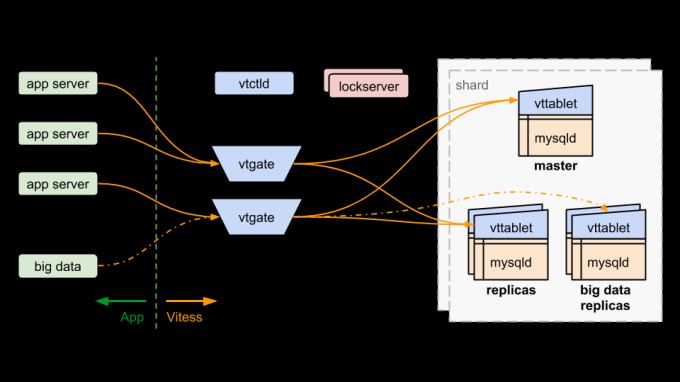
But how can a scrappy startup challenge the tech juggernauts for cloud supremacy? First, by actually working with them. The PlanetScale beta that’s now launching lets companies spin up Vitess clusters on its database-as-a-service, their own through a licensing deal, or on AWS with Google Cloud and Microsoft Azure coming shortly. Once these integrations with the tech giants are established, PlanetScale clients can use it as an interface for a multi-cloud setup where they could keep their data master copies on AWS US-West with replicas on Google Cloud in Ireland and elsewhere. That protects companies from becoming dependent on one provider and then getting stuck with price hikes or service problems.
PlanetScale also promises to uphold the principles that undergirded Vitess. “It’s our value that we will keep everything in the query pack completely open source so none of our customers ever have to worry about lock-in” Vaidya says.

PlanetScale co-founders (from left): Jiten Vaidya and Sugu Sougoumarane
He and Sougoumarane met 25 years ago while at Indian Institute of Technology Bombay. Back in 1993 they worked at pioneering database company Informix together before it flamed out. Sougoumarane was eventually hired by Elon Musk as an early engineer for X.com before it got acquired by PayPal, and then left for YouTube. Vaidya was working at Google and the pair were reunited when it bought YouTube and Sougoumarane pulled him on to the team.
“YouTube was growing really quickly and the relationship database they were using with MySQL was sort of falling apart at the seams,” Vaidya recalls. Adding more CPU and memory to the database infra wasn’t cutting it, so the team created Vitess. The horizontal scaling sharding middleware for MySQL let users segment their database to reduce memory usage while still being able to rapidly run operations. YouTube has smoothly ridden that infrastructure to 1.8 billion users ever since.
“Sugu and Mike Solomon invented and made Vitess open source right from the beginning since 2010 because they knew the scaling problem wasn’t just for YouTube, and they’ll be at other companies five or 10 years later trying to solve the same problem,” Vaidya explains. That proved true, and now top apps like Square and HubSpot run entirely on Vitess, with Slack now 30 percent onboard.

Vaidya left YouTube in 2012 and became the lead engineer at Endorse, which got acquired by Dropbox, where he worked for four years. But in the meantime, the engineering community strayed toward MongoDB-style non-relational databases, which Vaidya considers inferior. He sees indexing issues and says that if the system hiccups during an operation, data can become inconsistent — a big problem for banking and commerce apps. “We think horizontally scaled relationship databases are more elegant and are something enterprises really need.
Fed up with the engineering heresy, a year ago Vaidya committed to creating PlanetScale. It’s composed of four core offerings: professional training in Vitess, on-demand support for open-source Vitess users, Vitess database-as-a-service on PlanetScale’s servers and software licensing for clients that want to run Vitess on premises or through other cloud providers. It lets companies re-shard their databases on the fly to relocate user data to comply with regulations like GDPR, safely migrate from other systems without major codebase changes, make on-demand changes and run on Kubernetes.
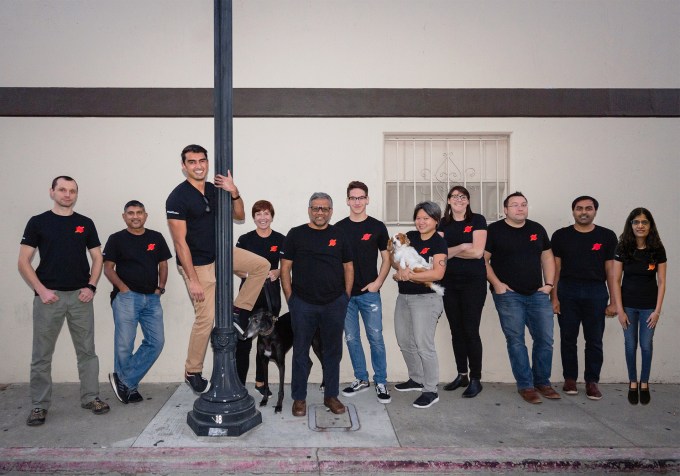
The PlanetScale team
PlanetScale’s customers now include Indonesian e-commerce giant Bukalapak, and it’s helping Booking.com, GitHub and New Relic migrate to open-source Vitess. Growth is suddenly ramping up due to inbound inquiries. Last month around when Square Cash became the No. 1 app, its engineering team published a blog post extolling the virtues of Vitess. Now everyone’s seeking help with Vitess sharding, and PlanetScale is waiting with open arms. “Jiten and Sugu are legends and know firsthand what companies require to be successful in this booming data landscape,” says Ilya Kirnos, founding partner and CTO of SignalFire.
The big cloud providers are trying to adapt to the relational database trend, with Google’s Cloud Spanner and Cloud SQL, and Amazon’s AWS SQL and AWS Aurora. Their huge networks and marketing war chests could pose a threat. But Vaidya insists that while it might be easy to get data into these systems, it can be a pain to get it out. PlanetScale is designed to give them freedom of optionality through its multi-cloud functionality so their eggs aren’t all in one basket.
Finding product market fit is tough enough. Trying to suddenly scale a popular app while also dealing with all the other challenges of growing a company can drive founders crazy. But if it’s good enough for YouTube, startups can trust PlanetScale to make databases one less thing they have to worry about.
Powered by WPeMatico
As companies shift to CI/CD (continuous integration/continuous delivery), they face a problem around monitoring and fixing problems in builds that have been deployed. How do you deal with an issue after moving onto the next delivery milestone? Harness, the startup launched last year by AppDynamics founder Jyoti Bansal, wants to fix that with a new tool called 24×7 Service Guard.
The new tool is designed to help companies working with a continuous delivery process by monitoring all of the builds, regardless of when they were launched. What’s more, the company claims that using AI and machine learning, it can dial back a problematic build to one that worked in an automated fashion, freeing developers and operations to keep working without worry.
The company launched last year with a tool called Continuous Verification to verify that a continuous delivery build got deployed. With today’s announcement, Bansal says the company is taking this to another level to help understand what happens after you deploy.
The tool watches every build, even days after deployment, taking advantage of data from tools like AppDynamics, New Relic, Elastic and Splunk, then using AI and machine learning to identify problems and bring them back to a working state without human intervention. What’s more, your team can get a unified view of performance and the quality of every build across all of your monitoring and logging tools.
“People are doing Continuous Delivery and struggling with it. They are also using these AI Ops kinds of products, which are watching things in production, and trying to figure out what’s wrong. What we are doing is we’re bringing the two together and ensuring nothing goes wrong,” Bansal explained.
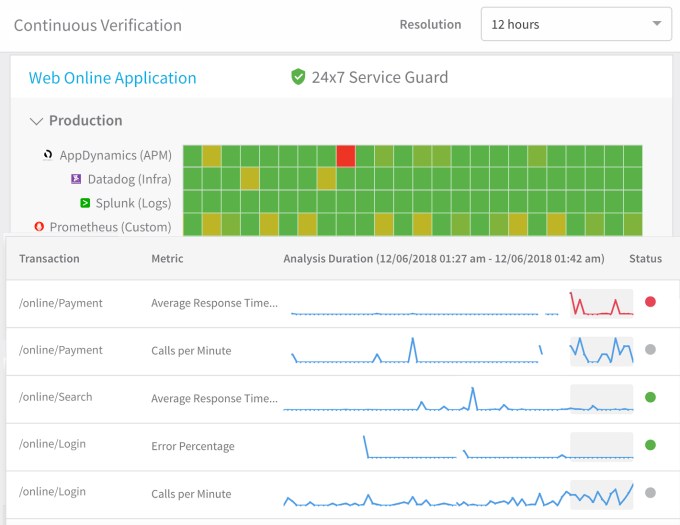
24×7 Service Guard Console. Screenshot: Harness
He says that he brought this product to market because he saw enterprise companies struggling with CI/CD. He said the early messaging that you should move fast and break things really doesn’t work in enterprise settings. They need tooling that ensures that critical applications will keep running even with continuous builds (however you define that). “How do you enable developers so that they can move fast and make sure the business doesn’t get impacted. I feel that industry was underserved by this [earlier] message,” he said.
While it’s hard for any product to absolutely guarantee up-time, this one is providing tooling for companies who see the value of CI/CD, but are looking for a way to keep their applications up and running, so they aren’t constantly on this deploy/repair treadmill. If it works as described, it could help advance CI/CD, especially for large companies that need to learn to move faster and want assurances that when things break, they can be fixed in an automated fashion.
Powered by WPeMatico
Work-Bench, an early-stage enterprise startup venture capital firm based in New York City, announced its $47 million Fund II today. It follows their initial $10 million fund.
Work-Bench is itself like a venture capital investment startup. A scrappy operation run by just five enterprise industry veterans, it defies convention in a number of ways, including setting up shop in New York City. While it’s based in New York, the company will invest anywhere in the country, writing checks for $1.5 million for Seed 2 and Series A investments.
Work-Bench’s philosophy centers around a sales approach and giving their startups entrée into some of the biggest companies in the country, many of which, not coincidentally, are based near their offices.
The company starts by trying to understand specific enterprise customer pain points, even before they send a founder in to pitch an executive. The startup founders are judged and guided by their ability to sell. In fact, one of the founders, Jonathan Lehr, says even before they invest in a company they will send them to pitch a couple of customers and take advantage of that two-way feedback channel as a way to understand the startup’s selling skills.
“Instead of starting with whiz-bang tech like a lot of West Coast VCs do, by starting with the problem and where budget dollars are being allocated, when we’re looking at companies from an investment perspective it really helps us connect all the dots a little a lot better. That’s because on the one hand the corporate executive is getting a solution to a pain point from the startup, and the startup founders are getting an introduction to the right stakeholder at the right time for them at the right organization,” Lehr told TechCrunch.
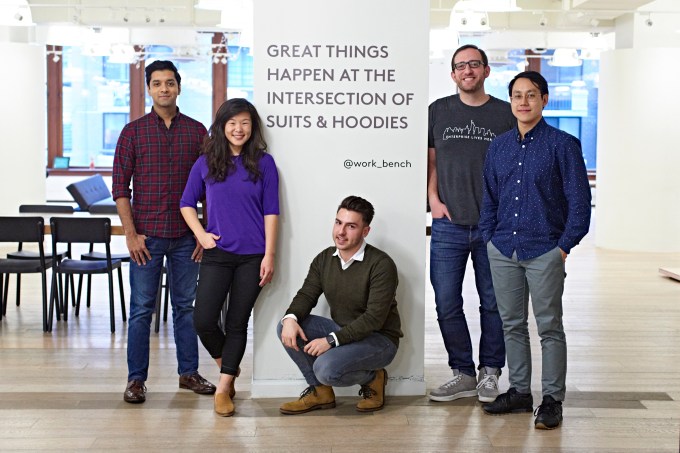
Work-Bench Team. Photo: Work-Bench
Work-Bench has set up their headquarters as space for hosting regular events that help introduce founders to key people in the community and learn about different subjects, such as writing a successful RFP, negotiating contracts and setting up a successful proof of concept (PoC). They also have work spaces where founders from the portfolio companies can interact on a daily basis and get direct feedback from the Work-Bench principals, who run a truly hands-on operation.
It seems to have worked. Among the enterprise startups funded with their initial fund were Dialpad, Tamr, Cockroach Labs and CoreOS, which was sold to Red Hat for $250 million in January. In all, they invested in 17 companies in the first fund.
The second fund is already under way with nine investments so far, including Scytale, a security and identity protocol startup; Algorithmia, which is working on DevOps for AI; and Catalyst, a customer success platform.
Fund II investors include co-anchors Industry Ventures and an unnamed Chicago family office. Corporate backers include Wipro, Schneider Electric and CA Technologies. Other investors include Fund I founders Craig Walker from Dialpad, Andy Palmer from Tamr and Tim Eades from vArmour.
Powered by WPeMatico
Chorus.ai, a service that listens to sales calls in real time, and then transcribes and analyses them to give helpful tips to the salesperson, has raised $33 million to double down on the current demand for more AI-based tools in the enterprise.
The Series B is being led by Georgian Partners, with participation also from Redpoint Ventures and Emergence Capital, previous investors that backed Israeli-founded, SF-based Chorus.ai in its $16 million Series A two years ago.
In the gap between then and now, the startup has seen strong growth, listening in to some 5 million calls, and performing hundreds of thousands of hours of transcriptions for around 200 customers, including Adobe, Zoom, and Outreach (among others that it will not name).
Micha Breakstone, the co-founder (who has a pretty long history in conversational AI, heading up R&D at Ginger Software and then Intel after it acquired the startup; and before that building the tech that eventually became Summly and got acquired by Yahoo, among other roles), says that while the platform gives information and updates to salespeople in real time, much of the focus today is on providing information to users post-conversation, based on both audio and video calls.
One of its big areas is “smart themes” — patterns and rules Chorus has learned through all those calls. For example, it has identified what kind of language the most successful sales people are using and in turn prompts those who are less successful to use it more. Two general tips Breakstone told me about: using more collaborative terms like we and us; and giving more backstory to clients, although there will be more specific themes and approaches based on Chorus’s specific customers and products.
“I’d say we are super attuned to our customers and what they need and want,” Breakstone said. Which makes sense given the whole premise of Chorus.
It also creates smart “playlists” for managers who will almost certainly never have the time to review hundreds of hours of calls but might want to hear instructive highlights or ‘red alert’ moments where a more senior person might need to step in to save or close a deal.
There are currently what seems like dozens of startups and larger businesses that are currently tackling the opportunity to provide “conversational intelligence” to sales teams, using advances in natural language processing, voice recognition, machine learning and big data to help turn every sales person into a Jerry Maguire (yes, I know he’s an agent, but still, he needs to close deals, and he’s a salesman). They include TalkIQ (which has now been acquired by Dialpad), People.AI, Gong, Voicera, VoiceOps, and I’m pulling from a long list.
“We were among the very first to start this, no one knew what conversational intelligence was before us,” Breakstone says. He describes most of what was out in the market at the time as “Nineties technology” and adds that “our tech is superior because we built it in the correct way from the ground up, with nothing sent to a third party.”
He says that this is one reason why the company has negative churn — it essentially wins customers and hasn’t lost any. And having the tech all in-house not only means the platform is smarter and more accurate, but that helps with compliance around regulations like GDPR, which also has been a boost to its business. It’s also scored well on metrics around reps hitting targets better with its tools (the company claims its products lead to 50 percent greater quota attainment and ‘ramp time’ up by 30 percent for new sales people who use it).
“Chorus.ai has helped us become a smarter sales organization as we’ve scaled. We have visibility into our sales conversations and what is working across all of our offices”, said Greg Holmes, Head of Sales for Zoom Video Communications, in a statement. “We’ve seen a drastic reduction in new hire ramp times and higher sales productivity with even more reps hitting quota. Chorus.ai is a game changer.”
Chorus has raised $55 million to date and Breakstone said he would not disclose its valuation — despite my best attempts to use some of those sales tips to winkle the information out of him. But I understand it to be “significantly higher” than in its last round, and definitely in the hundreds of millions.
As a point of reference, after its Series A two years ago, it was only valued at around $33 million post-money according to PitchBook.
“Maintaining high-quality sales conversations as you scale a sales organization is hard for many companies, but key to delivering predictable revenue growth. Chorus.ai’s Conversation Intelligence platform solves that challenge with a market-leading solution that is easy-to-use and delivers best-in-class results.” said Simon Chong, Managing Partner at Georgian Partners, in a statement. (Chong is joining the board with this round.) “Chorus.ai works with some of the best sales teams in the world and they love the product. We are very excited to partner with Chorus.ai on their next phase of growth as they help world class sales teams reach higher quota attainment and efficiency.”
Powered by WPeMatico