Enterprise
Auto Added by WPeMatico
Auto Added by WPeMatico
The Daily Crunch is TechCrunch’s roundup of our biggest and most important stories. If you’d like to get this delivered to your inbox every day at around 9am Pacific, you can subscribe here:

1. IBM unveils its first commercial quantum computer
The 20-qubit system combines the quantum and classical computing parts it takes to use a machine like this for research and business applications into a single package. While it’s worth stressing that the 20-qubit machine is nowhere near powerful enough for most commercial applications, IBM sees this as the first step towards tackling problems that are too complex for classical systems.
2. Apple’s trillion-dollar market cap was always a false idol
Nothing grows forever, not even Apple. Back in August we splashed headlines across the globe glorifying Apple’s brief stint as the world’s first $1 trillion company, but in the end it didn’t matter. Fast-forward four months and Apple has lost more than a third of its stock value, and last week the company lost $75 billion in market cap in a single day.
3. GitHub Free users now get unlimited private repositories
Starting today, free GitHub users will now get unlimited private projects with up to three collaborators. Previously, GitHub had a caveat for its free users that code had to be public if they didn’t pay for the service.
Photo credit: Chesnot/Getty Images
4. Uber’s IPO may not be as eye-popping as we expected
Uber’s public debut later this year is undoubtedly the most anticipated IPO of 2019, but the company’s lofty valuation (valued by some as high as $120 billion) has some investors feeling uneasy.
5. Amazon is getting more serious about Alexa in the car with Telenav deal
Amazon has announced a new partnership with Telenav, a Santa Clara-based provider of connected car services. The collaboration will play a huge role in expanding Amazon’s ability to give drivers relevant information and furthers the company’s mission to bake Alexa into every aspect of your life.
6. I used VR in a car going 90 mph and didn’t get sick
The future of in-vehicle entertainment could be VR. Audi announced at CES that it’s rolling out a new company called Holoride to bring adaptive VR entertainment to cars. The secret sauce here is matching VR content to the slight movements of the vehicle to help those who often get motion sickness.
7. Verizon and T-Mobile call out AT&T over fake 5G labels
Nothing like some CES drama to start your day. AT&T recently shared a shady marketing campaign that labeled its 4G networks as 5G and rivals Verizon and T-Mobile are having none of it.
Powered by WPeMatico
The heated debate around Amazon’s recently announced Long Island City “HQ2” is showing no signs of cooling down.
On Monday morning, the Retail, Wholesale and Department Store Union (RWDSU) hosted a briefing in which labor officials, economic development analysts, Amazon employees and elected New York State and City representatives further underlined concerns around the HQ2 process, the awarded incentives, and the potential impacts Amazon’s presence would have on city workers and residents.
While many of the arguments posed at the Summit weren’t necessarily new, the wide variety of stakeholders that showed up to express concern looked to contextualize the far-reaching risks associated with the deal.
The day began with representatives from New York union groups recounting Amazon’s shaky history with employee working conditions and questioning how the city’s working standards will be impacted if the 50,000 promised jobs do actually show up.
Two current employees working in an existing Amazon New York City warehouse in Staten Island provided poignant examples of improper factory conditions and promised employee benefits that never came to fruition. According to the workers, Amazon has yet to follow through on shuttle services and ride-sharing services that were promised to ease worker commutes, forcing the workers to resort to overcrowded and unreliable public transportation. One of the workers detailed that with his now four-hour commute to get to and from work, coupled with his meaningfully long shifts, he’s been unable to see his daughter for weeks.
Various economic development groups and elected officials including, New York City Comptroller Scott Stringer, City Council Speaker Corey Johnson, City Council Member Jimmy Van Bramer, and New York State Senator Mike Gianaris supported the labor arguments with spirited teardowns of the economic terms of the deal.
Like many critics of the HQ2 process, the speakers’ expressed their beliefs that Amazon knew where it wanted to bring its second quarters throughout the entirety of its auction process, given the talent pool and resources in the chosen locations, and that the entire undertaking was meant to squeeze out the best economic terms possible. And according to City Council Speaker Johnson, New York City “got played”.
Comptroller Stringer argued that Amazon is taking advantage of New York’s Relocation and Employment Assistance Program (REAP) and Industrial and Commercial Abatement Program (ICAP), which Stringer described as outdated and in need of reform, to receive the majority of the $2 billion-plus in promised economic incentives that made it the fourth largest corporate incentive deal in US history.
The speakers continued to argue that the unprecedented level of incentives will be nearly impossible to recoup and that New York will also face economic damages from lower sales tax revenue as improved Amazon service in the city cannibalizes local brick & mortar retail.
Fears over how Amazon’s presence will impact the future of New York were given more credibility with the presence of Seattle City Council members Lisa Herbold & Teresa Mosqueda, who had flown to New York from Seattle to discuss lessons learned from having Amazon’s Headquarters in the city and to warn the city about the negative externalities that have come with it.
Herbold and Mosqueda focused less on an outright rejection of the deal but instead emphasized that New York was in a position to negotiate for better terms focused on equality and corporate social responsibility, which could help the city avoid the socioeconomic turnover that has plagued Seattle and could create a new standard for public-private partnerships.
While the New York City Council noted it was looking into legal avenues, the opposition seemed to have limited leverage to push back or meaningfully negotiate the deal. According to state officials, the most clear path to fight the deal would be through votes by the state legislature and through the state Public Authorities Control Board who has to unanimously approve the subsidy package.
With the significant turnout seen at Monday’s summit, which included several high-ranking state and city officials, it seems clear that we’re still in the early innings of what’s likely to be a long battle ahead to close the HQ2 deal.
In response to the summit, an Amazon spokesperson offered the following statement: “Amazon is engaging in a long-term listening and engagement process to better understand the community’s needs. We’re committed to being a great neighbor – and ensuring our new headquarters is a win for all New Yorkers. Amazon makes substantial positive contributions to the economy, the communities where we operate, and to the lives and careers of our employees. We have created more than 250,000 full-time, full benefit jobs across the U.S. that now have a minimum $15 an hour pay and we have invested more than $160 billion in the U.S. economy since 2011.”
Updated with statement from Amazon.
Powered by WPeMatico
If you’re a GitHub user, but you don’t pay, this is a good week. Historically, GitHub always offered free accounts but the caveat was that your code had to be public. To get private repositories, you had to pay. Starting tomorrow, that limitation is gone. Free GitHub users now get unlimited private projects with up to three collaborators.
The amount of collaborators is really the only limitation here and there’s no change to how the service handles public repositories, which can still have unlimited collaborators.
This feels like a sign of goodwill on behalf of Microsoft, which closed its acquisition of GitHub last October, with former Xamarin CEO Nat Friedman taking over as GitHub’s CEO. Some developers were rather nervous about the acquisition (though it feels like most have come to terms with it). It’s also a fair guess to assume that GitHub’s model for monetizing the service is a bit different from Microsoft’s. Microsoft doesn’t need to try to get money from small teams — that’s not where the bulk of its revenue comes from. Instead, the company is mostly interested in getting large enterprises to use the service.
Talking about teams, GitHub also today announced that it is changing the name of the GitHub Developer suite to ‘GitHub Pro.’ The company says it’s doing so in order to “help developers better identify the tools they need.”
But what’s maybe even more important is that GitHub Business Cloud and GitHub Enterprise (now called Enterprise Cloud and Enterprise Server) have become one and are now sold under the ‘GitHub Enterprise’ label and feature per-user pricing.
The announcement of free private repositories probably took some of GitHub’s competitors by surprise, but here is what we heard from GitLab CEO Sid Sijbrandij: “GitHub today announced the launch of free private repositories with up to three collaborators. GitLab has offered unlimited collaborators on private repositories since the beginning.We believe Microsoft is focusing more on generating revenue with Azure and less on charging for DevOps software. At GitLab, we believe in a multi-cloud future where organizations use multiple public cloud platforms.”
Note: this story was scheduled for tomorrow, but due to a broken embargo, we decided to publish today. The updates will go live tomorrow.
Powered by WPeMatico
The Daily Crunch is TechCrunch’s roundup of our biggest and most important stories. If you’d like to get this delivered to your inbox every day at around 9am Pacific, you can subscribe here:
1. Nvidia launches the $349 GeForce RTX 2060
Nvidia broke with tradition and put a new focus on gaming at CES. Last night the company unveiled the RTX 2060, a $349 low-end version of its new Turing-based desktop graphics cards. The RTX 2060 will be available on Jan. 15.
2. Elon Musk’s vision of spaceflight is gorgeous
This spring SapceX intends to launch the next phase in its space exploration plans. The newly named Starship rocket, previously known as the BFR, intends to to be rocket to rule them all. And it’s going to look good doing it.
3. Apple’s increasingly tricky international trade-offs
Far from its troubles in emerging markets like China, Apple is starting to face backlash from a European population that’s crying foul over the company’s perceived hypocrisy on data privacy. It’s become clear that Apple’s biggest success is now its biggest challenge in Europe.

Photo by Justin Sullivan/Getty Images
4. Marc Andreessen: audio will be “titanically important” and VR will be “1,000” times bigger than AR
In a recently recorded podcast Marc Andreesen gave some predictions on the future of the tech industry. Surprisingly, the all-start investor is continuing his support of the shaky VR industry saying that expanding the immersive world will require us to remove the head-mounted displays we’ve become accustomed to.
5. Fitness marketplace ClassPass acquires competitor GuavaPass
ClassPass, the five-year-old fitness marketplace, is in the midst of an expansion sprint. The company announced yesterday that it’s acquiring one it competitors, GuavaPass, for an undisclosed amount to expand into Asia. The move now puts ClassPass in more than 80 markets across the 11 countries, with plans to expand to 50 new cities in 2019.
6. Apple shows off new smart home products from HomeKit partners
Apple gave a snapshot of its future smart home ecosystem at CES. Looks like an array of smart light switches, door cameras, electrical outlets and more are on the way and will be configurable through the Home app and Siri.
7. Parcel Guard’s smart mailbox protects your packages from porch thieves
Danby is showing off its newly launched smart mailbox called Parcel Guard at CES, which allows deliveries to be left securely at customers’ doorsteps. Turns out you won’t need a farting glitter bomb to protect your packages after all. The Parcel Guard starts at $399 and pre-orders are will be available this week.
Powered by WPeMatico
As every software company knows, over time as code ages and workarounds build on work-arounds, the code base becomes bloated. It becomes ever more difficult to get around the technical debt that you’ve built up over time. It’s really impossible to avoid this phenomenon, but at some point, companies realize that the debt is so great that it’s limiting their ability to build new functionality. That’s precisely what Trulia faced in 2017 when it began a process of paying down that debt and modernizing its architecture.
Trulia is a real estate site founded way back in 2005, an eternity ago in terms of technology. The company went public in 2012 and was acquired by Zillow in 2014 for $3.5 billion, but has continued to operate as an independent brand under the Zillow umbrella. It understood that a lot had changed technologically in the 12 years since its inception when engineering began thinking about this. The team knew it had a humongous, monolithic code base that was inhibiting the ability to update the site.
While they tried to pull out some of the newer functions as services, it didn’t really make the site any more nimble because these services always had to tie back into that monolithic central code base. The development team knew if it was to escape this coding trap, it would take a complete overhaul.
As you would expect, a process like this doesn’t happen overnight, taking months to plan and implement. It all started back in 2017 when the company held what they called an “Innovation Week” with the entire engineering team. Groups of engineers came up with ideas about how to solve this problem, but the one that got the most attention was one called Project Islands, which involved breaking out the different pieces of the site as individual coding islands that could operate independently of one another.
It sounds simple, but in practice it involved breaking down the entire code base into services. They would use Next.js and React to rebuild the front end and GraphQL, an open source graph database technology to rebuild the back end.
Deep Varma, Trulia’s VP of engineering, pointed out that as a company founded in 2005, the site was built on PHP and MySQL, two popular development technologies from that time. Varma says that whenever his engineers made a change to any part of the site, they needed to do a complete system release. This caused a major bottleneck.
What they really needed to do was move to a completely modern microservices architecture that allowed engineering teams to work independently in a continuous delivery approach without breaking any other team’s code. That’s where the concept of islands came into play.
The islands were actually microservices. Each one could communicate to a set of central common services like authentication, A/B testing, the navigation bar, the footer — all of the pieces that every mini code base would need, while allowing the teams building these islands to work independently and not require a huge rebuild every time they added a new element or changed something.

Cousine island. Seychelles. Photo: Martin Harvey/Getty Images
The harsh reality of this kind of overhaul came into focus as the teams realized they had to be writing the new pieces while the old system was still in place and running. In a video the company made describing the effort, one engineer likened it to changing the engine of a 747 in the middle of a flight.
Varma says he didn’t try to do everything at once, as he needed to see if the islands approach would work in practice first. In November 2017, he pulled the first engineering team together, and by January it had built the app shell (the common services piece) and one microservice island. When the proof of concept succeeded, Varma knew they were in business.
It’s one thing to build a single island, but it’s another matter to build a chain of them and that would be the next step. By last April, engineering had shown enough progress that they were able to present the entire idea to senior management and get the go-ahead to move forward with a more complex project.

Photo of Rock Islands, Palau, Micronesia: J.W.Alker/Getty Images
First, it took some work with the Next.js development team to get the development framework to work the way they wanted. Varma said he brought in the Next.js team to work with his engineers. He said that they needed to figure out how to stitch the various islands together and resolve dependencies among the different services. The Next.js team actually changed its development roadmap for Trulia, speeding up delivery of these requirements, understanding that other companies would have similar issues.
By last July, the company released Neighborhoods, the first fully independent island functionality on the site. Recently, it moved off-market properties to islands. Off-market properties, as the name implies, are pages with information about properties that are no longer on the market. Varma says that these pages actually make up a significant portion of the company’s traffic.
While Varma would not say just how much of the site has been moved to islands at this point, he said the goal is to move the majority to the new platform in 2019. All of this shows that a complete overhaul of a complex site doesn’t happen overnight, but Trulia is taking steps to move off the original system it created in 2005 and move to a more modern and flexible architecture it has created with islands. It may not have paid down its technical debt in full in 2018, but it went a long way on laying the foundation to do so.
Powered by WPeMatico
Cloudera and Hortonworks, two of the biggest players in the Hadoop big data space, today announced that they have finalized their all-stock merger. The new company will use the Cloudera brand and will continue to trade under the CLDR symbol on the New York Stock Exchange.
“Today, we start an exciting new chapter for Cloudera as we become the leading enterprise data cloud provider,” said Tom Reilly, chief executive officer of Cloudera, in today’s announcement. “This combined team and technology portfolio establish the new Cloudera as a clear market leader with the scale and resources to drive continued innovation and growth. We will provide customers a comprehensive solution-set to bring the right data analytics to data anywhere the enterprise needs to work, from the Edge to AI, with the industry’s first Enterprise Data Cloud.”
The companies describe the deal as a “merger of equals,” though Cloudera stockholders will own about 60 percent of the equity in the company.
The combined company expects to generate more than $720 million in revenue from its 2,500 customers that rely on it to help them manage the complexities of processing their data. While Hadoop itself is open source and freely available, Cloudera and Hortonworks abstract away most of the infrastructure. Both focused on slightly different markets, though, with Hortonworks going after a more technical user and a pure open-source approach, while Cloudera also offered some proprietary tools.
“Together, we are well-positioned to continue growing and competing in the streaming and IoT, data management, data warehousing, machine learning/AI and hybrid cloud markets,” said Hortonworks CEO Rob Bearden back when the deal was first announced. “Importantly, we will be able to offer a broader set of offerings that will enable our customers to capitalize on the value of their data.”
Powered by WPeMatico
While Facebook continues to repair its image with consumers disenchanted with the social network’s role in disseminating misleading or false information and mishandling their personal data, it’s ironically been finding some traction for its enterprise-focused service, Workplace. Today, the company announced that it has added another huge company to its books: Nestlé, the coffee, chocolate and FMCG giant with 2,000 brands and 240,000 employees, has signed up as its latest customer.
Facebook’s enterprise service competes against the likes of Microsoft Teams, Slack and smaller players like Crew and Zinc, among many others in a crowded market of mobile and desktop apps built to address a growing interest among organizations to have more user-friendly, modern ways for their employees to communicate.
Workplace positions itself as different from its competitors in a couple of ways: it says its communications platform is designed for all different employment demographics, covering so-called knowledge workers (the traditional IT customer) as well as waged and front-line employees; but it also claims to be the most democratic of the pack, by virtue of being a Facebook product, designed for mass market use from the ground up.
In the workplace, that translates to apps that do not require company email addresses or company devices to use; a strong proportion of employees at Workplace’s bigger customers, such as Walmart (2.2 million employees) and Starbucks (nearly 240,000 employees) do not sit at desks and, until relatively recently, would not have been using any kind of PC or phone on a regular basis on any average day.
But as smartphones have become as ubiquitous as having your keys and wallet, acceptance of having them and utilising them to communicate workplace-related information has changed, and that is the wave that services like Workplace are hoping to ride.
But despite the strong engine that is Facebook behind it, Workplace has a lot of challenges ahead.
The company has not updated its total number of customers in more than a year at this point — its last milestone was 30,000 customers, back in November 2017 — and today Facebook VP Julien Codorniou said the company might put out a more updated number later this year.
“We’re not using that metric to communicate our success,” he said, “but we have to communicate growth, I feel the demand from the market.” Slack claims 500,000 organizations, more than 70,000 of which pay; Teams from Microsoft has some 329,000 customers, the company says.
There also is the issue of how a customer win is actually translating to usage. Last month, a much smaller competitor, Crew, with 25,000 customers, noted that at least some of them were in fact those that Workplace was claiming to have secured.
“Starbucks is theoretically using Workplace, but it’s been deployed only to managers,” Crew CEO Danny Leffel told me. “We have almost 1,000 Starbucks locations using Crew. We knew we had a huge presence there, and we were worried when Facebook won them, but we haven’t seen even a dent in our business so far.”
Codorniou said that this also doesn’t tell the full story. He describes the approach that Crew and others take as “shadow IT,” in that the companies don’t talk to central HQ when winning the business. “You can’t give a voice to everyone by going in through the back,” he said. He also contends that it just takes time to deploy something across a massive business. “Workplace only works if you get 100 percent of the company using it,” he added. Notably, today Facebook announced that Nestlé has already onboarded 210,000 customers to Workplace.
There is also the bigger question of how these products will develop technically to further differentiate from the pack. For now, it feels like Slack still reigns supreme when it comes to desktop knowledge worker functionality — even without usefully threaded comments — because of the fact that you can integrate virtually any other app you might want to into its platform.
Crew, meanwhile, has differentiated by focusing on providing handy tools to help businesses managing scheduling for shift workers, which comprise the majority of its user base.
Others like Teams, and yes, Workplace, have also added integrations and their own functionality — Workplace’s most interesting features, I think, are how it has translated consumer-Facebook features like Live into the Workplace environment. But there is still a lot of space for apps to consider what other features and functionality will be most useful for the most employees and for the business customer at large.
It will be interesting to see how and if this is affected by way of a key leadership appointment. Last month, Facebook appointed a new “head” of Workplace, Karandeep Anand, who came to Facebook three years ago from Microsoft (and thus has a close understanding of enterprise software). Codorniou said Anand would be relocating to London, where Workplace is developed, and will focus on the technical development of the product while Codorniou focuses on sales, client relations and business development.
Technical leadership for Workplace had previously come straight from CTO Mike Schroepfer, Codorniou said. “We decided that we needed someone full time, here in London,” he said.
It’s not clear if Workplace’s win at Nestlé is replacing another product; it seems, however, that it is more likely a trend of how more businesses are making an investment in company-wide communications platforms where they may never have had one before, in hopes of it helping keep employees switched on, linked up and generally more happy and feeling less like expendable cogs.
“Nestlé is a people-first environment,” said EVP Chris Johnson, in a statement. “We really rely on our talented teams to manage more than 2,000 Nestlé brands worldwide. We help our employees develop and we give them the right tools, so Workplace is a perfect fit.”
Powered by WPeMatico
Social media has become a primary conduit for getting the word out, in some cases proving to be an even stronger force for publicity than more traditional media outlets and paid advertising, and so today, a company that has grown its business around public relations services has acquired a social media management company to make sure it has a foothold in the medium. Cision, which provides press release distribution, media monitoring and other PR services to businesses and the media industry, has acquired Falcon.io, a startup founded in Denmark that lets companies post, manage and analyse their presence on social media platforms.
Terms of the deal are not being disclosed, the companies tell me, but the whole of the Falcon team, including CEO/founder Ulrik Bo Larsen, are joining the company, where they will continue to operate its existing product set as well as integrate it into Cision’s wider business. The last valuation noted in April 2017 at the Danish Companies House was about $52 million (€45 million), but they have been growing very rapidly, and one source tells us that the price paid was around $200-$225 million, while Danish publication Borsen says it’s 800 million Danish kroner, or around $122 million. I’m still trying to get more detail.
Falcon had raised around $25 million according to PitchBook, and it has never disclosed its valuation. Cision — well-known to many journalists — is publicly traded and currently has a market cap of just under $1.6 billion. For some context, two other prominent social media management firms that compete with Falcon, Sprout Social and Hootsuite, are respectively valued at $800 million and anywhere between $750 million and $1 billion (depending on who you ask).
The latter two are bigger firms — Falcon has around 1,500 businesses as customers that use it to manage their social profiles and read social sentiment across platforms like Facebook, Twitter and LinkedIn, while Sprout says it has around 25,000 and Hootsuite counts millions of individual users — and both have raised significantly more capital, but their valuations underscore the demand that we’re seeing for platforms and user-friendly tools to target the world’s social media users — estimated to number at upwards of 2.5 billion people globally.
Kevin Akeroyd, who came on as Cision’s CEO after long stints at both Oracle and Salesforce, among other places, describes Falcon as a “top five” social media marketing and analytics firm, and in an interview he said that the new acquisition will form a key part of the “communications cloud” that Cision has been building.
As with Salesforce, Oracle and Adobe (which also use similar cloud-themed terminology to describe their product suites), Cision’s strategy is to build a one-stop shop for customers to manage all their communications needs from one platform. Falcon itself may be smaller than its competitors, but the idea is that it will be cross-sold to Cision’s customers, which currently number 75,000 businesses.
“We’re seeing too many of our customers using one application for content, another for something else, and so on. There are too many apps,” Akeroyd said. “We have always believed in earned media” — that is, media mentions that are not in the form of paid advertising — “and the role of influencers alongside paid and owned marketing. We believe we could provide the first solution for businesses across earned, communications services and public relations, helping to build a better data stack to measure and attribute what you are doing in comms.”
As social networking companies like Facebook and Twitter build more of their own tools in-house to serve the social media needs of organizations that want to better manage their profiles and interactions on these platforms, this has led to some consolidation and shifts among social media management companies. Some are merging or getting acquired, and some are shopping themselves around.
And in that wider trend, it’s not too surprising to see public relations firms get in on the action. Social media has completely changed the landscape for how information is disseminated today, sometimes complementing what traditional media organizations do — there are many examples of how newspapers and other news outlets leverage, for example, Facebook to grow and communicate with their audiences — and often replacing traditional media altogether. (Pew last month said that social media outpaced newspapers for the first time as a news source in the U.S., although TV and radio are still bigger than social… for now.)
Given that public relations management has long been the connecting link between organisations and media outlets, they have had to take a bigger step into social media in order to provide to their clients a more complete picture of the media landscape. Cision is not the first to have done this: Last year, Meltwater, another media monitoring firm, acquired DataSift to add social signals and traffic to its platform mix.
“This consolidation has to come because there is just too much value for the user,” Akeroyd said. “CMOs and CCOs do not want their own islands, they want something bigger.”
Powered by WPeMatico

Thunderbird, Mozilla’s desktop email client, doesn’t have anywhere near the amount of mindshare of the organization’s Firefox browser, yet even in this age of web-based email services, it still has a sizable user community. For 2019, those users can look forward to a faster and more beautiful application, Thunderbird community manager Ryan Sipes announced today.

Only a few years ago, Mozilla’s relationship with Thunderbird looked rather rocky. Back in 2015, the organization decided to decouple Thunderbird’s technical infrastructure from Firefox’s and look for other organizations that would like to invest in it. In the end, though, Mozilla decided to keep Thunderbird in-house and not move it to another organization and continue to support the project. That gave Thunderbird some much-needed stability and, as Sipes announced today, there are now eight full-time staffers who work on the project, with plans for hiring six more soon.
For 2019, the expanded team promises to make the application run faster and address performance issues — and to rewrite some parts of the client in an effort to build a multi-process version that can make better use of modern processors (it’s worth noting that Firefox went through a similar rewrite).
At the same time, Thunderbird will also get a few user interface updates, better notifications and, maybe even more importantly, better Gmail support. The current Gmail setup procedure isn’t actually all that complicated, but once you do have Thunderbird set up to work with your Gmail account, you don’t get access to many of Gmail’s proprietary features. To work around some of this, the Thunderbird team will soon offer better label support, for example.
Powered by WPeMatico
The good times kept on rolling this year for Salesforce with all of the requisite ingredients of a highly successful cloud company — the steady revenue growth, the expanding product set and the splashy acquisitions. The company also opened the doors of its shiny new headquarters, Salesforce Tower in San Francisco, a testament to its sheer economic power in the city.
Salesforce, which set a revenue goal of $10 billion a few years ago is already on its way to $20 billion. Yet Salesforce is also proof you can be ruthlessly good at what you do, while trying to do the right thing as an organization.
Make no mistake, Marc Benioff and Keith Block, the company’s co-CEOs, want to make obscene amounts of money, going so far as to tell a group of analysts earlier this year that their goal by 2034 is to be a $60 billion company. Salesforce just wants to do it with a hint of compassion as it rakes in those big bucks and keeps well-heeled competitors like Microsoft, Oracle and SAP at bay.
In the end, a publicly traded company like Salesforce is going to be judged by how much money it makes, and Salesforce it turns out is pretty good at this, as it showed once again this year. The company grew every quarter by over 24 percent YoY and ended up the year with $12.53 billion in revenue. Based on its last quarter of $3.39 billion, the company finished the year on a $13.56 billion run rate.
This compares with $9.92 billion in total revenue for 2017 with a closing run rate of $10.72 billion.
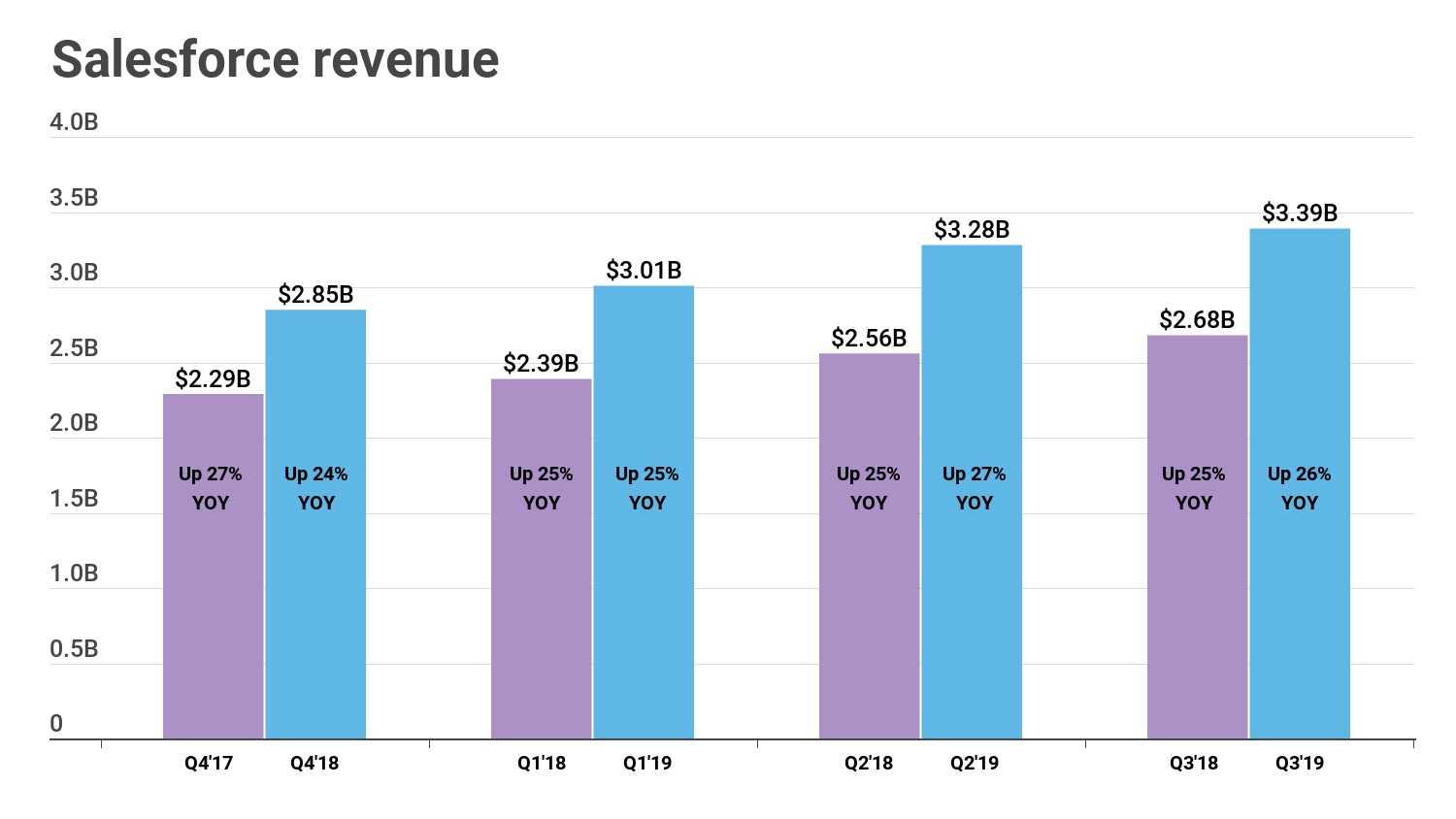
Even with this steady growth trajectory, it might be some time before it hits the $5 billion-a-quarter mark and checks off the $20 billion goal. Keep in mind that it took the company three years to get from $1.51 billion in Q12016 to $3.1 billion in Q12019.
As for the stock market, it has been highly volatile this year, but Salesforce is still up. Starting the year at $102.41, it was sitting at $124.06 as of publication, after peaking on October 1 at $159.86. The market has been on a wild ride since then and cloud stocks have taken a big hit, warranted or not. On one particularly bad day last month, Salesforce had its worst day since 2016 losing 8.7 percent in value,
When you make a lot of money you can afford to spend generously, and the company invested some of those big bucks when it bought Mulesoft for $6.5 billion in March, making it the most expensive acquisition it has ever made. With Mulesoft, the company had a missing link between data sitting on-prem in private data centers and Salesforce data in the cloud.
Mulesoft helps customers build access to data wherever it lives via APIs. That includes legacy data sitting in ancient data repositories. As Salesforce turns its eyes toward artificial intelligence and machine learning, it requires oodles of data and Mulesoft was worth opening up the wallet to provide the company with that kind of access to a variety of enterprise data.
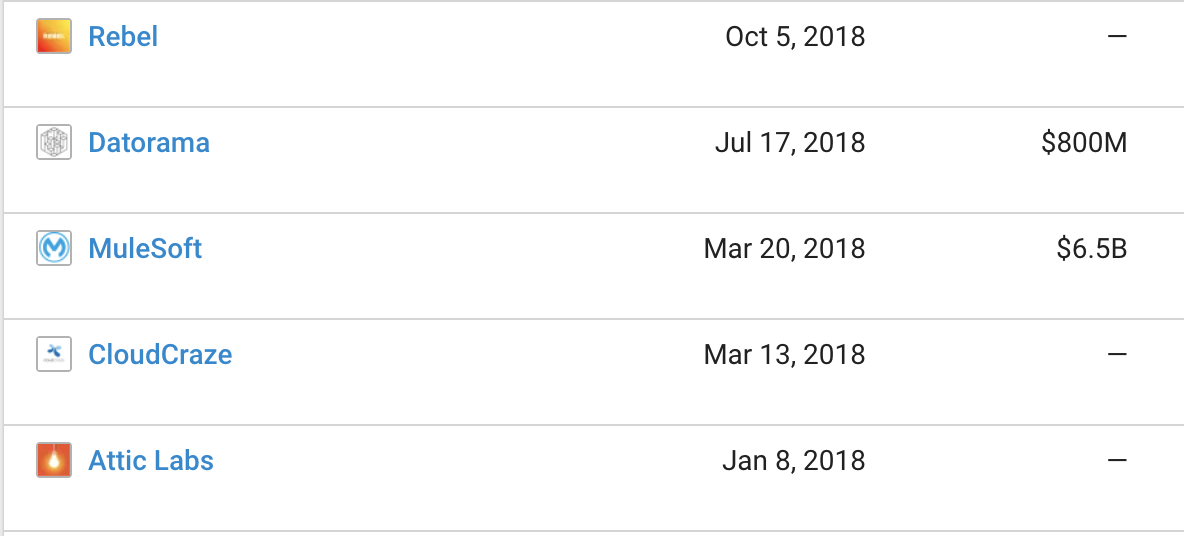
Salesforce 2018 acquisitions. Chart: Crunchbase.
But Mulesoft wasn’t the only thing Salesforce bought this year. It made five acquisitions in all. The other significant one came in July when it scooped up Dataorama for a cool $800 million, giving it a market intelligence platform.
What could be on board for 2019? If Salesforce sticks to its recent pattern of spending big one year, then regrouping the next, 2019 could be a slower one for acquisitions. Consider that it bought just one company last year after buying a dozen in 2016.
One other way to keep revenue rolling in comes from high-profile partnerships. In the past, Salesforce has partnered with Microsoft and Google, and this year it announced that it was teaming up with Apple. Salesforce also announced another high-profile arrangement with AWS to share data between the two platforms more easily. The hope with these types of cross pollination is that the companies can both increase their business. For Salesforce, that means using these partnerships as a platform to move the revenue needle faster.
Even while his company has made big bucks, Benioff has been preaching compassionate capitalism using Twitter and the media as his soap box.
He went on record throughout this year supporting Prop C, a referendum question designed to help battle San Francisco’s massive homeless problem by taxing companies with greater than $50 million in revenue — companies like Salesforce. Benioff was a vocal proponent of the idea, and it won. He did not find kindred spirits among some of his fellow San Francisco tech CEOs, openly debating Twitter CEO Jack Dorsey on Twitter.
Speaking about Prop C in an interview with Kara Swisher of Recode in November, Benioff talked in lofty terms about why he believed in the measure even though it would cost his company money.
“You’ve got to really be mindful and think about what it is that you want your company to be for and what you’re doing with your business and here at Salesforce, that’s very important to us,” he told Swisher in the interview.
He also talked about how employees at other tech companies were driving their CEOs to change their tune around social issues, including supporting Prop C, but Benioff had to deal with his own internal insurrection this year when 650 employees signed a petition asking him to rethink Salesforce’s contract with the U.S. Customs and Border Protection (CBP) in light of the current administration’s border policies. Benioff defended the contract, stating that that Salesforce tools were being used internally at CBP for staff recruiting and communication and not to enforce border policy.
Regardless, Salesforce has never lost its focus on meeting lofty revenue goals, and as we approach the new year, there is no reason to think that will change. The company will continue to look for new ways to expand markets and keep their revenue moving ever closer to that $20 billion goal, even as it continues to meld its unique form of compassion and capitalism.
Powered by WPeMatico