Enterprise
Auto Added by WPeMatico
Auto Added by WPeMatico

What do you do when your startup idea doesn’t prove big enough? Run it as a scrawny but profitable lifestyle business? Or sell it to a competitor and take another swing at the fences? Social audience analytics startup SocialRank chose the latter and is going for glory.
Today, SocialRank announced it’s sold its business, brand, assets, and customers to influencer marketing campaign composer and distributor Trufan which will run it as a standalone product. But SocialRank’s team isn’t joining up. Instead, the full six-person staff is sticking together to work on a mobile-first professional social network called Upstream aiming to nip at LinkedIn.

SocialRank co-founder and CEO Alex Taub
Started in 2014 amidst a flurry of marketing analytics tools, SocialRank had raised $2.1 million from Rainfall Ventures and others before hitting profitability in 2017. But as the business plateaued, the team saw potential to use data science about people’s identity to get them better jobs.
“A few months ago we decided to start building a new product (what has become Upstream). And when we came to the conclusion to go all-in on Upstream, we knew we couldn’t run two businesses at the same time” SocialRank co-founder and CEO Alex Taub tells me. “We decided then to run a bit of a process. We ended up with a few offers but ultimately felt like Trufan was the best one to continue the business into the future.”
The move lets SocialRank avoid stranding its existing customers like the NFL, Netflix, and Samsung that rely on its audience segmentation software. Instead, they’ll continue to be supported by Trufan where Taub and fellow co-founder Michael Schonfeld will become advisors.
“While we built a sustainable business, we essentially knew that if we wanted to go real big, we would need to go to the drawing board” Taub explains.

SocialRank
Two-year-old Trufan has raised $1.8 million Canadian from Round13 Capital, local Toronto startup Clearbanc’s founders, and several NBA players. Trufan helps brands like Western Union and Kay Jewellers design marketing initiatives that engage their customer communities through social media. It’s raising an extra $400,000 USD in venture debt from Round13 to finance the acquisition, which should make Trufan cash-flow positive by the end of the year.
Why isn’t the SocialRank team going along for the ride? Taub said LinkedIn was leaving too much opportunity on the table. While it’s good for putting resumes online and searching for people, “All the social stuff are sort of bolt-ons that came after Facebook and Twitter arrived. People forget but LinkedIn is the oldest active social network out there”, Taub tells me, meaning it’s a bit outdated.

Trufan’s team
Rather than attack head-on, the newly forged Upstream plans to pick the Microsoft-owned professional network apart with better approaches to certain features. “I love the idea of ‘the unbundling of LinkedIn’, ala what’s been happening with Craigslist for the past few years” says Taub. “The first foundational piece we are building is a social professional network around giving and getting help. We’ll also be focused on the unbundling of the groups aspect of LinkedIn.”
Taub concludes that entrepreneurs can shackle themselves to impossible goals if they take too much venture capital for the wrong business. As we’ve seen with SoftBank, investors demand huge returns that can require pursuing risky and unsustainable expansion strategies.

“We realized that SocialRank had potential to be a few hundred million dollar in revenue business but venture growth wasn’t exactly the model for it” Taub says. “You need the potential of billions in revenue and a steep growth curve.” A professional network for the smartphone age has that kind of addressable market. And the team might feel better getting out of bed each day knowing they’re unlocking career paths for people instead of just getting them to click ads.
Powered by WPeMatico
A year and a half after getting acquired by Salesforce for $6.5 billion, MuleSoft is beginning to resemble a Salesforce company — using its language and its methodologies to describe new products and services. This week at Dreamforce, as the company’s mega customer conference begins in San Francisco, MuleSoft announced a slew of new services as it integrates more deeply into the Salesforce family of products.
MuleSoft creates APIs to connect different systems together. This could be quite useful for Salesforce as a bridge between older software that may be on-prem or in the cloud. It allows Salesforce and its customers to access data wherever it lives, even from different parts of the Salesforce ecosystem itself.
MuleSoft made a number of announcements designed to simplify that process and put it in the hands of more customers. For starters, it’s announcing Accelerators, which are pre-defined integrations that let companies connect more easily to other systems. Not surprisingly, two of the first ones connect data from external products and services to Salesforce Service Cloud and Salesforce Commerce Cloud.
“What we’ve done is we’ve pre-built integrations to common back-end systems like ServiceNow and JIRA in Service Cloud, and we prebuilt those integrations, and then automatically connected that data and services through a Salesforce Lightning component directly in the Service console,” Lindsey Irvine, chief marketing officer at MuleSoft, explained.
What this does is allow the agent to get a more complete view of the customer by getting not just the data that’s stored in Salesforce, but in other systems as well.
The company also wants to put these kinds of integration skills in the hands of more Salesforce customers, so they have designed a set of courses in Trailhead, the company’s training platform, with the goal of helping 100,000 Salesforce admins, developers, integration architects and line of business users develop expertise around creating and managing these kinds of integrations.
The company is also putting resources into creating the API Community Manager, a place where people involved in building and managing these integrations can get help from a community of users, all built on Salesforce products and services, says Mark Dao, chief product officer at MuleSoft.
“We’re leveraging Community Cloud, Service Cloud and Marketing Cloud to create a true developer experience platform. And what’s interesting is that it’s targeting both the business users — in other words, business development teams and marketing teams — as well as external developers,” he said. He added that the fact this is working with business users as well as the integration experts is something new, and the goal is to drive increased usage of APIs using MuleSoft inside Salesforce customer organizations.
Finally, the company announced Flow Designer, a new tool fueled by Einstein AI, which helps automate the creation of workflows and integrations between systems in a more automated fashion without requiring coding skills.
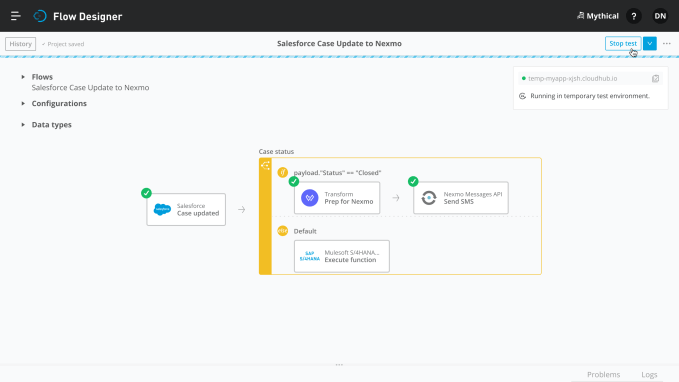
MuleSoft Flow Designer requires no coding (Screenshot: MuleSoft)
Dao says this is about putting MuleSoft in reach of more users. “It’s about enabling use cases for less technical users in the context of the MuleSoft Anypoint Platform. This really requires a new way of thinking around creating integrations, and we’ve been making Flow Designer simpler and simpler, and removing that technical layer from those users,” he said.
API Community Manager is available now. Accelerators will be available by the end of the year and Flow Designer updates will be available Q2 2020, according to the company.
These and other features are all designed to take some of the complexity out of using MuleSoft to help connect various systems across the organization, including both Salesforce and external programs, to make use of data wherever it lives. MuleSoft does requires a fair bit of technical skill, so if the company is able to simplify integration tasks, it could help put it in the hands of more users.
Powered by WPeMatico
The practice of Chaos Engineering developed at Amazon and Netflix a decade ago to help those web scale companies test their complex systems for worst-case scenarios before they happened. Gremlin was started by a former employee of both these companies to make it easier to perform this type of testing without a team of Site Reliability Engineers (SREs). Today, the company announced that it now supports Chaos Engineering-style testing on Kubernetes clusters.
The company made the announcement at the beginning of KubeCon, the Kubernetes conference taking place in San Diego this week.
Gremlin co-founder and CEO Kolton Andrus says that the idea is to be able to test and configure Kubernetes clusters so they will not fail, or at least reduce the likelihood. He says to do this it’s critical to run chaos testing (tests of mission-critical systems under extreme duress) in live environments, whether you’re testing Kubernetes clusters or anything else, but it’s also a bit dangerous to do be doing this. He says to mitigate the risk, best practices suggest that you limit the experiment to the smallest test possible that gives you the most information.
“We can come in and say I’m going to deal with just these clusters. I want to cause failure here to understand what happens in Kubernetes when these pieces fail. For instance, being able to see what happens when you pause the scheduler. The goal is being able to help people understand this concept of the blast radius, and safely guide them to running an experiment,” Andrus explained.
In addition, Gremlin is helping customers harden their Kubernetes clusters to help prevent failures with a set of best practices. “We clearly have the tooling that people need [to conduct this type of testing], but we’ve also learned through many, many customer interactions and experiments to help them really tune and configure their clusters to be fault tolerant and resilient,” he said.
The Gremlin interface is designed to facilitate this kind of targeted experimentation. You can check the areas you want to apply a test, and you can see graphically which parts of the system are being tested. If things get out of control, there is a kill switch to stop the tests.

Gremlin Kubernetes testing screen (Screenshot: Gremlin)
Gremlin launched in 2016. Its headquarters are in San Jose. It offers both a freemium and pay product. The company has raised almost $27 million, according to Crunchbase data.
Powered by WPeMatico
It was pretty unexpected when former SAP CEO Bill McDermott announced he was stepping down in October after a decade in the position. He indicated at that point he would stay until the end of the year to help with the transition to new leadership — then ServiceNow hired him to be its CEO just a few weeks later. Today, the company announced, McDermott has taken over his duties earlier than expected.
The company also announced it has filled its vacant CFO job, hiring Gina Mastantuono, who previously served in similar roles at Ingram Micro and Revlon, and has more than 20 years experience in finance.
It was a game of CEO musical chairs when ServiceNow announced on October 22 that former CEO John Donahoe was leaving to be CEO at Nike, and it would be bringing in McDermott to replace him.
Ray Wang, founder and principal analyst at Constellation Research says all of these changes had a cascading impact, and once Donahoe decided to leave early, everything else happened much faster than planned. “The original plan was to have a transition in January, however there was an urgency on Donahoe’s side to get the Nike thing wrapped up. One of the key reasons to do this early [from a business perspective] is to get the sales team and sales kickoff aligned for 2020. The other reason is providing the same smooth transition for SAP’s co-CEOs Jennifer Moran and Christian Klein,” Wang told TechCrunch.
It is a time of transition for ServiceNow, having to replace both a CFO and CEO, but they landed two experienced pros, who should help continue to guide the company into the future. The company has stated that it hopes to eventually achieve a $10 billion revenue goal under the new leadership team.
As I wrote in a piece analyzing his move to ServiceNow, McDermott seemed to fully embrace that challenge, even though he has a ways to go:
McDermott has his work cut out for him. The company’s 2018 revenue was $2.6 billion. Still, he fully embraced the $10 billion challenge. “Well let me answer that very simply, I completely stand by [the $10 billion goal], and I’m looking forward to achieving it,” he said with bravado during today’s call.
Mastantuono has a lot in common with McDermott, who also came from a much larger organization to help lead ServiceNow to the next level. At her previous position at Ingram Micro she led finance for a company with $50 billion in revenue and more than 200,000 customers.
Mastantuono sees a company with great potential as she takes over to guide the financial side of the organization. “ServiceNow is highly regarded by its customers and has tremendous momentum and opportunity to enable digital transformation and help make work, work better for people,” she said in a statement.
The new leadership duo has its work cut out for it, but it’s a company with lots of room for growth. It will now be up to McDermott and Mastantuono to lead it into that next phase.
Powered by WPeMatico
The world has gotten so much faster. Amazon has made two-day shipping the standard and same- or next-day shipping commonplace. And that doesn’t even include the collection of on-demand players that can get us everything from groceries to alcohol to services like concierge storage and in-home cleaning with the press of a button.
But the logistics around same- or next-day delivery are incredibly complicated, which usually means that only the biggest, most successful brands and platforms can pull it off.
Enter Ohi.
Ohi was founded last year by Ben Jones, with a mission to democratize e-commerce by offering Amazon-level speed to smaller brands. The company today announced the close of a $2.75 million seed round led by Flybridge Capital Partners .
Ohi partners with landlords to turn what would normally be leased as commercial retail property or office space into micro-warehouses within major cities. The company then offers those warehouses on flexible leases that can be as short as three months, which help D2C brands distribute their inventory and power same- or next-day delivery of their products. Ohi employs 1099 workers to handle pick and pack at warehouses, and partners with Postmates and Doordash for last-mile courier services.
Eventually, Ohi has plans to turn this into a full-fledged platform, paying landlords based on volume. For now, however, the startup is doing traditional leases with landlords, taking on more of a financial risk with the spaces, as it scales up the brand side of the platform.
Ohi charges brands a fixed monthly access fee to the platform, which starts at $750/month. More expensive tiers unlock premium intelligence features around matching inventory to warehouse location, as well as access to more spaces. At the transaction level, Ohi asks for a fee of $2.50 for pick and pack.
Jones says that delivery is actually a higher cost for brands than storage, and that same-day shipping can cost upwards of $50/package for a brand, with same-day pick and pack costing about $10/item. The hope is that Ohi can bring down the price of same-day and next-day delivery by using this Ohi network of commercial space, pick and pack and courier services to compete with Amazon.
Moreover, Ohi believes that the platform can go well beyond bringing down the price of same-day delivery. The company says its brands are also seeing a decrease in cart abandonment when customers see that same-day or next-day delivery option.
Plus, through the data it collects by handling fulfillment for brands, Ohi expects to be able to use its tech to predict demand based on geography and category, helping brands understand their own customers and customers shopping in their particular category.
“There is a lot of positive momentum behind what we’re doing,” said Jones. “Every brand we talk to knows this is the future.”
Jones came up with the idea for Ohi after suffering a serious back injury that left him for more than a year unable to get around easily or carry things. This forced him into a situation where e-commerce was his only option for just about everything. Many of the orders he placed offered three- to five-day shipping, leaving him waiting for what he needed.
He started to investigate how a service could democratize the convenience of same-day and next-day delivery for brands and their customers. And Ohi was born.
Ohi currently offers its service in Manhattan and Brooklyn in New York City, and is launching in Los Angeles this week.
“The greatest challenge we face is how to scale quickly without making mistakes,” said Jones. “It’s not quite as simple as a piece of software that has one-to-many distribution. We’re actually holding brands’ inventory and there’s a physical aspect to this business that makes it more complex. Making sure we can scale that efficiently without making mistakes is going to be one of the biggest challenges.”
Powered by WPeMatico
Last year at Dreamforce, Salesforce’s enormous annual customer conference, Apple and Salesforce announced the beginnings of a partnership where the two organizations would work together to enhance Salesforce products running on Apple devices. Today, as this year’s Dreamforce conference begins, the companies announced the fruits of that labor with general availability of two new tools that were first announced at last year’s event.
For starters, Apple has been working with Salesforce to redesign the Salesforce Mobile app to build in Apple iOS features into the app like being able to use Siri shortcuts to get work done faster, using your voice instead of typing, something that’s sometimes awkward to do on a mobile device.
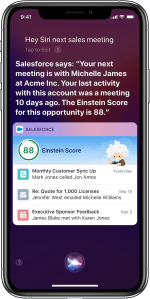
Photo: Salesforce
For instance, you could say, “Hey Siri, next sales meeting,” and Siri can interact with Salesforce CRM to tell you who your meeting is with, the name of his or her company, when you last met and what the Einstein opportunity score is to help you predict how likely it is that you could make a sale today (or eventually).
In addition, the Mobile App takes advantage of Apple’s Handoff feature to reflect changes across devices immediately, and Apple’s Face ID for easy log on to the app.
Salesforce also announced a pilot of Einstein Voice on Salesforce Mobile, allowing reps to enter notes, add tasks and update the CRM database using voice. Einstein is Salesforce’s general artificial intelligence layer, and the voice feature uses natural language understanding to interpret what the rep asks.
The company reports that over 1000 companies participated in piloting the updated app, which constitutes the largest pilot in the history of the organization.
Salesforce also announced its new mobile development platform SDK, built specifically for iOS and iPadOS using the Swift language. The idea is to provide a tool to give Salesforce developers with the ability to build apps for iPad and iPhone, then package them up with a new tool called Swift UI and Package Manager.
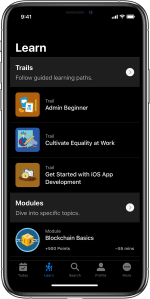
Photo: Salesforce
Trailhead Go is the mobile version of the company’s online learning platform designed specifically for iPad and iPhone. It was built using the new Mobile SDK, and allows users to access the same courses they can on the web in a mobile context. The new mobile tool includes the ability to Handoff between devices along with support for picture-in-picture and split view for multi-tasking when it makes sense.
Salesforce Mobile and Trailhead Go are available starting today for free in the iOS App Store. The Salesforce Mobile SDK will be available later this year.
As this partnership continues to develop, both companies should benefit. Salesforce gets direct access to Apple features, and can work with Apple to implement them in an optimized way. Apple gets deeper access to the enterprise with help from Salesforce, one of the biggest enterprise software vendors around.
Powered by WPeMatico
When Salesforce announced this week that it was moving Marketing Cloud to Microsoft Azure, it was easy to see this as another case of wacky enterprise partnerships. But there had to be sound business reasons why the partnership came together, rather than going with AWS or Google Cloud Platform, both of which are also Salesforce partners in other contexts.
If you ask Salesforce, it says it was ultimately because of compatibility with Microsoft SQL.
“Salesforce chose Azure because it is a trusted platform with a global footprint, multi-layered security approach, robust disaster recovery strategy with auto failover, automatic updates and more,” a Salesforce spokesperson told TechCrunch. “Marketing Cloud also has a long standing relationship with Microsoft SQL which makes the transition to SQL on Azure a natural decision.”
Except for the SQL part, Microsoft’s chief rivals at AWS and Google Cloud Platform also provide those benefits. In fact, each of those reasons cited by the spokesperson — with the exception of SQL — are all part of the general cloud infrastructure value proposition that all the major cloud vendors provide.
There’s probably more to it than simply compatibility. There is also a long-standing rivalry between the two companies, and why in spite of their competition, they continue to make deals like this in the spirit of co-opetition. We spoke to a few industry experts to get their take on the deal to find out why these two seeming rivals decided to come together.
Tony Byrne, founder and principal analyst at Real Story Group, thinks it could be related to the fact it’s a marketing tool and some customers may be wary about hosting their businesses on AWS while competing with Amazon on the retail side. This is a common argument for why retail customers in particular are more likely to go with Microsoft or Google over AWS.
“Salesforce Marketing Cloud tends to target B2C enterprises, so the choice of Azure makes sense in one context where some B2C firms are wary of Amazon for competitive reasons. But I’d also imagine there’s more to the decision than that,” Byrne said.
Powered by WPeMatico
Silicon is apparently the new gold these days, or so VCs hope.
What was once a no-go zone for venture investors, who feared the long development lead times and high technical risk required for new entrants in the semiconductor field, has now turned into one of the hottest investment areas for enterprise and data VCs. Startups like Graphcore have reached unicorn status (after its $200 million series D a year ago) while Groq closed $52M from the likes of Chamath Palihapitiya of Social Capital fame and Cerebras raised $112 million in investment from Benchmark and others while announcing that it had produced the first trillion transistor chip (and who I profiled a bit this summer).
Today, we have another entrant with another great technical team at the helm, this time with a Santa Clara, CA-based startup called NUVIA. The company announced this morning that it has raised a $53 million series A venture round co-led by Capricorn Investment Group, Dell Technologies Capital (DTC), Mayfield, and WRVI Capital, with participation from Nepenthe LLC.
Despite only getting started earlier this year, the company currently has roughly 60 employees, 30 more at various stages of accepted offers, and the company may even crack 100 employees before the end of the year.
What’s happening here is a combination of trends in the compute industry. There has been an explosion in data and by extension, the data centers required to store all of that information, just as we have exponentially expanded our appetite for complex machine learning algorithms to crunch through all of those bits. Unfortunately, the growth in computation power is not keeping pace with our demands as Moore’s Law slows. Companies like Intel are hitting the limits of physics and our current know-how to continue to improve computational densities, opening the ground for new entrants and new approaches to the field.
There are two halves to the NUVIA story. First is the story of the company’s founders, which include John Bruno, Manu Gulati, and Gerard Williams III, who will be CEO. The three overlapped for a number of years at Apple, where they brought their diverse chip skillsets together to lead a variety of initiatives including Apple’s A-series of chips that power the iPhone and iPad. According to a press statement from the company, the founders have worked on a combined 20 chips across their careers and have received more than 100 patents for their work in silicon.
Gulati joined Apple in 2009 as a micro architect (or SoC architect) after a career at Broadcom, and a few months later, Williams joined the team as well. Gulati explained to me in an interview that, “So my job was kind of putting the chip together; his job was delivering the most important piece of IT that went into it, which is the CPU.” A few years later in around 2012, Bruno was poached from AMD and brought to Apple as well.
Gulati said that when Bruno joined, it was expected he would be a “silicon person” but his role quickly broadened to think more strategically about what the chipset of the iPhone and iPad should deliver to end users. “He really got into this realm of system-level stuff and competitive analysis and how do we stack up against other people and what’s happening in the industry,” he said. “So three very different technical backgrounds, but all three of us are very, very hands-on and, you know, just engineers at heart.”
Gulati would take an opportunity at Google in 2017 aimed broadly around the company’s mobile hardware, and he eventually pulled over Bruno from Apple to join him. The two eventually left Google earlier this year in a report first covered by The Information in May. For his part, Williams stayed at Apple for nearly a decade before leaving earlier this year in March.
The company is being stealthy about exactly what it is working on, which is typical in the silicon space because it can take years to design, manufacture, and get a product into market. That said, what’s interesting is that while the troika of founders all have a background in mobile chipsets, they are indeed focused on the data center broadly conceived (i.e. cloud computing), and specifically reading between the lines, to finding more energy-efficient ways that can combat the rising climate cost of machine learning workflows and computation-intensive processing.
Gulati told me that “for us, energy efficiency is kind of built into the way we think.”
The company’s CMO did tell me that the startup is building “a custom clean sheet designed from the ground up” and isn’t encumbered by legacy designs. In other words, the company is building its own custom core, but leaving its options open on whether it builds on top of ARM’s architecture (which is its intention today) or other architectures in the future.
Outside of the founders, the other half of this NUVIA story is the collective of investors sitting around the table, all of whom not only have deep technical backgrounds, but also deep pockets who can handle the technical risk that comes with new silicon startups.
Capricorn specifically invested out of what it calls its Technology Impact Fund, which focuses on funding startups that use technology to make a positive impact on the world. Its portfolio according to a statement includes Tesla, Planet Labs, and Helion Energy.
Meanwhile, DTC is the venture wing of Dell Technologies and its associated companies, and brings a deep background in enterprise and data centers, particularly from the group’s server business like Dell EMC. Scott Darling, who leads DTC, is joining NUVIA’s board, although the company is not disclosing the board composition at this time. Navin Chaddha, an electrical engineer by training who leads Mayfield, has invested in companies like HashiCorp, Akamai, and SolarCity. Finally, WRVI has a long background in enterprise and semiconductor companies.
I chatted a bit with Darling of DTC about what he saw in this particular team and their vision for the data center. In addition to liking each founder individually, Darling felt the team as a whole was just very strong. “What’s most impressive is that if you look at them collectively, they have a skillset and breadth that’s also stunning,” he said.
He confirmed that the company is broadly working on data center products, but said the company is going to lie low on its specific strategy during product development. “No point in being specific, it just engenders immune reactions from other players so we’re just going to be a little quiet for a while,” he said.
He apologized for “sounding incredibly cryptic” but said that the investment thesis from his perspective for the product was that “the data center market is going to be receptive to technology evolutions that have occurred in places outside of the data center that’s going to allow us to deliver great products to the data center.”
Interpolating that statement a bit with the mobile chip backgrounds of the founders at Google and Apple, it seems evident that the extreme energy-to-performance constraints of mobile might find some use in the data center, particularly given the heightened concerns about power consumption and climate change among data center owners.
DTC has been a frequent investor in next-generation silicon, including joining the series A investment of Graphcore back in 2016. I asked Darling whether the firm was investing aggressively in the space or sort of taking a wait-and-see attitude, and he explained that the firm tries to keep a consistent volume of investments at the silicon level. “My philosophy on that is, it’s kind of an inverted pyramid. No, I’m not gonna do a ton of silicon plays. If you look at it, I’ve got five or six. I think of them as the foundations on which a bunch of other stuff gets built on top,” he explained. He noted that each investment in the space is “expensive” given the work required to design and field a product, and so these investments have to be carefully made with the intention of supporting the companies for the long haul.
That explanation was echoed by Gulati when I asked how he and his co-founders came to closing on this investor syndicate. Given the reputations of the three, they would have had easy access to any VC in the Valley. He said about the final investors:
They understood that putting something together like this is not going to be easy and it’s not for everybody … I think everybody understands that there’s an opportunity here. Actually capitalizing upon it and then building a team and executing on it is not something that just anybody could possibly take on. And similarly, it is not something that every investor could just possibly take on in my opinion. They themselves need to have a vision on their side and not just believe our story. And they need to strategically be willing to help and put in the money and be there for the long haul.
It may be a long haul, but Gulati noted that “on a day-to-day basis, it’s really awesome to have mostly friends you work with.” With perhaps 100 employees by the end of the year and tens of millions of dollars already in the bank, they have their war chest and their army ready to go. Now comes the fun (and hard) part as we learn how the chips fall.
Update: Changed the text to reflect that NUVIA is intending to build on top of ARM’s architecture, but isn’t a licensed ARM core.
Powered by WPeMatico
Surely just about everyone was surprised when the Department of Defense named Microsoft as the winner of the decade long, $10 billion JEDI cloud contract last month, none more so than Amazon, the company everyone assumed all along would be the winner. Today the company confirmed earlier reports that it was challenging the contract award in the Court of Federal Claims.
The Federal Times broke this story.
In a statement, an Amazon spokesperson suggested that there was possible bias and issues in the selection process. “AWS is uniquely experienced and qualified to provide the critical technology the U.S. military needs, and remains committed to supporting the DoD’s modernization efforts. We also believe it’s critical for our country that the government and its elected leaders administer procurements objectively and in a manner that is free from political influence.
“Numerous aspects of the JEDI evaluation process contained clear deficiencies, errors, and unmistakable bias — and it’s important that these matters be examined and rectified,” an Amazon spokesperson told TechCrunch.
It’s certainly worth noting that the president has not hidden his disdain for Amazon CEO and founder Jeff Bezos, who also is owner of the Washington Post newspaper. As I wrote in Even after Microsoft wins, JEDI saga could drag on:
Amazon, for instance, could point to Jim Mattis’ book where he wrote that the president told the then Defense Secretary to “screw Bezos out of that $10 billion contract.” Mattis says he refused, saying he would go by the book, but it certainly leaves the door open to a conflict question.
Oracle also filed a number of protests throughout the process including one with the Government Accountability Office that was later rejected. It also went to court and the case was dismissed. All of the protests claimed that the process favored Amazon. The end result proved it didn’t.
The president interjected himself in the decision process in August, asking the Defense secretary, Mark T. Esper to investigate once again if the procurement process somehow favored Amazon, and the week the contract was awarded, the White House canceled its subscription to the Washington Post.
In October, the decision finally came and the DOD chose Microsoft . Now Amazon is filing a challenge in federal Court, and the JEDI saga really ain’t over until it’s over.
Powered by WPeMatico
The customer data platform (CDP) is the newest tool in the customer experience arsenal as big companies try to help customers deal with data coming from multiple channels. Today, Adobe announced the general availability of its CDP.
The CDP is like a central data warehouse for all the information you have on a single customer. This crosses channels like web, email, text, chat and brick and mortar in-person visits, as well as systems like CRM, e-commerce and point of sale. The idea is to pull all of this data together into a single record to help companies have a deep understanding of the customer at an extremely detailed level. They then hope to leverage that information to deliver highly customized cross-channel experiences.
The idea is to take all of this information and give marketers the tools they need to take advantage of it. “We want to make sure we create an offering that marketers can leverage and makes use of all of that goodness that’s living within Adobe Experience platform,” Nina Caruso, product marketing manager for Adobe Audience Manager, explained.
She said that would involve packaging and presenting the data in such a way to make it easier for marketers to consume, such as dashboards to deliver the data they want to see, while taking advantage of artificial intelligence and machine learning under the hood to help them find the data to populate the dashboards without having to do the heavy lifting.
Beyond that, having access to real-time streaming data in one place under the umbrella of the Adobe Experience Platform should enable marketers to create much more precise market segments. “Part of real-time CDP will be building productized primo maintained integrations for marketers to be able to leverage, so that they can take segmentations and audiences that they’ve built into campaigns and use those across different channels to provide a consistent customer experience across that journey life cycle,” Caruso said.
As you can imagine, bringing all of this information together, while providing a platform for customization for the customer, raises all kinds of security and privacy red flags at the same time. This is especially true in light of GDPR and the upcoming California privacy law. Companies need to be able to enforce data usage rules across the platform.
To that end, the company also announced the availability of Adobe Experience Platform Data Governance, which helps companies define a set of rules around the data usage. This involves “frameworks that help [customers] enforce data usage policies and facilitate the proper use of their data to comply with regulations, obligations and restrictions associated with various data sets,” according to the company.
“We want to make sure that we offer our customers the controls in place to make sure that they have the ability to appropriately govern their data, especially within the evolving landscape that we’re all living in when it comes to privacy and different policies,” Caruso said.
These tools are now available to Adobe customers.
Powered by WPeMatico