Enterprise
Auto Added by WPeMatico
Auto Added by WPeMatico
Data breaches that could cause millions of dollars in potential damages have been the bane of the life of many a company. What’s required is a great deal of real-time monitoring. The problem is that this world has become incredibly complex. A SANS Institute survey found half of company data breaches were the result of account or credential hacking.
GitGuardian has attempted to address this with a highly developer-centric cybersecurity solution.
It’s now attracted the attention of major investors, to the tune of $12 million in Series A funding, led by Balderton Capital . Scott Chacon, co-founder of GitHub, and Solomon Hykes, founder of Docker, also participated in the round.
The startup plans to use the investment from Balderton Capital to expand its customer base, predominantly in the U.S. Around 75% of its clients are currently based in the U.S., with the remainder being based in Europe, and the funding will continue to drive this expansion.
Built to uncover sensitive company information hiding in online repositories, GitGuardian says its real-time monitoring platform can address the data leaks issues. Modern enterprise software developers have to integrate multiple internal and third-party services. That means they need incredibly sensitive “secrets,” such as login details, API keys and private cryptographic keys used to protect confidential systems and data.
GitGuardian’s systems detect thousands of credential leaks per day. The team originally built its launch platform with public GitHub in mind; however, GitGuardian is built as a private solution to monitor and notify on secrets that are inappropriately disseminated in internal systems as well, such as private code repositories or messaging systems.
Solomon Hykes, founder of Docker and investor at GitGuardian, said: “Securing your systems starts with securing your software development process. GitGuardian understands this, and they have built a pragmatic solution to an acute security problem. Their credentials monitoring system is a must-have for any serious organization.”
Do they have any competitors?
Co-founder Jérémy Thomas told me: “We currently don’t have any direct competitors. This generally means that there’s no market, or the market is too small to be interesting. In our case, our fundraise proves we’ve put our hands on something huge. So the reason we don’t have competitors is because the problem we’re solving is counterintuitive at first sight. Ask any developer, they will say they would never hardcode any secret in public source code. However, humans make mistakes and when that happens, they can be extremely serious: it can take a single leaked credential to jeopardize an entire organization. To conclude, I’d say our real competitors so far are black hat hackers. Black hat activity is real on GitHub. For two years, we’ve been monitoring organized groups of hackers that exchange sensitive information they find on the platform. We are competing with them on speed of detection and scope of vulnerabilities covered.”
Powered by WPeMatico

AWS today quietly brought spot capacity to Fargate, its serverless compute engine for containers that supports both the company’s Elastic Container Service and, now, its Elastic Kubernetes service.
Like spot instances for the EC2 compute platform, Fargate Spot pricing is significantly cheaper, both for storage and compute, than regular Fargate pricing. In return, though, you have to be able to accept the fact that your instance may get terminated when AWS needs additional capacity. While that means Fargate Spot may not be perfect for every workload, there are plenty of applications that can easily handle an interruption.
“Fargate now has on-demand, savings plan, spot,” AWS VP of Compute Services Deepak Singh told me. “If you think about Fargate as a compute layer for, as we call it, serverless compute for containers, you now have the pricing worked out and you now have both orchestrators on top of it.”
He also noted that containers already drive a significant percentage of spot usage on AWS in general, so adding this functionality to Fargate makes a lot of sense (and may save users a few dollars here and there). Pricing, of course, is the major draw here and an hour of CPU time on Fargate Spot will only cost $0.01245364 (yes, AWS is pretty precise there) compared to $0.04048 for the on-demand price,
With this, AWS is also launching another important new feature: capacity providers. The idea here is to automate capacity provisioning for Fargate and EC2, both of which now offer on-demand and spot instances, after all. You simply write a config file that, for example, says you want to run 70 percent of your capacity on EC2 and the rest on spot instances. The scheduler will then keep that capacity on spot as instances come and go, and if there are no spot instances available, it will move it to on-demand instances and back to spot once instances are available again.
In the future, you will also be able to mix and match EC2 and Fargate. “You can say, I want some of my services running on EC2 on demand, some running on Fargate on demand, and the rest running on Fargate Spot,” Singh explained. “And the scheduler manages it for you. You squint hard, capacity is capacity. We can attach other capacity providers.” Outpost, AWS’ fully managed service for running AWS services in your data center, could be a capacity provider, for example.
These new features and prices will be officially announced in Thursday’s re:Invent keynote, but the documentation and pricing is already live today.

Powered by WPeMatico
What kinds of businesses might be able to operate in space? Well, data centers are one potential target you might not have thought of. Space provides an interesting environment for data center operations, including advanced analytics operations and even artificial intelligence, due in part to the excellent cooling conditions and reasonable access to renewable power supply (solar). But there are challenges, which is why a new partnership between Florida-based space startup OrbitsEdge and Hewlett Packard Enterprises (HPE) makes a lot of sense.
The partnership will make OrbitsEdge a hardware supplier for HPE’s Edgeline Converged Edge Systems, and basically it means that the space startup will be handling everything required to “harden” the standard HPE micro-data center equipment for use in outer space. Hardening is a standard process for getting stuff ready to use in space, and essentially prepares equipment to withstand the increased radiation, extreme temperatures and other stressors that space adds to the mix.
OrbitsEdge, founded earlier this year, has developed a proprietary piece of hardware called the “SatFrame” which is designed to counter the stress of a space-based operating environment, making it relatively easy to take off-the-shelf Earth equipment like the HPE Edgeline system and get it working in space without requiring a huge amount of additional, custom work.
In terms of what this will potentially provide, the partnership will mean it’s more feasible than ever to set up a small-scale data center in orbit to handle at least some of the processing of space-based data right near where it’s collected, rather than having to shuttle it back down to Earth. That process can be expensive, and difficult to source in terms of even finding companies and infrastructure to use. As with in-space manufacturing, doing things locally could save a lot of overhead and unlock tons of potential down the line.
Powered by WPeMatico

Just as Qualcomm was starting to highlight its 5G plans for the coming years, Verizon CEO Hans Vestberg hit the stage at AWS re:Invent to discuss the carrier’s team up with the cloud computing giant.
As part of Verizon’s (TechCrunch’s parent company, disclosure, disclosure, disclosure) upcoming focus on 5G edge computing, the carrier will be the first to use the newly announced AWS Wavelength. The platform is designed to let developers build super-low-latency apps for 5G devices.
Currently, it’s being piloted in Chicago with a handful of high-profile partners, including the NFL and Bethesda, the game developer behind Fallout and Elder Scrolls. No details yet on those specific applications (though remote gaming and live streaming seem like the obvious ones), but potential future uses include things like smart cars, IoT devices, AR/VR — you know, the sorts of things people cite when discussing 5G’s life beyond the smartphone.
“AWS Wavelength provides the same AWS environment — APIs, management console and tools — that they’re using today at the edge of the 5G network,” AWS CEO Andy Jassy said onstage. Starting with Verizon’s 5G network locations in the U.S., customers will be able to deploy the latency-sensitive portions of an application at the edge to provide single-digit millisecond latency to mobile and connected devices.”
As Verizon’s CEO joined Vestberg onstage, CNO Nicki Palmer joined Qualcomm in Hawaii to discuss the carrier’s mmwave approach to the next-gen wireless. The technology has raised some questions around its coverage area. Verizon has addressed this to some degree with partnerships with third-parties like Boingo.
The company plans to have coverage in 30 U.S. cities by end of year. That number is currently at 18.
Powered by WPeMatico

For about a year now, continuous integration and delivery service CircleCI has offered Orbs, a way to easily reuse commands and integrations with third-party services. Unsurprisingly, some of the most popular Orbs focus on AWS, as that’s where most of the company’s developers are either testing their code or deploying it. Today, right in time for AWS’s annual re:Invent developer conference in Las Vegas, the company announced that it has now added Orb support for the AWS Serverless Application Model (SAM), which makes setting up automated CI/CD platforms for testing and deploying to AWS Lambda significantly easier.
In total, the company says, more than 11,000 organizations started using Orbs since it launched a year ago. Among the AWS-centric Orbs are those for building and updating images for the Amazon Elastic Container Services and the Elastic Container Service for Kubernetes (EKS), for example, as well as AWS CodeDeploy support, an Orb for installing and configuring the AWS command line interface, an Orb for working with the S3 storage service and more.
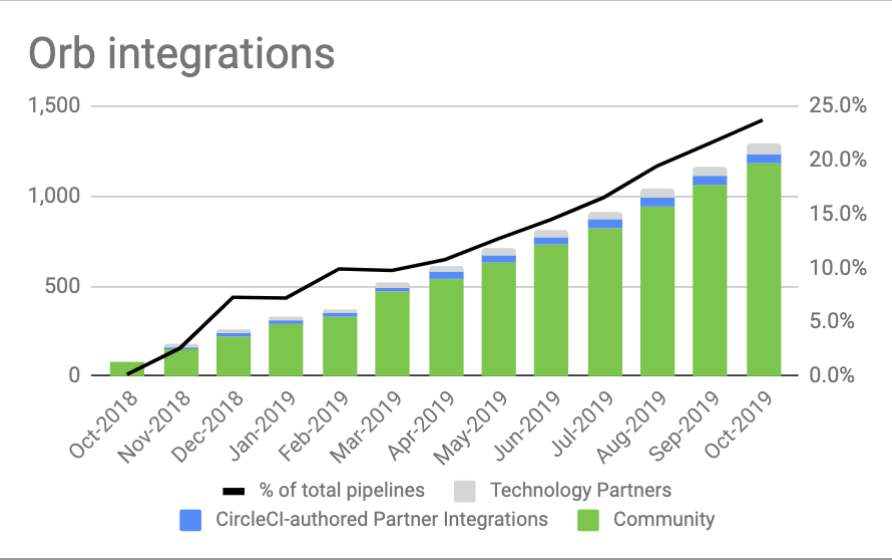
“We’re just seeing a momentum of more and more companies being ready to adopt [managed services like Lambda, ECS and EKS], so this became really the ideal time to do most of the work with the product team at AWS that manages their serverless ecosystem and to add in this capability to leverage that serverless application model and really have this out of the box CI/CD flow ready for users who wanted to start adding these into to Lambda,” CircleCI VP of business development Tom Trahan told me. “I think when Lambda was in its earlier days, a lot of people would use it and they would use it and not necessarily follow the same software patterns and delivery flow that they might have with their traditional software. As they put more and more into Lambda and are really putting a lot more what I would call ‘production quality code’ out there to leverage. They realize they do want to have that same software delivery capability and discipline for Lambda as well.”
Trahan stressed that he’s still talking about early adopters and companies that started out as cloud-native companies, but these days, this group includes a lot of traditional companies, as well, that are now rapidly going through their own digital transformations.
Powered by WPeMatico

As part of the flurry of announcements coming this week out of AWS re:Invent, Amazon announced the release of Amazon SageMaker Operators for Kubernetes, a way for data scientists and developers to simplify training, tuning and deploying containerized machine learning models.
Packaging machine learning models in containers can help put them to work inside organizations faster, but getting there often requires a lot of extra management to make it all work. Amazon SageMaker Operators for Kubernetes is supposed to make it easier to run and manage those containers, the underlying infrastructure needed to run the models and the workflows associated with all of it.
“While Kubernetes gives customers control and portability, running ML workloads on a Kubernetes cluster brings unique challenges. For example, the underlying infrastructure requires additional management such as optimizing for utilization, cost and performance; complying with appropriate security and regulatory requirements; and ensuring high availability and reliability,” AWS’ Aditya Bindal wrote in a blog post introducing the new feature.
When you combine that with the workflows associated with delivering a machine learning model inside an organization at scale, it becomes part of a much bigger delivery pipeline, one that is challenging to manage across departments and a variety of resource requirements.
This is precisely what Amazon SageMaker Operators for Kubernetes has been designed to help DevOps teams do. “Amazon SageMaker Operators for Kubernetes bridges this gap, and customers are now spared all the heavy lifting of integrating their Amazon SageMaker and Kubernetes workflows. Starting today, customers using Kubernetes can make a simple call to Amazon SageMaker, a modular and fully-managed service that makes it easier to build, train, and deploy machine learning (ML) models at scale,” Bindal wrote.
The promise of Kubernetes is that it can orchestrate the delivery of containers at the right moment, but if you haven’t automated delivery of the underlying infrastructure, you can over (or under) provision and not provide the correct amount of resources required to run the job. That’s where this new tool, combined with SageMaker, can help.
“With workflows in Amazon SageMaker, compute resources are pre-configured and optimized, only provisioned when requested, scaled as needed, and shut down automatically when jobs complete, offering near 100% utilization,” Bindal wrote.
Amazon SageMaker Operators for Kubernetes are available today in select AWS regions.
Powered by WPeMatico
Prevailing wisdom states that as an enterprise SaaS company evolves, there’s a tendency to sacrifice profitability for growth — understandably so, especially in the early days of the company. At some point, however, a company needs to become profitable.
Box has struggled to reach that goal since going public in 2015, but yesterday, it delivered a mostly positive earnings report. Wall Street seemed to approve, with the stock up 6.75% as we published this article.
Box CEO Aaron Levie says the goal moving forward is to find better balance between growth and profitability. In his post-report call with analysts, Levie pointed to some positive numbers.
“As we shared in October [at BoxWorks], we are focused on driving a balance of long-term growth and improved profitability as measured by the combination of revenue growth plus free cash flow margin. On this combined metric, we expect to deliver a significant increase in FY ’21 to at least 25% and eventually reaching at least 35% in FY ’23,” Levie said.
Part of the maturation and drive to profitability is spurred by the fact that Box now has a more complete product platform. While many struggle to understand the company’s business model, it provides content management in the cloud and modernizing that aspect of enterprise software. As a result, there are few pure-play content management vendors that can do what Box does in a cloud context.
Powered by WPeMatico
Xerox fired the latest volley in the Xerox –HP merger letter wars today. Xerox CEO John Visentin wrote to the HP board that his company planned to take its $33.5 billion offer directly to HP shareholders.
He began his letter with a tone befitting a hostile takeover attempt, stating that their refusal to negotiate defied logic. “We have put forth a compelling proposal – one that would allow HP shareholders to both realize immediate cash value and enjoy equal participation in the substantial upside expected to result from a combination. Our offer is neither ‘highly conditional’ nor ‘uncertain’ as you claim,” Visentin wrote in his letter.
He added, “We plan to engage directly with HP shareholders to solicit their support in urging the HP Board to do the right thing and pursue this compelling opportunity.”
The letter was in response to one yesterday from HP in which it turned down Xerox’s latest overture, stating that the deal seemed beyond Xerox’s ability to afford it. It called into question Xerox’s current financial situation, citing Xerox’s own financial reports, and took exception to the way in which Xerox was courting the company.
“It is clear in your aggressive words and actions that Xerox is intent on forcing a potential combination on opportunistic terms and without providing adequate information,” the company wrote.
Visentin fired back in his letter, “While you may not appreciate our “aggressive” tactics, we will not apologize for them. The most efficient way to prove out the scope of this opportunity with certainty is through mutual due diligence, which you continue to refuse, and we are obligated to require.”
He further pulled no punches writing that he believes the deal is good for both companies and good for the shareholders. “The potential benefits of a combination between HP and Xerox are self-evident. Together, we could create an industry leader – with enhanced scale and best-in-class offerings across a complete product portfolio — that will be positioned to invest more in innovation and generate greater returns for shareholders.”
Patrick Moorhead, founder and principal analyst at Moor Insights & Strategies, thinks HP ultimately has the upper hand in this situation. “I feel like we have seen this movie before when Carl Icahn meddled with Dell in a similar way. Xerox is a third of the size HP Inc., has been steadily declining in revenue, is running out of options, and needs HP more than HP needs it.”
It would seem Xerox has chosen a no-holds barred approach to the situation. The pen is now in HP’s hands as we await the next letter and see how the printing giant intends to respond to the latest missive from Xerox.
Powered by WPeMatico
Today, Amazon announced a new approach that it says will put machine learning technology in reach of more developers and line of business users. Amazon has been making a flurry of announcements ahead of its re:Invent customer conference next week in Las Vegas.
While the company offers plenty of tools for data scientists to build machine learning models and to process, store and visualize data, it wants to put that capability directly in the hands of developers with the help of the popular database query language, SQL.
By taking advantage of tools like Amazon QuickSight, Aurora and Athena in combination with SQL queries, developers can have much more direct access to machine learning models and underlying data without any additional coding, says VP of artificial intelligence at AWS, Matt Wood.
“This announcement is all about making it easier for developers to add machine learning predictions to their products and their processes by integrating those predictions directly with their databases,” Wood told TechCrunch.
For starters, Wood says developers can take advantage of Aurora, the company’s MySQL (and Postgres)-compatible database to build a simple SQL query into an application, which will automatically pull the data into the application and run whatever machine learning model the developer associates with it.
The second piece involves Athena, the company’s serverless query service. As with Aurora, developers can write a SQL query — in this case, against any data store — and based on a machine learning model they choose, return a set of data for use in an application.
The final piece is QuickSight, which is Amazon’s data visualization tool. Using one of the other tools to return some set of data, developers can use that data to create visualizations based on it inside whatever application they are creating.
“By making sophisticated ML predictions more easily available through SQL queries and dashboards, the changes we’re announcing today help to make ML more usable and accessible to database developers and business analysts. Now anyone who can write SQL can make — and importantly use — predictions in their applications without any custom code,” Amazon’s Matt Asay wrote in a blog post announcing these new capabilities.
Asay added that this approach is far easier than what developers had to do in the past to achieve this. “There is often a large amount of fiddly, manual work required to take these predictions and make them part of a broader application, process or analytics dashboard,” he wrote.
As an example, Wood offers a lead-scoring model you might use to pick the most likely sales targets to convert. “Today, in order to do lead scoring you have to go off and wire up all these pieces together in order to be able to get the predictions into the application,” he said. With this new capability, you can get there much faster.
“Now, as a developer I can just say that I have this lead scoring model which is deployed in SageMaker, and all I have to do is write literally one SQL statement that I do all day long into Aurora, and I can start getting back that lead scoring information. And then I just display it in my application and away I go,” Wood explained.
As for the machine learning models, these can come pre-built from Amazon, be developed by an in-house data science team or purchased in a machine learning model marketplace on Amazon, says Wood.
Today’s announcements from Amazon are designed to simplify machine learning and data access, and reduce the amount of coding to get from query to answer faster.
Powered by WPeMatico

Why are we all trapped in enterprise chat apps if we talk 6X faster than we type, and our brain processes visual info 60,000X faster than text? Thanks to Instagram, we’re not as camera-shy anymore. And everyone’s trying to remain in flow instead of being distracted by multi-tasking.
That’s why now is the time for Loom. It’s an enterprise collaboration video messaging service that lets you send quick clips of yourself so you can get your point across and get back to work. Talk through a problem, explain your solution, or narrate a screenshare. Some engineering hocus pocus sees videos start uploading before you finish recording so you can share instantly viewable links as soon as you’re done.
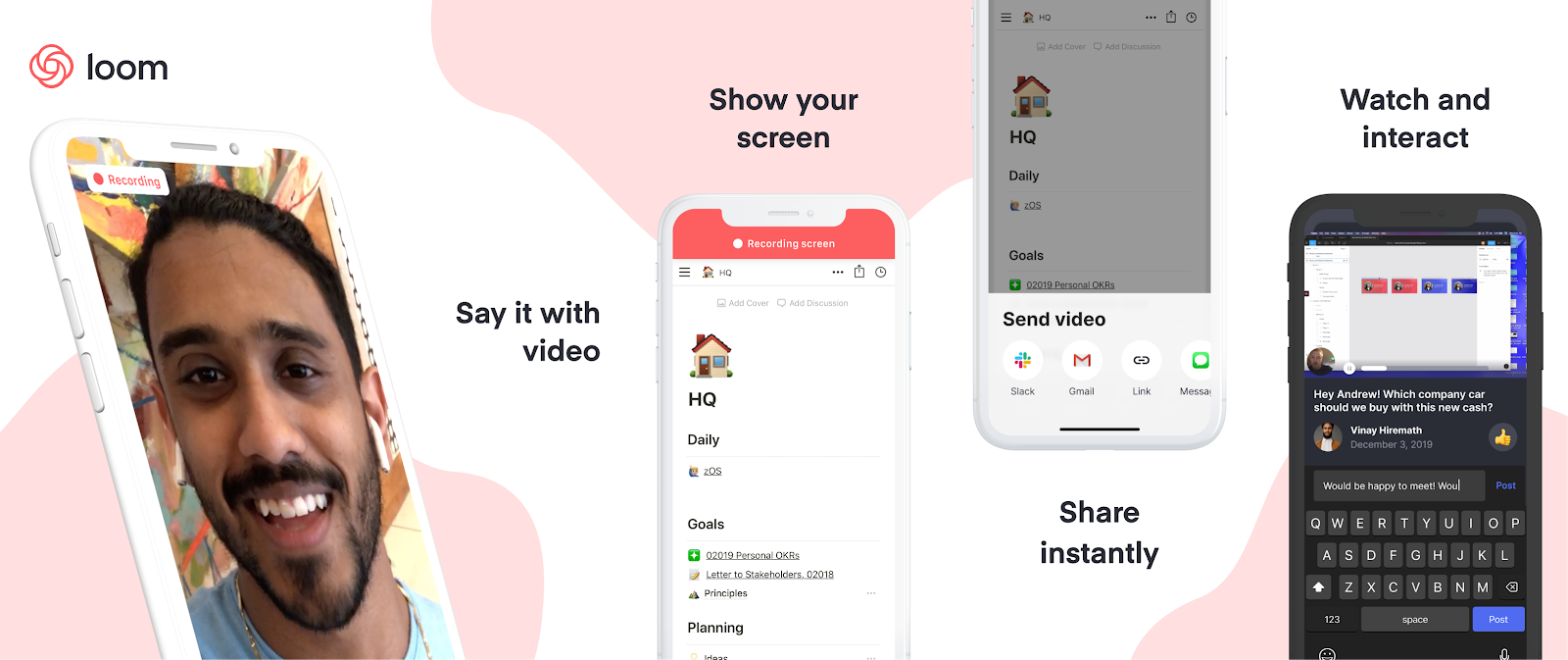
Loom video messaging on mobile
“What we felt was that more visual communication could be translated into the workplace and deliver disproportionate value” co-founder and CEO Joe Thomas tells me. He actually conducted our whole interview over Loom, responding to emailed questions with video clips.
Launched in 2016, Loom is finally hitting its growth spurt. It’s up from 1.1 million users and 18,000 companies in February to 1.8 million people at 50,000 businesses sharing 15 million minutes of Loom videos per month. Remote workers are especially keen on Loom since it gives them face-to-face time with colleagues without the annoyance of scheduling synchronous video calls. “80% of our professional power users had primarily said that they were communicating with people that they didn’t share office space with” Thomas notes.
A smart product, swift traction, and a shot at riding the consumerization of enterprise trend has secured Loom a $30 million Series B. The round that’s being announced later today was led by prestigious SAAS investor Sequoia and joined by Kleiner Perkins, Figma CEO Dylan Field, Front CEO Mathilde Collin, and Instagram co-founders Kevin Systrom and Mike Krieger.
“At Instagram, one of the biggest things we did was focus on extreme performance and extreme ease of use and that meant optimizing every screen, doing really creative things about when we started uploading, optimizing everything from video codec to networking” Krieger says. “Since then I feel like some products have managed to try to capture some of that but few as much as Loom did. When I first used Loom I turned to Kevin who was my Instagram co-founder and said, ‘oh my god, how did they do that? This feels impossibly fast.’”
Systrom concurs about the similarities, saying “I’m most excited because I see how they’re tackling the problem of visual communication in the same way that we tried to tackle that at Instagram.” Loom is looking to double-down there, potentially adding the ability to Like and follow videos from your favorite productivity gurus or sharpest co-workers.
Loom is also prepping some of its most requested features. The startup is launching an iOS app next month with Android coming the first half of 2020, improving its video editor with blurring for hiding your bad hair day and stitching to connect multiple takes. New branding options will help external sales pitches and presentations look right. What I’m most excited for is transcription, which is also slated for the first half of next year through a partnership with another provider, so you can skim or search a Loom. Sometimes even watching at 2X speed is too slow.
But the point of raising a massive $30 million Series B just a year after Loom’s $11 million Kleiner-led Series A is to nail the enterprise product and sales process. To date, Loom has focused on a bottom-up distribution strategy similar to Dropbox. It tries to get so many individual employees to use Loom that it becomes a team’s default collaboration software. Now it needs to grow up so it can offer the security and permissions features IT managers demand. Loom for teams is rolling out in beta access this year before officially launching in early 2020.
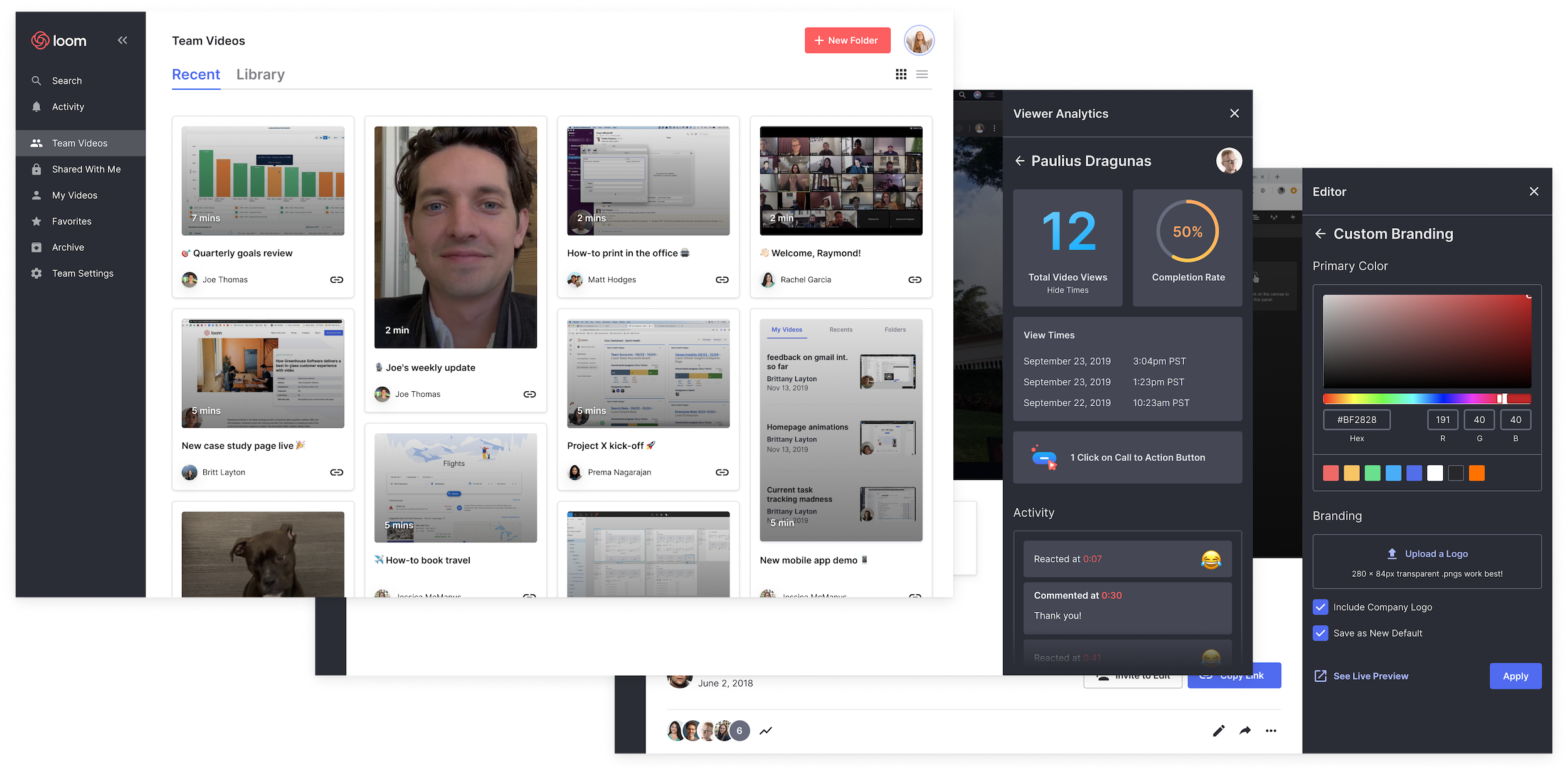
Loom’s bid to become essential to the enterprise, though, is its team video library. This will let employees organize their Looms into folders of a knowledge base so they can explain something once on camera, and everyone else can watch whenever they need to learn that skill. No more redundant one-off messages begging for a team’s best employees to stop and re-teach something. The Loom dashboard offers analytics on who’s actually watching your videos. And integration directly into popular enterprise software suites will let recipients watch without stopping what they’re doing.
To build out these features Loom has already grown to a headcount of 45, though co-founder Shahed Khan is stepping back from company. For new leadership, it’s hired away former head of web growth at Dropbox Nicole Obst, head of design for Slack Joshua Goldenberg, and VP of commercial product strategy for Intercom Matt Hodges.
Still, the elephants in the room remain Slack and Microsoft Teams. Right now, they’re mainly focused on text messaging with some additional screensharing and video chat integrations. They’re not building Loom-style asynchronous video messaging…yet. “We want to be clear about the fact that we don’t think we’re in competition with Slack or Microsoft Teams at all. We are a complementary tool to chat” Thomas insists. But given the similar productivity and communication ethos, those incumbents could certainly opt to compete. Slack already has 12 million daily users it could provide with video tools.

Loom co-founder and CEO Joe Thomas
Hodges, Loom’s head of marketing, tells me “I agree Slack and Microsoft could choose to get into this territory, but what’s the opportunity cost for them in doing so? It’s the classic build vs. buy vs. integrate argument.” Slack bought screensharing tool Screenhero, but partners with Zoom and Google for video chat. Loom will focus on being easily integratable so it can plug into would-be competitors. And Hodges notes that “Delivering asynchronous video recording and sharing at scale is non-trivial. Loom holds a patent on its streaming, transcoding, and storage technology, which has proven to provide a competitive advantage to this day.”
The tea leaves point to video invading more and more of our communication, so I expect rival startups and features to Loom will crop up. Vidyard and Wistia’s Soapbox are already pushing into the space. As long as it has the head start, Loom needs to move as fast as it can. “It’s really hard to maintain focus to deliver on the core product experience that we set out to deliver versus spreading ourselves too thin. And this is absolutely critical” Thomas tells me.
One thing that could set Loom apart? A commitment to financial fundamentals. “When you grow really fast, you can sometimes lose sight of what is the core reason for a business entity to exist, which is to become profitable. . . Even in a really bold market where cash can be cheap, we’re trying to keep profitability at the top of our minds.”
Powered by WPeMatico