Automation
Auto Added by WPeMatico
Auto Added by WPeMatico
This is it. The final call for all the mobility and transportation startuppers who want to save a solid Benjamin on their ticket to the TC Sessions: Mobility 2019 conference in San Jose, Calif. on July 10. The early-bird ticket price disappears tonight, June 14 at 11:59 p.m. (PT). Beat that deadline and buy a ticket — or pay full freight.
Get ready to experience a full day devoted to the revolution that’s taking place within the mobility and transportation industries. More than 1,000 people — the greatest minds, biggest names and influential thinkers, makers and investors — will attend a day packed with interviews, panel discussions, fireside chats, demos and workshops.
Along with TechCrunch editors, speakers will question assumptions and examine complex technological and regulatory issues. They’ll discuss capital investment concerns and look at the ethics and human factors in a future of autonomous cars, delivery robots and flying taxis.
Here’s a small sample of the programming that’s on tap. The event agenda can help you plan your day, although you may have to clone yourself to catch it all.
Building Business and Autonomy: Co-founder and CTO Jesse Levinson will be on hand to talk about Zoox, an independent autonomous vehicle company. Its cars can navigate tricky San Francisco streets — including the notoriously iconic Lombard Street. We’ll hear how Zoox plans to navigate the challenging road to business success.
The Future of Freight: The trucking industry is in serious trouble, and startups and OEMs are scrambling to come up with a solution. Volvo’s Jenny Elfsberg and Stefan Seltz-Axmacher of Starsky Robotics will join us to debate whether autonomous trucks are the fix we need or if another near-term technology can pave the way to a more efficient and profitable industry.
Will Venture Capital Drive the Future of Mobility? Michael Granoff of Maniv Mobility, Ted Serbinski of Techstars and Bain Capital’s Sarah Smith will debate the uncertain future of mobility tech and whether VC dollars are enough to push the industry forward.
Today’s the last day you can save $100 on your pass to the TC Sessions: Mobility 2019 conference in San Jose, Calif. on July 10. Buy your ticket by 11:59 p.m. (PT) tonight, June 14 or kiss that early bird — and $100 — goodbye.
Is your company interested in sponsoring or exhibiting at TC Sessions: Mobility? Contact our sponsorship sales team by filling out this form.
Powered by WPeMatico
Warehouse automation is all the rage in robotics these days. No surprise then, that another emerging player just got a healthy slice of venture funding. Massachusetts-based Locus Robotics this week announced that it has secured a $26 million Series C. The round, led by Zebra Ventures and Scale Venture Partners, brings the startup’s total funding to around $66 million.
The five-year-old company produces robotic shelving designed to transfer bins inside of warehouses. Founder Bruce E. Welty was onstage at our robotics event back in 2017 demonstrating the technology.
It’s a similar principle to many other players in the space, including Amazon’s Kiva and Bay Area-based Fetch. And like those companies, Locus has garnered interest from some big players — most notably delivery giant, DHL.
The robotics automation space has heated up quite a bit in 2019. Colorado-based Canvas, which makes autonomous warehouse delivery carts, was acquired by Amazon last week. Even Boston Dynamics is looking at the category as a way forward for its own impressive technologies, putting its robot Handle to work in a fulfillment center.
“We have seen a massive uptick in demand for the flexible automation incorporated into Locus’s multi-bot solution, which is uniquely suited to address these challenges,” CEO Rick Faulk says in a release tied to the news. “Not only is our solution proven to dramatically improve productivity and drive down costs, but it is also a source of scalable labor that can be adapted to meet the demands of numerous product and customer profiles. This new funding will enable us to scale to meet growing demand for our revolutionary solution worldwide.”
Powered by WPeMatico
This Thursday, we’ll be hosting our third annual Robotics + AI TechCrunch Sessions event at UC Berkeley’s Zellerbach Hall. The day is packed start-to-finish with intimate discussions on the state of robotics and deep learning with key founders, investors, researchers and technologists.
The event will dig into recent developments in robotics and AI, which startups and companies are driving the market’s growth and how the evolution of these technologies may ultimately play out. In preparation for our event, TechCrunch’s Brian Heater spent time over the last several months visiting some of the top robotics companies in the country. Brian will be on the ground at the event, alongside Lucas Matney, who will also be on the scene. Friday at 11:00 am PT, Brian and Lucas will be sharing with Extra Crunch members (on a conference call) what they saw and what excited them most.
Tune in to find out about what you might have missed and to ask Brian and Lucas anything else robotics, AI or hardware. And want to attend the event in Berkeley this week? It’s not too late to get tickets.
To listen to this and all future conference calls, become a member of Extra Crunch. Learn more and try it for free.
Powered by WPeMatico
How much does transportation cost you?
In most cities, bus or subway fare might set you back $3 or so. A tank of gas, maybe $30 or $40 depending on your car. An hour of street parking? Sometimes it’s free, sometimes it’s a few bucks. And you can usually snag an economy seat on a round-trip U.S. domestic flight for less than $300.
These numbers probably ring true for most people. There’s just one problem: Everything you know about the cost of transportation is wrong.
Despite a massive infusion of venture capital into the transportation sector over the past few years, mobility startups are starting to learn what every transportation business has known for generations: transportation profits are elusive, and the system is mainly held together by subsidies. Will this be the first generation of transportation businesses to escape history?
Powered by WPeMatico
Chef, the popular automation service, today announced that it is open-sourcing all of its software under the Apache 2 license. Until now, Chef used an open core model with a number of proprietary products that complemented its open-source tools. Most of these proprietary tools focused on enterprise users and their security and deployment needs. Now, all of these tools, which represent somewhere between a third and a half of Chef’s total code base, are open source, too.
“We’re moving away from our open core model,” Chef SVP of products and engineering Corey Scobie told me. “We’re now moving to exclusively open-source software development.”
He added that this also includes open product development. Going forward, the company plans to share far more details about its roadmap, feature backlogs and other product development details. All of Chef’s commercial offerings will also be built from the same open-source code that everybody now has access to.
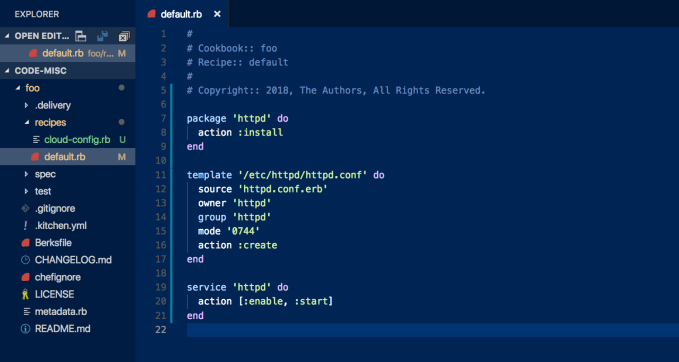 Scobie noted there are a number of reasons why the company is doing this. He believes, for example, that the best way to build software is to collaborate in public with those who are actually using it.
“With that philosophy in mind, it was really easy to justify how we’d take the remainder of the software that we produce and make it open source,” Scobie said. “We believe that that’s the best way to build software that works for people — real people in the real world.”
Another reason, Scobie said, is that it was becoming increasingly difficult for Chef to explain which parts of the software were open source and which were not. “We wanted to make that conversation easier, to be perfectly honest.”
Chef’s decision comes during a bit of a tumultuous time in the open-source world. A number of companies like Redis, MongoDB and Elastic have recently moved to licenses that explicitly disallow the commercial use of their open-source products by large cloud vendors like AWS unless they also buy a commercial license.
But here is Chef, open-sourcing everything. Chef co-founder and board member Adam Jacob doesn’t think that’s a problem. “In the open core model, you’re saying that the value is in this proprietary sliver. The part you pay me for is this sliver of its value. And I think that’s incorrect,” he said. “I think, in fact, the value was always in the totality of the product.”
Jacob also argues that those companies that are moving to these new, more restrictive licenses, are only hurting themselves. “It turns out that the product was what mattered in the first place,” he said. “They continue to produce great enterprise software for their customers and their customers continue to be happy and continue to buy it, which is what they always would’ve done.” He also noted that he doesn’t think AWS will ever be better at running Elasticsearch than Elastic or, for that matter, at running Chef better than Chef.
It’s worth noting that Chef also today announced the launch of its Enterprise Automation Stack, which brings together under a unified umbrella all of Chef’s tools (Chef Automate, Infra, InSpec, Habitat and Workstation).
“Chef is fully committed to enabling organizations to eliminate friction across the lifecycle of all of their applications, ensuring that, whether they build their solutions from our open-source code or license our commercial distribution, they can benefit from collaboration as code,” said Chef CEO Barry Crist. “Chef Enterprise Automation Stack lets teams establish and maintain a consistent path to production for any application, in order to increase velocity and improve efficiency, so deployment and updates of mission-critical software become easier, move faster and work flawlessly.”
Powered by WPeMatico

Solar installations are becoming a no-brainer for anyone with a roof in much of the country. But getting an estimate on how much it would cost and how much juice it would generate can be complicated and time-consuming. Aurora Solar has made an automated process for doing this, and attracted $20 million in funding as a result.
A big part of the uncertainty anyone has about getting solar installed is the upfront cost and return on investment. An on-site visit may cost hundreds, or thousands for a commercial property, or that cost may be rolled up into the overall charge. But why send someone out when all the data you need can be acquired in bulk from the air?
Aurora uses lidar data for this — but not the kind of lidar where you have to fly a drone with the instrument over the house. That would hardly be less expensive and time-consuming than a normal visit. Instead they use lidar collected by small aircraft making low-altitude passes over the city.
The resulting data (you can see it above) produces detailed 3D models of the terrain and all the buildings on it; the exact size and slope of a roof can be determined with high precision. It’s actually similar in a way to how archaeologists used it to map out an ancient Mayan metropolis.
There are some programs and services out there that do virtual site visits, but many just estimate your roof area and orientation by looking at satellite imagery. That’s good for a basic estimate, but Aurora uses multiple sources of data to create a detailed 3D map of your roof, and it’s proud of its results.
“From the get-go, we have been very ambitious about the way we address the problem, probably since we faced the same issues our clients face ourselves,” said co-founder Christopher Hopper in an email to TechCrunch. That would have been in 2012, when he and co-founder Samuel Adeyemo experienced significant friction with a solar install in East Africa. The installation itself was a snap, they found, but the planning and design of the system took months.
“Aurora pioneered the concept of ‘remote site visits,’ which enables solar installers to precisely calculate how many solar panels fit on a property, and how much energy they produce without traveling to the site,” Hopper said. “We have a large dataset of LIDAR data pre-loaded in the application that’s accessible to our users. We estimate that that covers about 2/3 of the US population.”
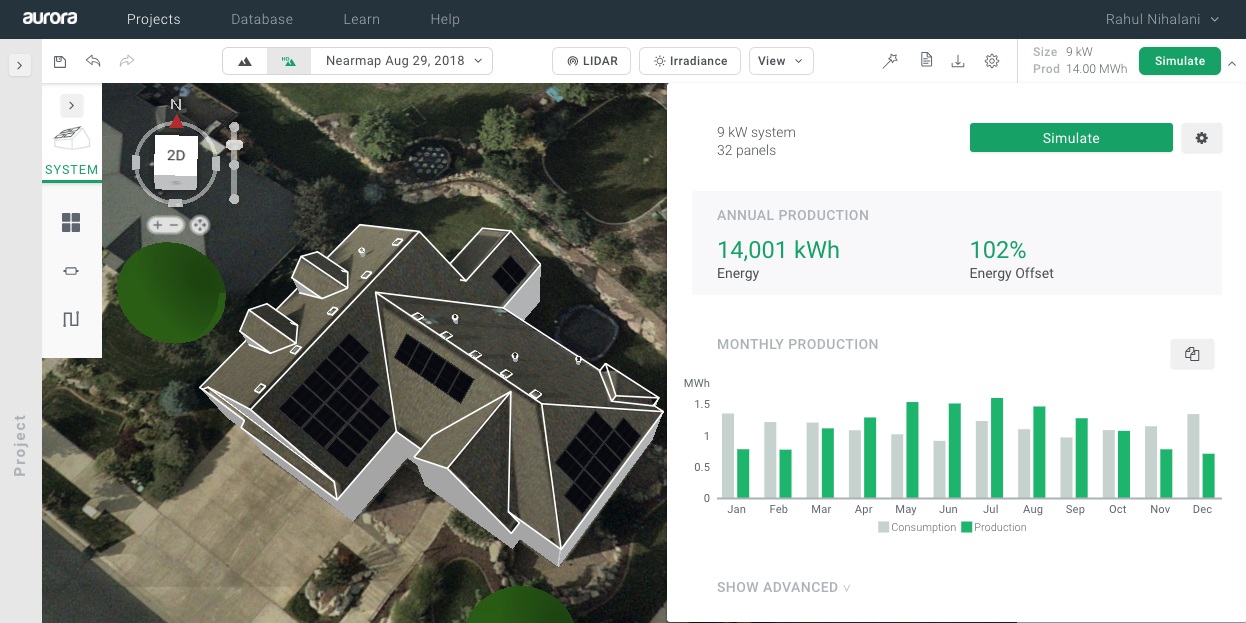
This and other data lets Aurora create a detailed CAD model of the building in just a few minutes, and generate a basic plan for solar cell placement as well that accounts for slope, exposure, and any shade-producing obstacles like chimneys or trees nearby. (Shade reports are usually done in person, and are necessary to receive certain rebates.)
From there users can go straight into the sales and financing process, even including line diagrams for the electrical system you’ll be building. And theoretically it could all take less than an hour, which is probably how much time you’d spend on the phone trying to get a local solar installer to come out.
The A round was led by Energize Ventures, whose managing director Amy Francetic will be joining the board, with S28 and seed investor Pear also contributing.
Once nice thing about companies relying on data and automation: they scale well. So Aurora won’t need to buy a thousand new trucks to get its next few thousand customers — it needs to hire engineers, sales and support people, which is exactly what it plans to do.
“We expect to expand all of the functions in our organization,” said Hopper. “We are particularly excited about all of the things we can do on the product side and in customer success. And finally, this funding means that we are here to stay. For companies [i.e. Aurora’s clients] that rely on a software provider for their day-to-day operations this is an important factor.”
Adeyemo notes in the press release announcing the funding that “the solar professional” is the “fastest growing occupation in the U.S.” Hopefully making things easier for the customer will keep it that way for a while.
Disclosure: Former TechCruncher Rahul Nihalani now works for Aurora. Rahul’s great, but this does not affect our coverage.
Powered by WPeMatico
Trello, the organizational tool owned by Atlassian, announced an acquisition of its very own this morning when it bought Butler for an undisclosed amount.
What Butler brings to Trello is the power of automation, stringing together a bunch of commands to make something complex happen automatically. As Trello’s Michael Pryor pointed out in a blog post announcing the acquisition, we are used to tools like IFTTT, Zapier and Apple Shortcuts, and this will bring a similar type of functionality directly into Trello.
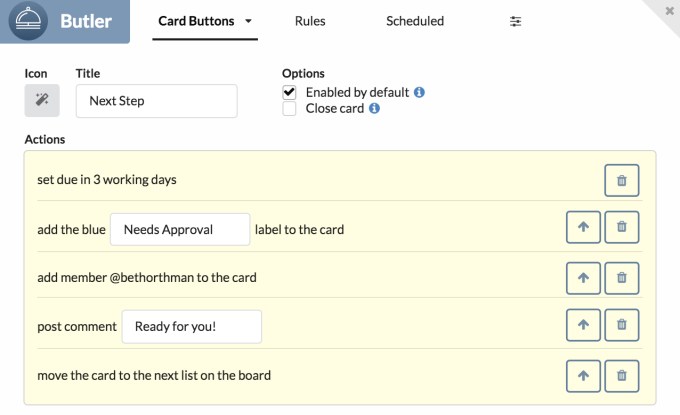
Screenshot: Trello
“Over the years, teams have discovered that by automating processes on Trello boards with the Butler Power-Up, they could spend more time on important tasks and be more productive. Butler helps teams codify business rules and processes, taking something that might take ten steps to accomplish and automating it into one click,” Pryor wrote.
This means that Trello can be more than a static organizational tool. Instead, it can move into the realm of light-weight business process automation. For example, this could allow you to move an item from your To Do board to your Doing board automatically based on dates, or to share tasks with appropriate teams as a project moves through its life cycle, saving a bunch of manual steps that tend to add up.
The company indicated that it will be incorporating the Alfred’s capabilities directly into Trello in the coming months. It will make it available to all levels of users, including the free tier, but they promise more advanced functionality for Business and Enterprise customers when the integration is complete. Pryor also suggested that more automation could be coming to Trello. “Butler is Trello’s first step down this road, enabling every user to automate pieces of their Trello workflow to save time, stay organized and get more done.”
Atlassian bought Trello in 2017 for $425 million, but this acquisition indicates it is functioning quasi-independently as part of the Atlassian family.
Powered by WPeMatico

Seemingly every industry is finding ways to use drones in some way or another, but deep underground it’s a different story. In the confines of a mine or pipeline, with no GPS and little or no light, off-the-shelf drones are helpless — but an Australian startup called Emesent is giving them the spatial awareness and intelligence to navigate and map those spaces autonomously.
Drones that work underground or in areas otherwise inaccessible by GPS and other common navigation techniques are being made possible by a confluence of technology and computing power, explained Emesent CEO and co-founder Stefan Hrabar. The work they would take over from people is the epitome of “dull, dirty, and dangerous” — the trifecta for automation.
The mining industry is undoubtedly the most interested in this sort of thing; mining is necessarily a very systematic process and one that involves repeated measurements of areas being blasted, cleared, and so on. Frequently these measurements must be made manually and painstakingly in dangerous circumstances.
One mining technique has ore being blasted from the vertical space between two tunnels; the resulting cavities, called “stopes,” have to be inspected regularly to watch for problems and note progress.
“The way they scan these stopes is pretty archaic,” said Hrabar. “These voids can be huge, like 40-50 meters horizontally. They have to go to the edge of this dangerous underground cliff and sort of poke this stick out into it and try to get a scan. It’s very sparse information and from only one point of view, there’s a lot of missing data.”
Emesent’s solution, Hovermap, involves equipping a standard DJI drone with a powerful lidar sensor and a powerful onboard computing rig that performs simultaneous location and mapping (SLAM) work fast enough that the craft can fly using it. You put it down near the stope and it takes off and does its thing.
“The surveyors aren’t at risk and the data is orders of magnitude better. Everything is running onboard the drone in real time for path planning — that’s our core IP,” Hrabar said. “The dev team’s background is in drone autonomy, collision avoidance, terrain following — basically the drone sensing its environment and doing the right thing.”
As you can see in the video below, the drone can pilot itself through horizontal tunnels (imagine cave systems or transportation infrastructure) or vertical ones (stopes and sinkholes), slowly working its way along and returning minutes later with the data necessary to build a highly detailed map. I don’t know about you, but if I could send a drone ahead into the inky darkness to check for pits and other scary features, I wouldn’t think twice.
The idea is to sell the whole stack to mining companies as a plug-and-play solution, but work on commercializing the SLAM software separately for those who want to license and customize it. A data play is also in the works, naturally:
“At the end of the day, mining companies don’t want a point cloud, they want a report. So it’s not just collecting the data but doing the analytics as well,” said Hrabar.
Emesent emerged from Data61, the tech arm of Commonwealth Scientific and Industrial Research Organisation, or CSIRO, an Australian agency not unlike our national lab system. Hrabar worked there for over a decade on various autonomy projects, and three years ago started on what would become this company, eventually passing through the agency’s “ON” internal business accelerator.
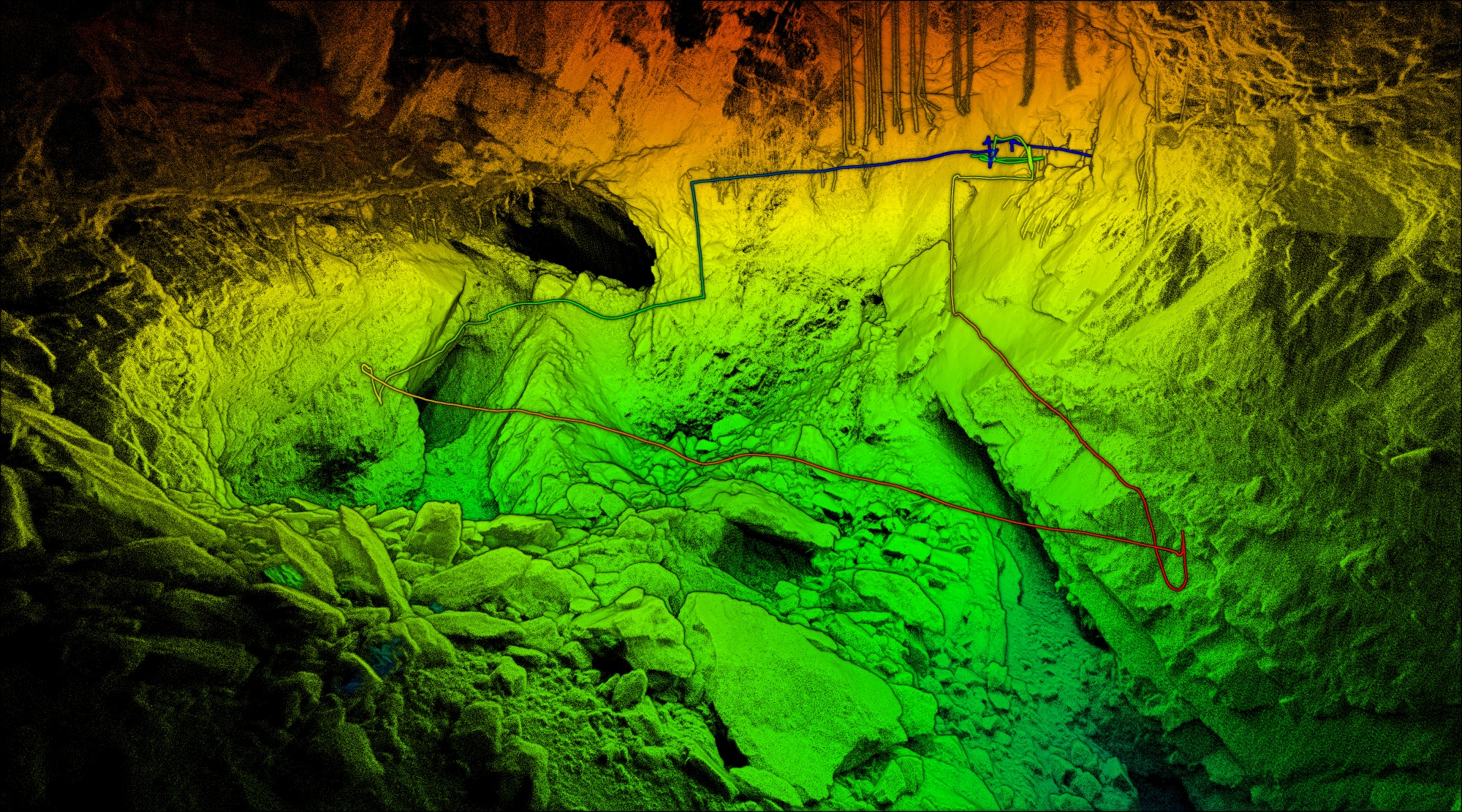
Data collected from a pass through a cave system.
“Just last week, actually, is when we left the building,” Hrabar noted. “We’ve raised the funding we need for 18 months of runway with no revenue. We really are already generating revenue, though.”
The $3.5 million (Australian) round comes largely from a new $200M CSIRO Innovation fund managed by Main Sequence Ventures. Hrabar suggested that another round might be warranted in a year or two when the company decides to scale and expand into other verticals.
DARPA will be making its own contribution after a fashion through its Subterranean Challenge, should (as seemly likely) Emesent achieve success in it (they’re already an approved participant). Hrabar was confident. “It’s pretty fortuitous,” he said. “We’ve been doing underground autonomy for years, and then DARPA announces this challenge on exactly what we’re doing.”
We’ll be covering the challenge and its participants separately. You can read more about Emesent at its website.
Powered by WPeMatico
HashiCorp, the company that has made hay developing open-source tools for managing cloud infrastructure, obviously has a pretty hefty commercial business going too. Today the company announced an enormous $100 million round on a unicorn valuation of $1.9 billion.
The round was led by IVP, whose investments include AppDynamics, Slack and Snap. Newcomer Bessemer Venture Partners joined existing investors GGV Capital, Mayfield, Redpoint Ventures and True Ventures in the round. Today’s investment brings the total raised to $179 million.
The company’s open-source tools have been downloaded 45 million times, according to data provided by the company. It has used that open-source base to fuel the business (as many have done before).
“Because practitioners choose technologies in the cloud era, we’ve taken an open source-first approach and partnered with the cloud providers to enable a common workflow for cloud adoption. Commercially, we view our responsibility as a strategic partner to the Global 2000 as they adopt hybrid and multi-cloud. This round of funding will help us accelerate our efforts,” company CEO Dave McJannet said in a statement.
To keep growing, it needs to build out its worldwide operations and that requires big bucks. In addition, as the company scales that means adding staff to beef up customer success, support and training teams. The company plans on making investments in these areas with the new funding.
HashiCorp launched in 2012. It was the brainchild of two college students, Mitchell Hashimoto and Armon Dadgar, who came up with the idea of what would become HashiCorp while they were still at the University of Washington. As I wrote in 2014 on the occasion of their $10 million Series A round:
After graduating and getting jobs, Hashimoto and Dadgar reunited in 2012 and launched HashiCorp. They decided to break their big problem down into smaller, more manageable pieces and eventually built the five open source tools currently on offer. In fact, they found as they developed each one, the community let them know about adjacent problems and they layered on each new tool to address a different need.
HashiCorp has continued to build on that early vision, layering on new tools over the years. It is not alone in building a business on top of open source and getting rewarded for their efforts. Just this morning, Neo4j, a company that built a business on top of its open-source graph database project, announced an $80 million Series E investment.
Powered by WPeMatico
UiPath is bringing automation to repetitive processes inside large organizations and it seems to have landed on a huge pain point. Today it announced a massive $225 million Series C on a $3 billion valuation.
The round was led by CapitalG and Sequoia Capital. Accel, which invested in the companies A and B rounds also participated. Today’s investment brings the total raised to $408 million, according to Crunchbase, and comes just months after a $153 million Series B we reported on last March. At that time, it had a valuation of over $1 billion, meaning the valuation has tripled in less than six months.
There’s a reason this company you might have never heard of is garnering this level of investment so quickly. For starters, it’s growing in leaps in bounds. Consider that it went from $1 million to $100 million in annual recurring revenue in under 21 months, according to the company. It currently has 1800 enterprise customers and claims to be adding 6 new ones a day, an astonishing rate of customer acquisition.
The company is part of the growing field of robotic process automation or RPA. While the robotics part of the name could be considered a bit of a misnomer, the software helps automate a series of mundane tasks that were typically handled by humans. It allows companies to bring a level of automation to legacy processes like accounts payable, employee onboarding, procurement and reconciliation without actually having to replace legacy systems.
Phil Fersht, CEO and chief analyst at HfS, a firm that watches the RPA market, says RPA isn’t actually that intelligent. “It’s about taking manual work, work-arounds and integrated processes built on legacy technology and finding way to stitch them together,” he told TechCrunch in an interview earlier this year.
It isn’t quite as simple as the old macro recorders that used to record a series of tasks and execute them with a keystroke, but it is somewhat analogous to that approach. Today, it’s more akin to a bot that may help you complete a task in Slack. RPA is a bit more sophisticated moving through a workflow in an automated fashion.
Ian Barkin from Symphony Ventures, a firm that used to do outsourcing, has embraced RPA. He says while most organizations have a hard time getting a handle on AI, RPA allows them to institute fundamental change around desktop routines without having to understand AI.
If you’re worrying about this technology replacing humans, it is somewhat valid, but Barkin says the technology is replacing jobs that most humans don’t enjoy doing. “The work people enjoy doing is exceptions and judgment based, which isn’t the sweet spot of RPA. It frees them from mundaneness of routine,” he said in an interview last year.
Whatever it is, it’s resonating inside large organizations and UiPath, is benefiting from the growing need by offering its own flavor of RPA. Today its customers include the likes of Autodesk, BMW Group and Huawei.
As it has grown over the last year, the number of employees has increased 3x and the company expects to reach 1700 employees by the end of the year.
Powered by WPeMatico