Automation
Auto Added by WPeMatico
Auto Added by WPeMatico
Power Automate is Microsoft’s platform for streamlining repetitive workflows — you may remember it under its original name: Microsoft Flow. The market for these robotic process automation (RPA) tools is hot right now, so it’s no surprise that Microsoft, too, is doubling down on its platform. Only a few months ago, the team launched Power Automate Desktop, based on its acquisition of Softomotive, which helps users automate workflows in legacy desktop-based applications, for example. After a short time in preview, Power Automate Desktop is now generally available.
The real news today, though, is that the team is also launching a new tool, the Process Advisor, which is now in preview as part of the Power Automate platform. This new process mining tool provides users with a new collaborative environment where developers and business users can work together to create new automations.
The idea here is that business users are the ones who know exactly how a certain process works. With Process Advisor, they can now submit recordings of how they process a refund, for example, and then submit that to the developers, who are typically not experts in how these processes usually work.
What’s maybe just as important is that a system like this can identify bottlenecks in existing processes where automation can help speed up existing workflows.
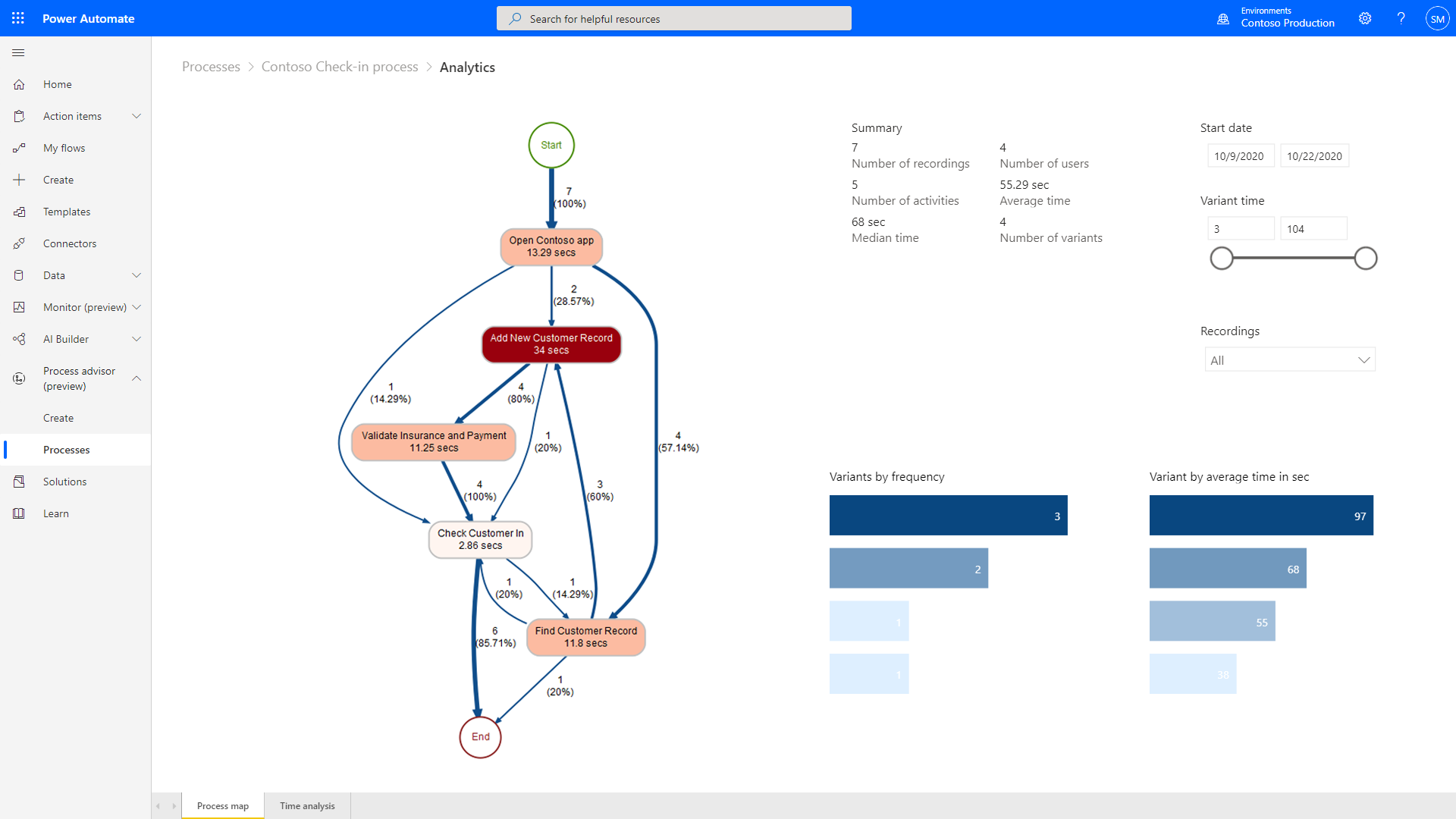
Image Credits: Microsoft
“This goes back to one of the things that we always talk about for Power Platform, which, it’s a corny thing, but it’s that development is a team sport,” Charles Lamanna, Microsoft’s corporate VP for its Low Code Application Platform, told me. “That’s one of our big focuses: how to bring people to collaborate and work together who normally don’t. This is great because it actually brings together the business users who live the process each and every day with a specialist who can build the robot and do the automation.”
The way this works in the backend is that Power Automate’s tools capture exactly what the users do and click on. All this information is then uploaded to the cloud and — with just five or six recordings — Power Automate’s systems can map how the process works. For more complex workflows, or those that have a lot of branches for different edge cases, you likely want more recordings to build out these processes, though.
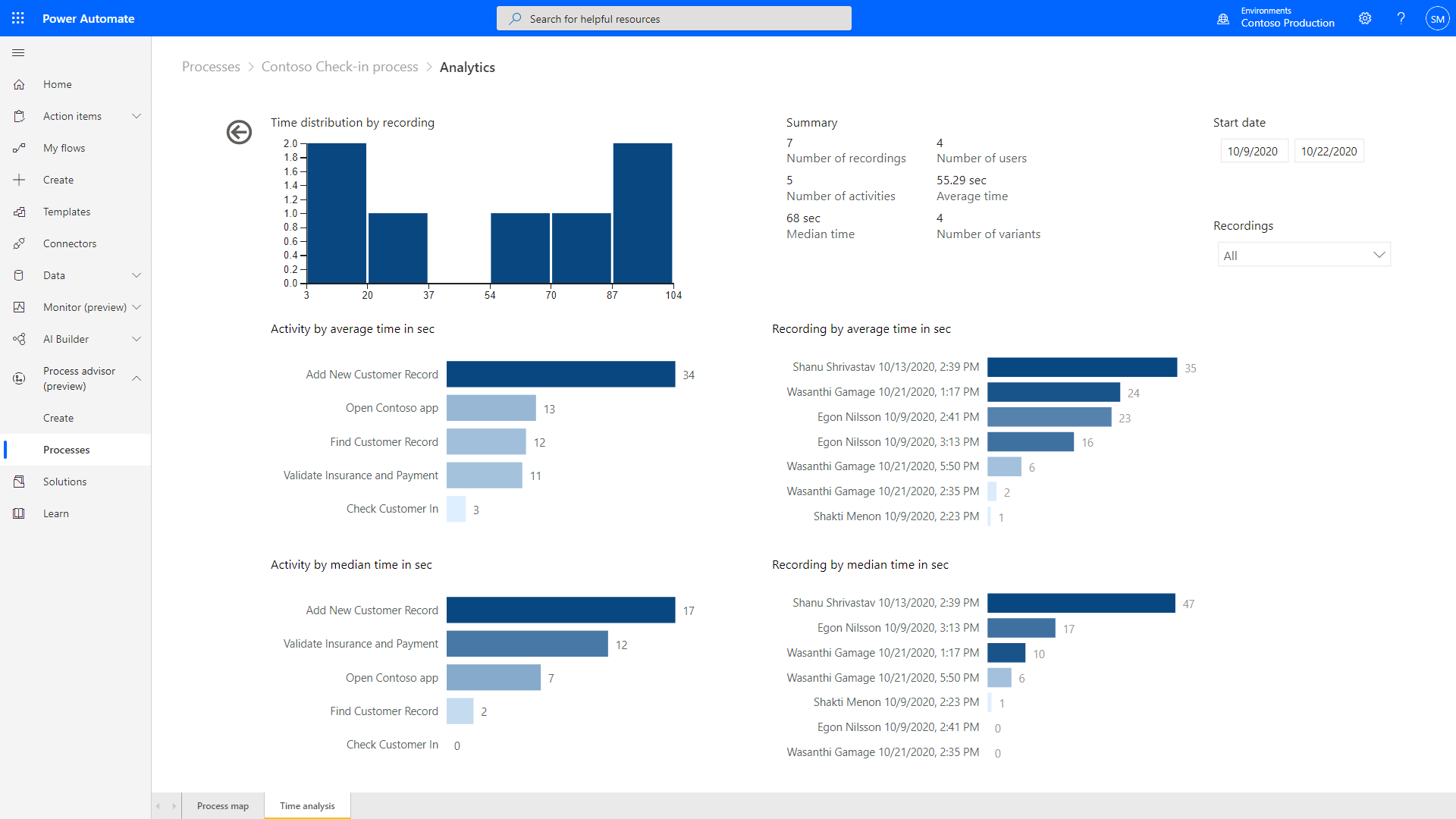
Image Credits: Microsoft
As Lamanna noted, building out these workflows and process maps can also help businesses better understand the ROI of these automations. “This kind of map is great to go build an automation on top of it, but it’s also great because it helps you capture the ROI of each automation you do because you’ll know for each step how long it took you,” Lamanna said. “We think that this concept of Process Advisor is probably going to be one of the most important engines of adoption for all these low-code/no-code technologies that are coming out. Basically, it can help guide you to where it’s worth spending the energy, where it’s worth training people, where it’s worth building an app, or using AI, or building a robot with our RPA like Power Automate.”
Lamanna likened this to the advent of digital advertising, which for the first time helped marketers quantify the ROI of advertising.
The new process mining capabilities in Power Automate are now available in preview.
Powered by WPeMatico
Residents of Shenzhen will see truly driverless cars on the road starting Thursday. AutoX, a four-year-old startup backed by Alibaba, MediaTek and Shanghai Motors, is deploying a fleet of 25 unmanned vehicles in downtown Shenzhen, marking the first time any autonomous driving car in China tests on public roads without safety drivers or remote operators.
The cars, meant as robotaxis, are not yet open to the public, an AutoX spokesperson told TechCrunch.
The milestone came just five months after AutoX landed a permit from California to start driverless tests, following in the footsteps of Waymo and Nuro.
It also indicates that China wants to bring its smart driving industry on par with the U.S. Cities from Shenzhen to Shanghai are competing to attract autonomous driving upstarts by clearing regulatory hurdles, touting subsidies and putting up 5G infrastructure.
As a result, each city ends up with its own poster child in the space: AutoX and Deeproute.ai in Shenzhen, Pony.ai and WeRide in Guangzhou, Momenta in Suzhou and Baidu’s Apollo fleet in Beijing, to name a few. The autonomous driving companies, in turn, work closely with traditional carmakers to make their vehicles smarter and more suitable for future transportation.
“We have obtained support from the local government. Shenzhen is making a lot of rapid progress on legislation for self-driving cars,” said the AutoX representative.
The decision to remove drivers from the front and operators from a remote center appears a bold move in one of China’s most populated cities. AutoX equips its vehicles with its proprietary vehicle control unit called XCU, which it claims has faster processing speed and more computational capability to handle the complex road scenarios in China’s cities.
“[The XCU] provides multiple layers of redundancy to handle this kind of situation,” said AutoX when asked how its vehicles will respond should the machines ever go rogue.
The company also stressed the experience it learned from “millions of miles” driven in China’s densest city centers through its 100 robotaxis in the past few years. Its rivals are also aggressively accumulating mileage to train their self-driving algorithms while banking sizable investments to fund R&D and pilot tests. AutoX itself, for instance, has raised more than $160 million to date.
Powered by WPeMatico
While Salesforce made a big splash yesterday with the announcement that it’s buying Slack for $27.7 billion, it’s not the only thing going on for the CRM giant this week. In fact, Dreamforce, the company’s customer extravaganza, is also on the docket. While it is virtual this year, there are still product announcements aplenty, and today the company announced Einstein Automate, a new AI-fueled set of workflow solutions.
Sarah Franklin, EVP & GM of Platform, Trailhead and AppExchange at Salesforce, says that she is seeing companies facing a digital imperative to automate processes as things move ever more quickly online, being driven there even faster by the pandemic. “With Einstein Automate, everyone can change the speed of work and be more productive through intelligent workflow automation,” she said in a statement.
Brent Leary, principal analyst at CRM Essentials, says that combined, these tools are designed to help customers get to work more quickly. “It’s not only about identifying the insight, it’s about making it easier to leverage it at the right time. And this should make it easier for users to do it without spending more time and effort,” Leary told TechCrunch.
Einstein is the commercial name given to Salesforce’s artificial intelligence platform that touches every aspect of the company’s product line, bringing automation to many tasks and making it easier to find the most valuable information on customers, which is often buried in an avalanche of data.
Einstein Automate encompasses several products designed to improve workflows inside organizations. For starters, the company has created Flow Orchestrator, a tool that uses a low-code, drag and drop approach for building workflows, but it doesn’t stop there. It also relies on AI to provide help to suggest logical next steps to speed up workflow creation.
Salesforce is also bringing into the mix MuleSoft, the integration company it bought for $6.5 billion in 2018. Instead of processes like a mortgage approval workflow, the MuleSoft piece lets IT build complex integrations between applications across the enterprise and the Salesforce family of products more easily.
To make it easier to build these workflows, Salesforce is announcing the Einstein Automate collection page available in AppExchange, the company’s application marketplace. The collection includes more than 700 pre-built connectors so customers can grab and go as they build these workflows, and finally it’s updating the OmniStudio, their platform for generating customer experiences. As Salesforce describes it, “Included in OmniStudio is a suite of resources and no-code tools, including pre-built guided experiences, templates and more, allowing users to deploy digital-first experiences like licensing and permit applications quickly and with ease.”
Per usual with Salesforce Dreamforce announcements, the Flow Orchestrator being announced today won’t be available in beta until next summer. The MuleSoft component will be available in early 2021, but the OmniStudio updates and the Einstein connections collection are available today.
Powered by WPeMatico
A few weeks ago, I bought a used paperback mystery for $3 via a small online bookseller. Intrigued that the book came with free shipping, I dug in a bit and was shocked to see that my little impulse purchase traveled through seven different distribution hubs across five states before it got to me. It was loaded and unloaded onto trucks in Indiana, Illinois, Colorado, Nevada and finally California and handled by an unknown number of logistics workers along the way, many of them in the middle of the night.
The logistics of getting the book to me, and the human toll it takes, are mind boggling, but we have become somewhat inured to them.
COVID-19 lockdowns have put a spotlight on the importance and complexity of supply chain dynamics. In a world shaped by the pandemic, our reliance on e-commerce for everything from PPE to toilet paper to hard-boiled paperback mysteries has exploded. A recent report from Adobe found that total online spending is up 77% year-over-year, accelerating growth by “four to six years.” That growth has a very real human cost, and one that we don’t think about or act on enough as a society.
While people recognize the contributions of frontline workers they can see like doctors and nurses, postal carriers and grocery store workers, there’s an entire hidden infrastructure of logistics workers that keeps the online economy humming. These workers are also on the frontlines, but they are behind the scenes. Most earn minimum wage and work long, grueling, high-stress shifts without strong protections in the event they get sick or injured. The fact is that many corporations haven’t made protections for those workers a priority. That was true before COVID-19, but the pandemic gave the issue a renewed urgency, prompting workers from Amazon, Walmart, Target and FedEx, among others, to organize walkouts. And with unprecedented levels of unemployment, more and more people are going to find jobs in the logistics sector.
This Labor Day, it’s time to think about how corporations can better support and protect this vital but often forgotten segment of the workforce.
Imagine there’s a package handler at a major manufacturer named Jack who spends his shifts heaving heavy boxes onto a conveyor belt. It’s an arduous movement that Jack will repeat a few thousand times before he punches out. As a 10-year veteran on the job, Jack has performed this singular task on this same warehouse floor more times than he can count. On this particular night, he’s tired after staying up late playing with his kids, and he slips a disk in his back. Unfortunately, Jack’s plight is all too often a reality for millions of workers today.
According to the Bureau of Labor Statistics, 5% of warehouse workers in the U.S. experience an injury on the job each year—higher than the national average. After service workers, like firefighters and police, transportation/shipping and manufacturing/production rank second and third as the occupations with the largest number of workplace injuries resulting in days away from work. Jobs that involve heavy lifting, arduous repetition and operating complex machinery come with serious risk.
Injuries can be devastating for workers, both physically and financially. Taking time off work can not only result in lost wages, but also drive people into debt due to health-related expenses, creating health-poverty traps that are difficult to climb out of. Worker injuries are also costly for employers. A study from Liberty Mutual, using data from the U.S. Bureau of Labor Statistics and the National Academy of Social Insurance, found that serious, nonfatal injuries cost $84.04 million a week in the transportation and warehousing industry. It is in corporations’ best interest to prioritize workplace safety.
One challenge is that traditional approaches to workplace safety are slow, inaccurate and costly. Without practical interventions, organizations spend an estimated $2,000+ per worker annually on injury prevention. Within manufacturing and logistics industries, it costs an additional $2,000+ annually for workers’ compensation per full-time employee. Currently, there is no standard solution to preventing workplace injuries while lowering costs, leaving workers like Jack without adequate protections. Fortunately, digital platforms and tools that leverage technological innovation, including sensors and wearables, are advancing new ways to prevent workplace accidents and injuries.
Take for example StrongArm, one of Flourish’s portfolio companies. StrongArm has built a technology platform that integrates a new generation of industrial wearables, big data analytics and smart algorithms. It is designed to modernize industry dynamics for workers, employers and workers’ compensation insurers. The company’s GDPR-compliant wearable hardware devices and data platform called FUSE deliver real-time injury prevention feedback and collect data to support precise interventions for overall injury reduction and has reduced injury rates by more than 40% year-over-year for its clients.
StrongArm has also helped keep workers safe during the pandemic by launching a new suite of capabilities on its FUSE platform, including CDC communication, proximity alerts (i.e., notifications to workers within six feet of one another), and exposure analysis (understanding who has interacted with whom, at what time, and for what duration, exposing any potential contact transfer with accuracy). These enhanced capabilities can get workers back to work faster, earning vitally needed income while reducing COVID-19 risk by 95%.
Fetch Robotics is another company using technological innovation and digital platforms to promote worker safety. Fetch makes an Autonomous Mobile Robot (AMR) that can transport materials within warehouses, factories and distribution centers while also gathering environmental data. This can relieve the burden of heavy lifting from human workers and ensure that conditions, like heat, remain safe in work environments. In June 2020, the company announced that it was launching a disinfecting AMR that can decontaminate spaces larger than 100,000 square feet in 1.5 hours, helping workers stay safe and get back to work quicker amid the spread of the virus.
In its report titled, “The Impact of COVID-19 on Tech Innovation,” Lux Research found that the outbreak of COVID-19 will likely push corporations with major manufacturing and logistics operations to assess the potential of robotics. More companies will explore how they can automate processes, particularly those that are repeatable and predictable. Findings like these inevitably lead to questions about how increased automation will impact workers — the eternal “will robots take all the jobs?” question. However, we are still a long way away from a world where human workers are obsolete (just ask Elon Musk).
Robots are still not good at picking up small or oddly shaped objects, for instance. For the foreseeable future, corporations will depend on logistics workers and have a responsibility to protect the safety of those workers. It’s not enough to plaster the required OSHA sign on the factory or warehouse floor. Corporations need to do more. Fortunately in this case, the right thing to do is the good thing to do. By embracing technological innovation, promoting worker safety is a win-win.
Powered by WPeMatico
Today, the U.S. exceeded three million COVID-19 cases and 132,000 deaths. In several states, new hotspots have rolled back plans to reopen businesses. The novel coronavirus has — and will continue — to profoundly impact the way we live and work.
For the moment, that includes a shift in the employment status of many Americans. More than 50 million people have filed for unemployment since mid-March. And while many states have made efforts to reopen businesses and return some sense of normality, these moves have led to a spike in cases and may prolong the pandemic and its ongoing economic impact.
Technology has been a lifeline for many, from food delivery to the 3D printing I highlighted last week, which has worked to address a nation suffering from personal protective equipment shortages. Automation and robotics have also been a constant in conversations around tech’s battle against COVID-19.
Robots don’t get sick, tired or emotionally burnt out, and unlike us, they aren’t walking, talking disease vectors. Automation advocates like to point to the “three Ds” of dull, dirty and dangerous jobs that will eventually be replaced by a robotic workforce, but in the age of COVID-19, nearly any essential job qualifies.
The robotic invasion has already begun in earnest. The service, delivery, health care and sanitation industries in particular have all opened a massive gap over the past several months that automation has been more than happy to roll right through. A recent report from The Brookings Institute notes that automation arrives in the workforce in fits and starts — most notably, during times of economic downturn.
“Robots’ infiltration of the workforce doesn’t occur at a steady, gradual pace. Instead, automation happens in bursts, concentrated especially in bad times such as in the wake of economic shocks, when humans become relatively more expensive as firms’ revenues rapidly decline,” the study found. “At these moments, employers shed less-skilled workers and replace them with technology and higher-skilled workers, which increases labor productivity as a recession tapers off.”
Powered by WPeMatico
Four years ago, mathematician Vlad Voroninski saw an opportunity to remove some of the bottlenecks in the development of autonomous vehicle technology thanks to breakthroughs in deep learning.
Now, Helm.ai, the startup he co-founded in 2016 with Tudor Achim, is coming out of stealth with an announcement that it has raised $13 million in a seed round that includes investment from A.Capital Ventures, Amplo, Binnacle Partners, Sound Ventures, Fontinalis Partners and SV Angel. More than a dozen angel investors also participated, including Berggruen Holdings founder Nicolas Berggruen, Quora co-founders Charlie Cheever and Adam D’Angelo, professional NBA player Kevin Durant, Gen. David Petraeus, Matician co-founder and CEO Navneet Dalal, Quiet Capital managing partner Lee Linden and Robinhood co-founder Vladimir Tenev, among others.
Helm.ai will put the $13 million in seed funding toward advanced engineering and R&D and hiring more employees, as well as locking in and fulfilling deals with customers.
Helm.ai is focused solely on the software. It isn’t building the compute platform or sensors that are also required in a self-driving vehicle. Instead, it is agnostic to those variables. In the most basic terms, Helm.ai is creating software that tries to understand sensor data as well as a human would, in order to be able to drive, Voroninski said.
That aim doesn’t sound different from other companies. It’s Helm.ai’s approach to software that is noteworthy. Autonomous vehicle developers often rely on a combination of simulation and on-road testing, along with reams of data sets that have been annotated by humans, to train and improve the so-called “brain” of the self-driving vehicle.
Helm.ai says it has developed software that can skip those steps, which expedites the timeline and reduces costs. The startup uses an unsupervised learning approach to develop software that can train neural networks without the need for large-scale fleet data, simulation or annotation.
“There’s this very long tail end and an endless sea of corner cases to go through when developing AI software for autonomous vehicles, Voroninski explained. “What really matters is the unit of efficiency of how much does it cost to solve any given corner case, and how quickly can you do it? And so that’s the part that we really innovated on.”
Voroninski first became interested in autonomous driving at UCLA, where he learned about the technology from his undergrad adviser who had participated in the DARPA Grand Challenge, a driverless car competition in the U.S. funded by the Defense Advanced Research Projects Agency. And while Voroninski turned his attention to applied mathematics for the next decade — earning a PhD in math at UC Berkeley and then joining the faculty in the MIT mathematics department — he knew he’d eventually come back to autonomous vehicles.
By 2016, Voroninski said breakthroughs in deep learning created opportunities to jump in. Voroninski left MIT and Sift Security, a cybersecurity startup later acquired by Netskope, to start Helm.ai with Achim in November 2016.
“We identified some key challenges that we felt like weren’t being addressed with the traditional approaches,” Voroninski said. “We built some prototypes early on that made us believe that we can actually take this all the way.”
Helm.ai is still a small team of about 15 people. Its business aim is to license its software for two use cases — Level 2 (and a newer term called Level 2+) advanced driver assistance systems found in passenger vehicles and Level 4 autonomous vehicle fleets.
Helm.ai does have customers, some of which have gone beyond the pilot phase, Voroninski said, adding that he couldn’t name them.
Powered by WPeMatico
Got your sights set on attending TC Sessions: Mobility 2020 on May 14 in San Jose? Spend the day with 1,000 or more like-minded founders, makers and leaders across the startup ecosystem. It’s a day-long deep dive dedicated to current and evolving mobility and transportation tech. Think autonomous vehicles, micromobility, AI-based mobility applications, battery tech and so much more.
Hold up. Don’t have a ticket yet? Buy your early-bird pass and save $100.
In addition to taking in all the great speakers (more added every week), presentations, workshops and demos, you’ll want to meet people and build the relationships that foster startup success. Get ready for a radical network experience with CrunchMatch. TechCrunch’s free business-matching platform makes finding and connecting with the right people easier than ever. It’s both curated and automated, a potent combination that makes networking simple and productive. Hey needle, kiss that haystack goodbye.
Here’s how it works.
When CrunchMatch launches, we’ll email all registered attendees. Create a profile, identify your role and list your specific criteria, goals and interests. Whomever you want to meet — investors, founders or engineers specializing in autonomous cars or ride-hailing apps. The CrunchMatch algorithm kicks into gear and suggests matches and, subject to your approval, proposes meeting times and sends meeting requests.
CrunchMatch benefits everyone — founders looking for developers, investors in search of hot prospects, founders looking for marketing help — the list is endless, and the tool is free.
You have one programming-packed day to soak up everything this conference offers. Start strategizing now to make the most of your valuable time. CrunchMatch will help you cut through the crowd and network efficiently so that you have time to learn about the latest tech innovations and still connect with people who can help you reach the next level.
TC Sessions: Mobility 2020 takes place on May 14 in San Jose, Calif. Join, meet and learn from the industry’s mightiest minds, makers, innovators and investors. And let CrunchMatch make your time there much easier and more productive. Buy your early-bird ticket, and we’ll see you in San Jose!
Is your company interested in sponsoring or exhibiting at TC Sessions: Mobility 2020? Contact our sponsorship sales team by filling out this form.
Powered by WPeMatico
Robotics startup company Soft Robotics has closed its Series B round of funding, raising $23 million led by Calibrate Ventures and Material Impact, and including participation from exiting investors including Honeywell, Yahama, Hyperplane and more. This round also brings in FANUC, the world’s largest maker of industrial robots and a recently announced strategic partner for Soft Robotics .
The company said in a press release announcing this latest round of funding that the round was oversubscribed, which suggests it isn’t looking to glut itself on capital investors, given that this $23 million follows a similarly sized $20 million round that closed in 2018 which it also referred to as “oversubscribed.” Prior to that, Soft Robotics had raised $5 million in a Series A round closed in 2015. It has plenty of large, global clients already, so it’s probably not hurting for revenue.
Soft Robotics is focused on developing robotic grippers that, as you might’ve guessed from the name, make use of soft material endpoints that can more easily grip a range of different objects without the kind of extremely specific and tolerance-allergic complex programming that’s required for most traditional industrial robotic claws.
With its 2018 funding raise, Soft Robotics said that it was expanding further into food and beverage, as well as doubling down on its presence in the retail and logistics industries. This round and its new partnership with FANUC (which involves a new integrated system that pairs its mGrip robotic gripper with a new Mini-P controller, all with simple integration to FANUC’s existing lineup of industrial robots) will give it strategic and functional access to what is the most influenentioal industrial robotics company in the world.
This round will specifically help Soft Robotics spend on growth, looking to increase its variability even further and work on expanding its food packaging and consumer goods applications, as well as diving into e-commerce and logistics – specifically to help automate and improve the returns process, a costly and ever-growing challenge as more retail moves online.
Powered by WPeMatico
The phrase “pull yourself up by your own bootstraps” was originally meant sarcastically.
It’s not actually physically possible to do — especially while wearing Allbirds and having just fallen off a Bird scooter in downtown San Francisco, but I should get to my point.
This week, Ken Cuccinelli, the acting Director of the United States Citizenship and Immigrant Services Office, repeatedly referred to the notion of bootstraps in announcing shifts in immigration policy, even going so far as to change the words to Emma Lazarus’s famous poem “The New Colossus:” no longer “give me your tired, your poor, your huddled masses yearning to breathe free,” but “give me your tired and your poor who can stand on their own two feet, and who will not become a public charge.”
We’ve come to expect “alternative facts” from this administration, but who could have foreseen alternative poems?
Still, the concept of ‘bootstrapping’ is far from limited to the rhetorical territory of the welfare state and social safety net. It’s also a favorite term of art in Silicon Valley tech and venture capital circles: see for example this excellent (and scary) recent piece by my editor Danny Crichton, in which young VC firms attempt to overcome a lack of the startup capital that is essential to their business model by creating, as perhaps an even more essential feature of their model, impossible working conditions for most everyone involved. Often with predictably disastrous results.
It is in this context of unrealistic expectations about people’s labor, that I want to introduce my most recent interviewee in this series of in-depth conversations about ethics and technology.
Mary L. Gray is a Fellow at Harvard University’s Berkman Klein Center for Internet and Society and a Senior Researcher at Microsoft Research. One of the world’s leading experts in the emerging field of ethics in AI, Mary is also an anthropologist who maintains a faculty position at Indiana University. With her co-author Siddharth Suri (a computer scientist), Gray coined the term “ghost work,” as in the title of their extraordinarily important 2019 book, Ghost Work: How to Stop Silicon Valley from Building a New Global Underclass.

Image via Mary L. Gray / Ghostwork / Adrianne Mathiowetz Photography
Ghost Work is a name for a rising new category of employment that involves people scheduling, managing, shipping, billing, etc. “through some combination of an application programming interface, APIs, the internet and maybe a sprinkle of artificial intelligence,” Gray told me earlier this summer. But what really distinguishes ghost work (and makes Mary’s scholarship around it so important) is the way it is presented and sold to the end consumer as artificial intelligence and the magic of computation.
In other words, just as we have long enjoyed telling ourselves that it’s possible to hoist ourselves up in life without help from anyone else (I like to think anyone who talks seriously about “bootstrapping” should be legally required to rephrase as “raising oneself from infancy”), we now attempt to convince ourselves and others that it’s possible, at scale, to get computers and robots to do work that only humans can actually do.
Ghost Work’s purpose, as I understand it, is to elevate the value of what the computers are doing (a minority of the work) and make us forget, as much as possible, about the actual messy human beings contributing to the services we use. Well, except for the founders, and maybe the occasional COO.
Facebook now has far more employees than Harvard has students, but many of us still talk about it as if it were little more than Mark Zuckerberg, Cheryl Sandberg, and a bunch of circuit boards.
But if working people are supposed to be ghosts, then when they speak up or otherwise make themselves visible, they are “haunting” us. And maybe it can be haunting to be reminded that you didn’t “bootstrap” yourself to billions or even to hundreds of thousands of dollars of net worth.
Sure, you worked hard. Sure, your circumstances may well have stunk. Most people’s do.
But none of us rise without help, without cooperation, without goodwill, both from those who look and think like us and those who do not. Not to mention dumb luck, even if only our incredible good fortune of being born with a relatively healthy mind and body, in a position to learn and grow, here on this planet, fourteen billion years or so after the Big Bang.
I’ll now turn to the conversation I recently had with Gray, which turned out to be surprisingly more hopeful than perhaps this introduction has made it seem.
Greg Epstein: One of the most central and least understood features of ghost work is the way it revolves around people constantly making themselves available to do it.
Mary Gray: Yes, [What Siddarth Suri and I call ghost work] values having a supply of people available, literally on demand. Their contributions are collective contributions.
It’s not one person you’re hiring to take you to the airport every day, or to confirm the identity of the driver, or to clean that data set. Unless we’re valuing that availability of a person, to participate in the moment of need, it can quickly slip into ghost work conditions.
Powered by WPeMatico

As I wrote for TechCrunch recently, immigration is not an issue always associated with tech — not even when thinking about the ethics of technology, as I do here.
So when I was moved to tears a few weeks ago, on seeing footage of groups of 18 Jewish protestors link arms to block the entrances to ICE detention facilities, bearing banners reading “Never Again” in reference to the Holocaust — these mostly young women risking their physical freedom and safety to try to help the children this country’s immigration service is placing in concentration camps today, one of my first thoughts was: I can’t cover that for my TechCrunch column. It’s about ethics of course, but not about tech.
It turns out that wasn’t correct. Immigration is a tech issue. In fact, companies such as Wayfair (furniture), Amazon (web services), and Palantir (the software used to track undocumented immigrants) have borne heavy criticism for their support of and partnership with ICE’s efforts under the current administration.
And as I discussed earlier this month with Jaclyn Friedman, a leading sex ethics expert and one of the ICE protestors arrested in a major demonstration in Boston, social media technology has been instrumental in building and amplifying those protests.
But there’s more. IBM, for example, has an unfortunate and dark history of support for Nazi extermination efforts, and many recent commentators have drawn parallels between what IBM did during the Holocaust and what companies like Palantir are beginning to do now.

Dozens of protestors huddle in the rain outside Palantir HQ.
I say “companies,” plural, with intention: immigrant advocacy organization Mijente recently released news that Anduril, the company founded by Palmer Luckey and composed of Palantir veterans, now has a $13.5 million contract with the Marine corps for their autonomous surveillance “Lattice” towers at four different USMC bases, including one border base. Documents procured via the Freedom of Information Act show the Marines mention “the intrusion dilemma” in their justification for choosing Anduril.
So now it seems the kinds of surveillance tech we know are badly biased at best — facial recognition? Panopticon-style observation? Algorithms of various other kinds — will be put to work by the most powerful fighting force ever designed, for expanded intervention into our immigration system.
Will the Silicon Valley elite say “no”? To what extent will new protests emerge, where the sorts of people likely to be reading this writing might draw a line and make work more difficult for their peers at places like Anduril?
Maybe the problem, however, is that most of us think of immigration ethics as an issue that might touch on a small handful of particularly libertarian-leaning tech companies, but surely it doesn’t go beyond that, right? Can’t the average techie in San Francisco or elsewhere safely and accurately say these problems don’t actually implicate them?
Turns out that’s not right either.
Which is why I had to speak this week with Cornell University historian Louis Hyman. Hyman is a Professor at Cornell’s School of Industrial and Labor Relations, and Director of the ILR’s Institute for Workplace Studies, in New York. In our conversation, Hyman and I dig into Silicon Valley’s history with labor rights, startup work structures and the role of immigration in the US tech ecosystem. Beyond that, I’ll let him introduce himself and his extraordinary work, below.

Louis Hyman. (Image by Jesse Winter)
Greg Epstein: I discovered your work via a piece you wrote in the Washington Post, which drew from your 2018 book, Temp: How American Work, American Business, and the American Dream Became Temporary. In it, you wrote, “Undocumented workers have been foundational to the rise of our most vaunted hub of innovative capitalism: Silicon Valley.”
And in the book itself, you write at one point, “To understand the electronics industry is simple: every time someone says “robot,” simply picture a woman of color. Instead of self-aware robots, workers—all women, mostly immigrants, sometimes undocumented—hunched over tables with magnifying glasses assembling parts, sometimes on a factory line and sometimes on a kitchen table. Though it paid a lot of lip service to automation, Silicon Valley truly relied upon a transient workforce of workers outside of traditional labor relations.”
Can you just give us a brief introduction to the historical context behind these kinds of comments?
Louis Hyman: Sure. One of the key questions all of us ask is why is there only one Silicon Valley. There are different answers for that.
Powered by WPeMatico