Automation
Auto Added by WPeMatico
Auto Added by WPeMatico
Work insights platform Fin raised $20 million in Series A funding and brought in Evan Cummack, a former Twilio executive, as its new chief executive officer.
The San Francisco-based company captures employee workflow data from across applications and turns it into productivity insights to improve the way enterprise teams work and remain engaged.
Fin was founded in 2015 by Andrew Kortina, co-founder of Venmo, and Facebook’s former VP of product and Slow Ventures partner Sam Lessin. Initially, the company was doing voice assistant technology — think Alexa but powered by humans and machine learning — and then workplace analytics software in 2020. You can read more about Fin’s origins at the link below.
The new round was led by Coatue, with participation from First Round Capital, Accel and Kleiner Perkins. The original team was talented, but small, so the new funding will build out sales, marketing and engineering teams, Cummack said.
“At that point, the right thing was to raise money, so at the end of last year, the company raised a $20 million Series A, and it was also decided to find a leadership team that knows how to build an enterprise,” Cummack told TechCrunch. “The company had completely pivoted and removed ‘Analytics’ from our name because it was not encompassing what we do.”
Fin’s software measures productivity and provides insights on ways managers can optimize processes, coach their employees and see how teams are actually using technology to get their work done. At the same time, employees are able to manage their workflow and highlight areas where there may be bottlenecks. All combined, it leads to better operations and customer experiences, Cummack said.
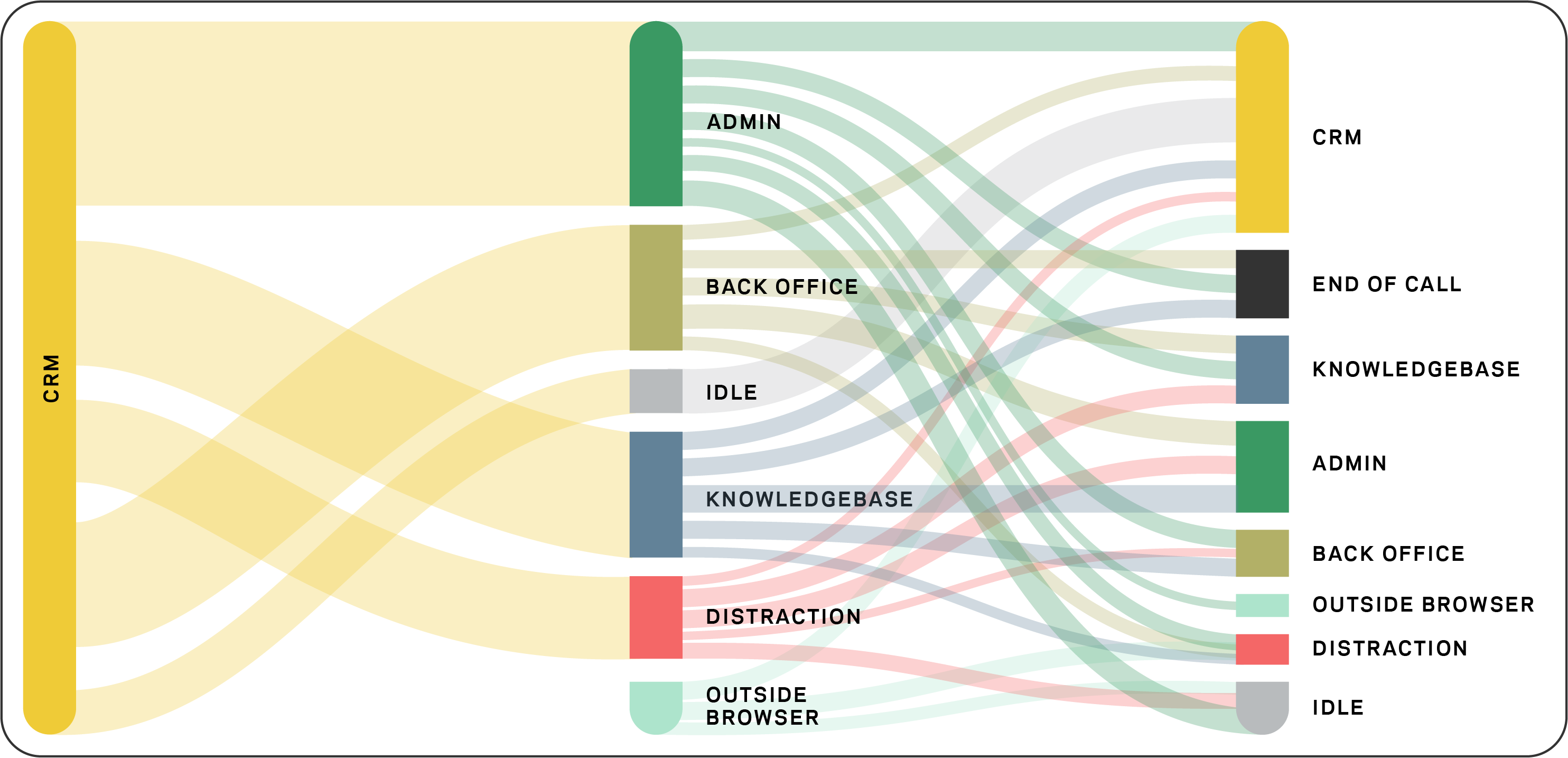
Graphic showing how work is really done. Image Credits: Fin
Fin’s view is that as more automation occurs, the company is looking at a “renaissance of human work.” There will be more jobs and more types of jobs, but people will be able to do them more effectively and the work will be more fulfilling, he added.
Particularly with the use of technology, he notes that in the era before cloud computing, there was a small number of software vendors. Now with the average tech company using over 130 SaaS apps, it allows for a lot of entrepreneurs and adoption of best-in-breed apps so that a viable company can start with a handful of people and leverage those apps to gain big customers.
“It’s different for enterprise customers, though, to understand that investment and what they are spending their money on as they use tools to get their jobs done,” Cummack added. “There is massive pressure to improve the customer experience and move quickly. Now with many people working from home, Fin enables you to look at all 130 apps as if they are one and how they are being used.”
As a result, Fin’s customers are seeing metrics like 16% increase in team utilization and engagement, a 25% decrease in support ticket handle time and a 71% increase in policy compliance. Meanwhile, the company itself is doubling and tripling its customers and revenue each year.
Now with leadership and people in place, Cummack said the company is positioned to scale, though it already had a huge head start in terms of a meaningful business.
Arielle Zuckerberg, partner at Coatue, said via email that she was part of a previous firm that invested in Fin’s seed round to build a virtual assistant. She was also a customer of Fin Assistant until it was discontinued.
When she heard the company was pivoting to enterprise, she “was excited because I thought it was a natural outgrowth of the previous business, had a lot of potential and I was already familiar with management and thought highly of them.”
She believed the “brains” of the company always revolved around understanding and measuring what assistants were doing to complete a task as a way to create opportunities for improvement or automation. The pivot to agent-facing tools made sense to Zuckerberg, but it wasn’t until the global pandemic that it clicked.
“Service teams were forced to go remote overnight, and companies had little to no visibility into what people were doing working from home,” she added. “In this remote environment, we thought that Fin’s product was incredibly well-suited to address the challenges of managing a growing remote support team, and that over time, their unique data set of how people use various apps and tools to complete tasks can help business leaders improve the future of work for their team members. We believe that contact center agents going remote was inevitable even before COVID, but COVID was a huge accelerant and created a compelling ‘why now’ moment for Fin’s solution.”
Going forward, Coatue sees Fin as “a process mining company that is focused on service teams.” By initially focusing on customer support and contact center use case — a business large enough to support a scaled, standalone business — rather than joining competitors in going after Fortune 500 companies where implementation cycles are long and there is slow time-to-value, Zuckerberg said Fin is better able to “address the unique challenges of managing a growing remote support team with a near-immediate time-to-value.”
Powered by WPeMatico
As artificial intelligence continues to weave its way into more enterprise applications, a startup that has built a platform to help businesses, especially non-tech organizations, build more customized AI decision-making tools for themselves has picked up some significant growth funding. Peak AI, a startup out of Manchester, England, that has built a “decision intelligence” platform, has raised $75 million, money that it will be using to continue building out its platform, expand into new markets and hire some 200 new people in the coming quarters.
The Series C is bringing a very big name investor on board. It is being led by SoftBank Vision Fund 2, with previous backers Oxx, MMC Ventures, Praetura Ventures and Arete also participating. That group participated in Peak’s Series B of $21 million, which only closed in February of this year. The company has now raised $119 million; it is not disclosing its valuation.
(This latest funding round was rumored last week, although it was not confirmed at the time and the total amount was not accurate.)
Richard Potter, Peak’s CEO, said the rapid follow-on in funding was based on inbound interest, in part because of how the company has been doing.
Peak’s so-called Decision Intelligence platform is used by retailers, brands, manufacturers and others to help monitor stock levels and build personalized customer experiences, as well as other processes that can stand to have some degree of automation to work more efficiently, but also require sophistication to be able to measure different factors against each other to provide more intelligent insights. Its current customer list includes the likes of Nike, Pepsico, KFC, Molson Coors, Marshalls, Asos and Speedy, and in the last 12 months revenues have more than doubled.
The opportunity that Peak is addressing goes a little like this: AI has become a cornerstone of many of the most advanced IT applications and business processes of our time, but if you are an organization — and specifically one not built around technology — your access to AI and how you might use it will come by way of applications built by others, not necessarily tailored to you, and the costs of building more tailored solutions can often be prohibitively high. Peak claims that those using its tools have seen revenues on average rise 5%, return on ad spend double, supply chain costs reduce by 5% and inventory holdings (a big cost for companies) reduce by 12%.
Peak’s platform, I should point out, is not exactly a “no-code” approach to solving that problem — not yet at least: It’s aimed at data scientists and engineers at those organizations so that they can easily identify different processes in their operations where they might benefit from AI tools, and to build those out with relatively little heavy lifting.
There have also been different market factors that have played a role. COVID-19, for example, and the boost that we have seen both in increasing “digital transformation” in businesses and making e-commerce processes more efficient to cater to rising consumer demand and more strained supply chains have all led to businesses being more open and keen to invest in more tools to improve their automation intelligently.
This, combined with Peak AI’s growing revenues, is part of what interested SoftBank. The investor has been long on AI for a while; but it also has been building out a section of its investment portfolio to provide strategic services to the kinds of businesses in which it invests.
Those include e-commerce and other consumer-facing businesses, which make up one of the main segments of Peak’s customer base.
Notably, one of its recent investments specifically in that space was made earlier this year, also in Manchester, when it took a $730 million stake (with potentially $1.6 billion more down the line) in The Hut Group, which builds software for and runs D2C businesses.
“In Peak we have a partner with a shared vision that the future enterprise will run on a centralized AI software platform capable of optimizing entire value chains,” Max Ohrstrand, senior investor for SoftBank Investment Advisers, said in a statement. “To realize this a new breed of platform is needed and we’re hugely impressed with what Richard and the excellent team have built at Peak. We’re delighted to be supporting them on their way to becoming the category-defining, global leader in Decision Intelligence.”
It’s not clear that SoftBank’s two Manchester interests will be working together, but it’s an interesting synergy if they do, and most of all highlights one of the firm’s areas of interest.
Longer term, it will be interesting to see how and if Peak evolves to extend its platform to a wider set of users at the organizations that are already its customers.
Potter said he believes that “those with technical predispositions” will be the most likely users of its products in the near and medium term. You might assume that would cut out, for example, marketing managers, although the general trend in a lot of software tools has precisely been to build versions of the same tools used by data scientists for these less technical people to engage in the process of building what it is that they want to use.
“I do think it’s important to democratize the ability to stream data pipelines, and to be able to optimize those to work in applications,” Potter added.
Powered by WPeMatico
With COVID-19 disrupting the entire manufacturing supply chain including semiconductor shortages, companies across multiple industries have been struggling to seek a procurement solution that can rebalance the gap between supply and demand.
CADDi, a Tokyo-based B2B ordering and supply platform in the manufacturing and procurement industry, helps both procurement (demand side) and manufacturing facilities (supply side) by aggregating and rebalancing supply and demand via its automated calculation system for manufacturing costs and databases of fabrication facilities across Japan.
The company announced this morning a $73 million Series B round co-led by Globis Capital Partners and World Innovation Lab (WiL), with participation from existing investors DCM and Global Brain. Six new investors also have joined the round including Arena Holdings, DST Global, Minerva Growth Partners, Tybourne Capital Management, JAFCO Group and SBI Investment.
CADDi was founded by CEO Yushiro Kato and CTO Aki Kobashi in November 2017.
The post-money valuation is estimated at $450 million, according to sources close to the deal.
The new funding brings CADDi’s total raised so far to $90.5 million. In December 2018, the company closed a $9 million Series A round led by DCM and followed by Globis Capital Partners and WiL and Global Brain.
The funding proceeds will be used for accelerating digital transformation of the platform, hiring and expanding to global markets.
“We enable integrated production of complete sets of equipment consisting of custom-made parts such as sheet metal, machined parts and structural frames. Using an automatic quotation system based on a proprietary cost calculation algorithm, we select the processing company that best matches the quality, delivery date and price of the order and build an optimal supply chain,” CEO and co-founder Yushiro Kato said.
The goal of CADDi’s ordering platform is to transform the manufacturing industry from a multiple subcontractor pyramid structure to a flat, connected structure based on each manufacturers’ individual strengths, thus creating a world where those on the front lines of manufacturing can spend more time on essential and creative work, Kato said.
CADDi’s ordering platform, backed by its unique technology including automatic cost calculation system, optimal ordering and production management system, and drawing management system, offers a 10%-15% cost reduction, stable capacity and balanced order placement to its more than 600 Japanese supply partners spanning a multitude of industries.
“The demand for CADDi’s services has seen significant acceleration. Our business has been growing very fast, and our latest orders have grown more than six times compared to the previous year, leading to the company’s expanded presence into both eastern and western Japan in order to meet this increase in demand,” Kato said.
“Going forward, in addition to continuously expanding our ordering platform, we will also start to provide purchases (manufacturers) and supply partners with our technology directly to promote digital transformation of their operations, for example, the production management system and drawing management system,” Kato continued.
“As a start point, in the near future, we are thinking about selling ‘Drawing Management SaaS,’” which has been used internally for CADDi’s ordering operation, to help customers solve operational pains in handling piles of drawings. “Our ‘Drawing Management SaaS’ technology will not only help manage drawings as documents properly but also allow utilization of data of drawings in a practical way for future decision-making and action in their procurement process.”
CADDi’s next axis of growth will be other growing markets, especially in Southeast Asia, Kato pointed out. “Many of our Japanese customers have subsidiaries and branches in these countries, so it’s a natural expansion opportunity for us to strengthen our value proposition and provide more continuity and seamless service to our customers,” Kato added.
Kato also said it wants to continue investing in hiring, especially engineers, to further the development of its platform CADDi and new business. It plans to hire 1,000 employees in the next three years. CADDi had 102 employees as of March 2021.
The company aims to become a global platform with sales of USD 9.1 billion (that is 1 trillion YEN) by 2030, Kato said.
COVID-19 had a different impact on different industries in the procurement and manufacturing sector, with “the automobile and machine tool industries were negatively affected by the pandemic and experienced an up to 90% temporary drop in sales, while other industries such as the medical and semiconductor industries have experienced explosive growth in demand. The overall result of COVID-19 is that the company has captured more demand because CADDi’s system rebalances receipts across multiple industries,” according to Kato.
Masaya Kubota, partner at World Innovation Lab, told TechCrunch, “CADDi’s solution of aggregating and rebalancing supply and demand has once again proven to be indispensable to both purchasers and manufacturers, with the pandemic disrupting the entire supply chain in manufacturing. We first invested in CADDi in 2018, because we strongly believed in their mission of digitally transforming one of the most analog industries, the $1 trillion procurement market.”
Another investor principal at DCM, Kenichiro Hara, also said in an email interview with TechCrunch, “The pandemic made the manufacturing industry’s supply chain vulnerabilities quite clear early on. For example, if a country is on lockdown or a factory stalls the operations, their customers cannot procure necessary parts to produce their products. This impact amplifies, and the entire supply chain is affected. Therefore, the demand for finding new, available and accessible suppliers in a timely manner increased in importance, which is CADDi’s primary value-add.”
Powered by WPeMatico
UiPath came seemingly out of nowhere in the last several years, going public last year in a successful IPO during which it raised more than $527 million. It raised $2 billion in private money prior to that with its final private valuation coming in at an amazing $35 billion. UiPath CEO Daniel Dines will be joining us on a panel to discuss automation at TC Sessions: SaaS on October 27th.
The company has been able to capture all this investor attention doing something called robotic process automation (RPA), which provides a way to automate a series of highly mundane tasks. It has become quite popular, especially to help bring a level of automation to legacy systems that might not be able to handle more modern approaches to automation involving artificial intelligence and machine learning. In 2019 Gartner found that RPA was the fastest growing category in enterprise software.
In point of fact, UiPath didn’t actually come out of nowhere. It was founded in 2005 as a consulting company and transitioned to software over the years. The company took its first VC funding, a modest $1.5 million seed round, in 2015, according to Crunchbase data.
As RPA found its market, the startup began to take off, raising gobs of money, including a $568 million round in April 2019 and $750 million in its final private raise in February 2021.
Dines will be appearing on a panel discussing the role of automation in the enterprise. Certainly, the pandemic drove home the need for increased automation as masses of office workers moved to work from home, a trend that is likely to continue even after the pandemic slows.
As the RPA market leader, he is uniquely positioned to discuss how this software and other similar types will evolve in the coming years and how it could combine with related trends like no-code and process mapping. Dines will be joined on the panel by investor Laela Sturdy from CapitalG and ServiceNow’s Dave Wright, where they will discuss the state of the automation market, why it’s so hot and where the next opportunities could be.
In addition to our discussion with Dines, the conference will also include Databricks’ Ali Ghodsi, Salesforce’s Kathy Baxter and Puppet’s Abby Kearns, as well as investors Casey Aylward and Sarah Guo, among others. We hope you’ll join us. It’s going to be a stimulating day.
Buy your pass now to save up to $100. We can’t wait to see you in October!
Is your company interested in sponsoring or exhibiting at TC Sessions: SaaS 2021? Contact our sponsorship sales team by filling out this form.
Powered by WPeMatico
Over the last couple of years, robotic process automation or RPA has been red hot with tons of investor activity and M&A from companies like SAP, IBM and ServiceNow. UIPath had a major IPO in April and has a market cap over $30 billion. I wondered when Salesforce would get involved and today the company dipped its toe into the RPA pool, announcing its intent to buy German RPA company Servicetrace.
Salesforce intends to make Servicetrace part of Mulesoft, the company it bought in 2018 for $6.5 billion. The companies aren’t divulging the purchase price, suggesting it’s a much smaller deal. When Servicetrace is in the fold, it should fit in well with Mulesoft’s API integration, helping to add an automation layer to Mulesoft’s tool kit.
“With the addition of Servicetrace, MuleSoft will be able to deliver a leading unified integration, API management and RPA platform, which will further enrich the Salesforce Customer 360 — empowering organizations to deliver connected experiences from anywhere. The new RPA capabilities will enhance Salesforce’s Einstein Automate solution, enabling end-to-end workflow automation across any system for service, sales, industries, and more,” Mulesoft CEO Brent Hayward wrote in a blog post announcing the deal.
While Einstein, Salesforce’s artificial intelligence layer, gives companies with more modern tooling the ability to automate certain tasks, RPA is suited to more legacy operations, and this acquisition could be another step in helping Salesforce bridge the gap between older on-prem tools and more modern cloud software.
Brent Leary, founder and principal analyst at CRM Essentials says that it brings another dimension to Salesforce’s digital transformation tools. “It didn’t take Salesforce long to move to the next acquisition after closing their biggest purchase with Slack. But automation of processes and workflows fueled by real-time data coming from a growing variety of sources is becoming a key to finding success with digital transformation. And this adds a critical piece to that puzzle for Salesforce/MuleSoft,” he said.
While it feels like Salesforce is joining the market late, in an investor survey we published in May, Laela Sturdy, general partner at CapitalG, told us that we are just skimming the surface so far when it comes to RPA’s potential.
“We’re a long way from needing to think about the space maturing. In fact, RPA adoption is still in its early infancy when you consider its immense potential. Most companies are only now just beginning to explore the numerous use cases that exist across industries. The more enterprises dip their toes into RPA, the more use cases they envision,” Sturdy responded in the survey.
Servicetrace was founded in 2004, long before the notion of RPA even existed. Neither Crunchbase nor PitchBook shows any money raised, but the website suggests a mature company with a rich product set. Customers include Fujitsu, Siemens, Merck and Deutsche Telekom.
Powered by WPeMatico
Understanding what you will change is most important to achieve a long-lasting and successful robotic process automation transformation. There are three pillars that will be most impacted by the change: people, process and digital workers (also referred to as robots). The interaction of these three pillars executes workflows and tasks, and if integrated cohesively, determines the success of an enterprisewide digital transformation.
Robots are not coming to replace us, they are coming to take over the repetitive, mundane and monotonous tasks that we’ve never been fond of. They are here to transform the work we do by allowing us to focus on innovation and impactful work. RPA ties decisions and actions together. It is the skeletal structure of a digital process that carries information from point A to point B. However, the decision-making capability to understand and decide what comes next will be fueled by RPA’s integration with AI.
From a strategic standpoint, success measures for automating, optimizing and redesigning work should not be solely centered around metrics like decreasing fully loaded costs or FTE reduction, but should put the people at the center.
We are seeing software vendors adopt vertical technology capabilities and offer a wide range of capabilities to address the three pillars mentioned above. These include powerhouses like UiPath, which recently went public, Microsoft’s Softomotive acquisition, and Celonis, which recently became a unicorn with a $1 billion Series D round. RPA firms call it “intelligent automation,” whereas Celonis targets the execution management system. Both are aiming to be a one-stop shop for all things related to process.
We have seen investments in various product categories for each stage in the intelligent automation journey. Process and task mining for process discovery, centralized business process repositories for CoEs, executives to manage the pipeline and measure cost versus benefit, and artificial intelligence solutions for intelligent document processing.
For your transformation journey to be successful, you need to develop a deep understanding of your goals, people and the process.
From a strategic standpoint, success measures for automating, optimizing and redesigning work should not be solely centered around metrics like decreasing fully loaded costs or FTE reduction, but should put the people at the center. To measure improved customer and employee experiences, give special attention to metrics like decreases in throughput time or rework rate, identify vendors that deliver late, and find missed invoice payments or determine loan requests from individuals that are more likely to be paid back late. These provide more targeted success measures for specific business units.
The returns realized with an automation program are not limited to metrics like time or cost savings. The overall performance of an automation program can be more thoroughly measured with the sum of successes of the improved CX/EX metrics in different business units. For each business process you will be redesigning, optimizing or automating, set a definitive problem statement and try to find the right solution to solve it. Do not try to fit predetermined solutions into the problems. Start with the problem and goal first.
To accomplish enterprise digital transformation via RPA, executives should put people at the heart of their program. Understanding the skill sets and talents of the workforce within the company can yield better knowledge of how well each employee can contribute to the automation economy within the organization. A workforce that is continuously retrained and upskilled learns how to automate and flexibly complete tasks together with robots and is better equipped to achieve transformation at scale.
Powered by WPeMatico
Robotic process automation (RPA) is rapidly moving beyond the early adoption phase across verticals. Automating just basic workflow processes has resulted in such tremendous efficiency improvements and cost savings that businesses are adapting automation at scale and across the enterprise.
While there is a technical component to robotic automation, RPA is not a traditional IT-driven solution. It is, however, still important to align the business and IT processes around RPA. Adapting business automation for the enterprise should be approached as a business solution that happens to require some technical support.
A strong working relationship between the CFO and CIO will go a long way in getting IT behind, and in support of, the initiative rather than in front of it.
A strong working relationship between the CFO and CIO will go a long way in getting IT behind, and in support of, the initiative rather than in front of it.
More important to the success of a large-scale RPA initiative is support from senior business executives across all lines of business and at every step of the project, with clear communications and an advocacy plan all the way down to LOB managers and employees.
As we’ve seen in real-world examples, successful campaigns for deploying automation at scale require a systematic approach to developing a vision, gathering stakeholder and employee buy-in, identifying use cases, building a center of excellence (CoE) and establishing a governance model.
Your strategy should include defining measurable, strategic objectives. Identify strategic areas that benefit most from automation, such as the supply chain, call centers, AP or revenue cycle, and start with obvious areas where business sees delays due to manual workflow processes. Remember, the goal is not to replace employees; you’re aiming to speed up processes, reduce errors, increase efficiencies and let your employees focus on higher value tasks.
Powered by WPeMatico
Artificial intelligence is becoming an increasingly common part of how customer service works — a trend that was accelerated in this past year as so many other services went virtual and digital — and today a startup that has built a set of low-code tools to help enterprises integrate more AI into their customer service processes is announcing some funding to fuel its growth.
Cognigy, which provides a low-code conversational AI platform that notably can be used flexibly across a range of applications and geographies — it supports 120 languages; it can be used in external or internal service applications; it can support voice services but also chatbots; it provides real-time assistance for human agents and usage analytics or fully automated responses; it can integrate with standard call center software, and also with RPA packages; and it can be run in the cloud or on-premise — has closed a round of $44 million, funding that it will be using to continue scaling its business internationally.
Insight Partners is leading the Series B investment, with previous backers DN Capital, Global Brain, Nordic Makers, Inventures and Digital Innovation and Growth also participating. The Dusseldorf-based company had previously only raised $11 million and spent the first several years of business bootstrapped.
Cognigy is not disclosing its valuation but it has up to now built up a concentration of customers in areas like transportation, e-commerce and insurance and counts a number of big multinational companies among its customer list, including Lufthansa, Mobily, BioNTech, Vueling Airlines, Bosch and Daimler, with “thousands” of virtual assistants now powered by Cognigy live in the market.
With 25% of Cognigy’s business already coming from the U.S., the plan now is to use some funding to invest in building out its service deeper into the U.S., Asia and across more of Europe, CEO and founder Philipp Heltewig said in an interview.
“Conversational AI” these days appears in many guises: it can be a chatbot you come across on a website when you’re searching for something, or it can be prompts provided to agents or salespeople, information and real-time feedback to help them do their jobs better. Conversational AI can also be a personal assistant on your company’s HR application to help you book time off or deal with any number of other administrative jobs, or a personal assistant that helps you use your phone or set your house alarm.
There are a number of companies in the tech world that have built tools to address these various use cases. Specifically in the area of services aimed at enterprises, some of them, like Gong, are raising huge money right now. What is notable about Cognigy is that it has built a platform that is attempting to address a wide swathe of applications: one platform, many uses, in other words.
Cognigy’s other selling point is that it is playing into the new interest in low- and no-code tools, which in Cognigy’s case makes the integration of AI into a customer assistance process a relatively easy task, something that can be built not just by developers, but data scientists, those working directly on conversation design, and nontechnical business users using the tools themselves.
“The low-code platform helps enterprises adopt what is otherwise complex technology in an easy and flexible way, whether it is a customer or employee contact center,” said Heltewig. As you might expect, there are some direct competitors in the low- and no-code conversational AI space, too, including Ada, Talkie, Snaps and more.
Flexibility seems to be the order of the day for enterprises, and also the companies building tools for them: it means that a company can grow into a larger customer, and that in theory Cognigy will also evolve the platform based on what its customers need. As one example, Heltewig pointed out that a number of its customers are — contrary to the beating drum and march you see every day toward cloud services — running a fair number of applications on-premises, since this appears to be a key way to ensure the security of the customer data that they handle.
“Lufthansa could never run its customer services in the cloud because they handle a lot of sensitive data and they want full ownership of it,” he noted. “We can run cloud services and have a full offering for those who want it, but many large enterprises prefer to run their services on premises.”
Teddie Wardi, an MD at Insight, is joining the board with this round. “We are thrilled to be leading Cognigy’s Series B as the company continues on their ScaleUp journey,” he said in a statement. “Evident by their strong customer retention, Cognigy has created an essential product for global businesses to improve their customer experience in an efficient and effortless manner. With the new funding, Cognigy will be able to expand their leadership position to reach new markets and acquire more customers.”
Powered by WPeMatico
Thousands of electric vehicle charging stations will be built around the country over the next decade. ChargerHelp!, founded in January 2020 by Kameale C. Terry and Evette Ellis, wants to make sure they stay up and running.
The idea for the on-demand repair app for EV charging stations came to Terry when she was working at EV Connect, where she held a number of roles including director of programs and head of customer experience. She noticed long wait times to fix non-electrical issues at charging stations due to the industry practice to use electrical contractors.
“When the stations went down we really couldn’t get anyone on site because most of the issues were communication issues, vandalism, firmware updates or swapping out a part — all things that were not electrical,” Terry said in an interview with TechCrunch earlier this year.
After Terry quit her job to start ChargerHelp!, she joined the Los Angeles Cleantech Incubator, where she developed a first-of-its-kind EV Network Technician Training Curriculum. Shortly after, Terry and Ellis were accepted into Elemental Excelerator’s startup incubator and have landed contracts with major EV charging network providers like EV Connect and SparkCharge.
The company uses a workforce-development approach to hiring, meaning that they only hire in cohorts. Workers receive full training, earn two safety licenses, are guaranteed a wage of $30 an hour and receive shares in the startup, Terry said.
We’re excited to announce that Kameale Terry will be joining us at TC Sessions: Mobility 2021, a one-day virtual event that is scheduled June 9. We’ll be covering a lot of ground with Terry, from how she developed her EV repair curriculum to what she sees in the company’s future.
Each year TechCrunch brings together founders, investors, CEOs and engineers who are working on all things transportation and mobility. If it moves people and packages from Point A to Point B, we cover it. This year’s agenda is filled with leaders in the mobility space who are shaping the future of transportation, from EV charging to autonomous vehicles to urban air taxis.
Among the growing list of speakers are Rimac Automobili founder Mate Rimac, Revel Transit CEO Frank Reig, community organizer, transportation consultant and lawyer Tamika L. Butler and Remix/Via co-founder and CEO Tiffany Chu, who will come together to discuss how (and if) urban mobility can increase equity while still remaining a viable business.
Other guests include Motional’s President and CEO Karl Iagnemma, Aurora co-founder and CEO Chris Urmson, GM‘s VP of Global Innovation Pam Fletcher, Scale AI CEO Alexandr Wang, Joby Aviation founder and CEO JoeBen Bevirt, investor and LinkedIn founder Reid Hoffman (whose special purpose acquisition company just merged with Joby), investors Clara Brenner of Urban Innovation Fund, Quin Garcia of Autotech Ventures and Rachel Holt of Construct Capital, Zoox co-founder and CTO Jesse Levinson.
We also recently announced a panel dedicated to China’s robotaxi industry, featuring three female leaders from Chinese AV startups: AutoX’s COO Jewel Li, Huan Sun, general manager of Momenta Europe with Momenta, and WeRide’s VP of Finance Jennifer Li.
Don’t wait to book your tickets to TC Sessions: Mobility as prices go up at the door. Grab your passes right now and hear from today’s biggest mobility leaders.
Powered by WPeMatico
Automation is extending into every aspect of how organizations get work done, and today comes news of a startup that is building tools for one industry in particular: life sciences. Artificial, which has built a software platform for laboratories to assist with, or in some cases fully automate, research and development work, has raised $21.5 million.
It plans to use the funding to continue building out its software and its capabilities, to hire more people, and for business development, according to Artificial’s CEO and co-founder David Fuller. The company already has a number of customers including Thermo Fisher and Beam Therapeutics using its software directly and in partnership for their own customers. Sold as aLab Suite, Artificial’s technology can both orchestrate and manage robotic machines that labs might be using to handle some work; and help assist scientists when they are carrying out the work themselves.
“The basic premise of what we’re trying to do is accelerate the rate of discovery in labs,” Fuller said in an interview. He believes the process of bringing in more AI into labs to improve how they work is long overdue. “We need to have a digital revolution to change the way that labs have been operating for the last 20 years.”
The Series A is being led by Microsoft’s venture fund M12 — a financial and strategic investor — with Playground Global and AME Cloud Ventures also participating. Playground Global, the VC firm co-founded by ex-Google exec and Android co-creator Andy Rubin (who is no longer with the firm), has been focusing on robotics and life sciences and it led Artificial’s first and only other round. Artificial is not disclosing its valuation with this round.
Fuller hails from a background in robotics, specifically industrial robots and automation. Before founding Artificial in 2019, he was at Kuka, the German robotics maker, for a number of years, culminating in the role of CTO; prior to that, Fuller spent 20 years at National Instruments, the instrumentation, test equipment and industrial software giant. Meanwhile, Artificial’s co-founder, Nikhita Singh, has insight into how to bring the advances of robotics into environments that are quite analogue in culture. She previously worked on human-robot interaction research at the MIT Media Lab, and before that spent years at Palantir and working on robotics at Berkeley.
As Fuller describes it, he saw an interesting gap (and opportunity) in the market to apply automation, which he had seen help advance work in industrial settings, to the world of life sciences, both to help scientists track what they are doing better, and help them carry out some of the more repetitive work that they have to do day in, day out.
This gap is perhaps more in the spotlight today than ever before, given the fact that we are in the middle of a global health pandemic. This has hindered a lot of labs from being able to operate full in-person teams, and increased the reliance on systems that can crunch numbers and carry out work without as many people present. And, of course, the need for that work (whether it’s related directly to Covid-19 or not) has perhaps never appeared as urgent as it does right now.
There have been a lot of advances in robotics — specifically around hardware like robotic arms — to manage some of the precision needed to carry out some work, but up to now no real efforts made at building platforms to bring all of the work done by that hardware together (or in the words of automation specialists, “orchestrate” that work and data); nor link up the data from those robot-led efforts, with the work that human scientists still carry out. Artificial estimates that some $10 billion is spent annually on lab informatics and automation software, yet data models to unify that work, and platforms to reach across it all, remain absent. That has, in effect, served as a barrier to labs modernising as much as they could.
A lab, as he describes it, is essentially composed of high-end instrumentation for analytics, alongside then robotic systems for liquid handling. “You can really think of a lab, frankly, as a kitchen,” he said, “and the primary operation in that lab is mixing liquids.”
But it is also not unlike a factory, too. As those liquids are mixed, a robotic system typically moves around pipettes, liquids, in and out of plates and mixes. “There’s a key aspect of material flow through the lab, and the material flow part of it is much more like classic robotics,” he said. In other words, there is, as he says, “a combination of bespoke scientific equipment that includes automation, and then classic material flow, which is much more standard robotics,” and is what makes the lab ripe as an applied environment for automation software.
To note: the idea is not to remove humans altogether, but to provide assistance so that they can do their jobs better. He points out that even the automotive industry, which has been automated for 50 years, still has about 6% of all work done by humans. If that is a watermark, it sounds like there is a lot of movement left in labs: Fuller estimates that some 60% of all work in the lab is done by humans. And part of the reason for that is simply because it’s just too complex to replace scientists — who he described as “artists” — altogether (for now at least).
“Our solution augments the human activity and automates the standard activity,” he said. “We view that as a central thesis that differentiates us from classic automation.”
There have been a number of other startups emerging that are applying some of the learnings of artificial intelligence and big data analytics for enterprises to the world of science. They include the likes of Turing, which is applying this to helping automate lab work for CPG companies; and Paige, which is focusing on AI to help better understand cancer and other pathology.
The Microsoft connection is one that could well play out in how Artificial’s platform develops going forward, not just in how data is perhaps handled in the cloud, but also on the ground, specifically with augmented reality.
“We see massive technical synergy,” Fuller said. “When you are in a lab you already have to wear glasses… and we think this has the earmarks of a long-term use case.”
Fuller mentioned that one area it’s looking at would involve equipping scientists and other technicians with Microsoft’s HoloLens to help direct them around the labs, and to make sure people are carrying out work consistently by comparing what is happening in the physical world to a “digital twin” of a lab containing data about supplies, where they are located, and what needs to happen next.
It’s this and all of the other areas that have yet to be brought into our very AI-led enterprise future that interested Microsoft.
“Biology labs today are light- to semi-automated—the same state they were in when I started my academic research and biopharmaceutical career over 20 years ago. Most labs operate more like test kitchens rather than factories,” said Dr. Kouki Harasaki, an investor at M12, in a statement. “Artificial’s aLab Suite is especially exciting to us because it is uniquely positioned to automate the masses: it’s accessible, low code, easy to use, highly configurable, and interoperable with common lab hardware and software. Most importantly, it enables Biopharma and SynBio labs to achieve the crowning glory of workflow automation: flexibility at scale.”
Harasaki is joining Peter Barratt, a founder and general partner at Playground Global, on Artificial’s board with this round.
“It’s become even more clear as we continue to battle the pandemic that we need to take a scalable, reproducible approach to running our labs, rather than the artisanal, error-prone methods we employ today,” Barrett said in a statement. “The aLab Suite that Artificial has pioneered will allow us to accelerate the breakthrough treatments of tomorrow and ensure our best and brightest scientists are working on challenging problems, not manual labor.”
Powered by WPeMatico