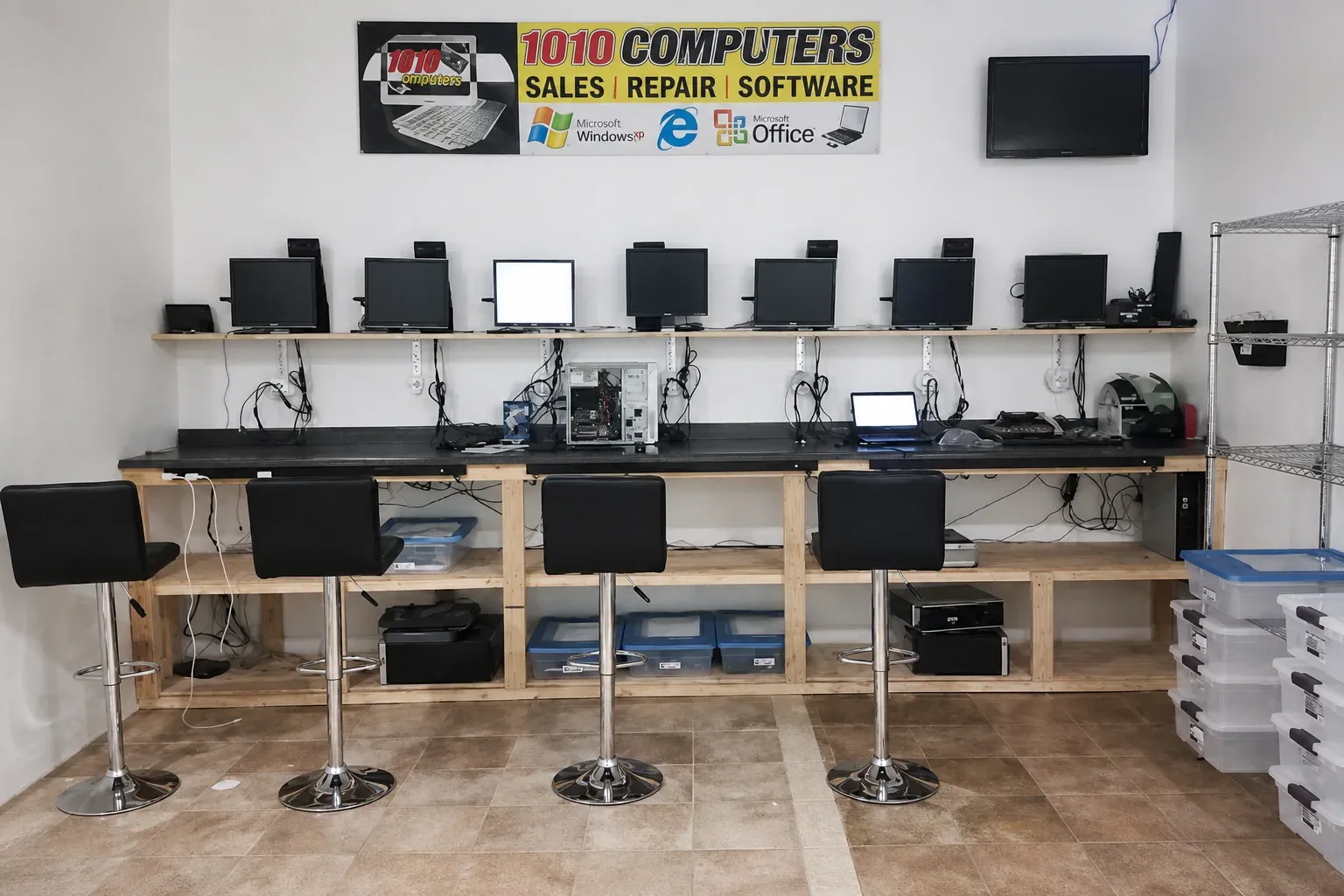
1010Computers | Computer Repair & IT Support

Samsung gives foldables another go with the Galaxy Z Flip

Samsung did a surprisingly good job keeping the Galaxy Fold under wraps, surprising the world with its first foldable this time last year during the Galaxy S10 unveil. When it came to the Galaxy Z Flip, on the other hand, the company just went ahead and showed the whole thing off during an Oscar ad buy. (Not to mention numerous Samsung employees playing around with the handsets in their seats this morning, ahead of unveil). Crazy world, these mobile phones.

Of course, that’s not to say we haven’t known about the Flip for a while now. Samsung teased out the Moto Razr-style form factor before it even officially announced the Fold. Samsung wanted to make it perfectly clear that the foldable wasn’t just a one-and-done situation for the company.

The company kicked off today’s Unpacked event by unveiling the new foldable, which it claims is “like nothing you’ve ever seen before.” Which, well, isn’t exactly true.

Certainly the Z Flip form factor seems a more logical one, harkening back to pre-smartphone days of clamshell devices. Of course, the Razr has been running into its own issues after its recent release. Between that and — even more notable — the Fold’s myriad problems, the Z Flip will no doubt be under as much scrutiny as any handset in recent memory.

When opened, the screen is 6.7 inches, with a hole-punch camera up top. When closed, there isn’t much of a display, beyond a quick bar that offers time, notifications and battery life. Users can also snap selfies with the case closed. The clam shell comes in three colors: black, purple and gold.

One assumes that Samsung learned plenty of lessons from the original Fold, after having to go back to the drawing board when multiple reviewers wound up with broken units.
Samsung claims the device can handle 200,000 flips, courtesy of foldable glass — which should give it some extra durability. In an off-handed reference to earlier issues, the company noted that the hinge is designed to keep debris out, one of the major downfalls of the first-gen Fold, which allowed dust and particles behind the screen, damaging it when users pressed down. The new phone has a kind of brush system inside to keep stuff out.

Obviously we can’t quite speak to durability just yet (though I, for one, am excited to get my hands on the thing), but at $1,380, it’s priced — well, it’s less expensive than the $2,000 Galaxy Fold, at least. That puts it more in line with the new Razr, not to mention, Samsung’s just now introduced Galaxy S20 Ultra.

The Flip will be available on Valentine’s Day.

A Thom Browne Edition, meanwhile, will bring the iconic designer’s touch to the device, which will be highlighted in more detail at a special event tomorrow in New York as part of Fashion Week. 

Powered by WPeMatico

Samsung skips nine numbers, announces the Galaxy S20

The world will likely never see the Galaxy S11. Or the Galaxies S12-S19, for that matter. At an event this morning in San Francisco, Samsung announced that it was skipping a decade’s worth of handsets and going straight to the Galaxy S20.

The new flagship debuted onstage today, in three flavors: the S20, S20+ and S20 Ultra, a sign of the company’s ever-shifting approach to the market. Samsung clearly has no plan to back away from the premium market, even as smartphone sales flag. With starting prices of $999, $1,199 and $1,399, respectively, the company’s making a big bet that consumers are still willing to pay top dollar for premium specs.

Paying top dollar means, among other things, 5G for all-comers. All three devices will be 5G-enabled, a year after Samsung introduced its first device with the next-gen technology. It’s 2020, and Samsung is all-in on 5G — on its flagships, at least. The S10/Note 10 and their Lite versions are continuing to stick around at a lower price, maintaining a broad range of devices currently on the market for the company. 

Samsung Galaxy S20

Another big new feature here is the addition of a 120hz refresh rate and improved touch response. In all cases, you’ve got a hole punch “Infinity O” camera up top. Once again, however, the biggest news is coming on the imaging side. The company’s using the phrase “pro grade” to describe the camera across the board.

All three models feature pretty massive camera modules, but the Ultra’s is next-level. Both the S20+ and Ultra feature the prominent Space Zoom camera (with a three-camera system, to the S20’s two). On the Ultra, the 48-megapixel folded lens is a hybrid of optical and digital zoom that offers a combined 100x. There’s some degradation of the image, naturally, but it’s still pretty impressive what the handset is capable of. This could be a game changer for amateur smartphone photographers.

Other camera improvements include 8K video recording at 24FPS, implode super-steady zoom and the addition of night time hyper-lapse shooting. On the camera software side, there’s the new Single Take mode, which saves a whole bunch of versions of a shot, including live focus and wide angle — basically all of the different shots at once, so you can go in and choose the best. The combined photos take up between 50 and 70MB a piece and you have to go in and manually delete the ones you don’t want, so probably don’t use that for every shot.

Samsung Galaxy S20

Nona binning is another one of the Ultra’s special photography surprises. Like the ridiculous Space Zoom, the technology could prove a game changer for amateur photographers looking to step up their game. The technology (which slipped out recently as a patent filing) reduces the mostly excessive 108-megapixel sensor down to 12 megapixels, utilizing the tremendous amount of light the sensor lets in.

Bixby is still hanging around. The smart assistant is still present as one of the side buttons, though, as with the recent Note, it’s easily mapped to different technologies. The tech did, however, make an appearance courtesy of a partnership with Spotify, which brings the popular music streaming platform for Bixby Routines. That essentially means that playlists are integrated into different modes, like wake-up and working out.

More interesting on the music side is a clever little feature called Music Share. With it, users with compatible Galaxy devices can piggyback on your Bluetooth connection and play songs on a connected stereo. The idea is to create a kind of collaborative playlist. The applications are admittedly extremely limited (especially when coupled with limited device compatibility), but it’s fun nonetheless.

Samsung Galaxy S20

There’s another surprise partnership in the form of Google. The software giant’s video chat platform is being baked directly into Samsung’s UI with an icon available in the dialer, so users can choose between a voice or video display — similar to Apple’s longtime FaceTime integration, albeit through a third-party here. The S20 is also the first device that can deliver a chat in full HD — though that will require a good 5G connection on both sides, so it’s safe to say it’s going to be…limited at launch.

One more big partnership to mention here is Microsoft. The company will be launching Forza Street in the Galaxy Store — its first appearance on Mobile. That arrives at some point in the spring.

Samsung Galaxy S20

As for internals, the S20 sports a healthy 4,000 mAh battery, which the S20+ and Ultra bump up to 4,500 mAh and 5,000 mAh, respectively. The systems will sport the latest Qualcomm 865 here in the system, along with healthy starting specs of 12GB of RAM and 128GB of storage.

Pre-order for the new flagships opens February 21, with wide availability on March 6. Rather than the more traditional bundles of things like earbuds or charging pads, Samsung is tossing in credits for pre-orders. Those who pick up the S20, S20+ or S20 Ultra will get a $100, $150 or $200 credit, respectively, redeemable for Samsung software or services.

Powered by WPeMatico

Samsung’s flagships get a new level of premium, starting at $1,400

Flagship prices that routinely top out well above $1,000 are among the chief factors in slowing smartphone adoption. Certainly Samsung has done something to address the phenomenon, both with a number of mid-tier products and the recent introduction of Lite versions of the Galaxy S10 and Note 10.

At the other end of the spectrum is the brand new Galaxy S20 Ultra. Having already broken the seal on a $2,000 handset with last year’s Galaxy Fold, the company just announced the somewhat more reasonable $1,400 Ultra. The most premium of the thee-tier devices sports a massive 6.9-inch display to the others’ 6.7 (S20+) and 6.2 (S20).

The camera is the other place the Ultra really sets itself apart from the others. All devices feature enhanced “Space Zoom,” but the premium product bumps the 30x up to a massive 100x, through a hybrid of optical and digital zoom, with a folded lens beneath the large camera bump on the rear.

Like the S20+, there’s a four-camera system on the rear (the standard S20 just has three). There are some differences in sensors in the group, including, most notably, the S20+ wide angle, which is bumped up to a massive 108 megapixels.

The Ultra is also the first device to include nona binning, which knocks the normally excessive 108-megapixel camera down to 12 megapixels, while retaining the large amounts of light let in by the sensors for improved photos.

Also of note is the downright giant battery. The Ultra’s is 5,000 mAh to the the S20+’s 4,500 mAh.

Powered by WPeMatico

Meet 5 cybersecurity unicorns that could IPO in 2020

There was a lot of moving and shaking in the cybersecurity unicorn world in 2019.

It was a year that saw two of the biggest exits in cybersecurity history: CrowdStrike went public valued at $3.35 billion and Cloudflare rocketed 20% in its first day on the stock market.

Clearly, the cybersecurity market is booming. Recent data suggests that cybersecurity investing could reach $250 billion by 2023, and spending rose in 2019 more than any other industry. If that pace keeps up, there’s little to suggest that the cybersecurity “bubble” will burst any time soon.

A number of cybersecurity companies are firmly in the club of private companies worth $1 billion or more. These unicorns represent some of the best talent, technologies and offerings in cybersecurity, but the club is getting crowded. Now that CrowdStrike and Cloudflare have graduated to the public market, there are a number of cybersecurity companies that could make the leap.

Tanium

Powered by WPeMatico

Sprint/T-Mobile merger gets federal judge approval

The U.S. mobile landscape is on track to look a whole lot different. A hotly contested $26 billion deal between T-Mobile and Sprint just got the go ahead from a U.S. district court judge. The merger would combine the country’s third and fourth largest mobile carriers, effectively reducing the number of key carriers from four down to three.

Critics of the deal, including attorneys general from more than one dozen states, have expressed concern that such a deal would diminish competition in the market. T-Mobile and Sprint, on the other hand, have argued that such a deal would actually make the market more competitive and give a combined company a better chance of battling with (TechCrunch parent company) Verizon and AT&T on the 5G front.

U.S. District Judge Victor Marrero, it seems, sided with the latter. He lauded T-Mobile’s business practices in a statement. “T-Mobile has redefined itself over the past decade as a maverick that has spurred the two largest players in its industry to make numerous pro-consumer changes,” Judge Marrero wrote.

The deal has already cleared a number of key hurdles, including Justice Department approval. Involved states, however, are considering an appeal. “From the start, this merger has been about massive corporate profits over all else, and despite the companies’ false claims, this deal will endanger wireless subscribers where it hurts most: their wallets,” NY Attorney General Attorney Letitia James said in a statement.

Powered by WPeMatico

Good news for enterprise startups: SaaS helped kill the single-vendor stack

In the old days of enterprise software, when companies like IBM, Oracle and Microsoft ruled the roost, there was a tendency to shop from a single vendor. You bought the whole stack, which made life easier for IT — even if it didn’t always work out so well for end users, who were stuck using software that was designed with administrators in mind.

Once Software-as-a-Service (SaaS) came along, IT no longer had complete control over software choices. The companies that dominated the market began to stumble — although Microsoft later found its way — and a new generation of SaaS vendors developed.

As that happened, users saw a way to pick and choose software that worked best for them, as they were no longer bound to clunky enterprise software; they wanted tools at work that worked as well as the ones they used in the consumer space at home.

Through freemium models and low-cost subscriptions, individual employees and teams started selecting their own tools, and a new way of buying software began to take hold. Instead of buying software from a single shop, consumers could buy the best tool for the job. This in turn, led to wider adoption, as these small groups of users led the way to more lucrative enterprise deals.

The philosophical change has worked well for enterprise startups. The new world means a well-executed idea can beat an incumbent with a similar product. Just ask companies like Slack, Zoom and Box, which have shown what’s possible when you put users first.

Powered by WPeMatico

Infosys is acquiring Simplus for $250M to grow its Salesforce consulting arm

Infosys is a huge consulting organization based in India, which works with clients as they implement complex software integrations. Today, the company announced it was buying Simplus, a Salesforce integration consultant, for $250 million.

The company, which is based in Salt Lake City, Utah, launched in 2014 and has raised almost $50 million, according to Crunchbase data. It brings a wide range of Salesforce consulting, training and integration services along with general Salesforce expertise, which Infosys hopes to put to work.

The acquisition follows the purchase of Fluido, another Salesforce consulting shop, in 2018. The moves suggest that Infosys wants to build deeper expertise around Salesforce and make that a key piece of its consulting operations moving forward.

Brent Leary, a CRM industry veteran, who is owner at CRM Essentials, says that Simplus is well-positioned in the Salesforce ecosystem to capture lucrative cloud integration services, and it should help expand Infosys’s Salesforce consulting arm. “By acquiring Simplus, it allows Infosys to grab more market share, while extending Salesforce capabilities to offer existing clients,” Leary told TechCrunch.

Ravi Kumar, president at Infosys, sees it in similar terms. “Simplus will be a valuable addition to the Infosys family. Complementing our industry knowledge and existing Salesforce footprint with their strong presence in key markets, deep Salesforce consulting and advisory expertise will help accelerate the transformation journey of incumbent companies,” Kumar said in a statement.

Holger Mueller, an analyst at Constellation Research, says Simplus should especially help in the area of Quote-to-Cash, that period after the sale when quotes are shared, contracts are signed and cash is collected on the sale. “It creates the opportunity for Infosys to break out of the vendor services silos and connect its Salesforce services with its ERP services (SAP, Oracle),” he said.

The deal is expected to close in Infosys’s fiscal 2020 fourth quarter. Per usual, it is subject to standard regulatory approval.

Powered by WPeMatico

N26 exits UK market following Brexit

German fintech startup N26 is shutting down its operations in the U.K. Customers who opened a bank account in the U.K. will have to transfer their deposits, spend everything with their card or withdraw money at an ATM, as all accounts will be automatically closed on April 15, 2020.

Many European fintech companies take advantage of a European process called passporting. It lets you apply for a license to operate as a bank or a financial service in an EU member state and then expand to all EU member states.

As you may have guessed, N26 has to exit from the U.K. banking market because it currently has a European banking license through the central bank of Germany. Passporting is going to change following Brexit.

In particular, European companies that operate in the U.K. using inward passporting have to follow a new application process in order to continue operating in the U.K.

“The timings and framework outlined in the EU Withdrawal Agreement mean that the company will in due course be unable to operate in the UK with its European banking licence,” N26 writes in a statement. N26 users in other markets won’t be affected by this change.

N26 also faces a ton of competition in the U.K. from Monzo, Starling and in some ways Revolut. It’s also possible that N26 didn’t want to invest a lot of time and money in order to set up a proper subsidiary company in the U.K. with its own banking license.

You can no longer sign up in the U.K. If you’re an existing customer, everything will work normally until April 15. You should empty your bank account, move your recurring payments to another bank, identify all your subscriptions, direct debits and deposits and move them to another bank.

On April 15, you won’t be able to access your account. Your card will be deactivated. Direct debits and deposits will bounce as well. If you have a premium subscription, N26 is going to stop charging you for your N26 You or N26 Metal subscription from March 14.

Powered by WPeMatico

Alpha Foods raises $28 million for its vegetarian prepared foods

Alpha Foods, the vegetarian prepared food manufacturer, has raised $28 million in financing for its portfolio of vegetarian burritos, tamales, nuggets, pizzas, burgers, patties and sausages.

The Glendale, Calif.-based company was launched by Loren Wallis, the founder of the dairy substitute, Good Karma Foods, and Cole Orobetz, a former director with the agricultural debt lending firm Avrio Capital.

First launched in 2015, Alpha Foods previously raised $12 million in financing from investment firms like New Crop Capital and AccelFoods, whose other brands include Kite Hill, Good Catch, BRAMi and Evoke Healthy Foods.

As more Americans move to supplement their diets with plant-based products, companies like Alpha Foods have found willing investors for new food brands. The company’s new round was led by AccelFoods, with existing investors, including New Crop Capital, Green Monday Ventures and Blue Horizon, also participating.

Companies like Alpha compete with huge consumer packaged goods companies like Kellogg’s (through its Morningstar Farms line of vegetarian products) and Nestlé (through Sweet Earth Foods).

While the Morningstar Farms brand might seem a bit stale, the market has been reinvigorated through the marketing muscle and venture dollars supplied by companies like Beyond Meat and Impossible Foods, whose products have captured contracts from some of the world’s biggest fast food chains — including McDonald’s, KFC and Burger King.

Alpha Foods said it will use the latest money to launch new products, make new hires and expand its distribution channels nationally and internationally.

The company is already sold in well over 9,000 stores at chains including Wegmans, Walmart, Kroger and Publix.

“As more and more people actively seek out plant-based options, whether for their health or the environment, we are looking to expand our innovations within the category and bring easy to prepare products to a wider audience,” said Cole Orobetz, co-founder and president of Alpha Foods, in a statement.

The sale of pre-prepared plant-based meals reached $387 million in 2019, up 6% over the past year, according to data from the Good Food Institute.

“We are in the early days of plant-based consumption. As a portable, functional food business geared towards the newly emergent flexitarian consumer, the Alpha platform meets all of its customers’ snack and mealtime needs,” said AccelFoods Managing Partner Jordan Gaspar. “We couldn’t be prouder to lead this strong nexus of collaborative investors, who had the opportunity to organically build trust this past year allowing for an incredibly successful outcome in this financing.”

Powered by WPeMatico

Sixgill raises $15M to expand its dark web intelligence platform

Sixgill, an Israeli cyberthreat intelligence company that specializes in monitoring the deep and dark web, today announced that it has raised a $15 million funding round led by Sonae IM, a fund based in Portugal, and London-based REV Venture Partners. Crowdfunding platform OurCrowd also participated in the round, as did previous investors Elron and Terra Venture Partners.

According to Crunchbase, this brings the company’s total funding to $21 million to date.

Sixgill, which was founded in 2014, plans to use the new funding to expand its efforts in North America, EMEA and APAC. In addition to expanding its geographic focus, Sixgill plans to expand its product’s capabilities, including its Dynamic CVE Rating.

Its current customer base mostly includes large enterprises, law enforcement and other government agencies, as well as other security providers.

Given its focus, that client list doesn’t come as a surprise. The company uses its technology to automatically monitor dark web forums and marketplaces for potential threats and then find those that could affect its clients. Users can either access Sixgill through its SaaS platform or install it on-premises. For enterprises and agencies that don’t have their own staff to run the service, Sixgills also offers access to its internal analysts.

“Sixgill uses advanced automation and artificial intelligence technologies to provide accurate, contextual intelligence to customers. The solution integrates seamlessly into the platforms that security teams use to orchestrate, automate, and manage security events,” said Sharon Wagner, CEO of Sixgill. “The market has made it clear that Sixgill has built a powerful real-time engine for more effective handling of the rapidly expanding threat landscape; this investment will position us for significant growth and expansion in 2020.”

Powered by WPeMatico