Startups
Auto Added by WPeMatico
Auto Added by WPeMatico
Julia is Sesame Street’s first autistic character and her mission is to make neuroatypical kids feel more comfortable and understand that there are kids out there just like them. She’s a sweet little muppet and now she’s getting her own Kickstarter campaign.
The campaign is raising $75,000 to produce content and a free book featuring Julia and her friends. They’ve just hit $10,000 in funding and it’s growing fast. $100 gets you a plush Julia doll and if they reach $150,000 they will print a paper copy of the new Julia book. The project aims to help reduce bullying of autistic children and the Sesame Street team will work with experts to create content and a book around Julia’s adventures.
From the team:
Julia’s television debut was greeted with hundreds of media stories and millions of social media impressions, but the biggest marker of our success was the overwhelming response from the autism community and beyond. Parents say their autistic children have more playdates because of Julia. Teachers report that their students are more inclusive in their play. One mother told us that she used the first Julia storybook to explain to her daughter that she, too, has autism. Her daughter responded, “So I’m amazing too, right?”
This is Sesame Street’s first Kickstarter and it’s really wonderful. This sort of community call-to-action is just what crowdfunding was born to do and it’s great to see the cash going to such a nice cause.
Powered by WPeMatico
Sam Kim, co-founder and CEO of Lucidity, said blockchain technology offers a solution to cut down on fraud and bring more transparency to digital advertising.
Kim was previously chief operating officer at The Mobile Majority, a mobile ad company where he said he saw the challenges of reconciling the data used by different parts of the ad supply chain. So at Lucidity, his team has created technology on the Ethereum blockchain for smart contracts that track this data across the ecosystem.
“What we’ve built is a protocol for industry participants to come to a consensus about what events are valid and what are invalid,” he said. “We allow all the participants trafficking that ad to submit that data … so that basically becomes a single source of truth across the industry.”
On top of the protocol, Lucidity has created products focused on specific issues. There’s one around fee transparency, where every participant in the supply chain submits the information about the fee they charged and verification that they actually ran the impression, which Kim said could replace a drawn-out reconciliation process. And there’s another product for confirming publisher identity and flagging fake bid requests.
When I asked whether ad platforms and publishers will feel comfortable sharing this data in a new way, Kim said, “As an industry, there’s a lot of pressure from the advertisers to become more transparent.”
“The way we designed it, it will benefit those who are honest and transparent,” he added. “Those who aren’t, it’ll be harmful to them. We expect to see adoption from those who are completely transparent and honest, and hopefully drive the industry in that direction.”
As for potential privacy concerns, Kim noted that Lucidity doesn’t currently include consumer data. That could change in the future, but if it does, Kim said it would be done in a way that ensured “privacy was addressed.”
Lucidity has been in beta testing since earlier this year, and it’s already signed up partners from the ad world including Audience Group and Digital Remedy.
Kim said the goal is to get “the benefits of the blockchain — disintermediation, transparency and trust — but deployed in a way that’s not cumbersome and difficult for the current players.” So if you’re an advertiser, you don’t need to worry too much about the underlying technology; you just get a dashboard with the data you want.
At the same time, Kim said the company is using “cutting edge technology,” for example by implementing Plasma, a side-chain processing technology that’s supposed to address Ethereum’s speed and scaling issues. And it’s partnered with IAB Tech Lab’s Blockchain Working Group, the Enterprise Ethereum Association and Hyperledger.
The startup was previously known as Kr8os (from the Greek word kratos, which was one of the ingredients for democracy). Today it’s rebranding as Lucidity.
“We’d been thinking about the rebrand for some time,” Kim said. “Kr8os is a process we used to ultimately drive our vision for Lucidity.”
Powered by WPeMatico
Landing pages might not sound like the most exciting problem for a startup to tackle, but Tyson Quick, founder and CEO of Instapage, said that they’re a real issue for marketers.
Quick was previously working on a marketing product called Jounce, where he was frustrated by the fact that even after someone had clicked on a Jounce ad and ended up on the company’s website, only 3 percent of them were converting.
“It was kind of ridiculous, since they’d already engaged with the ad,” Quick said. So just by creating a few personalized landing pages that targeted “major” customer segments, Jounce was able to increase conversions to around 20 percent.
In 2012, Quick decided to switch the company’s focus to Instapage, and it now offers a broader platform for creating and testing different landing pages that are personalized for different visitors.
“We can be this middleware between ad tech and traditional marketing and sales tech,” Quick said. “All this technology has made it so the ad-buying side has sophisticated targeting and relevancy. And once you capture a lead, you’ve got marketing automation that pushes them into your CRM. It’s the point of conversion that’s missing.”
Instapage now has more than 15,000 customers who are seeing average conversion rates above 22 percent. And it’s announcing that it’s raised $15 million in Series A funding from Morgan Stanley Expansion Capital.

Quick admitted that it hasn’t just been a straight line to success. He recalled moving from Salt Lake City to San Francisco and living in his car for part of the month so that he could rent out his apartment on Airbnb.
“I didn’t want to get a job,” he explained — and the Airbnb money helped him devote his time to Instapage.
Quick also said it took some time to find the ideal customers, namely larger companies that are always running digital advertising campaigns. The strategy seems to have worked, with Instapage not losing a single enterprise customer in the past year.
Quick also sees a broader opportunity around what he calls “post-click conversion optimization,” which he said has three key components — scalable creation, optimization and personalization. (That last category is what his team is focused on building out now.) And while other companies like Optimizely might tackle some of those segments, he said Instapage is leading the way in combining all three.
I wondered whether GDPR or other shifts in the landscape around online data and privacy could affect Instapage’s business, but Quick argued that the company doesn’t need detailed user data to be helpful: “The personalization comes from the advertising itself. We can glean insights from what ads did they engage with.”
As for raising money, Instapage had already raised $2 million in seed funding. Quick said that when he started to have conversations about a Series A, most VCs weren’t interested in giving the company “the valuation we felt we deserved.” (He speculated that they were “a little preoccupied by the buzzy things that were going on” like cryptocurrency and on-demand delivery.) And the company was profitable, with what Quick said is $12 million in annual recurring revenue, so it didn’t need to raise the funding.
However, he found that Morgan Stanley was more willing to dig in and learn about Instapage’s business.
“Instapage has a clear vision for improving digital marketing efficiency and has built an impressive product for marketers to create more successful advertising campaigns without the need for external or technical resources,” said Pete Chung, the head of Morgan Stanley Expansion Capital, in the funding announcement. “We’re confident that this next phase of growth will further establish Instapage as the authority on converting ad clicks and optimizing conversions, and we look forward to working with Instapage to bring post-click optimization to a larger audience.”
Powered by WPeMatico
Some folks I met in Chicago are holding an amazing event at a great place on South Canalport Avenue. This former macaroni factory now builds startups and I’ll be helping judge their pitch-off alongside some Chicago luminaries.
You can RSVP here and sign up for a spot to pitch here. We’ll choose eight startups to pitch there are some great prizes available.
Blue Lacuna is at 2150 South Canalport Avenue in Chicago and the event is on April 19 at 6pm. Grab your tickets early for this cool meet and greet.
Powered by WPeMatico
Fleetsmith, a startup that wants to make it easier for companies to manage their Apple devices, announced a $7.7 million Series A round today led by Upfront Ventures.
Seed investors Index Ventures and Harrison Metal also participated in the round. The company has raised a total of $11 million. They also announced that Luke Kanies, founder and former CEO of Puppet has joined their advisory board.
Fleetsmith wants to help SMBs provision and manage Apple devices whether that’s computers, phones, iPads or Apple TVs. Trying to provision these devices manually is a time-consuming process, one that larger organizations no longer have to deal with because of other commercial options or in-house solutions, but Fleetsmith puts that same kind of efficient device management within reach of smaller organizations by offering it as a cloud service.
Two of the co-founders, Zack Blum and Jesse Endahl, who came from Dropbox and Fandom, were both in positions where they needed to buy and deploy Apple devices and couldn’t find a good way for a small company to do that on the market.
“How do you manage a fleet of Macs and secure them through the internet? We looked around when we were in a build/buy position and saw a lot to be done. We are democratizing what companies like Google and Facebook have with their own [home-grown] internal Mac management tools,” CEO Blum told TechCrunch.
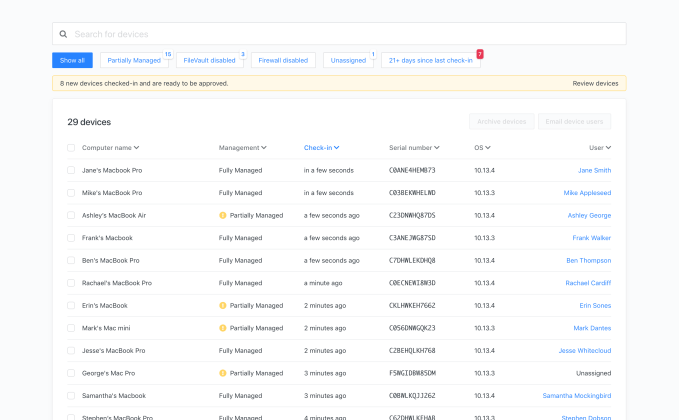
Fleetsmith device admin console. Photo: Fleetsmith
The company takes advantage of the Device Enrollment Program, a business device management service offered by Apple to simplify provisioning of Apple products. As long as the IT administrator is enrolled in DEP, you can use Fleetsmith for zero touch deployment, Blum explained. An employee can then order a laptop (or any device), and when they connect to WiFi, it connects to Fleetsmith, which configures the device automatically.
“The really cool thing about how DEP integrates into our feature set is that as soon as the employee connects to WiFi, it take care of deployment. The account is created, software gets installed, the drive gets encrypted. It makes installing and enrolling new people really simple,” he said. Once you’re setup with everything you need installed, the admin can force critical updates, but the system will give you several warnings before installing the update.
“Fleetsmith is automation applied perfectly, handing all of the menial work to the computer so the people do less firefighting and more strategic work. This is especially important in the mid-market because the teams are leaner and every computer counts,” new advisory board member Kanies said in a statement.
The service costs is just $99 per year per device to access the cloud service. They offer a freemium version to manage up to 10 devices at no cost. The company launched in 2016 and currently has 20 employees. Customers include HackerOne, Robinhood and Nuna.
Powered by WPeMatico
French startup Alan closed a $28.3 million Series A round a few months ago. Index Ventures is leading the round, Xavier Niel is participating as well as existing investors CNP Assurances, Partech and Portag3 Ventures LP.
Alan wants to make health insurance as simple as subscribing to a software-as-a-service product. It starts with clear pricing and transparent reimbursement policies. For instance, you can cover a 30-year-old employee for €55 per month.
The price will be exactly the same for all types of companies. The only thing that changes is that you’ll pay a bit less for younger employees and more for older employees. Each employee can choose to cover their significant other for the same price, and their kids for an extra €40 per month.
And then, Alan is following the startup playbook. The overall user experience is much nicer than the interface of a traditional health insurance.
You get a modern dashboard where you can control and view all your health expenses, a mobile app and good customer support. You can also add life insurance from CNP Assurances from the same interface.
This simple promise seems to be working quite well as Alan now covers 7,000 employees across 850 companies. As you can see, the startup has been focusing on small companies as it’s easier to make them switch.
Alan co-founder and CEO Jean-Charles Samuelian also told me that small companies are underserved by big insurance companies. There’s no reason you should pay more because you work for a small company.
With today’s funding round, Alan wants to offer the same product at scale. The company plans to grow from 22 employees right now to 80 employees by December 2018.
“The goal is to reach €100 million in annual recurring revenue as quickly as possible,” Samuelian told me. The startup currently generates between €5 and €6 million in annual recurring revenue.
Eventually, Alan wants to expand beyond France and address other European markets. While the U.S. seems like a big market, it’s already quite crowded. Samuelian thinks there will be a bigger opportunity by building a European company. It’ll take quite a bit of time as regulation is different in each European country.
Recently, Alan has been focused on building a solid infrastructure, optimizing processes and automating tasks. In many ways, Samuelian still thinks about Alan as a tech company. “We want to build the Apple or Google of Europe,” he said.
Alan can beat competitors on price and flexibility by building a tech product that actually works — that’s how you can serve 7,000 people with a lean team.
Disclosure: I share a personal connection with an executive at CNP Assurances.
Powered by WPeMatico
Sick of chatting but want to stay connected? Tribe‘s app lets you play clones of Space Invaders, Flappy Bird, Fruit Ninja, Name That Tune and more while video chatting with up to 7 friends or strangers. Originally a video messaging app, Tribe failed to gain traction in the face of Snapchat and Facebook Messenger. But thanks to a $3 million funding round led by Kleiner Perkins in June, Tribe had the runway to pivot into video chat gaming that could prove popular, even if not in its app.
“As we all know, Messaging is a super crowded area” says Tribe co-founder Cyril Paglino. “If you look closely, very few communication products have been blowing up in the past three years.” Now, he says “we’re building a ‘Social Game Boy.’”

A former breakdancer, Paglino formed his team in France before renting a “hacker house” and moving to San Francisco. They saw traction in late 2016, hitting 500,000 downloads. Tribe’s most innovative feature was speech recognition that could turn a mention of “coffee” into a pre-made calendar request, a celebrity’s name into a link to their social media accounts, locations into maps, and even offer Spotify links to songs playing in the background.
The promise of being the next hit teen app secured Tribe a $500,000 pre-seed from Kima and Ludlow Ventures in 2015, a $2.5 million seed in 2016 led by prestigious fund Sequoia Capital, and then the June 2017 $3 million bridge from KPCB and others. But that $6 million couldn’t change the fact that people didn’t want to sign up for a new chat app when their friends were already established on others.
 Luckily, Tribe saw a new trend emerging. Between HQ Trivia’s rise, the Apple App Store adding a Gaming tab, celebrities like Drake streaming their gameplay, and Snapchat acquiring 3D gaming engine PlayCanvas, the Tribe team believed there was demand for a new way to play.
Tribe’s rebuilt iOS and Android apps let you rally a crew of friends or join in with strangers to play one of its old school games. You’ll hear their voices and see their faces in the corner of the screen as everyone in your squad vies for first place. It’s like Houseparty’s group video chat, but with something to do. Facebook Messenger has its own gaming platform, but the games are largely asynchronous. That means you play separately and merely compare scores. That’s a lot less fun than laughing it up together as one of your buddies runs their race car off the road or gets attacked by an alien.

Powered by WPeMatico
UK startup Juro, which is applying a “design centric approach” and machine learning tech to help businesses speed up the authoring and management of sales contracts, has closed $2m in seed funding led by Point Nine Capital.
Prior investor Seedcamp also contributed to the round. Juro is announcing Taavet Hinrikus (TransferWise’s co-founder) as an investor now too, as well as Michael Pennington (Gumtree co-founder) and the family office of Paul Forster (co-founder of Indeed.com).
Back in January 2017 the London-based startup closed a $750,000 (£615k) seed round, though CEO and co-founder Richard Mabey tells us that was really better classed as an angel round — with Point Nine Capital only joining “late” in the day.
“We actually could have strung it out to Series A,” he says of the funding that’s being announced now. “But we had multiple offers come in and there is so much of an explosion in demand for the [machine learning] that it made sense to do a round now rather than wait for the A. The whole legal industry is undergoing radical change and we want to be leading it.”
Juro’s SaaS product is an integrated contracts workflow that combines contract creation, e-signing and commenting capabilities with AI-powered contract analytics.
Its general focus is on customers that have to manage a high volume of contacts — such as marketplaces.
The 2016-founded startup is not breaking out any customer numbers yet but says its client list includes the likes of Estee Lauder, Deliveroo and Nested. And Mabey adds that “most” of its demand is coming from enterprise at this point, noting it has “several tech unicorns and Fortune 500 companies in trial”.
While design is clearly a major focus — with the startup deploying clean-looking templates and visual cues to offer a user-friendly ‘upgrade’ on traditional legal processes — the machine learning component is its scalable, value-added differentiator to serve the target b2b users by helping them identify recurring sticking points in contract negotiations and keep on top of contract renewals.
Mabey tells TechCrunch the new funding will be used to double down on development of the machine learning component of the product.
“We’re not the first to market in contract management by about 25 years,” he says with a smilie. “So we have always needed to prove out our vision of why the incumbents are failing. One part of this is clunky UX and we’ve succeeded so far in replacing legacy providers through better design (e.g. we replace DocuSign at 80% of our customers).
“But the thing we and our investors are really excited about is not just helping businesses with contract workflow but helping them understand their contract data, auto-tag contracts, see pattens in negotiations and red flag unusual contract terms.”
While this machine learning element is where he sees Juro cutting out a competitive edge in an existing and established market, Mabey concedes it takes “quite a lot of capital to do well”. Hence taking more funding now.
“We need a level of predictive accuracy in our models that risk averse lawyers can get comfortable with and that’s a big ask!” he says.
Specifically, Juro will be using the funding to hire data scientists and machine learning engineers — building out the team at both its London and Riga offices. “We’re doing it like crazy,” adds Mabey. “For example, we just hired from the UK government Digital Service the data scientist who delivered the first ML model used by the UK government (on the gov.uk website).
“There is a huge opportunity here but great execution is key and we’re building a world class team to do it. It’s a big bet to grow revenue as quickly as we are and do this kind of R&D but that’s just what the market is demanding.”
Juro’s HQ remains in London for now, though Mabey notes its entire engineering team is based in the EU — between Riga, Amsterdam and Barcelona — “in part to avoid ‘Brexit risk’”.
“Only 27% of the team is British and we have customers operating in 12 countries — something I’m quite proud of — but it does leave us rather exposed. We’re very open minded about where we will be based in the future and are waiting to hear from the government on the final terms of Brexit,” he says when asked whether the startup has any plans to Brexit to Berlin.
“We always look beyond the UK for talent: if the government cannot provide certainty to our Romanian product designer (ex Kalo, Entrepreneur First) that she can stay in the UK post Brexit without risking a visa application, tbh it makes me less bullish on London!”
Powered by WPeMatico
Tencent is teaming up with Los Angeles-based education company Age of Learning to launch an English education program for kids in China. ABCmouse, Age of Learning’s flagship product, has been localized and will be available as a website and an iOS and Android app in China, with Tencent handling product development, marketing, sales and customer support.
The new partnership extends Tencent’s involvement in ed-tech, which already includes a strategic investment in VIPKID, an online video tutoring platform that connects Chinese kids with English teachers and competes with QKids and Dada ABC. ABCmouse, on the other hand, uses videos, books and online activities like games, songs and stories to help kids study English.
The Chinese version of ABCmouse includes integration with Tencent’s ubiqutioius messenger and online services platform WeChat, which now has more than one billion users, and its instant messaging service QQ, with 783 million monthly active users. This makes it easier for parents to sign up and pay for ABCmouse, because they can use their WeChat or QQ account and payment information. It also allows families to share kids’ English-learning progress on their news feeds or in chats. For example, Chen says parents can send video or audio recordings of their children practicing English to grandparents, who can then buy gift subscriptions with one click.
Though you probably haven’t heard of it unless you have young kids or work with elementary school-age children, Age of Learning has built a significant presence in online education since it was founded in 2007, thanks mainly to the popularity of ABCmouse in schools, public libraries and Head Start programs. Two years ago, Age of Learning hit unicorn status after raising $150 million at a $1 billion valuation from Iconiq Capital.

Jerry Chen, Age of Learning’s president of Greater China, says there are more than 110 million kids between the ages of three to eight in China and the online English language learning market there is “a several billion dollar market that’s growing rapidly.” He points to a recent study by Chinese research agency Yiou Intelligence that says total spending on online English learning programs for children will be 29.41 billion RMB, or about $4.67 billion, this year, and is projected to reach 79.17 billion, or $12.6 billion, by 2022.
The localization of ABCmouse will extend to the design of its eponymous cartoon rodent, who has a more stylized appearance in China. Lessons include animations featuring an English teacher and students in an international school classroom and begin with listening comprehension and speaking before moving onto phonics, reading and writing. Tencent-Age of Learning products will also include speech recognition tools to help kids hone their English pronunciation.
In an email, Jason Chen, Tencent’s general manager of online education, said that the company “reviewed several companies through an extensive research process, and it became clear that ABCmouse had the most engaging and effective online English self-learning curriculum and content for children. Age of Learning puts learning first, and that commitment to educational excellence made them a perfect fit for our online English language learning business.”
Powered by WPeMatico
Dictionary app Reverso is getting new features with its 8.0 update. There are new exercices and games to help you learn new words. Reverso also now has an integrated thesaurus.
Reverso is one of the biggest dictionary players out there. It now has over 40 million unique visitors on its website and app every month. It’s a weird industry because a significant part of the traffic on those reference websites comes from search engines. And Google Translate is quite dominant as well.
So how do you go beyond search engine optimization? Reverso has been building many different services to become your go-to destination when it comes to your language needs. For instance, you can translate a word or a sentence and find contextual examples. You can access verb conjugation, translate big chunks of text, access traditional dictionaries and more.
More interestingly, the company has been focused on language learning for its mobile app. Every time you search for something, you can add a word to your phrasebook. After that, you can then go through your phrasebook with a quiz to learn those words.
Your data will get synced across multiple devices as long as you’re logged in. You could install Reverso’s Chrome extension to add words to the mobile app for instance.
If you don’t have time to add words yourself, the company is also putting together lists of not-so-simple-but-generally-useful words. The idea is that you could be learning new words when you’re waiting in line instead of wasting time scrolling through feeds.
In addition to those new exercices, Reverso now has an integrated thesaurus. You can search for a word and tap the tiny “S” in the corner to access related words. The company has been crunching all its translations to put this together. Chances are that two words that have the same translation in multiple languages probably mean the same thing.
Reverso isn’t necessarily reinventing the wheel with all those services. But there’s an advantage in having the same company run all of those services. You can jump from one service to another, add words from multiple scenarios and more.
Powered by WPeMatico