Recent Funding
Auto Added by WPeMatico
Auto Added by WPeMatico
Nearly everything about Netdata, makers of an open-source monitoring tool, defies standard thinking about startups. Consider that the founder is a polished, experienced 50-year-old executive who started his company several years ago when he became frustrated by what he was seeing in the monitoring tools space. Like any good founder, he decided to build his own, and today the company announced a $17 million Series A led by Bain Capital.
Marathon Ventures also participated in the round. The company received a $3.7 million seed round earlier this year, which was led by Marathon.
Costa Tsaousis, the company’s founder and CEO, was working as an executive for a company in Greece in 2014 when he decided he had had enough of the monitoring tools he was seeing. “At that time, I decided to do something about it myself — actually, I was pissed off by the industry. So I started writing a tool at night and on weekends to simplify monitoring significantly, and also provide a lot more insights,” Tsaousis told TechCrunch.
Mind you, he was a 45-year-old executive who hadn’t done much coding in years, but he was determined, as any startup founder tends to be, and he took two years to create his monitoring tool. As he tells it, he released it to open source in 2016 and it just took off. “In 2016, I released this project to the public, and it went viral, I wrote a single Reddit post, and immediately started building a huge community. It grew up about 10,000 GitHub stars in a matter of a week,” he said. Even today, he says that it gets a half million downloads every single day, and hundreds of people are contributing to the open-source version of the product, relieving him of the burden of supporting the product himself.
Panos Papadopoulos, who led the investment at Marathon, says Tsaousis is not your typical early-stage startup founder. “He is not following many norms. He is 50 years old, and he was a C-level executive. His presentation and the depth of his thinking, and even his core materials, are unlike anything else have seen in an early-stage startup,” he said.
What he created was an open-source monitoring tool, one that he says simplifies monitoring significantly, and also provides a lot more insights, offering hundreds of metrics as soon as you install it. He says it is also much faster, providing those insights every second, and it’s distributed, meaning Netdata doesn’t actually collect the data, just provides insights on it wherever it lives.
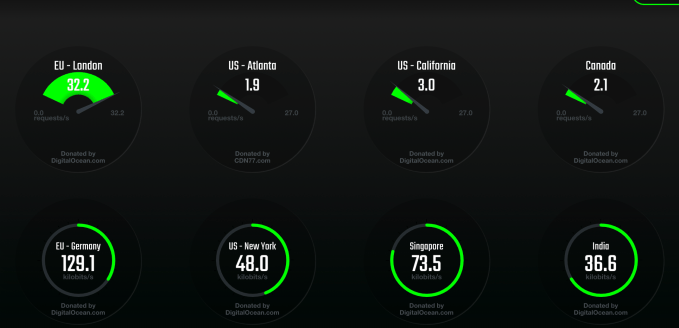
Live dashboard on the Netdata website
Today, the company has 24 employees and Tsaousis has set up shop in San Francisco. In addition, to the open-source version of the product, there is a SaaS version, which also has what he calls a “massively free plan.” He says the open-source monitoring agent is “a gift to the world.” The SaaS tool is about democratizing monitoring and the pay version is even different from most monitoring tools, charging by the seat instead of by the amount of infrastructure you are monitoring.
Tsaousis wants no less than to lead the monitoring space eventually, and believes that the free tiers will lead the way. “I think Netdata can change the way people perceive and understand monitoring, but in order to do this, I think that offering free services in a massive way is essential. Otherwise, it will not work. So my aim is to lead monitoring. This may sound arrogant, and Netdata is not there yet, but I think it can be,” he said.
Powered by WPeMatico
Kapwing is a laymen’s Adobe Creative Suite built for what people actually do on the internet: make memes and remix media. Need to resize a video? Add text or subtitles to a video? Trim or crop or loop or frame or rotate or soundtrack or… then you need Kapwing. The free web and mobile tool is built for everyone, not just designers. No software download or tutorials to slog through. Just efficient creativity.

In a year since coming out of stealth with 100,000 users, Kapwing has grown 10X, to more than 1 million. Now it going pro, building out its $20/month collaboration tools for social media managers and scrappy teams. But it won’t forget its roots with teens, so it has dropped its pay-$6-to-remove-watermarks tier while keeping its core features free.
Eager to capitalize on the meme and mobile content business, CRV has just led an $11 million Series A round for Kapwing. It’s joined by follow-on cash from Village Global, Sinai and Shasta Ventures, plus new investors Jane VC, Harry Stebbings, Vector and the Xoogler Syndicate. CRV partners “the venture twins” Justine and Olivia Moore actually met Kapwing co-founder and CEO Julia Enthoven while they all worked at The Stanford Daily newspaper in 2012.
Need to edit a meme or video? Kapwing has all the resizing, GIF, & subtitle tools you need https://t.co/FXDjShlUTq pic.twitter.com/1fEHxGoboz
— Josh Constine (@JoshConstine) September 24, 2019
“As a team, we love memes. We talk about internet fads almost every day at lunch and pay close attention to digital media trends,” says Enthoven, who started the company with fellow Googler Eric Lu. “One of our cultural tenets is to respect the importance of design, art and culture in the world, and another one is to not take ourselves too seriously.” But it is taking on serious clients.
As Kapwing’s toolset has grown, it has seen paying customers coming from Amazon, Sony, Netflix and Spotify. Now only 13% of what’s made with it are traditional text-plus-media memes. “Kapwing will always be designed for creators first: the students, artists, influencers, entrepreneurs, etc. who define and spread culture,” says Enthoven. “But we make money from the creative professionals, marketers, media teams and office workers who need to create content for work.”

That’s why in addition to plenty of templates for employing the latest trending memes, Kapwing now helps Pro subscribers with permanent hosting, saving throughout the creation process and re-editing after export. Eventually it plans to sell enterprise licenses to let whole companies use Kapwing.
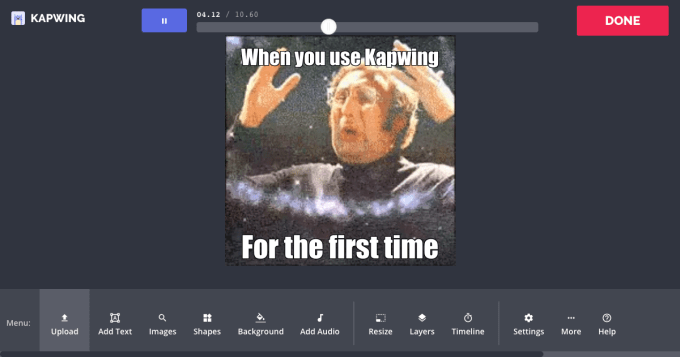
Copycats are trying to chip away at its business, but Kapwing will use its new funding to keep up a breakneck pace of development. Pronounced “Ka-Pwing,” like a bullet ricochet, it’s trying to stay ahead of Imgflip, ILoveIMG, Imgur’s on-site tool and more robust apps like Canva.
If you’ve ever been stuck with a landscape video that won’t fit in an Instagram Story, a bunch of clips you want to stitch together or the need to subtitle something for accessibility, you’ll know the frustration of lacking a purpose-built tool. And if you’re on mobile, there are even fewer options. Unlike some software suites you have to install on a desktop, Kapwing works right from a browser.

” ‘Memes’ is such a broad category of media nowadays. It could refer to a compilation like the political singalong videos, animations like Shooting Star memes or a change in music like the AOC Dancing memes,” Enthoven explains. “Although they used to be edgy, memes have become more mainstream . . . Memes popularized new types of multimedia formats and made raw, authentic footage more acceptable on social media.”
As communication continues to shift from text to visual media, design can’t only be the domain of designers. Kapwing empowers anyone to storytell and entertain, whether out of whimsy or professional necessity. If big-name creative software from Adobe or Apple don’t simplify and offer easy paths through common use cases, they’ll see themselves usurped by the tools of the people.
Powered by WPeMatico
Engage:BDR announced today that it has raised $23.25 million in new funding.
CEO Ted Dhanik told me that this includes both debt and equity funding, and will be used to grow the company’s NetZero payments program.
NetZero is designed to address the ongoing issue of long delays faced by publishers before they get paid by advertisers. Dhanik said “the terms are getting worse and worse,” with publishers being asked to wait 30, 60, 90 or even 120 days after they invoice their advertising partners before payment.
Other companies like FastPay have tried to fill in the gap, but Dhanik said these loans can have interest rates as high as 25%. So the team at Engage:BDR (which is publicly traded on the Australian Securities Exchange) asked itself: “Hey, what if we could just pay publishers the exact same day that they invoice us?”
Rather than making money by charging interest, Dhanik said his company is trying to drive more publishers to its programmatic advertising platform.
“We just want the business — the incremental revenue,” he said.
Engage:BDR says web, mobile and connected TV publishers in North America, Australia and Europe are eligible to participate in the NetZero program, though they’ll need to be approved by the company first.
“If you think about NetZero, you might think: Hey, if there’s fraud, it’s pretty dangerous you don’t have the ability to clawback [the payment],” Dhanik said. But apparently Engage:BDR has “a lot of technology in place to qualify them pretty quickly, within the first few days.”
Powered by WPeMatico
Lookiero, the online personal shopping service for clothes and accessories, has closed a $19 million funding round led by London-based VC MMC Ventures, with support from existing investor All Iron Ventures, and new investors Bonsai Partners, 10x and Santander Smart. The company will use the backing to expand in its main markets of Spain, France and the U.K. In June last year it closed a funding round of €4 million led by All Iron Ventures.
The startup applies algorithms to a database of personal stylists and customer profiles to thus provide a personalized online shopping experience to its customers. It then delivers a selection of five pieces of clothing or accessories curated by a personal shopper to fit the customer’s individual size, style and preferences. Customers then decide which items to keep or return (at no additional cost), allowing Lookiero to learn more about the customer’s taste before starting the whole process again.
By generating look-a-like profiles and analyzing previous customer interactions with each item, Lookiero says it can predict how likely a user is going to keep a certain item from a range of more than 150 European brands from a warehousing system that will ship more than 3 million items of clothing this year to seven European countries.
It’s not unlike the well-worn Birchbox model. Lookiero’s main competitor is Stitch Fix (U.S.), which has upwards of $1.5 billion in annual revenues and IPO’d in November 2017.
Founded in 2015 by Spanish entrepreneur Oier Urrutia, the company says it now has over 1 million registered users and has grown revenue by more than 200% from 2017 to 2018.
In a statement Urrutia said: “This investment round provides us with the necessary capital to further increase the accuracy of our technology, which is really exciting. It will allow us to offer the best possible experience for our users and to continue expanding across Europe.”
Simon Menashy, partner, MMC Ventures, said: “The migration of fashion brands online has improved consumers’ access to clothing, and there is now an almost overwhelming amount of choice. At the same time, it can still be really hard to find exactly what is right for you, especially with High Street retail stores in decline. Lookiero provides the best of both worlds, giving every customer a hand-picked selection from their personal stylist.”
Ander Michelena, co-founding partner of All Iron Ventures, said: “Even if what Oier and his team have achieved to date is remarkable, we believe that Lookiero still has great potential to continue expanding internationally and to become a player of reference in a market segment where there is still a lot to do in terms of innovation and user satisfaction.”
Powered by WPeMatico
You don’t see a startup get a $50 million seed round all that often, but such was the case with Vianai, an early-stage startup launched by Vishal Sikka, former Infosys managing director and SAP executive. The company launched recently with a big check and a vision to transform machine learning.
Just this week, the startup had a coming out party at Oracle Open World, where Sikka delivered one of the keynotes and demoed the product for attendees. Over the last couple of years, since he left Infosys, Sikka has been thinking about the impact of AI and machine learning on society and the way it is being delivered today. He didn’t much like what he saw.
It’s worth noting that Sikka got his PhD from Stanford with a specialty in AI in 1996, so this isn’t something that’s new to him. What’s changed, as he points out, is the growing compute power and increasing amounts of data, all fueling the current AI push inside business. What he saw when he began exploring how companies are implementing AI and machine learning today was a lot of complex tooling, which, in his view, was far more complex than it needed to be.
He saw dense Jupyter notebooks filled with code. He said that if you looked at a typical machine learning model, and stripped away all of the code, what you found was a series of mathematical expressions underlying the model. He had a vision of making that model-building more about the math, while building a highly visual data science platform from the ground up.
The company has been iterating on a solution over the last year with two core principles in mind: explorability and explainability, which involves interacting with the data and presenting it in a way that helps the user attain their goal faster than the current crop of model-building tools.
“It is about making the system reactive to what the user is doing, making it completely explorable, while making it possible for the developer to experiment with what’s happening in a way that is incredibly easy. To make it explainable means being able to go back and forth with the data and the model, using the model to understand the phenomenon that you’re trying to capture in the data,” Sikka told TechCrunch.
He says the tool isn’t just aimed at data scientists, it’s about business users and the data scientists sitting down together and iterating together to get the answers they are seeking, whether it’s finding a way to reduce user churn or discover fraud. These models do not live in a data science vacuum. They all have a business purpose, and he believes the only way to be successful with AI in the enterprise is to have both business users and data scientists sitting together at the same table working with the software to solve a specific problem, while taking advantage of one another’s expertise.
For Sikka, this means refining the actual problem you are trying to solve. “AI is about problem solving, but before you do the problem solving, there is also a [challenge around] finding and articulating a business problem that is relevant to businesses and that has a value to the organization,” he said.
He is very clear, that he isn’t looking to replace humans, but instead wants to use AI to augment human intelligence to solve actual human problems. He points out that this product is not automated machine learning (AutoML), which he considers a deeply flawed idea. “We are not here to automate the jobs of data science practitioners. We are here to augment them,” he said.
As for that massive seed round, Sikka knew it would take a big investment to build a vision like this, and with his reputation and connections, he felt it would be better to get one big investment up front, and he could concentrate on building the product and the company. He says that he was fortunate enough to have investors who believe in the vision, even though as he says, no early business plan survives the test of reality. He didn’t name specific investors, only referring to friends and wealthy and famous people and institutions. A company spokesperson reiterated they were not revealing a list of investors at this time.
For now, the company has a new product and plenty of money in the bank to get to profitability, which he states is his ultimate goal. Sikka could have taken a job running a large organization, but like many startup founders, he saw a problem, and he had an idea how to solve it. That was a challenge he couldn’t resist pursuing.
Powered by WPeMatico
Postmates, the popular food delivery service, has raised another $225 million at a valuation of $2.4 billion, the company confirmed to TechCrunch on Thursday, ahead of an imminent initial public offering.
Private equity firm GPI Capital has led the investment, first reported by Forbes, which brings Postmates’ total funding to nearly $1 billion. GPI takes non-controlling stakes — between 2% and 20% — in both late-stage private companies and publicly listed ventures.
After tapping JPMorgan Chase and Bank of America to lead its float, Postmates filed privately with the Securities and Exchange Commission for an IPO earlier this year. Sources familiar with the company’s exit plans say the business intends to publicly unveil its IPO prospectus this month.
To discuss the company’s journey to the public markets and the challenges ahead in the increasingly crowded food delivery space, Postmates co-founder and chief executive officer Bastian Lehmann will join us onstage at TechCrunch Disrupt on Friday October 4th.
As Forbes noted, last-minute financings are critical for companies poised to run out of cash and in need of an infusion prior to hitting the public markets. The motives for Postmates’ last-minute financing are unclear; however, the company will certainly begin trading on the stock market at an interesting time. 2019 has proven to be the year of unicorn listings, and former Silicon Valley darlings like Uber and Lyft have struggled to stabilize since their multi-billion-dollar debuts, despite years of support and coddling from venture capitalists.
Meanwhile, activity in the food delivery space has distracted from Postmates’ prospects. DoorDash, for one, recently purchased another food delivery service, Caviar, from Square in a deal worth $410 million. Uber is said to have considered buying Caviar, which had been looking for a buyer at least since 2016, according to Bloomberg. Postmates, for its part, has long been the subject of M&A rumors.
On-demand food delivery, undeniably popular, has yet to prove its long-term viability as a money-making business. At the very least, a sizeable check from a private equity firm ensures Postmates has the capital it needs, for the time being, to accelerate growth and double down on its autonomous robotic delivery ambitions.
Founded in 2011, Postmates is also backed by Spark Capital, Founders Fund, Uncork Capital, Slow Ventures, Tiger Global, Blackrock and others.
Powered by WPeMatico
After a week of launching new services to bring payments giant Stripe into the areas of lending and credit, the company is announcing another big step forward to fuel its growth: it’s raising another $250 million in funding at a pre-money valuation of $35 billion, money to fuel more international expansion, launching more products and targeting larger enterprise-sized businesses.
This is a huge jump in valuation for the company: Stripe was valued at $22.5 billion earlier this year when it raised $100 million.
The startup said that General Catalyst, Andreessen Horowitz and Sequoia are all in the round already. We’ve also heard that SoftBank had been considering an investment. “It was a big miss when SoftBank didn’t invest two years ago,” one source close to the VC said to TechCrunch. But we’ve confirmed also with John Collison — the president of Stripe who co-founded the company with his brother Patrick (who is the CEO) — that SoftBank is not in this round.
Nor will there be any corporate strategics involved in this round. Of note, Collison today confirmed that the bank providing the financial backing for its new cash advance and corporate card services is Celtic Bank, based in Salt Lake City. But the bank is not taking a strategic investment in the company as part of that deal.
Although the round is not yet closed, Collison said the $250 million size is unlikely to change. The round should close in the next several weeks, he added.
Stripe has long been reluctant to talk about when it might consider going public, and this round will put that prospect off even further. “We are still very happy as a private company,” Collison said today. “Our emphasis remans on the long-term opportunities.”
Stripe spent the first several years of its life slowly building up its payments business — which primarily consisted of providing an API to e-commerce businesses so that they could easily integrate a payments option in their apps or websites.
But in more recent years, it’s started to accelerate its growth with a significantly larger range of financial services — notably, now it describes its business as a “Global Payments and Treasury Network.” The latest products — cash advances and credit cards — are coming on the heels of other services that include incorporation services, fraud protection and and more.
All this means not only that the company can diversify its own revenues, but it can differentiate itself from (or, in some cases, offer the same services as) its competitors. Others offering similar services to Stripe’s include PayPal and Adeyn on the payments front, but as it adds more services, it’s also opening new competitive fronts with other rivals, now including Square, Brex and Clearbanc.
While the U.S. remains Stripe’s main market, especially for new launches, it’s getting increasingly global. The company last week expanded its payments out to eight more countries and that is set to expand again to total 40 in the coming months.
The company says it processes “hundreds of billions of dollars a year for millions of businesses worldwide,” although it declines to give specific numbers. Wayfair, Airbnb, Twilio, GitHub and The RealReal are among the kind of “enterprise” customers that it hopes to target more. Indeed, as startups in e-commerce grow into huge businesses, they are turning from being the kinds of small companies that Stripe used to target into the big companies that it now wants to target.
“This comes in the context of the fact that we feel strongly about Stripe’s role in the growing internet economy,” Collison said.
As we have pointed out before, the internet economy, for all its seeming ubiquity, is still a small part of all commerce, which is one reason brick and mortar is likely to be another target for Stripe in the long run, building on the point-of-sale services it already provides — even as the company continues to reap the rewards of its traction in the digital universe.
“Even now, in 2019, less than eight percent of commerce happens online,” said John Collison, president and co-founder of Stripe, in a statement announcing the round. “We’re investing now to build the infrastructure that’ll power internet commerce in 2030 and beyond. If we get it right, we can help the internet fulfill its potential as an engine for global economic progress.”
Updated with comments from John Collison, the co-founder of Stripe
Powered by WPeMatico
Of the 1.3 billion people who live in India, more than 100 million of whom are using digital payment apps each day, only about 20 million today invest in mutual funds and stocks. An Indian startup that is betting on changing that figure by courting millennials has just received a big backing.
Groww, a Bangalore-based startup, said today it has raised $21.4 million in a Series B financing round that was led by U.S.-based VC firm Ribbit Capital. Existing investors Sequoia India and Y Combinator also participated in the round, said the two-year-old startup that has raised about $29 million to date.
Groww allows users to invest in mutual funds, including systematic investment planning (SIP) and equity-linked savings. The app, which maintains a very simplified user interface to make it easier for its largely millennial customer base to comprehend the investment world, offers every fund that is currently available in India.
Lalit Keshre, co-founder and CEO of Groww, told TechCrunch in an interview earlier this week that the market of mutual funds is increasingly widening in India and the startup is hoping to accelerate its growth with the fresh capital. Other than that, he plans to double Groww’s headcount to 200 in the coming months.
Groww has amassed about 2.5 million registered users, two-thirds of whom are first-time investors, Keshre said. Groww is currently free to use and does not charge any commission on transactions. The startup eventually plans to offer a paid service as it looks to monetize its user base, but Keshre declined to share a timeline on how soon that would happen.
Groww will also soon begin to offer the ability to purchase stocks from its eponymous app, said Keshre, a former executive at Flipkart who co-founded Groww with three other Flipkart colleagues (Harsh Jain, Neeraj Singh and Ishan Bansal).
In a statement, Micky Malka, founder of Ribbit Capital, said, “We backed the Groww team because we believe in their mission. They have built the most trusted product in this space and are on the path to create a category-defining product.”
Ribbit Capital has made a number of investments in India in recent months. Last month, it invested in Cred, a startup that is trying to improve the financial behavior of credit card holders, and BharatPe, a payments solution for businesses.
In recent years, a number of startups such as INDWealth and Cube Wealth have emerged in India to offer wealth management platforms to the country’s growing internet population. Many established financial firms such as Paytm have also expanded their offerings to include investments in mutual funds.
Ashish Agarwal, a principal partner at Sequoia Capital India, said, “Investment products such as mutual funds and stocks were traditionally sold offline through financial advisors, who were mis-incentivized to sell high-commission products. Groww is taking a refreshing approach with a zero-commission mobile first model, enabling investors to make their own investment choices through a slick and easy user interface.”
Powered by WPeMatico
Darkstore, the tech-driven fulfillment solution to enable e-commerce companies to offer same-day delivery, just raised a $21 million Series B round led by EQT Ventures. The deal will bring EQT principal Laura Yao to Darkstore’s board of directors.
This Series B round comes less than one year after Darkstore raised a $7.5 million Series A round. In total, Darkstore has raised more than $30 million in funding.
Darkstore works by exploiting excess capacity in storage facilities, malls and bodegas and enables them to be fulfillment centers with just a smartphone. The idea is that brands without local inventory can store it in a Darkstore and then ship out same-day. Darkstore charges brands across three areas: fulfillment, storage and delivery.
“Consumer expectations are relentless,” Yao told TechCrunch via email. “We want things now, now, now. Obviously, it’s in a brand’s best interest to be able to meet those demands. The amazing team at Darkstore has built a platform-agnostic, cost-effective way for brands to do so, and in the process has unlocked a new revenue stream for urban infrastructure, and created valuable partnerships with last-mile delivery services.”
Currently, Darkstore has more than 600 fulfillment centers across 39 cities in the U.S., including Honolulu, Toledo, Ohio and Omaha, Neb.
Darkstore is unable to share the full roster of its customers, but it has worked with the likes of Nike, premium headphones maker Master & Dynamic, mattress startup Tuft & Needle and others. With the additional funding, Darkstore plans to grow the general team, as well as the management team.
Yao added, “We’ve worked with Lee [founder Lee Hnetinka] and the team for over a year and have been able to see this Darkstore flywheel come to life, and are excited to see what the future holds.”
Powered by WPeMatico
Ginkgo Bioworks is now worth $4 billion after a $290 million capital infusion that will give the company the cash to dramatically expand its developer shop for genetic programming.
The Boston-based company is one of a handful of U.S.-based early-stage companies that are on the forefront of developing the tools to modify genetic material for everyday applications.
“Cells are programmable similar to computers because they run on digital code in the form of DNA,” said Jason Kelly, CEO and co-founder of Ginkgo Bioworks, in a statement. “Ginkgo has the best compiler and debugger for writing genetic code and we use it to program cells for customers in a range of industries. Today’s fundraise will allow us to expand our technology and continue our drive to bring biology into every physical goods industry — materials, clothing, electronics, food, pharmaceuticals and more. They are all biotech industries but just don’t know it yet.”
Ginkgo makes money in two ways. The company sells its development services to anyone who comes in with an idea. Kelly said that it’d be like any agreement with an entrepreneur who hires a coding shop to develop an application.
For example, if an entrepreneur wanted to develop houseplants that smelled like roses or lilies, they could approach Ginkgo, pay a (not-insignificant) fee and Ginkgo would do the research into designing something like a lily-scented fern. (Kelly puts the sticker price on that kind of development somewhere in the neighborhood of $10 million, so a founder best believe their product can sell.)
“You don’t need to come in with deep biological know-how,” Kelly says. “The question is, is capital interested in the problem?”
The other way that Ginkgo is approaching the market is by taking equity stakes in businesses that rely on its technology.
Those take the form of joint ventures with companies like Bayer (the first joint venture partner for Ginkgo) and the launch of Joyn, a $100 million spin-out that was created in the summer of 2018.
The two companies are collaborating on the development of seeds that require less fertilizer for growth — something that could save the industry millions and decrease pollution associated with traditional chemical fertilizers.
Since that first spin-out, Ginkgo has created three other companies and joint ventures. There’s the $122 million deal to produce rare cannabinoids with the Canadian cannabis company, Cronos; a partnership with Roche that was born out of Ginkgo’s acquisition of Warp Drive Bio; and Motif Foodworks, which is working on manufacturing alternative proteins with a $120 million in financing.*
Alongside these large-scale initiatives, Ginkgo has signed partnerships with the West Coast powerhouse accelerator program from Y Combinator and a new Boston-based life sciences-focused group called Petri to conduct development work for startups from those programs in exchange for an equity stake.
“We’re not going to have all the good ideas,” says Kelly. “We want to tap the much larger pool of smart people and really have them building on our platform. Of all of the people we can give value to, we can give the most to startups. If we can offer them to do their biowork without all of the fixed costs of building a lab,” that’s valuable, he says.
Investors in the company include Y Combinator, DCVC, MassChallenge, Felicis Ventures, General Atlantic, Baillie Gifford, Bill Gates and Viking Global.
Powered by WPeMatico