Recent Funding
Auto Added by WPeMatico
Auto Added by WPeMatico
Another afternoon, another round of funding for a mobile banking app. This time, it’s Empower Finance, a San Francisco-based company that’s headed up by former Sequoia Capital partner Warren Hogarth and which just closed on $20 million in Series A funding from Icon Ventures and Defy Ventures.
David Velez, who is the founder and CEO of Nubank, the largest fintech in Latin America, also joined the round.
We’d first written about the company in 2017, when Hogarth was just getting the business off the ground. Fast-forward a bit and Empower now employs 35 people and has attracted more than 600,000 active users to its platform, says Hogarth. What has drawn them in: the company’s promise of combining AI and actual human financial planners to help millennials in particular accrue some wealth, including, more newly, through its own checking account product and through a savings account that’s currently promising 1.60% in annual percentage yield with no minimums, no overdraft fees and unlimited withdrawals.
It’s all part of an overall offering that crunches through account holders’ bank and credit card accounts, and recommends how much they save into which account, how much they should spend given their overall picture, various ways they can cut costs and where and when they’ve surpassed their pre-configured budgets.
Of course, the company has so much competition it’s dizzying, but like the various upstarts against which it’s battling for mindshare, the opportunity that Empower is chasing is enormous, too. Though companies like Chime can seem overpriced given how fast investors have marked up their rounds — Chime’s newest financing, announced in December, was done at a $5.8 billion post-money valuation, which was four times more than the company was worth at the outset of 2019 — digital banks are still tiny fish in an ocean of institutional financial services, representing something like 3% of the market.
They’re gaining more market share by the day, too, including by charging far lower fees for much more.
In Empower’s case, users pay $6 a month, but Hogarth says they also save $300 a year in additional fees they would pay a brick-and-mortar bank. He insists that on average, it also helps them save $1,300 more annually, too.
As for all those other companies — Mint, Acorns, the list goes on — Hogarth sounds surprisingly sanguine. “If you look at it from the outside, it looks crowded. But the consumer financial services in the U.S. is a $2 trillion business, and we haven’t had a fundamental shift since maybe Schwab came along 30 years ago.”
Indeed, says Hogarth, because Empower and its rivals are mobile and branchless and don’t have legacy software to contend with, they’re able to take 60 to 70% of the cost structure out of the business.
What that means on an individual company level is that even if each upstart can attract 2 to 3 million customers, they can get to a multibillion-dollar market cap. At least, that kind of math is “why there’s so much interest in this space,” says Hogarth.
It’s also why people like Nubank’s Velez, who have seen this story play out in Europe and Latin America and who are seeing the early phases of it in the U.S., are apparently keeping the money spigot open for now.
Empower had earlier raised an undisclosed amount of seed funding from Sequoia, followed by a $4.5 million round led by Initialized Capital.
Powered by WPeMatico
One of the more interesting and useful applications of artificial intelligence technology has been in the world of biotechnology and medicine, where now more than 220 startups (not to mention universities and bigger pharma companies) are using AI to accelerate drug discovery by using it to play out the many permutations resulting from drug and chemical combinations, DNA and other factors.
Now, a startup called Turing — which is part of the current cohort at Y Combinator due to present in the next Demo Day on March 22 — is taking a similar principle but applying it to the world of building (and “discovering”) new consumer packaged goods products.
Using machine learning to simulate different combinations of ingredients plus desired outcomes to figure out optimal formulations for different goods (hence the “Turing” name, a reference to Alan Turing’s mathematical model, referred to as the Turing machine), Turing is initially addressing the creation of products in home care (e.g. detergents), beauty and food and beverage.
Turing’s founders claim that it is able to save companies millions of dollars by reducing the average time it takes to formulate and test new products, from an average of 12 to 24 months down to a matter of weeks.
Specifically, the aim is to reduce all the time it takes to test combinations, giving R&D teams more time to be creative.
“Right now, they are spending more time managing experiments than they are innovating,” Manmit Shrimali, Turing’s co-founder and CEO, said.
Turing is in theory coming out of stealth today, but in fact it has already amassed an impressive customer list. It is already generating revenues by working with eight brands owned by one of the world’s biggest CPG companies, and it is also being trialed by another major CPG behemoth (Turing is not disclosing their names publicly, but suffice it to say, they and their brands are household names).
Turing is co-founded by Shrimali and Ajith Govind, two specialists in data science that worked together on a previous startup called Dextro Analytics. Dextro had set out to help businesses use AI and other kinds of business analytics to help with identifying trends and decision making around marketing, business strategy and other operational areas.
While there, they identified a very specific use case for the same principles that was perhaps even more acute: the research and development divisions of CPG companies, which have (ironically, given their focus on the future) often been behind the curve when it comes to the “digital transformation” that has swept up a lot of other corporate departments.
“We were consulting for product companies and realised that they were struggling,” Shrimali said. Add to that the fact that CPG is precisely the kind of legacy industry that is not natively a tech company but can most definitely benefit from implementing better technology, and that spells out an interesting opportunity for how (and where) to introduce artificial intelligence into the mix.
R&D labs play a specific and critical role in the world of CPG.
Before eventually being shipped into production, this is where products are discovered; tested; tweaked in response to input from customers, marketing, budgetary and manufacturing departments and others; then tested again; then tweaked again; and so on. One of the big clients that Turing works with spends close to $400 million in testing alone.
But R&D is under a lot of pressure these days. While these departments are seeing their budgets getting cut, they continue to have a lot of demands. They are still expected to meet timelines in producing new products (or often more likely, extensions of products) to keep consumers interested. There are a new host of environmental and health concerns around goods with huge lists of unintelligible ingredients, meaning they have to figure out how to simplify and improve the composition of mass-market products. And smaller direct-to-consumer brands are undercutting their larger competitors by getting to market faster with competitive offerings that have met new consumer tastes and preferences.
“In the CPG world, everyone was focused on marketing, and R&D was a blind spot,” Shrimali said, referring to the extensive investments that CPG companies have made into figuring out how to use digital to track and connect with users, and also how better to distribute their products. “To address how to use technology better in R&D, people need strong domain knowledge, and we are the first in the market to do that.”
Turing’s focus is to speed up the formulation and testing aspects that go into product creation to cut down on some of the extensive overhead that goes into putting new products into the market.
Part of the reason why it can take upwards of years to create a new product is because of all the permutations that go into building something and making sure it works as consistently as a consumer would expect it to (which still being consistent in production and coming in within budget).
“If just one ingredient is changed in a formulation, it can change everything,” Shrimali noted. And so in the case of something like a laundry detergent, this means running hundreds of tests on hundreds of loads of laundry to make sure that it works as it should.
The Turing platform brings in historical data from across a number of past permutations and tests to essentially virtualise all of this: It suggests optimal mixes and outcomes from them without the need to run the costly physical tests, and in turn this teaches the Turing platform to address future tests and formulations. Shrimali said that the Turing platform has already saved one of the brands some $7 million in testing costs.
Turing’s place in working with R&D gives the company some interesting insights into some of the shifts that the wider industry is undergoing. Currently, Shrimali said one of the biggest priorities for CPG giants include addressing the demand for more traceable, natural and organic formulations.
While no single DTC brand will ever fully eat into the market share of any CPG brand, collectively their presence and resonance with consumers is clearly causing a shift. Sometimes that will lead to acquisitions of the smaller brands, but more generally it reflects a change in consumer demands that the CPG companies are trying to meet.
Longer term, the plan is for Turing to apply its platform to other aspects that are touched by R&D beyond the formulations of products. The thinking is that changing consumer preferences will also lead to a demand for better “formulations” for the wider product, including more sustainable production and packaging. And that, in turn, represents two areas into which Turing can expand, introducing potentially other kinds of AI technology (such as computer vision) into the mix to help optimise how companies build their next generation of consumer goods.
Powered by WPeMatico
With just over one month to go until its official launch date, the short-form, subscription streaming service Quibi has closed on $750 million in new financing, according to a report in the company’s private PR firm The Wall Street Journal.
The company declined to disclose exactly who invested in the new round (which is always a great sign) and didn’t comment on how the new investment would effect the company’s valuation.
Chief Executive Officer Meg Whitman told the Journal that the new financing was made to ensure that the company would have the financial flexibility and runway to build a long-term business, but it’s likely that companies as diverse as Brandless and WeWork said the same thing about their goals when raising capital, as well.
According to the story in the WSJ, the company’s new investment contains both existing investors, like the Alibaba Group and Hollywood Studios, along with WndrCo, the investment firm and holding company launched by Quibi’s co-founder and Hollywood mogul Jeffrey Katzenberg.
To date, Quibi has raised $1.75 billion.
While the company touts its original approach to storytelling, and its list of marquee talent developing series for the app, the emphasis on short-form has been tried before by other companies (notably TechCrunch’s own parent company)… and the results were less than promising.
The idea that people need to consume short-form stories instead of … maybe just hitting the pause button… is interesting as an experiment to see what kinds of narratives or reality show-style entertainment needs to live behind a paywall rather than on YouTube or TikTok.
Perhaps Quibi will win with its slate of reality and narrative shows (which, to be honest, look pretty fun). The big names that Katzenberg and co-founder Meg Whitman promised are certainly on offer in the roster that is helpfully synopsized in a recent Entertainment Weekly article about the company’s programming.
Quibi, unlike some of the streaming services that it’s going to compete with, doesn’t have a back catalog of titles to tap to pad out the service, so it’s coming to market with a whopping 175 shows in its first year with 8,500 episodes, which run no longer than 10 minutes.
When it launches, there will be 50 shows on offer from the service. A lot depends on the reception of those shows. While many of the titles seem compelling, there are only a couple that seem to have the appeal to break through to the audience that Quibi hopes it can reach, and that will be willing to shell out money for its subscriptions.
The service is also hoping to differentiate itself by dropping new episodes daily — rather than weekly releases common on network television or the season-long binges that Netflix encourages.
The app itself seems to be fairly undifferentiated from the services available from other streamers. As we wrote when the company launched pre-orders for its app in February:
Much has been made about Quibi’s potential to reimagine TV by taking advantage of mobile technology in new ways, but the app itself looks much like any other streaming service, save for its last app store screenshot showing off its TurnStyle technology.
The app appears to favor a dark theme common to streaming apps, like Netflix and Prime Video, with just four main navigation buttons at the bottom.
The first is a personalized For You page, where you’re presented a feed where you’ll discover new things Quibi thinks you’ll like.
A Search tab will point you toward trending shows and it will allow you to search by show titles, genre or even mood.
The Following tab helps you keep track of your favorite shows and a Downloads tab keeps track of those you’ve made available for offline viewing.
Otherwise, Quibi’s interface is fairly simple. Shows are displayed with big images that you flip through either vertically on your home feed or both horizontally and vertically as you move through the Browse section.
The company does promote its TurnStyle viewing technology in its app store description, though it doesn’t reference the technology by name. Instead, it describes it as a viewing experience that puts you in full control. “No matter how you hold your phone, everything is framed to fit your screen,” it says.
In vertical viewing mode, it also introduces controls that appear on either the left or right side the screen — you choose, based on whether you’re left or right-handed.
Quibi did not formally announce the app was open for pre-order.
The startup, founded by Jeffrey Katzenberg, is backed by more than a billion dollars — including a recently closed $400 million round.
Despite the doubt surrounding its success, Quibi managed to sell out of the initial $150 million in available advertising for the service’s first year.
Whether it’s as big of a hit with potential subscribers as with advertisers remains to be seen. The service could still become the Mike Bloomberg campaign of streaming media — a lot of money and no discernible result.
Powered by WPeMatico
We are still years away from a time when fully-autonomous cars will be able to drive us from A to B, and the complexity of getting to that point is likely going to need hundreds of billions of dollars of investment before it becomes a reality.
That hard truth is now leading to some shifts in the self-driving startup landscape. England’s Five (formerly known as FiveAI), one of the more ambitious companies in the space, is moving away from its original plan, of designing its own fully self-driving cars, and then running fleets of them in its own transportation service. Instead, it plans to license technology — starting with software to help test and measure the accuracy of a vehicle’s driving systems –that it has created to others building autonomous cars as well as the wider service ecosystem that will exist around that. As part of that pivot, today it’s also announcing a fresh $41 million in funding.
“A year and a bit ago we thought we would probably build the entire thing and take it to market as a whole system,” said co-founder and CEO Stan Boland in an interview. “But we gradually realised just how deep and complex that would be. It was probably through 2019 that we realised that the right thing to do is to focus in on the key pieces.”
The funding, a Series B, includes backing from Trustbridge Partners, insurance giant Direct Line Group and Sistema VC, as well as previous investors Lakestar, Amadeus Capital Partners, Kindred Capital and Notion Capital. The company has now raised $77 million and while it’s not disclosing its valuation, Boland said that it was definitely up on its last round. (Its Series A, in 2017, was for $35 million.)
Five’s change in course is a significant development: the high-profile startup, founded by a team that had previously built and sold several chip companies to the likes of Broadcom, Nvidia and Huawei, had been the leading partner for a big government-backed pilot project, StreetWise, to test and work on autonomous driving systems across boroughs in London. The most recent phase of that project, running driver-assisted rides along a 19-km route across south London, got off the ground only last October after initially getting announced in 2018.
Five might continue to work on research projects like these, Boland said, but the primary business aim for the company will no longer be ultimately to build cars for themselves, but to work on tech that will be sold either to other carmakers, or those building services catering to the autonomous industry.
For example, Direct Line, one of Five’s new investors and also a participant in the StreetWise project, could use testing and measurement to determine risk and pricing for insurance packages for different vehicles.
“Autonomous and assisted driving technology is going to play a huge role in the future of cars,” said Gus Park, MD of Motor Insurance at Direct Line Group, in a statement. “We have worked closely with Five on the StreetWise project, and we share a common interest in solving the formidable challenges that will need to be addressed in bringing safe self-driving to market. Insurers will need to build the capability to measure and underwrite new types of risk. We will be collaborating with Five’s world-class team of scientists, mathematicians and engineers to gain the insight needed to build safe, insurable solutions and bring the motoring revolution ever closer.” Park is also joining Five’s board with this round.
There were already a number of big players in the self-driving space when FiveAI launched — they included the likes of Waymo, Cruise, Uber, Argo AI and many more — and you could have argued that the writing was already on the wall then for long-term consolidation in the industry. Indeed, there have been some significant casualties in the meantime, including Drive.AI (which Apple acquired after it ran out of money), Oryx Vision and Quanergy.
Five’s argument for why a UK — and indeed, European — startup was in a good place to build and operate self-driving cars, and the tech underpinning it, was because of the complexity behind building localised systems: a big US or Asian company might be able to map the streets in Europe, but it wouldn’t have as good of a feel for how people behaved on those roads.
Yet while it may have been easy to see the potential, the process of getting to that point proved to be too challenging.
“What’s happened in the last couple of years is that there has been an appreciation across the industry of just how wide and deep the challenges are for bringing self driving to market,” Boland said. “Many pieces of the jigsaw have to be assembled…. The B2C model needs billions [of investment], but others are finding their niche as great providers of technology needed to deliver the systems properly.”
As FiveAI (named after the “Level 5” that self-driving systems attain when they are truly autonomous), the company built (hacked) vehicles with dozens of sensors and through its tests managed to build a significant trove of vehicle technology.
“We could offer tech in a dozen different areas that are hard for autonomous driving companies,” Boland said. Its testing and measuring tools point to one of the toughest challenges among these: how to assure that the deep learning software a company is using is correctly identifying objects, people, weather, and other physical factors when it may have never seen them before.
“We have learned a lot about the types of errors that propagate from perception into planning… and now we can use that for providing absolute confidence” to those testing the systems, he said.
Self-driving cars are one of the biggest AI challenges of our time: not only is the requirement to essentially build from the ground up computer systems that behave as well as (or ideally better) than multitasking humans behind the wheel; but the consequence of doing that wrong is not just a strange string of words, or some other kind of non sequitur, but injury or death. No surprise that there appears still a very long way to go before we see anything like Level 5 systems in action, but in the meantime, investors are willing to continue placing their bets. Partly because of how advanced it got with its car project on relatively little funding, Five remains an interesting company to investors, and Boland hopes that this will help it with its next round down the road.
“We invest in category-leading companies that are delivering transformational change wherever they’re located,” said David Lin of Trustbridge Partners in a statement. “As Europe’s leading self-driving startup, Five is the furthest ahead in developing a clear understanding of the scientific challenges and novel solutions that move the needle for the whole industry. Five has successfully applied Europe’s outstanding science and engineering base to create a world-class team with the energy and ambition to deliver safe self-driving. We are delighted to join them for this next phase of growth.”
Powered by WPeMatico
I was honestly surprised to find out from Sensel that the company is only just recently raising its Series A. The Sunnyvale-based hardware startup has been around since 2013, bringing its first product, the modular music and computing Morph peripheral, to market a few years back.
Over the past few years, however, the company’s been undergoing a bit of a slow motion pivot. As fascinating as the Morph has been, the multiple touch input device has proven to be something more akin to a proof of concept for Sensel. I’ve met with co-founder and CEO Ilya Rosenberg at CES the last couple of years and watched as it changed its outward facing focus from a standalone hardware offering to smartphone and tablet components.
The new $28 million Series A brings its total funding up to $38 million, courtesy of Susquehanna International Group, Morningside Group, SMiT, Palm Commerce Holdings Co. Ltd, Chariot Gold Limited, SV Tech Ventures and Innolinks Ventures. A big part of this funding will no doubt be used to play a role in that shift, as Sensel works with OEMs to bring its advanced sensing technology to different devices.
“Since Sensel’s founding in 2013, we’ve worked tirelessly to create a sensor that outperforms existing touch technologies on every metric and at a lower overall cost,” Rosenberg says in a release. “This financing brings us closer to our ultimate goal of improving how people experience the products they rely on every single day.”
Sensel notes that it will “continue supporting the Morph,” but the language seems to pretty heavily imply that the device will no longer be a focus — something the company more or less confirmed with me during our most recent meeting. But working with OEMs to implement its technologies on third-party device is potentially a much more lucrative way forward.
Powered by WPeMatico
Sonantic, a U.K. startup that has developed “human-quality” artificial voice technology for the games and entertainment industry, has raised €2.3 million in funding.
Leading the round is EQT Ventures, with participation from existing backers, including Entrepreneur First (EF), AME Cloud Ventures and Bart Swanson of Horizons Ventures. I also understand one of the company’s earlier investors is Twitch co-founder Kevin Lin.
Founded in 2018 by CEO Zeena Qureshi and CTO John Flynn as they went through EF’s company builder programme in London, Sonantic (previously Speak Ai) says it wants to disrupt the global gaming and entertainment voice industry. The startup has developed artificial voice tech that it claims is able to offer “expressive, realistic voice acting” on-demand for use by game studios. It already has R&D partnerships underway with more than 10 AAA game studios.
“Getting dialogue into game development is a slow, expensive and labour-intensive task,” says Qureshi, when asked to define the problem Sonantic wants to solve. “Dialogue pipelines consist of casting, booking studios, contracts, scheduling, editing, directing and a whole lot of coordination. Voiced narrative video games can take up to 10 years to make with game design changing frequently, defaulting game devs to carry out several iteration cycles — often leading to going over budgets and game releases being delayed.”
To help remedy this, Sonantic offers what Qureshi dubs “dynamic voice acting on-demand,” with the ability to craft the exact type of character in terms of gender, personality, accent, tone and emotional state. The startup’s human quality text-to-speech system is offered via an API and a graphical user interface tool that lets its synthetic voice actors be edited, sculpted and directed “just like a human actor,” she tells me.
This sees Sonantic work directly with actors to synthesise their voices whilst also harnessing their unique skills in performance. “We then augment how actors work by offering them a digital version of themselves that can create passive income for them,” explains the Sonantic CEO.
For the games studios, Sonantic offers faster iteration cycles at a cheaper price because it cuts down logistical costs and has voice models ready to perform. Its SaaS model and API also makes it easier to create audio performances to test out potential narratives or to finesse a story, helping with editing and directing.
Meanwhile, Sonantic says it is gearing up to publicly reveal how its technology can capture “deep emotions across the full spectrum,” from subtle all the way through to exaggerated, which it says is usually something only very skilled actors can achieve.
Powered by WPeMatico
The world of consumer banking has seen a massive shift in the last ten years. Gone are the days where you could open an account, take out a loan, or discuss changing the terms of your banking only by visiting a physical branch. Now, you can do all this and more with a few quick taps on your phone screen — a shift that has accelerated with customers expecting and demanding even faster and more responsive banking services.
As one mark of that switch, today a startup called Thought Machine, which has built cloud-based technology that powers this new generation of services on behalf of both old and new banks, is announcing some significant funding — $83 million — a Series B that the company plans to use to continue investing in its platform and growing its customer base.
To date, Thought Machine’s customers are primarily in Europe and Asia — they include large, legacy outfits like Standard Chartered, Lloyds Banking Group, and Sweden’s SEB through to “challenger” (AKA neo-) banks like Atom Bank. Some of this financing will go towards boosting the startup’s activities in the US, including opening an office in the country later this year and moving ahead with commercial deals.
The funding is being led by Draper Esprit, with participation also from existing investors Lloyds Banking Group, IQ Capital, Backed and Playfair.
Thought Machine, which started in 2014 and now employs 300, is not disclosing its valuation but Paul Taylor, the CEO and founder, noted that the market cap is currently “increasing healthily.” In its last round, according to PitchBook estimates, the company was valued at around $143 million, which, at this stage of funding, puts this latest round potentially in the range of between $220 million and $320 million.
Thought Machine is not yet profitable, mainly because it is in growth mode, said Taylor. Of note, the startup has been through one major bankruptcy restructuring, although it appears that this was mainly for organisational purposes: all assets, employees and customers from one business controlled by Taylor were acquired by another.
Thought Machine’s primary product and technology is called Vault, a platform that contains a range of banking services: checking accounts, savings accounts, loans, credit cards and mortgages. Thought Machine does not sell directly to consumers, but sells by way of a B2B2C model.
The services are provisioned by way of smart contracts, which allows Thought Machine and its banking customers to personalise, vary and segment the terms for each bank — and potentially for each customer of the bank.
It’s a little odd to think that there is an active market for banking services that are not built and owned by the banks themselves. After all, aren’t these the core of what banks are supposed to do?
But one way to think about it is in the context of eating out. Restaurants’ kitchens will often make in-house what they sell and serve. But in some cases, when it makes sense, even the best places will buy in (and subsequently sell) food that was crafted elsewhere. For example, a restaurant will re-sell cheese or charcuterie, and the wine is likely to come from somewhere else, too.
The same is the case for banks, whose “Crown Jewels” are in fact not the mechanics of their banking services, but their customer service, their customer lists, and their deposits. Better banking services (which may not have been built “in-house”) are key to growing these other three.
“There are all sorts of banks, and they are all trying to find niches,” said Taylor. Indeed, the startup is not the only one chasing that business. Others include Mambu, Temenos and Italy’s Edera.
In the case of the legacy banks that work with the startup, the idea is that these behemoths can migrate into the next generation of consumer banking services and banking infrastructure by cherry-picking services from the VaultOS platform.
“Banks have not kept up and are marooned on their own tech, and as each year goes by, it comes more problematic,” noted Taylor.
In the case of neobanks, Thought Machine’s pitch is that it has already built the rails to run a banking service, so a startup — “new challengers like Monzo and Revolut that are creating quite a lot of disruption in the market” (and are growing very quickly as a result) — can integrate into these to get off the ground more quickly and handle scaling with less complexity (and lower costs).
Taylor was new to fintech when he founded Thought Machine, but he has a notable track record in the world of tech that you could argue played a big role in his subsequent foray into banking.
Formerly an academic specialising in linguistics and engineering, his first startup, Rhetorical Systems, commercialised some of his early speech-to-text research and was later sold to Nuance in 2004.
His second entrepreneurial effort, Phonetic Arts, was another speech startup, aimed at tech that could be used in gaming interactions. In 2010, Google approached the startup to see if it wanted to work on a new speech-to-text service it was building. It ended up acquiring Phonetic Arts, and Taylor took on the role of building and launching Google Now, with that voice tech eventually making its way to Google Maps, accessibility services, the Google Assistant and other places where you speech-based interaction makes an appearance in Google products.
While he was working for years in the field, the step changes that really accelerated voice recognition and speech technology, Taylor said, were the rapid increases in computing power and data networks that “took us over the edge” in terms of what a machine could do, specifically in the cloud.
And those are the same forces, in fact, that led to consumers being able to run our banking services from smartphone apps, and for us to want and expect more personalised services overall. Taylor’s move into building and offering a platform-based service to address the need for multiple third-party banking services follows from that, and also is the natural heir to the platform model you could argue Google and other tech companies have perfected over the years.
Draper Esprit has to date built up a strong portfolio of fintech startups that includes Revolut, N26, TransferWise and Freetrade. Thought Machine’s platform approach is an obvious complement to that list. (Taylor did not disclose if any of those companies are already customers of Thought Machine’s, but if they are not, this investment could be a good way of building inroads.)
“We are delighted to be partnering with Thought Machine in this phase of their growth,” said Vinoth Jayakumar, Investment Director, Draper Esprit, in a statement. “Our investments in Revolut and N26 demonstrate how banking is undergoing a once in a generation transformation in the technology it uses and the benefit it confers to the customers of the bank. We continue to invest in our thesis of the technology layer that forms the backbone of banking. Thought Machine stands out by way of the strength of its engineering capability, and is unique in being the only company in the banking technology space that has developed a platform capable of hosting and migrating international Tier 1 banks. This allows innovative banks to expand beyond digital retail propositions to being able to run every function and type of financial transaction in the cloud.”
“We first backed Thought Machine at seed stage in 2016 and have seen it grow from a startup to a 300-person strong global scale-up with a global customer base and potential to become one of the most valuable European fintech companies,” said Max Bautin, Founding Partner of IQ Capital, in a statement. “I am delighted to continue to support Paul and the team on this journey, with an additional £15 million investment from our £100 million Growth Fund, aimed at our venture portfolio outperformers.”
Powered by WPeMatico
End Game Interactive CEO Yang C. Liu has a refreshingly straightforward description of what he and his co-founder Luke Zbihlyj are up to: “We’re just building games. And to be honest, we don’t know what we’re doing.”
Despite this self-proclaimed ignorance, End Game has just raised $3 million in seed funding from an impressive group of investors: The round was led by the game-focused firm Makers Fund, with participation from Clash of Clans developer Supercell, Unity CEO David Helgason, Twitch COO Kevin Lin, Twitch VP Hubert Thieblot, Danny Epstien and Alexandre Cohen of Main Street Advisors and music executive Scooter Braun.
Liu told me that he and Zbihlyj got their start by building websites tied to existing games, such as PokéVision, a site for finding Pokémon in Pokémon GO. However, they were inspired by the success of simple, browser-based multiplayer games like Slither.io to create games of their own — first Zombs.io, then Spinz.io, then Zombs Royale.
Altogether, End Game says its titles have attracted more than 160 million players, with 1 million people playing in a single day. Zombs Royale, in particular, seems to have been a hit — the battle royale game (where a single map can pit up to 100 players against each other) was one of 2018’s most Googled games in the United States.
Liu said the team’s success convinced them to focus their efforts on game development: “Do we want to make products that people simply use, or games that people think about out when they’re going to school, or going to work, or dream about?”
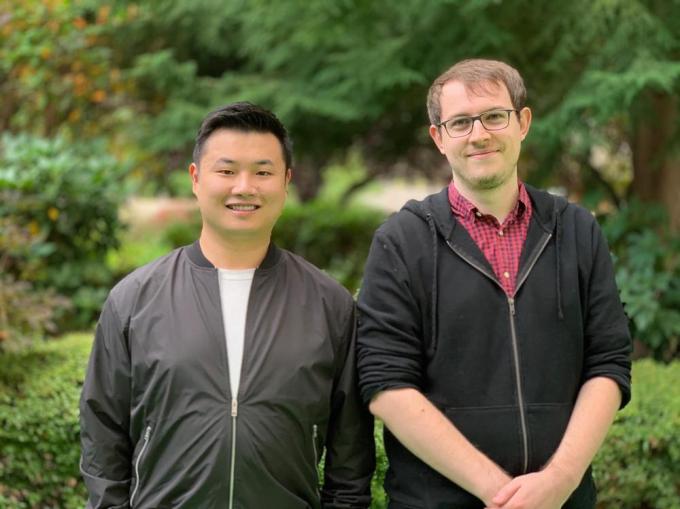
Zombs Royale was supposedly built in less than four weeks, but Liu said that after its launch in early 2018, the team spent most of the year maintaining and scaling the game. Then 2019 was all about building a team and creating the next game, Fate Arena, a title in the new Auto Chess genre that’s supposed to launch on PC, mobile and other platforms soon.
Liu noted that unlike End Game’s previous work, which featured simple 2D art (“On Zombs Royale and Spinz, I did the art, and it’s terrible”), Fate Arena will feature a “3D, high-fidelity art style.”
But even as the company’s games start looking a little less primitive, the goal is still to develop and iterate quickly. Liu said he hopes to fund “many tries” at building other cross-platform, multiplayer games with this seed round.
“We pride ourselves on rapid experimentation,” he said, adding that the key is “not biting off more than we can chew. We design [our games] to scale from the beginning. We don’t necessarily need to be World of Warcraft, where you need to make 100 quests as the baseline. We’re focused on games with a small starting point that can scale into something much bigger.”
Supercell Developer Relations Lead Jaakko Harlas made a similar point in a statement included in the funding announcement:
Many companies are quick to point out how fast-moving they are. Then you come across a team like this and realize what being lean and moving fast really means. Yang, Luke and the team have already shown that they can ship accessible games that showcase a real flair for fun, and we look forward to supporting them in their quest for the next big hit game.
Powered by WPeMatico
It wasn’t a fad. Yolo became the country’s No. 1 app just a week after launch by letting teens ask for anonymous replies to questions they posted on Snapchat. But nine months later, Yolo is still in the top 100 iOS apps and has 10 million active users. Now it’s safeguarding the app from predators while revealing a smart new feature for spinning up anonymous group chats, powered by $8 million in fresh funding.
“What we are trying to build is a new kind of network where there’s a fluidity to identity,” Yolo co-founder Greg Henrion tells me. “We weren’t sure if Yolo was here to stay, but we’re still ranking well and there seems to be a real opportunity in anonymity starting with Snapchat Q&A.”
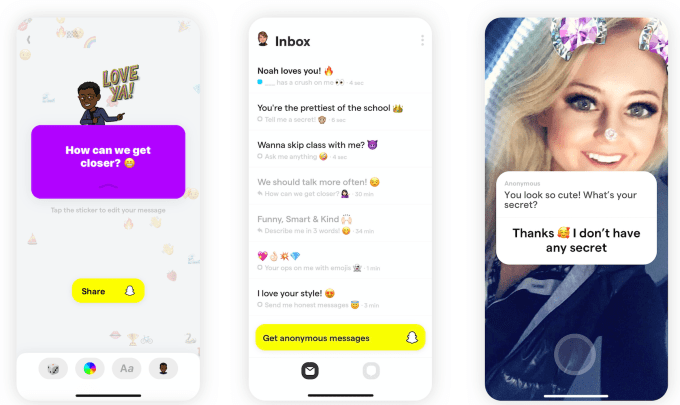
Yolo is the first big win for Snapchat’s Snap Kit platform that lets developers piggyback on its login, Bitmoji avatars, stickers and Stories. This lets tiny development teams build apps that hundreds of millions of people, teens in particular, can instantly sign up for in just a few taps. Another Snap Kit app for meeting new people called Hoop recently spiked to No. 2 on the charts
We haven’t seen this kind of social platform success since Zynga’s empire rose atop Facebook. Spawning more blockbusters like Yolo could ensure that a Snapchat account is a must-have utility for the next generation.
“For two weeks we basically didn’t sleep,” Henrion recalls about the chaos he and co-founder Clément Raffenoux endured after Yolo shot to No. 1 last May. “You’re trying to stay afloat. It was very, very wild.”
The basic premise of Yolo is that you write a question like, “Who’s my celebrity look alike?”, “What do people really think of me?” or “How could I be nicer?” You’re then switched over to Snapchat, where you can post the question in your Story or messages with a link back to Yolo. There, people can anonymously leave a response; you can post that and your reply with another post on Snapchat.

Yolo co-founder and CEO Greg Henrion, in real life and Bitmoji
The result is that friends and followers feel comfortable giving you real talk. They don’t have to sugarcoat their answers. And that makes people race to open Yolo each time they get a message. Yolo has seen 26 million downloads across iOS and Android globally, with nearly 70% in the U.S, according to Sensor Tower.
Other anonymous apps like tbh (acquired by Facebook) and Sarahah (kicked off the app stores) quickly faded, and others eventually imploded due to bullying, like Secret and YikYak. Although tbh hit No. 1 in September 2017, it was out of the top 500 by November. It seems a combination of inherent virality via Snapchat, easy user acquisition via Snap Kit and sharp product design has given Yolo some staying power. It still managed 2.2 million downloads last month versus a peak of 5.5 million in its first month back in May 2019.
 That June, Yolo quietly raised a $2 million seed round thanks to its sudden success. The team had been grinding since 2017 on a video reactions app called Popshow funded by a small pre-seed round from SV Angel, Shrug Capital and Product Hunt’s Ryan Hoover. They’d previously built music video-making app Mindie that eventually sold to influencer collective Shots Studios. Popshow never caught on, so the team began experimenting on Snap Kit, building a more official Q&A feature for Snapchat than predecessors like Sarahah and Polly. Then, boom. Days after launch, Yolo’s usage exploded.
But to keep users interested, Yolo needed to evolve. That would require more funding for the eight-person team split between Snapchat’s home of Los Angeles and Henrion’s home of Paris.
The concept of a social app where users could shift between full anonymity and representation via avatar attracted its $8 million Series A to invest in product and engineering. The round was led by Thrive Capital, Ron Conway’s A.Capital, former TechCrunch editor Alexia Tsotsis’ Dream Machine (also in the seed round), Shrug, Day One, Goodwater, Knight VC, ex-Facebooker Bobby Goodlatte, Twitter co-founder Biz Stone and SV Angel’s Brian Pokorny.

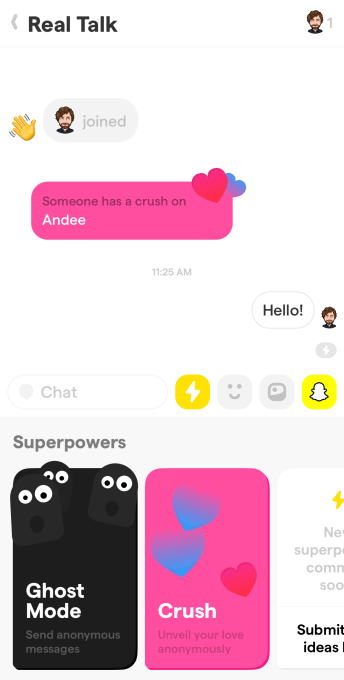 That cash fueled the release of Yolo’s new group chat feature. You can set up a chat room, give it a name and generate an invite URL or sticker you can post on Snapchat, just like its previous question feature. Friends or friends of friends that are already in can join the group chat, represented by their Bitmoji instead of their name. Yolo suggests people join the more open “party mode” chats where their friends are active.
What makes this special is that once an hour, users can tap the Yolo Superpowers button to send a totally anonymous message to the group. More Superpowers are coming, but there’s also an anonymous “Someone has a crush on [name]” message so you can secretly profess your affection to anyone or someone else in the chat.
“The limits of Q&A is that it doesn’t generate real conversation. It’s an ice breaker, but we also want conversations to happen,” Henrion stresses. “‘What do you think about this dress?’ The group chat is more about ‘let’s talk about the dress.’” The chats could be focused on people you actually know offline, or those you share interests with. The option to restrict group chats to either just your contacts or friends of friends “limits the amount of meeting strangers,” Henrion explains. “This is very different from the public communities like Reddit or the dating apps.”
Still, anonymous apps have consistently proven to be havens for cyberbullying and unsafe behavior. Without the accountability of having your name attached, people are free to say awful things. That can be even worse amongst teenagers who might get in trouble for being mean at school but not on an app.
Yolo first focused on messages blocking 10% of overall messages that contained offensive content. That meant blatant hate speech and trolling couldn’t spread through the app. “We’re strict on moderation. When looking at the reviews about bullying, it’s like nothing compared to any other anonymous app. I think we solved 90% of the problem.”

Now it’s working with Snapchat to safeguard the group chats feature. The goal is to ensure Yolo doesn’t actively recommend chat amongst adults to minors and vice-versa. Henrion says this update should roll out soon.
“It’s 2020 and we need to be very responsible” Henrion tells me. “Moderation and growth are the most difficult things to balance. It’s moderation first for sure. We don’t care about growth if it’s not healthy or sustainable.” The new funding also gives Yolo the luxury of pushing back monetization while it focuses on safely adding more users.

By making anonymity more private, Yolo has a chance to sidestep some of the worst elements of human behavior. Making fun of someone has less appeal if there’s no wider audience like trolls exploited in the feeds and comment reels of Secret and YikYak.
That could let the brighter side of anonymity shine through: vulnerability, honesty and deep connections that are enhanced by the absence of embarrassment. With all the change, uncertainty and anxiety that’s part of growing up, teens deserve a place where they can be open with each other and speak their minds. After all, you only live once.
Powered by WPeMatico

Every day, there’s another event-related cancellation owing to concern around coronavirus. Just today Microsoft announced it will not have a presence at the Game Developers Conference in mid-March “out of an abundance of caution.” Facebook also said today that it is canceling its annual F8 conference scheduled for May over coronavirus-outbreak concerns.
The last is a particularly big deal. F8 is by far the largest event that Facebook hosts every year, so it’s little wonder that it plans to host part of the event online.
Likely, Facebook will use its own tech toward this end. But there is a new option for other companies that are right now second-guessing their event plans, and that’s Run The World, a year-old, 18-person company that’s based in Mountain View, Calif., and has small teams both in China and Taiwan.
What it’s doing: smooshing together every functionality that a conference organizer might need in a time of a pandemic. Think video conferencing, ticketing, interactivity and networking.
Who’s backing it: Andreessen Horowitz largely, though the company — which has raised $4.3 million in seed funding — also counts as investors GSR Ventures, Pear Ventures, 122 West Ventures, Unanimous Capital, and angel investors like Kevin Weil, the VP of product at the Facebook subsidiary Calibra; Patreon co-founder Sam Yam; and Jetblue Airways Chairman Joel Peterson.
Who started it: Xiaoyin Qu, who is the CEO of the company and previously led products for both Facebook and Instagram (“basically anything to do with entertainment influencers and creators,” she says of part of her time at Facebook).
She dropped out Stanford’s MBA program after a year to start the company last year with Xuan Jiang, a former colleague who was a technical lead for Facebook events, ads and stories. (Jiang does have a master’s degree — one in computer science from the Georgia Institute of Technology.)
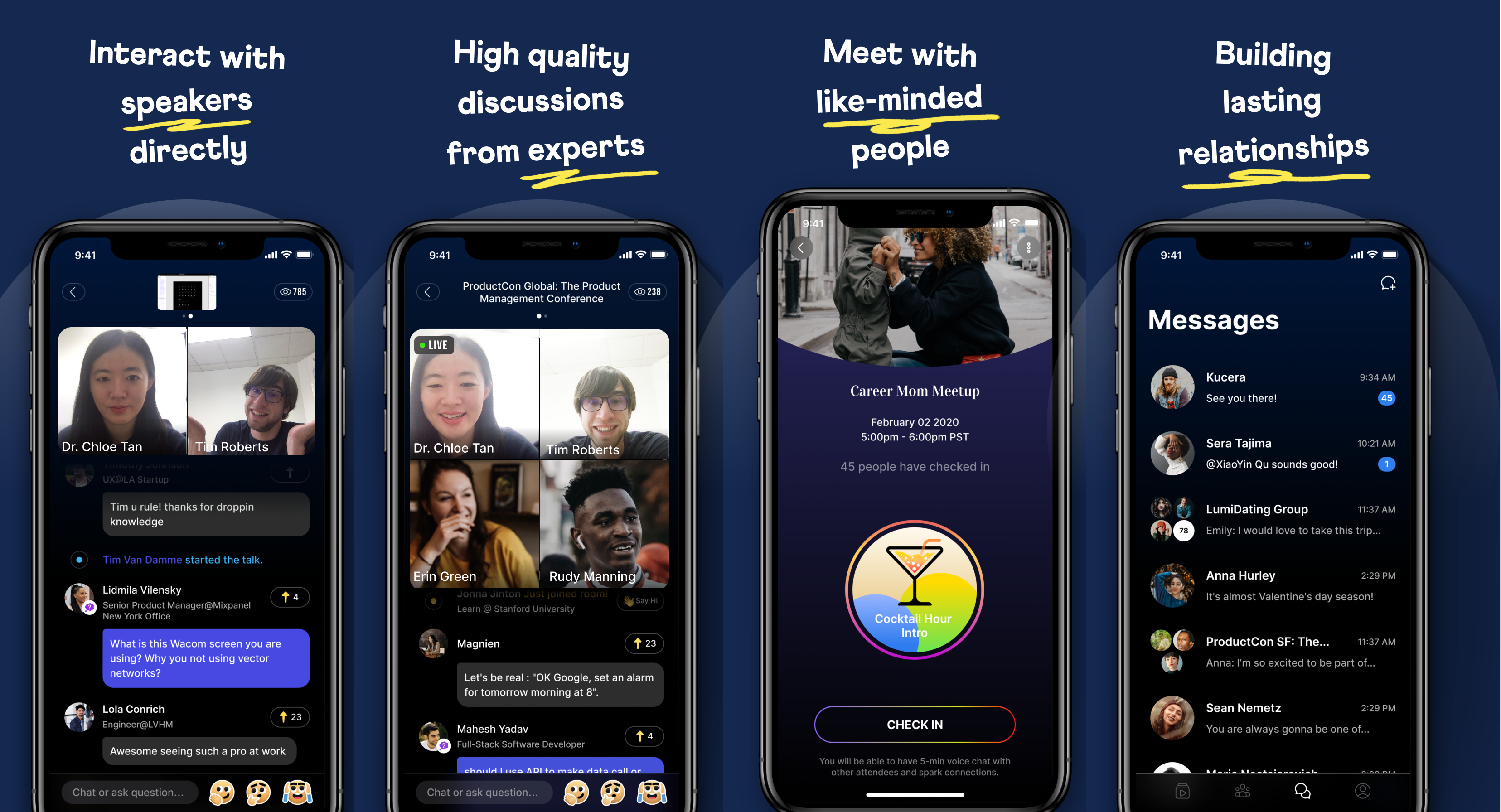
We talked with Qu yesterday after learning about the company from Connie Chan, the general partner who led the deal for a16z.
Qu says the impetus for the startup ties to her mother, a doctor in China who focuses on meningitis and traveled to a conference in Chicago in late 2018 where she made a connection with a Dubai-based physician who was able to share with her some rare, valuable insight into his own work around meningitis.
That might not seem so exceptional to those who travel regularly, but it was enough of an ordeal for Qu’s mother — who had to secure a visa; take off two weeks around the event, including for travel days; and spent a fortune on airfare and accommodations — that it was the first major trip she’d taken in 35 years.
As Qu half-joked, “It isn’t like at Stanford, where there are events held regularly that [local] doctors can even walk over to.”
Indeed, like a lot of founders who solve a pain point for themselves or someone they love, Qu wanted to create a platform where her mother could meet and have meaningful work connections with people regularly, and this would mean remotely, through digitized events.
Turns out, her timing is pretty good. Though numerous startups have launched live online events businesses in the past (many of them since shuttered), you can bet many more organizers are thinking about exactly the type of platform that Run The World is fine-tuning right now.
Though publicly launched just four months ago, it has already hosted dozens of events and has hundreds in the pipeline, says Qu. One of its customers is Wuhan2020, a large open-source community with more than 3,000 developers who will be using the platform as part of a long-distance hackathon that hopes to produce tech solutions to those affected by coronavirus in Wuhan.
Qu also points to an elephant conservation reserve in Laos that was recently able to raise $30,000 from donors from 15 countries in two weeks through a conference it organized on the platform. The reserve had a constrained budget, but being able to bring together a distributed audience (beyond just wealthy donors) for nearly zero overhead (no venue, no catering), turned it into a major success for the organization.
Smaller events are finding the platform, too. In just one instance, a dating coach who specializes in working with engineers recently held a workshop. Just 40 people showed up, says Qu, but she was able to make $1,300 from the event.
Run The World keeps the cost structure simple, taking 25% of ticket sales in exchange for what it provides organizers, from the templates they can choose for their events, to the ability to sell tickets, to processing those payments (via Stripe), streaming the event, enabling social interactions throughout the event, and helping organizers follow up with attendees afterward.
Indeed, beyond enabling organizers to reach a wider audience at perhaps a more accessible price point, a big advantage conferred by online events is the potential for more effective networking, insists Qu. For example, rather than walk into a physical space where it’s sometimes hard to know who to talk with about what, Run The World asks every event attendee to create a quick video profile akin to an Instagram story that can help inform other attendees about who is with them online.
It also organizes related “cocktail parties” where it can match attendees for several minutes at a time.
Naturally, there are also downsides to streamed live events as the world was reminded last year, when a gunman filmed the mass murder of 51 people in Christchurch, New Zealand on Facebook Live.
One could also imagine that those video profiles could attract unwanted attention to some attendees who might rather just watch an event.
These are certainly facets of the business about which Qu and Jiang are well aware. While the plan is to keep adding new features (including, potentially, to use LinkedIn to validate attendees’ identities), Qu notes that another way to ensure the quality of the events on the platform remains high — and that attendees feel safe — is to steer clear of most free events.
“When organizers are recruiting their own people and curating a community” of paid attendees who they know or can ostensibly learn more about, it keeps things above the level, she suggests, noting that paid attendees also show up in far greater numbers.
As Run The World scales, she concedes, “we’ll need to figure out new ways.”
Certainly, the lessons learned at Facebook and Instagram should help as the business picks up momentum and creates more structure around its offerings, she says. Besides, Qu adds, “The ideal event to me isn’t one with 2 million people. I’d rather we hosted 2 million events with 50 people.”
Powered by WPeMatico