Fundings & Exits
Auto Added by WPeMatico
Auto Added by WPeMatico
Tocano, a spinout from Delft Technology University in the Netherlands which is working on an inkless printing technology, has closed a €1 million angel round to fund the next stage of its tech development and move a step closer to building its first commercial product.
The startup began as the graduate student project of co-founder Venkatesh Chandrasekar who, along with fellow student Van der Veen, founded the business in 2015, gaining early backing from the university.
The team now consists of eight employees and is part of the business incubator Yes!Delft.
Now it’s true there are already some ‘inkless’ printing technologies in use commercially. One we covered back in 2009 is Zink: A color printer which doesn’t require ink cartridges in the actual printer; but does require special Zink photo paper which has colored ink embedded in it. So an ‘inkless printer’, technically, but not actually ink-less technology.
Tocano’s tech — which it is branding Inkless — has a much cleaner claim to the name because it doesn’t involve having to use ink-saturated paper. Nor any other type of special paper, such as thermal-coated paper — which is another type of inkless printing already in use (such as for receipts).
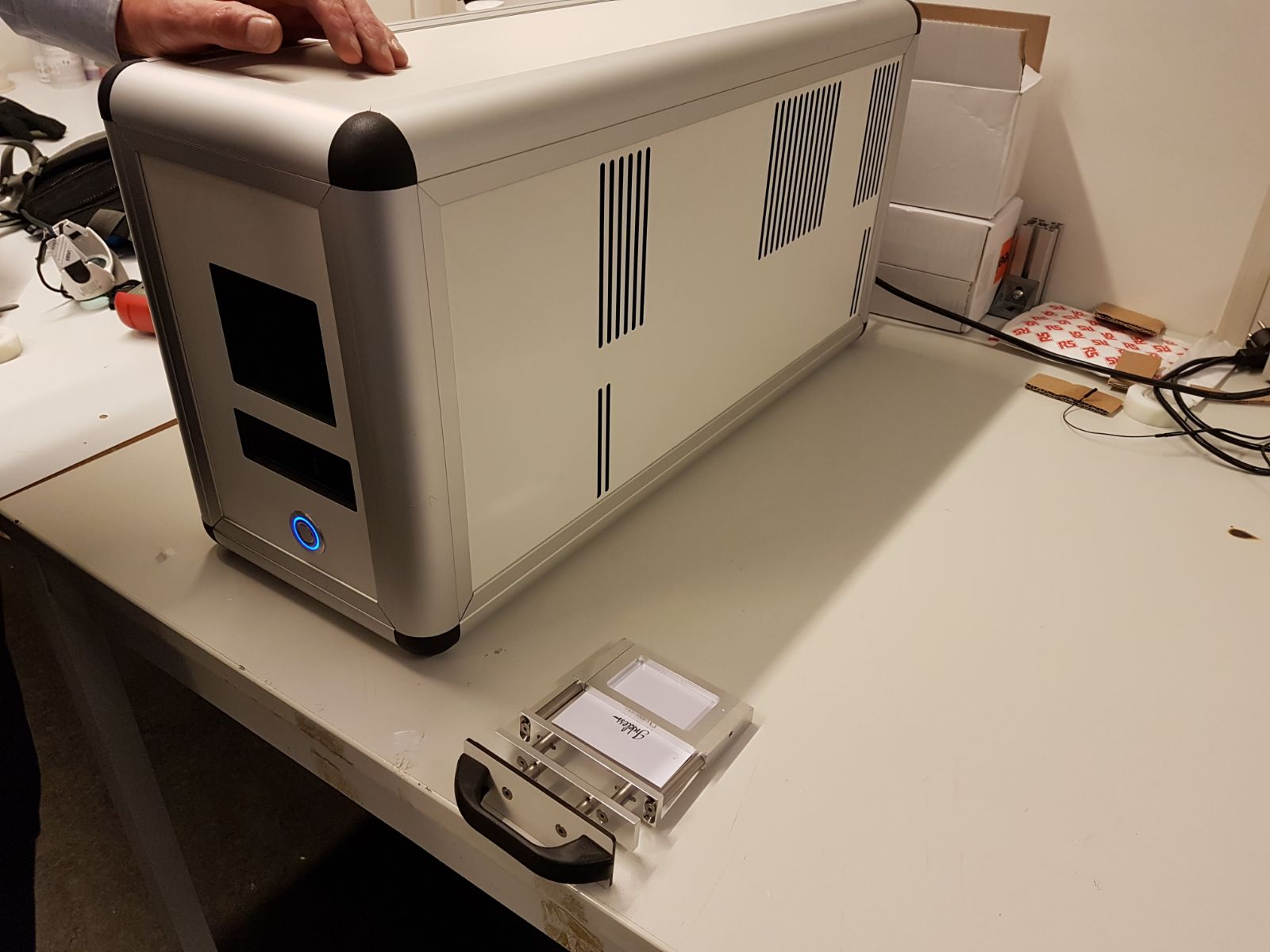
Rather they are using an infrared laser to burn the surface of the paper — so carbonization is being used as the printing medium.
And they claim their technique is able to produce black and white printing with blacks as dark and stable as ink-based prints. Though, clearly, they’re still early in the development process.
Here’s a photo of their current prototype, alongside a sample of text printed with it:
The angel funding will be used to try to reach what they dub “a competitive printing performance”. After which they say they’ll need to raise more money to build the first product — so they’re already planning the next financing round (for the end of the year).
“With this money we can make our technology ‘development-ready’, which means that we can meet the required quality and speed performance requirements so that we can begin with the development of our first product”, says co-founder and CEO Arnaud van der Veen in a statement.
“[The] next round will either be financed by strategic partners or venture capitalists. The first meetings have already taken place.”
If they can successfully productize their laser carbonization technique the promise is printing without the expense, waste and limits imposed by ink refills plus other consumables.
“I always compare this to the transition from the analogue camera to the digital camera,” says van der Veen. “Suddenly people were able to make unlimited photos and it was not needed to replace the films. Likewise, with our printing solutions, refill and replacement of ink and consumables will not be needed.”
Though quite how expensive the next-gen laser printer machines themselves will be if/when they arrive on shop shelves remains to be seen.
Tocano says its first product will be aimed at industrial users for packaging and labelling use cases — such as printing barcodes, shelf life data and product codes on packages and labels.
Its ambition is to range out after that, bringing additional printer products to market targeting other business users — and eventually even the consumer market.
“Our first product will fit [the packaging/labelling] market but after that we will make the technology accessible for production printers, office printers, consumer printers and receipt printers. In all these market we can offer the same advantages, a cheaper and more sustainable printer without any hassle with ink, cartridges or toners,” he adds.
Powered by WPeMatico
SpaceX has authorized a new Series I round for 3 million shares in a new round that will be worth up to $507 million, according to a certificate of incorporation document filed in Delaware.
If all shares in this round are issued, the new round would value SpaceX at around $23.7 billion, according to the new filing provided by Lagniappe Labs, creator of the Prime Unicorn Index. We’ve previously reported that SpaceX was planning to raise around $500 million in a financing round led by Fidelity, helping provide a lot of liquidity for the company as it begins to ramp up its plans to grow its ambitious launch schedule. While the filing does not confirm that it has raised the full $500 million, it serves as another data point to support that the company has picked up an additional huge influx of cash. The 3 million shares are priced at $169, in the range that we previously reported mid March.
The FCC in March gave SpaceX the green light to launch a network of thousands of satellites to blanket the globe with broadband access. Each additional flight offers SpaceX an opportunity to not only prove out its efficiency as a launching company, but also that it can provide a wide array of companies with a potentially cheaper option to get equipment into orbit for purposes like providing broadband. SpaceX already runs plenty of missions to the International Space Station. SpaceX also won a $290 million contract with the U.S. Air Force to launch three GPS satellites.
SpaceX isn’t the only company that may end up providing a new generation of orbital launches, like Jeff Bezos’ Blue Origin. Virgin Galactic also successfully tested its rocket-powered spacecraft for the first time since 2014 earlier this week, and while the details on that launch are still very slim it shows that there’s a wide variety of companies that see potential in figuring out a lower-cost way to get equipment into orbit.
We also previously reported that there could be a secondary offering that could also total up to $500 million in shares. That would run through special purpose vehicles, according to what we’re hearing, which would give investors an opportunity to get some liquidity in the company as it looks to remain private a little longer with the new financing.
We reached out to SpaceX for a comment and will update the story when we get back.
Powered by WPeMatico
Disrupt lands in San Francisco this September, and the agenda is shaping up to be absolutely amazing.
With new digs at Moscone West and expanded capacity, we expect Disrupt SF (September 5-7) to be the biggest and best conference TechCrunch has ever had. And, in large part, that’s credited to our incredible guests.
Today, we’re pleased to announce that GirlBoss Media CEO Sophia Amoruso, as well as Carbon CEO Dr. Joseph DeSimone and Adidas CMO Eric Liedtke, will be joining us on the Disrupt stage.
It’s been four years since GirlBoss Sophia Amoruso graced the Disrupt stage.
A lot has changed since then. Amoruso stepped down as CEO of Nasty Gal, which soon after filed for bankruptcy. She exposed her personal life, and faced harsh criticism, on a brief Netflix original series called GirlBoss.
But Amoruso is neither down nor out. The serial entrepreneur has started another venture by a familiar name. Amoruso described GirlBoss Media to investors as “Oprah for millennials and Supreme with boobs.”
Inspired by Amoruso’s memoir #GirlBoss, GirlBoss Media aims to motivate women to take action in their lives.
There’s something spectacular about falling off the horse and getting back up again, and we’re extremely excited to hear Amoruso tell her story in her own words on the Disrupt SF stage in September.
Bonus: We’re bringing in former TechCrunch co-editor Alexia Tsotsis to conduct the interview, four years after she interviewed Amoruso at Disrupt NY 2014. Tsotsis is now the founder of an SF-based seed-stage fund called Dream Machine.
You might not equate sneakers with technological advancement, but Carbon and Adidas could quickly prove you wrong.
Carbon, the 3D printing startup that has raised more than $420 million, has fundamentally changed manufacturing by creating a proprietary CLIP tech that speeds up the process of additive manufacturing by leaps and bounds.
Looking for proof of concept? Look no further than Adidas, who has invested in Carbon to help manufacture its 3D-printed Futurecraft sneakers. Carbon’s 3D printers (in relatively small numbers) are able to build out particularly impressive mid-soles, which feature 20,000 struts, a feat that would be far more difficult and exhaustive to accomplish through traditional manufacturing.
That said, Carbon is scaling quickly, with the duet planning to print shoes in the ‘hundreds of thousands of pairs’ this year, jumping to the millions by 2019.
Carbon co-founder and CEO Dr. Joseph DeSimone (winner of the $500K Lemelson-MIT prize in 2008) and Adidas Executive Board Member (global brands) Eric Liedtke (named 2017 CMO of the year in Germany) will join us on stage to discuss a range of topics, from upending traditional manufacturing to the relationship between incumbents and disruptive startups.
Disrupt SF runs from September 5 to September 7 at Moscone West. Passes to attend are now available at Super Early Bird pricing.
Powered by WPeMatico
Cambridge, U.K.-based startup Spectral Edge has closed a $5.3M Series A funding round from existing investors Parkwalk Advisors and IQ Capital.
The team, which in 2014 spun the business out of academic research at the University of East Anglia, has developed a mathematical technique for improving photographic imagery in real-time, also using machine learning technology.
As we’ve reported previously, their technology — which can be embedded in software or in silicon — is designed to enhance pictures and videos on mass-market devices. Mooted use cases include for enhancing low light smartphone images, improving security camera footage or even for drone cameras.
This month Spectral Edge announced its first customer, IT services provider NTT data, which said it would be incorporating the technology into its broadcast infrastructure offering — to offer its customers an “HDR-like experience”, via improved image quality, without the need for them to upgrade their hardware.
“We are in advanced trials with a number of global tech companies — household names — and hope to be able to announce more deals later this year,” CEO Rhodri Thomas tells us, adding that he expects 2-3 more deals in the broadcast space to follow “soon”, and enhance viewing experiences “in a variety of ways”.
On the smartphone front, Thomas says the company is waiting for consumer hardware to catch up — noting that RGB-IR sensors “haven’t yet begun to deploy on smartphones on a great scale”.
Once the smartphone hardware is there he reckons its technology will be able to help with various issues such as white balancing and bokeh processing.
“Right now there is no real solution for white balancing across the whole image [on smartphones] — so you’ll get areas of the image with excessive blues or yellows, perhaps, because the balance is out — but our tech allows this to be solved elegantly and with great results,” he suggests. “We also can support bokeh processing by eliminating artifacts that are common in these images.”
The new funding is going towards ramping up Spectral Edge’s efforts to commercialize its tech, including by growing the R&D team to 12 — with hires planned for specialists in image processing, machine learning and embedded software development.
The startup will also focus on developing real-world apps for smartphones, webcams and security applications alongside its existing products for the TV & display industries.
“The company is already very IP strong, with 10 patent families in the world (some granted, some filed and a couple about to be filed),” says Thomas. “The focus now is productizing and commercializing.”
“In a year, I expect our technology to be launched or launching on major flagship [smartphone] devices,” he adds. “We also believe that by then our CVD (color vision deficiency) product, Eyeteq, is helping millions of people suffering from color blindness to enjoy significantly better video experiences.”
Powered by WPeMatico

Over the course of the last few years, the Holberton School of Witchcraft and Wizardry Engineering has made a name for itself as one of the more comprehensive coding schools. The two-year program trains full-stack engineers with a focus on the basics of engineering and sees itself as an alternative to a traditional college experience. Today, the San Francisco-based school announced that it has raised an $8.2 million Series A round that will help it expand its programs.
The funding round was led by current investors daphni and Trinity Ventures. The Omidyar Network joined as a new investor. With this, the school has now raised a total of $13 million.
Holberton is currently teaching about 200 students (who have to pass a pretty rigorous entry exam) and the plan is to scale the program to 1,000 students per year. That’s a larger cohort than the computer science programs taught at even the biggest schools currently. Past students have found jobs at companies like Apple, IBM, Tesla, Docker and Dropbox. Instead of charging tuition, the school takes a 17 percent cut of its graduates’ salary for the first three years after they get their jobs.
To enable its expansion to 1,000 students, the team recently moved into a far larger space in San Francisco that can handle about 500 students. As the team has repeatedly told me, part of its mission is to bring in a diverse group of students — and one that isn’t held back by the prospect of student loans. In its recent classes, about 40 percent of the students were women, for example, and a slight majority of students were minorities. That’s sadly still quite unusual in Silicon Valley.
“Everyone deserves a first-rate education. Students at Holberton come from all walks of life, from cashiers to musicians to poker players (as well as right out of high school) without the money, background and education needed to be ‘Ivy League material,’” said Julien Barbier, co-founder and CEO of Holberton. “With Holberton, they now have the same opportunity as the more fortunate and they leave with skills to learn for a lifetime. Our students compete (sometimes after only 9-12 months) with Ivy League graduates and get the jobs.”
Powered by WPeMatico
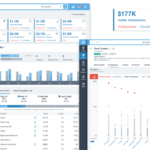
Procurement isn’t the most exciting topic in the world, but for large businesses, it’s an area where inefficiencies can quickly affect the bottom line. Simply getting a complete view of all of the products and services that a company buys is a challenge in itself, though, which in turn makes it hard to find savings, ensure compliance with company policy or government regulations or detect potential fraud. Suplari wants to change this by bringing its AI systems to bear on this problem.
The company today announced that it has raised a $10.3 million Series A round led by Shasta Ventures. Existing investors Madrona Ventures and Amplify Partners also joined this round, as well as new investors Two Sigma Ventures and Workday Ventures.
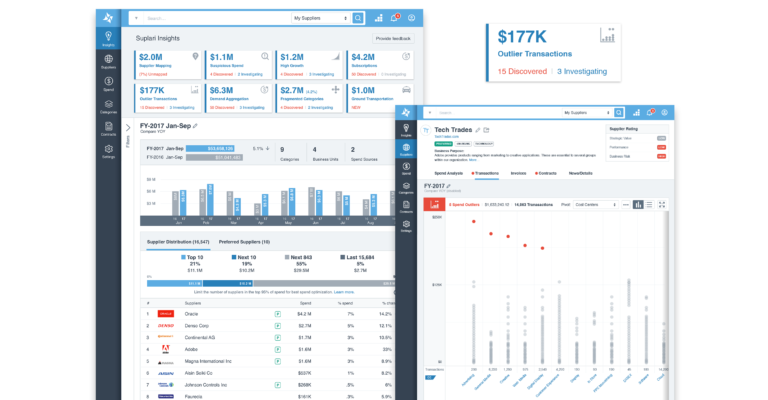
“Suplari uses advanced artificial intelligence on top of existing enterprise systems to proactively uncover the highest-value opportunities to pursue and empower the CFO or Chief Procurement Officer to unlock savings and profit that can be invested in growth, innovation, and their people,” said Suplari CEO and co-founder Nikesh Parekh in today’s announcement.
The company’s cloud-based service allows businesses to analyze all of their procurement data across platforms and formats. This data can include contracts, purchasing data, product usage information and data from corporate credit card accounts.
A number of Fortune 1000 customers have already signed up for the service and Supplari argues that it has helped its customers save software licensing fees by 33 percent and consolidate $200 million in professional service and temporary labor suppliers.
Powered by WPeMatico
Shine, an early arrival in a market now teeming with self-care apps and services, has closed on $5 million in Series A funding, the company announced today, alongside the milestone of hitting 2 million active users. The round was led by existing investor by Comcast Ventures with betaworks, Felix Capital, The New York Times, Eniac Ventures, Female Founders Fund
and BBG Ventures also participating.
The investment comes roughly two years after Shine launched its free service, a messaging bot aimed at younger users that doles out life advice and positive reinforcement on a daily basis through SMS texts or Facebook’s Messenger.
At the time, the idea that self-help could be put into an app or bot-like format was still a relatively novel concept. But today, digital wellness has become far more common with apps for everything from meditation to self-help to talk therapy.
“We’re proud that we were part of the catalyst to make well-being as an industry something that is so much more top-of-mind. We really sensed where the world was going and we were ahead of it,” says co-founder Naomi Hirabayashi, who built Shine along with her former DoSomething.org co-worker Marah Lidey. The founders had wanted to offer others something akin to the personal support system they had with each other, as close friends.
“Marah and I are both women of color, and we created this company from a very non-traditional background from an entrepreneurship standpoint – we didn’t go to business school,” Hirabayashi explains. “We saw there was something missing in the market because wellbeing companies didn’t really reach us – they didn’t speak to us. We didn’t see people that looked like us. We didn’t feel like the way they shared content sounded like how we spoke about the different wellbeing issues in our lives,” she says.
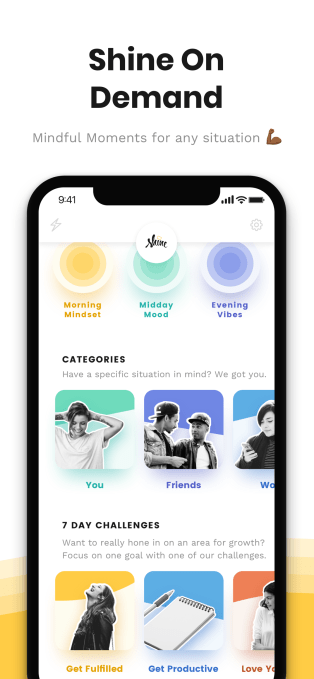
The company’s free messaging product, Shine Text, was the result of their frustrations with existing products. It tackles a timely theme every day in areas like confidence, productivity, mental health, happiness and more. And it isn’t just some sort of life-affirming text – Shine converses with you on the topic at hand using research-backed materials to help you better understand the information. It’s also presented in a style that makes Shine feel more like a friend chatting with you.
The service has grown to 2 million users across 189 countries, despite not being localized in other languages. 88 percent of users are under the age of 35, and 70 percent are female.
Shine attempted to generate revenue in the past with a life-coaching subscription, but users wanted to talk to a real person and the subscription was fairly steep at $15.99 per week. That product never emerged from testing, and the founders now refer to it as an “experiment.”
The company gave subscriptions another shot this past December, with the launch of a freemium (free with paid upgrades) app on iOS. The new app offers meditations, affirmations, and something called “Shine Stories.”
The meditations are short audio tracks voiced by influencers that help you with various challenges. There are quick hit meditations for recentering and relaxing, those where you can focus on handling a specific situation – like toxic friendships or online dating – and seven-day challenges that deal with a particular issue like burnout or productivity.
Affirmations are quick pep talks and Shine Stories are slightly longer – around five minutes-long, and also voiced by influencers.
“The biggest thing is that we want to meet the user where they are – and we know people are on the go,” says Hirabayashi. “You can expect a lot more to come in the future around how we combine this really exciting time that’s happening for audio consumption and the hunger that there is for audio content that’s motivational and makes you feel better.”
Asked specifically if the company was considering a voice-first app, like an Alexa skill, or perhaps a more traditional podcast, Lidey said they weren’t yet sure, but didn’t plan on limiting the Shine Stories to a single platform indefinitely. But one thing they weren’t interested in doing in the near-term was introducing ads into Shine’s audio content.
The Shine app for iOS is a free download with some selection of its audio available to free users. Users can unlock the full library for $4.99 per month, billed as an annual subscription of $59.99, or $7.99 per month if paid monthly.
The founders declined to offer specifics on their conversions from free to paid members, but said it was “on par with industry standards.”
With the Series A now under its belt, Shine plans to double its 8-person team this year, launch the app on Android, continue to grow the business, including potentially launching new products.
Now the question is whether the millennials are actually so into self-care that they’ll pay. There are some signs that could be true – the top ten self-care apps pulled in $15 million last quarter, with meditation apps leading the way.
“We’re dominating the self-care routine of millennial women right now and we want to keep doing that,” Lidey says.
Powered by WPeMatico
Dandelion, a clean energy startup that was originally incubated inside Google parent Alphabet, has raised $4.5 million in funding to build out its business — a geothermal heating and cooling system for homes that claims it will drastically reduce its customers’ bills — it claims to cut bills in half (notwithstanding the upfront costs, more on that below) — while also being significantly more friendly for the environment compared to conventional systems that use gas and fossil fuels.
The company opened for business first in Upstate New York — a market with extreme cold and hot spells — where it says it has started to install systems in people’s homes, and it’s going to use the funding to help work through what it says is a waitlist of “thousands” of customers nationally.
“We have been overwhelmed with demand and support from homeowners across the country,” said Kathy Hannun, cofounder and CEO of Dandelion, in a statement. “This round will help us ramp up operations to serve these customers and launch our new and improved 2018 offering.”
The funding was led by New Enterprise Associates, with participation also from new investors BoxGroup, Daniel Yates, and Ground Up, and previous investors Borealis Ventures, Collaborative Fund, and ZhenFund, the Chinese-based VC associated with Sequoia in China. It brings the total raised by Dandelion to $6.5 million, including a seed round it announced when first spinning out in July of last year.
The impressive list of backers — and the fact that Dandelion was originally incubated at Alphabet X, the company’s “moonshot” factory — underscores a couple of trends worth pointing out.
The first is the double maxim that everything is now a “tech” challenge, and that the interests of the tech world touch everything. As legacy businesses continue to try to update their systems or become more responsive to some of the challenges of running their legacy operations, a company like Dandelion becomes a direct threat, or a potential, strategic acquisition target.
The second is the ongoing interest among tech investors and tech companies to expand their horizons and explore companies and ideas that might prove to be disruptive in the same way that tech has been, further down the line; or whose solutions could prove to be a helpful boost to their more direct tech interests — for example by becoming acquirers of data systems to run these services better, or by making the cost of electricity to run other services (like internet, or maybe, these days, bitcoin mining) less expensive. (Dandelion is already proving its role in that wider ecosystem: just earlier this month, it acquired Geo-Connections, a geothermal SaaS startup.)
“Over the next decade, homeowners across America will replace their expensive, conventional home heating systems with Dandelion geothermal,” said Yates in a statement. “I’m thrilled to be part of the team that will lead this transition.” Yates — who had founded the energy efficiency startup Opower, which went public and then was acquired by Oracle — is joining the board as an executive director with this round.
In the case of Dandelion, its challenge and opportunity has been in the world of legacy energy services. Built largely on fossil fuel systems and centralised operation models — you have large plants and generators located in one place that distribute their energy to smaller stations, which distribute to individuals — the idea behind Dandelion has been to build a heating and cooling system that is significantly more decentralised: it operates directly from a person’s home — or more specifically, underneath it — leveraging the ground’s natural state of being 50°F, in order to work.

One big issue with scaling up geothermal energy solutions prior to Dandelion has been the up-front installation costs, both from a financial and practical point of view. As Hannun has described it:
The process of installing ground loops in homeowners’ yards has typically been messy and intrusive, using wide drills that are designed to dig water wells at depths of over 1,000 feet. These machines are unnecessarily large and slow for installing a system that needs only a few 4” diameter holes at depths of a few hundred feet. So we decided to try to design a better drill that could reduce the time, mess and hassle of installing these pipes, which could in turn reduce the final cost of a system to homeowners.
The company’s solution has been to build a system that bores a much smaller hole (a few inches is all that’s needed) at a much shallower depth of hundreds of feet — making the installation something that can be done in less than a day.
So far, the company’s upfront costs might prove to be too much of a gating factor for the majority of homeowners. Installations run between $20,000 and $25,000 in upfront costs alone. For those willing to take the plunge — or dig into the challenge, as the case may be — over twenty years, the company has claimed that savings can be about $35,000.
The company also tells me that homeowners are buying a lot of these using financing and will save around 20 percent annually if they finance. (The savings percentage comes after a tax credit, a spokesperson said. “Here is a real example from one of our homeowners. He needed a 4-ton system, which is the size most homes require. He formerly spent $2,621 on fuel oil annually (832 gallons over the year at $3.15/gallon). To run geothermal, he requires $803 in additional electricity costs. With Dandelion pricing, starting at $115/mo, geothermal heating costs for his home are $1,380 + $803 = $2,183. This is about 20% savings annually for heating alone. His air conditioning will also be over twice as efficient with geothermal than it was with conventional a/c.”)
The savings in terms of using clean versus dirty energy, of course, come from the start.
Powered by WPeMatico
Dropbox’s surge on the stock market has continued, with the company going up another 7 percent on its second day on the stock market.
The company saw its shares close at $30.45, giving the company above a $13 billion market cap, fully diluted.
When it priced its IPO, there was a question as to whether Dropbox would surpass the $10 billion valuation it achieved in its last private round. It eliminated those concerns overnight.
The first few days have been a strong indicator of investor demand for the cloud storage company.
To recap, Dropbox initially hoped to price its IPO between $16 and $18, then raised it from $18 to $20. Then it ultimately priced its IPO at $21, closing the day above $28. And it still continues to go up.
Bankers price IPOs to “pop” or go up about 20 percent on the first day. The surge implies that Dropbox exceeded Wall Street’s expectations. It also means that Dropbox could have priced its shares higher and raised more money.
It priced shares at $21, raising $756 million. If Dropbox had priced shares at $24, it would have raised $864 million and new investors would have still seen big gains.
It was certainly a win for stock market investors, which like the company’s improving financials.
It brought in $1.1 billion in revenue in its most recent year. This is up from $845 million in revenue the year before and $604 million for 2015.
Yet while it’s been cash flow positive since 2016, it is not profitable. Dropbox lost nearly $112 million last year. But its margins are looking better when compared with losses of $210 million for 2016 and $326 million for 2015.
Monday was a good day on the stock market in general. The Dow surged 600 points, partly due to gains from tech stocks like Microsoft and Apple.
Co-founder and CEO Drew Houston is the largest shareholder, owning 25.3 percent of the company ahead of its IPO. Sequoia Capital owned 23.2 percent of Dropbox.
Although Dropbox is very different from Spotify, which intends to list next week, investors will view this favorable debut as a sign that the IPO window is “open,” meaning that there is strong demand for newly public tech companies.
Zuora, Pivotal and Smartsheet also unveiled IPO filings recently, suggesting that they will go public in April. And we broke the news that DocuSign’s IPO is coming up.
The last few years have been slow for tech IPOs, but experts are hoping that this year will be different. John Tuttle, global head of listings at the New York Stock Exchange, says he expects “a strong year if market conditions hold constant.”
Powered by WPeMatico
Smartsheet is the latest company to file to go public, now that the IPO window is open.
The Bellevue, Washington-based company offers enterprise software for communication and collaboration.
It describes itself as the “leading cloud-based platform for work execution, enabling teams and organizations to plan, capture, manage, automate, and report on work at scale, resulting in more efficient processes and better business outcomes. ”
Smartsheet says it has 3.6 million users and its products are utilized at 90% of the Fortune 100 companies around the world.
It touts clients like Cisco and Starbucks. Smartsheet says Cisco uses it to keep tabs on spending and Starbucks uses it send product and business updates to its thousands of stores.
The company brought in $111.3 million in revenue for its fiscal 2018 year. It’s a big jump from $67 million for 2017 and $40.8 million for 2016.
But losses are also growing, totaling $49.1 million for 2018, up from negative $15.2 million and $14.3 million in prior years.
“We have a history of cumulative losses and we cannot assure you that we will achieve profitability in the foreseeable future,” the company warned in its prospectus.
Smartsheet acknowledges that it competes with Microsoft and Google on spreadsheets and other productivity tools. Its products also compete with Asana, Atlassian, Planview and Workfront.
“The market in which we participate is highly competitive, and if we do not compete effectively, our operating results could be harmed,” reads the “risk factors” section of the filing.
The largest shareholder is Insight Venture Partners, which owns a sizable 32.1% of the company heading into its IPO. Madrona Ventures owns 28.4% of the company, and Sutter Hill Ventures owns 5.4%.
Smartsheet had raised at least $106 million in venture funding, dating back to 2010, according to Crunchbase data. Last year, TechCrunch reported that it had an $800 million valuation.
The company plans to list on the New York Stock Exchange, under the ticker “SMAR.”
Morgan Stanley and J.P. Morgan are managing the offering. Fenwick & West and Wilson Sonsini served as counsel.
The floodgates have opened for enterprise tech IPOs. Last week we saw Dropbox debut and now we’ve seen filings for Zuora and Pivotal. DocuSign is also expected to file in the coming months.
Many of last year’s enterprise tech IPOs performed well, giving pipeline companies confidence in their debuts.
Spring also tends to be an active time for IPOs, with companies looking to debut before the summer slowdown.
And while consumer tech IPOs have been slow for several years now, one of the more anticipated companies looking to debut is Spotify, which is expected to go public next week via a “direct listing.”
Powered by WPeMatico