Enterprise
Auto Added by WPeMatico
Auto Added by WPeMatico
French startup Mirakl has raised a $300 million funding round at a $1.5 billion valuation — the company is now a unicorn. Mirakl helps you launch and manage a marketplace on your e-commerce website. Many customers also rely on Mirakl-powered marketplaces for B2B transactions.
Permira Advisers is leading the round, with existing investors 83North, Bain Capital Ventures, Elaia Partners and Felix Capital also participating.
“We’ve closed this round in 43 days,” co-founder and U.S. CEO Adrien Nussenbaum told me. But the due diligence process has been intense. “[Permira Advisers] made 250 calls to clients, leads, partners and former employees.”
Many e-commerce companies rely on third-party sellers to increase their offering. Instead of having one seller selling to many customers, marketplaces let you sell products from many sellers to many customers. Mirakl has built a solution to manage the marketplace of your e-commerce platform.
300 companies have been working with Mirakl for their marketplace, such as Best Buy Canada, Carrefour, Darty and Office Depot. More recently, Mirakl has been increasingly working with B2B clients as well.
These industry-specific marketplaces can be used for procurement or bulk selling of parts. In this category, clients include Airbus Helicopters, Toyota Material Handling and Accor’s Astore. 60% of Mirakl’s marketplace are still consumer-facing marketplaces, but the company is adding as many B2B and B2C marketplaces these days.
“We’ve developed a lot of features that enable platform business models that go further than simple marketplaces,” co-founder and CEO Philippe Corrot told me. “For instance, we’ve invested in services — it lets our clients develop service platforms.”
In France, Conforama can upsell customers with different services when they buy some furniture for instance. Mirakl has also launched its own catalog manager so that you can merge listings, add information, etc.
The company is using artificial intelligence to do the heavy-lifting on this front. There are other AI-enabled features, such as fraud detection.
Given that Mirakl is a marketplace expert, it’s not surprising that the company has also created a sort of marketplace of marketplaces with Mirakl Connect.
“Mirakl Connect is a platform that is going to be the single entry point for everybody in the marketplace ecosystem, from sellers to operators and partners,” Corrot said.
For sellers, it’s quite obvious. You can create a company profile and promote products on multiple marketplaces at once. But the company is also starting to work with payment service providers, fulfillment companies, feed aggregators and other partners. The company wants to become a one-stop shop on marketplaces with those partners.
Overall, Mirakl-powered marketplaces have generated $1.2 billion in gross merchandise volume (GMV) during the first half of 2020. It represents a 111% year-over-year increase, despite the economic crisis.
With today’s funding round, the company plans to expand across all areas — same features, same business model, but with more resources. It plans to hire 500 engineers and scale its sales and customer success teams.
Powered by WPeMatico
HubSpot, the Boston firm that made its name by helping to define the in-bound marketing concept, sees a pandemic landscape that’s changing the way companies sell, forcing more inside sales. Today, the company announced the HubSpot Sales Hub Enterprise at Inbound, their annual conference being held virtually this year.
While the company has been offering a CRM tool for five years now, where they feel they have addressed ease-of-use issues for salespeople, the new tool is about bringing a new end-to-end approach addressing not only the needs of sales people, but management and system admins, as well, says Lou Orfanos, GM and VP of Sales Hub at HubSpot.
“So, this is about [providing customers with a more powerful set of tools] and also just making sure that you can run your sales process end-to-end in our platform. We feel really good about being able to offer that out of the box natively and being able to do everything you need to do [in one tool], which is, I think, pretty unique given the state of the market and having to [cobble] a bunch of things together yourself,” Orfanos explained.
While the previous product was aimed more at smaller businesses, Chief Customer Officer Yamini Rangan, who previously worked at Dropbox, Workday and SAP, says this product is aimed more at midmarket companies with more complex sales workflows.
“What we find is that the customer experience for a 500-person company or for a 1,000-person company is quite different and their expectations are quite different than a 10-person small business. What the Sales Hub Enterprise specifically brings is the ease of use, as well as the powerful features [ … ] to a larger midmarket organization,” Rangan said.
HubSpot specifically sees larger companies in this space, like Adobe, Salesforce and SAP, acquiring different pieces of the stack, then incorporating them into a solution, or customers pulling together different pieces of the stack themselves. The company believes that by building a single integrated solution themselves, it’s going to be naturally easier to use.
“We also find that that’s the size of the company where the tech stack, the sales stack and the marketing stack gets super complex, and they’re spending a lot of time trying to integrate a lot of different point solutions and what we find is having all of this — marketing, CMS, sales underlined by a CRM platform — that gives them visibility that they need to run their entire go-to-market operations,” she said.
While the lower end of the market where HubSpot is targeting probably won’t interest larger competitors, especially Salesforce, as they move up in that market to larger companies, they expect to compete with those companies. Rangan says that she believes by providing this new offering, they are giving customers options they didn’t have before.
But she also sees this as a way into companies as they grow, and if HubSpot can catch them earlier in their evolution, they can grow with them and become their vendor of choice, rather than the usual suspects.
“What we find is that companies will start as a 100-person company and grow to become a 500- or a 1,000-person company, and as they grow up on HubSpot we become their growth suite and we become the core platform of record for them to continue to grow,” she said.
Powered by WPeMatico

Microsoft today announced the launch of Azure Communication Services, a new set of features in its cloud that enable developers to add voice and video calling, chat and text messages to their apps, as well as old-school telephony.
The company describes the new set of services as the “first fully managed communication platform offering from a major cloud provider,” and that seems right, given that Google and AWS offer some of these features, including the AWS notification service, for example, but not as part of a cohesive communication service. Indeed, it seems Azure Communication Service is more of a competitor to the core features of Twilio or up-and-coming MessageBird.
Over the course of the last few years, Microsoft has built up a lot of experience in this area, in large parts thanks to the success of its Teams service. Unsurprisingly, that’s something Microsoft is also playing up in its announcement.
“Azure Communication Services is built natively on top a global, reliable cloud — Azure. Businesses can confidently build and deploy on the same low latency global communication network used by Microsoft Teams to support over 5 billion meeting minutes in a single day,” writes Scott Van Vliet, corporate vice president for Intelligent Communication at the company.
Microsoft also stresses that it offers a set of additional smart services that developers can tap into to build out their communication services, including its translation tools, for example. The company also notes that its services are encrypted to meet HIPPA and GDPR standards.
Like similar services, developers access the various capabilities through a set of new APIs and SDKs.
As for the core services, the capabilities here are pretty much what you’d expect. There’s voice and video calling (and the ability to shift between them). There’s support for chat and, starting in October, users will also be able to send text messages. Microsoft says developers will be able to send these to users anywhere, with Microsoft positioning it as a global service.
Provisioning phone numbers, too, is part of the services and developers will be able to provision those for in-bound and out-bound calls, port existing numbers, request new ones and — most importantly for contact-center users — integrate them with existing on-premises equipment and carrier networks.
“Our goal is to meet businesses where they are and provide solutions to help them be resilient and move their business forward in today’s market,” writes Van Vliet. “We see rich communication experiences – enabled by voice, video, chat, and SMS – continuing to be an integral part in how businesses connect with their customers across devices and platforms.”

Powered by WPeMatico
Microsoft today launched a major update to its Arc multi-cloud service that allows Azure customers to run and manage workloads across clouds — including those of Microsoft’s competitors — and their on-premises data centers. First announced at Microsoft Ignite in 2019, Arc was always meant to not just help users manage their servers but also allow them to run data services like Azure SQL and Azure Database for PostgreSQL, close to where their data sits.
Today, the company is making good on this promise with the preview launch of Azure Arc-enabled data services with support for, as expected, Azure SQL and Azure Database for PostgreSQL.
In addition, Microsoft is making the core feature of Arc, Arc-enabled servers, generally available. These are the tools at the core of the service that allow enterprises that use the standard Azure Portal to manage and monitor their Windows and Linux servers across their multi-cloud and edge environments.

Image Credits: Microsoft
“We’ve always known that enterprises are looking to unlock the agility of the cloud — they love the app model, they love the business model — while balancing a need to maintain certain applications and workloads on premises,” Rohan Kumar, Microsoft’s corporate VP for Azure Data said. “A lot of customers actually have a multi-cloud strategy. In some cases, they need to keep the data specifically for regulatory compliance. And in many cases, they want to maximize their existing investments. They’ve spent a lot of CapEx.”
As Kumar stressed, Microsoft wants to meet customers where they are, without forcing them to adopt a container architecture, for example, or replace their specialized engineered appliances to use Arc.
“Hybrid is really [about] providing that flexible choice to our customers, meeting them where they are, and not prescribing a solution,” he said.
He admitted that this approach makes engineering the solution more difficult, but the team decided the baseline should be a container endpoint and nothing more. And for the most part, Microsoft packaged up the tools its own engineers were already using to run Azure services on the company’s own infrastructure to manage these services in a multi-cloud environment.
“In hindsight, it was a little challenging at the beginning, because, you can imagine, when we initially built them, we didn’t imagine that we’ll be packaging them like this. But it’s a very modern design point,” Kumar said. But the result is that supporting customers is now relatively easy because it’s so similar to what the team does in Azure, too.
Kumar noted that one of the selling points for the Azure Data Services is also that the version of Azure SQL is essentially evergreen, allowing them to stop worrying about SQL Server licensing and end-of-life support questions.
Powered by WPeMatico

Cortana may have failed as a virtual assistant for consumers, but Microsoft is still betting on it (or at least its brand) for business use cases, now that it has rebranded it as a “personal productivity assistant” as part of Microsoft 365. Today, at its Ignite conference, Microsoft launched and announced a number of new Cortana services for business users.
These include the general availability of Cortana for the new Microsoft Teams displays the company is launching in partnership with a number of hardware vendors. You can think of these as dedicated smart displays for Teams that are somewhat akin to Google Assistant-enabled smart displays, for example — but with the sole focus on meetings. These days, it’s hard to enable a device like this without support for a voice assistant, so there you go. It’ll be available in September in English in the U.S. and will then roll out to Australia, Canada, the U.K. and India in the coming months.
In addition to these Teams devices, which Microsoft is not necessarily positioning for meeting rooms but as sidekicks to a regular laptop or desktop, Cortana will also soon come to Teams Rooms devices. Once we go back to offices and meeting rooms, after all, few people will want to touch a shared piece of hardware, so a touchless experience is a must.
For a while now, Microsoft has also been teasing more email-centric Cortana services. Play My Emails, a service that reads you your email out aloud and that’s already available in the U.S. on iOS and Android, is coming to Australia, Canada, the U.K. and India in the coming months. But more importantly, later this month, Outlook for iOS users will be able to interact with their inbox by voice, initiate calls to email senders and play emails from specific senders.
Cortana can now also send you daily briefing emails if you are a Microsoft 365 Enterprise user. This feature is now generally available and will get better meeting preparation, integration with Microsoft To Do and other new features in the coming months.
And if you’re using Cortana on Windows 10, this chat-based app now lets you compose emails, for example (at least if you speak English and are in the U.S.). And if you so desire, you can now use a wake word to launch it.
Powered by WPeMatico

Unsurprisingly, Teams has become a major focus for Microsoft during the COVID-19 pandemic, so it’s no surprise that the company is using its annual Ignite IT conference to announce a number of new features for the service.
Today’s announcements follow the launch of features like Together Mode and dynamic view earlier this summer.
Together Mode, which puts cutouts of meeting participants in different settings, is getting a bit of an update today with the launch of new scenes: auditoriums, coffee shops and conference rooms. Like before, the presenter chooses the scene, but what’s new now is that Microsoft is also using machine learning to ensure that participants are automatically centered in their virtual chairs, making the whole scene look just a little bit more natural (and despite what Microsoft’s research shows, I can never help but think that this all looks a bit goofy, maybe because it reminds me of the opening credits of The Muppet Show).

Image Credits: Microsoft
Also new in Teams is custom layouts, which allow presenters to customize how their presentations — and their own video feeds — appear. With this, a presenter can superimpose her own video image over the presentation, for example.
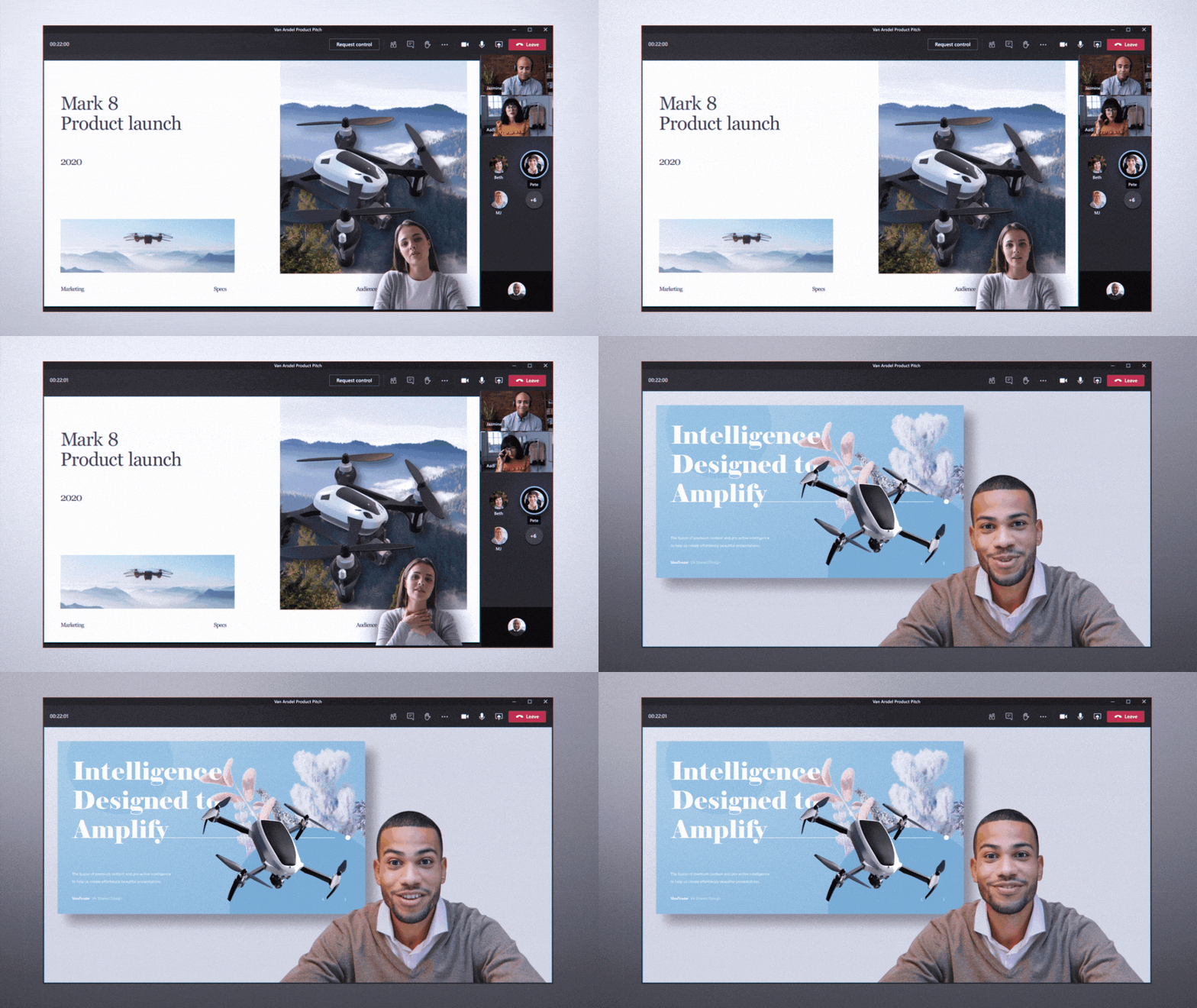
Image Credits: Microsoft
Breakout rooms, a feature that is getting a lot of use in Zoom these days, is now also coming to Teams. Microsoft calls it the most requested feature in Teams and, like in similar products, it allows meeting organizers to split participants into smaller groups — and the meeting organizer can then go from room to room. Unsurprisingly, this feature is especially popular with teachers, though companies, too, often use it to facilitate brainstorming sessions, for example.

Image Credits: Microsoft
After exhausting all your brainstorming power in those breakout rooms and finishing up your meeting, Teams can now also send you an automatic recap of a meeting that includes a recording, transcript, shared files and more. These recaps will automatically appear on your Outlook calendar. In the future, Microsoft will also enable the ability to automatically store these recordings on SharePoint.
For companies that regularly host large meetings, Microsoft will launch support for up to 1,000 participants in the near future. Attendees in these meetings will get the full Teams experience, Microsoft promises. Later, Microsoft will also enable view-only meetings for up to 20,000 participants. Both of these features will become available as part of a new “Advanced Communications” plan, which is probably no surprise, given how much bandwidth and compute power it will likely take to manage a 1,000-person meeting.

Image Credits: Microsoft
Microsoft also made two hardware announcements related to Teams today. The first is the launch of what it calls “Microsoft Teams panels,” which are essentially small tablets that businesses can put outside of their meeting rooms for wayfinding. One cool feature here — especially as businesses start planning their post-pandemic office strategy — is that these devices will be able to use information from the cameras in the room to count how many people are attending a meeting in person and then show remaining room capacity, for example.
The company also today announced that the giant Surface Hub 2S 85-inch model will be available in January 2021.
And there is more. Microsoft is also launching new Teams features for front-line workers to help schedule shifts, alert workers when they are using Teams off-shift and praise badges that enable organizations to recognize workers (though those workers would probably prefer hard cash over a digital badge).
Also new is an integration between Teams and RealWear head-mounted devices for remote collaboration and a new Walkie Talkie app for Android.
And since digital badges aren’t usually enough to improve employee well-being, Microsoft is also adding a new set of well-being features to Teams. These provide users with personalized recommendations to help change habits and improve well-being and productivity.
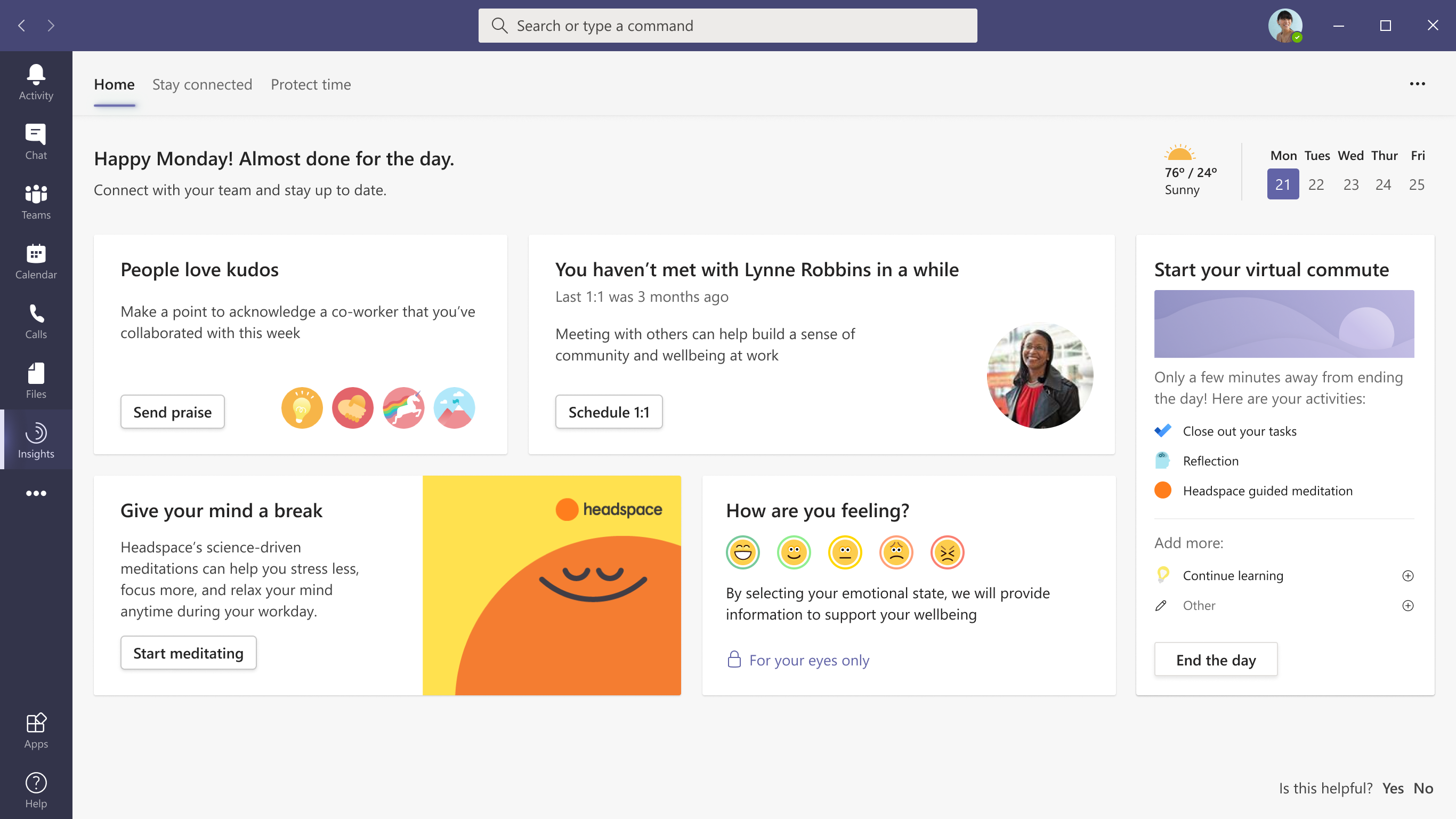
Image Credits: Microsoft
That includes a new “virtual commute” feature that includes an integration with Headspace and an emotional check-in experience.
I’ve always been a fan of short and manageable commutes for getting some distance between work and home, but that’s not exactly a thing right now. Maybe Headspace works as an example, but there’s only so much Andy Puddicombe I can take. Still, I think I’ll keep my emotional check-ins to myself, though Microsoft obviously notes that it will keep all of that information private.
And while businesses now care about your emotional well-being (because it’s closely related to your productivity), managers mostly care about the work you get done. For them, Workplace Analytics is coming to Teams, giving “managers line of sight into teamwork norms like after-hours collaboration, focus time, meeting effectiveness, and cross-company connections. These will then be compared to averages among similar teams to provide managers with actionable insights.”
If that doesn’t make your manager happy, what will? Maybe a digital praise badge?
Powered by WPeMatico

Earlier this year, Microsoft acquired Softomotive, a player in the low-code robotic process automation space with a focus on Windows. Today, at its Ignite conference, the company is launching Power Automate Desktop, a new application based on Softomotive’s technology that lets anyone automate desktop workflows without needing to program.
“The big idea of Power Platform is that we want to go make it so development is accessible to everybody,” Charles Lamanna, Microsoft’s corporate VP for its low-code platform, told me. “And development includes understanding and reporting on your data with Power BI, building web and mobile applications with Power Apps, automating your tasks — whether it’s through robotic process automation or workflow automation — with Power Automate, or building chatbots and chat-based experiences with Power Virtual Agent.”
Power Automate already allowed users to connect web-based applications, similar to Zapier and IFTTT, but the company also launched a browser extension late last year to help users connect native system components to Power Automate. Now, with the integration of the Softomotive technology and the launch of this new low-code Windows application, it’s taking this integration into the native Windows user interface one step further.
“Everything still runs in the cloud and still connects to the cloud, but you now have a rich desktop application to author and record your UI automations,” Lamanna explained. He likened it to an “ultimate connector,” noting that the “ultimate API is just the UI.”
He also stressed that the new app feels like any other modern Office app, like Outlook (which is getting a new Mac version today, by the way) or Word. And like the modern versions of those apps, Power Automate Desktop derives a lot of its power from being connected to the cloud.
It’s also worth noting that Power Automate isn’t just a platform for automating simple two or three-step processes (like sending you a text message when your boss emails you), but also for multistep, business-critical workflows. T-Mobile, for example, is using the platform to automate some of the integration processes between its systems and Sprint.
Lamanna noted that for some large enterprises, adopting these kinds of low-code services necessitates a bit of a culture shift. IT still needs to have some insights into how these tools are used, after all, to ensure that data is kept safe, for example.
Another new feature the company announced today is an integration between the Power Platform and GitHub, which is now in public preview. The idea here is to give developers the ability to create their own software lifecycle workflows. “One of the core ideas of Power Platform is that it’s low code,” Lamanna said. “So it’s built first for business users, business analysts, not the classical developers. But pro devs are welcome. The saying I have is: we’re throwing a party for business users, but pro devs are also invited to the party.” But to get them onto the platform, the team wants to meet them where they are and let them use the tools they already use — and that’s GitHub (and Visual Studio and Visual Studio Code).
Powered by WPeMatico

At its Ignite conference today, Microsoft announced a number of new features for the Microsoft Endpoint Manager, the company’s unified platform for managing and securing devices in an enterprise environment. The service, which combines the features of the Microsoft System Center Configuration Manager with the cloud-based tools of Intune, launched just under a year ago. Today’s updates build on the foundation the team created at the time and add improved macOS and iPad support, as well as new tools for connecting mobile devices to on-premises apps and additional productivity tools based on the date the company gathers from the service. The company is also making it easier for corporate IT departments to provision devices for employees remotely.
If anything, the pandemic has only accelerated both the growth of this business for Microsoft and the need for companies to manage their remote devices.
“It really is about bringing this cloud and all the intelligence that we had in Intune together with Config Manager and making it act as one,” Brad Anderson, Microsoft corporate VP for the Commercial Management Experiences team, told me. “And it’s been so fascinating to see how the pandemic accelerated people wanting and needing to use that. When the pandemic first hit — and as I go back to March 8th or 10th, in the U.S., the calls that I was having almost every day with CIOs centered around, ‘my VPN is overwhelmed. How am I going to keep all my systems updated?’ ”
Today’s announcements build on the work Microsoft has done on this service over the course of the last year. After launching support for scripting on macOS earlier this year, for example, the company today announced a new “first-class management experience on macOS” that brings deploy scripts, but also improved enrollment experiences and app lifecycle management feature, to the platform.
Endpoint Manager now also supports Apple’s Shared iPad for Business functionality, and will help businesses deploy iPads to their users and allow them to log in with Azure Active Directory accounts. This gives users two separate portions on the device: one for work and one for everything else.
Another new feature is Microsoft Tunnel. This gives businesses a VPN that can cover the entire device or single apps to ensure that their employees’ devices are secure and compliant with their internal policy to access their networks.
“The key thing [with Microsoft Tunnel] is that this is all integrated into our conditional access,” Anderson explained. “And so when that VPN comes up, before access is granted to the data or to the apps, the conditional access engine that we’ve built inside of Microsoft 365 has that point of view on the trust of the identity and the trust of the device. That really is the key differentiator on that. I’ll tell you, between you and I, that one feature is probably the single feature that customers who are running another MDM and then the Microsoft Endpoint Manager — that’s the one they’re waiting for.”
Endpoint Manager now also supports the Windows Virtual Desktop (WVD) environment. That’s been a massive growth area for the company — one that has only been accelerated by the COVID-19 pandemic. As Anderson told me, the company saw 10x growth for WVD through the pandemic. “Now, Windows Virtual Desktop is that first-class citizen inside Microsoft Endpoint Manager. So you can manage your virtual endpoints just like you manage your physical endpoints. All your policies are applicable, all your apps are clickable. And it just makes it easier to be able to use that as one of the tools you have to empower your users,” he said.
Another area of Endpoint Manager, which may only seem tangentially related at first, is Microsoft’s Productivity Score. There are two aspects to this service, though: employee experience and technology experience. Productivity Score is meant to help businesses better understand how their employees are working — and identify areas where companies can improve. On the technology side, that also means understanding which apps crash, for example, or why laptops slow down.
“Here’s one of the key scenarios,” said Anderson. “We’ll get a call every once in a while that says, like, ‘hey, my users are all having a great experience with Office 365 but I’ve got a handful of users for whom it’s slow.’ More often than not, that’s a networking issue. And so every time a user, for example, opens a file or saves a file, opens an attachment, we get telemetry back that helps us understand the operations of that. We probably know when an ISP in the south of France sneezes, because Office 365 is so ubiquitous now.”
The other new feature here is what Microsoft calls Endpoint Analytics. With this, Microsoft can now provide businesses with detailed information about when apps on their employees’ devices crash — no matter whether that’s an internal app, a third-party service — or a Microsoft app.
In addition to these technology scores, Productivity Score is also getting new categories like meetings, so managers can see how many meetings their employees have, as well as a new teamwork category.
Powered by WPeMatico

Microsoft’s Edge browser is coming to Linux, starting with the Dev channel. The first of these previews will go live in October.
When Microsoft announced that it would switch its Edge browser to the Chromium engine, it vowed to bring it to every popular platform. At the time, Linux wasn’t part of that list, but by late last year, it became clear that Microsoft was indeed working on a Linux version. Later, at this year’s Build, a Microsoft presenter even used it during a presentation.
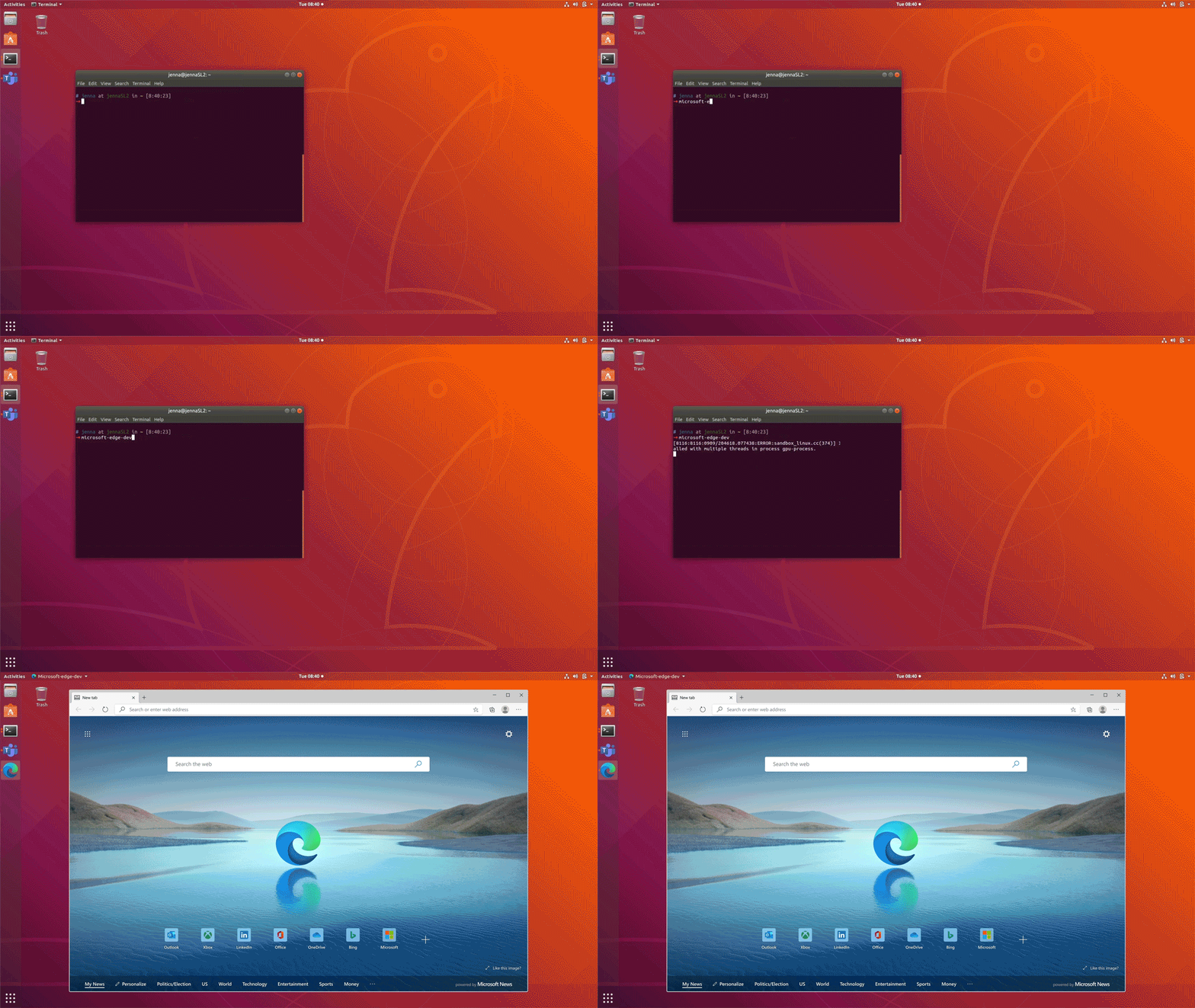
Image Credits: Microsoft
Starting in October, Linux users will be able to either download the browser from the Edge Insider website or through their native package managers. Linux users will get the same Edge experience as users on Windows and macOS, as well as access to its built-in privacy and security features. For the most part, I would expect the Linux experience to be on par with that on the other platforms.
Microsoft also today announced that its developers have made more than 3,700 commits to the Chromium project so far. Some of this work has been on support for touchscreens, but the team also contributed to areas like accessibility features and developer tools, on top of core browser fundamentals.
Currently, Microsoft Edge is available on Windows 7, 8 and 10, as well as macOS, iOS and Android.
Powered by WPeMatico
No-code and low-code software have become increasingly popular ways for companies — especially those that don’t count technology as part of their DNA — to bring in more updated IT processes without the heavy lifting needed to build and integrate services from the ground up.
As a mark of that trend, today, a company that has taken this approach to speeding up customer experience is announcing some funding. EasySend, an Israeli startup which has built a no-code platform for insurance companies and other regulated businesses to build out forms and other interfaces to take in customer information and subsequently use AI systems to process it more efficiently, is announcing that it has raised $16 million.
The funding has actually come in two tranches, a $5 million seed round from Vertex Ventures and Menora Insurance that it never disclosed, and another $11 million round that closed more recently, led by Hanaco with participation from Intel Capital. The company is already generating revenue, and did so from the start, enough that it was actually bootstrapped for the first three years of its life.
Tal Daskal, EasySend’s CEO and co-founder, said that the funding being announced today will be used to help it expand into more verticals: up to now its primary target has been insurance companies, although organically it’s picked up customers from a number of other verticals, such as telecoms carriers, banks and more.
The plan will be now to hone in on specifically marketing to and building solutions for the financial services sector, as well as hiring and expanding in Asia, Europe and the US.
Longer term, he said, that another area EasySend might like to look at more in the future is robotic process automation (RPA). RPA, and companies that deal in it like UIPath, Automation Anywhere and Blue Prism, is today focused on the back office, and EasySend’s focus on the “front office” integrates with leaders in that area. But over time, it would make sense for EasySend to cover this in a more holistic way, he added.
Menora was a strategic backer: it’s one of the largest insurance providers in Israel, Daskal said, and it used EasySend to build out better ways for consumers to submit data for claims and apply for insurance.
Intel, he said, is also strategic although how is still being worked out: what’s notable to mention here is that Intel has been building out a huge autonomous driving business in Israel, anchored by MobileEye, and not only will insurance (and overall risk management) play a big part in how that business develops, but longer term you can see how there will be a need for a lot of seamless customer interactions (and form filling) between would-be car owners, operators, and passengers in order for services to operate more efficiently.
“Intel Capital chose to invest in EasySend because of its intelligent and impactful approach to accelerating digital transformation to improve customer experiences,” said Nick Washburn, senior managing director, Intel Capital, in a statement. “EasySend’s no-code platform utilizes AI to digitize thousands of forms quickly and easily, reducing development time from months to days, and transforming customer journeys that have been paper-based, inefficient and frustrating. In today’s world, this is more critical than ever before.”
The rise and persistence of Covid-19 globally has had a big, multi-faceted impact how we all do business, and two of those ways have fed directly into the growth of EasySend.
First, the move to remote working has given organizations a giant fillip to work on digital transformation, refreshing and replacing legacy systems with processes that work faster and rely on newer technologies.
Second, consumers have really reassessed their use of insurance services, specifically health and home policies, respectively to make sure they are better equipped in the event of a Covid-19-precipitated scare, and to make sure that they are adequately covered for how they now use their homes all hours of the day.
EasySend’s platform for building and running interfaces for customer experience fall directly into the kinds of apps and services that are being identified and updated, precisely at a time when its initial target customers, insurers, are seeing a surge in business. It’s that “perfect storm” of circumstances that the startup wouldn’t have wished on the world, but which has definitely helped it along.
While there are a lot of companies on the market today that help organizations automate and run their customer interaction processes, the Daskal said that EasySend’s focus on using AI to process information is what makes the startup more unique, as it can be used not just to run things, but to help improve how things work.
It’s not just about taking in character recognition and organizing data, it’s “understanding the business logic,” he said. “We have a lot of data and we can understand [for example] where customers left the process [when filling out forms]. We can give insights into how to increase the conversion rates.”
It’s that balance of providing tools to do business better today, as well as to focus on how to build more business for tomorrow, that has caught the eye of investors.
“Hanaco is firmly invested in building a digital future. By bridging the gap between manual processes and digitization, EasySend is making this not only possible, but also easy, affordable, and practical,” said Hanaco founding partner Alon Lifshitz, in a statement.
Powered by WPeMatico