Enterprise
Auto Added by WPeMatico
Auto Added by WPeMatico
IBM, a company that originally made its name out of its leadership in building myriad enterprise hardware (quite literally: its name is an abbreviation for International Business Machines), is taking one more step away from that legacy and deeper into the world of cloud services. The company today announced that it plans to spin off its managed infrastructure services unit as a separate public company, a $19 billion business in annual revenues, to help it focus more squarely on newer opportunities in hybrid cloud applications and artificial intelligence.
Infrastructure services include a range of managed services based around legacy infrastructure and digital transformation related to it. It includes things like testing and assembly, but also product engineering and lab services, among other things. A spokesperson confirmed to me that the deal will not include the company’s servers business, only infrastructure services.
IBM said it expects to complete the process — a tax-free spin-off for shareholders — by the end of 2021. It has not yet given a name to “NewCo” but it said that out of the gate the spun-off company will have 90,000 employees, 4,600 big enterprise clients in 115 countries, a backlog of $60 billion in business “and more than twice the scale of its nearest competitor” in the area of infrastructure services.
Others that compete against it include the likes of BMC and Microsoft. The remaining IBM business is about three times as big: it currently generates some $59 billion in annual revenues.
At the same time that IBM announced the news, it also gave some updated guidance for Q3, which it plans to report officially later this month. It said it expects revenues of $17.6 billion, with GAAP diluted earnings per share from continuing operations of $1.89, and operating (non-GAAP) earnings per share of $2.58. As a point of comparison, in Q3 2019 it reported revenues of $18 billion. And last quarter IBM reported revenues of $18.1 billion. Tellingly, the division that contains infrastructure services saw declines last quarter.
The market seems to like the news: IBM shares are trading up some 10% ahead of the market opening.
The move is a significant shift for the company and underscores a bigger sea change in how enterprise IT has evolved and looks to continue changing in the future.
IBM is betting that legacy infrastructure and the servicing of it, while continuing to net revenues, will not grow as it has in the past, and as companies continue with their modernization (or “digital transformation,” as consultants like to refer to it today), they will turn increasingly to outsourced infrastructure and using cloud services, both to run their businesses and to build the services that interface with consumers. IBM, meanwhile, is in a race competing against the likes of Microsoft and Google in cloud services, and so doubling down on that part of the business is another way to focus on it for growth.
But IBM, often referred to as “Big Blue”, is also using the announcement as the start of an effort to streamline its business to spur growth (maybe we’ll have to rename it “Medium Blue”).
“IBM is laser-focused on the $1 trillion hybrid cloud opportunity,” said Arvind Krishna, IBM CEO, in a statement. “Client buying needs for application and infrastructure services are diverging, while adoption of our hybrid cloud platform is accelerating. Now is the right time to create two market-leading companies focused on what they do best. IBM will focus on its open hybrid cloud platform and AI capabilities. NewCo will have greater agility to design, run and modernize the infrastructure of the world’s most important organizations. Both companies will be on an improved growth trajectory with greater ability to partner and capture new opportunities – creating value for clients and shareholders.”
Its $34 billion purchase of Red Hat in 2019 is perhaps its most notable investment in recent times in IBM’s own transformation.
“We have positioned IBM for the new era of hybrid cloud,” said Ginni Rometty, IBM Executive Chairman in a statement. “Our multi-year transformation created the foundation for the open hybrid cloud platform, which we then accelerated with the acquisition of Red Hat. At the same time, our managed infrastructure services business has established itself as the industry leader, with unrivaled expertise in complex and mission-critical infrastructure work. As two independent companies, IBM and NewCo will capitalize on their respective strengths. IBM will accelerate clients’ digital transformation journeys, and NewCo will accelerate clients’ infrastructure modernization efforts. This focus will result in greater value, increased innovation, and faster execution for our clients.”
More to come.
Powered by WPeMatico
Grid AI, a startup founded by the inventor of the popular open-source PyTorch Lightning project, William Falcon, that aims to help machine learning engineers work more efficiently, today announced that it has raised an $18.6 million Series A funding round, which closed earlier this summer. The round was led by Index Ventures, with participation from Bain Capital Ventures and firstminute.
Falcon co-founded the company with Luis Capelo, who was previously the head of machine learning at Glossier. Unsurprisingly, the idea here is to take PyTorch Lightning, which launched about a year ago, and turn that into the core of Grid’s service. The main idea behind Lightning is to decouple the data science from the engineering.
The time argues that a few years ago, when data scientists tried to get started with deep learning, they didn’t always have the right expertise and it was hard for them to get everything right.
“Now the industry has an unhealthy aversion to deep learning because of this,” Falcon noted. “Lightning and Grid embed all those tricks into the workflow so you no longer need to be a PhD in AI nor [have] the resources of the major AI companies to get these things to work. This makes the opportunity cost of putting a simple model against a sophisticated neural network a few hours’ worth of effort instead of the months it used to take. When you use Lightning and Grid it’s hard to make mistakes. It’s like if you take a bad photo with your phone but we are the phone and make that photo look super professional AND teach you how to get there on your own.”
As Falcon noted, Grid is meant to help data scientists and other ML professionals “scale to match the workloads required for enterprise use cases.” Lightning itself can get them partially there, but Grid is meant to provide all of the services its users need to scale up their models to solve real-world problems.
What exactly that looks like isn’t quite clear yet, though. “Imagine you can find any GitHub repository out there. You get a local copy on your laptop and without making any code changes you spin up 400 GPUs on AWS — all from your laptop using either a web app or command-line-interface. That’s the Lightning “magic” applied to training and building models at scale,” Falcon said. “It is what we are already known for and has proven to be such a successful paradigm shift that all the other frameworks like Keras or TensorFlow, and companies have taken notice and have started to modify what they do to try to match what we do.”
The service is now in private beta.
With this new funding, Grid, which currently has 25 employees, plans to expand its team and strengthen its corporate offering via both Grid AI and through the open-source project. Falcon tells me that he aims to build a diverse team, not in the least because he himself is an immigrant, born in Venezuela, and a U.S. military veteran.
“I have first-hand knowledge of the extent that unethical AI can have,” he said. “As a result, we have approached hiring our current 25 employees across many backgrounds and experiences. We might be the first AI company that is not all the same Silicon Valley prototype tech-bro.”
“Lightning’s open-source traction piqued my interest when I first learned about it a year ago,” Index Ventures’ Sarah Cannon told me. “So intrigued in fact I remember rushing into a closet in Helsinki while at a conference to have the privacy needed to hear exactly what Will and Luis had built. I promptly called my colleague Bryan Offutt who met Will and Luis in SF and was impressed by the ‘elegance’ of their code. We swiftly decided to participate in their seed round, days later. We feel very privileged to be part of Grid’s journey. After investing in seed, we spent a significant amount with the team, and the more time we spent with them the more conviction we developed. Less than a year later and pre-launch, we knew we wanted to lead their Series A.”
Powered by WPeMatico
Most startup founders have a tough road to their first round of funding, but the founders of Digital Brain had it a bit tougher than most. The two young founders survived by entering and winning hackathons to pay their rent and put food on the table. One of the ideas they came up with at those hackathons was DigitalBrain, a layer that sits on top of customer service software like Zendesk to streamline tasks and ease the job of customer service agents.
They ended up in Y Combinator in the Summer 2020 class, and today the company announced a $3.4 million seed investment. This total includes $3 million raised this round, which closed in August, and previously unannounced investments of $250,000 in March from Unshackled Ventures and $150,000 from Y Combinator in May.
The round was led by Moxxie Ventures, with help from Caffeinated Capital, Unshackled Ventures, Shrug Capital, Weekend Fund, Underscore VC and Scribble Ventures, along with a slew of individual investors.
Company co-founder Kesava Kirupa Dinakaran says that after he and his partner Dmitry Dolgopolov met at a hackathon in May 2019, they moved into a community house in San Francisco full of startup founders. They kept hearing from their housemates about the issues their companies faced with customer service as they began scaling. Like any good entrepreneur, they decided to build something to solve that problem.
“DigitalBrain is an external layer that sits on top of existing help desk software to actually help the support agents get through their tickets twice as fast, and we’re doing that by automating a lot of internal workflows, and giving them all the context and information they need to respond to each ticket, making the experience of responding to these tickets significantly faster,” Dinakaran told TechCrunch.
What this means in practice is that customer service reps work in DigitalBrain to process their tickets, and as they come upon a problem such as canceling an order or reporting a bug, instead of traversing several systems to fix it, they choose the appropriate action in DigitalBrain, enter the required information and the problem is resolved for them automatically. In the case of a bug, it would file a Jira ticket with engineering. In the case of canceling an order, it would take all of the actions and update all of the records required by this request.
As Dinakaran points out, they aren’t typical Silicon Valley startup founders. They are 20-year-old immigrants from India and Russia, respectively, who came to the U.S. with coding skills and a dream of building a company. “We are both outsiders to Silicon Valley. We didn’t go to college. We don’t come from families of means. We wanted to come here and build our initial network from the ground up,” he said.
Eventually they met some folks through their housemates, who suggested that they apply to Y Combinator. “As we started to meet people that we met through our community house here, some of them were YC founders and they kept saying I think you guys will love the YC community, not just in terms of your ethos, but also just purely from a perspective of meeting new people and where you are,” he said.
He said while he and his co-founder have trouble wrapping their arms around a number like the amount they have in the bank now, considering it wasn’t that long ago that they were struggling to meet expenses every month, they recognize this money buys them an opportunity to help start building a more substantial company.
“What we’re trying to do is really accelerate the development and building of what we’re doing. And we think if we push the gas pedal with the resources we’ve gotten, we’ll be able to accelerate bringing on the next couple of customers, and start onboarding some of the larger companies we’re interested in,” he said.
Powered by WPeMatico
Delivery service DoorDash is giving employers a way to feed their remote employees through a new suite of products called DoorDash for Work.
There are four main products, starting with DashPass for Work, where employers can fund employee memberships to DashPass, a program that eliminates delivery fees on orders from thousands of restaurants. In fact, DoorDash says it already worked with Mt. Sinai to offer free DashPass subscriptions to 42,000 healthcare employees, and that other DashPass for Work customers include Charles Schwab, Hulu and Stanford Research Park.
DoorDash for Work also includes the ability for employers to provide credits for meal orders — there are options for day and time restrictions, so employers can be sure they’re paying for food while someone is working. For teams that are working in-person, there’s the ability to combine individual meal orders into a larger group order. And the service also includes employee gift cards (Zoom, for example, is providing these on employee birthdays).
In a blog post, Broderick McClinton, the head of DoorDash for Work, noted that COVID-19 has had “a profound impact on our daily routines, including the way we eat.”
“Instead of meeting our favorite barista on the way into the office or socializing with our colleagues in the lunch room, we’re spending a lot more time in the kitchen and eating solo at home, missing out on those moments to engage with peers and support our favorite restaurants,” McClinton wrote. “In this new normal, companies are adapting and looking for ways to support their employees’ wellbeing and productivity through new work-from-home corporate wellness benefits, including food perks.”
While free food might seem relatively low on the list of priorities during the pandemic (at least for those of us who have been fortunate enough to keep our jobs), DoorDash says it conducted a survey of 1,000 working Americans last month and found that 90% of them said they miss at least one food-related benefit from the office.
So DoorDash for Work is designed to help employers continue offering benefits in this area, and also it opens up a new source of revenue for DoorDash.
Powered by WPeMatico
Slack is holding its Frontiers conference this week — virtually like everyone else in 2020 — and it’s introducing some new features to make it easier to message between partners. At the same time, it’s talking about some experimental features that could appear in the platform at some point (or not).
Let’s start with some features to help communicate with partners outside of your company in a secure way. This is always a tough nut to crack whether it’s collaboration or file sharing or any of the things that trusted partners do when they are working closely together.
To help solve that, the company is creating the notion of trusted partners, and this has a few components. The first is Slack Connect DMs (direct messages), which allows users inside an organization to collaborate with anyone outside their company simply by sending an invite.
“You can now direct message anyone in the Slack ecosystem. That means that anyone that has a Slack license can connect to one another,” Ilan Frank, VP of product at Slack told TechCrunch. While the company is introducing the new capability this week, it won’t be widely available until next year as the company wants to make sure this is used for business purposes only in a secure and non-spammy way.
“We’re going to be focused on, before we make this widely available, a lot of different information privacy and security [components] to make sure that we account for things like spam and phishing attacks and all that. This should not be a LinkedIn or Facebook Messenger where anyone can connect with you. This is [going to focus on] business for business work,” Frank explained.
Slack is introducing a couple of concepts to help ensure that happens. For starters, it’s adding Verified Organizations, which works a bit like verified users on Twitter, to help ensure you are dealing with someone from an organization you trust and work with before you start exchanging information on Slack.
“So if someone connects to you through direct message or through a channel, before you even make that connection, [you can ensure] if they are [from] a verified Slack organization versus someone who has just signed up on the internet, and you have not heard them, don’t have a relationship with them and don’t know who they are,” Frank said.
The last piece is called Managed Connections, which lets Slack admins control which organizations and individuals can connect with people inside your organization on Slack in a streamlined manner, which helps ensure that the other two new features are used in a responsible way.
“Organizations have told us that they want to go even deeper into the granularity of control, and they want to have different policies by external organizations that they’re connected to,” he said. Managed Connections lets admins set policies around different types of relationships with outside organizations.
All of these new tools are being introduced this week, but will be released later this year or early next year.
Among the other things the company working on in is enabling customers to embed video or audio in a Slack channel, extending it beyond a pure text messaging tool. The company was careful to point out that these features are just experiments for now and may or may not end up in the product in the future.
Note: Since we published, Slack contacted us to say that it has since decided to release the audio and video tools before the end of this year.
Powered by WPeMatico
At its (virtual) Kong Summit 2020, API platform Kong today announced the launch of Kong Konnect, its managed end-to-end cloud-native connectivity platform. The idea here is to give businesses a single service that allows them to manage the connectivity between their APIs and microservices and help developers and operators manage their workflows across Kong’s API Gateway, Kubernetes Ingress and Kong Service Mesh runtimes.
“It’s a universal control plane delivery cloud that’s consumption-based, where you can manage and orchestrate API gateway runtime, service mesh runtime, and Kubernetes Ingress controller runtime — and even Insomnia for design — all from one platform,” Kong CEO and co-founder Augusto “Aghi” Marietti told me.
The new service is now in private beta and will become generally available in early 2021.
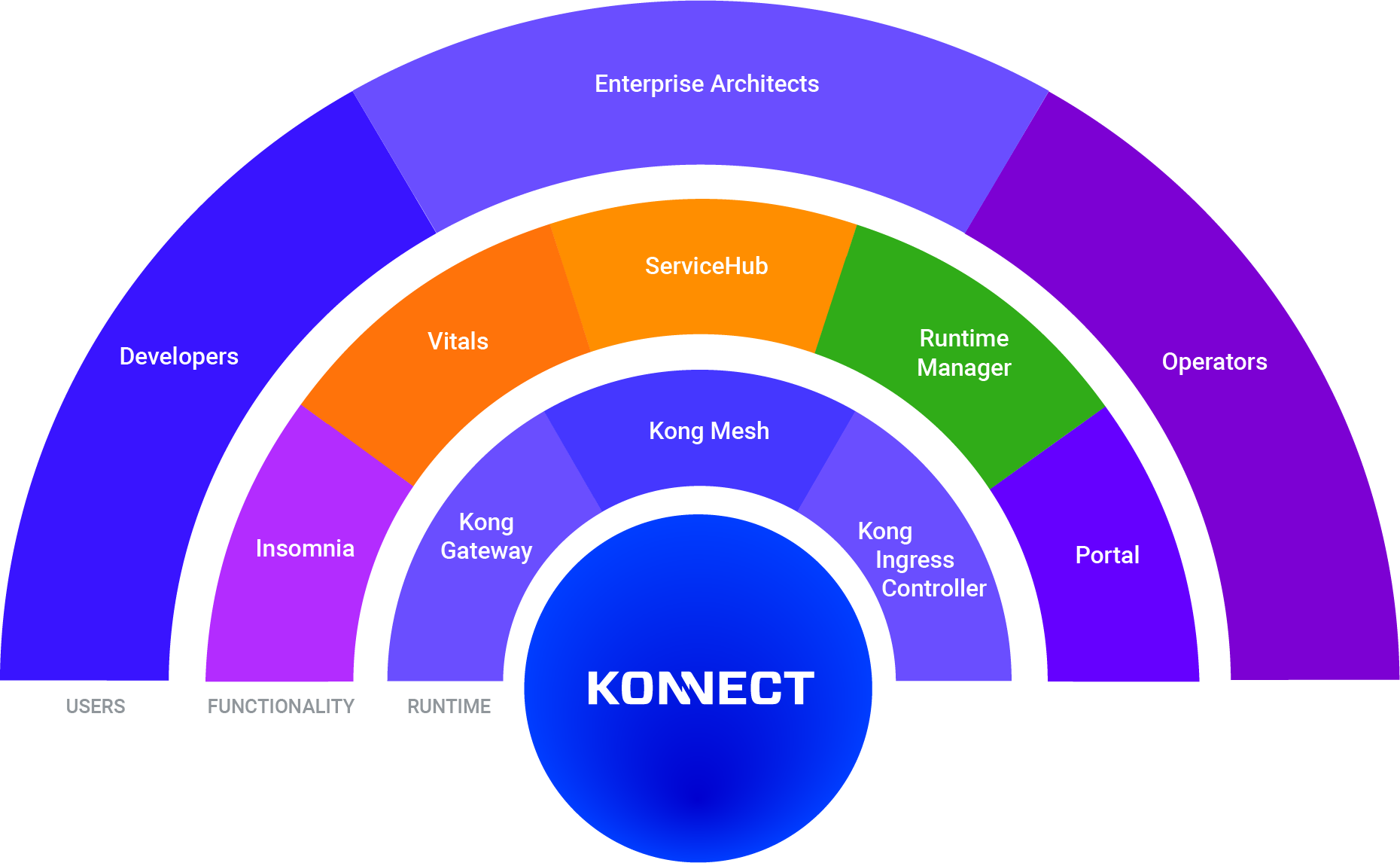
Image Credits: Kong
At the core of the platform is Kong’s new so-called ServiceHub, which provides that single pane of glass for managing a company’s services across the organization (and make them accessible across teams, too).
As Marietti noted, organizations can choose which runtime they want to use and purchase only those capabilities of the service that they currently need. The platform also includes built-in monitoring tools and supports any cloud, Kubernetes provider or on-premises environment, as long as they are Kubernetes-based.
The idea here, too, is to make all these tools accessible to developers and not just architects and operators. “I think that’s a key advantage, too,” Marietti said. “We are lowering the barrier by making a connectivity technology easier to be used by the 50 million developers — not just by the architects that were doing big grand plans at a large company.”
To do this, Konnect will be available as a self-service platform, reducing the friction of adopting the service.
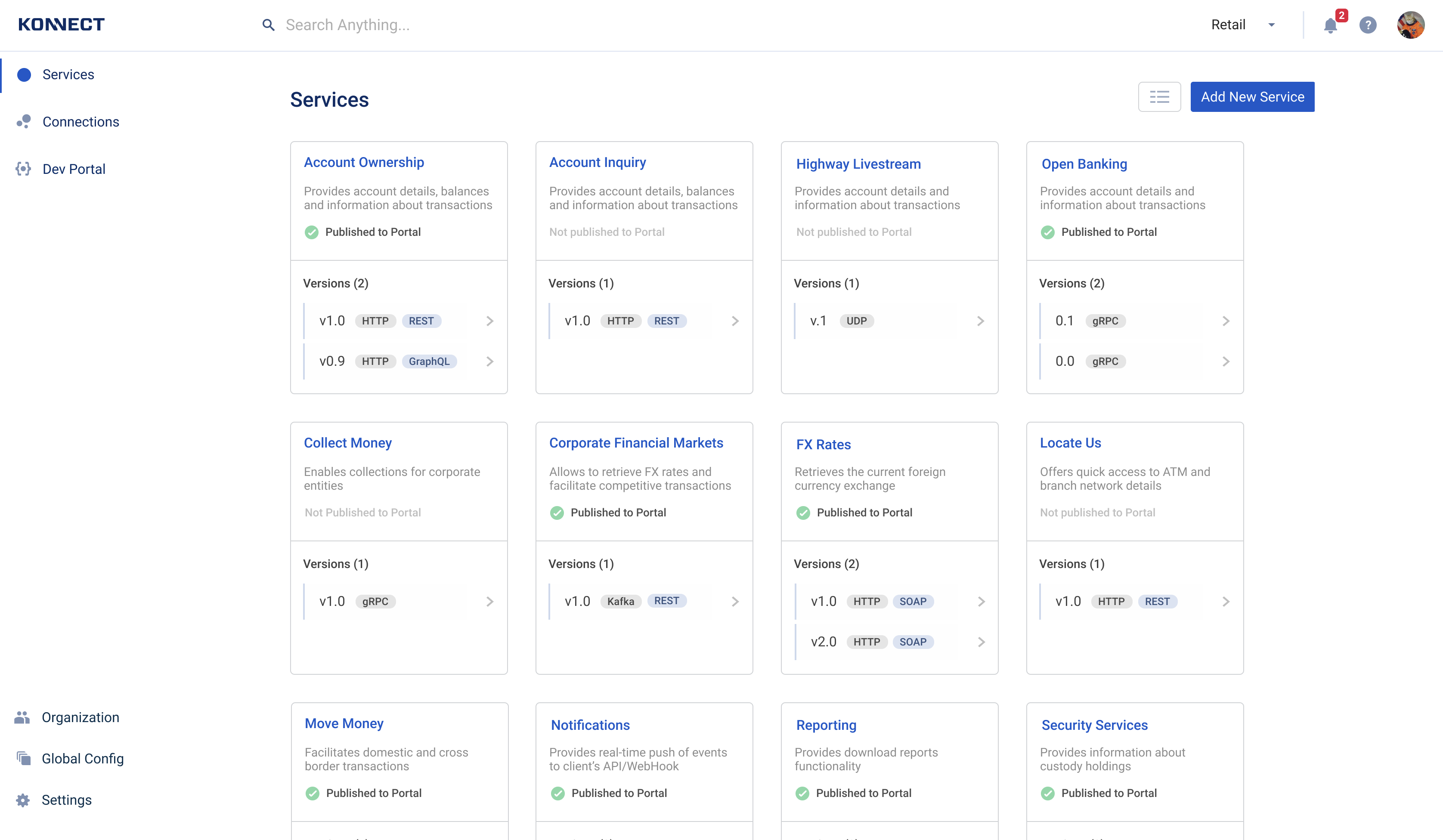
Image Credits: Kong
This is also part of the company’s grander plan to go beyond its core API management services. Those services aren’t going away, but they are now part of the larger Kong platform. With its open-source Kong API Gateway, the company built the pathway to get to this point, but that’s a stable product now and it’s now clearly expanding beyond that with this cloud connectivity play that takes the company’s existing runtimes and combines them to provide a more comprehensive service.
“We have upgraded the vision of really becoming an end-to-end cloud connectivity company,” Marietti said. “Whether that’s API management or Kubernetes Ingress, […] or Kuma Service Mesh. It’s about connectivity problems. And so the company uplifted that solution to the enterprise.”
Powered by WPeMatico
It seems that no-code is the tech watchword of the year. It refers to the ability to create something that normally would require a developer to code, and replace it with dragging and dropping components instead, putting the task in reach of much less technical business users. Today Okta announced new no-code workflows that provide a way to use identity as a trigger to launch a customer-centric workflow.
Okta co-founder and CEO Todd McKinnon says that the company has created a series of connectors to make it easier to connect identity to a workflow that includes sales and marketing tooling. This comes on the heels of the identity lifecycle workflows the company introduced at the Oktane customer conference in April.
“For this release we are introducing customer identity workflows which are focused on the connectors for all the customer-specific systems, things like Salesforce and Marketo and all the customer-centric [applications] that you’d want to do with your customer identities. And you can imagine over time that we’re going to expose this to more and more areas that will cover every kind of scenario a company would want to use,” McKinnon told TechCrunch.
McKinnon says that last year the company introduced Platform Services, which pulled apart the various pieces of the platform and exposed them as individual services, which bigger-company customers could tap into as needed. He says that this is an extension of that idea, but instead of having to get engineering talent to write complex code to tie the Okta service into say Salesforce, you can simply drag the Salesforce connector to your workflow.
As McKinnon describes this using early adopter MLB as an example, say someone downloads the MLB app, creates a log-in and signs in. At that point, if MLB marketing personnel wanted to connect to any applications outside of Okta, it would normally require leveraging some programming help to make it happen.
But with the new workflow tools, a marketing person can set up a workflow that checks the log-in for fraud, then sends the person’s information automatically into Salesforce to create a customer record, and also triggers a welcome email in Marketo — and all of this could be done automatically triggered by the customer sign up.
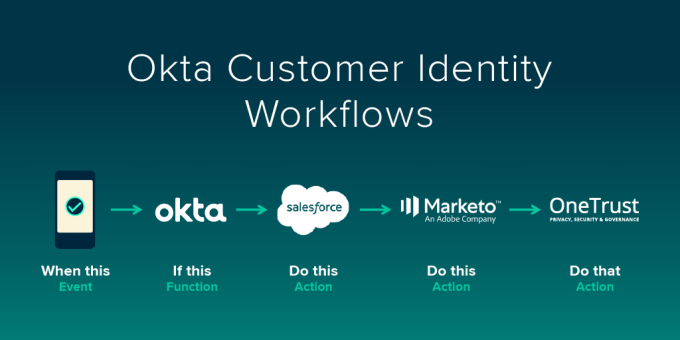
Image Credits: Okta
This functionality was made possible by the $52.5 million acquisition of Azuqua last year. As COO and co-founder Frederic Kerrest wrote in a blog post at the time of the acquisition (and we quoted in the article):
With Okta and Azuqua, IT teams will be able to use pre-built connectors and logic to create streamlined identity processes and increase operational speed. And, product teams will be able to embed this technology in their own applications alongside Okta’s core authentication and user management technology to build…integrated customer experiences.
And that’s precisely the kind of approach the company is delivering this week. For now, it’s available as an early adopter program, but as Okta works out the kinks, you can expect them to build on this and add other enterprise workflow connectors to the mix as it expands this vision, giving the company a way to move beyond pure identity management and connect to other parts of the organization.
Powered by WPeMatico
Google rebrands G Suite, Apple announces its next event date and John McAfee is arrested. This is your Daily Crunch for October 6, 2020.
The big story: G Suite becomes Google Workspace
To a large extent, Google Workspace is just a rebranding of G Suite, complete with a new set of (less distinctive) logos for Gmail, Calendar, Drive, Docs and Meet. But the company is also launching a number of new features.
For one thing, Google is (as previously announced) integrating Meet, Chat and Rooms across applications, with Gmail as the service where they really come together. Other features coming soon are the ability to collaborate on documents in Chats and a “smart chip” with contact details and suggested actions that appear when you @mention someone in a document.
Pricing remains largely the same, although there’s now an $18 per user per month Business Plus plan with additional security features and compliance tools.
The tech giants
Apple will announce the next iPhone on October 13 — Apple just sent out invites for its upcoming hardware event, all but confirming the arrival of the next iPhone.
Facebook’s Portal adds support for Netflix, Zoom and other features — The company will also introduce easier ways to launch Netflix and other video streaming apps via one-touch buttons on its new remote.
Instagram’s 10th birthday release introduces a Stories Map, custom icons and more — There’s even a selection of custom app icons for those who have recently been inspired to redesign their home screen.
Startups, funding and venture capital
SpaceX awarded contract to help develop US missile-tracking satellite network — The contract covers creation and delivery of “space vehicles” (actual satellites) that will form a constellation offering global coverage of advance missile warning and tracking.
Salesforce Ventures launches $100M Impact Fund to invest in cloud startups with social mission — Focus areas include education and reskilling, climate action, diversity, equity and inclusion, as well as providing tech for nonprofits and foundations.
Ÿnsect, the makers of the world’s most expensive bug farm, raises another $224 million — The team hopes to provide insect protein for things like fish food and fertilizer.
Advice and analysis from Extra Crunch
Inside Root’s IPO filing — As insurtech booms, Root looks to take advantage of a warm market and enthusiastic investors.
To fill funding gaps, VCs boost efforts to find India’s standout early-stage startups — Blume Ventures’ Karthik Reddy says, “There’s an artificial skew toward unicorns.”
A quick peek into Opendoor’s financial results — Opendoor’s 2020 results are not stellar.
(Reminder: Extra Crunch is our subscription membership program, which aims to democratize information about startups. You can sign up here.)
Everything else
John McAfee arrested after DOJ indicts crypto millionaire for tax evasion — The cybersecurity entrepreneur and crypto personality’s wild ride could be coming to an end after he was arrested in Spain and now faces extradition to the U.S.
Trump is already breaking platform rules again with false claim that COVID-19 is ‘far less lethal’ than the flu — Facebook took down Trump’s post, while Twitter hid it behind a warning.
The Daily Crunch is TechCrunch’s roundup of our biggest and most important stories. If you’d like to get this delivered to your inbox every day at around 3pm Pacific, you can subscribe here.

Powered by WPeMatico
When Salesforce Ventures launched the first $50 million Impact Fund in 2017, it wanted to invest not only in promising cloud businesses, but startups with a socially positive mission. Today, the company launched the second Impact Fund, this time doubling its initial investment with a new $100 million fund.
The latest fund is also designed to help bring more investment into areas that the company feels need to be emphasized as a corporate citizen beyond pure business goals, including education and reskilling, climate action, diversity, equity and inclusion, and providing tech for nonprofits and foundations.
Suzanne DiBianca, chief impact officer and EVP of Corporate Relations at Salesforce, says the money is being put to work on some of the world’s most pressing social issues. “Now more than ever, we believe business can be a powerful platform for change. We must leverage technology and invest in innovative ideas to drive the long-term health and wellness of all citizens, enable equal access to education and fuel impactful climate action,” DiBianca said in a statement.
Brent Leary, founder and principal analyst at CRM Essentials, says that this investment is consistent with their commitment to social issues. “This fits right in with Salesforce’s efforts on making business a force for change. They talk it, they walk it and they invest in it,” Leary told TechCrunch.
Claudine Emeott, director of Impact Investing, said in a Q&A on the company website that as with the first fund, the company is looking for cloud companies with some ties to Salesforce that address these core social components and can have a positive impact on the world. While there is a social aspect to each company, it still follows a particular investment thesis related to cloud computing. Her goal is to have a portfolio of cloud startups by next year that are addressing the set of social needs the firm has laid out.
“I hope that [by next year] we have made numerous investments in companies that are addressing today’s concurrent crises, and I hope that we can point to their measurable impact on those crises. I hope that we can point to exciting new integrations between our portfolio companies and Salesforce to tackle these challenges together,” Emeott said.
Paul Greenberg, president of the 56 Group and author of “CRM at the Speed of Light,” says that while he doesn’t always agree with Salesforce on every matter, he admires their social bent. “As an analyst, I might battle with them on some of their products, the things they do in the market and their messaging, but as a human being, I applaud them for their deep commitment to the common good,” he said.
Salesforce has always had a social component to its corporate goals, including its 1-1-1 philanthropy model. While Salesforce isn’t always completely consistent, as with its contract with ICE, it does put money and personnel toward helping in the communities where it operates, encouraging volunteerism and charitable giving from the top down and modeled across the organization.
This investment fund, while looking at the investments through a distinctly Salesforce lens, is designed to fund startups to help solve intractable social problems, while using its extensive financial resources for the betterment of the world.
Powered by WPeMatico
While many companies are using chatbots and other forms of automation to manage their communication with customers, Boston-based Tone is betting that humans will remain a key part of the equation.
“The traditional models of bots and humans is, ‘Hello, I’m a bot, now you get to battle with me to finally get to a human,’ ” said Tone CEO Tivan Amour. “Our version of that is, ‘I’m a human using AI to get you the answers you need more quickly.’ ”
Amour and his co-founders Vlad Pick and Kyle Weidman previously created a bicycle startup called Fortified Bicycle, and he said they “figured out that the best way to close our customers on these $750 to $1,000 orders was to actually engage them in text message conversations.”
After all, when it comes to “high consideration” purchases like bicycles, people usually want to discuss their questions and concerns with another human being. Over time, the Fortified team built what Amour said was a “semi-automated system” to help its sales team stay on top of these conversations.
“We started bragging to our friends about it, ‘You’ve gotta do this, it’s the future of mobile commerce,’ ” he recalled. “And they’d say, ‘Okay, that’s cool, but we don’t have any of the systems of doing that, we don’t have the salespeople.’ ”

Tone’s founders
So after selling Fortified Bicycle, Amour and Pick created Tone to help any e-commerce business manage similar text message conversations. Tone employs its own team of human agents to actually do the texting, assisted by software that helps them find the information they need.
It integrates with e-commerce systems like Shopify and Magento, and it’s already working with more than 1,000 brands like ThirdLove, Peak Design and Usual Wines — which are seeing as much as a 26% increase in revenue and a 15% increase in order size.
Amour also noted that specific Tone agents are assigned to specific brands, which means that customers will be talking to the same person whenever they have a question for that business. In some cases, customers have been talking to the same agent for months or years. (Update: Tone clarified that this isn’t a person, but a single persona that’s probably an amalgamation of multiple agents.)
“Particularly in a post-COVID world, it’s pretty clear that online shopping has become the dominant form of shopping, but I think nobody has thought about how you replace that human experience that you get in traditional retail,” he said.
Tone is announcing today that it has raised $4 million in seed funding led by Bling Capital, with participation from Day One Ventures, One Way Ventures, TIA Ventures and executives from Google, Facebook, Dropbox and Uber.
With the new funding, Amour said Tone will be able to build out the “relationship automation” aspect of the product. He also suggested that the platform could eventually expand beyond text messaging, but it sounds like that’s not a big priority.
“In theory, we’re a conversational sales platform more than we are an SMS company,” he said. “However there are a bunch of trends right now [such as the growth of mobile commerce] that make SMS the most obvious place for this sort of innovation.”
Powered by WPeMatico