Enterprise
Auto Added by WPeMatico
Auto Added by WPeMatico

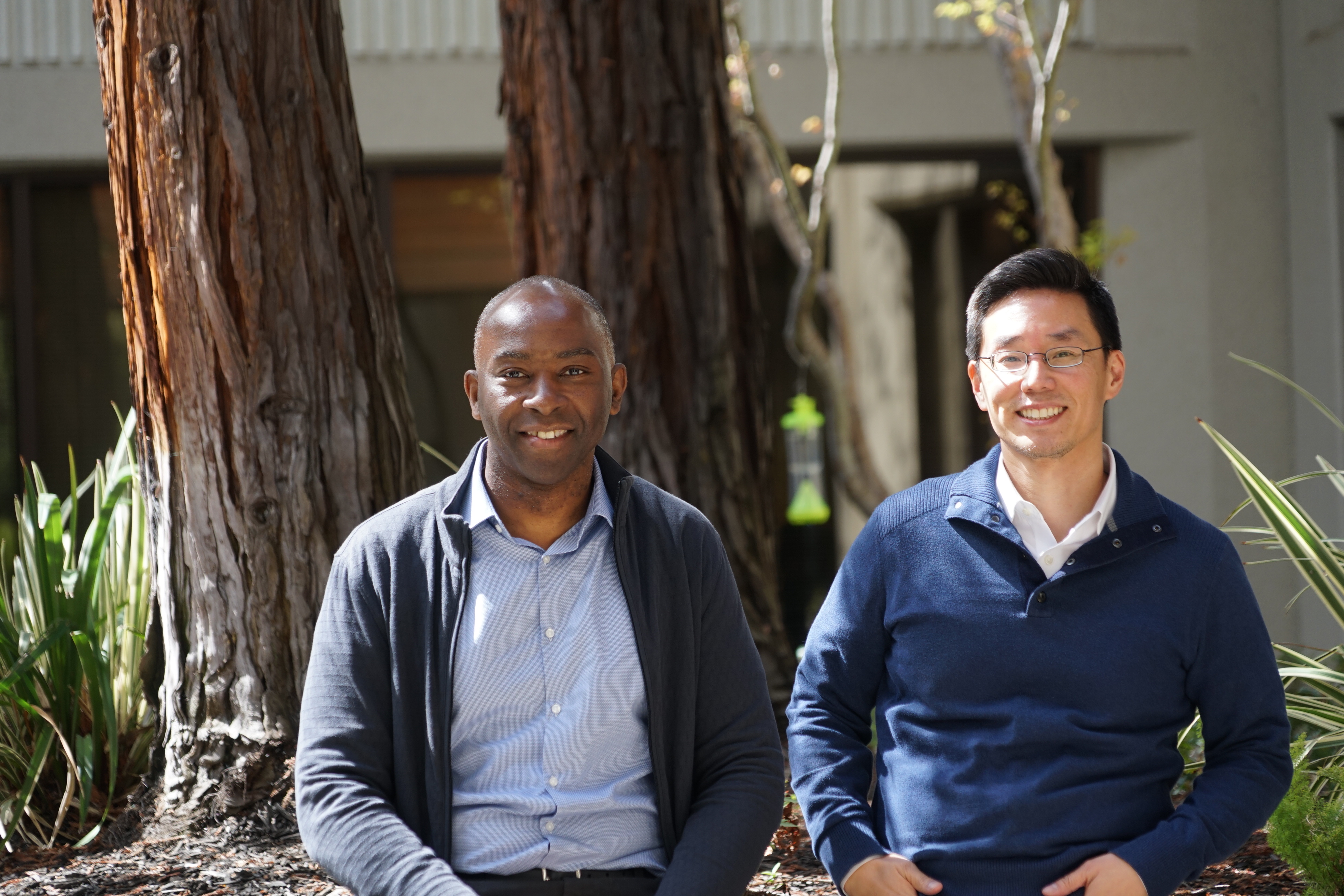
Another massive financing round for an AI chip company is coming in today, this time for SambaNova Systems — a startup founded by a pair of Stanford professors and a longtime chip company executive — to build out the next generation of hardware to supercharge AI-centric operations.
SambaNova joins an already quite large class of startups looking to attack the problem of making AI operations much more efficient and faster by rethinking the actual substrate where the computations happen. The GPU has become increasingly popular among developers for its ability to handle the kinds of lightweight mathematics in very speedy fashion necessary for AI operations. Startups like SambaNova look to create a new platform from scratch, all the way down to the hardware, that is optimized exactly for those operations. The hope is that by doing that, it will be able to outclass a GPU in terms of speed, power usage, and even potentially the actual size of the chip. SambaNova today said it has raised a huge $56 million series A financing round was co-led by GV and Walden International, with participation from Redline Capital and Atlantic Bridge Ventures.
SambaNova is the product of technology from Kunle Olukotun and Chris Ré, two professors at Stanford, and led by former Oracle SVP of development Rodrigo Liang, who was also a VP at Sun for almost 8 years. When looking at the landscape, the team at SambaNova looked to work their way backwards, first identifying what operations need to happen more efficiently and then figuring out what kind of hardware needs to be in place in order to make that happen. That boils down to a lot of calculations stemming from a field of mathematics called linear algebra done very, very quickly, but it’s something that existing CPUs aren’t exactly tuned to do. And a common criticism from most of the founders in this space is that Nvidia GPUs, while much more powerful than CPUs when it comes to these operations, are still ripe for disruption.
“You’ve got these huge [computational] demands, but you have the slowing down of Moore’s law,” Olukotun said. “The question is, how do you meet these demands while Moore’s law slows. Fundamentally you have to develop computing that’s more efficient. If you look at the current approaches to improve these applications based on multiple big cores or many small, or even FPGA or GPU, we fundamentally don’t think you can get to the efficiencies you need. You need an approach that’s different in the algorithms you use and the underlying hardware that’s also required. You need a combination of the two in order to achieve the performance and flexibility levels you need in order to move forward.”
While a $56 million funding round for a series A might sound colossal, it’s becoming a pretty standard number for startups looking to attack this space, which has an opportunity to beat the big chipmakers and create a new generation of hardware that will be omnipresent among any device that is built around artificial intelligence — whether that’s a chip sitting on an autonomous vehicle doing rapid image processing to potentially even a server within a healthcare organization training models for complex medical problems. Graphcore, another chip startup, got $50 million in funding from Sequoia Capital, while Cerebras Systems also received significant funding from Benchmark Capital.
Olukotun and Liang wouldn’t go into the specifics of the architecture, but they are looking to redo the operational hardware to optimize for the AI-centric frameworks that have become increasingly popular in fields like image and speech recognition. At its core, that involves a lot of rethinking of how interaction with memory occurs and what happens with heat dissipation for the hardware, among other complex problems. Apple, Google with its TPU, and reportedly Amazon have taken an intense interest in this space to design their own hardware that’s optimized for products like Siri or Alexa, which makes sense because dropping that latency to as close to zero as possible with as much accuracy as possible in the end improves the user experience. A great user experience leads to more lock-in for those platforms, and while the larger players may end up making their own hardware, GV’s Dave Munichiello — who is joining the company’s board — says this is basically a validation that everyone else is going to need the technology soon enough.
“Large companies see a need for specialized hardware and infrastructure,” he said. “AI and large-scale data analytics are so essential to providing services the largest companies provide that they’re willing to invest in their own infrastructure, and that tells us more investment is coming. What Amazon and Google and Microsoft and Apple are doing today will be what the rest of the Fortune 100 are investing in in 5 years. I think it just creates a really interesting market and an opportunity to sell a unique product. It just means the market is really large, if you believe in your company’s technical differentiation, you welcome competition.”
There is certainly going to be a lot of competition in this area, and not just from those startups. While SambaNova wants to create a true platform, there are a lot of different interpretations of where it should go — such as whether it should be two separate pieces of hardware that handle either inference or machine training. Intel, too, is betting on an array of products, as well as a technology called Field Programmable Gate Arrays (or FPGA), which would allow for a more modular approach in building hardware specified for AI and are designed to be flexible and change over time. Both Munichiello’s and Olukotun’s arguments are that these require developers who have a special expertise of FPGA, which is a sort of niche-within-a-niche that most organizations will probably not have readily available.

Nvidia has been a major benefactor in the explosion of AI systems, but it clearly exposed a ton of interest in investing in a new breed of silicon. There’s certainly an argument for developer lock-in on Nvidia’s platforms like Cuda. But there are a lot of new frameworks, like TensorFlow, that are creating a layer of abstraction that are increasingly popular with developers. That, too represents an opportunity for both SambaNova and other startups, who can just work to plug into those popular frameworks, Olukotun said. Cerebras Systems CEO Andrew Feldman actually also addressed some of this on stage at the Goldman Sachs Technology and Internet Conference last month.
“Nvidia has spent a long time building an ecosystem around their GPUs, and for the most part, with the combination of TensorFlow, Google has killed most of its value,” Feldman said at the conference. “What TensorFlow does is, it says to researchers and AI professionals, you don’t have to get into the guts of the hardware. You can write at the upper layers and you can write in Python, you can use scripts, you don’t have to worry about what’s happening underneath. Then you can compile it very simply and directly to a CPU, TPU, GPU, to many different hardwares, including ours. If in order to do that work, you have to be the type of engineer that can do hand-tuned assembly or can live deep in the guts of hardware, there will be no adoption… We’ll just take in their TensorFlow, we don’t have to worry about anything else.”
(As an aside, I was once told that Cuda and those other lower-level platforms are really used by AI wonks like Yann LeCun building weird AI stuff in the corners of the Internet.)
There are, also, two big question marks for SambaNova: first, it’s very new, having started in just November while many of these efforts for both startups and larger companies have been years in the making. Munichiello’s answer to this is that the development for those technologies did, indeed, begin a while ago — and that’s not a terrible thing as SambaNova just gets started in the current generation of AI needs. And the second, among some in the valley, is that most of the industry just might not need hardware that’s does these operations in a blazing fast manner. The latter, you might argue, could just be alleviated by the fact that so many of these companies are getting so much funding, with some already reaching close to billion-dollar valuations.
But, in the end, you can now add SambaNova to the list of AI startups that have raised enormous rounds of funding — one that stretches out to include a myriad of companies around the world like Graphcore and Cerebras Systems, as well as a lot of reported activity out of China with companies like Cambricon Technology and Horizon Robotics. This effort does, indeed, require significant investment not only because it’s hardware at its base, but it has to actually convince customers to deploy that hardware and start tapping the platforms it creates, which supporting existing frameworks hopefully alleviates.
“The challenge you see is that the industry, over the last ten years, has underinvested in semiconductor design,” Liang said. “If you look at the innovations at the startup level all the way through big companies, we really haven’t pushed the envelope on semiconductor design. It was very expensive and the returns were not quite as good. Here we are, suddenly you have a need for semiconductor design, and to do low-power design requires a different skillset. If you look at this transition to intelligent software, it’s one of the biggest transitions we’ve seen in this industry in a long time. You’re not accelerating old software, you want to create that platform that’s flexible enough [to optimize these operations] — and you want to think about all the pieces. It’s not just about machine learning.”
Powered by WPeMatico
A massive company probably has plenty of engineers on staff and the resources to build a complex backbone of interconnected information that can contain tons of data and make acting on it easy — but for smaller companies, and for those that aren’t technical, those tools aren’t very accessible.
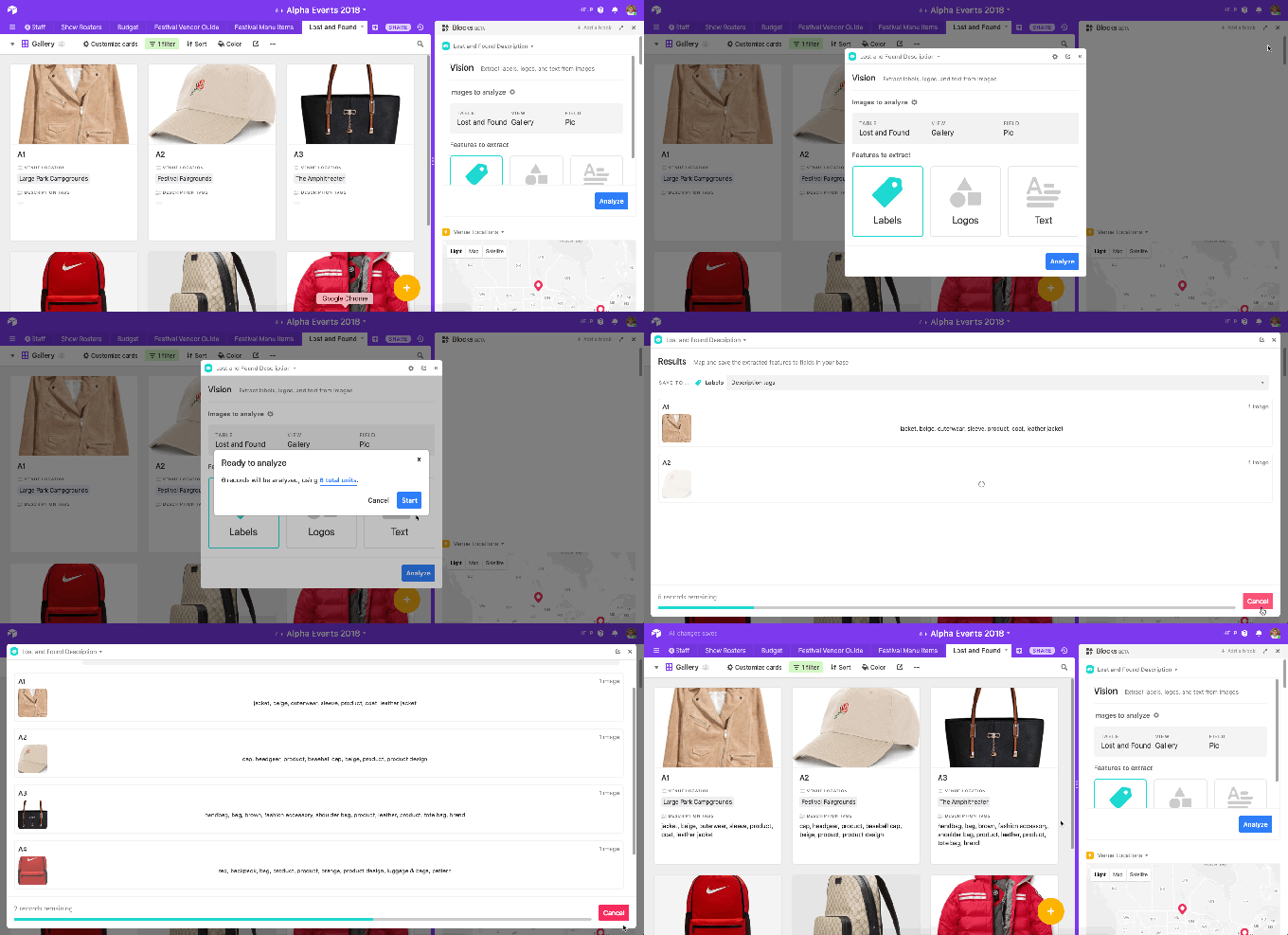
That’s what convinced Howie Liu to create Airtable, a startup that looks to turn what seems like just a normal spreadsheet into a robust database tool, hiding the complexity of what’s happening in the background while those without any programming experience create intricate systems to get their work done. Today, they’re trying to take that one step further with a new tool called Blocks, a set of mix-and-match operations like SMS and integrating maps that users can just drop into their systems. Think of it as a way to give a small business owner with a non-technical background to meticulously track all the performance activity across, say, a network of food trucks by just entering a bunch of dollar values and dropping in one of these tools.
“We really want to take this power you have in software creation and ‘consumerize’ that into a form anyone can use,” Liu said. “At the same time, from a business standpoint, we saw this bigger opportunity underneath the low-code app platforms in general. Those platforms solve the needs of heavyweight expensive use cases where you have a budget and have a lot of time. I would position Airtable making a leap toward a graphical user interface, versus a lot of products that are admin driven.”
Liu said the company has raised an additional $52 million in financing in a round led by CRV and Caffeinated Capital, with participation from Freestyle Ventures and Slow Ventures. All this is going toward a way to build a system that is trying to abstract out even the process of programming itself, though there’s always going to be some limited scope as to how custom of a system you can actually make with what amounts to a set of logic operation legos. That being said, the goal here is to boil down all of the most common sets of operations with the long tail left to the average programmers (and larger enterprises often have these kinds of highly-customized needs).
All this is coming at a time when businesses are increasingly chasing the long tail of small- to medium-sized businesses, the ones that aren’t really on the grid but represent a massive market opportunity. Those businesses also probably don’t have the kinds of resources to hire engineers while companies like Google or Facebook are camping out on college campuses looking to snap up students graduating with technical majors. That’s part of the reason why Excel had become so popular trying to abstract out a lot of complex operations necessary to run a business, but at the same time, Liu said that kind of philosophy should be able to be taken a step further.
“If you look at cloud, you have Amazon’s [cloud infrastructure] EC2, which abstracted the hardware level and you can build on existing machine intelligence,” Liu said. “Then, you get the OS level and up. Containers, Heroku, and other tools have extracted away the operation level complexity. But you have to write the app and modal logic. Our goal is to go a big leap forward on top of that and abstract out the app code layer. You should be able to directly use our interface, and blocks, all these plug and play lego pieces that give you more dynamic functionality — whether a map view or an integration with Twilio.”
And, really, all these platforms like Twilio have tried to make themselves pretty friendly to coding beginners as-is. Twilio has a lot of really good documentation for first-time developers to learn to use their platforms. But Airtable hopes to serve as a way to interconnect all these things in a complex web, creating a relational database behind the scenes that users can operate on in a more simplistic matter that’s still accurate, fast, and reliable.
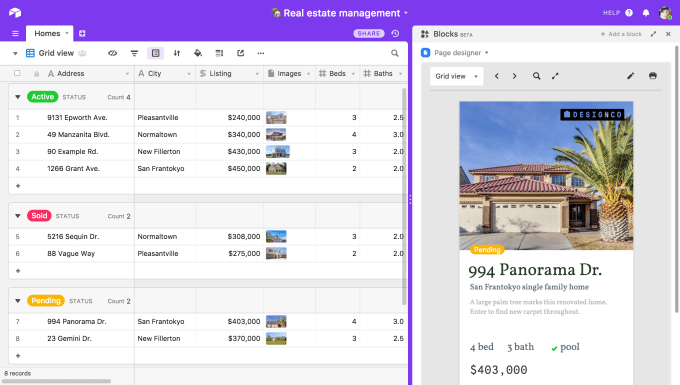
“Obviously MySQL is great if you want to use code or custom SQL queries to interface with the data,” Liu said. “But, ultimately, you’d never as a business end user consider using literally a terminal-based SQL prompt as the primary interface to and from your data. Certainly you wouldn’t put that on your designs. Clearly you would want some interface on top of the SQL level database. We basically expose the full value of a relational database like Postgres to the end user, but we also give them something equally but more important: the interface on the top that makes the data immediately visible.”
There’s been a lot of activity trying to rethink these sort of fundamental formats that the average user is used to, but are ripe for more flexibility. Coda, a startup trying to rethink the notion behind a word document, raised $60 million, and all this points towards moves to try to create a more robust toolkit for non-technical users. That also means that it’s going to be an increasingly hot space, and especially look like an opportunity for companies that are already looking to host these kinds of services online like Amazon or Microsoft and have the buy-in from those businesses.
Liu, too, said that the goal of the company was to go after all potential business cases right away by creating a what-you-see-is-what-you-get one size fits all platform — which is usually called a horizontal approach. That’s often a very risky move, and it’s probably the biggest question mark for the company as there’s an opportunity for some other startups or companies to come in and grab niches of that whole pie in specific areas (like, say, a custom GUI programming interface for healthcare). But Liu said the opportunity for Airtable was to go horizontal from day one.
“There’s this assumption that software has to involve literally writing code,” Liu said. “It’s sort of a difficult thing to extricate ourselves from because we have built so much with writing code. But when you think about what goes into a useful application, especially in the business-to-business internal tools in a company use case which forms the bulk of software that’s consumed in terms of lines of code written, most of them are primarily a relational database model, and the relational database aspect of it is not an arbitrary format.
Powered by WPeMatico
TypingDNA has a new approach to verifying your identity based on how you type.
The startup, which is part of the current class at Techstars NYC, is pitching this as an alternative to two-factor authentication — namely, the security feature that sends unique codes to a separate device (usually your phone) to make sure someone else isn’t logging in with your password.
The problem with two factor? TypingDNA Raul Popa put it simply: “It’s a bad user experience … Nobody wants to use a different device.” (I know that TechCrunch writers have had two-factor issues of their own, like when they’re trying to log in on an airplane and can’t connect their phone.)
So TypingDNA allows users to verify their identity without having to whip out their phone. Instead, they just enter their name and password into a window, then TypingDNA will analyze their typing and confirm that it’s really them.
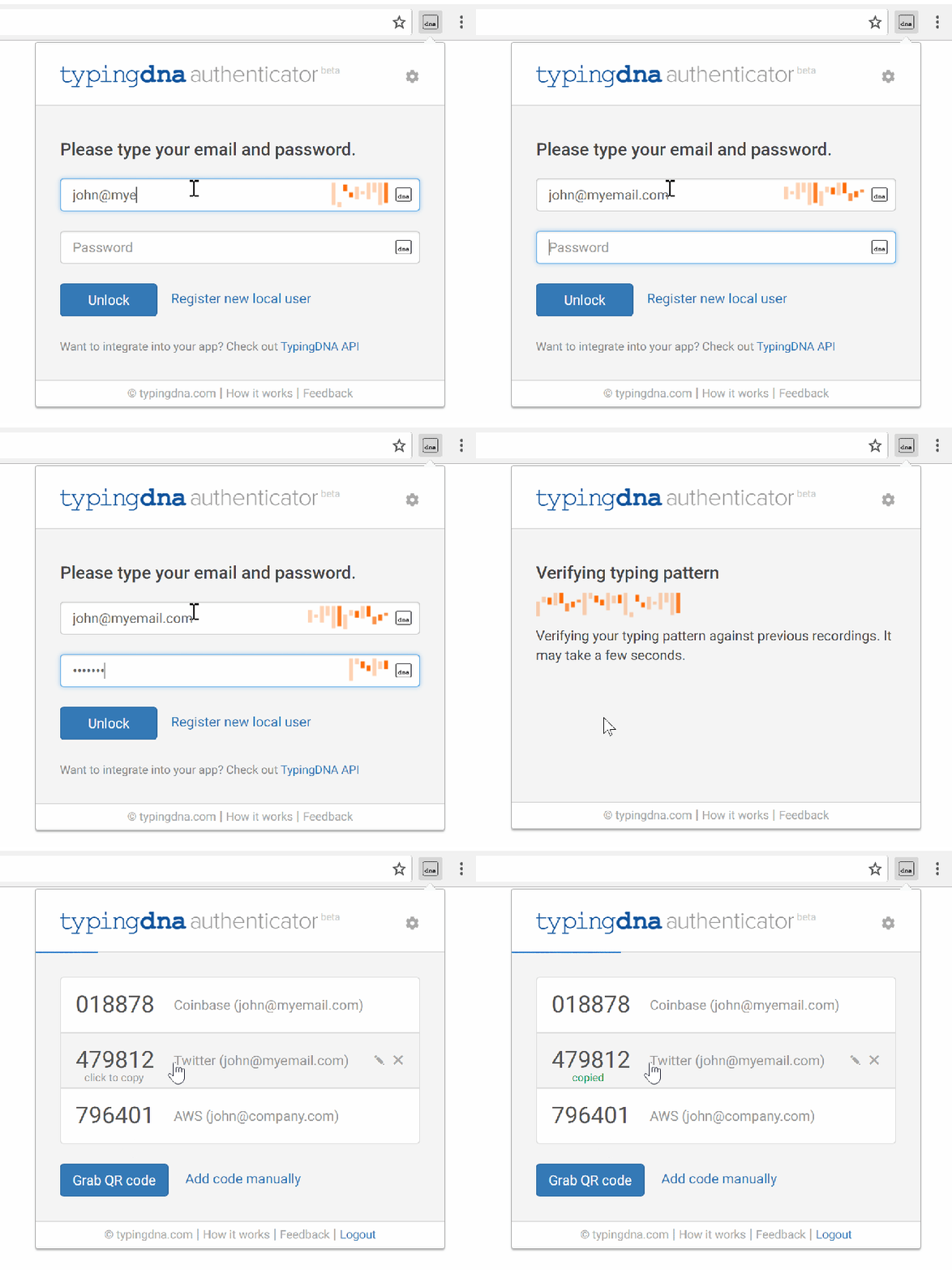
The startup’s business model revolves around working with partners to incorporate the technology, but it’s also launching a free Chrome extension that works as an alternative to two-factor authentication on a wide range of services, including Amazon Web Services, Coinbase and Gmail.
Popa said TypingDNA measures two key aspects of your typing: How long it takes you to reach a key and how long you keep the key pressed down. Apparently these patterns are unique; Popa showed me that the system could tell the difference between his typing and mine, and you can test it out for yourself on the TypingDNA website.
He also said that the company can adjust the strictness of the system, getting the rate of false positives as low as 0.1 percent. In the case of the Chrome authenticator, Popa said, “We minimize the false acceptance rate” — so you might get rejected if you’re typing in an unusual position, or if there’s some other reason you’re typing slower or faster than usual. But in that case, the authenticator will just ask you to try again.
And again, you can use the Chrome extension on a variety of sites. Most two-factor options include confirming a device using a QR code, which TypingDNA can grab. The two-factor codes are then sent to the TypingDNA extension (the codes are stored locally on your computer, not the company’s servers), and they’re revealed once you’ve verified your identity with the aforementioned typing.
You can visit TypingDNA to learn more and download the extension.
Powered by WPeMatico

Microsoft today announced its plans for a major expansion of the Microsoft Cloud with the launch of its first cloud regions in the Middle East. These new regions, which are scheduled to go online in 2019, will be located in Abu Dhabi and Dubai and will host the company’s usual Azure, Office 365 and Dynamics 365 services.
“Microsoft has been present in the Middle East for more than two decades and is deeply invested in the region in many ways,” said Sayed Hashish, regional general manager, Microsoft Gulf, in today’s announcement. “Driven by strong customer demand for cloud computing, local data centers were the logical next step given the enormous opportunity that the cloud presents. In areas like digital transformation, and the development of new intelligent services, our ambition is for the Microsoft Cloud to form a strategic part of the backbone for regional economic development.”

The region of the Middle East is relatively late in adopting cloud computing, but that also means that it has a lot of room left to grow. Microsoft is clearly trying to get ahead of this trend.
It’s worth noting that Amazon, too, has already announced its plans for a region in Bahrain, which will open in about a year, while Google has not announced any plans to enter this market yet.
In addition to the new Middle East regions, Microsoft also today announced its first region in Switzerland (with data centers around Geneva and Zürich), which is scheduled to go online in 2019. In Germany, the company is launching an additional cloud region and in France, the Microsoft Cloud is now generally available.
In total, Microsoft now offers 50 regions around the globe, with plans for 12 new regions in the works.
Powered by WPeMatico
The first time Waseem Daher, Jessica McKellar, and Jeff Arnold worked together on a startup, they built one that allowed administrators to patch security updates to a system without having to restart it.
So it might come as a bit of a surprise that the next big technical challenge the three MIT graduates want to tackle is bookkeeping . But after selling Ksplice to Oracle back in 2011, it was actually the financial software they had built internally that made the jaws of the finance teams at Oracle drop, Daher said. They had created a continuously-updating internal version of QuickBooks, keeping a close eye on their spending and accounting and not having do hire a bookkeeper to do so, out of pure frustration with the process. And today that’s basically launching as Pilot, a startup that has now raised $15 million in a financing round led by Index Ventures.
“If you look at the history of bookkeeping, it goes back to the 1400s,” Daher said. “Probably the oldest written records were of transactions. Around 1400s, we invented double-entry bookkeeping, a system for how money moves into and out of various accounts of companies. That system, as articulated in 1400 in Venice, is basically still what people do in every American business today. You hire a bookkeeper or bookkeeping firm, you send them all your stuff and they track and produce the set of books. The way it’s done today is the same way it’s done in the 90s, the 40s.”
When a company starts working with Pilot, the actual core experience on the customer side doesn’t really change all that much: they still work with a human on the other end. But the bookkeeper from Pilot is working with the internal tools they have built to bring in the data from the company, organize it and structure it, and produce a set of books that are more accurate than someone might have produced than just doing it by hand. Customers will get the kinds of questions you might expect from a normal bookkeeper as they look to clarify what’s happening, but in the end the process happens much more seamlessly. They can integrate directly with their existing services like Expensify or Gusto (or ask Pilot to help out with that) and then go from there.
That kind of human-software mix is something that’s increasingly common in services businesses — like Pilot — as the tech industry figures out what should be automated and what should still be handled by a person. There are still a lot of things that a person can catch, but there’s also the actual human relationship, which isn’t a kind of repetitive task you’d want to automate with an algorithm. To begin, Pilot isn’t trying to force companies to completely rip out their bookkeeping software and start from scratch, and instead start to collect the electronic information they already have.
“Uber’s like that, the drivers are humans but the software makes them much more effective,” Index Ventures’ Mike Volpi said. “You can see it in a lot of applications where in IT support there’s a few businesses like this, you troubleshoot using software, and when you can’t you fix it pass it to humans. In customer service chats, a lot of times it’s an AI, and when the questions get tricky enough it rolls over to humans. It’s interesting because there are tasks which humans are fundamentally needed and there are tasks that are mundane that software can do and the human can avoid doing. It’s an interesting thesis around this hybrid.”
Prior to Pilot, the team sold another company to Dropbox called Zulip, and spent some time at the company as it continued to scale up (Dropbox is now in the process of going public). Some of the challenge alone was somehow assembling a team that found some fascination with the intersection of accounting, machine learning and working directly with customers, but so far McKellar said that they’ve been able to put one together thus far. And, more importantly, now that they are starting to roll out their service they can start getting some perspective on the industry as a whole.
“I think people can get motivated by almost any problem if you know you’re tackling a big problem for many people,” McKellar said. “But there’s quite a lot of subtlety to what we’re building. The rules and principles of bookkeeping are well define but the real world is really messy, and designing the right systems to automate bookkeeping at scale is actually a tricky thing. We have an incredible engineering team that is able to tackle this with the right mindset it. The analogy you can draw is self-driving cars — that’s a system normally done by a human, everyone understands what it takes to drive a car, what actions you should take. It’s difficult for people to put into words, what are the rules given a set of inputs, but it needs to work and be reliable.”
As more and more of this information comes in, and more and more companies start to work with Pilot, they can start spotting trends in the industry. For example, if a 17th SaaS business with a similar business model to other Pilot companies signs up, they could down the line take a look at their info and spot potential discrepancies based on anonymized trend data picked up from other comparables in the industry — or do a better job of spotting inefficiencies or others. And there are some obvious funnels for this already, like getting the right information for tax purposes to accountants.
There’s going to be a lot of increasing activity in this space, though. Already you’re seeing some funded projects like botkeeper, which are looking to find some ways to automate a bookkeeping service. There’s nothing quite so formalized and an obvious tool that looks to take out QuickBooks (and, again, a lot of these seem to be playing nice for now), and there’s always the chance that Intuit could try to take on the space itself. But at the end of the day, Volpi says it’s based on the team that they’ve assembled — and that combination of humans and algorithms — that gives them a shot at succeeding.
“If you look at a fundamental level, the bookkeeping for the doctor’s office or florist, it is really all following the same underlying principles,” McKellar said. “One of the engineering challenges is to build the tooling and systems and software in a way that’s intelligent. It has to be a set of processes that can flexibly accommodate every vertical over time. In some sense this company, why we raised this, was to validate a huge hypothesis — it’s possible to automate bookkeeping at scale across a range of industries.”
Here’s the rest of the investors in this round, since it’s a long list: Patrick and John Collison, Drew Houston, Diane Greene, Frederic Kerrest, Hans Robertson, Adam D’Angelo, Paul English, Howard Lerman, Joshua Reeves, Tien Tzuo, as well as many others.
Powered by WPeMatico
 WeWork — the co-working startup valued at $20 billion with some 200,000 members across 200 locations globally — is continuing with its strategy of expanding into a wide array of adjacent operations to grow its business. Today the company announced that it will be expanding the coding-focused Flatiron School abroad, starting in London this June.
Alongside this, it’s also… Read More
Powered by WPeMatico
 Salesforce is set to buy CloudCraze, an enterprise e-commerce solution built on its cloud-based customer relationship management platform. Based in Chicago, CloudCraze announced on its site that it’s signed a definitive agreement to be acquired by Salesforce. The deal’s financial details were not disclosed. Read More
Powered by WPeMatico
 After getting delayed by at least a month or so following a regulatory investigation just days before the meeting was scheduled to take place, Qualcomm’s timetable to hold the meeting is now bumped up to ten days from now — and possibly before Broadcom may complete its move to the U.S. The new change is coming as part of a presidential order by the Trump administration to block… Read More
Powered by WPeMatico
 The massive fight over the fate of Qualcomm, which chipmaker Broadcom seeks to acquire in the largest deal in technology effort, took another dramatic turn this afternoon when the Trump administration said it would block the deal. The move is another chapter in a long story, a culmination of a lot of consolidation activity in the semiconductor space and months over jockeying over whether or… Read More
Powered by WPeMatico
 Earlier this year we reported that Twilio was going to launch a full contact center solution called Flex on March 12 — lo and behold, today is March 12 and Twilio today announced the launch of Flex at the Enterprise Connect conference in Orlando. Flex brings together virtually every part of the existing Twilio infrastructure and platform for developers that already power nearly 40… Read More
Powered by WPeMatico