Enterprise
Auto Added by WPeMatico
Auto Added by WPeMatico
By placing all the information about services or complex manufacturing and assembly processes on a private, permissioned blockchain, the idea is that a company can create an “immutable” audit trail of data. When you think about it, currently this involves a labor-intensive combination of paper and networks. But initial trials with private blockchains in the last couple of years have shown there is potential to reduce the identification process of a data trail from several days to minutes.
Indications that this is becoming a hot issue amongst startups arrives today in two pieces of news.
Firstly, London-based “Gospel”(yes, that really is their name…) has raised £1.4m in seed funding from investors led by European-focused LocalGlobe.
The blockchain startup says it has been working with an unnamed “aerospace and defence manufacturer” to develop a proof of concept to improve record keeping for its supply chain. What’s the betting it’s British Aerospace? They aren’t saying.
At any rate, Gospel says it has developed a way of securely distributing data across decentralised infrastructures, offering companies the potential to automate records for complex products that usually require significant manual management. The idea is that is shares only the information it needs to, securely, with other partners in its supply chain, potentially leading to improved efficiency and lower costs of information recall.
Founded in December 2016 by entrepreneur Ian Smith, Gospel uses a private blockchain that requires users to set up a network of “nodes” within their ecosystem. Each party controls their own node and all the nodes must agree before any transaction can be processed and put on the blockchain. The node network acts as a consensus and provides a mechanism of trust.
Smith says: “For manufacturers and other businesses dealing with critical data there is a problem of trust in data systems, particularly when there is a need to share that data outside the organization. With Gospel technology we can provide an immutable record store so that trust can be fully automated between systems of forward-thinking businesses.”
Prior to this seed round, Gospel was backed by a number of angel investors including Gumtree co-founder Michael Pennington and Vivek Kundra, the Chief Information Officer for the US Government during Barack Obama’s administration.
Secondly, Russia-based startup Waves, which has issued its own cryptocurrency, is getting into the space with the launch of Vostok, a universal blockchain solution for scalable digital infrastructure.
The idea is that public institutions and large enterprises can use the platform to enhance security, data storage, transparency and stability of their systems.
Vostok, which is named after the craft that carried Yuri Gagarin into space, claims to be significantly faster and cheaper than existing blockchain solutions, claiming 10,000 transactions per second (TPS) at only $0.000001 per a transaction. This is compared to Bitcoin which has transactional processing capacity of 3-6TPS and costs $0.951 per transaction. Vostok also uses a closed operational node set and Proof-of-Stake.
Sasha Ivanov, CEO and Founder of Vostok and Waves Platform, said: “Vostok is a multi- purpose solution, quite simple, but at the same time non-trivial. It will allow any large organisation to gain the benefits of blockchain without having to create new systems from scratch or retrain their staff.”
Powered by WPeMatico
Adobe reported its Q2 FY’18 earnings yesterday and the news was quite good. The company announced $2.2 billion in revenue for the quarter up 24 percent year over year. That puts them on an impressive $8.8 billion run rate, within reach of becoming the next $10 billion software company (or at least on a run rate).
Revenue was up across all major business lines, but as has been the norm, the vast majority comes from the company’s bread and butter, Creative Cloud, which houses the likes of Photoshop, InDesign and Dreamweaver, among others. In fact digital media, which includes Creative Cloud and Document Cloud accounted for $1.55 billion of the $2.2 billion in total revenue. The vast majority of that, $1.30 billion was from the creative side of the house with Document Cloud pulling in $243 million.
Adobe has been mostly known as a creative tools company until recent years when it also moved into marketing, analytics and advertising. Recently it purchased Magento for $1.6 billion, giving it a commerce component to go with those other pieces. Clearly Adobe has set its sights on Salesforce, which also has a strong marketing component and is not coincidentally perhaps, the most recently crowned $10 billion software company.
Adobe CEO Shantanu Narayen speaking to analysts on the post-reporting earnings call sees Magento as filling in a key piece across understanding the customer from shopping to purchase. “The acquisition of Magento will make Adobe the only company with leadership in content creation, marketing, advertising, analytics and now commerce, enabling real-time personalized experiences across the entire customer journey, whether on the web, mobile, social, in-product or in-store. We believe the addition of Magento expands our available market opportunity, builds out our product portfolio, and addresses a key underserved customer need,” Narayen told analysts.
If Adobe could find a way to expand that marketing and commerce revenue, it could easily surpass that $10 billion revenue run rate threshold, but so far while it has been growing, it remains less than half of the Creative revenue at $586 million. Yes, it grew at an 18 percent year over year clip, but it seems as though there is potential for so much more there and clearly Narayen hopes that the money spent on Magento will help drive that growth.
Even while it was announcing its revenue, rival Salesforce was meeting with Marketing Cloud customers in Chicago at the Salesforce Connections conference, a move that presented an interesting juxtaposition between the two competitors. Both have a similar approach to the marketing side, while Salesforce concentrates on the customer including CRM and service components. Adobe differentiates itself with content, which shows up on the balance sheet as the majority of its revenue .
Both companies have growth in common too. Salesforce has been on quite a run over the last five years reaching $3 billion in revenue for the first time last quarter. Adobe hit $2 billion for the first time in November. Consider that prior to moving to a subscription model in 2013, Adobe had revenue of $995 billion. Since it moved to that subscription model, it has reaped the benefits of recurring revenue and grown steadily ever since.
Each has used strategic acquisitions to help fuel that growth with Salesforce acquiring 27 companies since 2013 and Adobe 13, according to Crunchbase data. Each has bought a commerce company with Adobe buying Magento this year and Salesforce grabbing Demandware two years ago.
Adobe has the toolset to keep the marketing side of its business growing. It might never reach the revenue of the creative side, but it could help push the company further than it’s ever been. Ten billion dollars seems well within reach if things continue along the current trajectory.
Powered by WPeMatico
While Salesforce and Microsoft have a dominant position in the world of sales software today, there are a number of startups nipping at their heels, and today one of the more promising of them has announced a growth round to help them in the effort. Pipedrive, a startup co-headquartered in Estonia and New York that offers tools to salespeople to help them close deals that are still in their pipeline, has picked up $50 million to expand its product, develop its business globally and potentially make acquisitions in the CRM space.
The Series C round was co-led by new investor Insight Venture Partners and Bessemer Venture Partners, with participation also from Rembrandt Venture Partners and Atomico (which itself has Estonian roots: Atomico’s founder, Niklas Zennstrom, was the co-founder of Skype, which developed and built the core IP voice and messaging product in the country). It brings the total raised by Pipedrive to $80 million.
Timo Rein, Pipedrive’s co-founder and CEO (and a former salesman himself), would not disclose the company’s valuation, saying only that it was “a pretty good round.” For some more context, Pitchbook writes that Pipedrive’s last funding, in 2016, valued the company at $188 million. Sources very close to the company tell us that the valuation now is $300 million+. (We’re asking around and will update this as and when we learn more.)
The CRM market is currently estimated to be worth over $40 billion, according to Gartner, and so unsurprisingly there are a number of startups in the fray, from those that are infusing the process with AI (such as Clari) through to other startups that help organise leads to act on them better (such as Zoho and Hubspot), through to those focusing on specific verticals like software companies (Paddle out of the UK).
Rein said that there was some skepticism when the company first launched that it would be possible to make a dent in landscape dominated by the likes of Salesforce and Microsoft.
“When we entered the market in 2010, people asked us, ‘Why build a product in an area where Salesforce is already strong?’ But having been in sales for more than a decade ourselves, we realized that it’s not just the sheer number of features you offer users. The difference is finding the right spot on the spectrum where you are getting what you need out of a product that you can use,” Rein said. “We have proven that users are migrating from Salesforce and others and are coming to Pipedrive. We definitely have less functionality, but professional salespeople know that performance is largely about your personality.”
In the case of Pipedrive, this translates to a software platform whose aim is to cut down on busywork to focus you on selling: all of your activity across emails and phone calls gets and other actions (it integrates some 100 other apps used in business, for example Google Apps, Trello, Zapier, MailChimp, Yesware and PandaDoc) is tracked without you needing to update the system, with the aim of making it easier for you to see what you might tackle next (and that gets tracked, too).
This is not about finding sales leads, Rein said: that may be something the company would consider down the line, but for now it’s looking at what happens when you already have a lead and need to make it as easy as possible to close that deal.
Ironically, Rein said that Pipedrive hasn’t been using its own tools in the majority of its own sales efforts. “In areas where we can use Pipedrive, we do,” he said, “but the service we offer is almost the opposite of what we built.” Pipedrive is priced on a monthly, SaaS basis ranging from $12.50 per user per month to $62.50 depending on number of users and features.
One way to think of Pipedrive’s approach is akin to something like Razer for the gaming world, which touts its ethos as “For Gamers. By Gamers.”
“Pipedrive is built primarily for salespeople, not just their managers,” said Teddie Wardi, a partner at Insight who also led the company’s Series B when he was still at Atomico. “This principle has helped them to create a product loved by users around the world, differentiate from competitors and propel the company to stellar growth.”
And that growth has come: today the company has 75,000 customers in 170 countries, with triple digital revenue growth each year since it first opened for business in 2010.
The plethora of startups in the market focusing on different aspects of the sales cycle and the CRM that surrounds that creates a ripe landscape not just for what Pipedrive might choose to tackle next, but how it might go about that.
“Post-sales, when you already have a customer and now need to help manage it, is an opportunity,” Rein said. “But our main effort and focus has been a product to help sales people deal with their pressure, and their own need to stay focused on the steady flow of sales, from the beginning to the actual close.”
Powered by WPeMatico
When Docker burst on the scene in 2013, it brought the idea of containers to a broad audience. Since then Kubernetes has emerged as a way to orchestrate the delivery of those containerized apps, but Docker saw a gap that wasn’t being addressed beyond pure container deployment that they are trying to address with the next release of Docker Enterprise Edition. Docker made the announcement today at DockerCon in San Francisco.
Scott Johnston, chief product officer at Docker says that Docker Enterprise Edition’s new federated application management feature helps operations manage multiple clusters, whether those clusters are on premise, in the cloud or across different public cloud providers. This allows federated management of application wherever they live and supports managed Kubernetes tools from the big three public cloud providers including Azure AKS, AWS EKS and Google GKE.
Johnston says that deploying the containers is just the first part of the problem. There is a whole set of issues to deal with outside of Kubernetes (and other orchestration tools) once your application begins being deployed. “So, you know, you get portability of containers with the Docker format and the Kubernetes or Compose description files, but once you land on an environment, that environment has deployment scripts, security models, user management and [so forth]. So while the app is portable, the management of these applications is not,” he explained.
He says that can lead to a set of separate deployment tools creating a new level of complexity that using containers was supposed to eliminate. This is especially true when deploying across multiple clouds (and on prem sometimes too). If you need load balancing, security, testing and so forth — the kinds of tasks the operations team has to undertake — and you want to apply these in a consistent way regardless of the environment, Johnston says that Docker EE should help by creating a single place to manage across environments and achieve that cloud native goal of managing all your applications and data and infrastructure in a unified way.
In addition to the federated management component, Docker also announced Windows Server containers on Kubernetes for Docker Enterprise Edition. It had previously announced support for Linux containers last year.
Finally, the company is introducing a template-based approach to Docker deployment to enable people in the organization with a bit less technical sophistication to deploy from a guided graphical process instead of a command line interface.
The federated application management is available in Beta starting the second half of this year, support for Windows Server Containers will be included in the next release of Docker Enterprise Edition later this year and Templates will be available in Docker Desktop in Beta later this year.
Powered by WPeMatico
Managed by Q, the office management platform based out of NYC, today announced its acquisition of NVS.
Founded by Jason Havens in 2011, NVS is an office space planning and project management service, helping businesses plan their moves or office redesigns from start to finish. The company helps connect with a network of brokers, architects, interior designers, etc. and manage the project on behalf of their clients to ensure it stays on schedule and doesn’t end up costing more than expected.
For Managed by Q, NVS provides an added service layer for existing clients, and has the opportunity to bring new clients into the Managed by Q fold.
This marks Managed by Q’s second acquisition, as the company acquired task management software provider Hivy in September 2017.
Managed by Q, founded in 2014, has raised more than $70 million by providing software to help office managers do their job. From IT support to cleaning to office supplies, Managed by Q offers a centralized ‘operating system’ that connects office managers to various vendors and services.
The acquisition of NVS helps broaden Q’s product portfolio, while bringing in yet another revenue stream. NVS already has a proven record of success, serving more than 100 clients including big names like CBS Radio, the NBA Players Association, Glossier, Grovo, and Intent Media.
The terms of the deal were not disclosed, but Teran confirmed that the entire NVS team would be joining MBQ as part of the deal.
Powered by WPeMatico
When Tableau was founded back in 2003, not many people were thinking about artificial intelligence to drive analytics and visualization, but over the years the world has changed and the company recognized that it needed talent to keep up with new trends. Today, it announced it was acquiring Empirical Systems, an early stage startup with AI roots.
Tableau did not share the terms of the deal.
The startup was born just two years ago from research on automated statistics at the MIT Probabilistic Computing Project. According to the company website, “Empirical is an analytics engine that automatically models structured, tabular data (such as spreadsheets, tables, or csv files) and allows those models to be queried to uncover statistical insights in data.”
The product was still in private Beta when Tableau bought the company. It is delivered currently as an engine embedded inside other applications. That sounds like something that could slip in nicely into the Tableau analytics platform. What’s more, it will be bringing the engineering team on board for some AI knowledge, while taking advantage of this underlying advanced technology.
Francois Ajenstat, Tableau’s chief product officer says this ability to automate findings could put analytics and trend analysis into the hands of more people inside a business. “Automatic insight generation will enable people without specialized data science skills to easily spot trends in their data, identify areas for further exploration, test different assumptions, and simulate hypothetical situations,” he said in a statement.
Richard Tibbetts, Empirical Systems CEO, says the two companies share this vision of democratizing data analysis. “We developed Empirical to make complex data modeling and sophisticated statistical analysis more accessible, so anyone trying to understand their data can make thoughtful, data-driven decisions based on sound analysis, regardless of their technical expertise,” Tibbets said in a statement.
Instead of moving the team to Seattle where Tableau has its headquarters, it intends to leave the Empirical Systems team in place and establish an office in Cambridge, Massachusetts.
Empirical was founded in 2016 and has raised $2.5 million.
Powered by WPeMatico

Microsoft today announced that it’s bringing a new user interface design to its Office apps like Word, Excel, PowerPoint and Outlook. This new look will be in line with the Fluent Design System the company launched last year and will roll out to both the Office.com online apps and the Office desktop tools over the course of the next few months.
Besides the overall switch to the Fluent Design System, which is essentially Microsoft’s take on what Google is doing with Material Design, there are three major changes to the design of the Office apps.
The most obvious is the redesigned and simplified Ribbon — though Microsoft is taking a very cautious approach with rolling this new feature out to all users. While it was a bit controversial when it first launched in Office 2007, most users quickly got used to the Ribbon and Microsoft quickly brought it to virtually all its Windows and online applications. With this update, Microsoft is collapsing the traditional three-row view into a single line that highlights the most important features. Users who want the traditional view can still expand the simplified Ribbon and get that full view.

Microsoft is clearly aware that this is going to be a controversial move, so it’s only launching the new Ribbon for the web version of Word for now. Some Office Insiders will also see it in Outlook for Windows in July. For now, though, the company is holding back on a wider rollout.
“Word, Excel, and PowerPoint on Windows offer our deepest, richest feature set – and they’re the preferred experience for users who want to get the most from our apps,” the company writes in today’s announcement. “Users have a lot of ‘muscle memory’ built around these versions, so we plan on being especially careful with changes that could disrupt their work. We aren’t ready to bring the simplified ribbon to these versions yet because we feel like we need more feedback from a broader set of users first. But when we do, users will always be able to revert back to the classic ribbon with one click.”
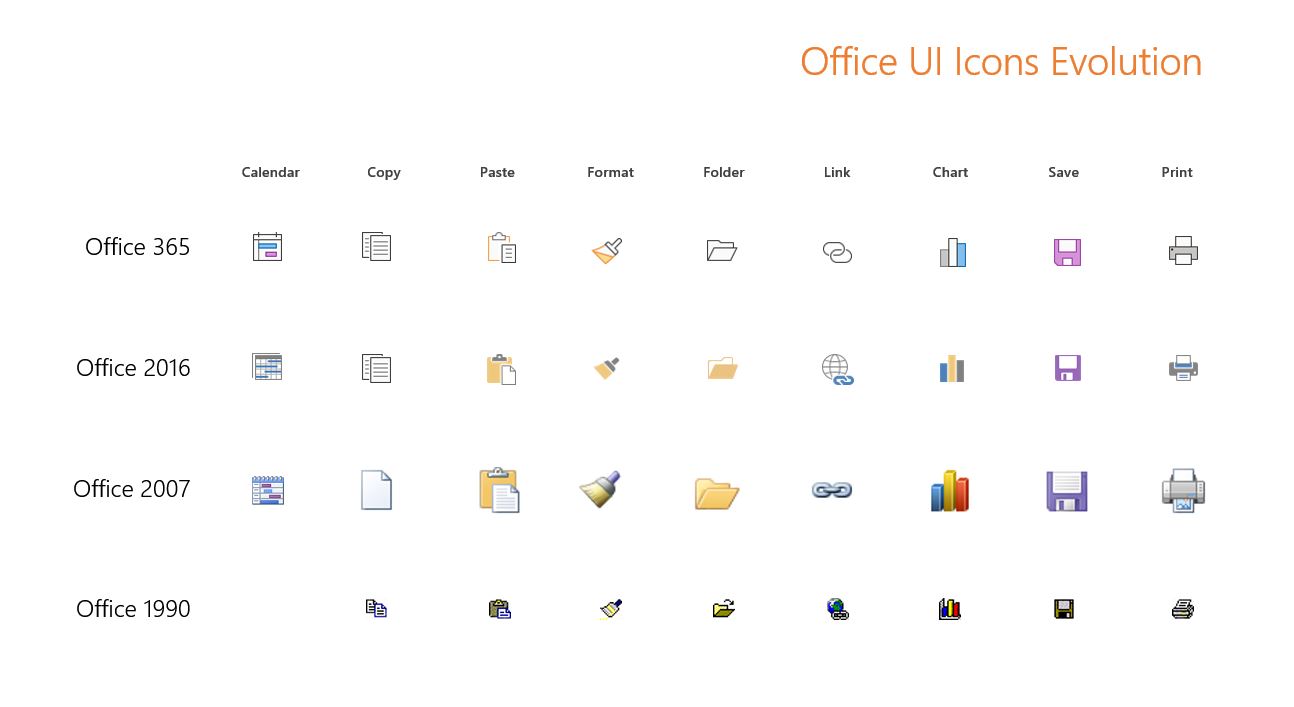
The other major visual overhaul here is a new set of colors and icons. Unlike the new Ribbon, these design changes will make their way to all the Office applications soon. The Web version of Word at Office.com will get it first, followed by an Insider release for Word, Excel and PowerPoint on Windows later this month. Outlook for Windows will follow in July, with Outlook for Mac getting it this update in August.
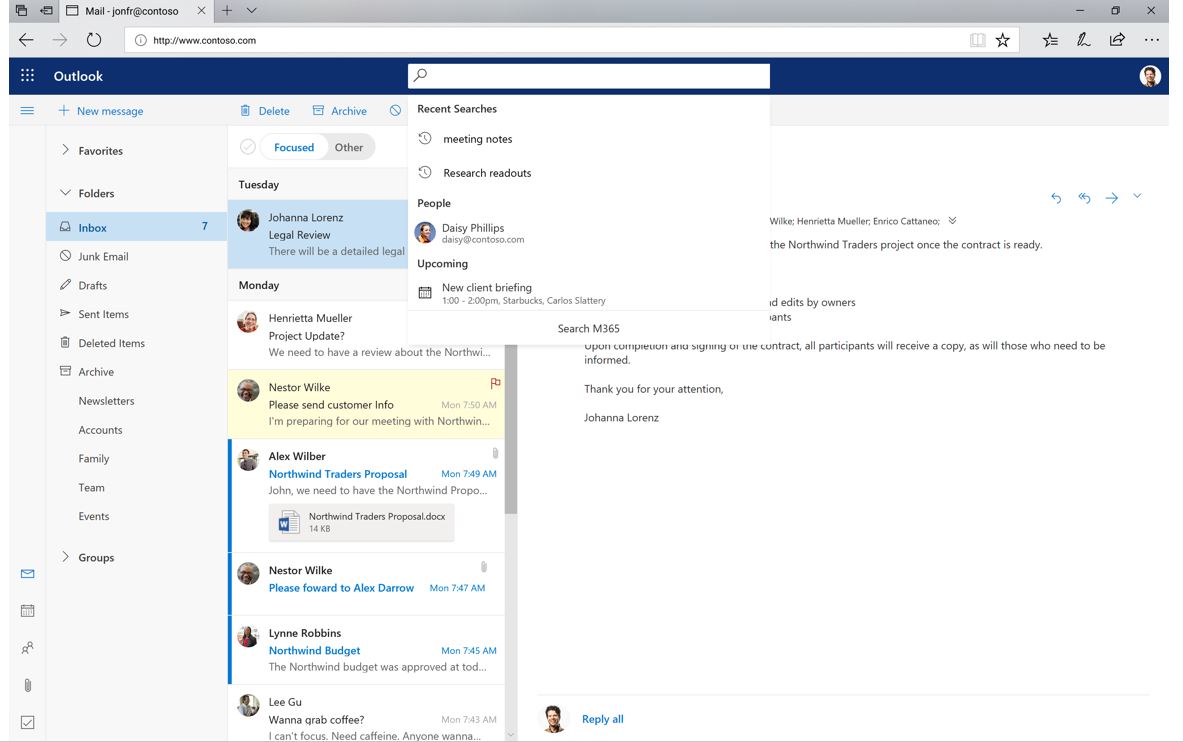
Another new feature that’s less about the design but the user experience is the launch of what Microsoft calls ‘zero query search.” This AI- and Microsoft Graph-powered feature is meant to bring up useful recommendations for your searches every time you place your cursor into the search box. For commercial users, this feature is already live in Office.com, SharePoint Online and the Outlook mobile app. It’ll roll out to Outlook on the web in August.
Powered by WPeMatico
Last Fall at Dreamforce, Salesforce announced a deepening friendship with Google . That began to take shape in January with integration between Salesforce CRM data and Google Analytics 360 and Google BigQuery. Today, the two cloud giants announced the next step as the companies will share data between Google Analytics 360 and the Salesforce Marketing Cloud.
This particular data sharing partnership makes even more sense as the companies can share web analytics data with marketing personnel to deliver ever more customized experiences for users (or so the argument goes, right?).
That connection certainly didn’t escape Salesforce’s VP of product marketing, Bobby Jania. “Now, marketers are able to deliver meaningful consumer experiences powered by the world’s number one marketing platform and the most widely adopted web analytics suite,” Jania told TechCrunch.
Brent Leary, owner of the consulting firm CRM Essentials says the partnership is going to be meaningful for marketers. “The tighter integration is a big deal because a large portion of Marketing Cloud customers are Google Analytics/GA 360 customers, and this paves the way to more seamlessly see what activities are driving successful outcomes,” he explained.
The partnership involves four integrations that effectively allow marketers to round-trip data between the two platforms. For starters, consumer insights from both Marketing Cloud and Google Analytics 360, will be brought together into a single analytics dashboard inside Marketing Cloud. Conversely, Market Cloud data will be viewable inside Google Analytics 360 for attribution analysis and also to use the Marketing Cloud information to deliver more customized web experiences. All three of these integrations will be generally available starting today.
A fourth element of the partnership being announced today won’t be available in Beta until the third quarter of this year. “For the first time ever audiences created inside the Google Analytics 360 platform can be activated outside of Google. So in this case, I’m able to create an audience inside of Google Analytics 360 and then I’m able to activate that audience in Marketing Cloud,” Jania explained.
An audience is like a segment, so if you have a group of like-minded individuals in the Google analytics tool, you can simply transfer it to Salesforce Marketing Cloud and send more relevant emails to that group.
This data sharing capability removes a lot of the labor involved in trying to monitor data stored in two places, but of course it also raises questions about data privacy. Jania was careful to point out that the two platforms are not sharing specific information about individual consumers, which could be in violation of the new GDPR data privacy rules that went into effect in Europe at the end of last month.
“What we’re [we’re sharing] is either metadata or aggregated reporting results. Just to be clear there’s no personal identifiable data that is flowing between the systems so everything here is 100% GDPR-compliant,” Jania said.
But Leary says it might not be so simple, especially in light of recent data sharing abuses. “With Facebook having to open up about how they’re sharing consumer data with other organizations, companies like Salesforce and Google will have to be more careful than ever before about how the consumer data they make available to their corporate customers will be used by them. It’s a whole new level of scrutiny that has to be apart of the data sharing equation,” Leary said.
The announcements were made today at the Salesforce Connections conference taking place in Chicago this week.
Powered by WPeMatico
When it comes to scaling startups, few people are as accomplished or consistently successful as Reid Hoffman .
While the rest of us consider scaling a startup to market domination a daunting task, Hoffman has continued to make it look easy.
In September, Hoffman will join us at TC Disrupt SF to share his strategies on “blitzscaling,” which also happens to be the title of his forthcoming book.
Hoffman started out his Silicon Valley career at PayPal, serving as EVP and a founding board member. In 2003, Hoffman founded LinkedIn from his living room. LinkedIn now has more than 500 million members across 200 countries and territories across the world, effectively becoming a necessity to the professional marketplace.
Hoffman left LinkedIn in 2007, but his contributions to the company certainly helped turn it into the behemoth it is today, going public in 2011 and selling to Microsoft for a whopping $26.2 billion in 2016.
At Disrupt, he’ll outline some of the methodology behind going from startup to scale up that is outlined in his new book, Blitzscaling, co-authored with Chris Yeh:
Blitzscaling is a specific set of practices for igniting and managing dizzying growth; an accelerated path to the stage in a startup’s life-cycle where the most value is created. It prioritizes speed over efficiency in an environment of uncertainty, and allows a company to go from “startup” to “scaleup” at a furious pace that captures the market.
Drawing on their experiences scaling startups into billion-dollar businesses, Hoffman and Yeh offer a framework for blitzscaling that can be replicated in any region or industry. Readers will learn how to design business models that support lightning-fast growth, navigate necessary shifts in strategy at each level of scale, and weather the management challenges that arise as their company grows.
Today, Hoffman leads Greylock Partners’ Discovery Fund, where he invests in seed-stage entrepreneurs and companies. He currently serves on the boards of Airbnb, Convoy, Edmodo and Microsoft. Hoffman’s place in the VC world is a natural continuation of his angel investing. His angel portfolio includes companies like Facebook, Flickr, Last.fm, and Zynga.
Hoffman has also invested in tech that affects positive change, serving on the non-profit boards of Biohub, Kiva, Endeavor, and DoSomething.org.
Blitzscaling marks Hoffman’s third book (others include The Startup of You and The Alliance) and we’re absolutely thrilled to have him teach us a thing or two at Disrupt SF.
Tickets to Disrupt SF are available now right here.
Powered by WPeMatico
Sumo Logic has long held the goal to help customers understand their data wherever it lives. As we move into the era of containers, that goal becomes more challenging because containers by their nature are ephemeral. The company announced a product enhancement today designed to instrument containerized applications in spite of that.
They are debuting these new features at DockerCon, Docker’s customer conference taking place this week in San Francisco.
Sumo’s CEO Ramin Sayer says containers have begun to take hold over the last 12-18 months with Docker and Kubernetes emerging as tools of choice. Given their popularity, Sumo wants to be able to work with them. “[Docker and Kubernetes] are by far the most standard things that have developed in any new shop, or any existing shop that wants to build a brand new modern app or wants to lift and shift an app from on prem [to the cloud], or have the ability to migrate workloads from Vendor A platform to Vendor B,” he said.
He’s not wrong of course. Containers and Kubernetes have been taking off in a big way over the last 18 months and developers and operations alike have struggled to instrument these apps to understand how they behave.
“But as that standardization of adoption of that technology has come about, it makes it easier for us to understand how to instrument, collect, analyze, and more importantly, start to provide industry benchmarks,” Sayer explained.
They do this by avoiding the use of agents. Regardless of how you run your application, whether in a VM or a container, Sumo is able to capture the data and give you feedback you might otherwise have trouble retrieving.
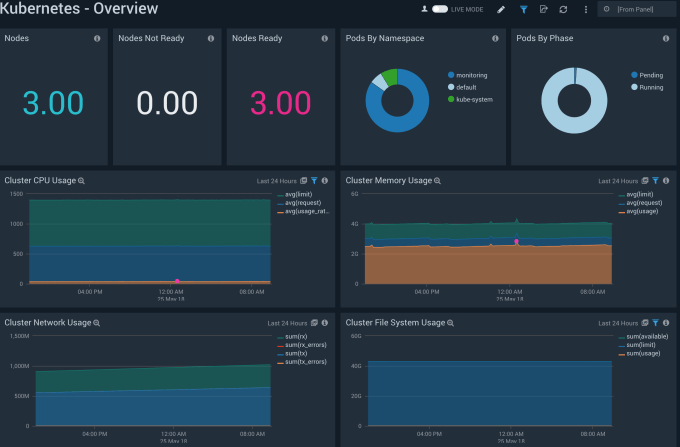
Screen shot: Sumo Logic (cropped)
The company has built in native support for Kubernetes and Amazon Elastic Container Service for Kubernetes (Amazon EKS). It also supports the open source tool Prometheus favored by Kubernetes users to extract metrics and metadata. The goal of the Sumo tool is to help customers fix issues faster and reduce downtime.
As they work with this technology, they can begin to understand norms and pass that information onto customers. “We can guide them and give them best practices and tips, not just on what they’ve done, but how they compare to other users on Sumo,” he said.
Sumo Logic was founded in 2010 and has raised $230 million, according to data on Crunchbase. Its most recent round was a $70 million Series F led by Sapphire Ventures last June.
Powered by WPeMatico