Enterprise
Auto Added by WPeMatico
Auto Added by WPeMatico

Have we reached “peak software”?
Just like the idea of “peak oil” — the hypothetical point at which global oil production could max out — you could say we’re approaching a saturation point for venture-capital investments in software companies.
Recent data from PitchBook shows that venture investing in software companies has plateaued: The amount of VC money invested in these companies — $32 billion last year — remained roughly constant over the last four years. The actual number of venture-backed software investments, mostly for business-focused companies, has actually declined, from 4,068 in 2014 to 2,980 last year.
But software is not, in fact, a declining industry. As I explore with my colleague Neeraj Agrawal in a recent report called Software 2018, released last month, a closer look at the PitchBook data shows that the fall-off in software deal volumes is primarily in the Bay Area, where an overheated market has boosted valuations and caused some investors to temporarily pull back. Investment in other U.S. regions, and globally, is actually going up. Investment in software companies based in Europe, Canada and Australia/New Zealand, for example, was $5.4 billion in 2017, up nearly 69 percent from the previous year.
Perhaps more important, a number of broader, global mega trends continue to fuel software innovation today, promising more new companies and more new jobs. These trends include everything from the rise of artificial intelligence, which is pushing software into new fields like autonomous driving, to the recent corporate tax cuts in the U.S., which could free up hundreds of billions of dollars for big corporations to buy up software startups.
Mary Meeker just released her annual, consumer-focused Internet Trends report in May. But here are some of the key trends we see shaping the global, mostly business-focused software market this year:

(Photo by Tomohiro Ohsumi/Getty Images)
SoftBank: Not just for consumer companies anymore
SoftBank’s new, $100 billion Vision Fund has had a huge impact on the technology industry already, given the Japanese firm’s ability to essentially play kingmaker in a given technology market by making a huge investment of hundreds of millions of dollars in one company. This, obviously, makes it extremely difficult for competitors to keep up in terms of building market share. And if a company declines SoftBank’s money, there’s the potentially lethal possibility that SoftBank could fund a competitor, essentially snuffing out the first company.
What’s less noticed, however, is that SoftBank is investing in many business-focused software companies, not just big consumer names like Uber, FlipKart and SoFi. Softbank recently put $2.25 billion into GM’s Cruise business unit for autonomous driving and $250 million into secondary storage vendor Cohesity, for example, and has backed other B2B players such as construction/building-software outfit Katerra; real-estate software company Compass; and workplace chat app Slack.
With these investments and others, SoftBank is accelerating the pace of growth in many key software markets and likely also dampening these companies’ IPO prospects, since companies receiving several hundred million dollars from the Japanese company face less of a financial need to go public. SoftBank is essentially taking the place of an IPO.

Image: Bryce Durbin/TechCrunch
More software means less hardware, more robots
The continuing march of software innovation isn’t great for everyone — losers in this picture could include hardware vendors and people with jobs that can be automated by smart, software-powered robots. (Yes, even lawyers and doctors could be affected — it’s not just truck drivers.)
The implications of artificial intelligence on the job market, and the auto industry, have been widely discussed. Less noticed, though, are the shifting growth rates in cloud-based IT gear versus traditional IT hardware, the technology that powers large corporations and other organizations. IDC predicts that by 2020, corporate spending on cloud-infrastructure software will finally exceed spending on non-cloud IT infrastructure — meaning all those boxes inside corporate data centers from vendors like Dell, IBM, Cisco, H-P etc. Many of those companies are trying to figure out their cloud services approach to stay relevant.
Lower taxes = more software M&A
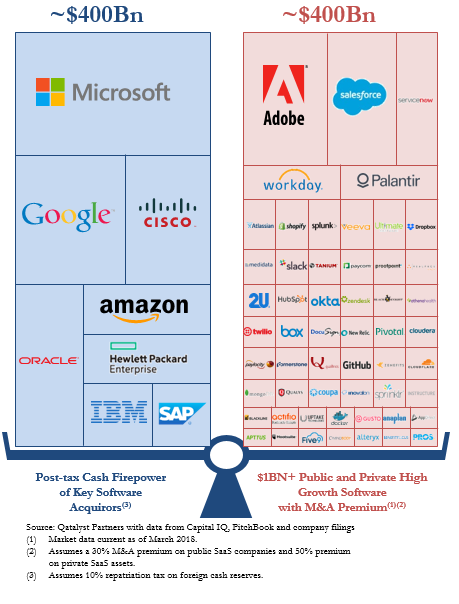
Not everyone loves the Trump administration’s policies, but if you’re a software CEO, you might be a fan of the administration’s new tax bill. That’s because the 2017 bill could be a boon for software-industry M&A. Two key components of the new law — the reduced rate charged to companies to repatriate cash from overseas and the lowering of the corporate tax rate to 21 percent from 35 percent — could leave many big tech acquirers with new war chests, analysts believe.
According to investment bank Qatalyst Partners, both changes could leave a group of the largest traditional tech-company acquirers with an additional $400 billion to spend, if they repatriate money from overseas. This would be enough to buy 50 leading software companies today, according to Qatalyst. We have already seen some of this with the recent acquisitions of GitHub by Microsoft ($7.5 billion) and Adaptive Insight by Workday ($1.55 billion) and Q1 deals like MuleSoft by Salesforce ($6.5 billion) and CallidusCloud by SAP ($2.4 billion).
The traditional tech acquirers could be more receptive to acquisitions than ever these days, given that the easy, low-cost cloud business model has allowed a range of young tech upstarts to attack many parts of their businesses from all angles. Often, the easiest solution is for the big tech companies to buy the upstarts.

Niche is nice for software
As software transforms big, well-known corporate markets — like data center software, and technology for functions like human resources, sales and marketing — it is also making inroads into much more narrow industries and corporate functions. The low cost of the cloud makes it easy for every industry, from physical therapy to prison management to mortgage lending, to grow its own, customized software, usually deployed for tasks like operations and customer management. Often there are multiple firms vying for customers (and investor dollars) today in these specialized fields.
Similarly, software is fueling extremely specialized companies to serve business needs inside companies today. These include companies as varied as DocuSign, which has built a multi-billion dollar public company focusing exclusively on document signing, and Carta, which sells technology to help companies manage their financial cap tables.
Mary Meeker is right that consumer internet trends like the rise of online wallets, subscription services for certain goods and increasing oversight of social media by regulators will have big economic implications in the years to come. But we humbly offer that business software is a pretty big economic driver too — you just have to work a little harder to figure out the implications for businesses and the markets.
Powered by WPeMatico

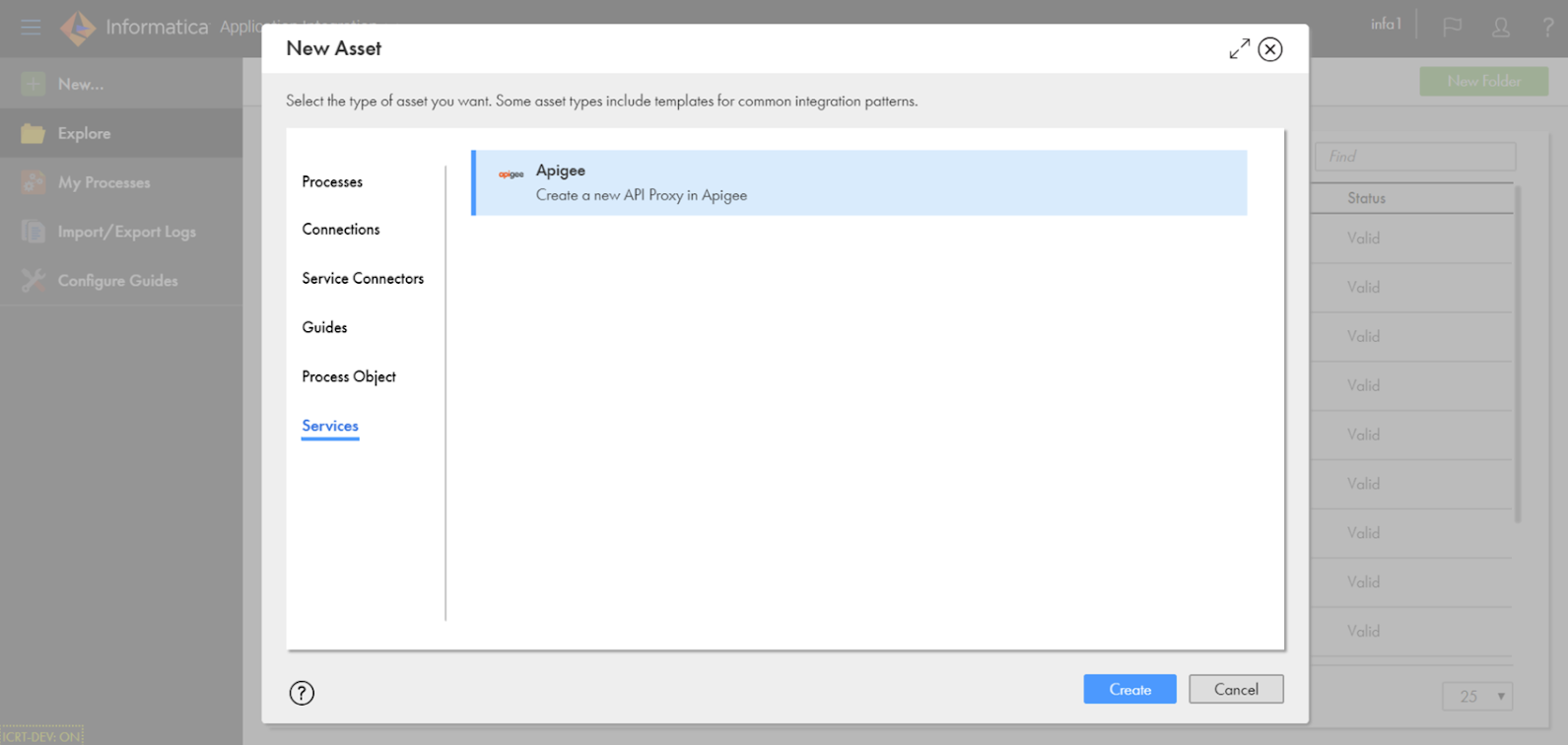
Google acquired API management service Apigee back in 2016, but it’s been pretty quiet around the service in recent years. Today, however, Apigee announced a number of smaller updates that introduce a few new integrations with the Google Cloud platform, as well as a major new partnership with cloud data management and integration firm Informatica that essentially makes Informatica the preferred integration partner for Google Apigee.
Like most partnerships in this space, the deal with Informatica involves some co-selling and marketing agreements, but that really wouldn’t be all that interesting. What makes this deal stand out is that Google is actually baking some of Informatica’s tools right into the Apigee dashboard. This will allow Apigee users to use Informatica’s wide range of integrations with third-party enterprise applications while Informatica users will be able to publish their APIs through Apigee and have that service manage them for them.
Some of Google’s competitors, including Microsoft, have built their own integration services. As Google Cloud director of product management Ed Anuff told me, that wasn’t really on Google’s road map. “It takes a lot of know-how to build a rich catalog of connectors,” he said. “You could go and build an integration platform but if you don’t have that, you can’t address your customer’s needs.” Instead, Google went to look for a partner who already has this large catalog and plenty of credibility in the enterprise space.
Similarly, Informatica’s senior VP and GM for big data, cloud and data integration Ronen Schwartz noted that many of his company’s customers are now looking to move into the cloud and this move will make it easier for Informatica’s customers to bring their services into Apigee and open them up for external applications. “With this partnership, we are bringing the best of breed of both worlds to our customers,” he said. “And we are doing it now and we are making it available in an integrated, optimized way.”
Powered by WPeMatico
Microsoft is launching a few new networking features today that will make it easier for businesses to use the company’s Azure cloud to securely connect their own offices and infrastructure using Azure and its global network.
The first of these is the Azure Virtual WAN service, which allows businesses to connect their various branches to and through Azure. This basically works like an airline hub and spoke model, where Azure becomes the central hub through which all data between branches flows. The advantage of this, Microsoft argues, is that it allows admins to manage their wide-area networks from a central dashboard and, of course, that it makes it easy to bind additional Azure services and appliances to the network. And with that, users also get access to all of the security services that Azure has to offer.
One new security service that Microsoft is launching today is the Azure Firewall, a new cloud-native security service that is meant to protect a business’s virtual network resources.
In addition to these two new networking features, Microsoft also today announced that it is expanding to two new regions its Azure Data Box service, which is basically Microsoft’s version of the AWS Snowball appliances for moving data into the cloud by loading it onto a shippable appliance: Europe and the United Kingdom (and let’s not argue about the fact that the U.K. is still part of Europe). There is also now a “Data Box Disk” option for those who don’t need to move petabytes of data. Orders with up to five of those disks can hold up to 40 terabytes of data and are currently in preview.
Powered by WPeMatico
Microsoft announced a number of new tools for its MyAnalytics tool for Office 365 users today that are geared toward giving employees more data about how they work, as well as ways to improve how teams work together. In today’s businesses, everybody has to be a team player, after all, and if you want to bring technology to bear on this, you first need data — and once you have data, you can go into full-on analytics mode and maybe even throw in a smidge of machine learning, too.
So today, Microsoft is launching two new products: Workplace Analytics and MyAnalytics nudges. Yes, Office 365 will now nudge you to be a better team player. “Building better teams starts with transparent, data-driven dialog—but no one is perfect and sticking to good collaboration habits can be challenging in a fast-paced job,” Microsoft’s Natalie McCullough and Noelle Beaujon, using language only an MBA could love, write in today’s announcement.
I’m not sure what exactly that means or whether I have good collaboration habits or not, but in practice, Office 365 can now nudge you when you need more focus time as your calendar fills up, for example. You can block off those times without leaving your Inbox (or, I guess, you could always ignore this and just set up a standing block of time every day where you don’t accept meetings and just do your job…). MyAnalytics can also now nudge you to delegate meetings to a co-worker when your schedule is busy (because your co-workers aren’t busy and will love you for putting more meetings on your calendar) and tell you to avoid after-hours emails as you draft them to co-workers so they don’t have to work after hours, too (that’s actually smart, but may not work well in every company).
With this new feature, Microsoft is also using some machine learning smarts, of course. MyAnalytics was already able to remind you of tasks you promised to co-workers over email, and now it’ll nudge you when you read new emails from those co-workers, too. Because the more you get nudged, the more likely you are to finish that annoying task you never intended to do but promised your co-worker you would do so he’d go away.
If you’re whole team needs some nudging, Microsoft will also allow the group to enroll in a change program and provide you with lots of data about how you are changing. And if that doesn’t work, you can always set up a few meetings to discuss what’s going wrong.
These new features will roll out this summer. Get ready to be nudged.
Powered by WPeMatico
Microsoft opened up the news floodgates this morning, in the kick off to its annual Inspire event in Vegas. One of the more compelling announcements of the bunch is the addition of a free version of Teams.
The Slack competitor has been kicking around in some form or other since late-2016, but the $60 a year fee has likely made it a bit of a nonstarter for smaller businesses. After all, it’s Slack’s free tier that helped the work chat app gain so much traction so quickly. A free version makes a lot of sense for Microsoft.
Signing users up for Teams is way to get more feet into the door of its application ecosystem, which was once ubiquitous in offices. Once they’ve download teams, workplaces will be hooked into the Microsoft 365 suite.
The free tier actually brings a fair bit of the app to up to 300 people per workplace. Here’s the full rundown of features per Microsoft,
The company’s done a good job hooking in enterprise customers, but as it notes, SMBs constitute 90+ percent of businesses globally, so that’s a whole lot more devices to tap into. The free tier is available in 40 languages starting today.
Powered by WPeMatico
GitHub, the code hosting service Microsoft recently acquired, is launching a couple of new features for its business users today that’ll make it easier for them to access public repositories on the service.
Traditionally, users on the hosted Business Cloud and self-hosted Enterprise were not able to directly access the millions of public open-source repositories on the service. Now, with the service’s release, that’s changing, and business users will be able to reach beyond their firewalls to engage and collaborate with the rest of the GitHub community directly.
With this, GitHub now also offers its business and enterprise users a new unified search feature that lets them tap into their internal repos but also look at open-source ones.
Other new features in this latest Enterprise release include the ability to ignore whitespace when reviewing changes, the ability to require multiple reviewers for code changes, automated support tickets and more. You can find a full list of all updates here.
Microsoft’s acquisition of GitHub wasn’t fully unexpected (and it’s worth noting that the acquisition hasn’t closed yet), but it is still controversial, given that Microsoft and the open-source community, which heavily relies on GitHub, haven’t always seen eye-to-eye in the past. I’m personally not too worried about that, and it feels like the dust has settled at this point and that people are waiting to see what Microsoft will do with the service.
Powered by WPeMatico
Your typical cloud monitoring service integrates with dozens of service and provides you a pretty dashboard and some automation to help you keep tabs on how your applications are doing. Datadog has long done that but today, it is adding a new service called Watchdog, which uses machine learning to automatically detect anomalies for you.
The company notes that a traditional monitoring setup involves defining your parameters based on how you expect the application to behave and then set up dashboards and alerts to monitor them. Given the complexity of modern cloud applications, that approach has its limits, so an additional layer of automation becomes necessary.
That’s where Watchdog comes in. The service observes all of the performance data it can get its paws on, learns what’s normal, and then provides alerts when something unusual happens and — ideally — provides insights into where exactly the issue started.
“Watchdog builds upon our years of research and training of algorithms on our customers data sets. This technology is unique in that it not only identifies an issue programmatically, but also points users to probable root causes to kick off an investigation,” Datadog’s head of data science Homin Lee notes in today’s announcement.
The service is now available to all Datadog customers in its Enterprise APM plan.
Powered by WPeMatico
In recent months, we’ve seen more and more funding flowing into tools for mental wellness — whether that’s AI-driven tools to help patients find help to meditation apps — and it seems like that trend is starting to pick up even more steam as smaller companies are grabbing the attention of investors.
There’s another one picking up funding today in Spring Health, a platform for smaller companies to help their employees get more access to mental health treatment. The startup looks to give employers a simple, effective way to start offering that treatment for their employees in the form of personalized mental wellness plans. The employees get access to confidential plans in addition to access to a network and ways to get in touch with a therapist or psychiatrist as quickly as possible. The company said it has raised an additional $6 million in funding led by Rethink Impact, with Work-Bench, BBG Ventures, and The Partnership Fund for New York City joining the round. RRE Ventures and the William K. Warren Foundation also participated.
“…I realized that mental health care is largely a guessing game: you use trial-and-error to find a compatible therapist, and you use trial-and-error to find the right treatment regimen, whether that’s a specific cocktail of medications or a specific type of psychotherapy,” CEO and co-founder April Koh said. “Everything around us is personalized these days – like shopping on Amazon, search results on Google, and restaurant recommendations on Yelp – but you can’t get personalized recommendations for your mental health care. I wanted to build a platform that connects you with the right care for you from the very beginning. So I partnered with leading expert on personalized psychiatry, Dr. Adam Chekroud our Chief Scientist, and my friend Abhishek Chandra, our CTO, to start Spring Health.”

The startup bills itself as an online mental health clinic that offers recommendations for employees, such as treatment options or tweaks to their daily routines (like exercise regimens). Like other machine learning-driven platforms, Spring Health puts a questionnaire in front of the end employee that adapts to the responses they are giving and then generates a wellness plan for that specific individual. As more and more patients get on the service, it gets more data, and can improve those recommendations over time. Those patients are then matched with clinicians and licensed medical health professionals from the company’s network.
“We found that employers were asking for it,” Koh said. “As a company we started off by selling an AI-enabled clinical decision support tool to health systems to empower their doctors to make data-driven decisions. While selling that tool to one big health system, word reached their benefits department, and they reached out to us and told us they need something in benefits to deal with mental health needs of their employee base. When that happened, we decided to completely focus on selling a “full-stack” mental health solution to employers for their employees. Instead of selling a tool to doctors, we decided we would create our own network of best-in-class mental health providers who would use our tools to deliver the best mental health care possible.”
However, Spring Health isn’t the only startup looking to create an intelligent matching system for employees seeking mental health. Lyra Health, another tool to help employees securely and confidentially begin the process of getting mental health treatment, raised $45 million in May this year. But Spring Health and Lyra Health are both part of a wave of startups looking to create ways for employees to more efficiently seek care powered by machine learning and capitalizing on the cost and difficulty of those tools dropping dramatically.
And it’s not the only service in the mental wellness category also picking up traction, with meditation app Calm raising $27 million at a $250 million valuation. Employers naturally have a stake in the health of their employees, and as all these apps look to make getting mental health treatment or improving mental wellness easier — and less of a taboo — the hope is they’ll continue to lower the barrier to entry, both from the actual product inertia and getting people comfortable with seeking help in the first place.
“I think VC’s are realizing there’s a huge opportunity to disrupt mental health care and make it accessible, convenient and affordable. But from our perspective, the problem with the space is that there is a lot of unvetted, non-evidence-based technology. There’s a ton of vaporware surrounding AI, big data, and machine-learning, especially in mental health care. We want to set a higher standard in mental healthcare that is based on evidence and clinical validation. Unlike most mental health care solutions on the market, we have multiple peer-reviewed publications in top medical journals like JAMA, describing and substantiating our technology. We know that our personalized recommendations and our Care Navigation approach are evidence-based and proven to work.
Powered by WPeMatico
Snowflake, the cloud data warehouse, announced a partnership with Microsoft today to expand their offering to the Azure cloud. The new product is still in Preview for now.
Given that Snowflake CEO Bob Muglia worked at Microsoft for more than 20 years, it’s certainly not surprising that Microsoft is the company’s second partner after working with only Amazon since its inception. But Muglia says it was really about seeing customer demand in the marketplace more than any nostalgia or connections at Microsoft. In fact, he says the company is on boarding one to two new Azure customers a day right now.
The plan is to open up a private preview today, then become generally available some time in the fall when they work out all of the kinks involved with porting their service to another provider.
The partnership didn’t happen overnight. It’s been developing for over a year and that’s because Muglia says Azure isn’t quite as mature as Amazon in some ways and it required some engineering cooperation to make it all work.
“We had to work with Microsoft on some of the things that we needed to make [our product] work [on their platform], particularly around the way we work with Azure Blob Storage that we really had to do a little differently on Azure. So there are changes we needed to make internally in our product to make it work,” he explained.
Overall though the two company’s engineers have worked together to solve those issues and Muglia says that when the Azure version becomes generally available in the Fall, it should basically be the same product they offer on Amazon, although there are still some features they are trying to make work on in the Preview. “Our goal is to have literally the same product on Azure as on Amazon, and we are very confident we’ll get there with Microsoft,” he said.
For Snowflake of course, it represents a substantial market expansion because now they can sell to companies working on Azure and Amazon and that has opened up a whole new pipeline of customers. Azure is the number two cloud provider behind Amazon.
The interesting aspect of all this is that Amazon and Microsoft compete in the cloud of course, but Snowflake is also competing with each cloud provider too with their own product. Yet this kind of partnership has become standard in the cloud. You have to work across platforms, then compete where it makes sense.
“Almost all of the relationships that we have in the industry, we have some element of competition with them, and so this is a normal mode of operation,” he said.
Powered by WPeMatico

Broadcom, the massive semiconductor supplier you may remember from its failed attempt to acquire Qualcomm, today announced that it has reached a definitive agreement with CA Technologies, a major IT management software and solutions provider. The price of the acquisition is $18.9 billion in cash. CA’s shareholders will receive $44.50 per share, a 20 percent premium over the closing price of the company’s stock today.
It’s a bit of a surprise to see chip manufacturer Broadcom acquire a major software and services company. “This transaction represents an important building block as we create one of the world’s leading infrastructure technology companies,” Broadcom CEO and president Hock Tan explains in today’s announcement. “With its sizeable installed base of customers, CA is uniquely positioned across the growing and fragmented infrastructure software market, and its mainframe and enterprise software franchises will add to our portfolio of mission critical technology businesses. We intend to continue to strengthen these franchises to meet the growing demand for infrastructure software solutions.”

This comment doesn’t exactly explain the rationale behind today’s acquisition, but Broadcom is clearly trying to diversify its offerings. Earlier this year, the company walked away from its proposed hostile takeover of Qualcomm after the Trump administration blocked it. At the time, Broadcom was willing to pay $117 billion for Qualcomm, which would have greatly extended the company’s semiconductor business. Today’s move sees Broadcom enter a completely new business.
The company expects the acquisition to close in the fourth quarter of 2018. It’s unlikely that Broadcom will face any major headwind from Washington this time around.
Powered by WPeMatico