Enterprise
Auto Added by WPeMatico
Auto Added by WPeMatico

As remote work became the default for many companies during the pandemic, it’s maybe no surprise that services like Microsoft’s Windows Virtual Desktop, which gives users access to a fully managed Windows 10 desktop experience from virtually anywhere, saw a lot of interest from large enterprises and a new crop of small businesses that suddenly had to find ways to better support their remote workers. That’s pretty much what Microsoft saw, too, which had originally targeted Windows Virtual Desktop at some of the world’s largest enterprises. And so as the user base changed, Microsoft’s vision for the product changed as well, leading it to now changing its name from Windows Virtual Desktop to Azure Virtual Desktop.
“When we first went GA with Windows Virtual Desktop, about a year and a half ago, the world was a very different place,” said Kam VedBrat, Microsoft’s general manager for Azure Virtual Desktop. “And to be blunt, we looked at the service and what we were building, who we were building it for, pretty differently. No one at that time had any idea that this global pandemic was going to happen and that it would cause so many organizations around the world and millions of people to have to essentially leave the office and work from home — and the role the service would play in enabling a lot of that.”
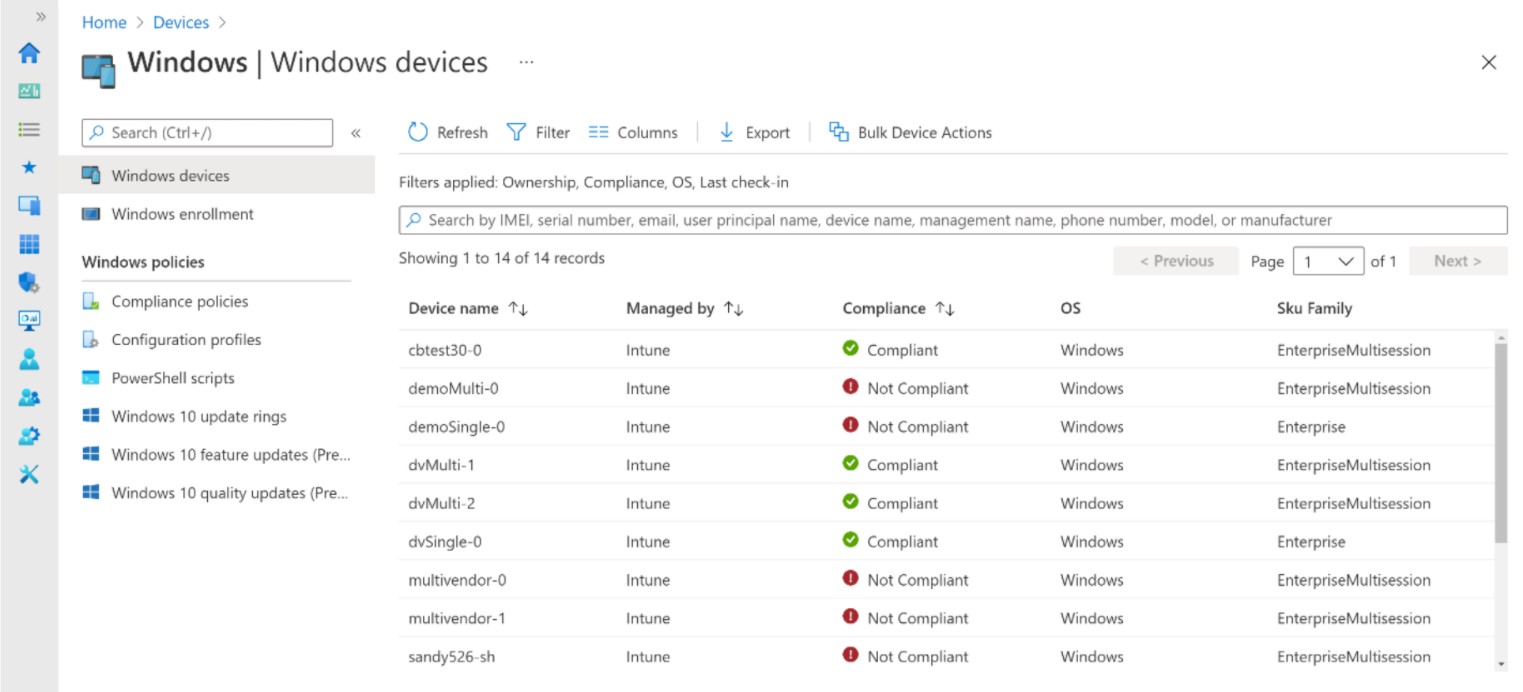
Image Credits: Microsoft
While the original idea was to help enterprises move their virtual desktop environments from their data centers to the cloud, the pandemic brought a slew of new use cases to Windows Azure Virtual Desktop. It now hosts anything from virtual school labs to the traditional remote enterprise use cases. These new users also have somewhat different needs and expertise from those users the service was originally meant for, so on top of today’s name change, the company is also launching a set of new features that should make it easier for new users to get started with using Azure Virtual Desktop.
Among those is a new Quickstart experience, which will soon launch in public preview. “One piece of feedback that we saw is that as so many organizations are looking at Azure Virtual Desktop to enable new scenarios for hybrid work, they want to get these environments up and running quickly to understand how they work, how their apps behave in them, how to think about app groups and host pools and some of the new concepts that are there,” VedBrat explained. Ideally, it should now only take a few clicks to set up a full virtual desktop environment from the Azure portal.
Also new in Azure Virtual Desktop is support for managing multi-session virtual machines (VMs) with Microsoft Endpoint Manager, Microsoft’s unified service for device management. This marks the first time Endpoint Manager is able to handle multi-session VMs, which are one of the biggest selling points for Azure Virtual Desktop, since it allows a business to host multiple users on the same machine running Windows 10 Enterprise in the cloud.
In addition, Azure Virtual Desktop now offers enhanced support for Azure Active Directory, in addition to a new per-user access pricing option (in addition to the cost of running on the Azure infrastructure) that will allow users to deliver apps to external users. This, Microsoft argues, will allow software vendors to deliver their apps as a SaaS solution, for example.
As for the name change, VedBrat argues that while Windows is obviously at the core of the experience, a lot of the service’s users care about the underlying Azure infrastructure as well, be that storage or networking, for example. “They look at that broader environment that they’re creating — that window estate that they’re creating in the cloud — and they see that as a larger thing and they look at a lot of Azure as part of that. So we felt like the right thing to do at this point, in order to address that broader view that our customers are taking, was to look at the new name,” he explained.
I thought Windows Virtual Desktop explained the core concept just fine, but nobody has ever accused me of being a marketing genius.
Powered by WPeMatico
Many people in emerging markets depend on informal public transport to move across cities. But while there are ride-hailing and bus-hailing applications in some of these cities, there’s a dire need for journey-planning apps to improve mobility for users and reduce the time they spend commuting.
South African-founded startup WhereIsMyTransport is one such company filling that gap for now. Today, it is announcing a $14.5 million Series A extension to continue its expansion across emerging markets; the company already has a presence in South Africa and Mexico.
Naspers, via its investment arm, Naspers Foundry, co-led the investment with Cathay AfricInvest Innovation Fund. According to Naspers, the size of its check was $3 million. Japan’s SBI Investment also participated in the round.
The extension round is coming a year after WhereIsMyTransport received a $7.5 million Series A investment from VC firms and strategic investment from Google, Nedbank and Toyota Tsusho Corporation (TTC).
Devin de Vries, Chris King and Dave New started the company in 2015. As a mobility startup, WhereIsMyTransport maps formal and informal public transport networks. The company then uses data gotten to improve the public transport experience, making commuting safe and accessible.
In addition to this, WhereIsMyTransport licenses some of this data to governments, DFIs, NGOs, operators, and third-party developers. It claims this is done for research, analytics, insights and consumer and enterprise solutions purposes.
“WhereIsMyTransport started in South Africa, focused on becoming a central source of accurate and reliable public transport data for high-growth markets. We’re thrilled to welcome Naspers as an investor as our journey continues in megacities across the majority world,” said CEO Devin de Vries in a statement.
Last year when we covered the company, it had mapped 34 cities in Africa while actively mapping some in India, Southeast Asia and Latin America. Since then, it expanded into Mexico City last November and has completed multiple data production projects in the city alongside Lima, Bangkok, Gauteng and Dhaka. Right now, the company has worked in 41 cities across 28 countries.
WhereIsMyTransport also launched its first consumer product Rumbo, which provides network information from all modes of public transport in Mexico with more than 100,000 users delivering over 750,000 real-time network alerts. The company says there are plans to launch Rumbo in Lima, Peru later this year.

Devin de Vries (CEO WhereIsMyTransport). Image Credits: WhereIsMyTransport
For co-lead investor Naspers Foundry, this is the firm’s first investment in mobility. So far, it has funded four other South African startups — Aerobotics, SweepSouth, Food Supply Network and The Student Hub — with a focus on edtech, food and cleaning sectors.
“We couldn’t pass on the opportunity to back an extraordinary South African founder who has built his business here in Cape Town to a global market leader in mapping formal and informal transportation with a strong focus on emerging markets,” head of Naspers Foundry Fabian Whate told TechCrunch.
He also added that there is an overlap between mobility and the food and e-commerce businesses that seem to be the main focus from a Naspers perspective. “The global food and e-commerce businesses, often operating in emerging markets, are quite reliant on mobility solutions. So there’s a great overlap between what the Naspers Group does and the vision for WhereIsMyTransport.”
In South Africa, WhereIsMyTransport’s clients include Johannesburg commuter rail system Gautrain and Transport for Cape Town. On the other hand, its international client base includes Google, the World Bank and WSP, and others.
South Africa CEO of Naspers Phuthi Mahanyele-Dabengwa said: “Mobility remains an obstacle for billions of people in high-growth markets across the world. Our investment in WhereIsMyTransport is a testimony of our belief that great innovation and tech talent is found in South Africa, and with the right backing and support, these businesses can provide solutions to local challenges that can improve the lives of ordinary people in South Africa and abroad.”
Powered by WPeMatico
Xometry, a Maryland-based service that connects companies with manufacturers with excess production capacity around the world, filed an S-1 form with the U.S. Securities and Exchange Commission announcing its intent to become a public company.
Growth aside, it’s clear that Xometry is no modern software business, at least from a revenue-quality profile.
As the global supply chain tightened during the pandemic in 2020, a company that helped find excess manufacturing capacity was likely in high demand. CEO and co-founder Randy Altschuler described his company to TechCrunch this way last September upon the announcement of a $75 million Series E investment:
“We’ve created a marketplace using artificial intelligence to power it, and provide an e-commerce experience for buyers of custom manufacturing and for suppliers to deliver that manufacturing,” Altschuler said at the time. Xometry raised nearly $200 million while private, per Crunchbase data.
With Xometry, companies looking to build custom parts now have the ability to do so in a digital way. Rather than working the phones or starting an email chain, they can go into the Xometery marketplace, define parameters for their project and find a qualified manufacturer who can handle the job at the best price.
As of last September, the company had built relationships with 5,000 manufacturers around the world and had 30,000 customers using the platform.
At the time of that funding round, perhaps it wasn’t a coincidence that the company’s lead investor was T. Rowe Price. When an institutional investor is involved in a late-stage round, it’s usually a sign that the company is ready to start thinking about an IPO. Altschuler said it was definitely something the company was considering and had brought on a CFO, too, another sign that a company is ready to take that next step.
So what do Xometry’s financials look like as it heads to the public markets? We took a look at the S-1 to find out.
Xometry makes money in two ways. The first comes from one part of its marketplace, with the company generating “substantially all of [its] revenue” from charging “buyers on its platform.” The other way that Xometry engenders top line is seller-related services, including financial work. The company notes that seller-generated revenues were just 5% of its 2020 total, though it does expect that figure to rise.
Powered by WPeMatico
Gong, the revenue intelligence startup, has been raising capital at a rapid pace, and today the company announced another $250 million on a $7.25 billion valuation, a number that triples its previous valuation from last summer.
Franklin Templeton led today’s festivities with participation from Coatue, Salesforce Ventures, Sequoia, Thrive Capital and Tiger Global. The company raised $200 million last August at a $2.2 billion valuation, and has now raised $584 million, $450 million coming in the last year.
What is making investors open their wallets and pull out such large sums of cash? The company is helping solve a hard problem on how to bring more intelligence to the revenue process. They do this by using artificial intelligence to listen to every customer interaction, whether that’s a sales or service call (or anything else), and use that information to determine valuable information like who is most likely to buy and who is most likely to churn.
It’s been going well and CEO Amit Bendov says the company’s performance really validates the valuation. While he wasn’t ready to discuss specific numbers, he did say that ARR grew 2.3x between Q1 last year and this year, and he says Q2 is on pace to triple ARR.
“The valuation is up about 3x from last summer, but sales are more than 3x. We have high logo customers. [Last year], it was still unclear how COVID was going to impact us. People believed [our business] was going to do well [during the pandemic], but it wasn’t as obvious. Now, it is obvious. And all the […] financials are way better, so from a pure financials [perspective] our multipliers are pretty reasonable for our revenue trajectory,” he said.
With all this growth, the company is adding employees at a rapid pace. It closed the year with 400 people, and is up to around 550 today with a goal of reaching 950 by year end. It has partnered with a consulting firm called ReadySet, which helps companies build diverse and inclusive organizations, and Bendov says they are an equal-pay company.
Women represent around 40% of the employees and around 4% are Black, a number he hopes to increase by growing the Atlanta office. In the office in Israel, he has set up employment and training programs to build bridges to the Arab community.
Bendov says he looks forward to meeting his U.S. employees in the coming weeks when he’ll be visiting the Atlanta office for the first time.
Powered by WPeMatico
When Cloudera announced its sale to a pair of private equity firms yesterday for $5.3 billion, along with a couple of acquisitions of its own, the company detailed a new path that could help it drive back toward relevance in the big data market.
When the company launched in 2008, Hadoop was in its early days. The open-source project developed at Yahoo three years earlier was built to deal with the large amounts of data that the internet pioneer generated. It became increasingly clear over time that every company would have to deal with growing data stores, and it seemed that Cloudera was in the right market at the right time.
And for a while things went well. Cloudera rode the Hadoop startup wave, garnering a cool billion in funding along the way, including a stunning $740 million check from Intel Capital in 2014. It then went public in 2018 to much fanfare.
But the markets had already started to shift by the time of its public debut. Hadoop, a highly labor-intensive way to manage data, was being supplanted by cheaper and less complex cloud-based solutions.
“The excitement around the original promise of the Hadoop market has contracted significantly. It’s incredibly expensive and complex to get it working effectively in an enterprise context,” Casey Aylward, an investor at Costanoa Ventures told TechCrunch.
The company likely saw that writing on the wall when it merged with another Hadoop-based company, Hortonworks, in 2019. That transaction valued the combined entity at $5.2 billion, almost the same amount it sold for yesterday, two years down the road. The decision to sell and go private may also have been spurred by Carl Icahn buying an 18% stake in the company that same year.
Looking to the future, Cloudera’s sale could provide the enterprise unicorn room as it regroups.
Patrick Moorhead, founder and principal analyst at Moor Insight & Strategies, sees the deal as a positive step for the company. “I think this is good news for Cloudera because it now has the capital and flexibility to dive head first into SaaS. The company invented the entire concept of a data life cycle, implemented initially on premises, then extended to private and public clouds,” Moorhead said.
Adam Ronthal, Gartner Research VP, agrees that it at least gives Cloudera more room to make necessary adjustments to its market strategy as long as it doesn’t get stifled by its private equity overlords. “It should give Cloudera an opportunity to focus on their future direction with increased flexibility — provided they are able to invest in that future and that this does not just focus on cost cutting and maximizing profits. Maintaining a culture of innovation will be key,” Ronthal said.
Which brings us to the two purchases Cloudera also announced as part of its news package.
If you want to change direction in a hurry, there are worse ways than via acquisitions. And grabbing Datacoral and Cazena should help Cloudera alter its course more quickly than it could have managed on its own.
“[The] two acquisitions will help Cloudera capture some of the value on top of the lake storage layer — perhaps moving into different data management features and/or expanding into the compute layer for analytics and AI/ML use cases, where there has been a lot of growth and excitement in recent years,” Aylward said.
Chandana Gopal, research director for the future of intelligence at IDC, agrees that the transactions give Cloudera some more modern options that could help speed up the data-wrangling process. “Both the acquisitions are geared towards making the management of cloud infrastructure easier for end-users. Our research shows that data prep and integration takes 70%-80% of an analyst’s time versus the time spent in actual analysis. It seems like both these companies’ products will provide technology to improve the data integration/preparation experience,” she said.
The company couldn’t stay on the path it was on forever, certainly not with an activist investor breathing down its neck. Its recent efforts could give it the time away from public markets it needs to regroup. How successful Cloudera’s turnaround proves to be will depend on whether the private equity companies buying it can both agree on the direction and strategy for the company, while providing the necessary resources to push the company in a new direction. All of that and more will determine if these moves pay off in the end.
Powered by WPeMatico
Confluent became the latest company to announce its intent to take the IPO route, officially filing its S-1 paperwork with the U.S. Securities and Exchange Commission this week. The company, which has raised over $455 million since it launched in 2014, was most recently valued at just over $4.5 billion when it raised $250 million last April.
What we can see in Confluent is nearly an old-school, high-burn SaaS business. It has taken on oodles of capital and used it in an increasingly expensive sales model.
What does Confluent do? It built a streaming data platform on top of the open-source Apache Kafka project. In addition to its open-source roots, Confluent has a free tier of its commercial cloud offering to complement its paid products, helping generate top-of-funnel inflows that it converts to sales.
Kafka itself emerged from a LinkedIn internal project in 2011. As we wrote at the time of Confluent’s $50 million Series C in 2017, the open-source project was designed to move massive amounts of data at the professional social network:
At its core, Kafka is simply a messaging system, created originally at LinkedIn, that’s been designed from the ground up to move massive amounts of data smoothly around the enterprise from application to application, system to system or on-prem to cloud — and deal with extremely high message volume.
Confluent CEO and co-founder Jay Kreps wrote at the time of the funding that events streaming is at the core of every business, reaching sales and other core business activities that occur in real time that go beyond storing data in a database after the fact.
“[D]atabases have long helped to store the current state of the world, but we think this is only half of the story. What is missing are the continually flowing stream of events that represents everything happening in a company, and that can act as the lifeblood of its operation,” he wrote.
That’s where Confluent comes in.
But enough about the technology. Is Confluent’s work with Kafka a good business? Let’s find out.
Powered by WPeMatico

Iterative, an open-source startup that is building an enterprise AI platform to help companies operationalize their models, today announced that it has raised a $20 million Series A round led by 468 Capital and Mesosphere co-founder Florian Leibert. Previous investors True Ventures and Afore Capital also participated in this round, which brings the company’s total funding to $25 million.
The core idea behind Iterative is to provide data scientists and data engineers with a platform that closely resembles a modern GitOps-driven development stack.
After spending time in academia, Iterative co-founder and CEO Dmitry Petrov joined Microsoft as a data scientist on the Bing team in 2013. He noted that the industry has changed quite a bit since then. While early on, the questions were about how to build machine learning models, today the problem is how to build predictable processes around machine learning, especially in large organizations with sizable teams. “How can we make the team productive, not the person? This is a new challenge for the entire industry,” he said.
Big companies (like Microsoft) were able to build their own proprietary tooling and processes to build their AI operations, Petrov noted, but that’s not an option for smaller companies.
Currently, Iterative’s stack consists of a couple of different components that sit on top of tools like GitLab and GitHub. These include DVC for running experiments and data and model versioning, CML, the company’s CI/CD platform for machine learning, and the company’s newest product, Studio, its SaaS platform for enabling collaboration between teams. Instead of reinventing the wheel, Iterative essentially provides data scientists who already use GitHub or GitLab to collaborate on their source code with a tool like DVC Studio that extends this to help them collaborate on data and metrics, too.
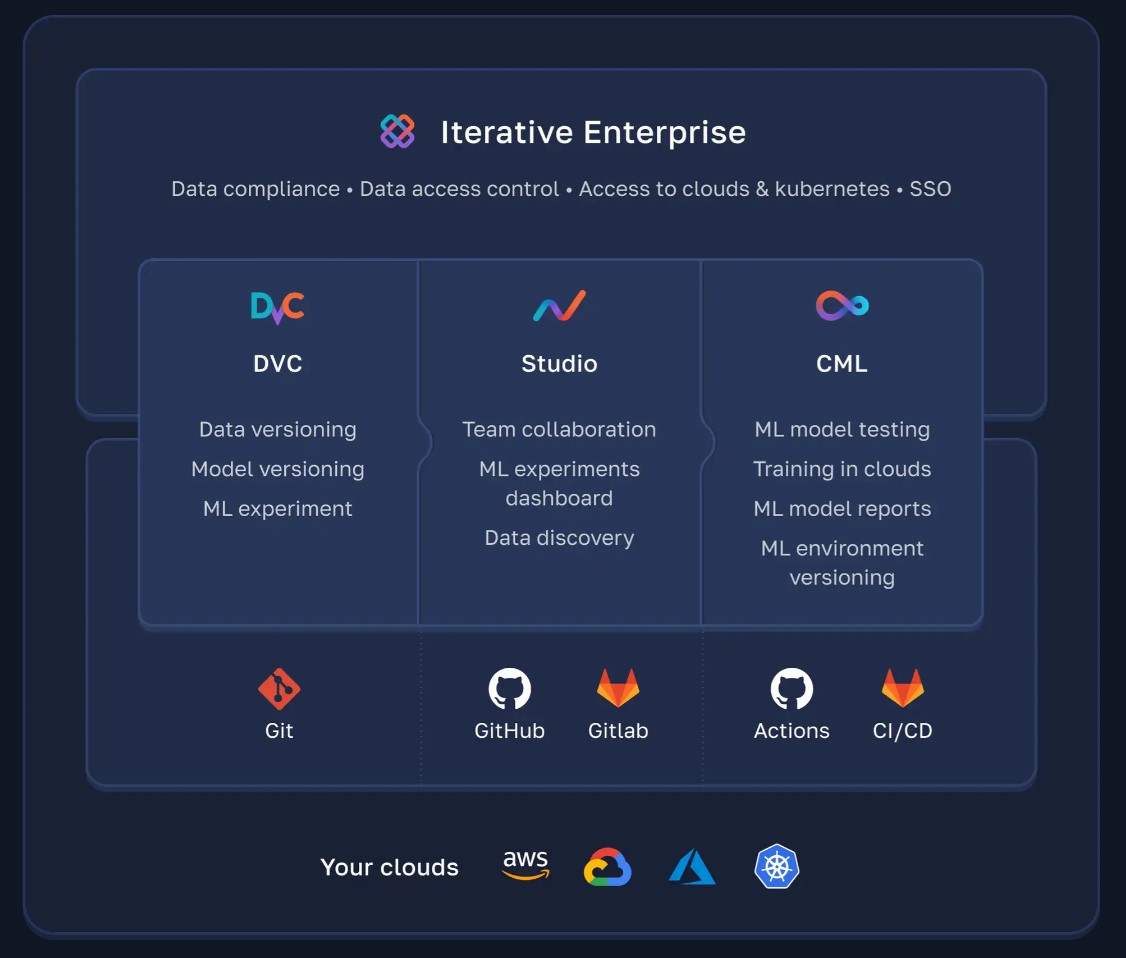
Image Credits: Iterative
“DVC Studio enables machine learning developers to run hundreds of experiments with full transparency, giving other developers in the organization the ability to collaborate fully in the process,” said Petrov. “The funding today will help us bring more innovative products and services into our ecosystem.”
Petrov stressed that he wants to build an ecosystem of tools, not a monolithic platform. When the company closed this current funding round about three months ago, Iterative had about 30 employees, many of whom were previously active in the open-source community around its projects. Today, that number is already closer to 60.
“Data, ML and AI are becoming an essential part of the industry and IT infrastructure,” said Leibert, general partner at 468 Capital. “Companies with great open-source adoption and bottom-up market strategy, like Iterative, are going to define the standards for AI tools and processes around building ML models.”
Powered by WPeMatico
F8 Refresh, Facebook’s annual developer conference with a new twist — it’s more pared down than in years past, and virtual — is going to be kicking off later today, and ahead of that Facebook is unveiling some news: all businesses can now use the Messenger API to interact with users on Instagram. The feature is opening first to all developers globally, with a phased approach for businesses:
Phase 1 will see Instagram accounts with follower counts of over 10,000 and under 100,000 connect to the API. It plans to expand that to accounts with followers numbering between 1,000 and 100,000 in July (phase 2), with remaining accounts coming online by Q3.
The feature was first announced as a closed beta in October with select businesses — 30 developers and 700 brands in all. Now, any brand or organization using Instagram to interact with customers can use it.
The key point with this tool is that this integration represents a significant step forward in how companies can leverage the wider Facebook platform.
In the past, a brand that wanted to interact with customers either needed to do so directly through Instagram, or via Facebook’s unified business inbox, which are limited how they can be used, especially by companies that might be handling large volumes of traffic, or keen to be able to link up those customer interactions with wider customer service databases.
The Messenger API, by contrast, can be integrated into any third-party application that a company or brand might be using to manage communication, whether it’s a social media management platform like Hootsuite or Sprinklr, or a CRM application that can bring in other kinds of customer data, for example warranty information or loyalty card numbers.
Facebook noted that one of the key takeaways from the closed beta was that brands and companies wanted better ways of managing communications from one place; and another was that many of them are making more investments in software to better manage their communications and workflows. So extending the Messenger API to Instagram was a feature that was long needed in that regard.
The move to expand the Messenger API to Instagram makes sense in a couple of different ways. For starters, Facebook has been turning up the volume for some time on how it leverages Instagram’s commercial potential, starting with advertising but expanding into areas like conversation between brands or businesses and users, and most recently, enhanced shopping features. Facebook also notes that 90% of Instagram users today follow at least one business, so creating a better route for managing those conversations is a logical move.
At the same time, Facebook has been working on ways of better linking up its various apps and platforms — which include Facebook itself, Messenger, WhatsApp, Instagram and Oculus, not just for users to interact across them but to help businesses leverage them in a more unified social strategy. Rolling out the Messenger API — created originally to help brands interact with bots and manage conversations on Messenger — to include support for Instagram fits into both of those bigger strategies.
And for those wondering why it’s being announced ahead of F8 Refresh? Perhaps it’s a hint of what is the social network’s bigger priorities for this year’s event: partnerships to enable more business to take place on the social networking giant’s platforms.
Powered by WPeMatico
Take a close look at any ambitious startup and you’ll find pugnacity nestled in its core. Stubbornness and a bullheaded belief in the worth of what a company wants to bring to fruition is often the biggest driver of its success, and the people at such companies also tend to share this quality.
So it wouldn’t be too far off the mark to say the people at Expensify are a stubborn lot — to the company’s ultimate benefit. This group of P2P pirates/hackers that set out to build an expense management app stuck to their gut, made their own rules. They asked questions few thought of, like: Why have lots of employees when you can find a way to get work done and reach impressive profitability with a few? Why work from an office in San Francisco when the internet lets you work from anywhere, even a sailboat in the Caribbean?
It makes sense in a way: If you’re a pirate, to hell with the rules, right? And even more so when nobody can explain the rules in the first place.
With that in mind, one could assume Expensify decided to ask itself: Why not build our own totally custom tech stack? Indeed, Expensify has made several tech decisions that were met with disbelief — from having an open-source frontend and cross-platform mobile development to hiring contractors to train its AI and recruiting open-source contributors — but its belief in its own choices has paid off over the years, and the company is ready to IPO any day now.
How much of a tech advantage Expensify enjoys owing to such choices is an open question, but one thing is clear: These choices are key to understanding Expensify and its roadmap. Let’s take a look.
I think another question Expensify also decided to ask in its early days was something like: Why not have our database on top of a technology that’s built for small-scale application software?
It may sound incredible, but Expensify actually runs on a custom database built on top of SQLite. This is surprising, because despite being one of the most widely deployed database engines, SQLite is known for running on small, embedded systems like smartphones and web browsers, not powering enterprise-scale databases.
It may sound incredible, but Expensify actually runs on a custom database built on top of SQLite.
This custom database is called Bedrock, and its architecture is as unique as they come. Expensify explains it as an “RDBMS optimized for self-healing replication across relatively slow, relatively unreliable WAN (internet) connections, enabling extremely high availability/high performance multi-datacenter deployments without any single point of failure.” RDBMS means relational database management system, describing SQLite and other row-based databases where entries are interconnected with each other.
But why would Expensify build this instead of going for any number of widely available enterprise database solutions?
To answer that question, we need to go back to the early days of the company, which was originally a side project for its founder and CEO, David Barrett. His initial idea was to develop a prepaid card for the homeless, but this required putting a server on the Visa network, which brought several strict requirements and challenges. “I would say one of the most difficult [parts] was that I needed the ability to automatically replicate and failover,” Barrett told TechCrunch when we interviewed him a couple of months ago.
This was no easy feat in 2007, but Barrett was up for the challenge. “I just hit a moment where the technology available off the shelf just wasn’t that good. And I happened to be a peer-to-peer software developer who had tons of spare time and really wanted to build this thing to put on the Visa backend,” he said. The P2P aspect was important, as Barrett had the skills to make it work. His first hires for Expensify, P2P engineers he had worked with at Red Swoosh and Akamai, were also unusually suited for the job.
Powered by WPeMatico
As companies increasingly rely on data to run their businesses, having accurate sources of data becomes paramount. Stemma, a new early-stage startup, has come up with a solution, a managed data catalogue that acts as an organization’s source of truth.
Today the company announced a $4.8 million seed investment led by Sequoia with assorted individual tech luminaries also participating. The product is also available for the first time today.
Company co-founder and CEO Mark Grover says the product is actually built on top of the open-source Amundsen data catalogue project that he helped launch at Lyft to manage its massive data requirements. The problem was that with so much data, employees had to kludge together systems to confirm the data validity. Ultimately manual processes like asking someone in Slack or even creating a Wiki failed under the weight of trying to keep up with the volume and velocity.
“I saw this problem firsthand at Lyft, which led me to create the open-source Amundsen project with a team of talented engineers,” Grover said. That project has 750 users at Lyft using it every week. Since it was open-sourced, 35 companies like Brex, Snap and Asana have been using it.
What Stemma offers is a managed version of Amundsen that adds functionality like using intelligence to show data that’s meaningful to the person who is searching in the catalogue. It also can add metadata automatically to data as it’s added to the catalogue, creating documentation about the data on the fly, among other features.
The company launched last fall when Grover and co-founder and CTO Dorian Johnson decided to join forces and create a commercial product on top of Amundsen. Grover points out that Lyft was supportive of the move.
Today the company has five employees, in addition to the founders, and has plans to add several more this year. As he does that, he is cognizant of diversity and inclusion in the hiring process. “I think it’s super important that we continue to invest in diversity, and the two ways that I think are the most meaningful for us right now is to have early employees that are from diverse groups, and that is the case within the first five,” he said. Beyond that, he says that as the company grows he wants to improve the ratio, while also looking at diversity in investors, board members and executives.
The company, which launched during COVID, is entirely remote right now and plans to remain that way for at least the short term. As the company grows, they will look at ways to build camaraderie, like organizing a regular cadence of employee offsite events.
Powered by WPeMatico