Enterprise
Auto Added by WPeMatico
Auto Added by WPeMatico
JFrog, the company best known for a platform that helps developers continuously manage software delivery and updates, is making a deal to help it expand its presence and expertise in an area that has become increasingly connected to DevOps: security. The company is acquiring Vdoo, which has built an AI-based platform that can be used to detect and fix vulnerabilities in the software systems that work with and sit on IoT and connected devices. The deal — in a mix of cash and stock — is valued at approximately $300 million, JFrog confirmed to me.
Sunnyvale-based, Israeli-founded JFrog is publicly traded on Nasdaq, where it went public last September, and currently it has a market cap of $4.65 billion. Vdoo, meanwhile, had raised about $70 million from investors that include NTT, Dell, GGV and Verizon (disclaimer: Verizon owns TechCrunch), and when we covered its most recent funding round, we estimated that the valuation was somewhere between $100 million and $200 million, making this a decent return.
Shlomi Ben Haim, JFrog’s co-founder and CEO, said that his company’s turn to focusing deeper on security, and making this acquisition in particular to fill out that strategy, are a natural progression in its aim to build out an end-to-end platform for the DevOps team.
“When we started JFrog, the main challenge was to educate the market on what we saw as most important priorities when it comes to building, testing and deploying software,” he said. Then sometime around 2015-2016 he said they started to realize there was a “crack” in the system, “a crack called security.” InfoSec engineers and developers sometimes work at cross purposes, as “developers became too fast” the work they were doing has inadvertently led to a lot of security vulnerabilities.
JFrog has been building a number of tools since then to address that and to bring the collective priorities together, such as its X-ray product. And indeed, Vdoo is not JFrog’s first foray into security, but it represents a significant step deeper into the hardware and systems that are being run on software. “It’s a very important leap forward,” Ben Haim said.
For its part, Vdoo was born out of a realization as well as a challenging mission: IoT and other connected devices — a universe of some 50 billion pieces of hardware as of last year — represents a massive security headache, and not just because of the volume of devices: Each object uses and interacts with software in the cloud and so each instance represents a potential vulnerability, with zero-day vulnerabilities, CVEs, configuration and hardening issues, and standard non-compliance among some of the most common.
While connected-device security up to now has typically focused on monitoring activity on the hardware, how data is moving in and out of it, Vdoo’s approach has been to build a platform that monitors the behavior of the devices themselves on top of that, using AI to compare that behavior to identify when something is not working as it should. Interestingly, this mirrors the kind of binary analysis that JFrog provides in its DevOps platform, making the two complementary to each other.
But what’s notable is that this will give JFrog a bigger play at the edge, since part of Vdoo’s platform works on devices themselves, “micro agents” as the company has described them to me previously, to detect and repair vulnerabilities on endpoints.
While JFrog has built a lot of its own business from the ground up, it has made a number of acquisitions to bolt on technology (one example: Shippable, which it used to bring continuous integration and delivery into its DevOps platform). In this case, Netanel Davidi, the co-founder and CEO of Vdoo (who previously co-founded and sold another security startup, Cyvera, to Palo Alto Networks) said that this was a good fit because the two companies are fundamentally taking the same approaches in their work (another synergy and justification for DevOps and InfoSec being more closely knitted together too I might add).
“In terms of the fit between the companies, it’s about our approach to binaries,” Davidi said in an interview, noting that the two being on the same page with this approach was fundamental to the deal. “That’s only the way to cover the entire pipeline from the very beginning, when they go you develop something, all the way to the device or to the server or to the application or to the mobile phone. That’s the only way to truly understand the context and contextual risk.”
He also made a note not just of the tech but of the talent that is coming on with the acquisition: 100 people joining JFrog’s 800.
“If JFrog chose to build something like this themselves, they could have done it,” he said. “But the uniqueness here is that we have built the best security team, the best security researchers, the best vulnerability researchers, the best reverse engineers, which focus not only on embedded systems, and IoT, which is considered to be the hardest thing to learn and to analyze, but also in software artifacts. We are bringing this knowledge along with us.”
JFrog said that Vdoo will continue to operate as a standalone SaaS product for the time being. Updates that are made will be in aid of supporting the JFrog platform and the two aim to have a fully integrated, “holistic” product by 2022.
Along with the deal, JFrog reiterated financial guidance for the next quarter that will end June 30, 2021. It expects revenues of $47.6 million to $48.6 million, with non-GAAP operating income of $0.5 million to $1.5 million and non-GAAP EPS of $0.00 to $0.01, assuming approximately 104 million weighted average diluted shares outstanding. For Full Year 2021, revenues are expected to be $198 million to $204 million, with non-GAAP operating income between $5 million and $7 million and an approximately 3% increase in weighted average diluted shares. JFrog anticipates consolidated operating expenses to increase by approximately $9-10 million for the remainder of 2021, subject to the acquisition closing.
Powered by WPeMatico

Seattle-based Edge Delta, a startup that is building a modern distributed monitoring stack that is competing directly with industry heavyweights like Splunk, New Relic and Datadog, today announced that it has raised a $15 million Series A funding round led by Menlo Ventures and Tim Tully, the former CTO of Splunk. Previous investors MaC Venture Capital and Amity Ventures also participated in this round, which brings the company’s total funding to date to $18 million.
“Our thesis is that there’s no way that enterprises today can continue to analyze all their data in real time,” said Edge Delta co-founder and CEO Ozan Unlu, who has worked in the observability space for about 15 years already (including at Microsoft and Sumo Logic). “The way that it was traditionally done with these primitive, centralized models — there’s just too much data. It worked 10 years ago, but gigabytes turned into terabytes and now terabytes are turning into petabytes. That whole model is breaking down.”
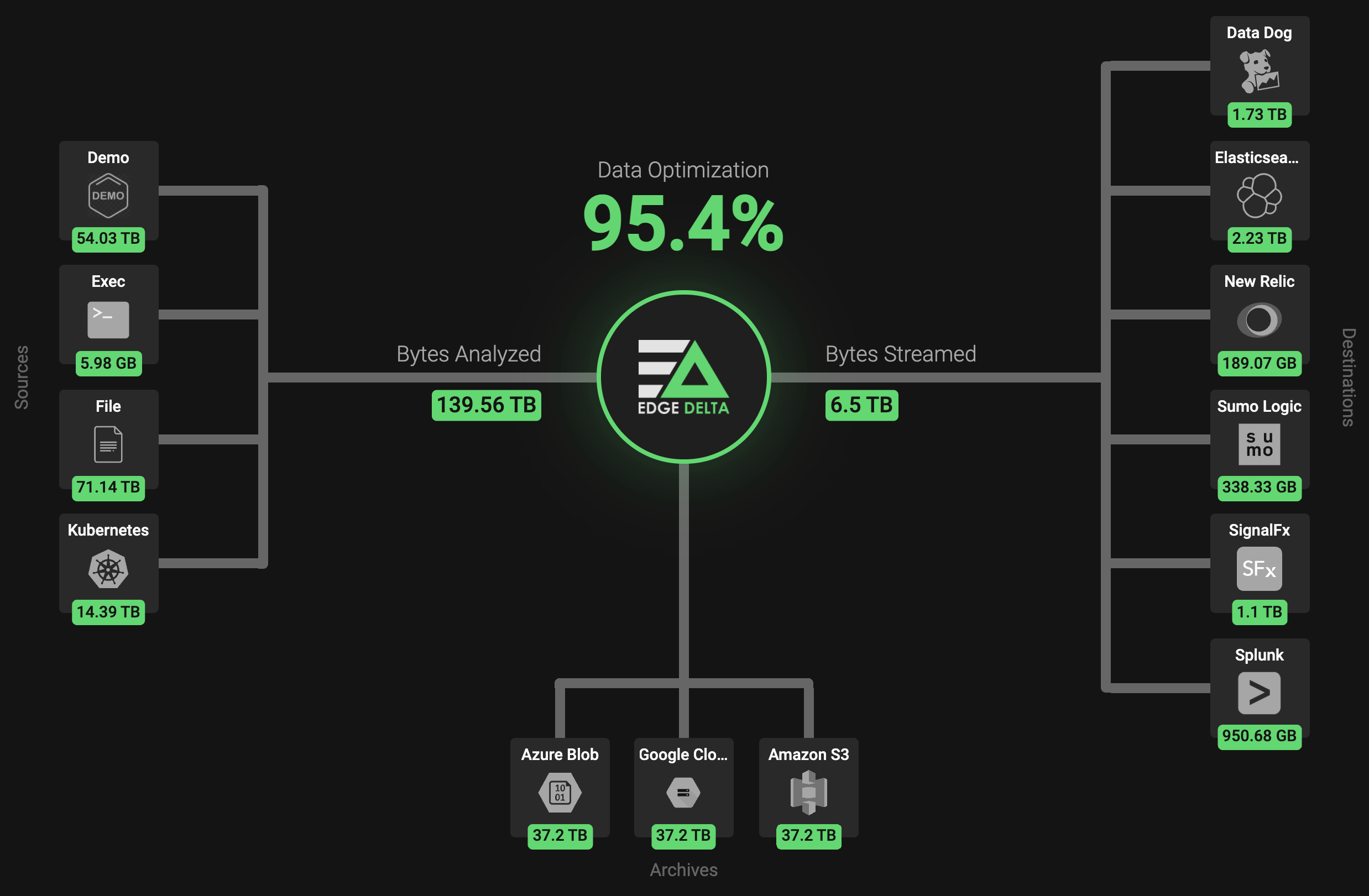
Image Credits: Edge Delta
He acknowledges that traditional big data warehousing works quite well for business intelligence and analytics use cases. But that’s not real-time and also involves moving a lot of data from where it’s generated to a centralized warehouse. The promise of Edge Delta is that it can offer all of the capabilities of this centralized model by allowing enterprises to start to analyze their logs, metrics, traces and other telemetry right at the source. This, in turn, also allows them to get visibility into all of the data that’s generated there, instead of many of today’s systems, which only provide insights into a small slice of this information.
While competing services tend to have agents that run on a customer’s machine, but typically only compress the data, encrypt it and then send it on to its final destination, Edge Delta’s agent starts analyzing the data right at the local level. With that, if you want to, for example, graph error rates from your Kubernetes cluster, you wouldn’t have to gather all of this data and send it off to your data warehouse where it has to be indexed before it can be analyzed and graphed.
With Edge Delta, you could instead have every single node draw its own graph, which Edge Delta can then combine later on. With this, Edge Delta argues, its agent is able to offer significant performance benefits, often by orders of magnitude. This also allows businesses to run their machine learning models at the edge, as well.
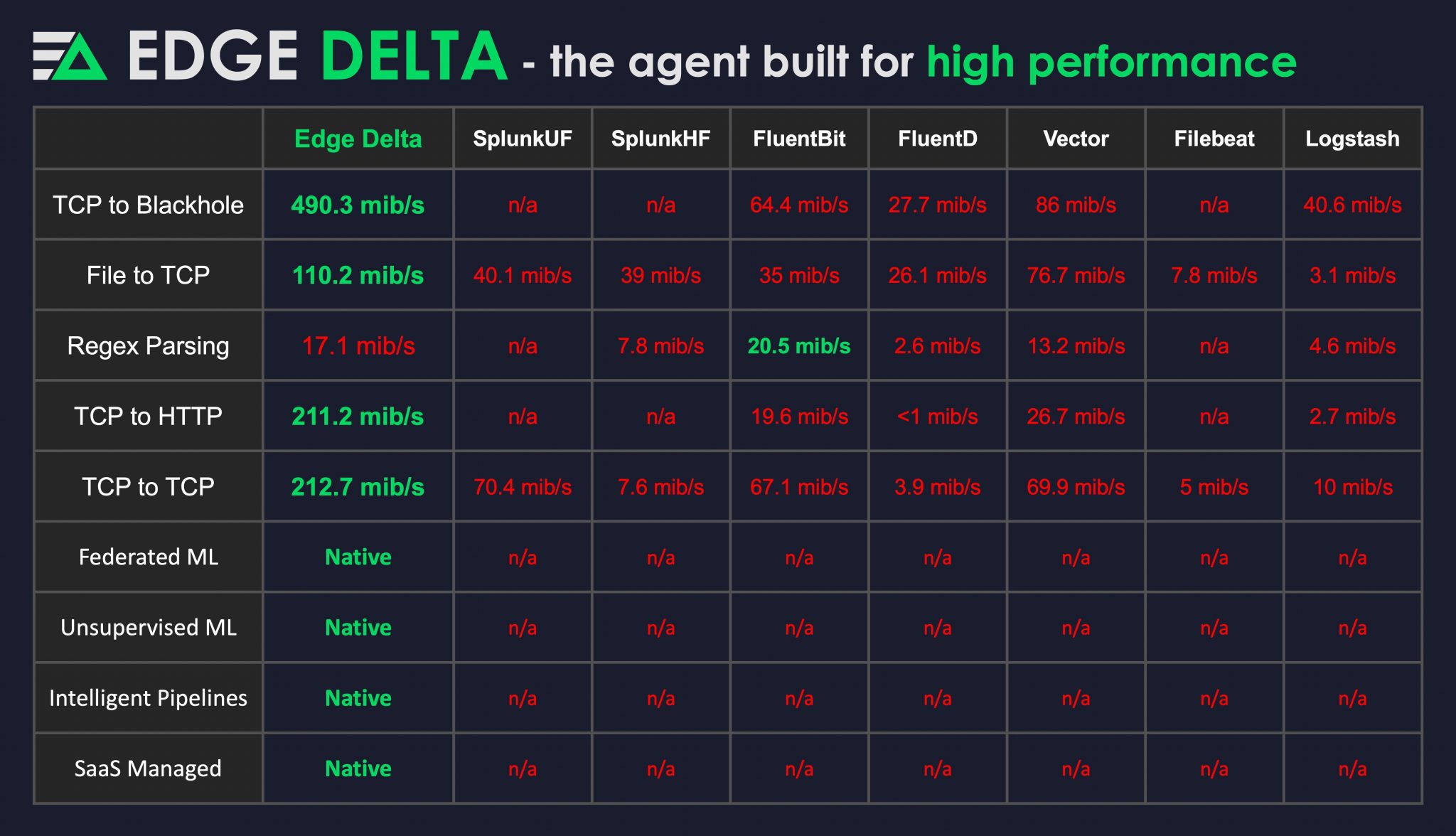
Image Credits: Edge Delta
“What I saw before I was leaving Splunk was that people were sort of being choosy about where they put workloads for a variety of reasons, including cost control,” said Menlo Ventures’ Tim Tully, who joined the firm only a couple of months ago. “So this idea that you can move some of the compute down to the edge and lower latency and do machine learning at the edge in a distributed way was incredibly fascinating to me.”
Edge Delta is able to offer a significantly cheaper service, in large part because it doesn’t have to run a lot of compute and manage huge storage pools itself since a lot of that is handled at the edge. And while the customers obviously still incur some overhead to provision this compute power, it’s still significantly less than what they would be paying for a comparable service. The company argues that it typically sees about a 90 percent improvement in total cost of ownership compared to traditional centralized services.
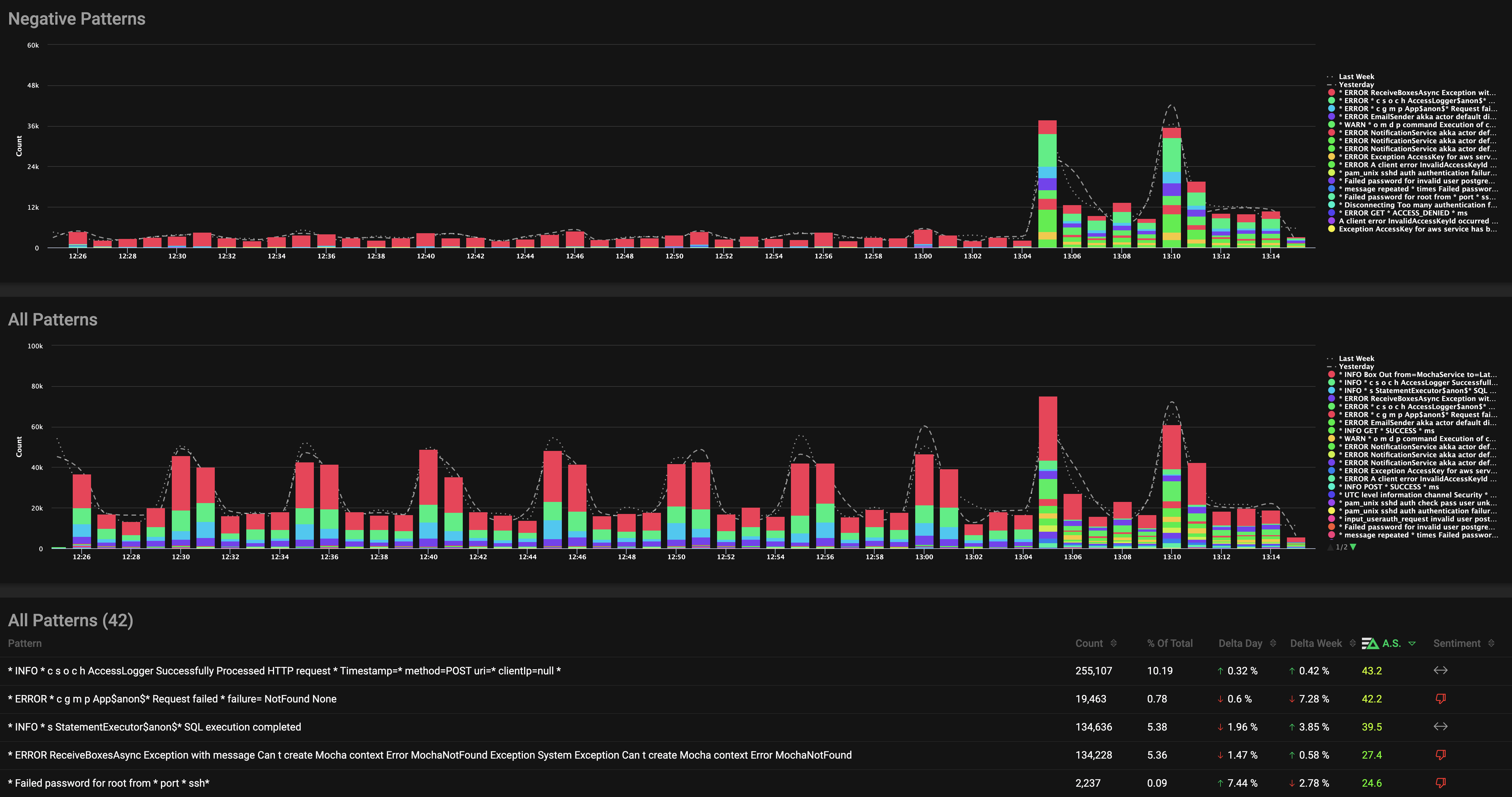
Image Credits: Edge Delta
Edge Delta charges based on volume and it is not shy to compare its prices with Splunk’s and does so right on its pricing calculator. Indeed, in talking to Tully and Unlu, Splunk was clearly on everybody’s mind.
“There’s kind of this concept of unbundling of Splunk,” Unlu said. “You have Snowflake and the data warehouse solutions coming in from one side, and they’re saying, ‘hey, if you don’t care about real time, go use us.’ And then we’re the other half of the equation, which is: actually there’s a lot of real-time operational use cases and this model is actually better for those massive stream processing datasets that you required to analyze in real time.”
But despite this competition, Edge Delta can still integrate with Splunk and similar services. Users can still take their data, ingest it through Edge Delta and then pass it on to the likes of Sumo Logic, Splunk, AWS’s S3 and other solutions.
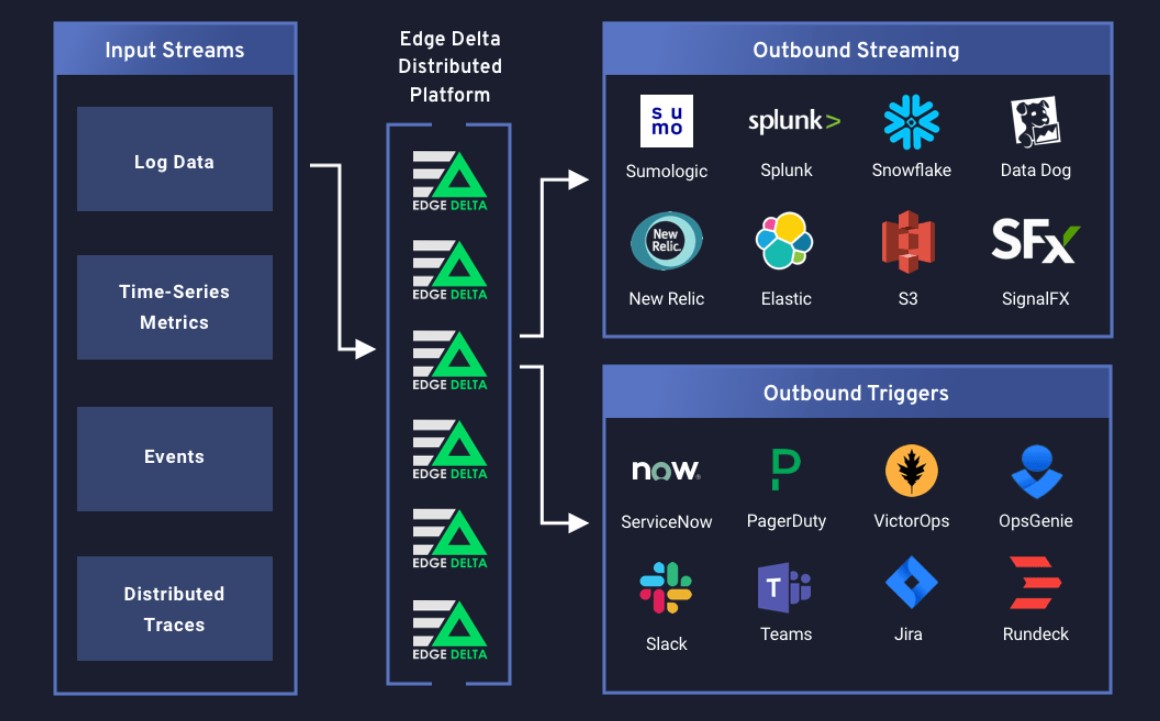
Image Credits: Edge Delta
“If you follow the trajectory of Splunk, we had this whole idea of building this business around IoT and Splunk at the Edge — and we never really quite got there,” Tully said. “I think what we’re winding up seeing collectively is the edge actually means something a little bit different. […] The advances in distributed computing and sophistication of hardware at the edge allows these types of problems to be solved at a lower cost and lower latency.”
The Edge Delta team plans to use the new funding to expand its team and support all of the new customers that have shown interest in the product. For that, it is building out its go-to-market and marketing teams, as well as its customer success and support teams.
Powered by WPeMatico
Snowflake changed the conversation for many companies when it comes to the potentials of data warehousing. Now one of the startups that’s hoping to disrupt the disruptor is announcing a big round of funding to expand its own business.
Firebolt, which has built a new kind of cloud data warehouse that promises much more efficient, and cheaper, analytics around whatever is stored within it, is announcing a major Series B of $127 million on the heels of huge demand for its services.
The company, which only came out of stealth mode in December, is not disclosing its valuation with this round, which brings the total raised by the Israeli company to $164 million. New backers Dawn Capital and K5 Global are in this round, alongside previous backers Zeev Ventures, TLV Partners, Bessemer Venture Partners and Angular Ventures.
Nor is it disclosing many details about its customers at the moment. CEO and co-founder Eldad Farkash told me in an interview that most of them are U.S.-based, and that the numbers have grown from the dozen or so that were using Firebolt when it was still in stealth mode (it worked quietly for a couple of years building its product and onboarding customers before finally launching six months ago). They are all migrating from existing data warehousing solutions like Snowflake or BigQuery. In other words, its customers are already cloud-native, Big Data companies: it’s not trying to proselytize on the basic concept but work with those who are already in a specific place as a business.
“If you’re not using Snowflake or BigQuery already, we prefer you come back to us later,” he said. Judging by the size and quick succession of the round, that focus is paying off.
The challenge that Firebolt set out to tackle is that while data warehousing has become a key way for enterprises to analyze, update and manage their big data stores — after all, your data is only as good as the tools you have to parse it and keep it secure — typically data warehousing solutions are not efficient, and they can cost a lot of money to maintain.
The challenge was seen firsthand by the three founders of Firebolt, Farkash (CEO), Saar Bitner (COO) and Ariel Yaroshevich (CTO) when they were at a previous company, the business intelligence powerhouse Sisense, where respectively they were one of its co-founders and two members of its founding team. At Sisense, the company continually came up against an issue: When you are dealing in terabytes of data, cloud data warehouses were straining to deliver good performance to power their analytics and other tools, and the only way to potentially continue to mitigate that was by piling on more cloud capacity. And that started to become very expensive.
Firebolt set out to fix that by taking a different approach, rearchitecting the concept. As Farkash sees it, while data warehousing has indeed been a big breakthrough in Big Data, it has started to feel like a dated solution as data troves have grown.
“Data warehouses are solving yesterday’s problem, which was, ‘How do I migrate to the cloud and deal with scale?’” he told me back in December. Google’s BigQuery, Amazon’s RedShift and Snowflake are fitting answers for that issue, he believes, but “we see Firebolt as the new entrant in that space, with a new take on design on technology. We change the discussion from one of scale to one of speed and efficiency.”
The startup claims that its performance is up to 182 times faster than that of other data warehouses with a SQL-based system that works on academic research that had yet to be applied anywhere, around how to handle data in a lighter way, using new techniques in compression and how data is parsed. Data lakes in turn can be connected with a wider data ecosystem, and what it translates to is a much smaller requirement for cloud capacity. And lower costs.
Fast forward to today, and the company says the concept is gaining a lot of traction with engineers and developers in industries like business intelligence, customer-facing services that need to parse a lot of information to serve information to users in real time and back-end data applications. That is proving out what investors suspected would be a shift before the startup even launched, stealthily or otherwise.
“I’ve been an investor at Firebolt since their Series A round and before they had any paying customers,” said Oren Zeev of Zeev Ventures. “What had me invest in Firebolt is mostly the team. A group of highly experienced executives mostly from the big data space who understand the market very well, and the pain organizations are experiencing. In addition, after speaking to a few of my portfolio companies and Firebolt’s initial design partners, it was clear that Firebolt is solving a major pain, so all in all, it was a fairly easy decision. The market in which Firebolt operates is huge if you consider the valuations of Snowflake and Databricks. Even more importantly, it is growing rapidly as the migration from on-premise data warehouse platforms to the cloud is gaining momentum, and as more and more companies rely on data for their operations and are building data applications.”
Powered by WPeMatico
Salesforce and AWS represent the two most successful cloud companies in their respective categories. Over the last few years the two cloud giants have had an evolving partnership. Today they announced plans for a new set of integration capabilities to make it easier to share data and build applications that cross the two platforms.
Patrick Stokes, EVP and GM for Platform at Salesforce, points out that the companies have worked together in the past to provide features like secure sharing between the two services, but they were hearing from customers that they wanted to take it further and today’s announcement is the first step towards making that happen.
“[The initial phases of the partnership] have really been massively successful. We’re learning a lot from each other and from our mutual customers about the types of things that they want to try to accomplish, both within the Salesforce portfolio of products, as well as all the Amazon products, so that the two solutions complement each other really nicely. And customers are asking us for more, and so we’re excited to enter into this next phase of our partnership,” Stokes explained.
He added, “The goal really is to unify our platforms, so bring [together] all the power of the Amazon services with all of the power of the of the Salesforce platform.” These capabilities could be the next step in accomplishing that.
This involves a couple of new features the companies are working on to help developers on both the platform and application side of the equation. For starters that includes enabling developers to virtualize Amazon data inside Salesforce without having to do all the coding to make that happen manually.
“More specifically, we’re going to virtualize Amazon data within the Salesforce platform, so whether you’re working with an S3 bucket, Amazon RDS or whatever it is we’re going to make it so that that the data is virtualized and just appears just like it’s native data on the Salesforce platform,” he said.
Similarly, developers building applications on Amazon will be able to access Salesforce data and have it appear natively in Amazon. This involves providing connectors between the two systems to make the data flow smoothly without a lot of coding to make that happen.
The companies are also announcing event sharing capabilities, which makes it easier for both Amazon and Salesforce customers to build microservices-based applications that cross both platforms.
“You can build microservices-oriented architecture that spans the services of Salesforce and Amazon platforms, again without having to write any code. To do that, [we’re developing] out of the box connectors so you can click and drag the events that you want.”
The companies are also announcing plans to make it easier from an identity and access management perspective to access the platforms with a guided setup. Finally, the companies are working on applications to build Amazon Chime communications tooling into Service Cloud and other Salesforce services to build things like virtual call centers using AWS machine learning technology.
Amazon VP of Global Marketing Rachel Thorton says that having the two cloud giants work together in this way should make it easier for developers to create solutions that span the two platforms. “I just think it unlocks such possibilities for developers, and the faster and more innovative developers can be, it just unlocks opportunities for businesses, and creates better customer experiences,” Thornton said.
It’s worth noting that Salesforce also has extensive partnerships with other cloud providers including Microsoft Azure and Google Cloud Platform.
As is typically the case with Salesforce announcements, while all of these capabilities are being announced today, they are still in the development stage and won’t go into beta testing until later this year with GA expected sometime next year. The companies are expected to release more details about the partnership at Dreamforce and re:Invent, their respective customer conferences later this year.
Powered by WPeMatico
Diversity and inclusion have become central topics in the world of work. In the best considerations, improving them is a holistic effort, involving not just conceiving of products with this in mind, but hiring and managing talent in a diverse and inclusive way, too. A new startup called Pequity, which has built a product to help with the latter of these areas, specifically in equitable compensation, has now raised some funding — a sign of the demand in the market, as well as how tech is being harnessed in aid of helping it.
The San Francisco-based startup has raised $19 million in a Series A led by Norwest Venture Partners. First Round Capital, Designer Fund, and Scribble Ventures also participated in the fundraise, which will be used to continue investing in product and also hiring: the company has 20 on its own books now and will aim to double that by the end of this year, on the heels of positive reception in the market.
Since launching officially last year, Pequity has picked up over 100 customers, with an initial focus on fast-scaling companies in its own backyard, a mark of how D&I have come into focus in the tech industry in particular. Those using Pequity to compare and figure out compensation include Instacart, Scale.ai and ClearCo, and the company said that in the last four months, the platform’s been used to make more then 5,000 job offers.

Image Credits: Pequity (opens in a new window)
Kaitlyn Knopp, the CEO who co-founded the company with Warren Lebovics (both pictured, right), came up for the idea for Pequity in much the same way that many innovations in the world of enterprise IT come to market: through her own first-hand experience.
She spent a decade working in employment compensation in the Bay Area, with previous roles at Google, Instacart, and Cruise. In that time, she found the tools that many companies used were lacking and simply “clunky” when it came to compensation analysis.
“The way the market has worked so far is that platforms had compensation as an element but not the focus,” she said. “It was the end of the tagline, the final part of a ‘CRM for candidates.’ But you still have to fill in all the gaps, you have to set the architecture the right way. And with compensation, you have to bake in your own analytics, which implies that you have to have some expertise.”
Indeed, as with other aspects of enterprise software, she added that the very biggest tech companies sometimes worked on their own tools, but not only does that leave smaller or otherwise other-focused businesses out of having better calculation tools, but it also means that those tools are siloed and miss out on being shaped by a bigger picture of the world of work. “We wanted to take that process and own it.”
The Pequity product essentially works by plugging into all of the other tools that an HR professional might be using — HRIS, ATS, and payroll products — to manage salaries across the whole of the organization in order to analyse and compare how compensation could look for existing and prospective employees. It combines a company’s own data and then compares it to data from the wider market, including typical industry ranges and market trends, to provide insights to HR teams.
All of this means that HR teams are able to make more informed decisions, which is step number one in being more transparent and equitable, but is also something that Pequity is optimized to cover specifically in how it measures compensation across a team.
And in line with that, there is another aspect of the compensation mindset that Knopp also wanted to address in a standalone product, and that is the idea of building a tool with a mission, one of providing a platform that can bring in data to make transparent and equitable decisions.
“A lot of the comp tools that I’ve interacted with are reactive,” she said. “You may have to do, say, a pay equity test, you do your promotion and merit cycles, and then you find all these issues that you have to solve. We’re flagging those things proactively with our analytics, because we’re plugging into those systems, which will give you those alerts before the decisions need to be made.”
As an added step in that direction, Knopp said that ultimately she believes the tool should be something that those outside of HR, such as managers and emploiyees themselves, should be able to access to better understand the logic of their own compensation and have more information going into any kind of negotiation.
Ultimately, it will be interesting to see whether modernized products like Pequity, which are tackling old problems with a new approach and point of view, find traction in the wider market. If one purpose in HR is to address diversity and inclusion, and part of the problem has been that the tools are just not fit for that purpose, then it seems a no-brainer that we’ll see more organizations trying out new things to see if they can help them in their own race to secure talent.
“Compensation reflects a company’s values, affects its ability to hire talent, and is the biggest expense on its P&L. And yet, most comp teams run on spreadsheets and emails,” said Parker Barrile, Partner at Norwest, in a statement. “Pequity empowers comp teams to design and manage equitable compensation programs with modern software designed by comp professionals, for comp professionals.”
Powered by WPeMatico

Vantage, a service that helps businesses analyze and reduce their AWS costs, today announced that it has raised a $4 million seed round led by Andreessen Horowitz. A number of angel investors, including Brianne Kimmel, Julia Lipton, Stephanie Friedman, Calvin French Owen, Ben and Moisey Uretsky, Mitch Wainer and Justin Gage, also participated in this round.
Vantage started out with a focus on making the AWS console a bit easier to use — and helping businesses figure out what they are spending their cloud infrastructure budgets on in the process. But as Vantage co-founder and CEO Ben Schaechter told me, it was the cost transparency features that really caught on with users.
“We were advertising ourselves as being an alternative AWS console with a focus on developer experience and cost transparency,” he said. “What was interesting is — even in the early days of early access before the formal GA launch in January — I would say more than 95% of the feedback that we were getting from customers was entirely around the cost features that we had in Vantage.”
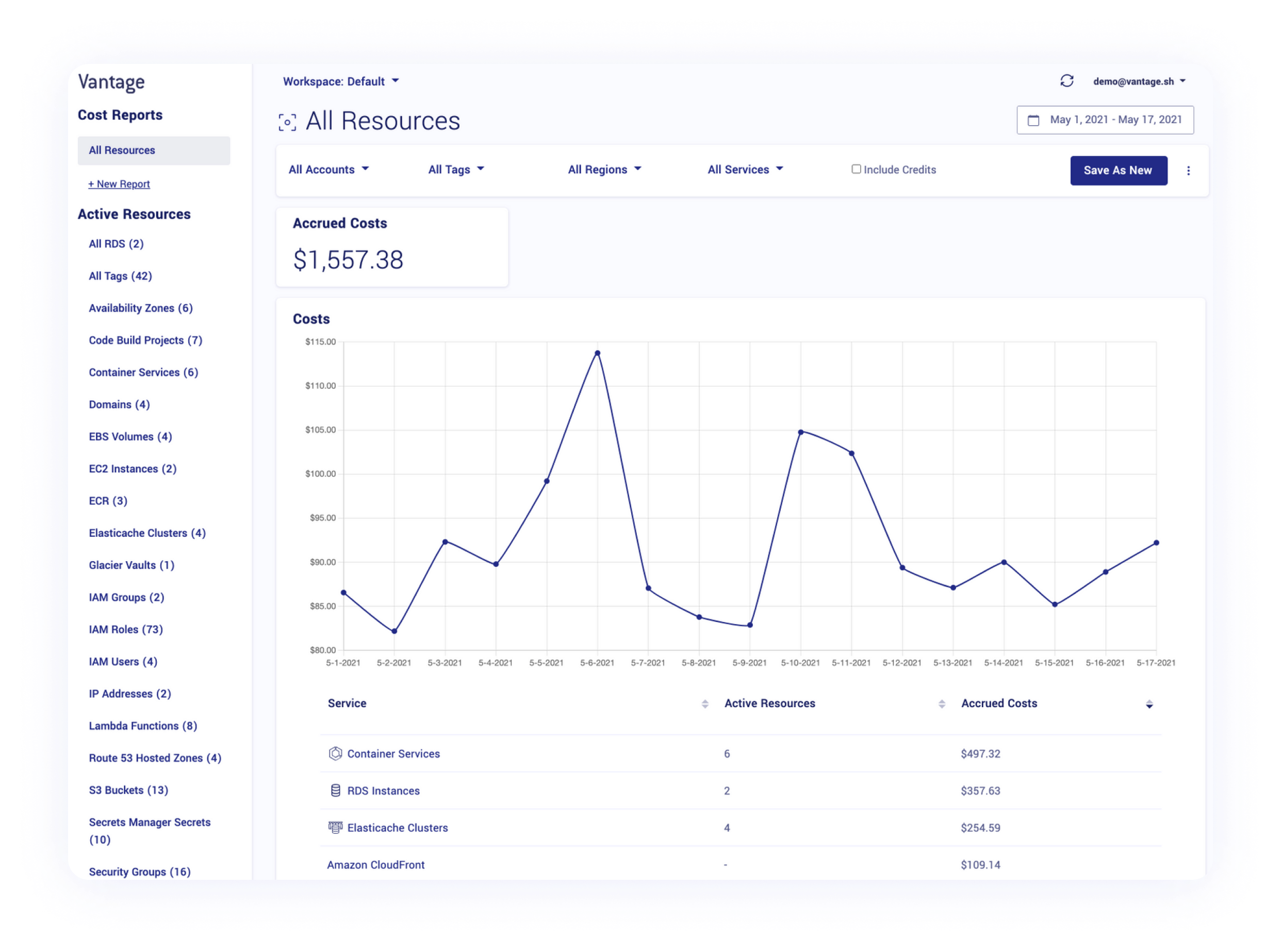
Image Credits: Vantage
Like any good startup, the Vantage team looked at this and decided to double down on these features and highlight them in its marketing, though it kept the existing AWS Console-related tools as well. The reason the other tools didn’t quite take off, Schaechter believes, is because more and more, AWS users have become accustomed to infrastructure-as-code to do their own automatic provisioning. And with that, they spend a lot less time in the AWS Console anyway.
“But one consistent thing — across the board — was that people were having a really, really hard time 12 times a year, where they would get a shocking AWS bill and had to figure out what happened. What Vantage is doing today is providing a lot of value on the transparency front there,” he said.
Over the course of the last few months, the team added a number of new features to its cost transparency tools, including machine learning-driven predictions (both on the overall account level and service level) and the ability to share reports across teams.
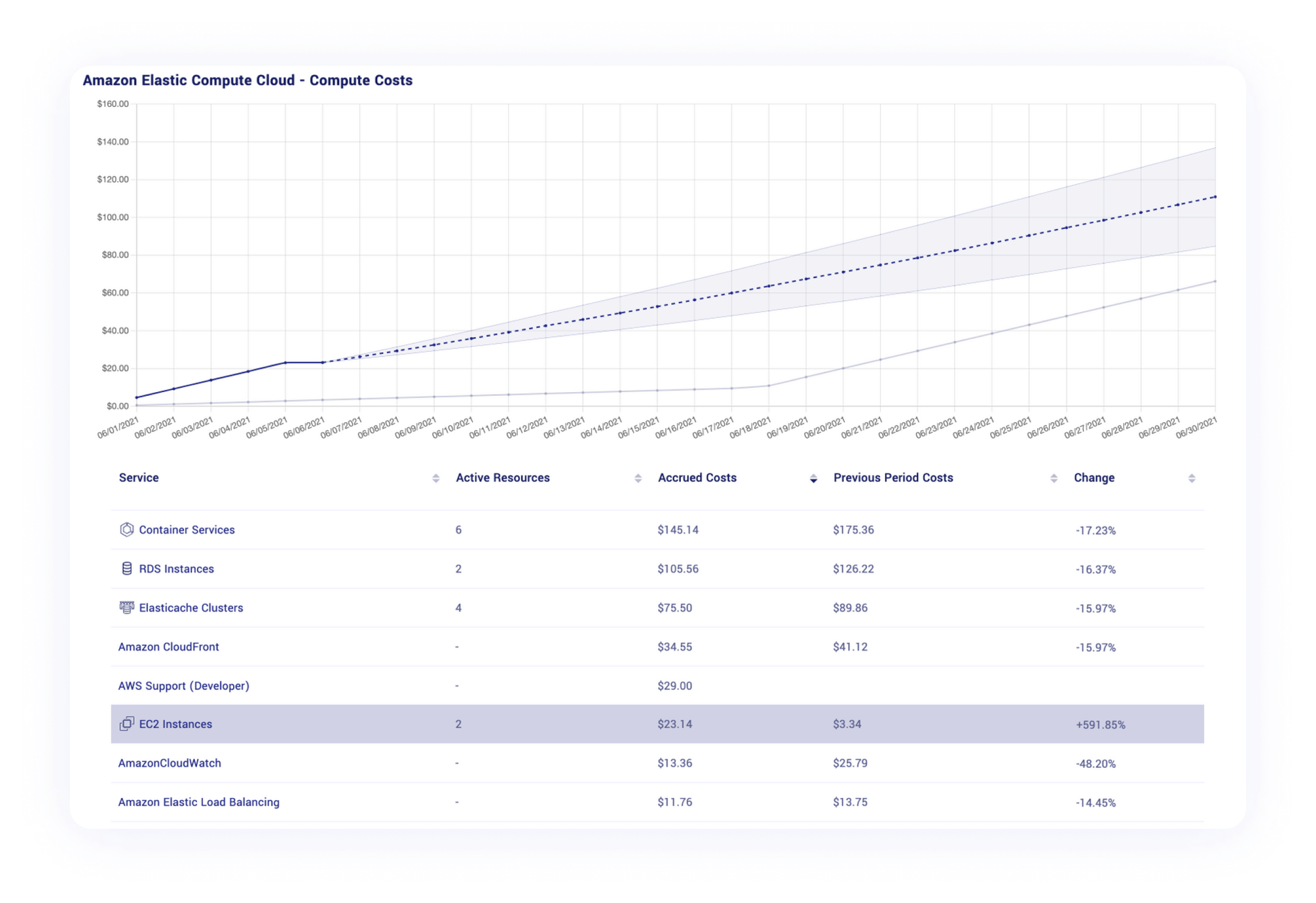
Image Credits: Vantage
While Vantage expects to add support for other clouds in the future, likely starting with Azure and then GCP, that’s actually not what the team is focused on right now. Instead, Schaechter noted, the team plans to add support for bringing in data from third-party cloud services instead.
“The number one line item for companies tends to be AWS, GCP, Azure,” he said. “But then, after that, it’s Datadog, Cloudflare, Sumo Logic, things along those lines. Right now, there’s no way to see, P&L or an ROI from a cloud usage-based perspective. Vantage can be the tool where that’s showing you essentially, all of your cloud costs in one space.”
That is likely the vision the investors bought into, as well, and even though Vantage is now going up against enterprise tools like Apptio’s Cloudability and VMware’s CloudHealth, Schaechter doesn’t seem to be all that worried about the competition. He argues that these are tools that were born in a time when AWS had only a handful of services and only a few ways of interacting with those. He believes that Vantage, as a modern self-service platform, will have quite a few advantages over these older services.
“You can get up and running in a few clicks. You don’t have to talk to a sales team. We’re helping a large number of startups at this stage all the way up to the enterprise, whereas Cloudability and CloudHealth are, in my mind, kind of antiquated enterprise offerings. No startup is choosing to use those at this point, as far as I know,” he said.
The team, which until now mostly consisted of Schaechter and his co-founder and CTO Brooke McKim, bootstrapped the company up to this point. Now they plan to use the new capital to build out its team (and the company is actively hiring right now), both on the development and go-to-market side.
The company offers a free starter plan for businesses that track up to $2,500 in monthly AWS cost, with paid plans starting at $30 per month for those who need to track larger accounts.
Powered by WPeMatico
Time is your most valuable asset — as the saying goes — and today a startup called Memory.ai, which is building AI-based productivity tools to help you with your own time management, is announcing some funding to double down on its ambitions: It wants not only to help manage your time, but to, essentially, provide ways to use it better in the future.
The startup, based out of Oslo, Norway, initially made its name with an app called Timely, a tool for people to track time spent doing different tasks. Aimed not just at people who are quantified self geeks, but those who need to track time for practical reasons, such as consultants or others who work on the concept of billable hours. Timely has racked up 500,000 users since 2014, including more than 5,000 paying businesses in 160 countries.
Now, Memory.ai has raised $14 million as it gears up to launch its next apps, Dewo (pronounced “De-Voh”), an app that is meant to help people do more “deep work” by learning about what they are working on and filtering out distractions to focus better; and Glue, described as a knowledge hub to help in the creative process. Both are due to be released later in the year.
The funding is being led by local investors Melesio and Sanden, with participation from Investinor, Concentric and SNÖ Ventures, who backed Memory.ai previously.
“Productivity apps” has always been something of a nebulous category in the world of connected work. They can variously cover any kind of collaboration management software ranging from Asana and Jira through to Slack and Notion; or software that makes doing an existing work task more efficient than you did it before (e.g. Microsoft has described all of what goes into Microsoft 365 — Excel, Word, PowerPoint, etc. — as “productivity apps”); or, yes, apps like those from Memory.ai that aim to improve your concentration or time management.
These days, however, it feels like the worlds of AI and advances in mobile computing are increasingly coming together to evolve that concept once again.
If the first wave of smartphone communications and the apps that are run on smartphone devices — social, gaming, productivity, media, information, etc. — have led to us getting pinged by a huge amount of data from lots of different places, all of the time, then could it be that the second wave is quite possibly going to usher in a newer wave of tools to handle all that better, built on the premise that not everything is of equal importance? No-mo FOMO? We’ll see.
In any case, some bigger platform players also helping to push the agenda of what productivity means in this day and age.
For example, in Apple’s recent preview of iOS 15 (due to come out later this year) the company gave a supercharge to its existing “do not disturb” feature on its phones, where it showed off a new Focus mode, letting users customize how and when they want to receive notifications from which apps, and even which apps they want to have displayed, all organized by different times of day (e.g. work time), place, calendar items and so on.
“Today, iPhone plays so many roles in our lives. It’s where we get information, how people reach us, and where we get things done. This is great, but it means our attention is being pulled in so many different directions and finding that balance between work and life can be tricky,” said Apple’s Craig Federighi in the WWDC keynote earlier this month. “We want to free up space to focus and help you be in the moment.” How well that gets used, and how much other platforms like Google follow suit, will be interesting to see play out. It feels, in any case, like it could be the start of something.
And, serendipitously — or maybe because this is some kind of zeitgeist — this is also playing into what Memory.ai has built and is building.
Mathias Mikkelsen, the Oslo-based founder of Memory.ai, first came up with his idea for Timely (which had also been the original name of the whole startup) when he was working as a designer in the ad industry, one of those jobs that needed to track what he was working on, and for how long, in order to get paid.
He said he knew the whole system as it existed was inefficient: “I just thought it was insane how cumbersome and old it was. But at the same time how important it was for the task,” he said.
The guy had an entrepreneurial itch that he was keen to scratch, and this idea would become the salve to help him. Mikkelsen was so taken with building a startup around time management, that he sold his apartment in Oslo and moved himself to San Francisco to be where he believed was the epicenter of startup innovation. He tells me he lived off the proceeds of his flat for two years “in a closet” in a hacker house, bootstrapping Timely, until eventually getting into an accelerator (500 Startups) and subsequently starting to raise money. He eventually moved back to Oslo after two years to continue growing the business, as well as to live somewhere a little more spacious.
The startup’s big technical breakthrough with Timely was to figure out an efficient way of tracking time for different tasks, not just time worked on anything, without people having to go through a lot of data entry.
The solution: to integrate with a person’s computer, plus a basic to-do schedule for a day or week, and then match up which files are open when to determine how long one works for one client or another. Phone or messaging conversations, for the moment, are not included, and neither are the contents of documents — just the titles of them. Nor is data coming from wearable devices, although you could see how that, too, might prove useful.
The basic premise is to be personalised, so managers and others cannot use Timely to track exactly what people are doing, although they can track and bill for those billable hours. All this is important, as it also will feed into how Dewo and Glue will work.
The startup’s big conceptual breakthrough came around the same time: Getting time tracking or any productivity right “has never been a UI problem,” Mikkelsen said. “It’s a human nature problem.” This is where the AI comes in, to nudge people towards something they identify as important, and nudge them away from work that might not contribute to that. Tackling bigger issues beyond time are essential to improving productivity overall, which is why Memory.ai now wants to extend to apps for carving out time for deep thinking and creative thinking.
While it might seem to be a threat that a company like Apple has identified the same time management predicament that Memory.ai has, and is looking to solve that itself, Mikkelsen is not fazed. He said he thinks of Focus as not unlike Apple’s work on Health: there will be ways of feeding information into Apple’s tool to make it work better for the user, and so that will be Memory.ai’s opportunity to hopefully grow, not cannibalize, its own audience with Timely and its two new apps. It is, in a sense, a timely disruption.
“Memory’s proven software is already redefining how businesses around the world track, plan and manage their time. We look forward to working with the team to help new markets profit from the efficiencies, insights and transparency of a Memory-enabled workforce,” said Arild Engh, a partner at Melesio, in a statement.
Kjartan Rist, a partner at Concentric, added: “We continue to be impressed with Memory’s vision to build and launch best-in-class products for the global marketplace. The company is well on its way to becoming a world leader in workplace productivity and collaboration, particularly in light of the remote and hybrid working revolution of the last 12 months. We look forward to supporting Mathias and the team in this exciting new chapter.”
Powered by WPeMatico
The IPO rush of 2021 continued this week with a fresh filing from NoSQL provider Couchbase. The company raised hundreds of millions while private, making its impending debut an important moment for a number of private investors, including venture capitalists.
According to PitchBook data, Couchbase was last valued at a post-money valuation of $580 million when it raised $105 million in May 2020. The company — despite its expansive fundraising history — is not a unicorn heading into its debut to the best of our knowledge.
We’d like to uncover whether it will be one when it prices and starts to trade, so we dug into Couchbase’s business model and its financial performance, hoping to better understand the company and its market comps.
The Couchbase S-1 filing details a company that sells database tech. More specifically, Couchbase offers customers database technology that includes what NoSQL can offer (“schema flexibility,” in the company’s phrasing), as well as the ability to ask questions of their data with SQL queries.
Couchbase’s software can be deployed on clouds, including public clouds, in hybrid environments, and even on-prem setups. The company sells to large companies, attracting 541 customers by the end of its fiscal 2021 that generated $107.8 million in annual recurring revenue, or ARR, by the close of last year.
Couchbase breaks its revenue into two main buckets. The first, subscription, includes software license income and what the company calls “support and other” revenues, which it defines as “post-contract support,” or PCS, which is a package of offerings, including “support, bug fixes and the right to receive unspecified software updates and upgrades” for the length of the contract.
The company’s second revenue bucket is services, which is self-explanatory and lower-margin than its subscription products.
Powered by WPeMatico

As enterprise startups continue to target interesting gaps in the market, we’re seeing increasingly sophisticated tools getting built for small and medium businesses — traditionally a tricky segment to sell to, too small for large enterprise tools, and too advanced in their needs for consumer products. In the latest development of that trend, an Israeli startup called DataRails has raised $25 million to continue building out a platform that lets SMBs use Excel to run financial planning and analytics like their larger counterparts.
The funding closes out the company’s Series A at $43.5 million, after the company initially raised $18.5 million in April (some at the time reported this as its Series A, but it seems the round had yet to be completed). The full round includes Zeev Ventures, Vertex Ventures Israel and Innovation Endeavors, with Vintage Investment Partners added in this most recent tranche. DataRails is not disclosing its valuation, except to note that it has doubled in the last four months, with hundreds of customers and on target to cross 1,000 this year, with a focus on the North American market. It has raised $55 million in total.
The challenge that DataRails has identified is that on one hand, SMBs have started to adopt a lot more apps, including software delivered as a service, to help them manage their businesses — a trend that has been accelerated in the last year with the pandemic and the knock-on effect that has had for remote working and bringing more virtual elements to replace face-to-face interactions. Those apps can include Salesforce, NetSuite, Sage, SAP, QuickBooks, Zuora, Xero, ADP and more.
But on the other hand, those in the business who manage finances and financial reporting are lacking the tools to look at the data from these different apps in a holistic way. While Excel is a default application for many of them, they are simply reading lots of individual spreadsheets rather than integrated data analytics based on the numbers.
DataRails has built a platform that can read the reported information, which typically already lives in Excel spreadsheets, and automatically translate it into a bigger picture view of the company.
For SMEs, Excel is such a central piece of software, yet such a pain point for its lack of extensibility and function, that this predicament was actually the germination of starting DataRails in the first place,
Didi Gurfinkel, the CEO who co-founded the company with Eyal Cohen (the CPO) said that DataRails initially set out to create a more general-purpose product that could help analyze and visualize anything from Excel.
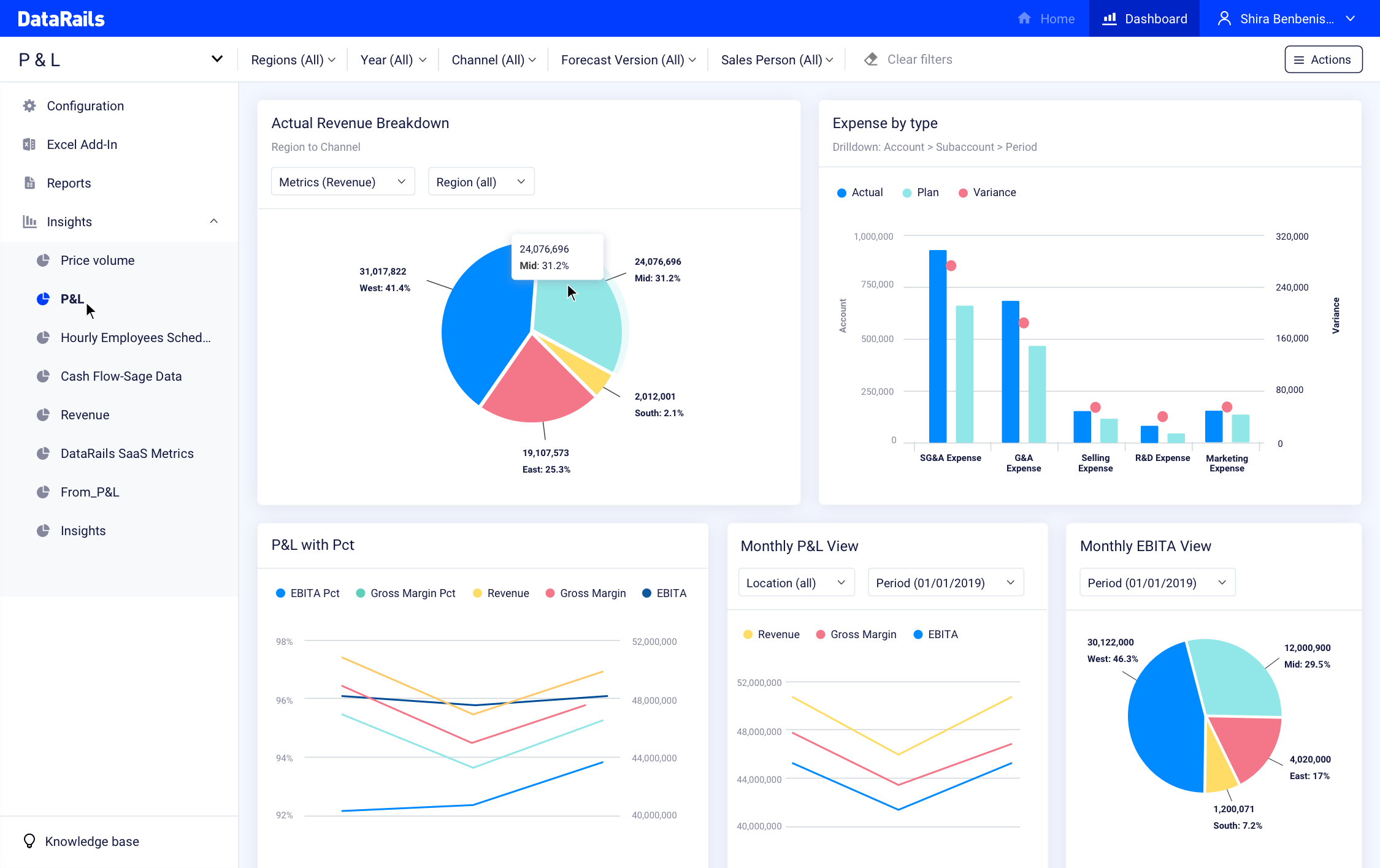
Image: DataRails
“We started the company with a vision to save the world from Excel spreadsheets,” he said, by taking them and helping to connect the data contained within them to a structured database. “The core of our technology knows how to take unstructured data and map that to a central database.” Before 2020, DataRails (which was founded in 2015) applied this to a variety of areas with a focus on banks, insurance companies, compliance and data integrity.
Over time, it could see a very specific application emerging, specifically for SMEs: providing a platform for FP&A (financial planning and analytics), which didn’t really have a solution to address it at the time. “So we enabled that to beat the market.”
“They’re already investing so much time and money in their software, but they still don’t have analytics and insight,” said Gurfinkel.
That turned out to be fortunate timing, since “digital transformation” and getting more out of one’s data was really starting to get traction in the world of business, specifically in the world of SMEs, and CFOs and other people who oversaw finances were already looking for something like this.
The typical DataRails customer might be as small as a business of 50 people, or as big as 1,000 employees, a size of business that is too small for enterprise solutions, “which can cost tens of thousands of dollars to implement and use,” added Cohen, among other challenges. But as with so many of the apps that are being built today to address those using Excel, the idea with DataRails is low-code or even more specifically no-code, which means “no IT in the loop,” he said.
“That’s why we are so successful,” he said. “We are crossing the barrier and making our solution easy to use.”
The company doesn’t have a huge number of competitors today, either, although companies like Cube (which also recently raised some money) are among them. And others like Stripe, while currently not focusing on FP&A, have most definitely been expanding the tools that it is providing to businesses as part of their bigger play to manage payments and subsequently other processes related to financial activity, so perhaps it, or others like it, might at some point become competitors in this space as well.
In the meantime, Gurfinkel said that other areas that DataRails is likely to expand to cover alongside FP&A include HR, inventory and “planning for anything,” any process that you have running in Excel. Another interesting turn would be how and if DataRails decides to look beyond Excel at other spreadsheets, or bypass spreadsheets altogether.
The scope of the opportunity — in the U.S. alone there are more than 30 million small businesses — is what’s attracting the investment here.
“We’re thrilled to reinvest in DataRails and continue working with the team to help them navigate their recent explosive and rapid growth,” said Yanai Oron, general partner at Vertex Ventures, in a statement. “With innovative yet accessible technology and a tremendous untapped market opportunity, DataRails is primed to scale and become the leading FP&A solution for SMEs everywhere.”
“Businesses are constantly about to start, in the midst of, or have just finished a round of financial reporting — it’s a never-ending cycle,” added Oren Zeev, founding partner at Zeev Ventures. “But with DataRails, FP&A can be simple, streamlined, and effective, and that’s a vision we’ll back again and again.”
Powered by WPeMatico

Coda entered the market with an ambitious, but simple, mission. Since launching in 2014, it has seemingly forged a path to realizing its vision with $140 million in funding and 25,000 teams across the globe using the platform.
Coda is simple in that its focus is on the document, one of the oldest content formats/tools on the internet, and indeed in the history of software. Its ambition lies in the fact that there are massive incumbents in this space, like Google and Microsoft.
Co-founder and CEO Shishir Mehrotra told TechCrunch that that level of competition wasn’t a hindrance, mainly because the company was very good at communicating its value and building highly effective flywheels for growth.
Mehrotra was generous enough to let us take a look through his pitch doc (not deck!) on a recent episode of Extra Crunch Live, diving not only into the factors that have made Coda successful, but how he communicated those factors to investors.
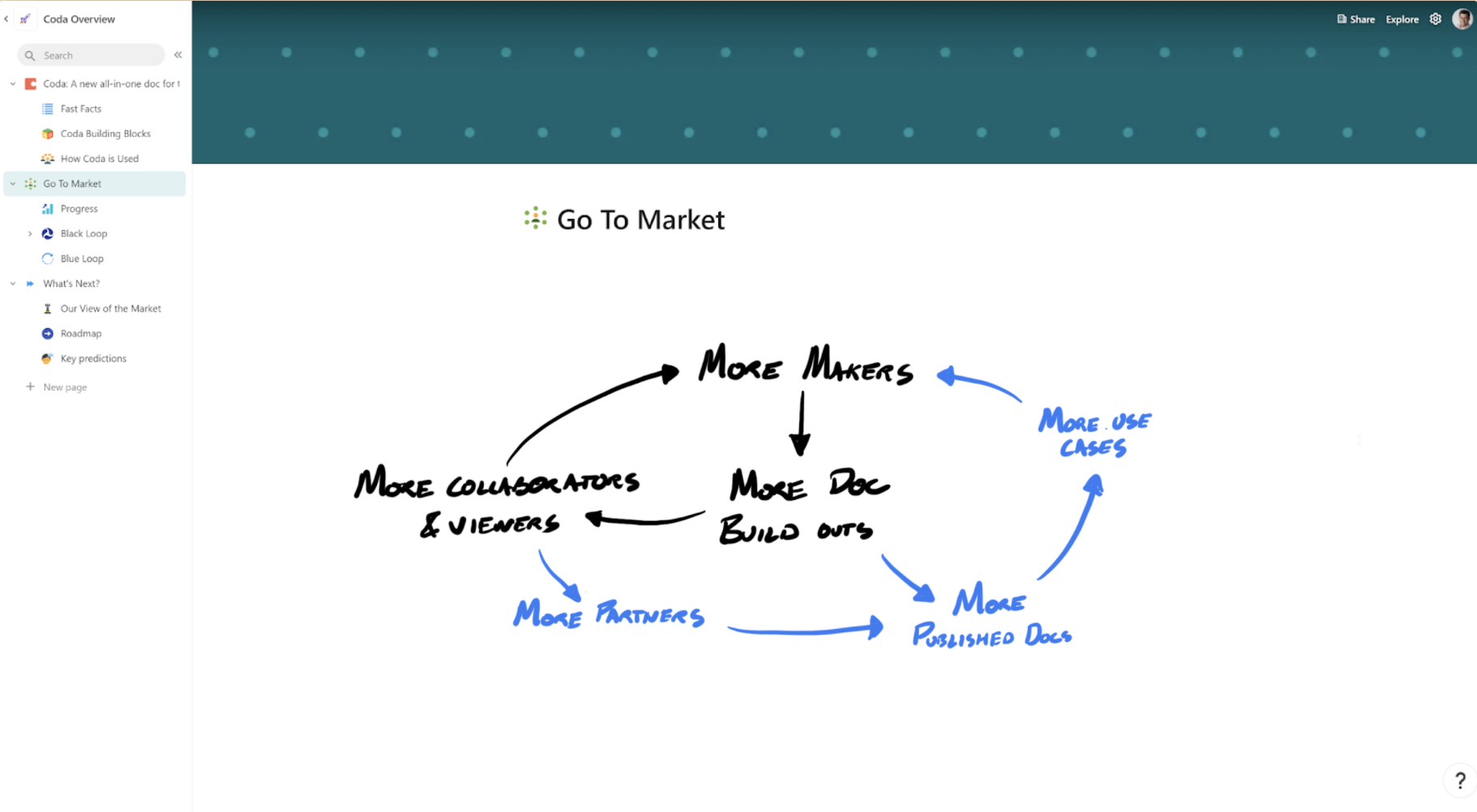
A screenshot from Coda’s pitch doc.
Extra Crunch Live also features the ECL Pitch-off, where founders in the audience come “onstage” to pitch their products to our guests. Mehrotra and his investor, Madrona partner S. Somasegar, gave their live feedback on pitches from the audience, which you can check out in the video (full conversation and pitch-off) below.
As a reminder, Extra Crunch Live takes place every Wednesday at 3 p.m. EDT/noon PDT. Anyone can hang out during the episode (which includes networking with other attendees), but access to past episodes is reserved exclusively for Extra Crunch members. Join here.
Like many investors and founders, Mehrotra and Somasegar met well before Mehrotra was working on his own project. They met when both of them worked at Microsoft and maintained a relationship while Mehrotra was at Google.
In their earliest time together, the conversations centered around advice on the Seattle tech ecosystem or on working with a particular team at Microsoft.
“Many people will tell you building relationships with investors … you want to do it outside of a fundraise as much as possible,” said Mehrotra.
Eventually, Mehrotra got to work on Coda and kept in touch with Somasegar. He even pitched him for Series B fundraising — and ultimately got a no. But the relationship persisted.
Powered by WPeMatico