Enterprise
Auto Added by WPeMatico
Auto Added by WPeMatico
APIs are the grease turning the gears and wheels for many organizations’ IT systems today, but as APIs grow in number and use, tracking how they work (or don’t work) together can become complex and potentially critical if something goes awry. Now, a startup that has built an innovative way to help with this is announcing some funding after getting traction with big enterprises adopting its approach.
Tyk, which has built a way for users to access and manage multiple internal enterprise APIs through a universal interface by way of GraphQL, has picked up $35 million, an investment that it will be using both for hiring and to continue enhancing and expanding the tools that it provides to users. Tyk has coined a term describing its approach to managing APIs and the data they produce — “universal data graph” — and today its tools are being used to manage APIs by some 10,000 businesses, including large enterprises like Starbucks, Societe Generale and Domino’s.
Scottish Equity Partners led the round, with participation also from MMC Ventures — its sole previous investor from a round in 2019 after boostrapping for its first five years. The startup is based out of London but works in a very distributed way — one of the co-founders is living in New Zealand currently — and it will be hiring and growing based on that principle, too. It has raised just over $40 million to date.
Tyk (pronounced like “tyke”, meaning small/lively child) got its start as an open source side project first for co-founder Martin Buhr, who is now the company’s CEO, while he was working elsewhere, as a “load testing thing,” in his words.
The shifts in IT toward service-oriented architectures, and building and using APIs to connect internal apps, led him to rethink the code and consider how it could be used to control APIs. Added to that was the fact that as far as Buhr could see, the API management platforms that were in the market at the time — some of the big names today include Kong, Apigee (now a part of Google), 3scale (now a part of RedHat and thus IBM), MuleSoft (now a part of Salesforce) — were not as flexible as his needs were. “So I built my own,” he said.
It was built as an open source tool, and some engineers at other companies started to use it. As it got more attention, some of the bigger companies interested in using it started to ask why he wasn’t charging for anything — a sure sign as any that there was probably a business to be built here, and more credibility to come if he charged for it.
“So we made the gateway open source, and the management part went into a licensing model,” he said. And Tyk was born as a startup co-founded with James Hirst, who is now the COO, who worked with Buhr at a digital agency some years before.
The key motivation behind building Tyk has stayed as its unique selling point for customers working in increasingly complex environments.
“What sparked interest in Tyk was that companies were unhappy with API management as it exists today,” Buhr noted, citing architectures using multiple clouds and multiple containers, creating more complexity that needed better management. “It was just the right time when containerization, Kubernetes and microservices were on the rise… The way we approach the multi-data and multi-vendor cloud model is super flexible and resilient to partitions, in a way that others have not been able to do.”
“You engage developers and deliver real value and it’s up to them to make the choice,” added Hirst. “We are responding to a clear shift in the market.”
One of the next frontiers that Tyk will tackle will be what happens within the management layer, specifically when there are potential conflicts with APIs.
“When a team using a microservice makes a breaking change, we want to bring that up and report that to the system,” Buhr said. “The plan is to flag the issue and test against it, and be able to say that a schema won’t work, and to identify why.”
Even before that is rolled out, though, Tyk’s customer list and its growth speak to a business on the cusp of a lot more.
“Martin and James have built a world-class team and the addition of this new capital will enable Tyk to accelerate the growth of its API management platform, particularly around the GraphQL focused Universal Data Graph product that launched earlier this year,” said Martin Brennan, a director at SEP, in a statement. “We are pleased to be supporting the team to achieve their global ambitions.”
Keith Davidson, a partner at SEP, is joining the Tyk board as a non-executive director with this round.
Powered by WPeMatico
In less than a year after raising $25 million in Series B funding, technical assessment company CodeSignal announced a $50 million in Series C funding to offer new features for its platform that helps companies make data-driven hiring decisions to find and test engineering talent.
Similar to attracting a big investor lead for its B round — Menlo Ventures — it has partnered with Index Ventures to lead the C round. Menlo participated again and was joined by Headline and A Capital. This round brings CodeSignal’s total fundraising to $87.5 million.
Co-founder and CEO Tigran Sloyan got the idea for the company from an experience his co-founder and friend Aram Shatakhtsyan had while trying to find an engineering job. Both from Armenia, the two went in different paths for college, with Shatakhtsyan staying in Armenia and Sloyan coming to the U.S. to study at MIT. He then went on to work at Google.
“As companies were recruiting myself and my classmates, Aram was trying to get his resume picked up, but wasn’t getting attention because of where he went to college, even though he was the greatest programmer I had ever known,” Sloyan told TechCrunch. “Hiring talent is the No. 1 problem companies say they have, but here was the best engineer, and no one would bring him in.”
They, along with Sophia Baik, started CodeSignal in 2015 to act as a self-driving interview platform that directly measures skills regardless of a person’s background. Like people needing to take a driver’s test in order to get a license, Sloyan calls the company’s technical assessment technology a “flight simulator for developers,” that gives candidates a simulated evaluation of their skills and comes back with a score and highlighted strengths.
The need by companies to hire engineers has led to CodeSignal growing 3.5 times in revenue year over year and to gather a customer list that includes Brex, Databricks, Facebook, Instacart, Robinhood, Upwork and Zoom.
Sloyan said the company has not yet touched the money it received in its Series B, but wanted to jump at the opportunity to work with Nina Achadjian, partner at Index Ventures, whom he had known for many years since their time together at Google. To work together and for Achadjian to join the company’s board was something “I couldn’t pass up,” Sloyan said.
When Achadjian moved over to venture capital, she helped Sloyan connect to mentors and angel investors while keeping an eye on the company. Hiring engineers is “mission critical” for technology companies, but what became more obvious to her was that engineering functions have become necessary for all companies, Achadjian explained.
While performing due diligence on the space, she saw traditional engineering cultures utilizing CodeSignal, but then would also see nontraditional companies like banks and insurance companies.
“Their traction was undeniable, and many of our portfolio companies were using CodeSignal,” she added. “It is rare to see a company accelerate growth at the stage they are at.”
U.S. Department of Labor statistics estimate there is already a global talent labor shortage of 40 million workers, and that number will grow to over 85 million by 2030. Achadjian says engineering jobs are also expected to increase during that time, and with all of those roles and applicants, vetting candidates will be more important than ever, as will the ability for candidates to apply from wherever they are.
The new funding enabled the company to launch its Integrated Development Environment for candidates to interact with relevant assessment experiences like codes, files and a terminal on a machine that is familiar with them, so that they can showcase their skills, while also being able to preview their application. At the same time, employers are able to assign each candidate the same coding task based on the open position.
In addition, Sloyan intends to triple the company’s headcount over the next couple of months and expand into other use cases for skills assessment.
Powered by WPeMatico
Performance reviews eat up a lot of a manager’s time and are often the most dreaded part of work. OnLoop aims to bring some joy into the process by enabling information-gathering to happen behind the scenes and be easier for hybrid workforces.
The Singapore-based company designed a mobile-first product that consistently gathers employee feedback and goals so that the company has better insights into how both individuals and teams are doing. The feedback is also captured and converted into auto-generated reviews that lay out all of the content collected for managers to then quickly put together a finished product.
The platform was in private beta since January 2021, and after a successful run with 25 companies, OnLoop raised $5.5 million co-led by MassMutual Ventures and Square Peg Capital along with Hustle Fund and a group of angel investors including XA Network, BCG’s Aliza Knox, Uber’s Andrew Macdonald, Ready’s Allen Penn, Google’s Bambos Kaisharis, Ripple’s Brooks Entwistle, Robert Hoyt, Nordstar’s Eddie Lee, Nas Academy’s Alex Dwek and hedge fund managers John Candeto and Keshav Lall.
OnLoop co-founder and CEO Projjal Ghatak spent over three years at Uber and said he saw his fair share of productivity tools, but still struggled to develop his own team as tasks and communication were done differently by each employee.
“This is the one problem that companies consistently complain about — not having the right tool to develop teams,” he added.
As someone who began spending more and more time on his phone, Ghatak wanted his product to be mobile-native and eliminate the need for managers to start from scratch on performance reviews each time. Rather than spend days gathering the information, as the name suggests, OnLoop continuously and automatically captures the data and converts it into a well-written summary.
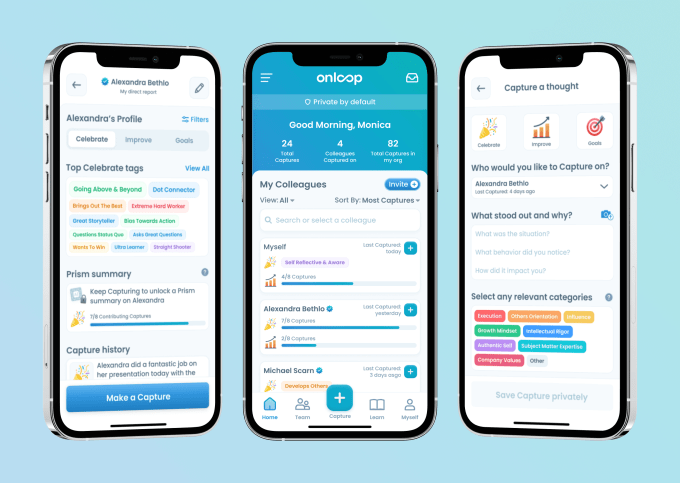
OnLoop app. Image Credits: OnLoop
Having that continuous loop of information is good for morale, he said. He points to data that shows regular self-reflection and feedback increased productivity by 20%, and a Gallup study where only 14% of employees thought their performance reviews inspired them to improve.
“A lot of company culture is set by the leaders, so as they want to drive this culture in their organizations, we are the tool that drives this,” Ghatak said. “Our job is to help educate the teams on how to do that well. We hear time and time again to make it fun and convenient. Teams don’t realize that if you are helping colleagues understand, showing them a light they didn’t have before, it will drive impact.”
The new funding will be mainly invested into product development and R&D, including expanding product, data and engineering teams. The company will also look at its sales and marketing framework. The company currently has 22 employees.
OnLoop was able to convert some of its early adopters into paying customers and is now focusing on figuring out a scalable way to get the product into the hands of more teams.
Piruze Sabuncu, partner at Square Peg Capital, experienced the pain of performance reviews when she was working in Stripe’s Southeast Asia and Hong Kong region. One of the challenges she faced working with regional teams was that an employee’s direct manager could be located elsewhere, yet work closely with a manager in their respective office.
Square Peg itself uses OnLoop, and Sabuncu said she liked that it is mobile-first and was designed in a way that people didn’t open it up and dread using it.
“Who your manager is, is a big question, but it shouldn’t matter,” she added. “It would still be my duty to be capturing and developing the person even if they were not my direct person. Everyone is talking about remote and hybrid work, and it is not going anywhere — it is here to stay. We believe this is a huge opportunity, a $400 billion market to disrupt, and OnLoop is providing better ways to communicate and give feedback.”
Editor’s note: Due to error, the round amount and lead investors were updated following the announcement.
Powered by WPeMatico
Sorcero announced Thursday a $10 million Series A round of funding to continue scaling its medical and technical language intelligence platform.
The latest funding round comes as the company, headquartered in Washington, D.C. and Cambridge, Massachusetts, sees increased demand for its advanced analytics from life sciences and technical companies. Sorcero’s natural language processing platform makes it easier for subject-matter experts to find answers to their questions to aid in better decision making.
CityRock Venture Partners, the growth fund of H/L Ventures, and Harmonix Fund co-led the round and were joined by new investors Rackhouse, Mighty Capital and Leawood VC, as well as existing investors, Castor Ventures and WorldQuant Ventures. The new investment gives Sorcero a total of $15.7 million in funding since it was founded in 2018.
Prior to starting Sorcero, Dipanwita Das, co-founder and CEO, told TechCrunch she was working in public policy, a place where scientific content is useful, but often a source of confusion and burden. She thought there had to be a more effective way to make better decisions across the healthcare value chain. That’s when she met co-founders Walter Bender and Richard Graves and started the company.
“Everything is in service of subject-matter experts being faster, better and less prone to errors,” Das said. “Advances of deep learning with accuracy add a lot of transparency. We are used by science affairs and regulatory teams whose jobs it is to collect scientific data and effectively communicate it to a variety of stakeholders.”
The total addressable market for language intelligence is big — Das estimated it to be $42 billion just for the life sciences sector. Due to the demand, the co-founders have seen the company grow at 324% year over year since 2020, she added.
Raising a Series A enables the company to serve more customers across the life sciences sector. The company will invest in talent in both engineering and on the commercial side. It will also put some funds into Sorcero’s go-to-market strategy to go after other use cases.
In the next 12 to 18 months, a big focus for the company will be scaling into product market fit in the medical affairs and regulatory space and closing new partnerships.
Oliver Libby, partner at CityRock Venture Partners, said Sorcero’s platform “provides the rails for AI solutions for companies” that have traditionally found issues with AI technologies as they try to integrate data sets that are already in existence in order to run analysis effectively on top of that.
Rather than have to build custom technology and connectors, Sorcero is “revolutionizing it, reducing time and increasing accuracy,” and if AI is to have a future, it needs a universal translator that plugs into everything, he said.
“One of the hallmarks in the response to COVID was how quickly the scientific community had to do revolutionary things,” Libby added. “The time to vaccine was almost a miracle of modern science. One of the first things they did was track medical resources and turn them into a hook for pharmaceutical companies. There couldn’t have been a better use case for Sorcero than COVID.”
Powered by WPeMatico
When Salesforce announce0d it was buying German RPA vendor Servicetrace last month, it seemed that it might match up well with MuleSoft, the company the CRM giant bought in 2018 for $6.5 billion. MuleSoft, among other things, helps customers build APIs to legacy systems, while Servicetrace provides a way to add automation to legacy systems. Sure enough, the company announced today that it’s planning a new MuleSoft-Servicetrace tool called MuleSoft RPA.
The Servicetrace deal closed on September 2nd and the company isn’t wasting any time putting it to work wherever it makes sense across the organization — and the MuleSoft integration is a primary use case. John Kucera, SVP of product management at Salesforce where he leads product automation, says that MuleSoft has API management and integration tooling already, but RPA will add another dimension to those existing capabilities.
“We found that many of our customers also need to automate and integrate with disconnected systems, with PDFs, with spreadsheets, but also these legacy systems that don’t have events or API’s. And so we wanted to make sure that we can meet our customers where they are, and that we could have this end-to-end, solution to automate these capabilities,” Kucera told me.
The company will be packaging ServiceTrace as a part of MuleSoft, while blending it with other parts of the Salesforce family of integration tools, as well as other parts of the platform. The MuleSoft RPA tool will live under the Einstein Automate umbrella, but MuleSoft will also sell it as a standalone service, so customers can take advantage of it, even if they aren’t using other parts of the MuleSoft platform or even the broader Salesforce platform. Einstein is the name of Salesforce’s artificial intelligence capabilities. Although RPA isn’t really AI, it can become integrated into an AI-fueled workflow like this.
The MuleSoft acquisition always seemed to be about giving Salesforce, a fully cloud company at its core, a way to access on-prem, legacy enterprise systems, allowing customers to reach data wherever it lives. Adding RPA to the mix takes that a step further, enabling companies to build connections to these systems inside their more modern Einstein Automate workflow tooling to systems that previously wouldn’t have been accessible to the Einstein Automate system.
This is often the case for many large companies, which typically use a mix of newer and often very old systems. Giving them a way to link the two and bring automation across the company could prove quite useful if it truly works as described.
The company is announcing all of these capabilities at Dreamforce, its annual customer conference taking place next week. As with many announcements at the conference, this one is designed to let customers know what’s coming, rather than something that’s available now (or at least soon). MuleSoft RPA is not expected to be ready for general availability until some time in the first half of next year.
Powered by WPeMatico
LinkedIn normalized the idea of making people’s resume’s visible to anyone who wanted to look at them, and today a startup that’s hoping to do the same for companies and how they are organized and run is announcing some funding. The Org, which wants to build a global, publicly viewable database of company organizational charts — and then utilize that database as a platform to power a host of other services — has raised $20 million, money that it will be using to hire more people, add on more org charts and launch new features, with a recruitment toolkit being first on the list.
The Series B is led by Tiger Global, with previous backers Sequoia, Founders Fund and Balderton Capital also participating alongside new investors Thursday Ventures, Lars Fjeldsoe-Nielsen (a former Balderton partner), Neeraj Arora (formative early WhatsApp exec), investor Gavin Baker, and more. From what we understand, the investment values The Org at $100 million.
Founders Fund led the company’s last round, a Series A in February 2020, and the whole world of work has really changed a lot in the interim because of COVID-19: companies have become more distributed (a result of offices shutting down); the make-up of businesses has changed because of new demands; and many of us have had our sense of connection to our jobs tested in ways that we never thought it would.
All of that has had a massive impact on The Org, and has played into its theory of why org charts are useful, and most useful as a tool for transparency.
“In many ways the pandemic has forced us to reevaluate the norms of how work happens. One of the misconceptions was the idea that you are only working when you are at the office, 9-5. But the future of work is a hybrid set up but you get a lot of issues that arise out of that, communication being one of them. Now it’s much more important to create alignment, a sense of connection, and really feeling a sense of belonging in your company,” Christian Wylonis, the CEO who co-founded the company with Andreas Jarbøl, said in an interview (the two are pictured below). “We think that a lot of these issues are rooted around transparency and that is what The Org is about. Who is doing what, and why?”

Image Credits: The Org
He said that when the coronavirus suddenly ramped up into a global issue — and it really was sudden; our conversation in February 2020 had nothing whatsoever to do with it, yet it was only weeks later that everything shut down — it wasn’t obvious that The Org would have a place in the so-called “new normal.”
“We were as nervous as anyone else, but the idea of what work would look like and how we enable people around that has gotten a lot higher on the agenda,” he said. “The appetite for new tools has improved dramatically, and we can see that in our traffic.”
The Org has indeed seen some very impressive growth. The company now hosts some 130,000 public org charts, sees 30,000 daily visitors and has more than 120,000 registered users. And more casual usage has boomed, too. Wylonis notes that The Org now has close to 1 million visitors each month versus just 100,000 in February 2020, when it only had 16,000 org charts on its platform.
Monetization is coming slowly for the startup. Building, editing and officially “claiming” a profile on the platform are all still free, but in the meantime The Org is working on its platform play and using the database that it is building to power other services. Job hunting is the first area that it will tackle.
Posting jobs will be free, and it’s integrating with Greenhouse to feed information into its system, but recruiters and HR pros are given an option to manage the sourcing and screening process through The Org, a kind of executive recruitment tool, which will come at a charge. Down the line there are plans for more communications and HR tools, Wylonis said. Some of this will be built by way of integrations and APIs with other services, and some tools — such as communications features — will be built in-house, from the ground up.
When I covered the company’s last round, I’d noted that there were some obvious hurdles for The Org, as well as potentially others like Charthop or Visier building business models on providing more transparency and information around hiring and how companies are run.
Sometimes the companies in question don’t actually want to have more transparency. And any database that is based around self-reporting runs the risk of being only as good as the data that is put into it — meaning it may be incomplete, or simply wrong, or just presented to the contributors’ best advantage, not that of the company itself. (This is one of the issues with LinkedIn, too: Even with people’s resumes being public, it’s still very easy to lie about what you actually do, or have done.)
So far, the theory is that some of this will be resolved by way of who The Org is targeting and how it is growing. Today the company’s “sweet spot” is early-stage startups with about 50-200 employees, and generally org charts are created for these businesses in part by The Org itself, and then largely by way of wiki-style user-edited content (anyone with a company email can get involved).
The plan is both to continue working with those smaller startups as they scale up, but also target bigger and bigger businesses. These, however, can be trickier to snag — not least because they will stretch into the realm of public companies, but also because their charts will be more complicated to map and manage consistently. For that reason, The Org is also adding in more features around how companies can “claim” their profiles, including managing permissions for who can edit profiles.
This might mean more managed public profiles, but the idea is that it will be a start, and once more companies post more information, we will see more transparency overall, not unlike how LinkedIn evolved, Wylonis said.
The LinkedIn analogy is interesting for another reason. It seems a no-brainer that LinkedIn, which is at its heart a massive database of information about the world of professional work, and the people and companies involved in it, would have wanted to build its own version of org charts at some point. And yet it hasn’t.
Some of this might be down to how LinkedIn has fundamentally built and organised its own database and knowledge graph, but Wylonis believes it might also be a conceptual difference.
“We think that this might be the fundamental difference between us and them,” Wylonis said of LinkedIn. “They are a database of resumes. ‘I can say whatever I want.’ But for us, the atomic unit is the organization itself. That is an important distinction because it’s a one to many relationship. It can’t be only me editing my profile. And allows us to build structures.”
He added that this was one of the reasons that Keith Rabois — who was an early exec at LinkedIn — became an early investor in The Org: “LinkedIn has been looking at this forever, but they haven’t been able to build it, and so that is how we caught his attention.”
Powered by WPeMatico
French startup Skello has raised a $47.3 million funding round (€40 million). The company has been working on a software-as-a-service tool that lets you manage the work schedule of your company. What makes it special is that Skello automatically takes into account local labor laws and collective agreements.
Partech is leading today’s funding round. Existing investors XAnge and Aglaé Ventures are also participating. The startup had previously raised a €300,000 seed round and a €6 million Series A round in 2018.
Skello works with companies across many industries, such as retail, hospitality, pharmacies, bakeries, gyms, escape games and more. And many of them were simply using Microsoft Excel to manage their schedule.
By using Skello, you get an online service that works for both managers and employees. On the manager side, you can view who is working and when. You can assign employees to fill some gaps.
For employees, they can also connect to the platform to see their own schedule. Employees can also say when they are unavailable and request time off. And when something unexpected comes up, employees can trade shifts.
“We really want to put employees at the center of the product,” co-founder and CEO Quitterie Mathelin-Moreaux told me. “They have a mobile app and the idea is to make the work schedule as collaborative as possible in order to allocate resources as efficiently as possible and increase team retention.”
At every step of the scheduling process, Skello manages legal requirements. For instance, Skello remembers mandatory weekly rest periods. The platform knows that your employees can’t work across a long time range. And Skello can count overtime hours, holiday hours, Sunday shifts, etc.
When you’re approaching the end of the month, Skello can generate a report with everyone’s timesheet. You can integrate Skello directly with your payroll tool to make this process a bit less tedious as well.
Skello is currently used across 7,000 points of sale. Now, the company wants to expand to more European countries and increase the size of the team from 150 employees to 300 employees by 2022.
Powered by WPeMatico

Customer communication platform Front is holding an event today to introduce three new features. These new features focus on showing you more information about your customers right from Front’s user interface.
If you’re not familiar with Front, the company started as a shared email inbox product so that you can interact with incoming emails as a team. For instance, if your company uses email lists, such as support@companyname.com, sales@companyname.com or jobs@companyname.com, multiple team members can see incoming emails in Front.
Before replying, you can triage conversations by assigning them to specific team members, discuss the current conversation in the comment section or show your email draft before sending it.
Over time, Front has evolved to integrate more communication channels. You can now use Front for SMS conversations, live chat on your website with your customers, Facebook messages, etc. The company has also refined its product with more powerful features.
For instance, you can set up rules to automate your workflow with simple “if this then that” rules. It’s a good way to spread out work across multiple team members and make sure the right person sees the incoming message as quickly as possible.
Today, the company is showcasing features that will be particularly useful for teams that interact with bigger customers, such as sales, support and customer success teams. First, Front users will be able to learn more about the customer they’re interacting with directly from their inbox.
The refreshed context panel works better if the team is interacting with multiple people working for your client. Instead of viewing past conversations with someone in particular, you can view past conversations with everyone working for this client.
Front already integrates with your CRM, such as Salesforce or HubSpot. You can now more easily pull data into the context panel. You can see the name of the account owner, the customer segment and the SLA (service-level agreement) commitment with this customer.
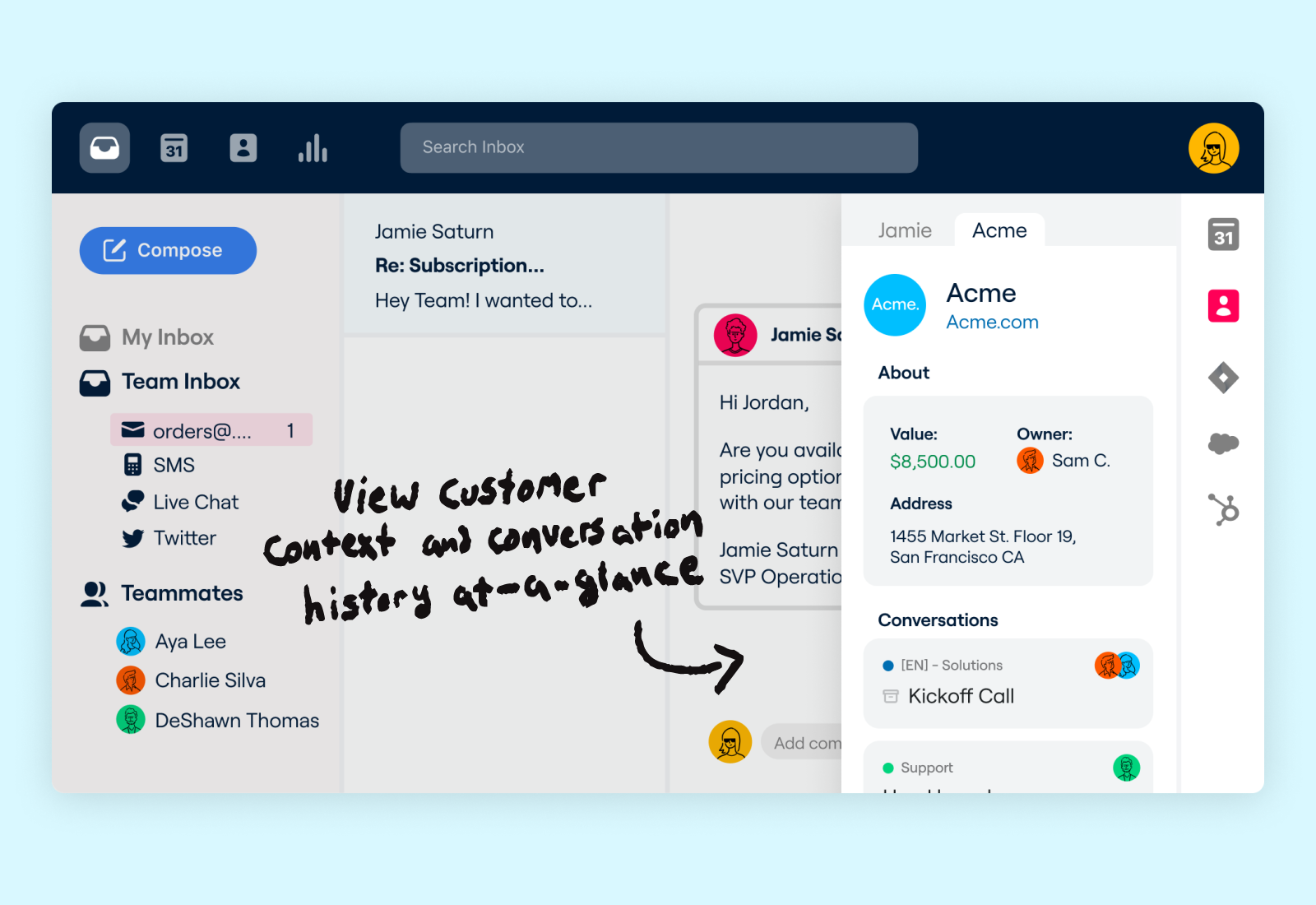
Image Credits: Front
Second, Front is adding new capabilities for its automated routing feature with deeper integrations with your CRM. For instance, you can find the name of the account owner in your CRM and assign incoming emails to the account owner directly.
If the account owner changes in Salesforce, rules will be automatically updated in Front. You can also fetch annual revenue data from your CRM and set a VIP tag if you’re receiving a message from an important customer.
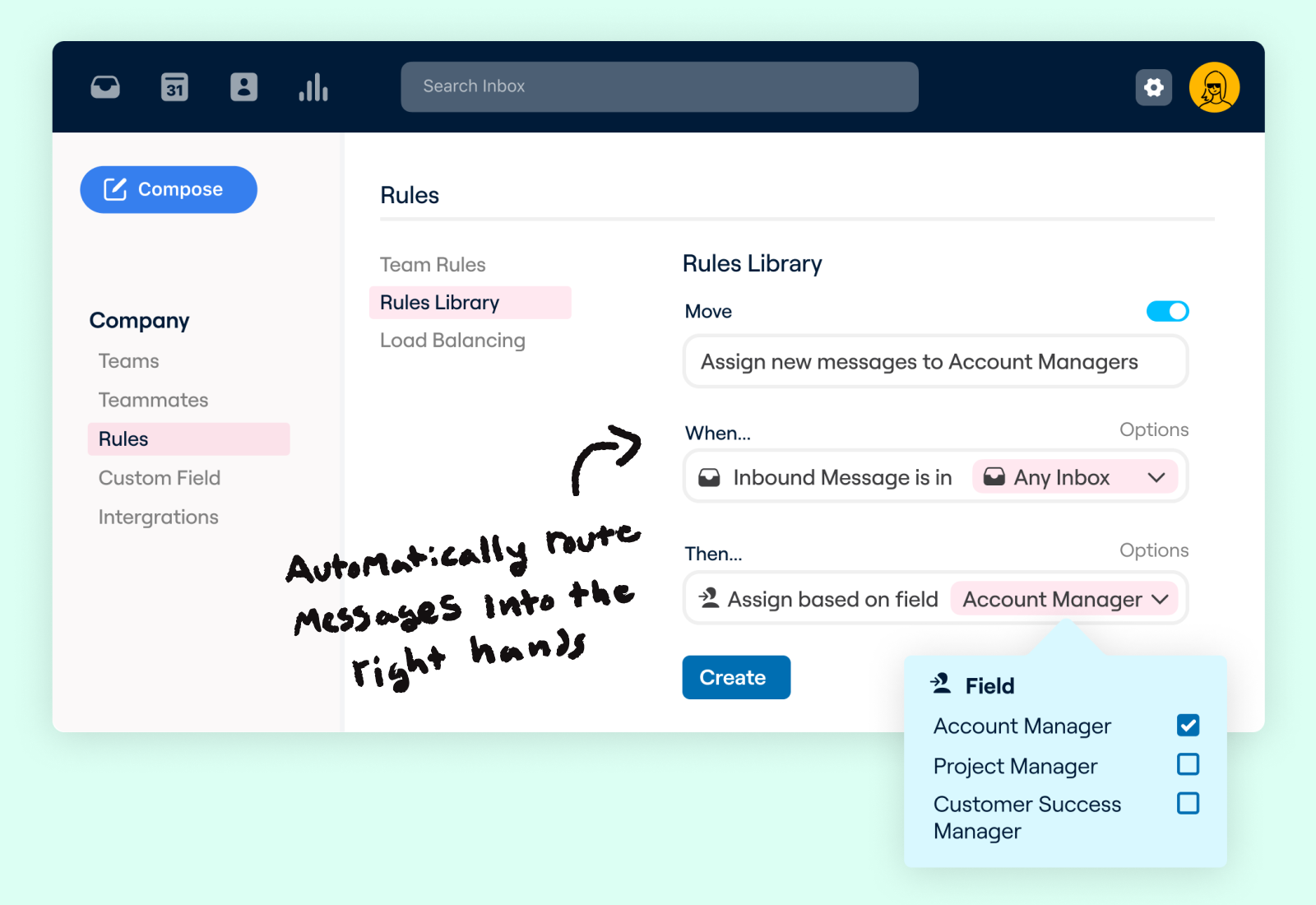
Image Credits: Front
Finally, Front will soon upgrade the analytics pages. For instance, you can track the team’s performance for a specific account and compare that to the SLA.
These updates position Front as a tool that works better for bigger enterprise clients with expensive B2B contracts. Current Front customers include Shopify, Dropbox, Flexport, Checkout.com, Lydia and Airbnb.
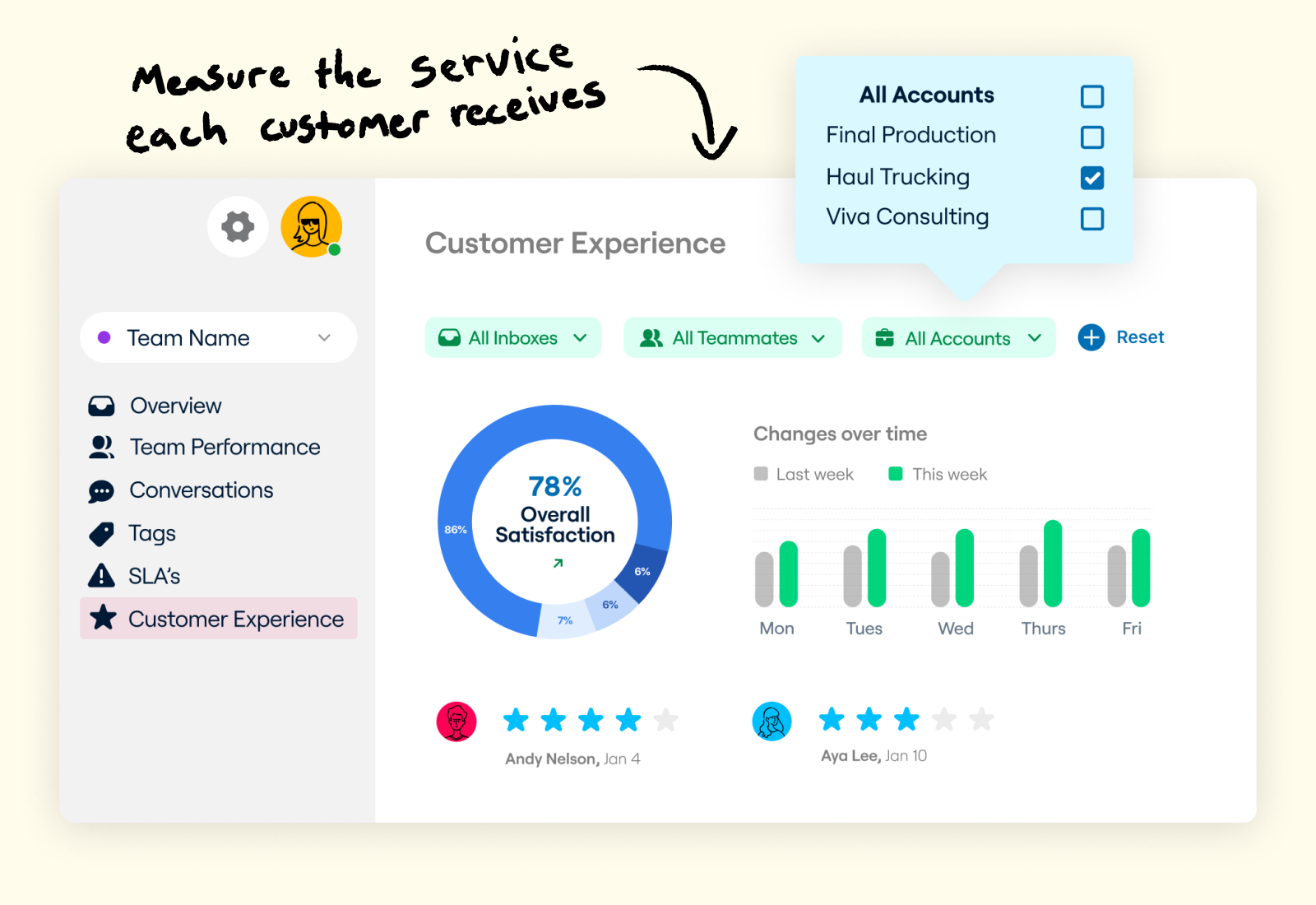
Image Credits: Front
Powered by WPeMatico
Relyance AI, an early-stage startup that is helping companies stay in compliance with privacy laws at the code level, announced a $25 million Series A today. At the same time, they revealed a previously unannounced $5 million seed round.
Menlo Ventures and Unusual Ventures led the A round, while Unusual was sole lead on the seed. Serial entrepreneur Jyoti Bansal from Unusual will join the board under the terms of the deal. His partner John Vrionis had previously joined after the seed round. Matt Murphy from Menlo is coming on as a board observer. The company has now raised $30 million.
Relyance takes an unusual approach to verifying that data stays in compliance working at the code level, while ingesting contracts and existing legal requirements as code to ensure that a company is in compliance. Company co-CEO and co-founder Abhi Sharma says that code-level check is key to the solution. “For the first time, we are building the legal compliance and regulation into the source code,” Sharma told me.
He added, “Relyance is actually embedded within the DevOps pipeline of our customers’ infrastructure. So every time a new ETL pipeline is built or a machine learning model is receiving new source code, we do a compiler-like analysis of how personal sensitive data is flowing between internal microservices, data lakes and data warehouses, and then get a metadata analysis back to the privacy and compliance professionals [inside an organization].”
Leila R. Golchehreh, the other founder and co-CEO, brings a strong compliance background to the equation and has experienced the challenge of keeping companies in compliance firsthand. She said that Relyance also enables companies to define policy and contracts as code.
“Our approach is specifically to ingest contracts. We’ve actually created an algorithm around how [you] actually write a good data protection agreement. We’ve extracted those relevant provisions and we will compare that against [your] operational reality. So if there’s a disconnect, we will be able to raise that as an intelligent insight of a data misalignment,” she said.
With 32 employees, the co-founders hope to double or perhaps even triple that number in the next 12-18 months. Golchehreh and Sharma are a diverse co-founder team and they are attempting to build a company that reflects that. They believe being remote-first gives them a leg up in this regard, but they also have internal policies to drive it.
“The recruiters we work with have a mandate internally to say, ‘Hey, we really want to hire good people and diverse people.’ Relyance as a company is the genesis of two individuals from two completely different ends of the spectrum coming together. And I think hopefully, we can do our job of relaying that into the company as we scale,” Sharma said.
The two founders have been friends for several years and began talking about forming a company together in 2019 over a pizza dinner. The idea began to gel and they launched the company in February 2020. They spent some time talking to compliance pros to understand their requirements better, then in July 2020 began building the solution they have today. They released a beta in February and began quietly selling it in March.
Today they have a number of early customers working with their software, including Dialpad, Patreon, Samsara and True.
Powered by WPeMatico
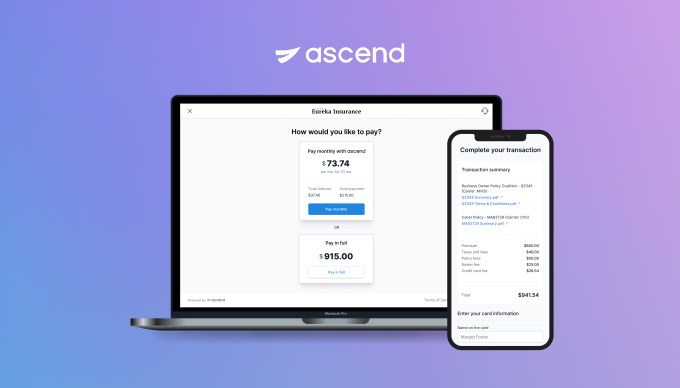
Ascend on Wednesday announced a $5.5 million seed round to further its insurance payments platform that combines financing, collections and payables.
First Round Capital led the round and was joined by Susa Ventures, FirstMark Capital, Box Group and a group of angel investors, including Coalition CEO Joshua Motta, Newfront Insurance executives Spike Lipkin and Gordon Wintrob, Vouch Insurance CEO Sam Hodges, Layr Insurance CEO Phillip Naples, Anzen Insurance CEO Max Bruner, Counterpart Insurance CEO Tanner Hackett, former Bunker Insurance CEO Chad Nitschke, SageSure executive Paul VanderMarck, Instacart co-founders Max Mullen and Brandon Leonardo and Houseparty co-founder Ben Rubin.
This is the first funding for the company that is live in 20 states. It developed payments APIs to automate end-to-end insurance payments and to offer a buy now, pay later financing option for distribution of commissions and carrier payables, something co-founder and co-CEO Andrew Wynn, said was rather unique to commercial insurance.
Wynn started the company in January 2021 with his co-founder Praveen Chekuri after working together at Instacart. They originally started Sheltr, which connected customers with trained maintenance professionals and was acquired by Hippo in 2019. While working with insurance companies they recognized how fast the insurance industry was modernizing, yet insurance sellers still struggled with customer experiences due to outdated payments processes. They started Ascend to solve that payments pain point.
The insurance industry is largely still operating on pen-and-paper — some 600 million paper checks are processed each year, Wynn said. He referred to insurance as a “spaghetti web of money movement” where payments can take up to 100 days to get to the insurance carrier from the customer as it makes its way through intermediaries. In addition, one of the only ways insurance companies can make a profit is by taking those hundreds of millions of dollars in payments and investing it.
Home and auto insurance can be broken up into payments, but the commercial side is not as customer friendly, Wynn said. Insurance is often paid in one lump sum annually, though, paying tens of thousands of dollars in one payment is not something every business customer can manage. Ascend is offering point-of-sale financing to enable insurance brokers to break up those commercial payments into monthly installments.
“Insurance carriers continue to focus on annual payments because they don’t have a choice,” he added. “They want all of their money up front so they can invest it. Our platform not only reduces the friction with payments by enabling customers to pay how they want to pay, but also helps carriers sell more insurance.”
Ascend app
Startups like Ascend aiming to disrupt the insurance industry are also attracting venture capital, with recent examples including Vouch and Marshmallow, which raised close to $100 million, while Insurify raised $100 million.
Wynn sees other companies doing verticalized payment software for other industries, like healthcare insurance, which he says is a “good sign for where the market is going.” This is where Wynn believes Ascend is competing, though some incumbents are offering premium financing, but not in the digital way Ascend is.
He intends to deploy the new funds into product development, go-to-market initiatives and new hires for its locations in New York and Palo Alto. He said the raise attracted a group of angel investors in the industry, who were looking for a product like this to help them sell more insurance versus building it from scratch.
Having only been around eight months, it is a bit early for Ascend to have some growth to discuss, but Wynn said the company signed its first customer in July and six more in the past month. The customers are big digital insurance brokerages and represent, together, $2.5 billion in premiums. He also expects to get licensed to operate as a full payment in processors in all states so the company can be in all 50 states by the end of the year.
The ultimate goal of the company is not to replace brokers, but to offer them the technology to be more efficient with their operations, Wynn said.
“Brokers are here to stay,” he added. “What will happen is that brokers who are tech-enabled will be able to serve customers nationally and run their business, collect payments, finance premiums and reduce backend operation friction.”
Bill Trenchard, partner at First Round Capital, met Wynn while he was still with Sheltr. He believes insurtech and fintech are following a similar story arc where disruptive companies are going to market with lower friction and better products and, being digital-first, are able to meet customers where they are.
By moving digital payments over to insurance, Ascend and others will lead the market, which is so big that there will be many opportunities for companies to be successful. The global commercial insurance market was valued at $692.33 billion in 2020, and expected to top $1 trillion by 2028.
Like other firms, First Round looks for team, product and market when it evaluates a potential investment and Trenchard said Ascend checked off those boxes. Not only did he like how quickly the team was moving to create momentum around themselves in terms of securing early pilots with customers, but also getting well known digital-first companies on board.
“The magic is in how to automate the underwriting, how to create a data moat and be a first mover — if you can do all three, that is great,” Trenchard said. “Instant approvals and using data to do a better job than others is a key advantage and is going to change how insurance is bought and sold.”
Powered by WPeMatico