Enterprise
Auto Added by WPeMatico
Auto Added by WPeMatico

Extra Crunch offers members the opportunity to tune into conference calls led and moderated by the TechCrunch writers you read every day. This week, TechCrunch’s Josh Constine and Frederic Lardinois discuss major announcements that came out of Facebook’s F8 conference and dig into how Facebook is trying to redefine itself for the future.
Though touted as a developer-focused conference, Facebook spent much of F8 discussing privacy upgrades, how the company is improving its social impact, and a series of new initiatives on the consumer and enterprise side. Josh and Frederic discuss which announcements seem to make the most strategic sense, and which may create attractive (or unattractive) opportunities for new startups and investment.
“This F8 was aspirational for Facebook. Instead of being about what Facebook is, and accelerating the growth of it, this F8 was about Facebook, and what Facebook wants to be in the future.
That’s not the newsfeed, that’s not pages, that’s not profiles. That’s marketplace, that’s Watch, that’s Groups. With that change, Facebook is finally going to start to decouple itself from the products that have dragged down its brand over the last few years through a series of nonstop scandals.”

(Photo by Justin Sullivan/Getty Images)
Josh and Frederic dive deeper into Facebook’s plans around its redesign, Messenger, Dating, Marketplace, WhatsApp, VR, smart home hardware and more. The two also dig into the biggest news, or lack thereof, on the developer side, including Facebook’s Ax and BoTorch initiatives.
For access to the full transcription and the call audio, and for the opportunity to participate in future conference calls, become a member of Extra Crunch. Learn more and try it for free.
Powered by WPeMatico

Couchbase, the company behind the eponymous NoSQL database, announced a major update to its mobile database today that brings some machine learning smarts, as well as improved synchronization features and enhanced stats and logging support, to the software.
“We’ve led the innovation and data management at the edge since the release of our mobile database five years ago,” Couchbase’s VP of Engineering Wayne Carter told me. “And we’re excited that others are doing that now. We feel that it’s very, very important for businesses to be able to utilize these emerging technologies that do sit on the edge to drive their businesses forward, and both making their employees more effective and their customer experience better.”
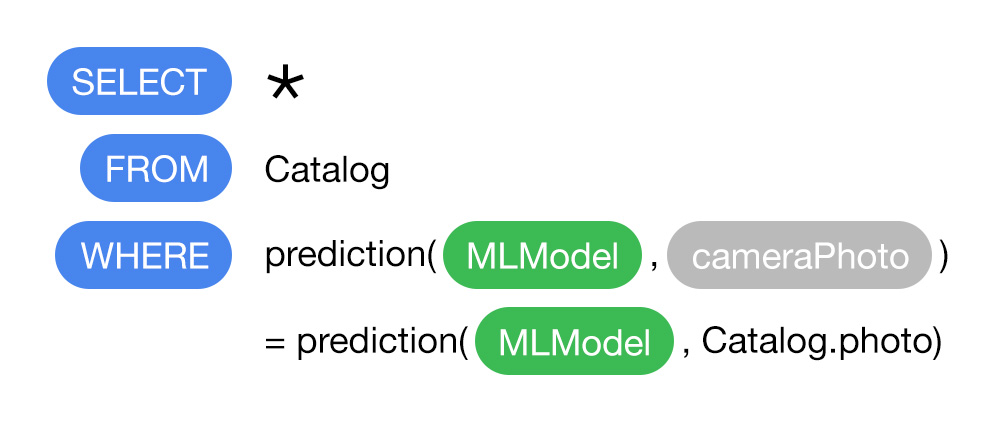
 The latter part is what drove a lot of today’s updates, Carter noted. He also believes that the database is the right place to do some machine learning. So with this release, the company is adding predictive queries to its mobile database. This new API allows mobile apps to take pre-trained machine learning models and run predictive queries against the data that is stored locally. This would allow a retailer to create a tool that can use a phone’s camera to figure out what part a customer is looking for.
To support these predictive queries, Couchbase mobile is also getting support for predictive indexes. “Predictive indexes allow you to create an index on prediction, enabling correlation of real-time predictions with application data in milliseconds,” Carter said. In many ways, that’s also the unique value proposition for bringing machine learning into the database. “What you really need to do is you need to utilize the unique values of a database to be able to deliver the answer to those real-time questions within milliseconds,” explained Carter.
The other major new feature in this release is delta synchronization, which allows businesses to push far smaller updates to the databases on their employees’ mobile devices. That’s because they only have to receive the information that changed instead of a full updated database. Carter says this was a highly requested feature, but until now, the company always had to prioritize work on other components of Couchbase.
This is an especially useful feature for the company’s retail customers, a vertical where it has been quite successful. These users need to keep their catalogs up to data and quite a few of them supply their employees with mobile devices to help shoppers. Rumor has it that Apple, too, is a Couchbase user.
The update also includes a few new features that will be more of interest to operators, including advanced stats reporting and enhanced logging support.
Powered by WPeMatico
The last few years have seen a rapid expansion of national regulations that, in the name of data protection, govern how and where organizations like healthcare and insurance companies, financial services companies and others store residents’ personal data that is used and collected through their services.
But keeping abreast of and following those rules has proven to be a minefield for companies. Now, a startup is coming out of stealth with a new product to to help.
InCountry, which provides “data residency-as-a-service” to businesses and other organizations, is launching with $7 million in funding and its first product: Profile, which focuses on user profile and registration information in 50 countries on six continents. There will be more products launched covering payment, transaction and health data later in the year, co-founder and CEO Peter Yared said in an interview.
The funding — a seed round — is coming from Caffeinated Capital , Felicis Ventures, Ridge Ventures, Bloomberg Beta, CRV, Global Founders Capital.
InCountry is founded and led by Yared, a repeat entrepreneur who most recently co-founded and eventually sold the “micro-app” startup Sapho, which was acquired by Citrix. Other companies he’s sold startups to include VMWare, Sun, and Oracle, and he was also once the CIO of CBS Interactive.
Yared told me in an interview that he has actually been self-funding, running and quietly accruing customers for InCountry for two years. He decided to raise this seed round — a number of investors in this list are repeat backers of his ventures — to start revving up the engines. (One of those ‘revs’ is an interesting talent hire. Today the company is also announcing Alex Castro as chief product officer. Castro was an early employee working on Amazon Web Services and Mircosoft’s move into CRM, and also worked on autonomous at Uber.)
If you have never heard of the term “data residency-as-a-service”, that might be because it’s something that has been coined by Yared himself to describe the function of his startup.
InCountry is part tech provider, part consultancy.
On the tech side, it provides the technical aspects of providing personal data storage in a specific national border for companies that might otherwise run other aspects of their services from other locations. That includes SDKs that link to a variety of data centers and cloud service providers that allow new countries to be added in under 10 minutes; two types of encryption on the data to make sure that it remains secure; and managed services for its biggest clients. (InCountry is not disclosing any client names right now, except for video-editing company Revl.)
On the consultancy side, it has an in-house team of researchers and partnerships with law firms to continually update its policies and ensure that customers remain compliant with any changes. InCountry says that to provide further assurance to customers, it provides insurance of up to three times the value of a customer’s spend.
InCountry’s aim is twofold: first, to solve the many pain points that a company or other organization has to go through when considering how to comply with data hosting regulations; and second, to make sure that by making it easy, companies actually do what’s required of them.
As Yared describes it, the process for becoming data compliant can be painful, but his startup is applying an economy of scale, since the process is essentially one that everyone will have to follow:
“They have to figure out what the requirements are, find the facility, audit the facility, which includes making sure it’s not owned by the state, make sure the network is properly segregated, develop the right software layer to manage the data, hire program managers, network operations people and more,” he said. And for those handling this themselves, cloud service providers will typically cover a smaller footprint of regions, 17 at most for the biggest. “We take care of all that, and add on more as we need to.”
The problem is that because the process is so painful, many companies often flout the requirements, which isn’t good for its customers, nor for the companies themselves, which run the risk of getting fined.
“It’s universally acknowledged that the way data is stored and handled by most companies and handled is not meeting the average requirements of citizens rights,” Yared said. “That’s why we now have GDPR, and will see more GDPR-like regulations get rolled out.”
One thing that InCountry is not touching is data such as messages between users and other kinds of personal files — data that has been the subject of sometimes very controversial data regulations. Its limit are the pieces of personal information about users — bank details, health information, social security numbers, and so on — that are part and parcel of what we provide to companies in the course of interacting with them online.
“In early outreach, we have had people as for private data storage, but we would be ethically uncomfortable with that,” Yared said. “We want to be in the business of helping people who have regulated data, by storing that in a compliant manner that is more helpful, and more fruitful to users.”
The aim will be to add more services over time covering ever more countries, to keep in line with the growing trend among regulators to put more data residency laws in place.
“We’re witnessing more countries signing in data laws each week, and we’re only going to see those numbers increase,” said Sundeep Peechu, Managing Director at Felicis Ventures, in a statement. “We’re excited to be leading the round and reinvesting in Peter as he launches his seventh company. He recognized the problem early on and started working on a solution nearly two years ago that goes beyond regional data centers and patchwork in-house DIY solutions.”
Powered by WPeMatico
Oculus is getting serious about monetizing VR for enterprise.
The company has previously sold specific business versions of the headsets, but now they’re adding a pricey annual device-management subscription.
Oculus Go for business starts at $599 (64 GB) and the enterprise Oculus Quest starts at $999 (128 GB). These fees include the first year of enterprise device management and support, which goes for $180 per year per device.
Here’s what that fee gets you:
This includes a dedicated software suite offering device setup and management tools, enterprise-grade service and support, and a new user experience customized for business use cases.
The new Oculus for Business launches in the fall.
Powered by WPeMatico
To win chat, Facebook Messenger must be as accessible as SMS, yet more entertaining than Snapchat. Today, Messenger pushes on both fronts with a series of announcements at Facebook’s F8 conference. Those include that it will launch Mac and PC desktop apps, a faster and smaller mobile app, simultaneous video co-watching and a revamped Friends tab, where friends can use an emoji to tell you what they’re up to or down for.
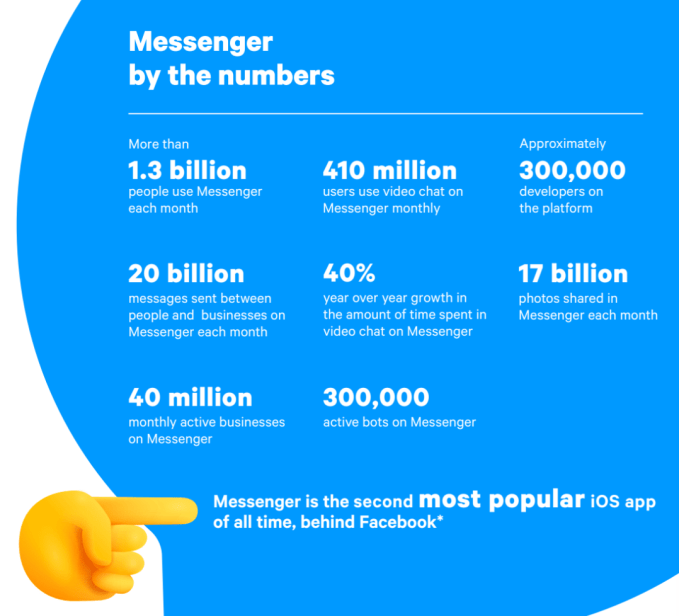
Facebook is also beefing up its tools for the 40 million active businesses and 300,000 businesses on Messenger, up from 200,000 businesses a year ago. Merchants will be able to let users book appointments at salons and masseuses, collect information with new lead generation chatbot templates and provide customer service to verified customers through authenticated m.me links. Facebook hopes this will boost the app beyond the 20 billion messages sent between people and businesses each month, which is up 10X from December 2017.
“We believe you can build practically any utility on top of messaging,” says Facebook’s head of Messenger Stan Chudnovsky. But he stresses that “All of the engineering behind it is has been redone” to make it more reliable, and to comply with CEO Mark Zuckerberg’s directive to unite the backends of Messenger, WhatsApp and Instagram Direct. “Of course, if we didn’t have to do all that, we’d be able to invest more in utilities. But we feel that utilities will be less functional if we don’t do that work. They need to go hand-in-hand together. Utilities will be more powerful, more functional and more desired if built on top of a system that’s interoperable and end-to-end encrypted.”
Here’s a look at the major Messenger announcements and why they’re important:
Messenger Desktop – A stripped-down version of Messenger focused on chat, audio and video calls will debut later this year. Chudnovsky says it will remove the need to juggle and resize browser tabs by giving you an always-accessible version of Messenger that can replace some of the unofficial knock-offs. Especially as Messenger focuses more on businesses, giving them a dedicated desktop interface could convince them to invest more in lead generation and customer service through Messenger.
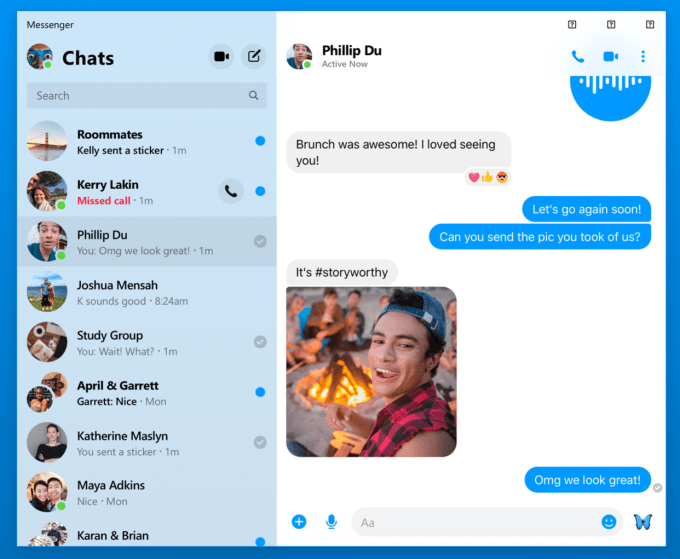
Facebook Messenger’s upcoming desktop app
Project Lightspeed – Messenger is reengineering its app to cut 70 mb off its download size so people with low-storage phones don’t have to delete as many photos to install it. In testing, the app can cold start in merely 1.3 seconds, which Chudnovsky says is just 25 percent of where Messenger and many other apps are today. While Facebook already offers Messenger Light for the developing world, making the main app faster for everyone else could help Messenger swoop in and steal users from the status quo of SMS. The Lightspeed update will roll out later this year.
Video Co-Watching – TechCrunch reported in November that Messenger was building a Facebook Watch Party-style experience that would let users pick videos to watch at the same time as a friend, with reaction cams of their faces shown below the video. Now in testing before rolling out later this year, users can pick any Facebook video, invite one or multiple friends and laugh together. Unique capabilities like this could make Messenger more entertaining between utilitarian chat threads and appeal to a younger audience Facebook is at risk of losing.

Watch Videos Together on Messenger
Business Tools – After a rough start to its chatbot program a few years ago, where bots couldn’t figure out users’ open-ended responses, Chudnovsky says the platform is now picking up steam with 300,000 developers on board. One option that’s worked especially well is lead-generation templates, which teach bots to ask people standardized questions to collect contact info or business intent, so Messenger is adding more of those templates with completion reminders and seamless hand-off to a live agent.
To let users interact with appointment-based businesses through a platform they’re already familiar with, Messenger launched a beta program for barbers, dentists and more that will soon open to let any business handle appointment booking through the app. And with new authenticated m.me links, a business can take a logged-in user on their website and pass them to Messenger while still knowing their order history and other info. Getting more businesses hooked on Messenger customer service could be very lucrative down the line.

Appointment booking on Messenger
Close Friends and Emoji Status – Perhaps the most interesting update to Messenger, though, is its upcoming effort to help you make offline plans. Messenger is in the early stages of rebuilding its Friends tab into “Close Friends,” which will host big previews of friends’ Stories, photos shared in your chats, and let people overlay an emoji on their profile pic to show friends what they’re doing. We first reported this “Your Emoji” status update feature was being built a year ago, but it quietly cropped up in the video for Messenger Close Friends. This iteration lets you add an emoji like a home, barbell, low battery or beer mug, plus a short text description, to let friends know you’re back from work, at the gym, might not respond or are interested in getting a drink. These will show up atop the Close Friends tab as well as on location-sharing maps and more once this eventually rolls out.

Messenger’s upcoming Close Friends tab with Your Emoji status
Facebook Messenger is the best poised app to solve the loneliness problem. We often end up by ourselves because we’re not sure which of our friends are free to hang out, and we’re embarrassed to look desperate by constantly reaching out. But with emoji status, Messenger users could quietly signal their intentions without seeming needy. This “what are you doing offline” feature could be a whole social network of its own, as apps like Down To Lunch have tried. But with 1.3 billion users and built-in chat, Messenger has the ubiquity and utility to turn a hope into a hangout.
Click below to check out all of TechCrunch’s Facebook conference coverage from today:

Powered by WPeMatico

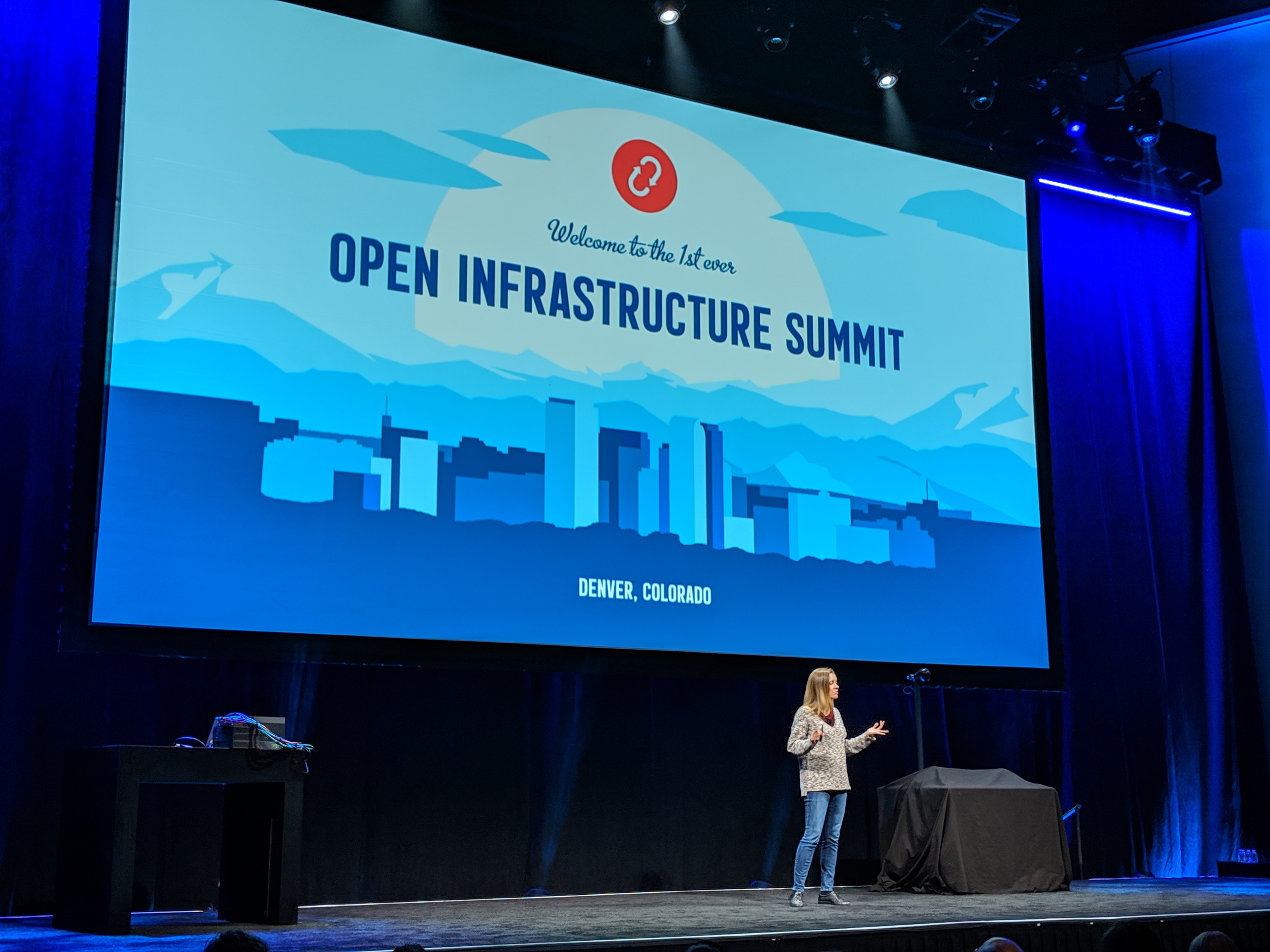
At the Open Infrastructure Summit, which was previously known as the OpenStack Summit, Canonical founder Mark Shuttleworth used his keynote to talk about the state of open-source foundations — and what often feels like the increasing competition between them. “I know for a fact that nobody asked to replace dueling vendors with dueling foundations,” he said. “Nobody asked for that.”
He then put a point on this, saying, “what’s the difference between a vendor that only promotes the ideas that are in its own interest and a foundation that does the same thing. Or worse, a foundation that will only represent projects that it’s paid to represent.”
Somewhat uncharacteristically, Shuttleworth didn’t say which foundations he was talking about, but since there are really only two foundations that fit the bill here, it’s pretty clear that he was talking about the OpenStack Foundation and the Linux Foundation — and maybe more precisely the Cloud Native Computing Foundation, the home of the incredibly popular Kubernetes project.
It turns out, that’s only part of his misgivings about the current state of open-source foundations, though. I sat down with Shuttleworth after his keynote to discuss his comments, as well as Canonical’s announcements around open infrastructure.
One thing that’s worth noting at the outset is that the OpenStack Foundation is using this event to highlight that fact that it has now brought in more new open infrastructure projects outside of the core OpenStack software, with two of them graduating from their pilot phase. Shuttleworth, who has made big bets on OpenStack in the past and is seeing a lot of interest from customers, is not a fan. Canonical, it’s worth noting, is also a major sponsor of the OpenStack Foundation. He, however, believes, the foundation should focus on the core OpenStack project.
“We’re busy deploying 27 OpenStack clouds — that’s more than double the run rate last year,” he said. “OpenStack is important. It’s very complicated and hard. And a lot of our focus has been on making it simpler and cleaner, despite the efforts of those around us in this community. But I believe in it. I think that if you need large-scale, multi-tenant virtualization infrastructure, it’s the best game in town. But it has problems. It needs focus. I’m super committed to that. And I worry about people losing their focus because something newer and shinier has shown up.”
To clarify that, I asked him if he essentially believes that the OpenStack Foundation is making a mistake by trying to be all things infrastructure. “Yes, absolutely,” he said. “At the end of the day, I think there are some projects that this community is famous for. They need focus, they need attention, right? It’s very hard to argue that they will get focus and attention when you’re launching a ton of other things that nobody’s ever heard of, right? Why are you launching those things? Who is behind those decisions? Is it a money question as well? Those are all fair questions to ask.”
He doesn’t believe all of the blame should fall on the Foundation leadership, though. “I think these guys are trying really hard. I think the common characterization that it was hapless isn’t helpful and isn’t accurate. We’re trying to figure stuff out.” Shuttleworth indeed doesn’t believe the leadership is hapless, something he stressed, but he clearly isn’t all that happy with the current path the OpenStack Foundation is on either.
The Foundation, of course, doesn’t agree. As OpenStack Foundation COO Mark Collier told me, the organization remains as committed to OpenStack as ever. “The Foundation, the board, the community, the staff — we’ve never been more committed to OpenStack,” he said. “If you look at the state of OpenStack, it’s one of the top-three most active open-source projects in the world right now […] There’s no wavering in our commitment to OpenStack.” He also noted that the other projects that are now part of the foundation are the kind of software that is helpful to OpenStack users. “These are efforts which are good for OpenStack,” he said. In addition, he stressed that the process of opening up the Foundation has been going on for more than two years, with the vast majority of the community (roughly 97 percent) voting in favor.
OpenStack board member Allison Randal echoed this. “Over the past few years, and a long series of strategic conversations, we realized that OpenStack doesn’t exist in a vacuum. OpenStack’s success depends on the success of a whole network of other open-source projects, including Linux distributions and dependencies like Python and hypervisors, but also on the success of other open infrastructure projects which our users are deploying together. The OpenStack community has learned a few things about successful open collaboration over the years, and we hope that sharing those lessons and offering a little support can help other open infrastructure projects succeed too. The rising tide of open source lifts all boats.”
As far as open-source foundations in general, he surely also doesn’t believe that it’s a good thing to have numerous foundations compete over projects. He argues that we’re still trying to figure out the role of open-source foundations and that we’re currently in a slightly awkward position because we’re still trying to determine how to best organize these foundations. “Open source in society is really interesting. And how we organize that in society is really interesting,” he said. “How we lead that, how we organize that is really interesting and there will be steps forward and steps backward. Foundations tweeting angrily at each other is not very presidential.”
He also challenged the notion that if you just put a project into a foundation, “everything gets better.” That’s too simplistic, he argues, because so much depends on the leadership of the foundation and how they define being open. “When you see foundations as nonprofit entities effectively arguing over who controls the more important toys, I don’t think that’s serving users.”
When I asked him whether he thinks some foundations are doing a better job than others, he essentially declined to comment. But he did say that he thinks the Linux Foundation is doing a good job with Linux, in large parts because it employs Linus Torvalds . “I think the technical leadership of a complex project that serves the needs of many organizations is best served that way and something that the OpenStack Foundation could learn from the Linux Foundation. I’d be much happier with my membership fees actually paying for thoughtful, independent leadership of the complexity of OpenStack rather than the sort of bizarre bun fights and stuffed ballots that we see today. For all the kumbaya, it flatly doesn’t work.” He believes that projects should have independent leaders who can make long-term plans. “Linus’ finger is a damn useful tool and it’s hard when everybody tries to get reelected. It’s easy to get outraged at Linus, but he’s doing a fucking good job, right?”
OpenStack, he believes, often lacks that kind of decisiveness because it tries to please everybody and attract more sponsors. “That’s perhaps the root cause,” he said, and it leads to too much “behind-the-scenes puppet mastering.”
In addition to our talk about foundations, Shuttleworth also noted that he believes the company is still on the path to an IPO. He’s obviously not committing to a time frame, but after a year of resetting in 2018, he argues that Canonical’s business is looking up. “We want to be north of $200 million in revenue and a decent growth rate and the right set of stories around the data center, around public cloud and IoT.” First, though, Canonical will do a growth equity round.
Powered by WPeMatico
Mirantis, the company you may still remember as one of the biggest players in the early days of OpenStack, launched an interesting new hosted SaaS service today that makes it easier for enterprises to build and deploy their on-premises clouds. The new Mirantis Model Designer, which is available for free, lets operators easily customize their clouds — starting with OpenStack clouds next month and Kubernetes clusters in the coming months — and build the configurations to deploy them.
 Typically, doing so involves writing lots of YAML files by hand, something that’s error-prone and few developers love. Yet that’s exactly what’s at the core of the infrastructure-as-code model. Model Designer, on the other hand, takes what Mirantis learned from its highly popular Fuel installer for OpenStack and takes it a step further. The Model Designer, which Mirantis co-founder and CMO Boris Renski demoed for me ahead of today’s announcement, presents users with a GUI interface that walks them through the configuration steps. What’s smart here is that every step has a difficulty level (modeled after Doom’s levels, ranging from “I’m too young to die” to “ultraviolence” — though it’s missing Dooms “nightmare” setting), which you can choose based on how much you want to customize the setting.
Model Designer is an opinionated tool, but it does give users quite a bit of freedom, too. Once the configuration step is done, Mirantis actually takes the settings and runs them through its Jenkins automation server to validate the configuration. As Renski pointed out, that step can’t take into account all of the idiosyncrasies of every platform, but it can ensure that the files are correct. After this, the tool provides the user with the configuration files, and actually deploying the OpenStack cloud is then simply a matter of taking the files, together with the core binaries that Mirantis makes available for download, to the on-premises cloud and executing a command-line script. Ideally, that’s all there is to the process. At this point, Mirantis’ DriveTrain tools take over and provision the cloud. For upgrades, users simply have to repeat the process.
Mirantis’ monetization strategy is to offer support, which ranges from basic support to fully managing a customer’s cloud. Model Designer is yet another way for the company to make more users aware of itself and then offer them support as they start using more of the company’s tools.
Powered by WPeMatico
Over the course of the last year and a half, the OpenStack Foundation made the switch from purely focusing on the core OpenStack project to opening itself up to other infrastructure-related projects as well. The first two of these projects, Kata Containers and the Zuul project gating system, have now exited their pilot phase and have become the first top-level Open Infrastructure Projects at the OpenStack Foundation.
The Foundation made the announcement at its Open Infrastructure Summit (previously known as the OpenStack Summit) in Denver today after the organization’s board voted to graduate them ahead of this week’s conference. “It’s an awesome milestone for the projects themselves,” OpenStack Foundation executive direction Jonathan Bryce told me. “It’s a validation of the fact that in the last 18 months, they have created sustainable and productive communities.”
It’s also a milestone for the OpenStack Foundation itself, though, which is still in the process of reinventing itself in many ways. It can now point at two successful projects that are under its stewardship, which will surely help it as it goes out and tries to attract others who are looking to bring their open-source projects under the aegis of a foundation.
In addition to graduating these first two projects, Airship — a collection of open-source tools for provisioning private clouds that is currently a pilot project — hit version 1.0 today. “Airship originated within AT&T,” Bryce said. “They built it from their need to bring a bunch of open-source tools together to deliver on their use case. And that’s why, from the beginning, it’s been really well-aligned with what we would love to see more of in the open-source world and why we’ve been super excited to be able to support their efforts there.”
With Airship, developers use YAML documents to describe what the final environment should look like and the result of that is a production-ready Kubernetes cluster that was deployed by OpenStack’s Helm tool — though without any other dependencies on OpenStack.
AT&T’s assistant vice president, Network Cloud Software Engineering, Ryan van Wyk, told me that a lot of enterprises want to use certain open-source components, but that the interplay between them is often difficult and that while it’s relatively easy to manage the life cycle of a single tool, it’s hard to do so when you bring in multiple open-source tools, all with their own life cycles. “What we found over the last five years working in this space is that you can go and get all the different open-source solutions that you need,” he said. “But then the operator has to invest a lot of engineering time and build extensions and wrappers and perhaps some orchestration to manage the life cycle of the various pieces of software required to deliver the infrastructure.”
It’s worth noting that nothing about Airship is specific to the telco world, though it’s no secret that OpenStack is quite popular in the telco world and unsurprisingly, the Foundation is using this week’s event to highlight the OpenStack project’s role in the upcoming 5G rollouts of various carriers.
In addition, the event will showcase OpenStack’s bare-metal capabilities, an area the project has also focused on in recent releases. Indeed, the Foundation today announced that its bare-metal tools now manage more than a million cores of compute. To codify these efforts, the Foundation also today launched the OpenStack Ironic Bare Metal program, which brings together some of the project’s biggest users, like Verizon Media (home of TechCrunch, though we don’t run on the Verizon cloud), 99Cloud, China Mobile, China Telecom, China Unicom, Mirantis, OVH, Red Hat, SUSE, Vexxhost and ZTE.
Powered by WPeMatico
Tray.io, the startup that wants to put automated workflows within reach of line of business users, announced a $37 million Series B investment today.
Spark Capital led the round with help from Meritech Capital, along with existing investors GGV Capital, True Ventures and Mosaic Ventures. Under the terms of the deal Spark’s Alex Clayton will be joining the Tray’s board of directors. The company has now raised over $59 million.
Rich Waldron, CEO at Tray, says the company looked around at the automation space and saw tools designed for engineers and IT pros and wanted to build something for less technical business users.
“We set about building a visual platform that would enable folks to essentially become programmers without needing to have an engineering background, and enabling them to be able to build out automation for their day-to-day role.”
He added, “As a result, we now have a service that can be used in departments across an organization, including IT, whereby they can build extremely powerful and flexible workflows that gather data from all these disparate sources, and carry out automation as per their desire.”
Alex Clayton from lead investor Spark Capital sees Tray filling in a big need in the automation space in a spot between high end tools like Mulesoft, which Salesforce bought last year for $6.5 billion, and simpler tools like Zapier. The problem, he says, is that there’s a huge shortage of time and resources to manage and really integrate all these different SaaS applications companies are using today to work together.
“So you really need something like Tray because the problem with the current Status Quo [particularly] in marketing sales operations, is that they don’t have the time or the resources to staff engineering for building integrations on disparate or bespoke applications or workflows,” he said.
Tray is a seven year old company, but started slowly taking the first 4 years to build out the product. They got $14 million Series A 12 months ago and have been taking off ever since. The company’s annual recurring revenue (ARR) is growing over 450 percent year over year with customers growing by 400 percent, according to data from the company. It already has over 200 customers including Lyft, Intercom, IBM and SAP.
The company’s R&D operation is in London, with headquarters in San Francisco. It currently has 85 employees, but expects to have 100 by the end of the quarter as it begins to put the investment to work.
Powered by WPeMatico
Slack has filed to go public via a direct listing. Similar to what Spotify did last year, this means that the company won’t have a traditional IPO, and will instead allow existing shareholders to sell their stock to investors.
The company’s S-1 filing says it plans to make $100 million worth of shares available, but that’s probably a placeholder figure.
The S-1 offers data about the company’s financial performance, reporting a net loss of $138.9 million and revenue of $400.6 million in the fiscal year ending January 31, 2019. That’s compared to a loss of $140.1 million on revenue of $220.5 million for the year before.
The company attributes these losses to its decision “to invest in growing our business to capitalize on our market opportunity,” and notes that they’re shrinking as a percentage of revenue.
Slack also says that in the three months ending on January 31, it had more than 10 million daily active users across more than 600,000 organizations — 88,000 on the paid plan and 550,000 on the free plan.
In the filing, the company says the Slack team created the product to meet its own collaboration needs.
“Since our public launch in 2014, it has become apparent that organizations worldwide have similar needs, and are now finding the solution with Slack,” it says. “Our growth is largely due to word-of-mouth recommendations. Slack usage inside organizations of all kinds is typically initially driven bottoms-up, by end users. Despite this, we (and the rest of the world) still have a hard time explaining Slack. It’s been called an operating system for teams, a hub for collaboration, a connective tissue across the organization, and much else. Fundamentally, it is a new layer of the business technology stack in a category that is still being defined.”
The company suggests that the total market opportunity for Slack and other makers of workplace collaboration software is $28 billion, and it plans to grow through strategies like expanding its footprint within organizations already using Slack, investing in more enterprise features, expanding internationally and growing the developer ecosystem.
The risk factors mentioned in the filing sound pretty boilerplate and/or similar to other internet companies going public, like the aforementioned net losses and the fact that its current growth rate might not be sustainable, as well as new compliance risks under Europe’s GDPR.
Slack has previously raised a total of $1.2 billion in funding, according to Crunchbase, from investors including Accel, Andreessen Horowitz, Social Capital, SoftBank, Google Ventures and Kleiner Perkins.
Powered by WPeMatico