Enterprise
Auto Added by WPeMatico
Auto Added by WPeMatico
Ensuring food safety compliance can be challenging at one restaurant, let alone across thousands of restaurants. Zenput has developed technology aimed at making sure operating procedures are quickly adapted so that businesses maintain quality.
The San Francisco-based operations execution company raised $27 million in Series C financing, led by Golub Capital, to continue developing its application to automate operation procedures like tracking food safety, public health protocols and changing market conditions.
Restaurants, convenience stores and grocery chain customers can use Zenput to update all of their locations — at the same time — with new processes, promotional campaigns and key initiatives while also gathering data and insights from those locations to find opportunities for improvement.
Joining Golub in the round were existing investors, including Jackson Square Ventures, MHS Capital and Goldcrest Capital. This brings the company’s total funding to more than $47 million, co-founder and CEO Vladik Rikhter told TechCrunch.
Greg Gretsch, founding partner and managing director at Jackson Square Ventures, led Zenput’s Series A round in 2016 and had met Rikhter a year prior. At the time, Rikhter was in the early stages of developing what Gretsch called an organization task manager. While he didn’t invest then, he kept in touch with Rikhter and saw “how much of a grinder he was” in expanding the platform.
“When he sees a problem, he works and works to solve it,” Gretsch said. “Whenever you have a multilocation business, you have a remote management problem. You’re trying to manage everything so your weakest link can perform as best as the best link, but you need a platform to manage that so that you can hold stores accountable to improve the end product.”
Front-line workers use Zenput’s mobile app for onboarding at the beginning of the day and to track safety compliance and fresh food checks, something Rikhter said was historically challenging once a business had thousands of locations. The app can also alert when food has been left out too long to assist in lowering food waste rates.
Since its founding in 2012, Zenput is currently used by customers like Chipotle, Domino’s, P.F. Chang’s, Five Guys, Smart & Final and 7-Eleven in over 60,000 locations across more than 100 countries.
The Series C round comes as the company saw 100% revenue growth over the past year. At the same time, product usage more than doubled at stores, and to date, 1.5 billion questions were answered through Zenput, a figure Rikhter expects to double over the next 12 months as locations aim to find ways to do more things remotely.
“The pandemic inadvertently helped us,” he added. “Initially, it was rough, but then a lot of the brands we dealt with needed to expedite technology and saw an opportunity to invest in our technology. We have more products coming because there is more that can be done to make sure every meal is a safe meal.”
Much of the new funding will go toward building those new products and capabilities and into marketing to expand the customer base. The company recently launched an expansion of its Zenput for Franchisors tool and updates to its food prep labeling and temperature monitoring functions.
Rikhter also plans to double Zenput’s employees over the 16 to 18 months, especially in the product engineering and marketing areas.
All of that is to be ready for customer demand as restaurants, convenience stores and grocery chains do more to change up the way they do business in the future.
“I wouldn’t be surprised to show up at a restaurant and see changes made daily on protocols, which will drive a lot more of the journey than before,” Rikhter said. “We see more operators flexing muscles they didn’t know they had, as it relates to promotions and products, so they can grow faster and run totally different operational features and offer more options for customers.”
Powered by WPeMatico
The global COVID-19 pandemic had a chilling effect on a number of industries and their workforces, resulting in mass furloughs and layoffs. But now, with countries taking steps back to “normal”, that has been leading, in many cases, back to a hiring surge. Today, SmartRecruiters, one of the companies that has built software to handle that process more smoothly, is announcing $110 million in funding to seize the moment.
The funding, a Series E, is coming in at a $1.5 billion valuation, the company confirmed. Silver Lake Waterman is leading this round, with previous backers Insight Partners and Mayfield Fund also participating.
The investment will be used in two areas. First, SmartRecruiters plans to continue expanding business — its primary customers are large enterprises, with Visa, Square, McDonald’s, Ubisoft, FireEye, Biogen, Equinox and Public Storage among them, and the plan will be to bring on more of these globally. Jerome Ternynck, SmartRecruiters’ CEO and founder, pointed out that one of its clients, Pilot Travel Centers, made a move recently in which it had to swiftly ramp up by 10,000 people in 90 days.
“That is the scale of the great rehire that we are aiming to serve,” he said.
And second, it plans to hire and invest more in product. Specifically, Ternynck said the company is looking to build more intelligence into its platform, so that it can help customers find ideal matches for roles and provide them with tools to automate and reduce the busy work of managing a recruitment process.
This is a notable area for growth, and one that smaller startups have also identified and are building to fix: Just yesterday, one of them, Dover, announced a Series A.
Ternynck likes to describe SmartRecruiters as “the Salesforce of recruiting”, by which he means that it provides a system of record for large enterprises that can manage 100% of the process of recruitment, from sourcing candidates to hiring.
“In recruiting tech, we are the mothership,” he said, with some 600 vendors integrated into its platform — a mark of how fragmented the wider industry really is.
(Salesforce, incidentally, is an investor in SmartRecruiters, and while right now it’s not directly working with its portfolio company to build recruitment into what it operates as essentially a massive CRM behemoth, it’s an interesting prospect and seems like a no-brainer that it might try to some day. Ternynck would not comment…)
There are already a lot of application tracking systems in the market that can handle the basics of logging candidates and managing their progress through the screening, interview, references and hiring/rejection cycle — Ternynck, in fact founded and sold one of the pioneers in that space. But the problem with these is that they are limited and often work within their own silos. He refers to these ATS systems as “the first generation” of recruitment software, a generation that is now getting replaced.
There are some big changes driving that evolution, and specifically SmartRecruiters’ growth. One key area is the bigger shift in “digital transformation”, precipitated by the pandemic but also a bigger shift to cloud-based computing and evolutions in big data management. Fragmentation is rife in recruiting, but we now are equipped in the world of IT with many, many ways of navigating that and using the wide amount of information out there to our advantage.
But there is another, more epistemological shift, too. Recruitment, and talent in general, has become a critical part of how a company conceives of its future success. Get the right people on board and you will grow. Fail to hire correctly and you will not, and you might even fail.
“This round and our progression signals the fact that CEOs have been forced to care more about recruiting,” he said. They want want to hire the best, he added, but that is fundamentally different from how recruiting has traditionally been approached, which is focused on cost per hire.
“This means recruiting is coming out of the administration function and into value add and sales and marketing,” he added. (That’s another interesting parallel with Dover, which has gone so far as to conceive of its recruitment approach as “orchestration”, a word more commonly associated with sales software.)
The pandemic has had an impact here, too: employees and “hires” today are not what they used to be. It has become more acceptable to work remotely, and what people have come to expect out of jobs, and what roles they are coming from when applying, are all so different, and that also demands a different kind of platform to engage with them.
Indeed, that bigger area — sometimes referred to as “the future of work” — is part of what attracted this investment.
“Hiring talent and building human capital is more complex and important than ever, and SmartRecruiters is well positioned to help companies attract and land top talent,” said Shawn O’Neill, managing director and group head, Silver Lake Waterman, in a statement. “Their scale and customer growth are testament to their strong leadership and industry leading platform. We are excited to help fuel SmartRecruiters’ next growth chapter.”
Interestingly, Ternynck noted that even despite the mass layoffs and furloughs experienced in some industries in the last year and a half, SmartRecruiters has seen business grow, even through some of the worst moments of COVID-19. Over the last 12 months, bookings have grown by 70%, he said. That’s a mark of how recruiting priorities are indeed changing, regardless of whether it’s a SmartRecruiters, or another kind of company entirely — and there are many, from Taleo and Cornerstone, through to smaller hopefuls like Dover, and even Salesforce — who might reap the spoils longer term.
Powered by WPeMatico
The United States estimates of the food produced here approximately 40% is wasted. Globally, $2.6 trillion annually is lost.
Berlin-based Choco, which has built ordering software for restaurants and their suppliers, is working to digitize the food supply chain and announced $100 million in Series B funding, led by Left Lane Capital, to give it a $600 million post-market valuation. Joining in is new investor Insight Partners and existing investors Coatue Management and Bessemer Venture Partners.
The new round comes just over a year after Choco’s $63.7 million Series A, raised at two different periods, a $33.5 million round in 2019 and a $30.2 million round in 2020 — at a $230 million valuation — to bring total funding to $171.5 million since the company was founded in 2018.
The company’s core food procurement technology digitizes ordering workflow and communications for restaurants and suppliers. During the global pandemic, Khachab said Choco became the go-to tool for operators to be more efficient around procurement processes and reducing expenses as they adapted to the changing market conditions.
With the food industry a $6 trillion market, Choco CEO Daniel Khachab told TechCrunch he aims to make the food supply chain more transparent and sustainable in order to help increase margins in the food service sector and combat climate change.
The company did 14 months of food waste research and found that it was central to a lot of other global problems: Food waste is the third-largest driver of climate change and is causing deforestation — as evident by news from the Amazon last year — and the extinction of animals.
“It makes sense to try and solve it,” he added. “The food system is highly fragile, and what was shown in the first and second waves of the pandemic is how fragile and inflexible it was. It made the industry realize that it has to step up and that it can’t continue to work on pen and paper.”
Between the farmer and the end point, there are some nine parties involved, Khachab said. None are connected to another, which often means nine data silos and data not collected along the chain. It is important to connect them on one single platform so decision-making can be data-driven, he added.
As uncertainty swept across the food industry at the beginning of the pandemic, Khachab said Choco could either lay low and wait or invest in the company. He chose the latter, pumping up the team, regions and technology. As a result, Choco’s technology is stronger than it was 15 months ago and proved to be flexible amid the inflexible environment.
Choco saw orders quadruple on the platform in the past year, and gross merchandise value grew to $900 million annualized, up from $230 million, Khachab said.
As the company continues to learn how it can provide value to the food supply chain, half of the Series B funding will go into technology development. It will also go toward doubling its headcount, especially on the engineering side. Choco recently brought on ex-Uber and Facebook executive Vikas Gupta as chief technology officer, and Khachab said Gupta’s expertise will enable the company “to build the best technology team in Europe” and scale faster.
Choco is already operating in six markets, including the United States, Germany, France, Spain, Austria and Belgium. Khachab expects to expand in those markets and gain a footprint in new markets like Latin America, the Middle East and Asia.
Powered by WPeMatico
Despite being one of the earliest adopters of using the world wide web to disrupt how its business is done and connect with more potential customers, the recruitment industry ironically remains one of the more fragmented and behind the times when it comes to using new, cloud-based services to work more efficiently. A new startup is hoping to change that, and it’s picked up some funding on strong, early signs of traction.
Dover, which has built what CEO and co-founder Max Kolysh describes as a “recruitment orchestration platform” — aimed at recruiters, it helps them juggle and aggregate multiple candidate pools to source suitable job candidates automatically, and then manage the process of outreach (including using tools to automatically re-write job descriptions, as well as to write recruitment and rejection letters) — has raised $20 million from an impressive list of investors.
Tiger Global led the Series A round, with Founders Fund, Abstract Ventures and Y Combinator also investing. Dover was part of YC’s Summer 2019 class (which debuted in August 2020), and Founders Fund led its seed round. Since leaving the incubator, it has picked up more than 100 customers, mostly from the world of tech, including ClearCo, Lattice, Samsara and others, even larger companies that you might have assumed would have their own in-house orchestration and automation platforms in place already.
“Orchestration” in the world of business IT is commonly used for software built for the fields of sales and marketing: In both of these, there is a lot of fragmentation and work involved in sourcing good leads to become potential customers, and so tech companies have built platforms both to source interesting contacts and handle some of the initial steps needed to reach out to them, and get them engaged.
That, it turns out, is a very apt way to think of the recruitment industry, too, not least because it also, to a degree, involves a company “selling” itself to candidates to get them interested.
“I would say recruiting is sales and marketing,” Kolysh said. “We’re comparable to sales ops, but sales is five-10 years ahead in terms of technology.”
Recruiters and hiring managers, especially those working in industries where talent is at a premium and therefore proactively hiring good people can be a challenge, are faced with a lot of busy work to find interesting candidates and engage them to consider open jobs, and subsequently handling the bigger process of screening, reaching out to them and potentially rejecting some while making offers to others.
This is mainly because the process of doing all of these is typically very fragmented: Not only are there different tools built to handle these different processes, but there is an almost endless list of sources today where people go to look for work, or get their names out there.
Dover’s approach is based on embracing that fragmentation and making it easier to handle. Using AI, it taps platforms like LinkedIn, Indeed and Triplebyte — a likely list, given its initial focus on tech — to source candidates that it believes are good fits for a particular opening at a company.
Dover does this with a mix of AI and understanding what a recruiter is looking for, plus any extra parameters if they have been set by the recruiter to carry this out (for example, diversity screening, if the employer would like to have a candidate pool that is in line with a company’s inclusion targets).
Dover also uses data science and AI to help calibrate a recruiter’s communications with would-be candidates, from the opening job description through to job offer or rejection letters. (Why dwell on rejection letters? Because these candidates are already in a short list, and so even if they didn’t get one particular job, they are likely good prospects for future roles.)
“No human wants to write 100 cold emails per week, but on the other hand, there are many people to hit up and connect with,” Kolysh said of the challenges that recruiters face. “When a company is seeing a lot of growth, it needs to scale fast. You just can’t do that without technology anymore.” Kolysh — who co-founded the company with Anvisha Pai (CTO) and George Carollo (COO) — said all three founders experienced that firsthand working at previous startups and trying to recruit while also building the other aspects of the business. (They are pictured above, along with founding engineer John Holliman.)
Given how much orchestration has caught on in the world of sales, there is a strong opportunity here for Dover to bring a similar approach to recruitment, based on what seems to be a very close understanding of the flawed recruitment process as it exists today. Whether that brings more competitors to the space — or more tools from some of the bigger players in, say, candidate sourcing — will be one factor to watch, as will how and if Dover manages to make the leap to other industries beyond tech.
But for now, its usefulness for a particular segment of the market is also what caught the eye of Tiger Global.
John Luttig, the partner who led the investment for Founders Fund, noted in an interview that most recruiting tools in the market today might best be described as point solutions, addressing scheduling or interviews, for example.
“It’s the full stack here that is appealing,” he told me. “And it’s automated, which is particularly valuable for early and mid-stage tech companies, to keep candidates from falling through the cracks. It also saves time from having to build up big recruiting departments. And because Dover owns all that work, those working in recruitment can instead focus on culture building, or assessing the candidates.”
Updated to note that Luttig is at Founders Fund, and to correct that the customer is ClearCo.
Powered by WPeMatico
Commercial real estate tenants and property managers have to abide by strict liability rules that any vendor entering the property must have insurance certificates and meet other requirements. The approval process for this currently can take days and is still largely done on paper.
Enter Jones. The New York-based commercial real estate startup is curating a marketplace of pre-approved vendors for tenants and property managers to find and hire the people they need in a compliant way.
To continue advancing its network, the company announced Monday it raised $12.5 million in Series A funding led by JLL Spark and Khosla Ventures that also included strategic investors Camber Creek, Rudin Management, DivcoWest and Sage Realty. This new investment brings Jones’ total raised to $20 million, according to Crunchbase data.
Jones, founded in 2017, also manages certifications and approvals, moving the whole process online. Its technology can process an insurance certificate in less than an hour and reduce the overall vendor approval time to 2.5 days — from 12 days — with 99.9% accuracy, co-founder and CEO Omri Stern told TechCrunch.
The accuracy portion is key. With much of the work being done by hand, current accuracy is at about 30%, he added. In addition, the certifications are lengthy, and it is typically up to property managers to parse through the insurance documents to identify what is missing rather than spending time with tenants.
“In the consumer world, a homeowner expects to go on a marketplace and find a service and hire them,” Stern said. “Office managers and tenants can’t get their preferred vendors through the approval process, so we want to provide a similar digital experience that they can consume and use in real estate.”
He says Jones’ differentiator from competitors is that all of the stakeholders are in place: a group of high-profile real estate customers, including Lincoln Property Co., Prologis, DivcoWest, Rudin Management, Sage Realty and JLL.
Yishai Lerner, co-CEO of JLL Spark, agrees, telling TechCrunch that commercial real estate is one of the largest and last asset classes that is undergoing a technology transformation, similar to what fintech was 20 years ago.
He estimates the U.S. market to be $16 trillion, of which technology could unlock a lot of the value. That opportunity was one of the drivers for JLL to create JLL Spark, where Jones is one of the first investments.
Though Lerner spent time with property management teams on the ground, he became up close and personal with the problem when his wife, while moving offices, found out her vendors were not allowed in the building because they didn’t have the right insurance.
“We learned that property managers spend half of their time just working to verify the compliance of vendors coming into their building,” Lerner said. “We wondered why there wasn’t technology for this. Jones was doing construction at the time, and we brought them into commercial real estate because they had an example of how technology could solve the problem.”
Meanwhile, the Series A comes at a time when Stern is seeing Jones’s SaaS tool take off in the past 10 months. He would not get specific with growth metrics, but did say that what is driving growth is “competing against the status quo” as companies are searching for and adapting workflow solutions.
The company intends to use the new funds on product development in both quicker and easier approvals and bringing on new vendors. Jones already works with tens of thousands of vendors. It will also focus on integration, offering an API that could be used in other industry verticals where compliance is necessary.
Stern would also like to continue building the team. Having brought in real estate experts, he is now also looking for people with backgrounds in fintech, cybersecurity and insurtech to bring in additional perspectives.
“We are building an incredible company with the opportunity to be the next big digital marketplace,” he added.
Powered by WPeMatico

Zoom is taking advantage of the impressive rise in its stock price in the past year to make its first major acquisition. The popular video conferencing firm, which was valued at about $9 billion at its IPO two years ago, said Sunday evening it has agreed a deal to buy cloud call centre service provider Five9 for about $14.7 billion in an all-stock transaction.
20-year-old Five9 will become an operating unit of Zoom after the deal, which is expected to close in the first half of 2022, the two firms said.
The proposed acquisition is Zoom’s latest attempt to expand its offerings. In the past year, the video conferencing software has added several office collaboration products, a cloud phone system, and an all-in-one home communications appliance.
The acquisition of Five9 — which has amassed over 2,000 customers worldwide including Citrix and Under Armour and processes over 7 billion minutes of calls annually — will help Zoom enter the “$24 billion” market for contact centers, the company said.
“We are continuously looking for ways to enhance our platform, and the addition of Five9 is a natural fit that will deliver even more happiness and value to our customers,” said Eric S. Yuan, founder and chief executive of Zoom, in a statement.
So grateful for this journey, and the fantastic outcome for all. Ty @rowantrollope for the opportunity!

https://t.co/niGaOhHeev
— Anand C
(@anandc) July 19, 2021
Joining forces will offer both firms “significant” cross-selling opportunities in each other’s respective customer bases, the two firms said.
“Businesses spend significant resources annually on their contact centers, but still struggle to deliver a seamless experience for their customers,” said Rowan Trollope, chief executive of Five9.
“It has always been Five9’s mission to make it easy for businesses to fix that problem and engage with their customers in a more meaningful and efficient way. Joining forces with Zoom will provide Five9’s business customers access to best-of-breed solutions, particularly Zoom Phone, that will enable them to realize more value and deliver real results for their business. This, combined with Zoom’s ‘ease-of use’ philosophy and broad communication portfolio, will truly enable customers to engage via their preferred channel of choice.”
The two firms will do a joint Zoom call Monday to share more about the transaction.
Powered by WPeMatico
ServiceMax, a company that builds software for the field-service industry, announced yesterday that it will go public via a special purpose acquisition company, or SPAC, in a deal valued at $1.4 billion. The transaction comes after ServiceMax was sold to GE for $915 million in 2016, before being spun out in late 2018. The company most recently raised $80 million from Salesforce Ventures, a key partner.
Broadly, ServiceMax’s business has a history of modest growth and cash consumption.
ServiceMax competes in the growing field-service industry primarily with ServiceNow, and interestingly enough given Salesforce Ventures’ recent investment, Salesforce Service Cloud. Other large enterprise vendors like Microsoft, SAP and Oracle also have similar products. The market looks at helping digitize traditional field service, but also touches on in-house service like IT and HR giving it a broader market in which to play.
GE originally bought the company as part of a growing industrial Internet of Things (IoT) strategy at the time, hoping to have a software service that could work hand in glove with the automated machine maintenance it was looking to implement. When that strategy failed to materialize, the company spun out ServiceMax and until now it remained part of Silver Lake Partners thanks to a deal that was finalized in 2019.
TechCrunch was curious why that was the case, so we dug into the company’s investor presentation for more hints about its financial performance. Broadly, ServiceMax’s business has a history of modest growth and cash consumption. It promises a big change to that storyline, though. Here’s how.
The company’s pitch to investors is that with new capital it can accelerate its growth rate and begin to generate free cash flow. To get there, the company will pursue organic (in-house) and inorganic (acquisition-based) growth. The company’s blank-check combination will provide what the company described as “$335 million of gross proceeds,” a hefty sum for the company compared to its most recent funding round.
Powered by WPeMatico
When it comes to M&A in the chip world, the numbers are never small. In 2020, four deals involving chip companies totaled $106 billion, led by Nvidia snagging ARM for $40 billion. One surprise from last year’s chip-laced M&A frenzy was Intel remaining on the sidelines. That would change if a rumored $30 billion deal to buy chip manufacturing concern GlobalFoundries comes to fruition.
The rumor was first reported by The Wall Street Journal yesterday.
Patrick Moorhead, founder and principal analyst at Moor Insight & Strategies, who watches the chip industry closely, says that snagging GlobalFoundries would certainly make sense for Intel. The company is currently pursuing a new strategy to manufacture and sell chips for both Intel and to others under CEO Pat Gelsinger, who came on board in January to turn around the flagging chip maker.
“GlobalFoundries has technologies and processes that are specialized for 5G RF, IoT and automotive. Intel with GlobalFoundries would become what I call a ‘full-stack provider’ that could offer a customer everything. This is in full alignment with IDM 2.0 (Intel’s chip manufacturing strategy) and would get Intel there years before it could without GlobalFoundries,” Moorhead told TechCrunch.
It would also give Intel a chip manufacturing facility at a time when there are global chip shortages and huge demand for product from every corner, due in part to the pandemic and the impact it has had on the global supply chain. Intel has already indicated it has plans to spend more than $20 billion to build two fabs (chip manufacturing plants) in Arizona. Adding GlobalFoundries to these plans would give them a broad set of manufacturing capabilities in the coming years if it came to pass, but would also involve a significant investment of tens of billions of dollars to get there.
GlobalFoundries is a worldwide chip manufacturing concern based in the U.S. The company was spun off from Intel’s rival chip maker AMD in 2012, and is currently owned by Mubadala Investment Company, the investment arm of the government of Abu Dhabi.
Investors seem to like the idea of combining these two companies, with Intel stock up 1.59% as of publication. It’s important to note that this deal is still in the rumor stage and nothing is definitive or final yet. We will let you know if that changes.
Powered by WPeMatico
Halla wants to answer the question of how people decide what to eat, and now has $4.5 million in fresh Series A1 capital from Food Retail Ventures to do it.
Headquartered in New York, Halla was founded in 2016 by Gabriel Nipote, Henry Michaelson and Spencer Price to develop “taste intelligence,” using human behavior to steer shoppers to food items they want while also discovering new ones as they shop online. This all results in bigger basket orders for stores. SOSV and E&A Venture Capital joined in on the round, which brings Halla’s total capital raised to $8.5 million, CEO Price told TechCrunch.
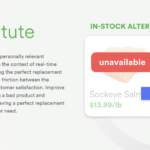
The company’s API technology is a plug-and-play platform that leverages more than 100 billion shopper and product data points and funnels it into three engines: Search, which takes into account a shopper’s preferences; Recommend, which reveals relevant complementary products as someone shops; and Substitute, which identifies replacement options.
Halla’s Substitute product was released earlier this year as an answer to better recommendations for out-of-stock items that even retailers like Walmart are creating technology to solve. Price cited a McKinsey report that found 20% of grocery shoppers sought out competitors following a negative outcome from bad substitutions.

Halla Substitute. Image Credits: Halla
None of these data points are linked to any shoppers’ private data, just the attributes around the shopping itself. The APIs, rather, are looking for context to return relevant recommendations and substitutions. For example, Halla’s platform would take into account the way someone adds items to their cart and suggest next ones: if you added turkey and then bread, the platform may suggest cheese and condiments.
“It’s also about personalization when it comes to grocery shopping and food,” Price said. “When you want organic eggs from a specific brand and it is out of stock, it is often up to your personal shopper’s discretion. We want to lead them to the right substitutions, so you can still cook the meal you intended instead of ‘close enough.’ ”
Halla’s technology is now live in more than 1,100 e-commerce storefronts. The new funding gives Halla some fuel for the fire Price said is happening within the company, including plans to double the number of stores it supports across accounts. He also expects to double employees to 30 in order to support growth and customer base, admitting there is “more inbound interest that we can handle.” Halla has been busy fast-tracking big customers for pilots, and at the same time, wants to expand internationally with additional product lines over the next 18 months.
The company is also seeing “a near infinite increase in recurring revenue,” as it attracts six- and seven-figure contracts that push the company closer to cash flow positivity. All of that growth is positioning Halla for a Series B if it needs it, Price said.
Meanwhile, as part of the investment, Food Retail Ventures’ James McCann will join Halla’s board of directors.
McCann, who only invests in food and retail technology, told TechCrunch that grocery stores need a way to inspire shoppers, that Halla is doing that and in a better way than other intelligence versions he has seen.
“Their technology is miles ahead of everyone else,” he added. “They have a terrific team and a terrific product. They are seeing huge uplifts in terms of suggestions and what people are buying, and their measurements are out of this world.”
Photo includes Halla co-founders, from left, Spencer Price (CEO), Henry Michaelson (CTO & President) and Gabriel Nipote (COO).
Powered by WPeMatico
Every application is a palimpsest of technologies, each layer forming a base that enables the next layer to function. Web front ends rely on JavaScript and browser DOM, which rely on back-end APIs, which themselves rely on databases.
As one goes deeper down the stack, engineering decisions become ever more conservative — changing the location of a button in a web app is an inconvenience; changing a database engine can radically upend an entire project.
It’s little surprise then that database technologies are among the longest-lasting engineering projects in the modern software developer toolkit. MySQL, which remains one of the most popular database engines in the world, was first released in the mid-1990s, and Oracle Database, launched more than four decades ago, is still widely used in high-performance corporate environments.
Database technology can change the world, but the world in these parts changes very, very slowly. That’s made building a startup in the sector a tough equation: Sales cycles can be painfully slow, even when new features can dramatically expand a developer’s capabilities. Competition is stiff and comes from some of the largest and most entrenched tech companies in the world. Exits have also been few and far between.
That challenge — and opportunity — is what makes studying Cockroach Labs so interesting. The company behind CockroachDB attempts to solve a long-standing problem in large-scale, distributed database architecture: How to make it so that data created in one place on the planet is always available for consumption by applications that are thousands of miles away, immediately and accurately. Making global data always available immediately and accurately might sound like a simple use case, but in reality it’s quite the herculean task. Cockroach Labs’ story is one of an uphill struggle, but one that saw it turn into a next-generation, $2-billion-valued database contender.
The lead writer of this EC-1 is Bob Reselman. Reselman has been writing about the enterprise software market for more than two decades, with a particular emphasis on teaching and educating engineers on technology. The lead editor for this package was Danny Crichton, the assistant editor was Ram Iyer, the copy editor was Richard Dal Porto, figures were designed by Bob Reselman and stylized by Bryce Durbin, and illustrations were drawn by Nigel Sussman.
CockroachDB had no say in the content of this analysis and did not get advance access to it. Reselman has no financial ties to CockroachDB or other conflicts of interest to disclose.
The CockroachDB EC-1 comprises four main articles numbering 9,100 words and a reading time of 37 minutes. Here’s what we’ll be crawling over:
We’re always iterating on the EC-1 format. If you have questions, comments or ideas, please send an email to TechCrunch Managing Editor Danny Crichton at danny@techcrunch.com.
Powered by WPeMatico
