Enterprise
Auto Added by WPeMatico
Auto Added by WPeMatico
Xage is working with utilities, energy companies and manufacturers to secure their massive systems, and today it announced some significant updates to deal with the scale and complexity of these customers’ requirements, including a new hierarchical blockchain.
Xage enables customers to set security policy, then enforce that policy on the blockchain. Company CEO Duncan Greatwood says as customers deploy his company’s solutions more widely, it has created a set of problems around scaling that they had to address inside the product, including the use of blockchain.
As you have multiple sites involved in a system, there needed to be a way for these individual entities to operate, whether they are connected to the main system or not. The answer was to provide each site with its own local blockchain, then have a global blockchain that acts as the ultimate enforcer of the rules once the systems reconnected.
“What we’ve done is by creating independent blockchains for each location, you can continue to write even if you are separated or the latency is too high for a global write. But when the reconnect happens with the global system, we replay the writes into the global blockchain,” Greatwood explained.
While classical blockchain doesn’t allow these kinds of separations, Xage felt it was necessary to deal with its particular kind of use case. When there is a separation, a resynchronization happens where the global blockchain checks the local chains for any kinds of changes, and if they are not consistent with the global rules, it will overwrite those entries.
Greatwood says these changes can be malicious if someone managed to take over a node or they could be non-malicious, such as a password change that wasn’t communicated to the global chain until it reconnected. Whatever the reason, the global blockchain has this power to fix the record when it’s required.
Another issue that has come up for Xage customers is the idea that majority rules on a blockchain, but that’s not always a good idea when you have multiple entities working together. As Greatwood explains, if one entity has 600 nodes and the other has 400, the larger entity can always enforce its rules on the smaller one. To fix that, they have created what they are calling a supermajority.
“The supermajority allows us to impose impose rules such as, after you have the majority of 600 nodes, you also have to have the majority of the 400 nodes. Obviously, that will give you an overall majority. But the important point is that the company with 400 nodes is protected now because the write to the ledger account can’t happen unless a majority of the 400 node customers also agrees and participates in the write,” Greatwood explained.
Finally, the company also announced scaling improvements, which reduce computing requirements to run Xage by 10x, according to the company.
Powered by WPeMatico
Salesforce certainly has a lot of tools crossing the sales, service and marketing categories, but until today when it announced Lightning Order Management, it lacked an integration layer that allowed companies to work across these systems to manage orders in a seamless way.
“This is a new product built from the ground up on the Salesforce Lightning Platform to allow our customers to fulfill, manage and service their orders at scale,” Luke Ball, VP of product management at Salesforce told TechCrunch.
He says that order management is an often-overlooked part of the sales process, but it’s one that’s really key to the whole experience you’re trying to provide for your customers. “We think about advertising and acquisition and awareness. We think about creating amazing, compelling commerce experiences on the storefront or on your website or in your app. But I think a lot of brands don’t necessarily think about the delivery experience as part of that customer experience,” he said.
The problem is that order management involves so many different systems along with internal and external stakeholders. Trying to pull them together into a coherent system is harder than it looks, especially when it could also involve older legacy technology. As Ball pointed out, the process includes shipping carriers, warehouse management systems, ERP systems and payment and tax and fraud tools.
The Salesforce solution involves a few key pieces. For starters there is order life cycle management, what Ball calls the brains of the operation. “This is the core logic of an order management system. Everything that extends commerce beyond the Buy button — supply chain management, order fulfillment, payment capture, invoice creation, inventory availability and custom business logic. This is the bread and butter of an order management system,” he said.
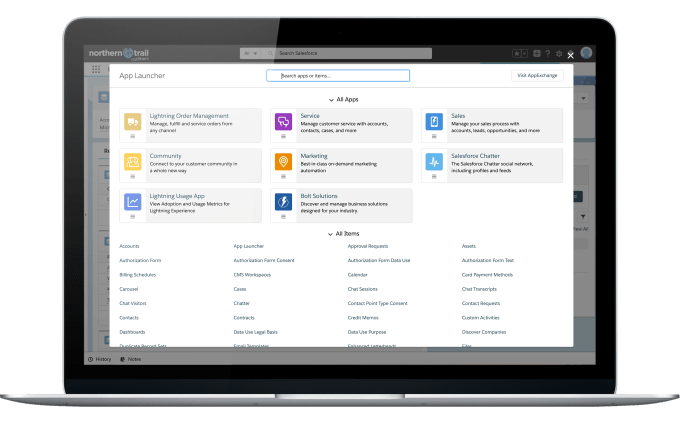
Salesforce Lightning Order Management App Picker (Image: Salesforce)
Customers start by building visual order workflows. They can move between systems in an App Picker, and the information is shared between Commerce Cloud and Service Cloud, so that as customers move from sales to service, the information moves with them and it makes it easier to process inquiries from customers about an order, including returns.
Ball says that Salesforce recognizes that not every customer will be an all-Salesforce shop and the system is designed to work with tools from other vendors, although these external tools won’t show up in the App Picker. It also knows that this process involves external vendors like shipping companies, so they will be offering specific integration apps for Lightning Order Management in the Salesforce AppExchange.
The company is announcing the product today and will be making it generally available in February.
Powered by WPeMatico
Clari uses AI to help companies find key information like the customers most likely to convert, the state of orders in the sales process or the next big sources of revenue. As its revenue management system continues to flourish, the company announced a $60 million Series D investment today.
Sapphire Ventures led the round with help from newcomer Madrona Venture Group and existing investors Sequoia Capital, Bain Capital Ventures and Tenaya Capital. Today’s investment brings the total raised to $135 million, according to the company.
The valuation, which CEO and co-founder Andy Byrne pegged at around a half a billion, appears to be a hefty raise from what the company was likely valued at in 2018 after its $35 million Series C. As TechCrunch’s Ingrid Lunden wrote at the time:
For some context, Clari, according to Pitchbook, had a relatively modest post-money valuation of $83.5 million in its last round in 2014, so my guess is that it’s now comfortably into hundred-million territory, once you add in this latest $35 million.
Byrne says the company wasn’t even really looking for a new round, but when investors came knocking, he couldn’t refuse. “On the fundraise side, what’s really interesting is how this whole thing went down. We weren’t out looking, but we had a massive amount of interest from a lot of firms. We decided to engage, and we got it done in less than three weeks, which the board was kind of blown away by,” Byrne told TechCrunch.
What’s motivating these companies to invest is that Clari is helping to define this revenue operations category, and has attracted companies like Okta, Zoom and Qualtrics as customers. What they are providing is this AI-fueled way to see where the best sales opportunities are to drive revenue, and that’s what every company is looking for. At the same time, Byrne says that he’s moving companies away from a spreadsheet-driven record keeping system, enabling them to see all of the data in one place.
“Clari is allowing a rep to really understand where they should spend time, automating a lot of things for them to close deals faster, while giving managers new insights they’ve never had before to allow them to drive more revenue. And then we’re getting them out of ‘Excel hell.’ They’re no longer in these spreadsheets. They’re in Clari, and have more predictability in their forecasting,” he said.
Clari was founded in 2012 and is headquartered in Sunnyvale, Calif. It has more than 300 customers and just passed the 200 employee mark, a number that should increase as the company uses this money to begin to accelerate growth and expand the product’s capabilities.
Powered by WPeMatico
End users tend to get a bad rap in the security business because they are often the weakest security link. They fall for phishing schemes, use weak passwords and often unknowingly are the conduit for malicious actors getting into your company’s systems. Okta wants to change that by giving end users information about suspicious activity involving their login, while letting them share information with the company’s security apparatus when it makes sense.
Okta actually developed a couple of new products under the umbrella SecurityInsights. The end user product is called UserInsights. The other new product, called HealthInsights, is designed for administrators and makes suggestions on how to improve the overall identity posture of a company.
UserInsights lets users know when there is suspicious activity associated with their accounts, such as a login from an unrecognized device. If it appears to involve a stolen password, he or she would click the Report button to report the incident to the company’s security apparatus where it would trigger an automated workflow to start an investigation. The person should also obviously change that compromised password.
HealthInsights operates in a similar fashion, except for administrators at the system level. It checks the configuration parameters and makes sure the administrator has set up Okta according to industry best practices. When there is a gap between the company’s settings and a best practice, the system alerts the administrator and allows them to fix the problem. This could involve implementing a stricter password policy, creating a block list for known rogue IP addresses or forcing users to use a second factor for certain sensitive operations.
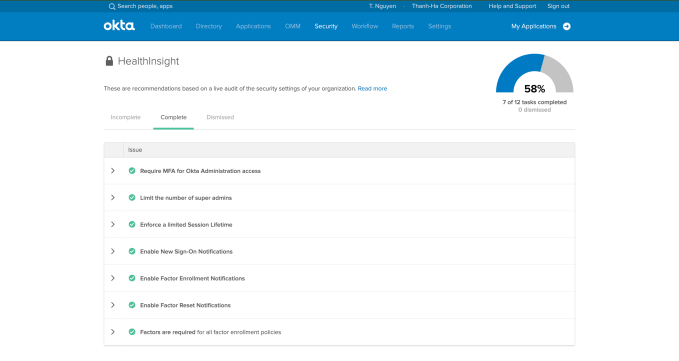
Health Insights Report. Image: Okta
Okta is first and foremost an identity company. Organizations, large and small, can tap into Okta to have a single sign-on interface where you can access all of your cloud applications in one place. “If you’re a CIO and you have a bunch of SaaS applications, you have a [bunch of] identity systems to deal with. With Okta, you narrow it down to one system,” CEO Todd McKinnon told TechCrunch.
That means, if your system does get spoofed, you can detect anomalous behavior much more easily because you’re dealing with one logon instead of many. The company developed these new products to take advantage of that, and provide these groups of employees with the information they need to help protect the company’s systems.
The SecurityInsights tools are available starting today.
Powered by WPeMatico
Suse, the newly independent open-source company behind the eponymous Linux distribution and an increasingly large set of managed enterprise services, today announced a bit of a new strategy as it looks to stay on top of the changing trends in the enterprise developer space. Over the course of the last few years, Suse put a strong emphasis on the OpenStack platform, an open-source project that essentially allows big enterprises to build something in their own data centers akin to the core services of a public cloud like AWS or Azure. With this new strategy, Suse is transitioning away from OpenStack . It’s ceasing both production of new versions of its OpenStack Cloud and sales of its existing OpenStack product.
“As Suse embarks on the next stage of our growth and evolution as the world’s largest independent open source company, we will grow the business by aligning our strategy to meet the current and future needs of our enterprise customers as they move to increasingly dynamic hybrid and multi-cloud application landscapes and DevOps processes,” the company said in a statement. “We are ideally positioned to execute on this strategy and help our customers embrace the full spectrum of computing environments, from edge to core to cloud.”
What Suse will focus on going forward are its Cloud Application Platform (which is based on the open-source Cloud Foundry platform) and Kubernetes-based container platform.
Chances are, Suse wouldn’t shut down its OpenStack services if it saw growing sales in this segment. But while the hype around OpenStack died down in recent years, it’s still among the world’s most active open-source projects and runs the production environments of some of the world’s largest companies, including some very large telcos. It took a while for the project to position itself in a space where all of the mindshare went to containers — and especially Kubernetes — for the last few years. At the same time, though, containers are also opening up new opportunities for OpenStack, as you still need some way to manage those containers and the rest of your infrastructure.
The OpenStack Foundation, the umbrella organization that helps guide the project, remains upbeat.
“The market for OpenStack distributions is settling on a core group of highly supported, well-adopted players, just as has happened with Linux and other large-scale, open-source projects,” said OpenStack Foundation COO Mark Collier in a statement. “All companies adjust strategic priorities from time to time, and for those distro providers that continue to focus on providing open-source infrastructure products for containers, VMs and bare metal in private cloud, OpenStack is the market’s leading choice.”
He also notes that analyst firm 451 Research believes there is a combined Kubernetes and OpenStack market of about $11 billion, with $7.7 billion of that focused on OpenStack. “As the overall open-source cloud market continues its march toward eight figures in revenue and beyond — most of it concentrated in OpenStack products and services — it’s clear that the natural consolidation of distros is having no impact on adoption,” Collier argues.
For Suse, though, this marks the end of its OpenStack products. As of now, though, the company remains a top-level Platinum sponsor of the OpenStack Foundation and Suse’s Alan Clark remains on the Foundation’s board. Suse is involved in some of the other projects under the OpenStack brand, so the company will likely remain a sponsor, but it’s probably a fair guess that it won’t continue to do so at the highest level.
Powered by WPeMatico
At its annual TechCon event in San Jose, Arm today announced Custom Instructions, a new feature of its Armv8-M architecture for embedded CPUs that, as the name implies, enables its customers to write their own custom instructions to accelerate their specific use cases for embedded and IoT applications.
“We already have ways to add acceleration, but not as deep and down to the heart of the CPU. What we’re giving [our customers] here is the flexibility to program your own instructions, to define your own instructions — and have them executed by the CPU,” ARM senior director for its automotive and IoT business, Thomas Ensergueix, told me ahead of today’s announcement.
He noted that Arm always had a continuum of options for acceleration, starting with its memory-mapped architecture for connecting over a bus GPUs and today’s neural processor units. This allows the CPU and the accelerator to run in parallel, but with the bus being the bottleneck. Customers also can opt for a co-processor that’s directly connected to the CPU, but today’s news essentially allows Arm customers to create their own accelerated algorithms that then run directly on the CPU. That means the latency is low, but it’s not running in parallel, as with the memory-mapped solution.
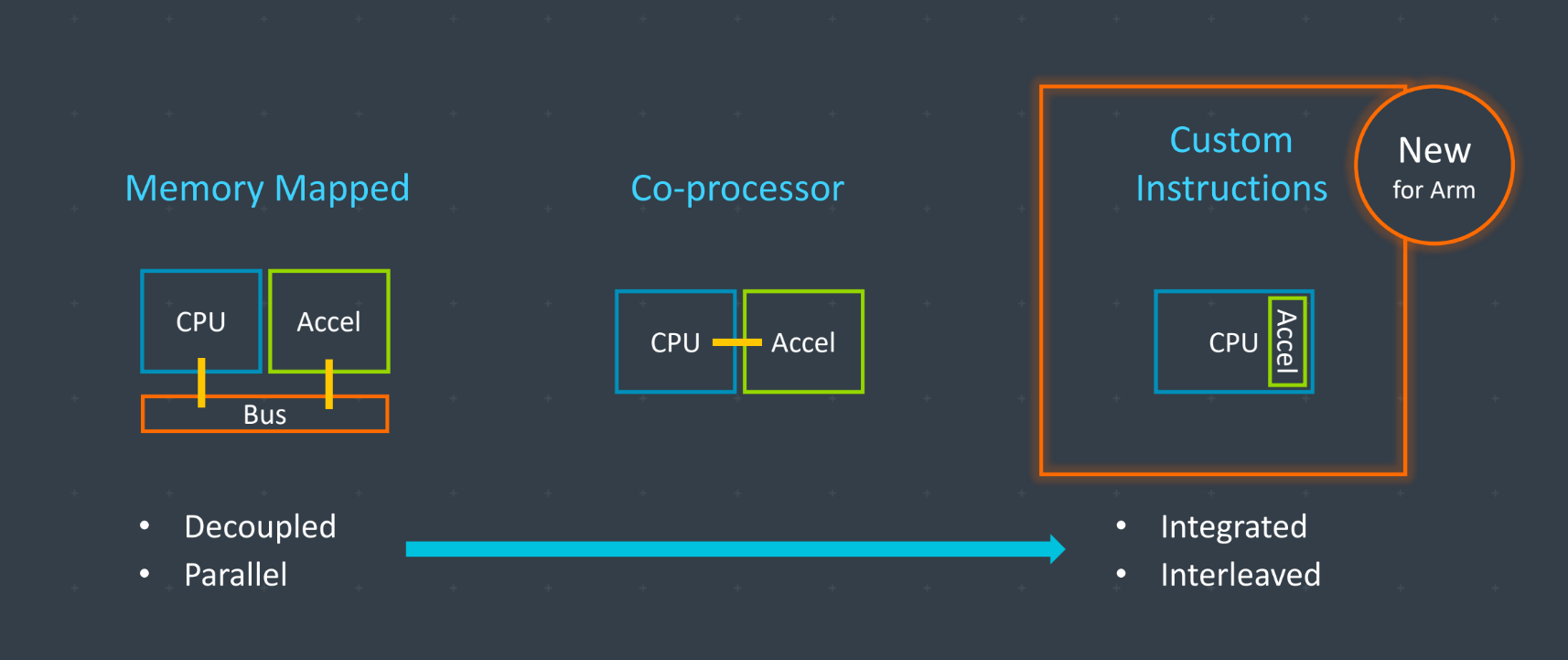
As Arm argues, this setup allows for the lowest-cost (and risk) path for integrating customer workload acceleration, as there are no disruptions to the existing CPU features and it still allows its customers to use the existing standard tools with which they are already familiar.
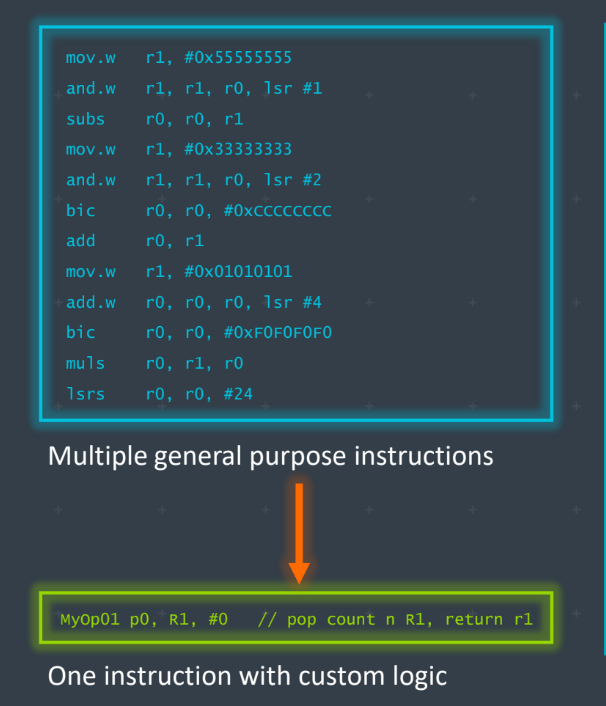 For now, custom instructions will only be available to be implemented in the Arm Cortex-M33 CPUs, starting in the first half of 2020. By default, it’ll also be available for all future Cortex-M processors. There are no additional costs or new licenses to buy for Arm’s customers.
Ensergueix noted that as we’re moving to a world with more and more connected devices, more of Arm’s customers will want to optimize their processors for their often very specific use cases — and often they’ll want to do so because by creating custom instructions, they can get a bit more battery life out of these devices, for example.
Arm has already lined up a number of partners to support Custom Instructions, including IAR Systems, NXP, Silicon Labs and STMicroelectronics .
“Arm’s new Custom Instructions capabilities allow silicon suppliers like NXP to offer their customers a new degree of application-specific instruction optimizations to improve performance, power dissipation and static code size for new and emerging embedded applications,” writes NXP’s Geoff Lees, SVP and GM of Microcontrollers. “Additionally, all these improvements are enabled within the extensive Cortex-M ecosystem, so customers’ existing software investments are maximized.”
In related embedded news, Arm also today announced that it is setting up a governance model for Mbed OS, its open-source operating system for embedded devices that run an Arm Cortex-M chip. Mbed OS has always been open source, but the Mbed OS Partner Governance model will allow Arm’s Mbed silicon partners to have more of a say in how the OS is developed through tools like a monthly Product Working Group meeting. Partners like Analog Devices, Cypress, Nuvoton, NXP, Renesas, Realtek,
Samsung and u-blox are already participating in this group.
Powered by WPeMatico
Microsoft CEO Satya Nadella, delivering the keynote at the Microsoft Government Leaders Summit in Washington, DC today, had a message for attendees to maintain user trust in their tools technologies above all else.
He said it is essential to earn user trust, regardless of your business. “Now, of course, the power law here is all around trust because one of the keys for us, as providers of platforms and tools, trust is everything,” he said today. But he says it doesn’t stop with the platform providers like Microsoft. Institutions using those tools also have to keep trust top of mind or risk alienating their users.
“That means you need to also ensure that there is trust in the technology that you adopt, and the technology that you create, and that’s what’s going to really define the power law on this equation. If you have trust, you will have exponential benefit. If you erode trust it will exponentially decay,” he said.
He says Microsoft sees trust along three dimensions: privacy, security and ethical use of artificial intelligence. All of these come together in his view to build a basis of trust with your customers.
Nadella said he sees privacy as a human right, pure and simple, and it’s up to vendors to ensure that privacy or lose the trust of their customers. “The investments around data governance is what’s going to define whether you’re serious about privacy or not,” he said. For Microsoft, they look at how transparent they are about how they use the data, their terms of service and how they use technology to ensure that’s being carried out at runtime.
He reiterated the call he made last year for a federal privacy law. With GDPR in Europe and California’s CCPA coming on line in January, he sees a centralized federal law as a way to streamline regulations for business.
As for security, as you might expect, he defined it in terms of how Microsoft was implementing it, but the message was clear that you needed security as part of your approach to trust, regardless of how you implement that. He asked several key questions of attendees.
“Cyber is the second area where we not only have to do our work, but you have to [ask], what’s your operational security posture, how have you thought about having the best security technology deployed across the entire chain, whether it’s on the application side, the infrastructure side or on the endpoint, side, and most importantly, around identity,” Nadella said.
The final piece, one which he said was just coming into play, was how you use artificial intelligence ethically, a sensitive topic for a government audience, but one he wasn’t afraid to broach. “One of the things people say is, ‘Oh, this AI thing is so unexplainable, especially deep learning.’ But guess what, you created that deep learning [model]. In fact, the data on top of which you train the model, the parameters and the number of parameters you use — a lot of things are in your control. So we should not abdicate our responsibility when creating AI,” he said.
Whether Microsoft or the U.S. government can adhere to these lofty goals is unclear, but Nadella was careful to outline them both for his company’s benefit and this particular audience. It’s up to both of them to follow through.
Powered by WPeMatico
The rapid rise of Slack — which has recently broken the 100,000 mark for paying businesses using its service — has ushered in a rush of competition from other companies across the worlds of social media and enterprise software, all aiming to become the go-to conversation layer for businesses. Today, Workplace, Facebook’s effort in that race, announced a milestone in its growth, along with a bigger push into video services and other improvements.
The service — which starts at $1.50 per month per front-line worker and then has tiers of $4 and $8 — now has passed 3 million paying users, adding 1 million workers from mostly enterprise businesses in the last eight months.
And to capitalize on Facebook’s growing focus on video in its consumer service, Workplace is announcing several steps of its own into video. It’s releasing a special app that can be used on the Portal, Facebook’s video screen; and alongside that, it’s announcing new video features: captioning at the bottom of videos; auto-translating starting with 14 languages; and a new P2P architecture that will speed up video transmission for those who might be watching videos on Workplace in places where bandwidth is constrained.
The features and milestone number are all being announced today at Flock, the Workplace user conference that Facebook puts on each year. Alongside all these, Facebook also announced several other features for its enterprise app (more on the other new features below).
The push to video comes at an interesting time for Workplace on the competitive front. Karandeep Anand, who came to Facebook from Microsoft and currently heads up Workplace with Julien Codorniou managing business development, has made a point of differentiating Workplace from others in the field of workplace collaboration by emphasizing how it’s used by very large enterprises like Walmart (the world’s largest single employer) to bring together on to a single communication platform not just white-collar knowledge workers but also frontline workers.
The company says that today, its customers include 150 companies with over 10,000 active users apiece, with other names on its books including Starbucks, Spotify, AstraZeneca, Deliveroo and Kering.
The push to video follows that trajectory: it’s a way for Workplace (and Facebook) to differentiate the experience and use cases for the product to businesses, which might already be using Slack but might consider buying this as well, if not migrating away from the other product altogether. (Teams is a different ballgame, of course, as it has a strong video component of its own and also likes to position itself as a product for all kinds of employees, too.)
Workplace’s video efforts here will mark the first time that Facebook is positioning Portal as a product for businesses. This is notable, when you consider there has been some adoption of Amazon’s Alexa in workplace scenarios, too; and that there has been some pushback from consumers about the prospect of having a Facebook video device sitting in their homes. This gives Facebook’s $179 hardware (which will be sold at the same price to businesses) a new avenue for sales.
Video has been a cornerstone of how Workplace has been developing for a while now, with companies using it as a way for, say, the big boss to send out more personalised communications to workers, and for people in workgroups to create video chats with each other. A dedicated screen for video chats takes this idea to the next level, and plays on the fact that video conferencing services like Zoom have caught on like wildfire in modern offices, where people who work together often work in disparate locations.
There is another way that Portal could find some traction with businesses: videoconferencing solutions tend to be very expensive, in part because of the hefty hardware investments that need to be made. Offering a device at $179 drastically undercuts that investment. Codorniou declined to comment on whether Facebook might make a more concerted effort to push this as a cost-effective videoconferencing alternative down the line, but he did point out that today Facebook and Zoom have a close relationship.
The other video features that Workplace is announcing today will further enhance the experience: Facebook will now give users the option to include automatic captions at the bottoms of videos, with the bonus of translation, initially in 14 languages. And the improved video quality for those with limited bandwidth is significantly not something that Facebook has rolled out in its consumer app: the aim is to improve the quality of broadcasting in scenarios where bandwidth might not be as strong but there are simultaneous people watching the same event — something you could imagine applying, say, at a company all-hands or town hall event with remote participants.
Alongside all of these video features, Workplace is adding in a host of other features to expand the use cases for the product beyond basic chatting:
Workplace is also adding in some gamification features to the platform, where people can publicly thank people, set and follow workplace goals and award badges to individuals who have achieved something in areas like sales, anniversaries or other positive milestones.
As with the video features, the idea is to bring services to Workplace that you are not necessarily getting in Slack and other competitive products. That is the maxim also when the features are replicas of features you might have seen elsewhere, but not all in one consolidated place.
Asked what he thought about the claims that Facebook is too much of a “copycat” when it came to building new features, Codorniou was defensive. “I think Workplace itself is getting to a market that has been untouched before. When it comes to badges or goals, for example, yes people have but these before, but the difference is that we are offering them to a wide network of people. If you have to use a separate app, it’s not a great experience.”
And, he added, “everything that we ship is the result of customer feedback and requests. If they tell us they want these, it means they’re not finding what they needed on the market.”
Powered by WPeMatico
Speaking today at the Microsoft Government Leaders Summit in Washington, DC, Microsoft CEO Satya Nadella made the case for edge computing, even while pushing the Azure cloud as what he called “the world’s computer.”
While Amazon, Google and other competitors may have something to say about that, marketing hype aside, many companies are still in the midst of transitioning to the cloud. Nadella says the future of computing could actually be at the edge, where computing is done locally before data is then transferred to the cloud for AI and machine learning purposes. What goes around, comes around.
But as Nadella sees it, this is not going to be about either edge or cloud. It’s going to be the two technologies working in tandem. “Now, all this is being driven by this new tech paradigm that we describe as the intelligent cloud and the intelligent edge,” he said today.
He said that to truly understand the impact the edge is going to have on computing, you have to look at research, which predicts there will be 50 billion connected devices in the world by 2030, a number even he finds astonishing. “I mean this is pretty stunning. We think about a billion Windows machines or a couple of billion smartphones. This is 50 billion [devices], and that’s the scope,” he said.
The key here is that these 50 billion devices, whether you call them edge devices or the Internet of Things, will be generating tons of data. That means you will have to develop entirely new ways of thinking about how all this flows together. “The capacity at the edge, that ubiquity is going to be transformative in how we think about computation in any business process of ours,” he said. As we generate ever-increasing amounts of data, whether we are talking about public sector kinds of use case, or any business need, it’s going to be the fuel for artificial intelligence, and he sees the sheer amount of that data driving new AI use cases.
“Of course when you have that rich computational fabric, one of the things that you can do is create this new asset, which is data and AI. There is not going to be a single application, a single experience that you are going to build, that is not going to be driven by AI, and that means you have to really have the ability to reason over large amounts of data to create that AI,” he said.
Nadella would be more than happy to have his audience take care of all that using Microsoft products, whether Azure compute, database, AI tools or edge computers like the Data Box Edge it introduced in 2018. While Nadella is probably right about the future of computing, all of this could apply to any cloud, not just Microsoft.
As computing shifts to the edge, it’s going to have a profound impact on the way we think about technology in general, but it’s probably not going to involve being tied to a single vendor, regardless of how comprehensive their offerings may be.
Powered by WPeMatico
Security breaches and other activities that cause network surges and outages are all on the rise in the enterprise, and today, a startup called Forward Networks, which has built a clever way to help businesses monitor their network traffic to identify when things are going wrong, has raised a round of $35 million to continue expanding its business to meet that demand.
The money, a Series C, is being led by Goldman Sachs, which in this case is both a strategic and financial investor. David Erickson, the startup’s co-founder and CEO, said the investment bank started out as a customer, and Joshua Matheus, MD for technology at Goldman Sachs, was so pleased with the results that he recommended the bank also invest in the company. Others participating in this round include Andreessen Horowitz, Threshold Ventures (previously DFJ Venture) and A. Capital, the three investors that were behind Forward Networks’ previous round of $16 million in 2017.
Erickson, along with other co-founders Nikhil Handigol, Brandon Heller and Peyman Kazemian, were all Stanford PhDs, and the company’s technology is based around work they did there around mathematical modeling. Here, that concept is applied to a company’s network to create essentially a replica of a company’s network architecture, which is in turn used to simulate individual processes and apps running on the network to figure out how they interact and what would represent “normal” versus “abnormal” behavior, which in turn is applied in real time to monitor the network and predict what might happen on it. This is not a fixing platform per se, but in developer operations, there is a fundamental need and gap in the market for products that help engineers identify what is not working in order to know what to try to fix.
If you are familiar with Honeycomb.io — a DevOps platform for running apps to determine when and where bugs or conflicts might arise (which itself recently raised funding) — this seems to be taking a similar approach, but on a network scale.
Considered together, it seems that we’re starting to see a new wave of services and platforms designed to provide more granular and intelligent pictures of how apps and networks behave in our modern technology landscapes.
Erickson tells me that today, the vast majority of Forward Networks’ customers are using the product to monitor on-premises rather than cloud architectures.
“We launched a public cloud product for AWS towards the end of last year, which today is in use by customers, but the dominant use case for us is on-prem,” Erickson said, who said that while the media (ahem) loves to talk about cloud, in many cases large enterprises have actually been slower to migrate processes in cases where legacy services still work well, and they still harbour distrust of public cloud security and reliability. “We see growth towards the cloud but it’s baby steps.”
The company has been growing steadily; today its network monitoring covers some 75,000 devices. In that context, Goldman Sachs is a significant client, with some 15,000 devices in its network alone.
Looking ahead, Erickson said that the funding would be used in part for R&D and in part to continue its business development. There are a number of other solutions and services out there that have identified the opportunity of providing better network management as a route to identifying security threats and other risks, so that also presents an opportunity for M&A for Forward, although Erickson declined to comment further on that.
“We continue to see the value that Forward Networks’ platform brings to large enterprises running complex networks,” said Bill Krause, board partner at Andreessen Horowitz. “They have solved a critical business problem, which presents a real growth opportunity.”
Powered by WPeMatico