Enterprise
Auto Added by WPeMatico
Auto Added by WPeMatico
Searchable.ai wants to solve an old problem around search in the enterprise. The stealthy startup announced a $2 million seed round.
Defy Partners led the round with a slew of other participants, including Paul English, co-founder of Kayak; Wayne Chang, co-founder of Crashlytics; Brian Halligan, co-founder and CEO of HubSpot; Jonathan Kraft, president and COO of the Kraft Group and the New England Patriots; MIT Prof. Edward Roberts; Eric Dobkin, founder and chairman emeritus of Goldman Sachs Global Equity Capital Markets; and Susquehanna International Group.
The prestigious group of investors saw that Searchable.ai is trying to solve a big problem around findability. Company co-founder Brian Shin says that knowledge workers have been struggling for years trying to find a way to better utilize all of the information that exists within an organization.
“The problem we’re really solving is that there are a trillion documents created every year in Microsoft Office, Google Docs, etc., and it’s really difficult if you’re a knowledge worker to find what you need in terms of either a document, an asset like a slide or worksheet within a document or the actual answer to a question that you have,” Shin said.
The questioning part could be particularly valuable because it lets you ask a natural language question and find a specific piece of information within a document, rather than just the document itself. “Let’s say you have a giant spreadsheet, you could actually ask a question of all your spreadsheets and find the atomic unit of knowledge that you’re actually looking for,” he said.
The product itself is not quite ready for the big reveal, but if it works as described, it will be a huge boost to knowledge workers who have continually struggled to find a nugget of information they know is out there across the myriad documents in an organization.
Shin is an experienced entrepreneur who has helped launch and sell three companies. He reports he has raised $100 million in venture capital and most recently has worked as a venture capitalist himself, but he saw this opportunity and decided to jump back into the development side of things.
He admits he’s giving up a lot to go back to the startup lifestyle, but he and his co-founders decided this was worth it. “You know the draw, the compulsion to do another startup is is really what this is about. So my three other colleagues and I have have all started companies before and we’re all giving up big jobs to do this, and I’m so excited about the team and the massive opportunity.”
He promised more details about the company and the solution would be coming early next year.
Powered by WPeMatico
In a wide ranging interview with The Wall Street Journal’s global technology editor Jason Dean yesterday, Slack CEO and co-founder Stewart Butterfield had some strong words regarding Microsoft, saying the software giant saw his company as an existential threat.
The interview took place at the WSJ Tech Live event. When Butterfield was asked about a chart Microsoft released in July during the Slack quiet period, which showed Microsoft Teams had 13 million daily active users compared to 12 million for Slack, Butterfield appeared taken aback by the chart.
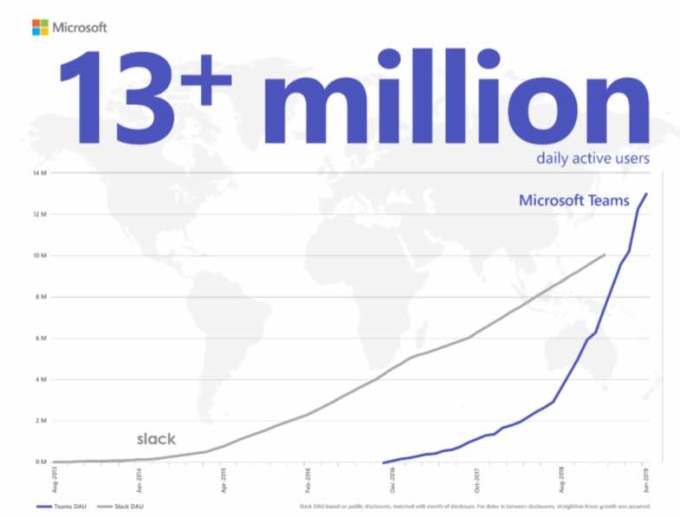
Chart: Microsoft
“The bigger point is that’s kind of crazy for Microsoft to do, especially during the quiet period. I had someone say it was unprecedented since the [Steve] Ballmer era. I think it’s more like unprecedented since the Gates’ 98-99 era. I think they feel like we’re an existential threat,” he told Dean.
It’s worth noting, that as Dean pointed out, you could flip that existential threat statement. Microsoft is a much bigger business with a trillion-dollar market cap versus Slack’s $400 million. It also has the benefit of linking Microsoft Teams to Office 365 subscriptions, but Butterfield says the smaller company with the better idea has often won in the past.
For starters, Butterfield noted that of his biggest customers, more than two-thirds are actually using Slack and Office 365 in combination. “When we look at our top 50 biggest customers, 70% of them are not only Office 365 users, but they’re Office 365 users who use the integrations with Slack,” he said.
He went on to say that smaller companies have taken on giants before and won. As examples, he held up Microsoft itself, which in the 1980s was a young upstart taking on established players like IBM. In the late 1990s, Google prevailed as the primary search engine in spite of the fact that Microsoft controlled most of the operating system and browser market at the time. Google then tried to go after Facebook with its social tools, all of which have failed over the years. “And so the lesson we take from that is, often the small startup with real traction with customers has an advantage versus the large incumbent with multiple lines of business,” he said.
When asked by Dean if Microsoft, which ran afoul with the Justice Department in the late 1990s, should be the subject of more regulatory scrutiny for its bundling practices, Butterfield admitted he wasn’t a legal expert, but joked that it was “surprisingly unsportsmanlike conduct.” He added more seriously, “We see things like offering to pay companies to use Teams and that definitely leans on a lot of existing market power. Having said that, we have been asked many times, and maybe it’s something we should have looked at, but we haven’t taken any action.”
Powered by WPeMatico
Grafana Labs, the commercial company built to support the open-source Grafana project, announced a healthy $24 million Series A investment today. Lightspeed Venture Partners led the round with participation from Lead Edge Capital.
Company CEO and co-founder Raj Dutt says the startup started life as a way to offer a commercial layer on top of the open-source Grafana tool, but it has expanded and now supports other projects, including Loki, an open-source monitoring tool not unlike Prometheus, which the company developed last year.
All of this in the service of connecting to data sources and monitoring data. “Grafana has always been about connecting data together no matter where it lives, whether it’s in a proprietary database, on-prem database or cloud database. There are over 42 data sources that Grafana connects together,” Dutt explained.
But the company has expanded far beyond that. As it describes the product set, “Our products have begun to evolve to unify into a single offering: the world’s first composable open-source observability platform for metrics, logs and traces. Centered around Grafana.” This is exactly where other monitoring and logging tools like Elastic, New Relic and Splunk have been heading this year. The term “observability” is a term that’s been used often to describe these combined capabilities of metrics, logging and tracing.
Grafana Labs is the commercial arm of the open-source projects, and offers a couple of products built on top of these tools. First of all it has Grafana Enterprise, a package that includes enterprise-focused data connectors, enhanced authentication and security and enterprise-class support over and above what the open-source Grafana tool offers.
The company also offers a SaaS version of the Grafana tool stack, which is fully managed and takes away a bunch of the headaches of trying to download raw open-source code, install it, manage it and deal with updates and patches. In the SaaS version, all of that is taken care of for the customer for a monthly fee.
Dutt says the startup took just $4 million in external investment over the first five years, and has been able to build a business with 100 employees and 500 customers. He is particularly proud of the fact that the company is cash flow break-even at this point.
Grafana Labs decided the time was right to take this hefty investment and accelerate the startup’s growth, something they couldn’t really do without a big cash infusion. “We’ve seen this really virtuous cycle going with value creation in the community through these open-source projects that builds mind share, and that can translate into building a sustainable business. So we really want to accelerate that, and that’s the main reason behind the raise.”
Powered by WPeMatico
Tines, a Dublin-based startup that lets companies automate aspects of their cybersecurity, has raised $4.1 million in Series A funding. Leading the round is Blossom Capital, the venture capital firm co-founded by ex-Index Ventures and LocalGlobe VC Ophelia Brown.
Founded in February 2018 by ex-eBay, PayPal and DocuSign security engineer Eoin Hinchy, who was subsequently joined by former eBay and DocuSign colleague Thomas Kinsella, Tines automates many of the repetitive manual tasks faced by security analysts so they can focus on other high-priority work. The pair have bootstrapped the company until now.
“It was while I was at DocuSign that I felt there was a need for a platform like Tines,” explains Hinchy. “We had a team of really talented engineers in charge of incident response and forensics but they weren’t developers. I found they were doing the same tasks over and over again so I began looking for a platform to automate these repetitive tasks and didn’t find anything. Certainly nothing that did what we needed it to, so I came up with the idea to plug this gap in the market.”
To that end, Tines lets companies automate parts of their manual security processes with the help of six software “agents,” with each acting as a multipurpose building block. Therefore, regardless of the process being automated, it only requires combinations of these six agent types configured in different ways to replicate a particular workflow.
“I wanted there to be as few agent types as possible, to simplify the system, and I haven’t discovered a workflow in which tasks sit outside of these agents yet,” says Hinchy. “Once a customer signs up they can start automating their own workflows immediately, and most of our customers see value from day one. If they need a hand, my team works with them to establish how they currently manually carry out tasks, such as identifying and dealing with a phishing attack. Each step of dealing with the attack — from cross-checking the email address with trusted contacts or a blacklist, to scanning attachments for viruses or examining URLs — will be performed by one of the six agent types. This means we can assign these tasks to an agent to create the workflow, or as we call it, the “story.”
So, for example, once a phishing email triggers the first agent, the following steps in the “story” are automatically carried out. In this way, Tines might be described as akin to IFTTT, “but an exceptionally powerful, enterprise version of the IFTTT concept, designed to manage much more complex workflows.”
Competitors are cited as Phantom, which last year was acquired by Splunk, and Demisto, which was bought by Palo Alto Networks. However, Hinchy argues that a key differentiator is that Tines doesn’t rely on pre-built integrations to interact with external systems. Instead, he says the software is able to plug in to any system that has an API.
Meanwhile, Tines says it will use the new funding to hire engineers in Dublin who can help improve the platform through R&D, as well as grow its customer base with companies in the U.S. and in Europe. Notably, the startup plans to expand beyond cybersecurity automation, too.
“Our background is in security, so with Tines, we’ve initially focused on helping security teams automate their repetitive, manual processes,” says Hinchy. “What makes us different is that nowhere does it say we can’t expand beyond this, to help other teams and sectors automate tasks. The advantage of our direct-integration model is that Tines doesn’t care if you’re talking to a security tool, HR system or CRM, it treats them the same. In the next 18 months, we plan to expand Tines outside security, hire more talent and increase the product team from 8 to 20.”
Powered by WPeMatico
Bill McDermott has landed. Two weeks ago, he stepped down as CEO at SAP after a decade leading the company. Yesterday, ServiceNow announced that he will be its new CEO.
It’s unclear how quickly the move came together but the plan for him is clear: to scale revenue like he did in his last job.
Commenting during the company’s earning’s call today, outgoing CEO John Donahoe said that McDermott met all of the board’s criteria for its next leader. This includes the ability to expand globally, expand the markets it serves and finally scale the go-to-market organization internally, all in the service of building toward a $10 billion revenue goal. He believes McDermott checks all those boxes.
McDermott has his work cut out for him. The company’s 2018 revenue was $2.6 billion. Still, he fully embraced the $10 billion challenge. “Well let me answer that very simply, I completely stand by [the $10 billion goal], and I’m looking forward to achieving it,” he said with bravado during today’s call.
It’s worth noting that as the company strives to reach that lofty revenue goal in the coming years, it will be doing with a new CEO in McDermott, as well as a new CFO. The company is in the midst of a search to fill that key position, as well.
McDermott has been here before though. He points out that in the decade he was at SAP, under his leadership the company moved the market cap from $39 billion to $163 billion. Today, ServiceNow’s market cap is similar to when McDermott started at SAP at a little over $41 billion.
He also recognizes that this is going to be a new challenge. “I’ve seen a lot of different business models, and [SAP has] a very different business model than ServiceNow. This is a pure play cloud,” he said. That means as a leader, he says that has to think about product changes differently, how they fit in the overall platform, while maintaining simplicity and keeping the developer community in mind.
Ray Wang, founder and principal analyst at Constellation Research said that ServiceNow is at a point where it needs an enterprise-class CEO who understands tech, partnerships, systems integrators and real enterprise sales and marketing — and McDermott brings all of that to his new employer.
Powered by WPeMatico
Demodesk, an early-stage startup that wants to change how sales meetings are conducted online, announced a $2.3 million seed investment today.
Investors included GFC, FundersClub, Y Combinator, Kleiner Perkins and an unnamed group of angel investors. The company was a member of the Y Combinator Winter 2019 cohort.
CEO and co-founder Veronika Riederle says that the fact it’s so closely focused on sales separates it from other more general meeting tools like Zoom, WebEx or GoToMeeting. “We are building the first intelligent online meeting tool for customer-facing conversations. So that is for inside sales and customer service professionals,” Riederle explained.
One of the key pieces of technology is what Riederle calls “a unique approach to screen sharing.” Whereas most meeting software involves downloading software to use the tool, Demodesk doesn’t do this. You simply click a link and you’re in. The two parties online are seeing a live screen and each can interact with it. It’s not just a show and tell.
What’s more, in a sales scenario with a slide presentation, the customer sees the same live screen as the salesperson, but while the salesperson can see their presentation notes, the customer cannot.
She said while this could work for any number of scenarios, from customer service to IT Help desks, at this stage in the company’s development she wants to concentrate on the sales scenario, then expand the vision over time. The service works on a subscription model with tiered per user pricing starting at $19 per user, per month.
When they got to Y Combinator, the company already had a working product and paying customers, but Riederle says the experience has helped them grow the business to moew than 100 customers. “YC was extremely important for us because we immediately got access to an extremely valuable network of founders and potential customers, and also just a base for us to really [develop] the business.
Riederle founded the company with CTO Alex Popp in 2017 in Munich. Prior to this seed round, the founders mostly bootstrapped the company. With the $2.3 million, it should be able to hire more people and begin building out the product further, while investing in sales and marketing to expand its customer base.
Powered by WPeMatico
The JEDI drama never stops. The $10 billion, decade-long cloud contract has produced a series of twists and turns since the project was announced in 2018. These include everything from court challenges to the president getting involved to accusations of bias and conflict of interest. It has had all this and more. Today, in the latest plot twist, the Secretary of Defense Mark Esper recused himself from the selection process because one of his kids works at a company that was involved earlier in the process.
Several reports name his son, Luke Esper, who has worked at IBM since February. The RFP closed in April and Esper is a Digital Strategy Consultant, according to his LinkedIn page (which is no longer available), but given the persistent controversy around this deal, his dad apparently wanted to remove even a hint of impropriety in the selection and review process.
Chief Pentagon Spokesperson Jonathan Rath Hoffman issued an official DoD Cloud update earlier today:
As you all know, soon after becoming Secretary of Defense in July, Secretary Esper initiated a review of the Department’s cloud computing plans and to the JEDI procurement program. As part of this review process he attended informational briefings to ensure he had a full understanding of the JEDI program and the universe of options available to DoD to meet its cloud computing needs. Although not legally required to, he has removed himself from participating in any decision making following the information meetings, due to his adult son’s employment with one of the original contract applicants. Out of an abundance of caution to avoid any concerns regarding his impartiality, Secretary Esper has delegated decision making concerning the JEDI Cloud program to Deputy Secretary Norquist. The JEDI procurement will continue to move to selection through the normal acquisition process run by career acquisition professionals.
Perhaps the biggest beef around this contract, which was supposed to be decided in August, has been the winner-take-all nature of the deal. Only one company will eventually walk away a winner, and there was a persistent belief in some quarters that the deal was designed specifically with Amazon in mind. Oracle’s co-CEO Safra Catz took that concern directly to the president in 2018.
The DoD has repeatedly denied there was any vendor in mind when it created the RFP, and internal Pentagon reviews, courts and a government watchdog agency repeatedly found the procurement process was fair, but the complaints continue. The president got involved in August when he named his then newly appointed defense secretary to look into the JEDI contract procurement process. Now Espers is withdrawing from leading that investigation, and it will be up to others, including his deputy secretary, to finally bring this project over the finish line.
Last April, the DoD named Microsoft and Amazon as the two finalists. It’s worth pointing out that both are leaders in Infrastructure as a Service market share with around 16% and 33%, respectively.
It’s also worth noting that while $10 billion feels like a lot of money, it’s spread out over a 10-year period with lots of possible out clauses built into the deal. To put this deal size into perspective, a September report from Synergy Research found that worldwide combined infrastructure and software service spending in the cloud had already reached $150 billion, a number that is only expected to continue to rise over the next several years as more companies and government agencies like the DoD move more of their workloads to the cloud.
For complete TechCrunch JEDI coverage, see the Pentagon JEDI Contract.
Powered by WPeMatico
When Bill McDermott announced he was stepping down as CEO at SAP a couple of weeks ago, it certainly felt like a curious move — but he landed on his feet pretty quickly. ServiceNow announced he would be taking over as CEO there. The transition will take place at year-end.
If you’re wondering what happened to the current ServiceNow CEO, John Donahoe, well he landed a job as CEO at Nike. The CEO carousel goes round and round (and painted ponies go up and down).
Jeff Miller, lead independent director on the ServiceNow board of directors, was “thrilled” to have McDermott fill the void left by Donahoe’s departure. “His global experience and proven track record will provide for a smooth transition and continued strong leadership. Bill will further enhance ServiceNow’s momentum and reputation as a digital workflows leader committed to customer success, and as a preferred strategic partner enabling enterprise digital transformation,” Miller said in a statement.
Jennifer Morgan and Christian Klein replaced McDermott as co-CEOs at SAP, and during the announcement, McDermott indicated he would stay until the end of the year to help with the transition. After that, no vacation for McDermott, who will apparently start at ServiceNow after his obligations at SAP end.
As Frederic Lardinois wrote regarding McDermott’s resignation:
I last spoke to McDermott about a month ago, during a fireside chat at our TechCrunch Sessions: Enterprise event. At the time, I didn’t come away with the impression that this was a CEO on his way out (though McDermott reminded me that if he had already made his decision a month ago, he probably wouldn’t have given it away).
ServiceNow is a much different company than SAP. SAP was founded in 1972 and was a traditional on-premises software company. ServiceNow was founded in 2004 and was born as a SaaS company. While McDermott was part of a transition from a traditional, on-premises enterprise software company to the cloud, working at ServiceNow he will be leading a much smaller organization. Published estimates have SAP at around 100,000 employees, while ServiceNow now has around 10,000.
It’s worth noting that the company made the announcement after the market closed and it announced its latest quarterly earnings. Wall Street did not appear to the like news, as the stock was down $13.34, or 5.84%, in early after-hours trading.
Powered by WPeMatico
Databricks is a SaaS business built on top of a bunch of open-source tools, and apparently it’s been going pretty well on the business side of things. In fact, the company claims to be one of the fastest growing enterprise cloud companies ever. Today the company announced a massive $400 million Series F funding round on a hefty $6.2 billion valuation. Today’s funding brings the total raised to almost a $900 million.
Andreessen Horowitz’s Late Stage Venture Fund led the round with new investors BlackRock, Inc., T. Rowe Price Associates, Inc. and Tiger Global Management also participating. The institutional investors are particularly interesting here because as a late-stage startup, Databricks likely has its eye on a future IPO, and having those investors on board already could give them a head start.
CEO Ali Ghodsi was coy when it came to the IPO, but it sure sounded like that’s a direction he wants to go. “We are one of the fastest growing cloud enterprise software companies on record, which means we have a lot of access to capital as this fundraise shows. The revenue is growing gangbusters, and the brand is also really well known. So an IPO is not something that we’re optimizing for, but it’s something that’s definitely going to happen down the line in the not-too-distant future,” Ghodsi told TechCrunch.
The company announced as of Q3 it’s on a $200 million run rate, and it has a platform that consists of four products, all built on foundational open source: Delta Lake, an open-source data lake product; MLflow, an open-source project that helps data teams operationalize machine learning; Koalas, which creates a single machine framework for Spark and Pandos, greatly simplifying working with the two tools; and, finally, Spark, the open-source analytics engine.
You can download the open-source version of all of these tools for free, but they are not easy to use or manage. The way that Databricks makes money is by offering each of these tools in the form of Software as a Service. They handle all of the management headaches associated with using these tools and they charge you a subscription price.
It’s a model that seems to be working, as the company is growing like crazy. It raised $250 million just last February on a $2.75 billion valuation. Apparently the investors saw room for a lot more growth in the intervening six months, as today’s $6.2 billion valuation shows.
Powered by WPeMatico
As Slack has grown in popularity, one of the company’s key differentiators has been the ability to integrate with other enterprise tools. But as customers use Slack as a central work hub, it has created its own set of problems. In particular, users have trouble understanding which apps they have access to and how to make best use of them. Slack announced several ways to ease those issues at its Spec developer conference today.
Andy Pflaum, director of Slack platform, points out there are 1,800 app integrations available out of the box in Slack, and developers have created 500,000 additional custom apps. That’s obviously far too many for any user to keep track of, so Slack has created a home page for apps. Called App Launcher, it acts a bit like the Mac Launchpad — a centralized place where you can see your installed apps.
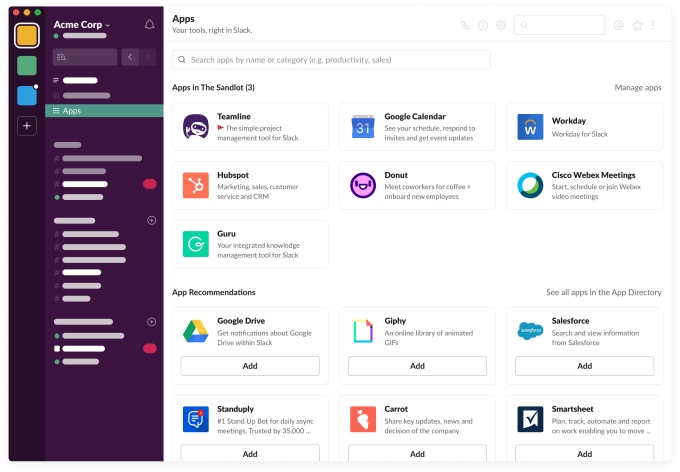
Slack App Launcher (Image: Slack)
You access App Launcher from the Slack sidebar by clicking Apps. It opens App Launcher with the apps that make sense for you. When you select an app, Pflaum says it takes you to that app’s home screen where it will be ready to enter or display relevant information.
For example, if you selected Google Calendar, you would see your daily schedule along with meeting requests, which you can accept or reject. You also can launch meeting software directly from this page. All of this happens within Slack, without having to change focus. App Home will be available in beta in the next few months, according to Pflaum.
Another way Slack is helping ease the app burden is with a new concept called Actions from Anywhere. The company actually launched Actions last year, enabling users to take an action from a message like attaching a Slack message to a pull request in Jira, as an example. Pflaum said that people liked these actions so much they were requesting the ability to take actions from anywhere in Slack.
“At Spec, we are previewing this new kind of action — Actions from Anywhere — which gives users the ability to take an action from anywhere they are in Slack,” Pflaum said. To really take advantage of this capability, the company is adding a feature to select the five most recent actions from a quick-access menu. These actions fill in automatically based on your most recent activities, and could be a real time-saver for people working inside Slack all day.
Finally, the company is enabling developers to open an external window inside Slack, what they call Modal windows, which open when users have to fill out a form, take a survey, enter expenses or provide additional information outside the flow of Slack itself.
All of these and other announcements at Spec are part of the maturation process of Slack as it moves to solve some of the pain points of growing so quickly. When you grow past the point of understanding what a complex piece of software can do, it’s up to the vendor to provide ways to surface all of the benefits and features, and that’s what Slack is attempting to do with these new tools.
Powered by WPeMatico