Enterprise
Auto Added by WPeMatico
Auto Added by WPeMatico
Amperity announced today that it’s acquiring another company in the customer data business, Custora.
Amperity co-founder and CEO Kabir Shahani told me that Custora’s technology complements what Amperity is already offering. To illustrate this point, he said that customer data tools fall into three big buckets: “The first is know your customer, the second is … use insights to make decisions, the third is … activate the data and use it to serve the customer.”
Amperity’s strength, Shahani said, is in that first bucket, while Custora’s is in the second. So with this acquisition (Amperity’s first), the existing Amperity technology will become the Amperity Customer 360, while Custora is rebranded as Amperity Insights.
The products can still be used separately, but Custora CEO Corey Pierson argued that they’re particularly powerful together.
“The stronger you actually know your customer, the stronger you have your customer 360 profile, the better those insights are,” Pierson said. “When we sit on top of Amperity, every insight we produce is more valuable to our customers.”
Shahani said Pierson and the rest of his team will be joining Seattle-based Amperity, with Custora’s New York office becoming the combined company’s East Coast headquarters.
The financial terms of the acquisition were not disclosed. According to Crunchbase, Custora previously raised a total of $20.3 million in funding.
Powered by WPeMatico
Seismic is announcing that it’s acquiring Percolate in a deal that it says is combining “two essential pillars of the marketing technology stack.”
It sounds like the two companies aren’t direct competitors, but they offer related tools: Seismic helps companies create and manage the content they use in sales and marketing, while Percolate expanded from a social media publishing tool to a broader suite of software for managing the marketing process.
As part of the acquisition, Percolate CEO Randy Wootton is joining the Seismic team, where he will continue to lead Percolate, and where he will report to Seismic CEO Doug Winter. The combined company will have a headcount of more than 800 people.
“Both of our companies endeavor to foster better alignment between marketing and sales and improve the buyer/seller interaction, resulting in accelerated deals and pipeline for our customers,” Wootton said in a statement. “Combining with Seismic allows Percolate to provide even more capability to our customer base and more value to the marketing ecosystem.”
The financial terms of the acquisition were not disclosed. Percolate raised a total of $106.5 million from investors including GGV Capital, Sequoia Capital, Lightspeed, Slow Ventures, Lerer Hippeau and First Round Capital, according to Crunchbase.
Seismic, meanwhile, raised a $100 million investment at a $1 billion valuation last year.
Powered by WPeMatico

ZenHub, the popular project management tool that integrates right into GitHub, today announced the launch of Roadmaps. As you can guess from the name, this is a roadmapping feature that allows teams to better plan their projects ahead of time and visualize their status — all from within GitHub.
“We’re diving into a brand new category which is super exciting and we’re really starting to think not only about how forward-thinking software teams are managing their software projects but how they’re actually planning ahead,” ZenHub co-founder Aaron Upright told me. “And we’re really using this as an opportunity to really evolve the product and really introduce now a new kind of entrant into the space for product roadmapping.”
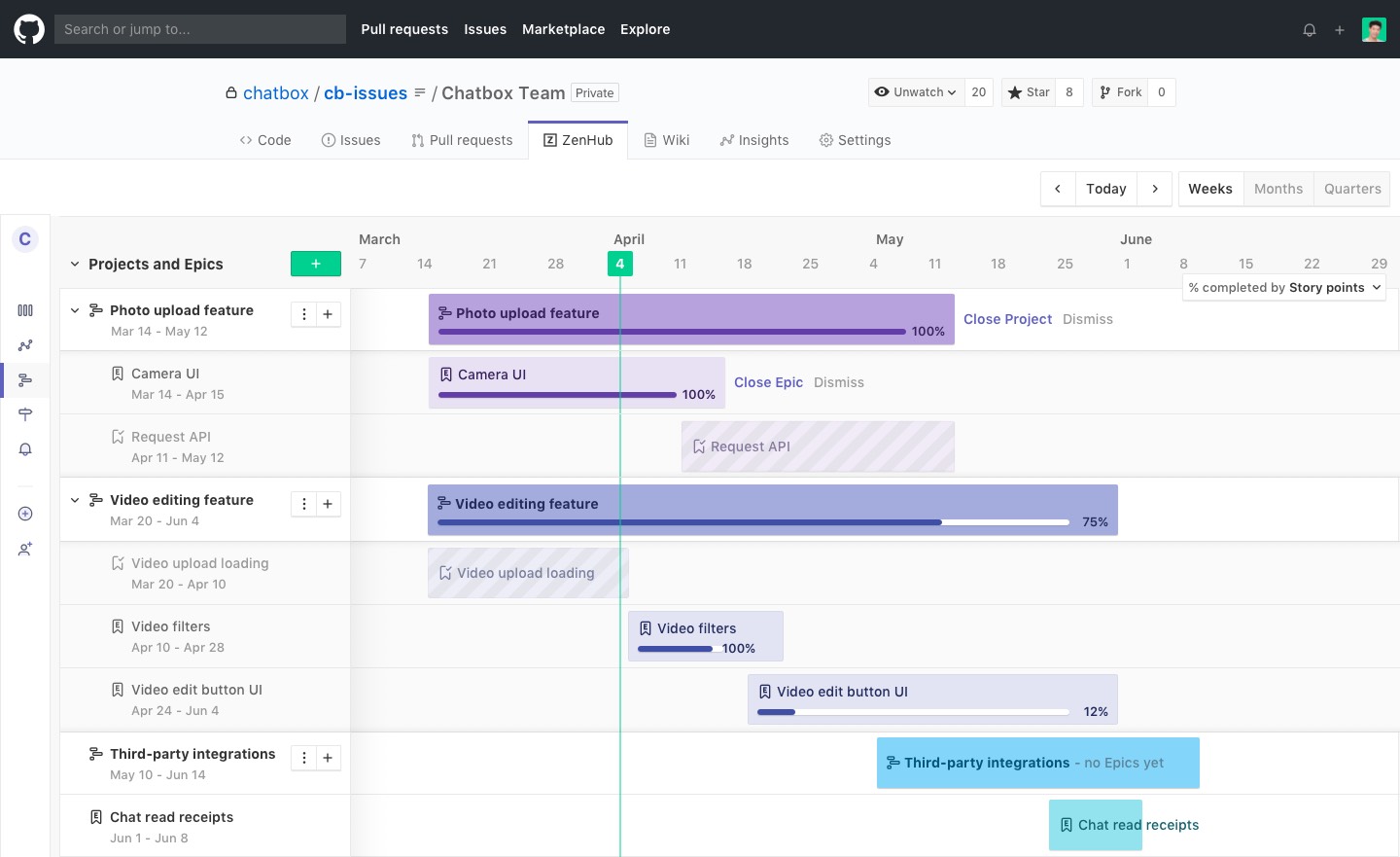
The product itself is indeed pretty straightforward. By default, it takes existing projects and epics a team has already defined and visualizes those on a timeline — including data about how many open issues still remain. In its current iteration, the tool is still pretty basic, but going forward ZenHub will add more advanced features, like blocking. As Upright noted, that’s just fine, though, because while the main goal here is to help teams plans, ZenHub also wants to give other stakeholders a kind of 30,000-foot overview of the state of a project without having to click around every issue in GitHub or Jira.
Upright also argues that existing solutions tend to fall short of what teams really need. “Smaller organizations — teams that are 10, 15 or 25 people — they can’t afford these tools. They’re really expensive. They’re cost-prohibitive,” he said. “And so oftentimes what they do is they turn to Excel files or Google spreadsheets in order to keep track of their roadmap. And keeping the spreadsheets up to date really becomes a complex and really a full-time job.” Yet those tools that are affordable often don’t offer a way to sync data back and forth between GitHub and their platforms, which results in the product team not getting those updates in GitHub, for example. Because ZenHub lives inside of GitHub, that’s obviously not a problem.
ZenHub Roadmaps is now available to all users.

Powered by WPeMatico
Chronosphere, a startup from two ex-Uber engineers who helped create the open-source M3 monitoring project to handle Uber-level scale, officially launched today with the goal of building a commercial company on top of the open-source project.
It also announced an $11 million investment led by Greylock, with participation from venture capitalist Lee Fixel.
While the founders, CEO Martin Mao and CTO Rob Skillington, were working at Uber, they recognized a gap in the monitoring industry, particularly around cloud-native technologies like containers and microservices. There weren’t any tools available on the market that could handle Uber’s scaling requirements — so like any good engineers, they went out and built their own.
“We looked around at the market at the time and couldn’t find anything in open source or commercially available that could really scale to our needs. So we ended up building and open sourcing our solution, which is M3. Over the last three to four years we’ve scaled M3 to one of the largest production monitoring systems in the world today,” Mao explained.
The essential difference between M3 and other open-source, cloud-native monitoring solutions like Prometheus is that ability to scale, he says.
One of the main reasons they left to start a company, with the blessing of Uber, was that the community began asking for features that didn’t really make sense for Uber. By launching Chronosphere, Mao and Skillington would be taking on the management of the project moving forward (although sharing governance for the time being with Uber), while building those enterprise features the community has been requesting.
The new company’s first product will be a cloud version of M3 to help reduce some of the complexity associated with managing an M3 project. “M3 itself is a fairly complex piece of technology to run. It is solving a fairly complex problem at large scale, and running it actually requires a decent amount of investment to run at large scale, so the first thing we’re doing is taking care of that management,” Mao said.
Jerry Chen, who led the investment at Greylock, saw a company solving a big problem. “They were providing such a high-resolution view of what’s going on in your cloud infrastructure and doing that at scale at a cost that actually makes sense. They solved that problem at Uber, and I saw them, and I was like wow, the rest of the market needs what guys built and I wrote the Series A check. It was as simple as that,” Chen told TechCrunch.
The cloud product is currently in private beta; they expect to open to public beta early next year.
Powered by WPeMatico
Workday announced this afternoon that it has entered into an agreement to acquire online procurement platform Scout RFP for $540 million. The company raised more than $60 million on a post valuation of $184.5 million, according to PitchBook data.
The acquisition builds on top of Workday’s existing procurement solutions, Workday Procurement and Workday Inventory, but Workday chief product product officer Petros Dermetzis wrote in a blog post announcing the deal that Scout gives the company a more complete solution for customers.
“With increased importance around the supplier as a strategic asset, the acquisition of Scout RFP will help accelerate Workday’s ability to deliver a comprehensive source-to-pay solution with a best-in-class strategic sourcing offering, elevating the office of procurement in strategic importance and transforming the procurement function,” he wrote.
Ray Wang, founder and principal analyst at Constellation Research says that Workday has been trying to be the end-to-end cloud back office player. In spite of their own offerings in this area, he says, “One of their big gaps has been in procurement.”
Wang says that Workday has been investing with eye toward filling gaps in the product set for some time. In fact, Workday Ventures has been an investor in Scout RFP since 2018, and it’s also an official Workday partner.
“A lot of the Workday investments are in portfolio companies that are complimentary to Workday’s larger vision of the future of Cloud ERP. Today’s definition of ERP includes finance, HCM (human capital management), projects, procurement, supply chai and asset management, Wang told TechCrunch
As the Scout RFP founders stated in a blog post about today’s announcement, the two companies have worked well together and a deal made sense. “Working closely with the Workday team, we realized how similar our companies’ beliefs and values are. Both companies put user experience at the center of product focus and are committed to customer satisfaction, employee engagement and overall business impact. It was not surprising how easy it was to work together and how quickly we saw success partnering on go-to-market activities. From a culture standpoint, it just worked,” they wrote. A deal eventually came together as a result.
Scout RFP is a fairly substantial business, with 240 customers in 155 countries. There are 300,000 users on the platform, according to data supplied by the company. The company’s 160 employees will be moving to Workday when the deal closes, which is expected by the end of January, pending standard regulatory review.
Powered by WPeMatico

It’s Microsoft Ignite this week, the company’s premier event for IT professionals and decision-makers. But it’s not just about new tools for role-based access. Ignite is also very much a forward-looking conference that keeps the changing role of IT in mind. And while there isn’t a lot of consumer news at the event, the company does tend to make a few announcements for developers, as well.
This year’s Ignite was especially news-heavy. Ahead of the event, the company provided journalists and analysts with an 87-page document that lists all of the news items. If I counted correctly, there were about 175 separate announcements. Here are the top seven you really need to know about.
What was announced: Microsoft was among the first of the big cloud vendors to bet big on hybrid deployments. With Arc, the company is taking this a step further. It will let enterprises use Azure to manage their resources across clouds — including those of competitors like AWS and Google Cloud. It’ll work for Windows and Linux Servers, as well as Kubernetes clusters, and also allows users to take some limited Azure data services with them to these platforms.
Why it matters: With Azure Stack, Microsoft already allowed businesses to bring many of Azure’s capabilities into their own data centers. But because it’s basically a local version of Azure, it only worked on a limited set of hardware. Arc doesn’t bring all of the Azure Services, but it gives enterprises a single platform to manage all of their resources across the large clouds and their own data centers. Virtually every major enterprise uses multiple clouds. Managing those environments is hard. So if that’s the case, Microsoft is essentially saying, let’s give them a tool to do so — and keep them in the Azure ecosystem. In many ways, that’s similar to Google’s Anthos, yet with an obvious Microsoft flavor, less reliance on Kubernetes and without the managed services piece.

What was announced: Project Cortex creates a knowledge network for your company. It uses machine learning to analyze all of the documents and contracts in your various repositories — including those of third-party partners — and then surfaces them in Microsoft apps like Outlook, Teams and its Office apps when appropriate. It’s the company’s first new commercial service since the launch of Teams.
Why it matters: Enterprises these days generate tons of documents and data, but it’s often spread across numerous repositories and is hard to find. With this new knowledge network, the company aims to surface this information proactively, but it also looks at who the people are who work on them and tries to help you find the subject matter experts when you’re working on a document about a given subject, for example.

What was announced: Microsoft is combining its ConfigMgr and Intune services that allow enterprises to manage the PCs, laptops, phones and tablets they issue to their employees under the Endpoint Manager brand. With that, it’s also launching a number of tools and recommendations to help companies modernize their deployment strategies. ConfigMgr users will now also get a license to Intune to allow them to move to cloud-based management.
Why it matters: In this world of BYOD, where every employee uses multiple devices, as well as constant attacks against employee machines, effectively managing these devices has become challenging for most IT departments. They often use a mix of different tools (ConfigMgr for PCs, for example, and Intune for cloud-based management of phones). Now, they can get a single view of their deployments with the Endpoint Manager, which Microsoft CEO Satya Nadella described as one of the most important announcements of the event, and ConfigMgr users will get an easy path to move to cloud-based device management thanks to the Intune license they now have access to.
What was announced: Microsoft’s Chromium-based version of Edge will be generally available on January 15. The release candidate is available now. That’s the culmination of a lot of work from the Edge team, and, with today’s release, the company is also adding a number of new privacy features to Edge that, in combination with Bing, offers some capabilities that some of Microsoft’s rivals can’t yet match, thanks to its newly enhanced InPrivate browsing mode.
Why it matters: Browsers are interesting again. After years of focusing on speed, the new focus is now privacy, and that’s giving Microsoft a chance to gain users back from Chrome (though maybe not Firefox). At Ignite, Microsoft also stressed that Edge’s business users will get to benefit from a deep integration with its updated Bing engine, which can now surface business documents, too.

What was announced: At Build earlier this year, Microsoft announced that it would soon launch a web-based version of its Visual Studio development environment, based on the work it did on the free Visual Studio Code editor. This experience, with deep integrations into the Microsoft-owned GitHub, is now live in a preview.
Why it matters: Microsoft has long said that it wants to meet developers where they are. While Visual Studio Online isn’t likely to replace the desktop-based IDE for most developers, it’s an easy way for them to make quick changes to code that lives in GitHub, for example, without having to set up their IDE locally. As long as they have a browser, developers will be able to get their work done.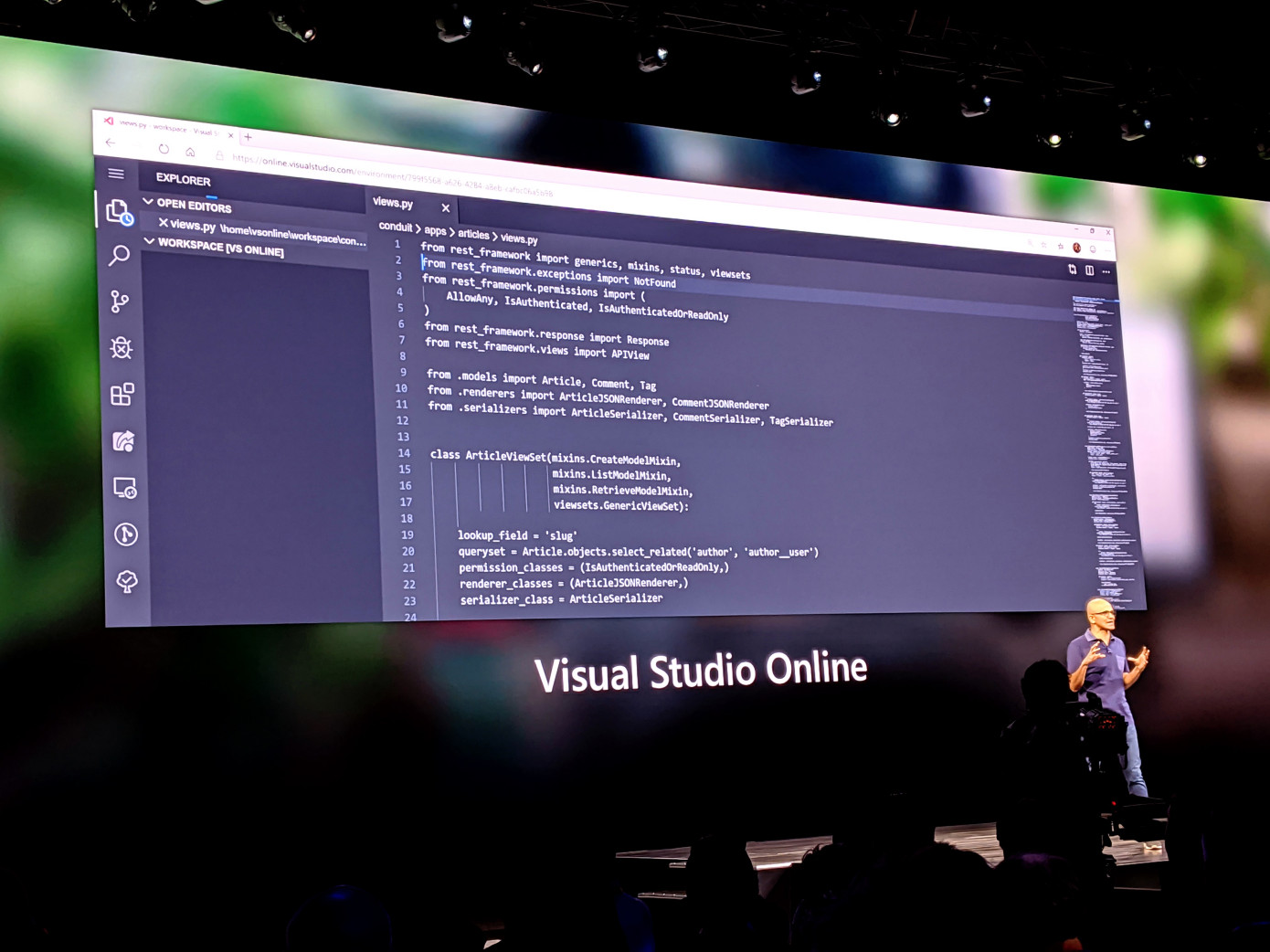 .
.
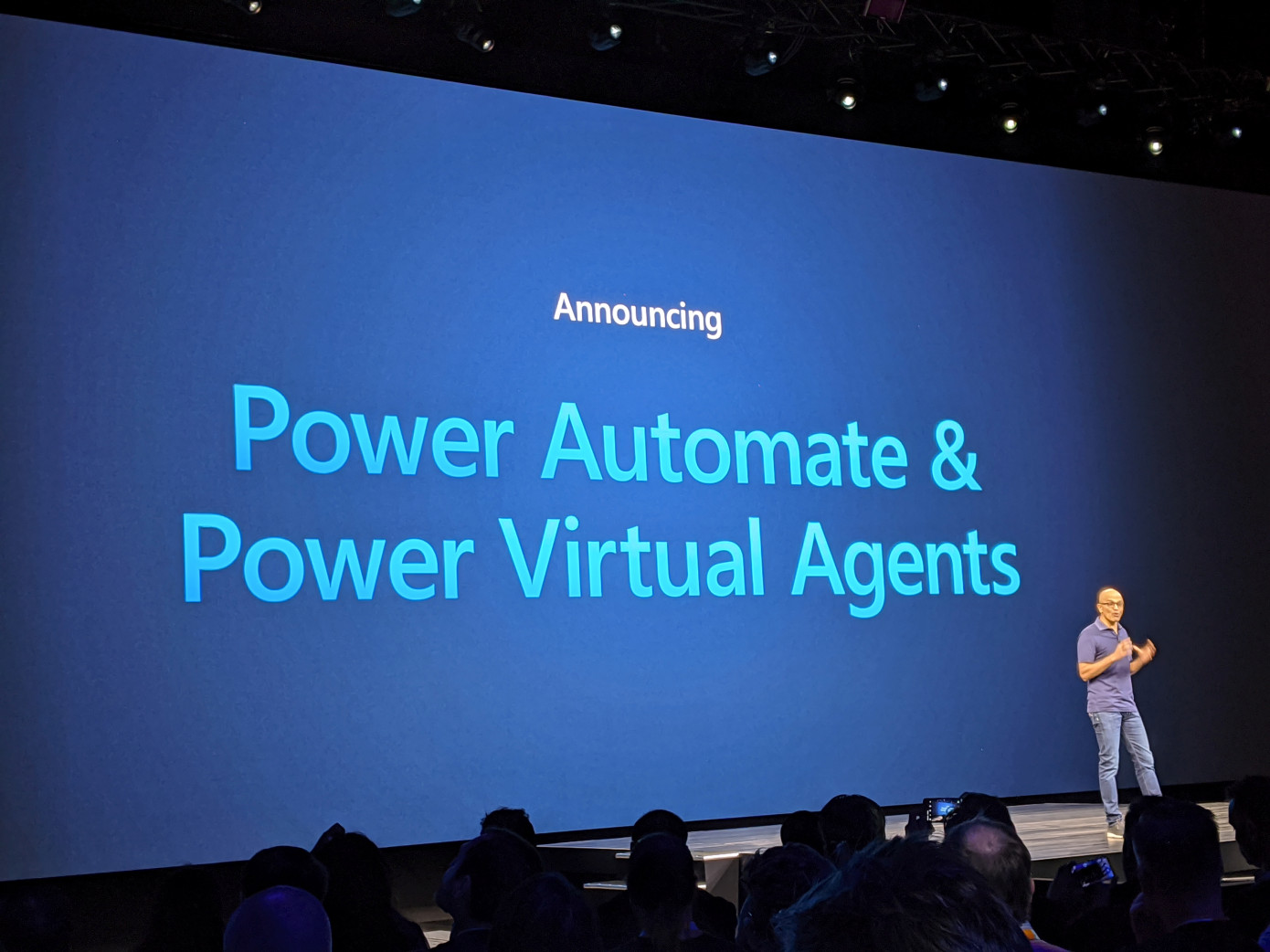
What was announced: Power Virtual Agents is Microsoft’s new no-code/low-code tool for building chatbots. It leverages a lot of Azure’s machine learning smarts to let you create a chatbot with the help of a visual interface. In case you outgrow that and want to get to the actual code, you can always do so, too.
Why it matters: Chatbots aren’t exactly at the top of the hype cycle, but they do have lots of legitimate uses. Microsoft argues that a lot of early efforts were hampered by the fact that the developers were far removed from the user. With a visual too, though, anybody can come in and build a chatbot — and a lot of those builders will have a far better understanding of what their users are looking for than a developer who is far removed from that business group.
What was announced: Cortana lives — and it now also has a male voice. But more importantly, Microsoft launched a few new focused Cortana-based experiences that show how the company is focusing on its voice assistant as a tool for productivity. In Outlook on iOS (with Android coming later), Cortana can now read you a summary of what’s in your inbox — and you can have a chat with it to flag emails, delete them or dictate answers. Cortana can now also send you a daily summary of your calendar appointments, important emails that need answers and suggest focus time for you to get actual work done that’s not email.
Why it matters: In this world of competing assistants, Microsoft is very much betting on productivity. Cortana didn’t work out as a consumer product, but the company believes there is a large (and lucrative) niche for an assistant that helps you get work done. Because Microsoft doesn’t have a lot of consumer data, but does have lots of data about your work, that’s probably a smart move.

SAN FRANCISCO, CA – APRIL 02: Microsoft CEO Satya Nadella walks in front of the new Cortana logo as he delivers a keynote address during the 2014 Microsoft Build developer conference on April 2, 2014 in San Francisco, California (Photo by Justin Sullivan/Getty Images)
Bonus: Microsoft agrees with you and thinks meetings are broken — and often it’s the broken meeting room that makes meetings even harder. To battle this, the company today launched Managed Meeting Rooms, which for $50 per room/month lets you delegate to Microsoft the monitoring and management of the technical infrastructure of your meeting rooms.

Powered by WPeMatico

There’s too much hype about mythical “10X developers.” Everyone’s desperate to hire these “ninja rockstars.” In reality, it’s smarter to find ways of deleting annoying chores for the coders you already have. That’s where CTO.ai comes in.
Emerging from stealth today, CTO.ai lets developers build and borrow DevOps shortcuts. These automate long series of steps they usually have to do manually, thanks to integrations with GitHub, AWS, Slack and more. CTO.ai claims it can turn a days-long process like setting up a Kubernetes cluster into a 15-minute task even sales people can handle. The startup offers both a platform for engineering and sharing shortcuts, and a service where it can custom build shortcuts for big customers.

What’s remarkable about CTO.ai is that amidst a frothy funding environment, the 60-person team quietly bootstrapped its way to profitability over the past two years. Why take funding when revenue was up 400% in 18 months? But after a chance meeting aboard a plane connected its high school dropout founder Kyle Campbell with Slack CEO Stewart Butterfield, CTO.ai just raised a $7.5 million seed round led by Slack Fund and Tiger Global.
“Building tools that streamline software development is really expensive for companies, especially when they need their developers focused on building features and shipping to customers,” Campbell tells me. The same way startups don’t build their own cloud infrastructure and just use AWS, or don’t build their own telecom APIs and just use Twilio, he wants CTO.ai to be the “easy button” for developer tools.
“I’ve been a software engineer since the age of 8,” Campbell recalls. In skate-punk attire with a snapback hat, the young man meeting me in a San Francisco Mission District cafe almost looked too chill to be a prolific coder. But that’s kind of the point. His startup makes being a developer more accessible.
After spending his 20s in software engineering groups in the Bay, Campbell started his own company, Retsly, that bridged developers to real estate listings. In 2014, it was acquired by property tech giant Zillow, where he worked for a few years.
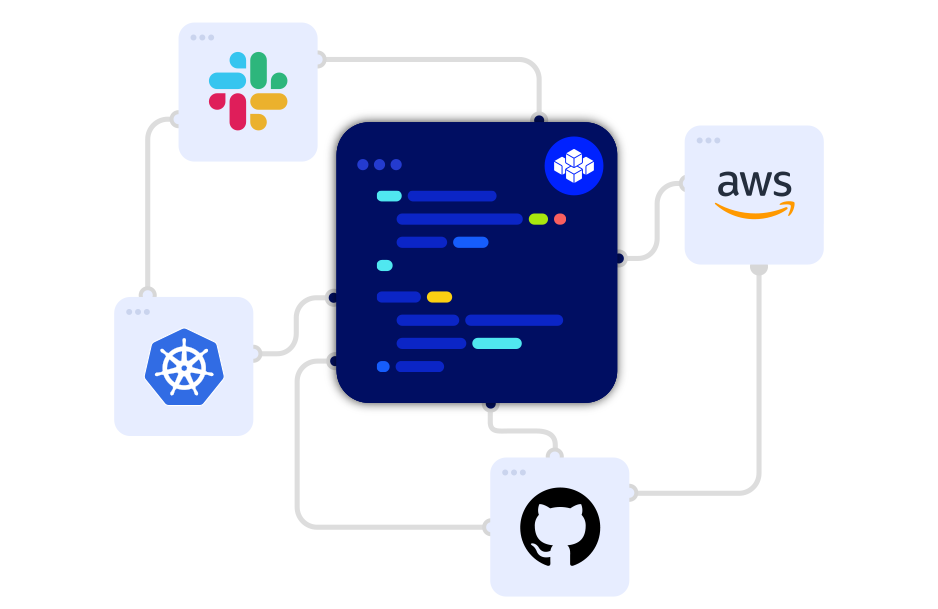
That’s when he discovered the difficulty of building dev tools inside companies with other priorities. “It’s the equivalent of a snake swallowing an elephant,” he jokes. Yet given these tools determine how much time expensive engineers waste on tasks below their skill level, their absence can drag down big enterprises or keep startups from rising.
CTO.ai shrinks the elephant. For example, the busywork of creating a Kubernetes cluster such as having to the create EC2 instances, provision on those instances and then provision a master node gets slimmed down to just running a shortcut. Campbell writes that “tedious tasks like running reports can be reduced from 1,000 steps down to 10,” through standardization of workflows that turn confusing code essays into simple fill-in-the-blank and multiple-choice questions.

The CTO.ai platform offers a wide range of pre-made shortcuts that clients can piggyback on, or they can make and publish their own through a flexible JavaScript environment for the rest of their team or the whole community to use. Companies that need extra help can pay for its DevOps-as-a-Service and reliability offerings to get shortcuts made to solve their biggest problems while keeping everything running smoothly.
Campbell envisions a new way to create a 10X engineer that doesn’t depend on widely mocked advice on how to spot and capture them like trophy animals. Instead, he believes one developer can make five others 2X more efficient by building them shortcuts. And it doesn’t require indulging bad workplace or collaboration habits.
With the new funding that also comes from Yaletown Partners, Pallasite Ventures, Panache Ventures and Jonathan Bixby, CTO.ai wants to build deeper integrations with Slack so developers can run more commands right from the messaging app. The less coding required for use, the broader the set of employees that can use the startup’s tools. CTO.ai may also build a self-service tier to augment its seats, plus a complexity model for enterprise pricing.

Now it’s time to ramp up community outreach to drive adoption. CTO.ai recently released a podcast that saw 15,000 downloads in its first three weeks, and it’s planning some conference appearances. It also sees virality through its shortcut author pages, which, like GitHub profiles, let developers show off their contributions and find their next gig.
One risk is that GitHub or another core developer infrastructure provider could try to barge directly into CTO.ai’s business. Google already has Cloud Composer, while GitHub launched Actions last year. Campbell says its defense comes through neutrally integrating with everyone, thereby turning potential competitors into partners.
The funding firepower could help CTO.ai build a lead. With every company embracing software, employers battling to keep developers happy and teams looking to get more of their staff working with code, the startup sits at the intersection of some lucrative trends of technological empowerment.
“I have a three-year-old at home and I think about what it will be like when he comes into creating things online,” Campbell concludes. “We want to create an amazing future for software developers, introducing automation so they can focus on what makes them such an important aspect. Devs are defining society!”
[Image Credit: Disney/Pixar via WallHere Goodfon]
Powered by WPeMatico
Volterra is an early-stage startup that has been quietly working on a comprehensive solution to help companies manage applications in hybrid environments. The company emerged from stealth today with a $50 million investment and a set of products.
Investors include Khosla Ventures and Mayfield, along with strategic investors M12 (Microsoft’s venture arm), Itochu Technology Ventures and Samsung NEXT. The company, which was founded in 2017, already has 100 employees and more than 30 customers.
What attracted these investors and customers is a full-stack solution that includes both hardware and software to manage applications in the cloud or on-prem. Volterra founder and CEO Ankur Singla says when he was at his previous company, Contrail Systems, which was acquired by Juniper Networks in 2012 for $176 million, he saw first-hand how large companies were struggling with the transition to hybrid.
“The big problem we saw was in building and operating applications that scale is a really hard problem. They were adopting multiple hybrid cloud strategies, and none of them solved the problem of unifying the application and the infrastructure layer, so that the application developers and DevOps teams don’t have to worry about that,” Singla explained.
He says the Volterra solution includes three main products — VoltStack, VoltMesh and VoltConsole — to help solve this scaling and management problem. As Volterra describes the total solution, “Volterra has innovated a consistent, cloud-native environment that can be deployed across multiple public clouds and edge sites — a distributed cloud platform. Within this SaaS-based offering, Volterra integrates a broad range of services that have normally been siloed across many point products and network or cloud providers.” This includes not only the single management plane, but security, management and operations components.
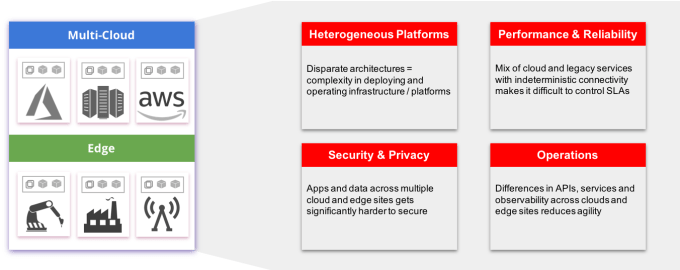
Diagram: Volterra
The money has come over a couple of rounds, helping to build the solution to this point, and it required a complex combination of hardware and software to do it. They are hoping organizations that have been looking for a cloud-native approach to large-scale applications, such as industrial automation, will adopt this approach.
Powered by WPeMatico
Robotic Process Automation (RPA) has been a hot commodity in recent years as it helps automate tedious manual workflows inside large organizations. Robocorp, a San Francisco startup, wants to bring open source and RPA together. Today it announced a $5.6 million seed investment.
Benchmark led the round, with participation from Slow Ventures, firstminute Capital, Bret Taylor (president and chief product officer at Salesforce) and Docker CEO Rob Bearden. In addition, Benchmark’s Peter Fenton will be joining the company’s board.
Robocorp co-founder and CEO Antti Karjalainen has been around open-source projects for years, and he saw an enterprise software category that was lacking in open-source options. “We actually have a unique angle on RPA, where we are introducing open source and cloud native technology into the market and focusing on developer-led technologies,” Karjalainen said.
He sees a market that’s top-down and focused on heavy sales cycles. He wants to bring the focus back to the developers who will be using the tools. “We are all about removing friction from developers. So, we are focused on giving developers tools that they like to use, and want to use for RPA, and doing it in an open-source model where the tools themselves are free to use,” he said.
The company is built on the open-source Robot Framework project, which was originally developed as an open-source software testing environment, but he sees RPA having a lot in common with testing, and his team has been able to take the project and apply it to RPA.
If you’re wondering how the company will make money, they are offering a cloud service to reduce the complexity even further of using the open-source tools, and that includes the kinds of features enterprises tend to demand from these projects, like security, identity and access management, and so forth.
Benchmark’s Peter Fenton, who has invested in several successful open-source startups, including JBoss, SpringSource and Elastic, sees RPA as an area that’s ripe for a developer-focused open-source option. “We’re living in the era of the developer, where cloud-native and open source provide the freedom to innovate without constraint. Robocorp’s RPA approach provides developers the cloud native, open-source tools to bring RPA into their organizations without the burdensome constraints of existing offerings,” Fenton said.
The company intends to use the money to add new employees and continue scaling the cloud product, while working to build the underlying open-source community.
While UIPath, a fast-growing startup with a hefty $7.1 billion valuation recently announced it was laying off 400 people, Gartner published a study in June showing that RPA is the fastest growing enterprise software category.
Powered by WPeMatico
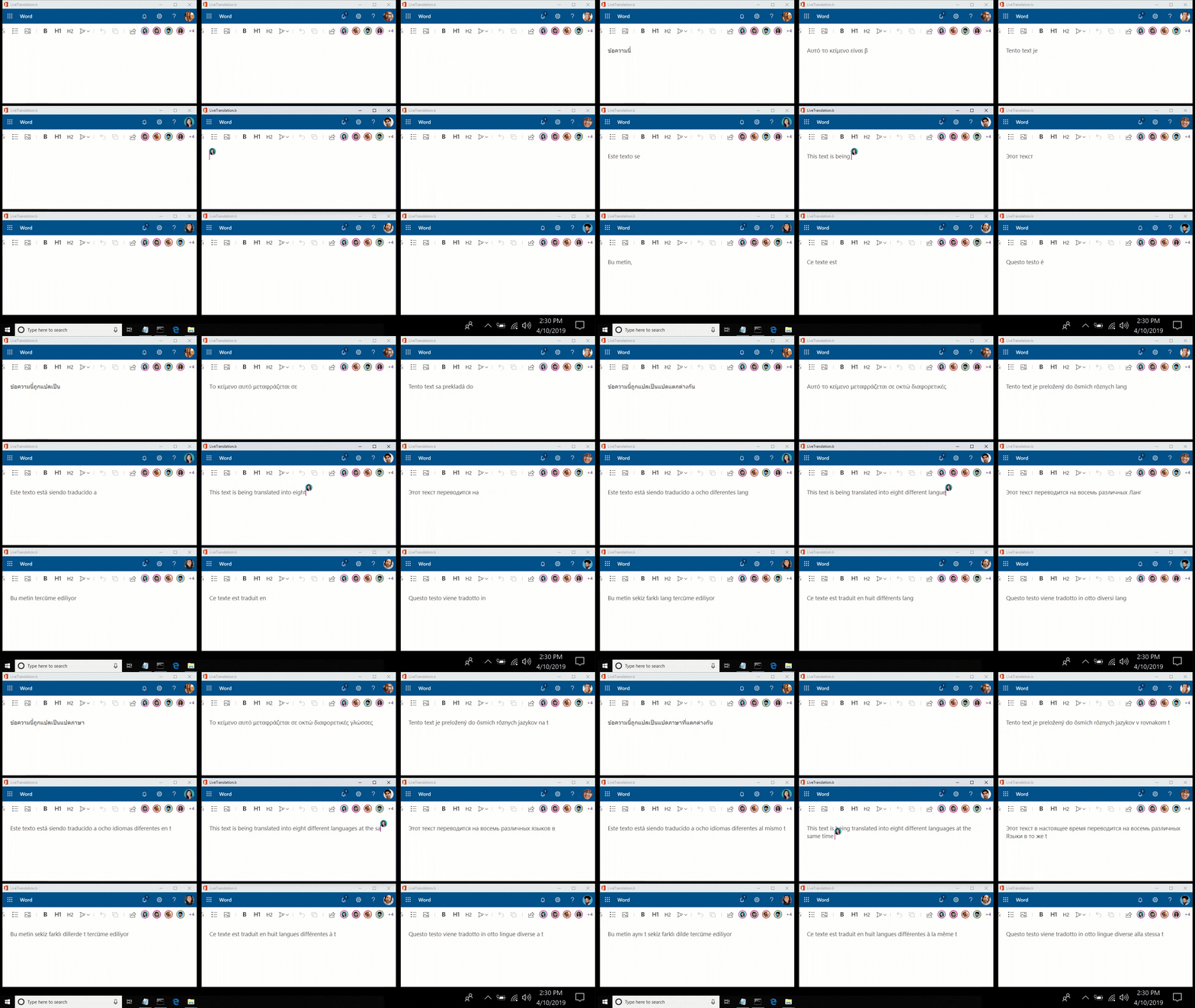
One of the most interesting (and confusing) news announcements of Microsoft’s Build developer conference earlier this year was the first public demo of the company’s Fluid Framework. Fluid is meant to make building collaborative real-time editing experiences easier for developers, but Microsoft is also building it into some of its own tools, like Office and Outlook. It’s nothing less than a re-imagining of what documents should look and feel like.
Today, at its Ignite conference in Orlando, Fla., Microsoft launched the first public preview of the Fluid Framework end-user experience, as well as a private preview for developers.
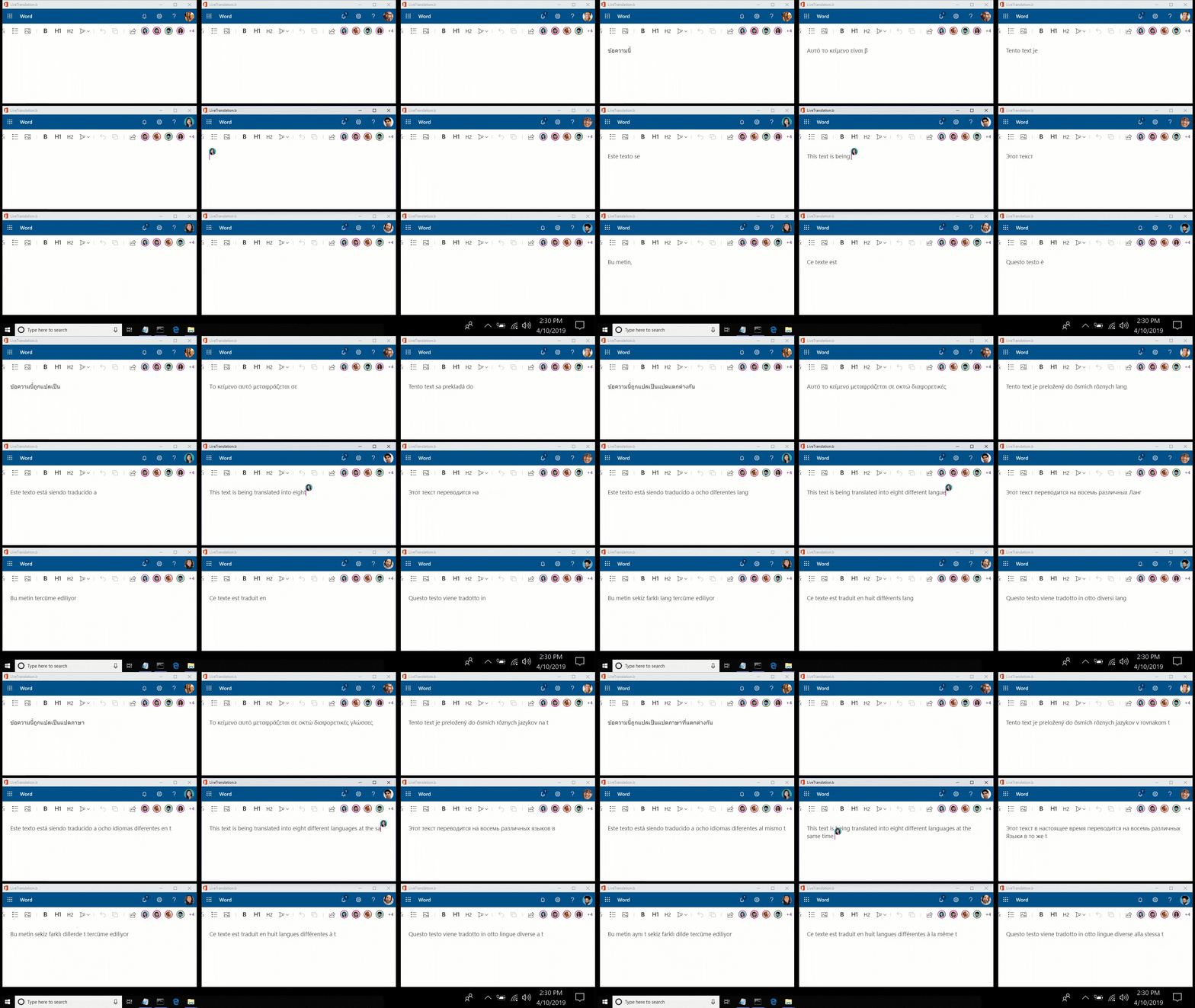
As Microsoft notes, the Fluid Framework has three main capabilities: the multi-person co-authoring features, the componentized document model and the ability to plug in intelligent agents that can, for example, translate text in real-time or suggest edits. To some degree, this isn’t all that different from Google Docs or even Microsoft’s own collaboration features in Office. But what’s new is that Microsoft is opening this up to developers and that it is looking at the Fluid Framework as a new way to deconstruct and componentize documents, which can then be used across applications.
Microsoft plans to build the Fluid Framework into lots of experiences across Microsoft 365, including Teams, Outlook, SharePoint, OneNote and Office. If you want to see it in action, you can now try the public preview to see what editing documents with it feels like.
Powered by WPeMatico