Enterprise
Auto Added by WPeMatico
Auto Added by WPeMatico
Moving data to the cloud from an on-prem data warehouse like Teradata is a hard problem to solve, especially if you’ve built custom applications that are based on that data. Datometry, a San Francisco startup, has developed a solution to solve that issue, and today it announced a $17 million Series B investment.
WRVI Capital led the round with participation from existing investors including Amarjit Gill, Dell Technologies Capital, Redline Capital and Acorn Pacific. The company has raised a total of $28 million, according to Crunchbase data.
The startup is helping move data and applications — lock, stock and barrel — to the cloud. For starters, it’s focusing on Teradata data warehouses and applications built on top of that because it’s a popular enterprise offering, says Mike Waas CEO and co-founder at the company.
“Pretty much all major enterprises are struggling right now with getting their data into the cloud. At Datometry, we built a software platform that lets them take their existing applications and move them over to new cloud technology as is, and operate with cloud databases without having to change any SQL or APIs,” Waas told TechCrunch.
Today, without Datometry, customers would have to hire expensive systems integrators and take months or years rewriting their applications, but Datometry says it has found a way to move the applications to the cloud, reducing the time to migrate from years to weeks or months, by using virtualization.
The company starts by building a new schema for the cloud platform. It supports all the major players including Amazon, Microsoft and Google. It then runs the applications through a virtual database running the schema and connects the old application with a cloud data warehouse like Amazon Redshift.
Waas sees virtualization as the key here as it enables his customers to run the applications just as they always have on prem, but in a more modern context. “Personally I believe that it’s time for virtualization to disrupt the database stack just the way it has disrupted pretty much everything else in the datacenter,” he said.
From there, they can start developing more modern applications in the cloud, but he says that his company can get them to the cloud faster and cheaper than was possible before, and without disrupting their operations in any major way.
Waas founded the company in 2013 and it took several years to build the solution. This is a hard problem to solve, and he was ahead of the curve in terms of trying to move this type of data. As his solution came online in the last 18 months, it turned out to be good timing as companies were suddenly looking for ways to move data and applications to the cloud.
He says he has been able to build a client base of 40 customers with 30 employees because the cloud service providers are helping with sales and walking them into clients, more than they can handle right now as a small startup.
The plan moving forward is to use some of the money from this round to build a partner network with systems integrators to help with implementation so that they can concentrate on developing the product and supporting other data repositories in the future.
Powered by WPeMatico
Tozny, a Portland, Oregon startup that wants to help companies more easily incorporate encryption into programs and processes, introduced TozID today. It is an identity and access control tool that can work independently or in conjunction with the company’s other encryption tools.
“Basically we have a Security as a Service platform, and it’s designed to help developers and IT departments add defense in depth by [combining] centralized user management with an end-to-end encryption platform,” Tozny CEO and founder Isaac Potoczny-Jones told TechCrunch.
The company is introducing an identity and access solution today with the hope of moving beyond its core developer and government audience to a broader enterprise customer base.
Under the hood, TozID uses standards identity constructs like single sign-on, SAML and OpenID, and it can plug into any existing identity framework, but the key here is that it’s encryption-based and uses Zero Knowledge identification. This allows a user (or application) to control information with a password while reducing the risk of sharing data because Tozny does not store passwords or send them over the network.
In this tool, the password acts as the encryption key, which enables users or applications to control access to data in a very granular way, only unlocking information for people or applications they want to be able to access that information.
As Potoczny-Jones pointed out, this can be as simple as one-to-one communication in an encrypted messaging app, but it can be more complex at the application layer depending on how it’s set up. “It’s really powerful to have a user make that decision, but that’s not the only use case. There are many different ways to enable who gets access to data, and this tool enforces those kinds of decisions with encryption,” he explained.
Regardless of how this is implemented, the user never has to understand encryption or even know that encryption is in play in the application. All they need to do is enter a password as they always have, and then Tozny deals with the complex parts under the hood using standard open source encryption algorithms.
The company also has a data privacy tool geared towards developers to build in end-to-end encryption into applications, whether that’s web, mobile, server and so forth. Developers can use the Tozny SDK to add encryption to their applications without a lot of encryption knowledge.
The company has been around since 2013 and hasn’t taken any private investment. Instead, it has developed an encryption toolkit for government agencies, including NIST and DARPA, that has acted as a funding mechanism.
“This is an open source toolkit on the client side, so that folks can vet it for security — cryptographers like that — and on the server side it’s a SaaS-type platform,” he said. The latter is how the company makes money, by selling the service.
“Our goal really here is to bring the kind of cybersecurity that we’ve been building for government agencies into the commercial market, so this is really work on our side to try to, you might say, bring it down market as the threat landscape moves up market,” he said.
Powered by WPeMatico
Model9, an Israeli startup launched by mainframe vets, has come up with a way to transfer data between mainframe computers and the cloud, and today the company announced a $9 million Series A.
Intel Capital led the round with help from existing investors, including StageOne, North First Ventures and Glenrock Israel. The company reports it has now raised almost $13 million.
You may not realize it, but the largest companies in the world, like big banks, insurance companies, airlines and retailers, still use mainframes. These companies require the massive transaction processing capabilities of these stalwart machines, but find it’s difficult to get the valuable data out for more modern analytics capabilities. This is the hard problem that Model9 is attempting to solve.
Gil Peleg, CEO and co-founder at Model9, says that his company’s technology is focused on helping mainframe users get their data to the cloud or other on-prem storage. “Mainframe data is locked behind proprietary storage that is inaccessible to anything that’s happening in the evolving, fast-moving technology world in the cloud. And this is where we come in with patented technology that enables mainframes to read and write data directly to the cloud or any non-mainframe distributed storage system,” Peleg explained.
This has several important use cases. For starters, it can act as a disaster recovery system, eliminating the need to maintain expensive tape backups. It also can move this data to the cloud where customers can apply modern analytics to data that was previously inaccessible.
The company’s solution works with AWS, Google Cloud Platform, Microsoft Azure and IBM’s cloud solution. It also works with other on-prem storage solutions like EMC, Nutanix, NetApp and Hitatchi. He says the idea is to give customers true hybrid cloud options, whether a private cloud or a public cloud provider.
“Ideally our customers will deploy a hybrid cloud topology and benefit from both worlds. The mainframe keeps doing what it should do as a reliable, secure, trusted [machine], and the cloud can manage the scale and the rapidly growing amount of data and provide the new modern technologies for disaster recovery, data management and analytics,” he said.
The company was founded in 2016 and took a couple of years to develop the solution. Today, the company is working with a number of large organizations using mainframes. Peleg says he wants to use the money to expand the sales and marketing operation to grow the market for this solution.
Powered by WPeMatico
In the old days of enterprise software, when companies like IBM, Oracle and Microsoft ruled the roost, there was a tendency to shop from a single vendor. You bought the whole stack, which made life easier for IT — even if it didn’t always work out so well for end users, who were stuck using software that was designed with administrators in mind.
Once Software-as-a-Service (SaaS) came along, IT no longer had complete control over software choices. The companies that dominated the market began to stumble — although Microsoft later found its way — and a new generation of SaaS vendors developed.
As that happened, users saw a way to pick and choose software that worked best for them, as they were no longer bound to clunky enterprise software; they wanted tools at work that worked as well as the ones they used in the consumer space at home.
Through freemium models and low-cost subscriptions, individual employees and teams started selecting their own tools, and a new way of buying software began to take hold. Instead of buying software from a single shop, consumers could buy the best tool for the job. This in turn, led to wider adoption, as these small groups of users led the way to more lucrative enterprise deals.
The philosophical change has worked well for enterprise startups. The new world means a well-executed idea can beat an incumbent with a similar product. Just ask companies like Slack, Zoom and Box, which have shown what’s possible when you put users first.
Powered by WPeMatico
Infosys is a huge consulting organization based in India, which works with clients as they implement complex software integrations. Today, the company announced it was buying Simplus, a Salesforce integration consultant, for $250 million.
The company, which is based in Salt Lake City, Utah, launched in 2014 and has raised almost $50 million, according to Crunchbase data. It brings a wide range of Salesforce consulting, training and integration services along with general Salesforce expertise, which Infosys hopes to put to work.
The acquisition follows the purchase of Fluido, another Salesforce consulting shop, in 2018. The moves suggest that Infosys wants to build deeper expertise around Salesforce and make that a key piece of its consulting operations moving forward.
Brent Leary, a CRM industry veteran, who is owner at CRM Essentials, says that Simplus is well-positioned in the Salesforce ecosystem to capture lucrative cloud integration services, and it should help expand Infosys’s Salesforce consulting arm. “By acquiring Simplus, it allows Infosys to grab more market share, while extending Salesforce capabilities to offer existing clients,” Leary told TechCrunch.
Ravi Kumar, president at Infosys, sees it in similar terms. “Simplus will be a valuable addition to the Infosys family. Complementing our industry knowledge and existing Salesforce footprint with their strong presence in key markets, deep Salesforce consulting and advisory expertise will help accelerate the transformation journey of incumbent companies,” Kumar said in a statement.
Holger Mueller, an analyst at Constellation Research, says Simplus should especially help in the area of Quote-to-Cash, that period after the sale when quotes are shared, contracts are signed and cash is collected on the sale. “It creates the opportunity for Infosys to break out of the vendor services silos and connect its Salesforce services with its ERP services (SAP, Oracle),” he said.
The deal is expected to close in Infosys’s fiscal 2020 fourth quarter. Per usual, it is subject to standard regulatory approval.
Powered by WPeMatico
As the number of IoT devices proliferate, and machines conduct transactions with machines without humans involved, it becomes increasingly necessary to have a permissionless system that facilitates this kind of communication in a secure way.
Enter the IOTA Foundation, a Berlin-based open-source distributed ledger technology (DLT) project, which has hooked up with the Eclipse Foundation to bring IOTA DLT to the enterprise via the Tangle EE project. For starters, this involves forming a working group.
The distributed ledger idea first emerged as a way to distribute digital currency on the blockchain. Since then, there have been multiple ideas, both open source and commercial, to bring this concept to the enterprise to provide a secure, immutable and frictionless way to share data.
One such open-source project is IOTA, which saw an issue with DLT as it was being implemented by other entities. “IOTA is the first distributed ledger technology that went beyond blockchain with a completely new architecture that resolves the bottleneck problems of blockchain that has prevented real-world adoption,” Dominik Schiener, co-founder of IOTA Foundation, told TechCrunch.
The broad vision is to provide a way for machines and devices to communicate securely. “We provide a protocol layer that enables both humans and machines to bulk transact value without fees, as well as ensure data integrity, which is, of course, increasingly important in the age of Internet of Things, where hundreds of billions of devices are being connected over the next decades,” Schiener said.
Tangle EE is the part of the project aimed at enterprise users — EE stands for Enterprise Edition — that can take this technology and enable larger organizations to build applications on top of the project. For starters the foundation is working with the Eclipse Foundation to bring corporate entities on board who can help better define the requirements of the large business user.
Dell Technologies and STMicroelectronics are the first major companies joining the project, but the hope is that through discussion and dialogue, Tangle EE will begin to gain traction. “The main reason why we created Tangle EE was because of the discussions that we’ve had with corporations. They really understood that we need to have a working group around IOTA to discuss the application layer, to discuss what kind of solutions we can develop broadly across industries, but also really start having more serious discussions about the protocol,” Schiener said.
Much like the Linux Foundation, the Eclipse Foundation will provide a governance framework for the project. “The Eclipse Foundation will provide a vendor-neutral governance framework for open collaboration, with IOTA’s scalable, feeless and permissionless DLT as a base,” Mike Milinkovich, executive director of the Eclipse Foundation, explained in a statement.
If it gains traction, more companies will join in the coming months and years, and begin building out Tangle EE, while developing applications based on the protocol.
Powered by WPeMatico
There have been plenty of stories written about the so-called “Slack-lash” and the growing unrest among workers dealing with DM interruptions that take their attention away from the task at hand. Slack is a poster child for the problem, but VCs have invested heavily in a number of collaboration tools over the past several years that have compartmentalized chat and commenting systems and have left workers reeling.
It seems fairly likely that we’ve reached peak VC interest in collaboration, but VCs are dealing with any slowdown by betting more heavily on tools that help workers make sense of the panoply of slick interfaced messaging tools. The latest bet, ’nuffsaid, is, yes, yet another productivity startup, though one that seems devoted to making the messaging realities of 2020 employment a bit more tolerable.
The Utah startup is emerging from stealth, launching the first element of their productivity platform in early access, and disclosing that they’ve raised $4.3 million in seed funding from General Catalyst, Google’s Gradient Ventures, Global Founders Capital, Work Life Ventures, SV Angel and Wasabi Ventures.
The oddly named company is releasing its first oddly named product, ‘nflow, into early access, bringing multiple collaboration platforms and a calendar into a single inbox. Just as the algorithmic timeline shaped how we digest the firehose of social media content, algorithmic inboxes might be the solution to a Slack-lash. And ’nuffsaid is taking this algorithmic approach for prioritizing Slack messages, as well as emails, texts and Zoom messages, with ‘nflow. The searchable unified inbox brings all of your messages into a single app, letting you know what’s urgent and what can probably wait until you’re finished taking care of the task at hand.
“We think there’s going to be an entire category of products that are all about adding AI into existing workflows. With ‘nflow, we think we’re taking our first baby step to our vision of that future,” CEO and co-founder Chris Hicken tells TechCrunch. Hicken was previously COO of UserTesting.
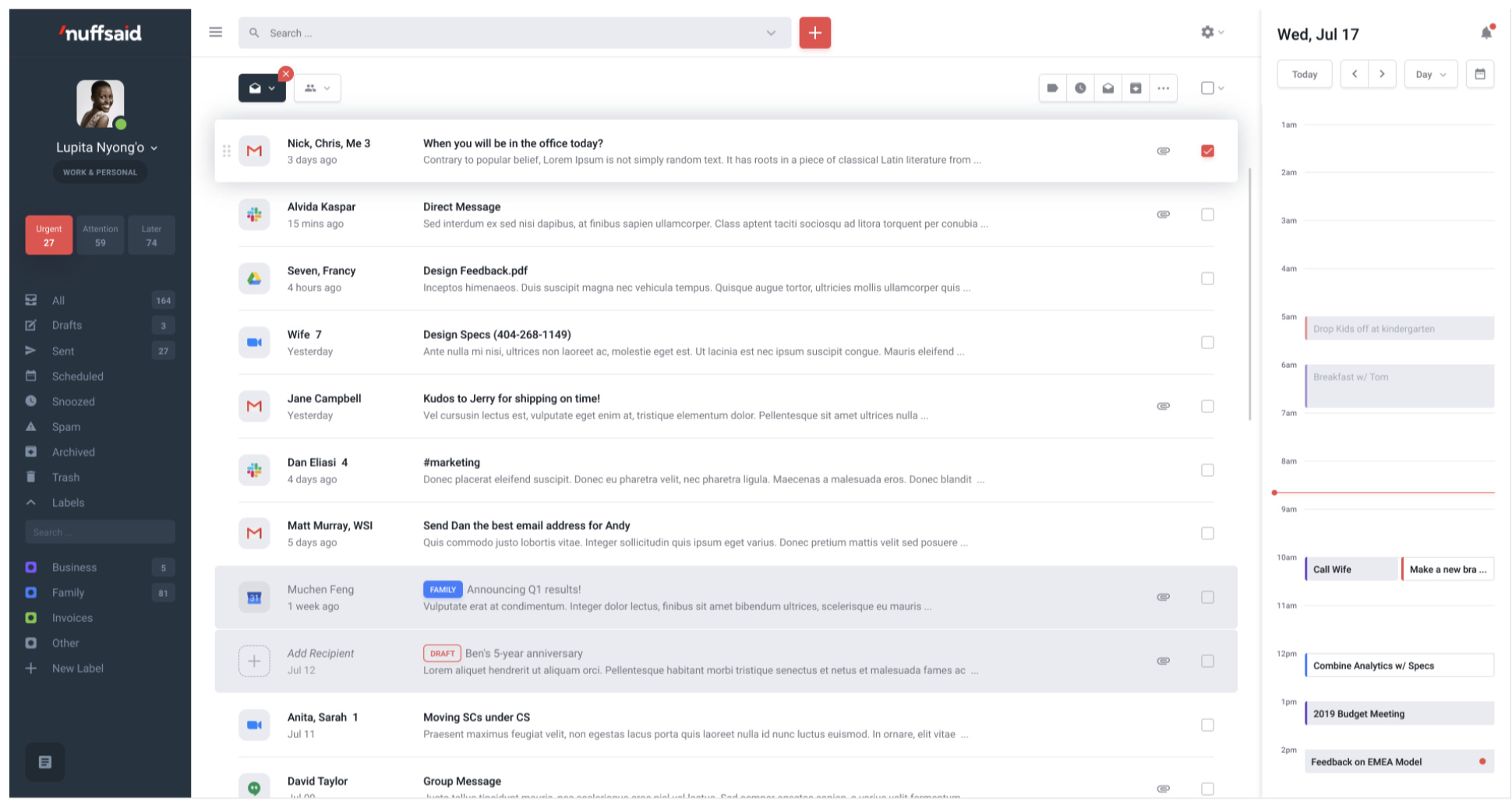
One of the more exciting elements of ‘nflow is the way it brings the calendar inside the communications hub. Google Calendar is still among the more estranged elements of productivity workflows. Using messages and emails as the basis for calendar events has always been a wishlist item, but the integration is rarely tight enough. Although ’nuffsaid’s drag-and-drop interface for creating calendar events while tagging team members and adding additional info showcases seems to be a pretty attractive solution, I’ll wait until I can poke around the app myself before making any full-throated endorsements.
The ’nuffsaid team says ‘nflow will launch commercially at (a rather pricey) $25 per month, but that people who sign up for their early access waitlist will unlock a lifetime rate of $10 per month.
The team of 18 has bigger near-term ambitions than the product they’re launching in early access today. If ‘nflow represents a more mass-market approach to delivering a productivity tool to workers frustrated by a messaging overload, their future launches signify a desire to dig deeper into specific enterprise workflows and bring specific types of teams on board.
Over the summer, the company plans to roll out a separate AI-driven customer success module that integrates with a variety of apps to give workers more actionable insights on what tasks are the most critical to maintaining and building customer relationships. The startup plans to build and roll out dedicated versions of the module for engineering, product and marketing, as well.
“There are so many collaboration tools, what I like about ’nuffsaid is that it’s where the work is actually happening and they’re not asking users to change their procedures,” General Catalyst Managing Director Niko Bonatsos tells TechCrunch. “Users still have the same email address, they’re still contacting their customers the same ways, they don’t have to start doing unnatural things that disrupt their workflows.”
Powered by WPeMatico
Negotiatus, a SaaS business meant to optimize and streamline the purchasing and procurement process for businesses, has today announced the close of a $10 million Series A round.
The funding was led by Rally Ventures, with participation from ERA, 645 Ventures, Green Visor Capital and Stage 2 Capital. This brings the company’s total funding to nearly $20 million.
Negotiatus was founded by Zach Garippa and Tom Jaklitsch with an idea to detangle the process of purchasing supplies for a business. Garippa told TechCrunch that most solutions to this problem focus on one piece of the puzzle, serving finance or operations or the purchasers themselves, but ultimately making the process more difficult for the other functions in the business.
Negotiatus pulls all of those stakeholders into a single platform where they can shop, place orders, track delivery information and manage spend all from one place.
For example, finance departments often have to manually review and remit payment for thousands of invoices a month, normally across at least several vendors and various formats. Negotiatus allows the finance department to view all of that in a weekly or monthly invoice.
Before Negotiatus, purchasers had to cross-reference approved brands, vendors and products each time they needed a new set of pens or toilet paper, jumping from one website to another and tracking shipments across multiple websites. Negotiatus scrapes your past purchase history to show purchasers what they want in a single place. And, of course, users can track those products directly from the Negotiatus dashboard.
Operations can centralize order requests and approvals within the Negotiatus platform, and leverage analytics provided by the company to make better purchasing decisions. Negotiatus scrapes the SKUs themselves, across vendors, to make sure that businesses are making the smartest possible decision with their budget.
The company says that it takes less than a day to get going on the platform.
Negotiatus generates revenue in two ways. The first is a regular subscription model that charges on a monthly basis for each location on the platform. The second is based on spend volume on the platform (which comes from the vendor side).
Thus far, Negotiatus has 300 customers, with a particular popularity among health and wellness businesses (SoulCycle, Orangetheory, CorePower Yoga) and co-working businesses (WeWork, Zeus, Domio). The company hopes to soon expand beyond physical products into software services.
Powered by WPeMatico
“It’s an open secret that every company is on fire,” says Kintaba co-founder John Egan. “At any given moment something is going horribly wrong in a way that it has never gone wrong before.” Code failure downtimes, server outages and hack attacks plague engineering teams. Yet the tools for waking up the right employees, assembling a team to fix the problem and doing a post-mortem to assess how to prevent it from happening again can be as chaotic as the crisis itself.
Text messages, Slack channels, task managers and Google Docs aren’t sufficient for actually learning from mistakes. Alerting systems like PagerDuty focus on the rapid response, but not the educational process in the aftermath. Finally, there’s a more holistic solution to incident response with today’s launch of Kintaba.
The Kintaba team experienced these pains firsthand while working at Facebook after Egan and Zac Morris’ Y Combinator-backed data transfer startup Caffeinated Mind was acqui-hired in 2012. Years later, when they tried to build a blockchain startup and the whole stack was constantly in flames, they longed for a better incident alert tool. So they built one themselves and named it after the Japanese art of Kintsugi, where gold is used to fill in cracked pottery, “which teaches us to embrace the imperfect and to value the repaired,” Egan says.
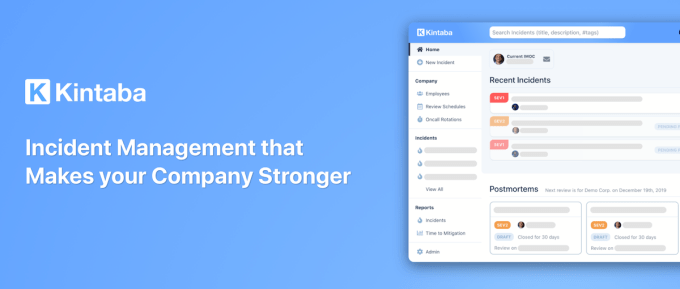
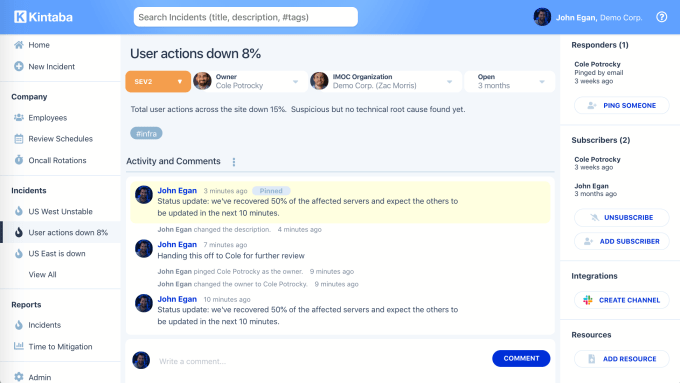
With today’s launch, Kintaba offers a clear dashboard where everyone in the company can see what major problems have cropped up, plus who’s responding and how. Kintaba’s live activity log and collaboration space for responders let them debate and analyze their mitigation moves. It integrates with Slack, and lets team members subscribe to different levels of alerts or search through issues with categorized hashtags.
“The ability to turn catastrophes into opportunities is one of the biggest differentiating factors between successful and unsuccessful teams and companies,” says Egan. That’s why Kintaba doesn’t stop when your outage does.

Kintaba Founders (from left): John Egan, Zac Morris and Cole Potrocky
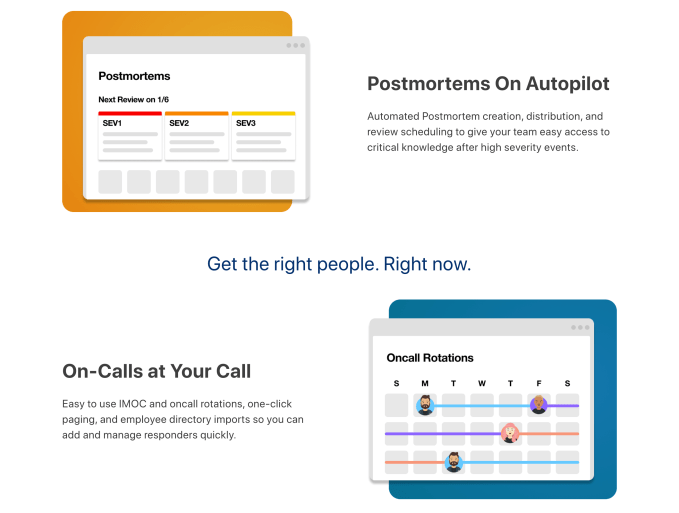
As the fire gets contained, Kintaba provides a rich text editor connected to its dashboard for quickly constructing a post-mortem of what went wrong, why, what fixes were tried, what worked and how to safeguard systems for the future. Its automated scheduling assistant helps teams plan meetings to internalize the post-mortem.
Kintaba’s well-pedigreed team and their approach to an unsexy but critical software-as-a-service attracted $2.25 million in funding led by New York’s FirstMark Capital.
“All these features add up to Kintaba taking away all the annoying administrative overhead and organization that comes with running a successful modern incident management practice,” says Egan, “so you can focus on fixing the big issues and learning from the experience.”
Egan, Morris and Cole Potrocky met while working at Facebook, which is known for spawning other enterprise productivity startups based on its top-notch internal tools. Facebook co-founder Dustin Moskovitz built a task management system to reduce how many meetings he had to hold, then left to turn that into Asana, which filed to go public this week.
The trio had been working on internal communication and engineering tools as well as the procedures for employing them. “We saw firsthand working at companies like Facebook how powerful those practices can be and wanted to make them easier for anyone to implement without having to stitch a bunch of tools together,” Egan tells me. He stuck around to co-found Facebook’s enterprise collaboration suite Workplace while Potrocky built engineering architecture there and Morris became a mobile security lead at Uber.
Like many blockchain projects, Kintaba’s predecessor, crypto collectibles wallet Vault, proved an engineering nightmare without clear product market fit. So the team ditched it and pivoted to build out the internal alerting tool they’d been tinkering with. That origin story sounds a lot like Slack’s, which began as a gaming company that pivoted to turn its internal chat tool into a business.
So what’s the difference between Kintaba and just using Slack and email or a monitoring tool like PagerDuty, Splunk’s VictorOps or Atlassian’s OpsGenie? Here’s how Egan breaks a site downtime situation handled with Kintaba:
You’re on call and your pager is blowing up because all your servers have stopped serving data. You’re overwhelmed and the root cause could be any of the multitude of systems sending you alerts. With Kintaba, you aren’t left to fend for yourself. You declare an incident with high severity and the system creates a collaborative space that automatically adds an experienced IMOC (incident manager on call) along with other relevant on calls. Kintaba also posts in a company-wide incident Slack channel. Now you can work together to solve the problem right inside the incident’s collaborative space or in Slack while simultaneously keeping stakeholders updated by directing them to the Kintaba incident page instead of sending out update emails. Interested parties can get quick info from the stickied comments and #tags. Once the incident is resolved, Kintaba helps you write a postmortem of what went wrong, how it was fixed, and what will be done to prevent it from happening. Kintaba then automatically distributes the postmortem and sets up an incident review on your calendar.
Essentially, instead of having one employee panicking about what to do until the team struggles to coordinate across a bunch of fragmented messaging threads, a smoother incident reporting process and all the discussion happens in Kintaba. And if there’s a security breach that a non-engineer notices, they can launch a Kintaba alert and assemble the legal and PR team to help, too.
Alternatively, Egan describes the downtime fiascoes he’d experience without Kintaba like this:
The on call has to start waking up their management chain to try and figure out who needs to be involved. The team maybe throws a Slack channel together but since there’s no common high severity incident management system and so many teams are affected by the downtime, other teams are also throwing slack channels together, email threads are happening all over the place, and multiple groups of people are trying to solve the problem at once. Engineers begin stepping all over each other and sales teams start emailing managers demanding to know what’s happening. Once the problem is solved, no one thinks to write up a postmortem and even if they do it only gets distributed to a few people and isn’t saved outside that email chain. Managers blame each other and point fingers at people instead of taking a level headed approach to reviewing the process that led to the failure. In short: panic, thrash, and poor communication.
While monitoring-apps like PagerDuty can do a good job of indicating there’s a problem, they’re weaker at the collaborative resolution and post-mortem process, and designed just for engineers rather than everyone, like Kintaba. Egan says, “It’s kind of like comparing the difference between the warning lights on a piece of machinery and the big red emergency button on a factory floor. We’re the big red button . . . That also means you don’t have to rip out PagerDuty to use Kintaba,” since it can be the trigger that starts the Kintaba flow.
 Still, Kintaba will have to prove that it’s so much better than a shared Google Doc, an adequate replacement for monitoring solutions or a necessary add-on that companies should pay $12 per user per month. PagerDuty’s deeper technical focus helped it go public a year ago, though it has fallen about 60% since to a market cap of $1.75 billion. Still, customers like Dropbox, Zoom and Vodafone rely on its SMS incident alerts, while Kintaba’s integration with Slack might not be enough to rouse coders from their slumber when something catches fire.
If Kintaba can succeed in incident resolution with today’s launch, the four-person team sees adjacent markets in task prioritization, knowledge sharing, observability and team collaboration, though those would pit it against some massive rivals. If it can’t, perhaps Slack or Microsoft Teams could be suitable soft landings for Kintaba, bringing more structured systems for dealing with major screw-ups to their communication platforms.
When asked why he wanted to build a legacy atop software that might seem a bit boring on the surface, Egan concluded that, “Companies using Kintaba should be learning faster than their competitors . . . Everyone deserves to work within a culture that grows stronger through failure.”
Powered by WPeMatico
Today, AWS made public its Motion to Supplement the Record in its protest of the JEDI contract decision. As part of that process, the company has announced it wants to depose President Trump and Secretary of Defense Mark Esper.
When Amazon announced at the end of last year that it was protesting the DoD’s decision to award the $10 billion, decade-long JEDI contract to Microsoft, the company made clear that it was not happy with the decision. The company believes that the president steered the contract away from Amazon because of personal political differences with Amazon CEO Jeff Bezos, who also owns The Washington Post.
“President Trump has repeatedly demonstrated his willingness to use his position as President and Commander in Chief to interfere with government functions – including federal procurements – to advance his personal agenda. The preservation of public confidence in the nation’s procurement process requires discovery and supplementation of the administrative record, particularly in light of President Trump’s order to ‘screw Amazon.’ The question is whether the President of the United States should be allowed to use the budget of the DoD to pursue his own personal and political ends,” an AWS spokesperson said in a statement.
This is consistent with public statements the company has been making since the DoD made the surprise decision in October to go with Microsoft. It had been widely believed that Amazon would win the contract, and there was much wrangling and complaining throughout the procurement process that the contract had been designed to favor Amazon, something that the DoD repeatedly denied.
At AWS re:Invent at the end last year, AWS CEO Andy Jassy made it clear he was unhappy with the decision and that he believed the president showed bias. “I think that we ended up with a situation where there was political interference. When you have a sitting president, who has shared openly his disdain for a company, and the leader of that company, it makes it really difficult for government agencies, including the DoD, to make objective decisions without fear of reprisal,” Jassy said last year.
Sources say that the DoD gave Amazon a written debriefing after the decision to award the contract to Microsoft, but the company is particularly upset that the department has failed to respond in a timely fashion to requests for additional information and questions, as required by law.
Powered by WPeMatico