Enterprise
Auto Added by WPeMatico
Auto Added by WPeMatico
I worked at Google for six years. Internally, you have no choice — you must use Kubernetes if you are deploying microservices and containers (it’s actually not called Kubernetes inside of Google; it’s called Borg). But what was once solely an internal project at Google has since been open-sourced and has become one of the most talked about technologies in software development and operations.
For good reason. One person with a laptop can now accomplish what used to take a large team of engineers. At times, Kubernetes can feel like a superpower, but with all of the benefits of scalability and agility comes immense complexity. The truth is, very few software developers truly understand how Kubernetes works under the hood.
I like to use the analogy of a watch. From the user’s perspective, it’s very straightforward until it breaks. To actually fix a broken watch requires expertise most people simply do not have — and I promise you, Kubernetes is much more complex than your watch.
How are most teams solving this problem? The truth is, many of them aren’t. They often adopt Kubernetes as part of their digital transformation only to find out it’s much more complex than they expected. Then they have to hire more engineers and experts to manage it, which in a way defeats its purpose.
Where you see containers, you see Kubernetes to help with orchestration. According to Datadog’s most recent report about container adoption, nearly 90% of all containers are orchestrated.
All of this means there is a great opportunity for DevOps startups to come in and address the different pain points within the Kubernetes ecosystem. This technology isn’t going anywhere, so any platform or tooling that helps make it more secure, simple to use and easy to troubleshoot will be well appreciated by the software development community.
In that sense, there’s never been a better time for VCs to invest in this ecosystem. It’s my belief that Kubernetes is becoming the new Linux: 96.4% of the top million web servers’ operating systems are Linux. Similarly, Kubernetes is trending to become the de facto operating system for modern, cloud-native applications. It is already the most popular open-source project within the Cloud Native Computing Foundation (CNCF), with 91% of respondents using it — a steady increase from 78% in 2019 and 58% in 2018.
While the technology is proven and adoption is skyrocketing, there are still some fundamental challenges that will undoubtedly be solved by third-party solutions. Let’s go deeper and look at five reasons why we’ll see a surge of startups in this space.
Docker revolutionized how developers build and ship applications. Container technology has made it easier to move applications and workloads between clouds. It also provides as much resource isolation as a traditional hypervisor, but with considerable opportunities to improve agility, efficiency and speed.
Powered by WPeMatico
Salesforce just closed a $28 billion mega-deal to buy Slack, generating significant debt along the way, but it’s not through spending big money.
Today the CRM giant announced it was taking a leap into streaming media with Salesforce+, a forthcoming digital media network with a focus on video that, in the words of the company, “will bring the magic of Dreamforce to viewers across the globe with luminary speakers.” (Whether that’s a good thing or not is in the eye of the beholder.)
Over the last year, Salesforce has watched companies struggle to quickly transform into fully digital entities. The Slack purchase is part of Salesforce’s response to the evolving market, but the company believes it can do even more with an on-demand video service providing business content around the clock.
Salesforce president and CMO Sarah Franklin said in an official post that her company has had to “reimagine how to succeed in the new digital-first world.” The answer apparently involves getting the larger Salesforce community together in a new live, and recorded video push.
In a Q&A with Colin Fleming, Salesforce’s senior vice president of Global Brand Marketing, he sees it as a way to evolve the content the company has been sharing all along. “As a result of the pandemic, we looked at the media landscape, where people are consuming content, and decided the days of white papers in a business-to-business setting were no longer interesting to people. We’re staring at a cookie-less future. And looking at the consumer world, we reflected on that for Salesforce and asked, “Why shouldn’t we be thinking about this too,” he said in the Q&A.
The company’s efforts are not small. Axios reports that there are “50 editorial leads” aboard the project to help it launch, and “hundreds of people at Salesforce currently working on Salesforce+” more broadly.
Notably Salesforce does not have near-term monetization plans for Salesforce+. The service will be free, and will not feature external advertising. Salesforce+ will launch in September in conjunction with Dreamforce and include four channels: Primetime for news and announcements, Trailblazer for training content, Customer 360 for success stories and Industry Channels for industry-specific offerings.
The company hopes that by combining the announcement with Dreamforce, it will help drive interest in what Salesforce has cooked up. After the Dreamforce push, Salesforce+ will enter into interesting territory. How much do Salesforce customers, and the larger business community, really want what the company describes as “compelling live and on-demand content for every role, industry and line of business,” and “engaging stories, thought leadership and expert advice”?
Salesforce is considered the most successful SaaS-first company in history, and as such may have an opinion that people are interested in hearing. In its most recent quarterly earnings report in May, the company disclosed $5.96 billion in revenue, up 23% compared to the year-ago quarter, putting it close to a $25 billion run rate. The company also generates lots of cash. But being cash-rich doesn’t absolve the question of whether this new streaming effort will prove to be a money pit, costing buckets of cash to produce with limited returns.
The service sounds a bit like your LinkedIn feed brought to life, but in video form. At the very least, it’s probably the largest content marketing scheme of all time, but can it ever pay for itself either as a business unit or through some other monetization plans (like advertising) down the road?
Brent Leary, founder and principal analyst at CRM essentials, says that he could see Salesforce eyeing advertising revenue with this venture and having it all tie into the Salesforce platform. “A customer could sponsor a show, advertise a show or possibly collaborate on a show… and have leads generated from the show directly tied to the activity from those options while tracking ROI, and it’s all done on one platform. And the content lives on with ads living on with them,” Leary told TechCrunch.
Whether that’s the ultimate goal of this venture remains to be seen, but Salesforce has proven that there is market appetite for Dreamforce content at least in the physical world, with over a hundred thousand people involved in 2019, the last time the company was able to hold a live event. While the pandemic shifted most traditional conference activity into the digital realm, making Dreamforce and related types of content available year-round in video format makes some sense in that context.
Precisely how the company will justify the sizable addition to its marketing budget will be interesting; measuring ROI from video products is not entirely straightforward when it is not monetized directly. And sooner or later it will have to have some direct or indirect impact on the business or face questions from shareholders on the purpose of the venture.
Powered by WPeMatico
As the use of AI has grown and developed over the last several years, companies like Salesforce have tried to tap into it to improve their software and help customers operate faster and more efficiently. Kathy Baxter, principal architect for the ethical AI practice at Salesforce, will be joining us at TechCrunch Sessions: SaaS on October 27th to talk about the impact of AI on SaaS.
Baxter, who has more than 20 years of experience as a software architect, joined Salesforce in 2017 after more than a decade at Google in a similar role. We’re going to tap into her expertise on a panel discussing AI’s growing role in software.
Salesforce was one of the earlier SaaS adherents to AI, announcing its artificial intelligence tooling, which the company dubbed Einstein, in 2016. While the positioning makes it sound like a product, it’s actually much more than a single entity. It’s a platform component, which the various pieces of the Salesforce platform can tap into to take advantage of various types of AI to help improve the user experience.
That could involve feeding information to customer service reps on Service Cloud to make the call move along more efficiently, helping salespeople find the customers most likely to close a deal soon in the Sales Cloud or helping marketing understand the optimal time to send an email in the Marketing Cloud.
The company began building out its AI tooling early on with the help of 175 data scientists and has been expanding on that initial idea since. Other companies, both startups and established companies like SAP, Oracle and Microsoft, have continued to build AI into their platforms as Salesforce has. Today, many SaaS companies have some underlying AI built into their service.
Baxter will join us to discuss the role of AI in software today and how that helps improve the operations of the service itself, and what the implications are of using AI in your software service as it becomes a mainstream part of the SaaS development process.
In addition to our discussion with Baxter, the conference will also include Databricks’ Ali Ghodsi, UiPath’s Daniel Dines and Puppet’s Abby Kearns, as well as investors Casey Aylward and Sarah Guo, among others. We hope you’ll join us. It’s going to be a stimulating day.
Buy your pass now to save up to $100, and use CrunchMatch to make expanding your empire quick, easy and efficient. We can’t wait to see you in October!
Is your company interested in sponsoring or exhibiting at TC Sessions: SaaS 2021? Contact our sponsorship sales team by filling out this form.
Powered by WPeMatico
OwnBackup, the late-stage startup that helps companies in the Salesforce ecosystem back up their data, announced a $240 million Series E today at a $3.35 billion valuation. The latter is up from $1.4 billion in January when the company announced a $167.5 million Series D.
Alkeon Capital and B Capital Group co-led today’s investment, which also included BlackRock Private Equity Partners and Tiger Global along with existing investors Insight Partners, Salesforce Ventures, Sapphire Ventures and Vertex Ventures. The company has now raised close to $500 million, with more than $455 million coming since last July.
That’s a lot of capital, but OwnBackup CEO Sam Gutmann says that as the Salesforce ecosystem has grown, which includes not only Salesforce itself, but companies like Veeva and nCino, business has been booming, growing 100% year-over-year since 2018. That kind of growth gets investor attention, and Gutmann reported a lot of inbound investor interest in this round.
What’s more, the company announced that it will now support the same type of backup for Microsoft Dynamics 365 customers, thereby greatly expanding its potential market. “We’re also announcing that we are expanding into the Microsoft ecosystem specifically around Microsoft Dynamics 365’s huge ecosystem. I think it’s the second-largest B2B SaaS ecosystem beyond Salesforce. We’re just getting started there, but super excited about the opportunity,” he said.
The company also sees the opportunity to grow the business through acquisition. Over the last year, it bought two small companies, but he says that was more focused on acquiring specific talent to develop the platform, while future acquisitions could be more focused on expanding the business itself.
As the company takes on this kind of investment, Gutmann sees an IPO possibility at some point in the future, but for now he’s concentrating on growth. “We’re not focused on exiting. We’ve really focused on developing what is already a huge market and growing into an even bigger market, continuing to expand with a business that has great unit economics and continues to grow nicely,” he said.
The company has ballooned to 500 employees this year, with plans to double that number in the next year. As he does that, Gutmann says that hiring in general is challenging, but he is always looking to find ways to diversify his workforce. “It’s really, really hard. Our hiring managers definitely focus on [diversity], but at the end of the day, we want the best employees for the job. I think we’ve made a lot of strides. We’re working with one of our largest investors, Insight, who is co-sponsoring a program to train, more on the junior side, some underrepresented minorities in technical fields and bring them on as full-time employees after that program,” Gutmann said.
Gutmann says his offices have remained open throughout the pandemic, but nobody was required to come in. In fact, he says that his company is one of the few that has actually added office space to make it easier to distance. The company, which is located in New Jersey, has also expanded space outdoors for working outside when the weather permits.
Powered by WPeMatico
Upscribe founder and CEO Dileepan Siva watched the retail industry make a massive shift to subscription e-commerce for physical products over the past decade, and decided to get in it himself in 2019.
The Los Angeles-based company, developing subscription software for direct-to-consumer e-commerce merchants, is Siva’s fourth startup experience and first time as founder. He closed a $4 million seed round to go after two macro trends he is seeing: buying physical products, like consumer-packaged goods, on a recurring basis, and new industries offering subscriptions, like car and fashion companies.
Merchants use Upscribe’s technology to drive subscriber growth, reduce churn and enable their customers to personalize a subscription experience, like skipping shipments, swapping out products and changing the order frequency. Brands can also feature products for upsell purposes throughout the subscriber lifecycle, from checkout to post-purchase.
Upscribe also offers APIs for merchants to integrate tools like Klaviyo, Segment and Shopify — a new subscription offering for checkouts.
Uncork Capital led the seed round and was joined by Leaders Fund, The House Fund, Roach Capitals’ Fahd Ananta and Shippo CEO Laura Behrens Wu.
“As the market for D2C subscriptions booms, there is a need for subscription-first brands to grow and scale their businesses,” said Jeff Clavier, founder and managing partner of Uncork Capital, in a written statement. “We have spent a long time in the e-commerce space, working with D2C brands and companies who are solving common industry pain points, and Upscribe’s merchant-centric approach raised the bar for subscription services, addressing the friction in customer experiences and enabling merchants to engage subscribers and scale recurring revenue growth.”
Siva bootstrapped the company, but decided to go after venture capital dollars when Upscribe wanted to create a more merchant-centric approach, which required scaling with a bigger team. The “real gems are in the data layer and how to make the experience exceptional,” he added.
The company is growing 43% quarter over quarter and is close to profitable, with much of its business stemming from referrals, Siva said. It is already working with customers like Athletic Greens, Four Sigmatic and True Botanicals and across multiple verticals, including food and beverage, health and wellness, beauty and cosmetics and home care.
The new funding will be used to “capture the next wave of brands that are going to grow,” he added. Siva cites the growth will come as the DTC subscription market is forecasted to reach $478 billion by 2025, and 75% of those brands are expected to offer subscriptions in the next two years. As such, the majority of the funding will be used to bring on more employees, especially in the product, customer success and go-to-market functions.
Though there is competition in the space, many of those are focused on processing transactions, while Siva said Upscribe’s approach is customer relationships. The cost of acquiring new customers is going up, and subscription services will be the key to converting one-time buyers into loyal customers.
“It is really about customer relationships and the ongoing engagement between merchants and subscribers,” he added. “We are in a different world now. The first wave could play the Facebook game, advertising on social media with super low acquisition and scale. That is no longer the case anymore.”
Powered by WPeMatico

James Evans, Richard Freling and Vinay Ayyala, co-founders at CommandBar, were working on a software product when they hit a wall while trying to access certain functionalities within the software.
That’s when the lightbulb moment happened and, in 2020, the team shifted to building an embeddable search widget to make software easier to use.
“We thought this paradigm feels like it could be useful, but it is hard to build well, so we built it,” Evans told TechCrunch.
On Monday, CommandBar emerged from beta and announced its $4.8 million seed round, led by Thrive Capital, with participation from Y Combinator, BoxGroup and a group of angel investors including, AngelList’s Naval Ravikant, Worklife Ventures’ Brianne Kimmel, StitchFix president Mike Smith and others.
CommandBar’s business-to-business tool, referred to as “command k,” was designed to make software simpler and faster to use. The technology is a search interface that sits on top of web-based apps so that users can access functionalities by searching simple keywords. It can also be used to boost new users with recommended prompts like referrals.
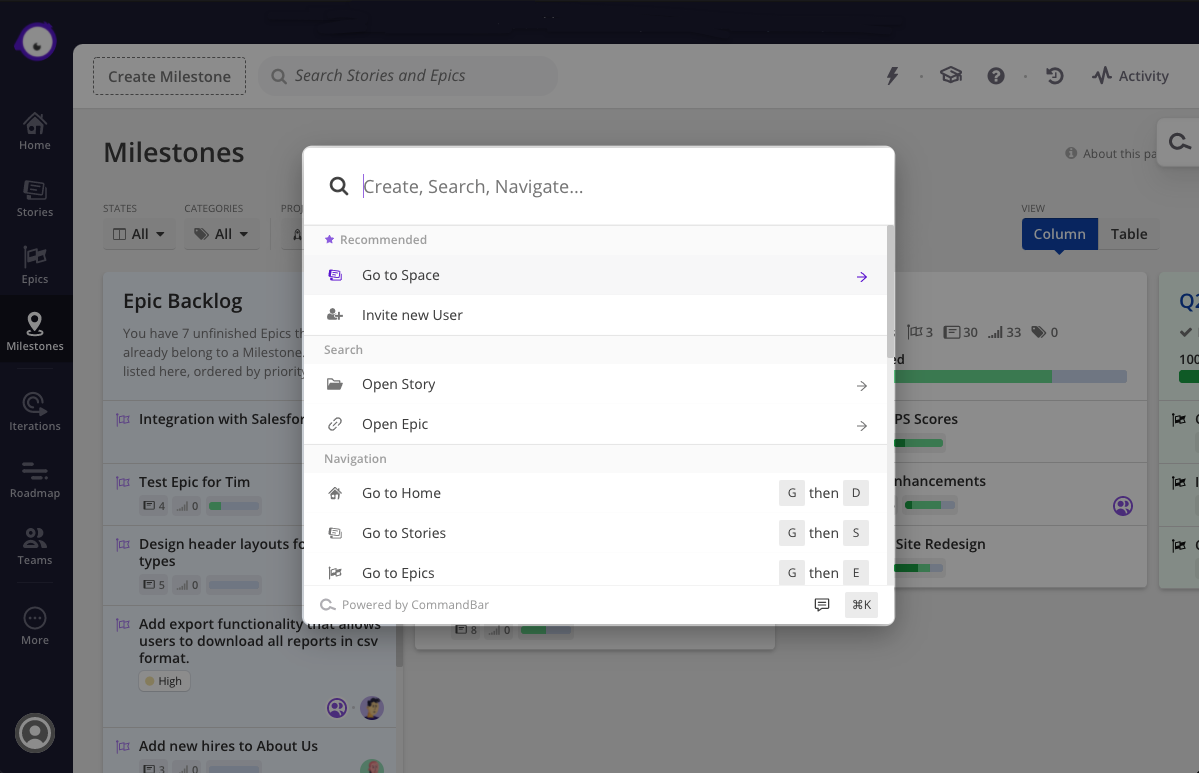
CommandBar in Clubhouse. Image Credits: CommandBar
Companies integrate CommandBar by pasting in a line of code and using configuration tools to quickly add commands relevant to their apps. The product was purposefully designed as low-code so that product and customer success teams can add configurations without relying on engineering support, Evans said.
Initially, it was a difficult sell: One of the more challenging parts in the early days of the company was helping customers and investors understand what CommandBar was doing.
“It was hard to describe over the phone, we had to try to get people on Zoom so they could see it,” he said. “It is easier now to sell the product because they can see it being used in an app. That is where many new users come from.”
CommandBar is already being used by companies like Clubhouse.io, Canix and Stacker that are serving hundreds of thousands of users. The most common use case for CommandBar so far is onboarding new software users.
He intends to use the new funding to grow the team, hiring across engineering, sales and marketing. The beta testing was successful in receiving good feedback from the early customers, and Evans wants to reflect that in new products and functionalities that will come out later this year.
Vince Hankes, an investor at Thrive Capital, was introduced to CommandBar through one of its pre-seed investors.
His interest is in B2B software companies and applications, and one of the things that became obvious to him while looking into the space was the natural tension between the simplicity and functionality of apps.
Apps are sometimes hard for even a power user to navigate, he said, but CommandBar makes something as simple as resetting a password easier by being able to search for that term and go right to that page if it is configured that way by the company.
“The types of companies interested in their product are impressive,” Hankes said. “We began to see demand from a broad range of companies that weren’t obvious. In fact, they are using CommandBar as a tool for deeper customer engagement.”
Powered by WPeMatico
Statsig is taking the A/B testing applications that drive Facebook’s growth and putting similar functionalities into the hands of any product team so that they, too, can make faster, data-informed decisions on building products customers want.
The Seattle-based company on Thursday announced $10.4 million in Series A funding, led by Sequoia Capital, with participation from Madrona Venture Group and a group of individual investors, including Robinhood CPO Aparna Chennapragada, Segment co-founder Calvin French-Owen, Figma CEO Dylan Field, Instacart CEO Fidji Simo, DoorDash exec Gokul Rajaram, Code.org CEO Hadi Partovi and a16z general partner Sriram Krishnan.
Founder and CEO Vijaye Raji started the company with seven other former Facebook colleagues in February, but the idea for the company started more than a year ago.
He told TechCrunch that while working at Facebook, A/B testing applications, like Gatekeeper, Quick Experiments and Deltoid, were successfully built internally. The Statsig team saw an opportunity to rebuild these features from scratch outside of Facebook so that other companies that have products to build — but no time to build their own quick testing capabilities — can be just as successful.
Statsig’s platform enables product developers to run quick product experiments and analyze how users respond to new features and functionalities. Tools like Pulse, Experiments+ and AutoTune allow for hundreds of experiments every week, while business metrics guide product teams to build and ship the right products to their customers.
Raji intends to use the new funding to hire folks in the area of design, product, data science, sales and marketing. The team is already up to 14 since February.
“We already have a set of customers asking for features, and that is a good problem, but now we want to scale and build them out,” he added.
Statsig has no subscription or upfront fees and is already serving millions of end-users every month for customers like Clutter, Common Room and Take App. The company will always offer a free tier so customers can try out features, but also offers a Pro tier for 5 cents per thousand events so that when the customer grows, so does Statsig.
Raji sees adoption of Statsig coming from a few different places: developers and engineers that are downloading it and using it to serve a few million people a month, and then through referrals. In fact, the adoption the company is getting is “bottom up,” which is what Statsig wants, he said. Now the company is talking to bigger customers.
There are plenty of competitors for this product, including incumbents in the market, according to Raji, but they mostly focus on features, while Statsig provides insights and ties metrics back to features. In addition, the company has automated analysis where other products require manual set up and analysis.
Sequoia partner Mike Vernal worked at Facebook prior to joining the venture capital firm and had worked with Raji, calling him “a top 1% engineer” that he was happy to work with.
Having sat on many company boards, he has found that many companies spend a long time talking about sales and marketing, but very little on product because there is not an easy way to get precise numbers for planning purposes, just a discussion about what they did and plan to do.
What Vernal said he likes about Statsig is that the company is bringing that measurement aspect to the table so that companies don’t have to hack together a poorer version.
“What Statsig can do, uniquely, is not only set up an experiment and tell if someone likes green or blue buttons, but to answer questions like what the impact this is of the experiment on new user growth, retention and monitorization,” he added. “That they can also answer holistic questions and understand the impact on any single feature on every metric is really novel and not possible before the maturation of the data stack.”
Powered by WPeMatico
Two decades after businesses first started deploying AI solutions, one can argue that they’ve made little progress in achieving significant gains in efficiency and profitability relative to the hype that drove initial expectations.
On the surface, recent data supports AI skeptics. Almost 90% of data science projects never make it to production; only 20% of analytics insights through 2022 will achieve business outcomes; and even companies that have developed an enterprisewide AI strategy are seeing failure rates of up to 50%.
But the past 25 years have only been the first phase in the evolution of enterprise AI — or what we might call Enterprise AI 1.0. That’s where many businesses remain today. However, companies on the leading edge of AI innovation have advanced to the next generation, which will define the coming decade of big data, analytics and automation — Enterprise AI 2.0.
The difference between these two generations of enterprise AI is not academic. For executives across the business spectrum — from healthcare and retail to media and finance — the evolution from 1.0 to 2.0 is a chance to learn and adapt from past failures, create concrete expectations for future uses and justify the rising investment in AI that we see across industries.
Two decades from now, when business leaders look back to the 2020s, the companies who achieved Enterprise AI 2.0 first will have come to be big winners in the economy, having differentiated their services, scooped up market share and positioned themselves for ongoing innovation.
Framing the digital transformations of the future as an evolution from Enterprise AI 1.0 to 2.0 provides a conceptual model for business leaders developing strategies to compete in the age of automation and advanced analytics.
Starting in the mid-1990s, AI was a sector marked by speculative testing, experimental interest and exploration. These activities occurred almost exclusively in the domain of data scientists. As Gartner wrote in a recent report, these efforts were “alchemy … run by wizards whose talents will not scale in the organization.”
Powered by WPeMatico
In spite of the pandemic, New York City remains the center of commerce and business, and over the last decade a robust startup community has developed there. Work-Bench, the NYC VC firm that concentrates on early-stage enterprise seed investments, announced its $100 million Fund 3 this morning.
The company started back in 2013, when most investment was still concentrated in Silicon Valley, but founders Jonathan Lehr and Jessica Lin believed there was room for a new firm in NYC that concentrated on writing first checks for enterprise startups. The founding team knew IT and believed that with the concentration of Fortune 500 companies in the city, they could build something that took advantage of that proximity.
The bet has paid off in a big way with investments in successful startups like Cockroach Labs, Catalyst, Dialpad and FireHydrant (all companies TechCrunch has covered). Big exits include CoreOs, which Red Hat acquired for $250 million in 2018.
Writing in a blog post announcing the new fund, Lehr and Lin said their initial idea has grown far beyond anything they could have hoped for in those early days. “By utilizing our deep corporate network of Fortune 500 customers here in NYC, we can get conviction in companies early on, and before they have the metrics other VC firms require. It’s also through this network of customers that we can land critical early customer logos and through our extensive community events and playbooks that we can enable pivotal knowledge sharing,” the two founders wrote.
Lehr says, even with the pandemic, which could have allowed it to expand its reach, the company is mostly sticking to its NYC focus with the majority of investments based there. “This may sound ironic, but while businesses went virtual, the pandemic reinforced our focus on New York City. Our city was hit first and hardest by COVID, but despite it all, VC funding activity for local enterprise startups actually increased substantially during the pandemic. Along with that, with so many Fortune 500s in NYC all going through accelerated digital transformation during the pandemic, there was a ton of work to be done and numerous customer opportunities right here in our own backyard,” Lehr said.
He says that the $47 million Fund 2 portfolio was deployed to 70% NYC-based startups, and he predicts that Fund 3 will have a similar composition, if not slightly more concentrated in New York.
The company didn’t just decide to write first checks though, it tried to build the community by offering workspace in their offices where early-stage companies could feed off one another (at least until the pandemic came along). The founders have also offered events where various speakers came to their offices, hosting hundreds of events since inception, while going virtual when the pandemic closed down in-person gatherings.
Lehr says as the company deploys Fund 3 money, it is looking for ways to invest in a more diverse group of founders. “Right now, 20% of our portfolio is made up of women founders. While we are proud of that number within an enterprise context, we believe there is so much room for improvement. As we’ve learned, deal flow doesn’t become diverse on its own — you need to make it diverse, which is why we place a huge emphasis on identifying and amplifying the voices of women and diverse founders within our own Investment Committee meetings and across the rest of the VC and enterprise tech community.”
The company will continue to look at enterprise startups, particularly in New York City, as it looks to distribute these new funds.
Powered by WPeMatico
One year after raising $16 million, construction technology company Buildots is back to claim another $30 million, this time in Series B funding.
Lightspeed Venture Partners led the round, with participation from previous investors TLV Partners, Future Energy Ventures, Tidhar Construction Group and Maor Investments. This gives the company $46 million in total funding, Roy Danon, co-founder and CEO of Buildots, told TechCrunch.
The three-year-old company, with headquarters in Tel Aviv and London, is leveraging artificial intelligence computer vision technology to address construction inefficiencies. Danon said though construction accounts for 13% of the world’s GDP and employs hundreds of millions of people, construction productivity continues to lag, only growing 1% in the past two decades.
Danon spent six months on construction sites talking to workers to understand what was happening and learned that control was one of the areas where efficiency was breaking down. While construction processes would seem similar to manufacturing processes, building to the design or specs didn’t happen often due to different rules and reliance on numerous entities to get their jobs done first, he said.
Buildots’ technology is addressing this gap using AI algorithms to automatically validate images captured by hardhat-mounted 360-degree cameras, detecting immediately any gaps between the original design, scheduling and what is actually happening on the construction site. Project managers can then make better decisions to speed up construction.
“It even finds events where contractors are installing out of place and streamline payments so that information is transparent and clear,” Danon said. “Buildots also creates a collaborative environment and trust by having a single source telling everyone what is going on. There is no more blaming or cutting corners because the system validates that and also makes construction a healthier industry to work in.”
Buildots went after new funding once it was able to show product market fit and was expanding into other countries. The platform is being utilized on major building projects in countries like the U.S., U.K., Germany, Switzerland, Scandinavia and China. To meet demand, Buildots will use the new funding to continue that expansion; double the size of its global team with a focus on sales, marketing and R&D; and grow on the business side. Danon’s aim is “to get to the point where we are the standard for every construction site.” The company is also looking at areas outside construction where its technology would be applicable.
Tal Morgenstern, partner at Lightspeed Venture Partners, said he keeps an eye on graduates of the Israel Defense Forces, where the three Buildots founders came from. However, in the case of this company, Lightspeed actually passed on both the seed and Series A.
Morgenstern admits the decision was a mistake, but at the time, he thought the technology Buildots was trying to build “first, impossible and second, I knew construction was difficult to sell into.” He felt that Buildots, with such a premium product, would have a challenge selling to a low-margin industry that was late to adopt technology in general.
By the time the Series B came round, he said Buildots had solved both of those issues, proving that it works, but also that customers were adopting the technology without much sales and marketing. In addition, other solutions in construction tech were still relying on lasers or people to manually input or tap photos.
“Buildots is seamlessly capturing images and providing a level of insights that is so high, and that is why the company is able to command the price structure they have and are receiving interesting commercial results,” Morgenstern said.
Walking around today’s construction site, Danon said the adoption of technology is enabling Buildots to move quickly to build processes for the industry.
As such, the company saw more than 50% growth quarter over quarter over the past year in three of the countries in which it operates. It is now working with four of the top 10 construction companies in Europe and around the world.
“We did a good job selling remotely, but now we need local offices,” Danon added. “We are also sitting on piles of data from construction sites. We learn from one project to another and want to look for the challenges where data will help make a financial impact. It’s a natural next step for the company.”
Powered by WPeMatico