1010Computers | Computer Repair & IT Support

UpKeep raises $36 million Series B to help facilities and maintenance teams go mobile

UpKeep, a mobile-first platform for maintenance and operations collaboration, has today announced the close of a $36 million Series B financing round. The round was led by Insight Partners, with participation from existing investors Emergence Capital, Battery Ventures, Y Combinator, Mucker Capital and Fundersclub.

UpKeep was founded by Ryan Chan. Chan worked at Trisep Corporation, a chemical manufacturing company, before founding UpKeep and saw first-hand how plant maintenance was handled. Despite the fact that the plant had purchased software for facilities maintenance and operations, most of the data was written down on pen and paper before being input into the system because that software was desktop only.

The idea for UpKeep was born.

UpKeep meets maintenance workers where they are, which could be just about anywhere.

With any maintenance job, from changing a lightbulb in an office building to repairing a complicated piece of machinery on the floor of a manufacturing plant, there are usually three parties involved: the requester, the facilities manager, and the technician.

Before UpKeep, the requester would either send an email to the facilities manager or perhaps use some other software to let them know of the problem. The facilities manager would prioritize the various requests of the day and send out technicians to resolve them.

Technicians have to log plenty of information when they’re out on the job, but this usually involved writing this info down on paper and then returning to a desk to input the data into the system.

With UpKeep, the requester can use the app itself to notify the facilities manager of problems, or send an email that flows directly into the UpKeep system. Facilities managers use UpKeep to prioritize and assign issues to their team of technicians, who then receive the work orders right on UpKeep.

Instead of logging information on paper, these technicians can take pictures of the problem and note the parts they need or other details of the job right in the app. No duplication of effort.

UpKeep operates on a freemium model, allowing technicians to manage their own work for free. Collaborative use of the product across an organization costs on a per user on both an annual or monthly basis. The company offers various tiers, from a Starter Plan ($35/month/user) to an Enterprise Plan ($180/month/user).

Higher tier plans offer more in-depth reporting and analysis around the work that gets done. Chan explained that these reports are not necessarily about tracking people, though.

“Yes, we track technicians and it’s a tool to manage work done by people,” said Chan. “But a manufacturing facility really cares much more about the equipment. They can use UpKeep to manage things like how many hours of downtime a piece of equipment has, etc. It’s more targeted toward the actual asset and the equipment versus the person completing their work.”

Chan said that around 80 percent of the company’s 400,000 users are on the free version of the app. Some brands on the app include Unilever, Siemens, DHL, McDonald’s, and Jet.com. Chan said UpKeep saw a 206 percent increase in revenue in 2019.

Important to the company’s future, UpKeep is working with OSHA and a group called SQF (Safe Quality Food) to offer templates around best practices during the pandemic. Now, maintenance workers and facilities staffs have a whole new checklist around sanitation and safety that many businesses are just getting up to speed on. UpKeep is working to make these new practices easier to adopt by providing those checklists directly to facilities managers.

This latest funding round brings UpKeep’s total funding to $48.8 million.

Powered by WPeMatico

SiMa.ai announces $30M Series A to build out lower-power edge chip solution

Krishna Rangasayee, founder and CEO, at SiMa.ai, has 30 years of experience in the semiconductor industry. He decided to put that experience to work in a startup and launched SiMa.ai last year with the goal of building an ultra low-power software and chip solution for machine learning at the edge.

Today he announced a $30 million Series A led by Dell Technologies Capital with help from Amplify Partners, Wing Venture Capital and +ND Capital. Today’s investment brings the total raised to $40 million, according to the company.

Rangasayee says in his years as a chip executive he saw a gap in the machine learning market for embedded devices running at the edge and he decided to start the company to solve that issue.

“While the majority of the market was serviced by traditional computing, machine learning was beginning to make an impact and it was really amazing. I wanted to build a company that would bring machine learning at significant scale to help the problems with embedded markets,” he told TechCrunch.

The company is trying to focus on efficiency, which it says will make the solution more environmentally friendly by using less power. “Our solution can scale high performance at the lowest power efficiency, and that translates to the highest frames per second per watt. We have built out an architecture and a software solution that is at a minimum 30x better than anybody else on the frames per second,” he explained.

He added that achieving that efficiency required them to build a chip from scratch because there isn’t a solution available off the shelf today that could achieve that.

So far the company has attracted 20 early design partners, who are testing what they’ve built. He hopes to have the chip designed and the software solution in Beta in the Q4 timeframe this year, and is shooting for chip production by Q2 in 2021.

He recognizes that it’s hard to raise this kind of money in the current environment and he’s grateful to the investors, and the design partners who believe in his vision. The timing could actually work in the company’s favor because it can hunker down and build product while navigating through the current economic malaise.

Perhaps by 2021 when the product is in production, the market and the economy will be in better shape and the company will be ready to deliver.

Powered by WPeMatico

Microsoft partners with Redis Labs to improve its Azure Cache for Redis

For a few years now, Microsoft has offered Azure Cache for Redis, a fully managed caching solution built on top of the open-source Redis project. Today, it is expanding this service by adding Redis Enterprise, Redis Lab’s commercial offering, to its platform. It’s doing so in partnership with Redis Labs and while Microsoft will offer some basic support for the service, Redis Labs will handle most of the software support itself.

Julia Liuson, Microsoft’s corporate VP of its developer tools division, told me that the company wants to be seen as a partner to open-source companies like Redis Labs, which was among the first companies to change its license to prevent cloud vendors from commercializing and repackaging their free code without contributing back to the community. Last year, Redis Labs partnered with Google Cloud to bring its own fully managed service to its platform and so maybe it’s no surprise that we are now seeing Microsoft make a similar move.

Liuson tells me that with this new tier for Azure Cache for Redis, users will get a single bill and native Azure management, as well as the option to deploy natively on SSD flash storage. The native Azure integration should also make it easier for developers on Azure to integrate Redis Enterprise into their applications.

It’s also worth noting that Microsoft will support Redis Labs’ own Redis modules, including RediSearch, a Redis-powered search engine, as well as RedisBloom and RedisTimeSeries, which provide support for new datatypes in Redis.

“For years, developers have utilized the speed and throughput of Redis to produce unbeatable responsiveness and scale in their applications,” says Liuson. “We’ve seen tremendous adoption of Azure Cache for Redis, our managed solution built on open source Redis, as Azure customers have leveraged Redis performance as a distributed cache, session store, and message broker. The incorporation of the Redis Labs Redis Enterprise technology extends the range of use cases in which developers can utilize Redis, while providing enhanced operational resiliency and security.”

Powered by WPeMatico

Amazon releases Kendra to solve enterprise search with AI and machine learning

Enterprise search has always been a tough nut to crack. The Holy Grail has always been to operate like Google, but in-house. You enter a few keywords and you get back that nearly perfect response at the top of the list of the results. The irony of trying to do search locally has been a lack of content.

While Google has the universe of the World Wide Web to work with, enterprises have a much narrower set of responses. It would be easy to think that should make it easier to find the ideal response, but the fact is that it’s the opposite. The more data you have, the more likely you’ll find the correct document.

Amazon is trying to change the enterprise search game by putting it into a more modern machine learning-driven context to use today’s technology to help you find that perfect response just as you typically do on the web.

Today the company announced the general availability of Amazon Kendra, its cloud enterprise search product that the company announced last year at AWS re:Invent. It uses natural language processing to allow the user to simply ask a question, then searches across the repositories connected to the search engine to find a precise answer.

“Amazon Kendra reinvents enterprise search by allowing end-users to search across multiple silos of data using real questions (not just keywords) and leverages machine learning models under the hood to understand the content of documents and the relationships between them to deliver the precise answers they seek (instead of a random list of links),” the company described the new service in a statement.

AWS has tuned the search engine for specific industries including IT, healthcare and insurance. It promises energy, industrial, financial services, legal, media and entertainment, travel and hospitality, human resources, news, telecommunications, mining, food and beverage and automotive will be coming later this year.

This means any company in one of those industries should have a head start when it comes to searching because the system will understand the language specific to those verticals. You can drop your Kendra search box into an application or a website, and it has features like type ahead you would expect in a tool like this.

Enterprise search has been around for a long time, but perhaps by bringing AI and machine learning to bear on it, we can finally solve it once and for all.

Powered by WPeMatico

4 edtech CEOs peer into the industry’s future

When Zach Sims first started pitching his coding startup, Codecademy, he framed it to investors as a corporate tutoring company. That was intentional, despite the fact that edtech is a $5 trillion business.

“It was much easier for investors to understand instead of an education company,” he said, noting that the industry has long been defined by tight budgets and slow sales cycles.

But, as millions adopt remote learning overnight, edtech’s reputation is changing — and investors are scrambling accordingly. The revitalization means that a new wave of edtech startups is upon us. We asked four entrepreneurs who have been working in this space to share what they think the next billion-dollar business will look like. While we’ve covered the investor side of edtech quite a bit, it was refreshing to hear from founders and executives who are on the ground making decisions:

How to sell: Classroom and outside the box

According to Matthew Glotzbach, CEO of Quizlet, “any edtech solution tailored toward schools and classrooms may find a significant headwind,” such as games or VR/AR headsets that need to be used within classroom settings. “Not because physical spaces are going away, but in this limited time, limited budget environment, teachers and administrators are going to spend their money on solutions that are more tailored toward distance.”

Startups should plan to be useful in both a pre-coronavirus and post-coronavirus world, likely hybridizing tech solutions that are useful for day-to-day classroom operations as well as remote learning.

How to reach scale: B2C or B2B? 

Powered by WPeMatico

Former Tesla president and Lyft COO Jon McNeill on what both companies have gotten right and wrong

We recently interviewed Jon McNeill to learn more about his newest project, a startup studio called DeltaV Ventures. But we also wanted to hear about what it’s like to work inside of Tesla and Lyft.

McNeill spent two-and-a-half years as the carmaker’s president, heading up global sales, marketing, delivery and government relations before heading to Lyft in early 2018, where he served as COO for 18 months. (He left four months after the ride-hail company’s IPO last year.)

He shared his take on his experience at both places, and what, from each, he is using and eschewing at DeltaV. Our conversation has been edited lightly for length and clarity.

TechCrunch: What was it like working with Elon Musk?

Jon McNeill: To me, it was fascinating. He’s the best practitioner of my craft as an entrepreneur. It’s hard to name another entrepreneur who has started four companies, all of which are worth more than $10 billion in market cap [and] several of which are worth more than $50 billion.

We were in hyper-growth mode, and there were no playbooks. Like, literally, when I started, the company had about $2 billion in annual run rate revenue, and three years later, it had $20 billion in annual run rate revenue. And there are no playbooks for that, so we were innovating constantly to either try to get ahead of that growth or just to keep up with it.

Powered by WPeMatico

Banjo’s CEO resigns after report details KKK ties in his past

After investigative reporting revealed his undisclosed involvement in shooting at a synagogue with KKK members at age 17, the CEO of Banjo will leave the company he founded.

In a short blog post, the company announced a “change in leadership” and the resignation of its founder and CEO Damien Patton. The Utah-based company will transition “to a new, reconstituted leadership team effectively immediately.”

“I am confident Banjo’s greatest days are still ahead, and will do everything in my power to ensure our mission succeeds,” Patton said in the post. “However, under the current circumstances, I believe Banjo’s best path forward is under different leadership.”

Patton leaves the company as valuable contracts with its home state of Utah went on hold in light of the explosive report, published in OneZero. The story revealed that at age 17, Patton drove a KKK member past a synagogue while he shot at the building. He reportedly went into hiding at a white supremacist training camp after the incident.

In a statement provided to TechCrunch, Utah’s Attorney General office said it was “shocked and dismayed” at reports of Patton’s prior affiliation with hate groups.

The company’s CTO, Justin R. Lindsey, who joined the company full-time less than a year ago, will step into the top role.

Even prior to revelations of Patton’s past, Banjo had come under scrutiny by privacy advocates for its pivot from a social tech company into a real-time intelligence platform for law enforcement. Last year, the company’s director of government affairs for Utah told a group of public officials that Banjo “essentially [does] most of what Palantir does, we just do it live.”

In its blog post announcing Patton’s departure, the company emphasized its “unswerving commitment” to protecting private data and characterized its work as “technology solutions that protect privacy.”

Powered by WPeMatico

Clyde raises $14 million Series A to help e-commerce businesses offer extended warranty plans

Four years ago, Brandon Gell was an architecture student who spent most of his time working on 3D printing modular housing. Now, he’s the founder of Clyde, an extended warranty startup that wants to help small e-commerce businesses offer product protection.

Today, the company announced it has raised a $14 million Series A led by Spark Capital with participation from Crosslink, RRE, Rea Sea Ventures and others. 

How do you go from being a product person to the founder of an insurance startup? According to Gell: a stint at a four-person 3D scanner startup in Columbus, Ohio.

Because the team and resources were small, Gell was put in charge of finding an insurance company to work with to protect their expensive end product of scanners.  

“I spent six months trying to find a company,” he said. After seeing how seamless it was to work with fintech customer support tools from companies like Stripe, Shopify, Affirm and others, he said it was clear that insurance, and especially the extended warranty space, wasn’t as mature. So he set up an office in his grandma’s New York apartment. 

Clyde is a platform that connects small retailers to insurance companies to launch and manage product protection programs. 

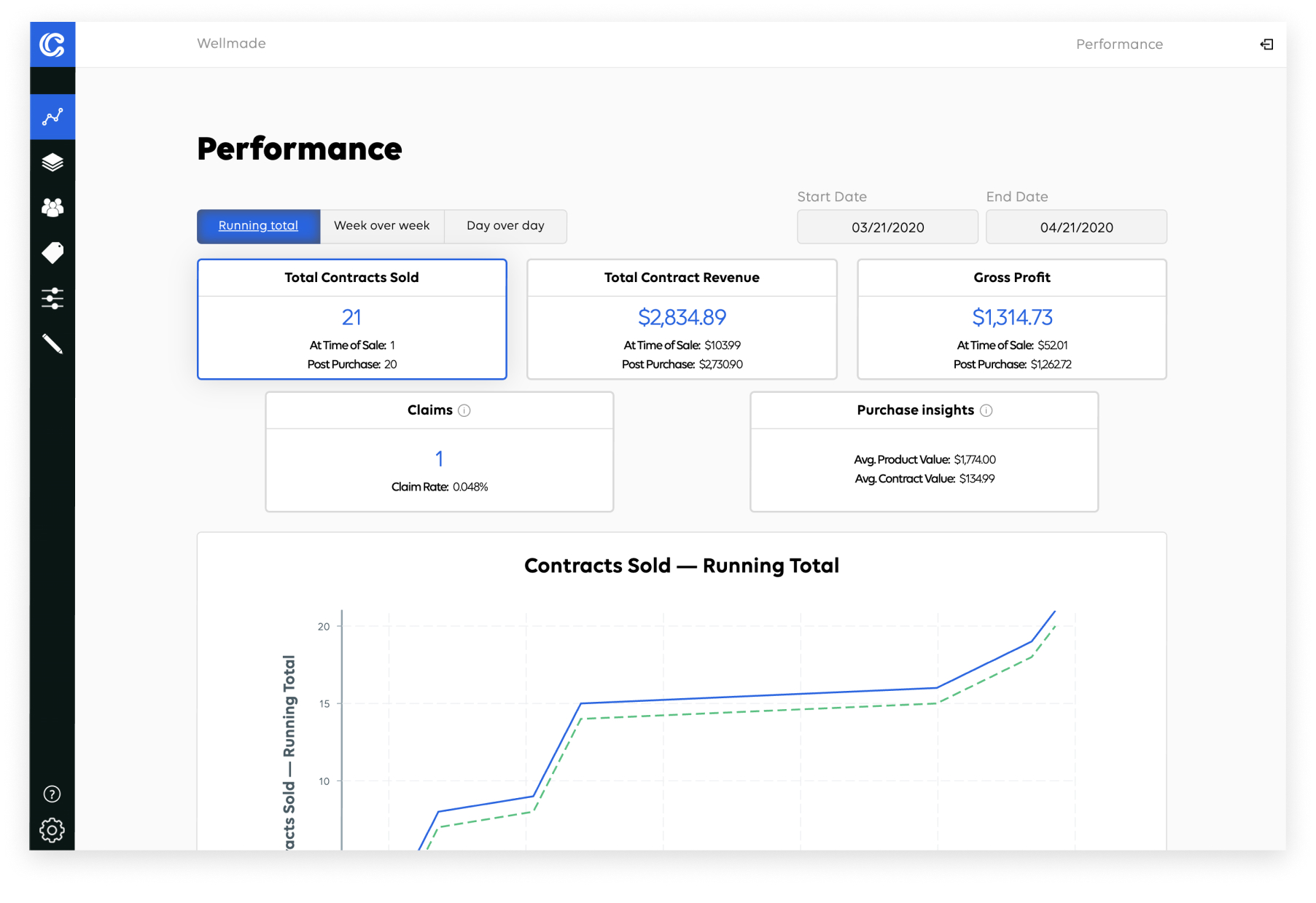
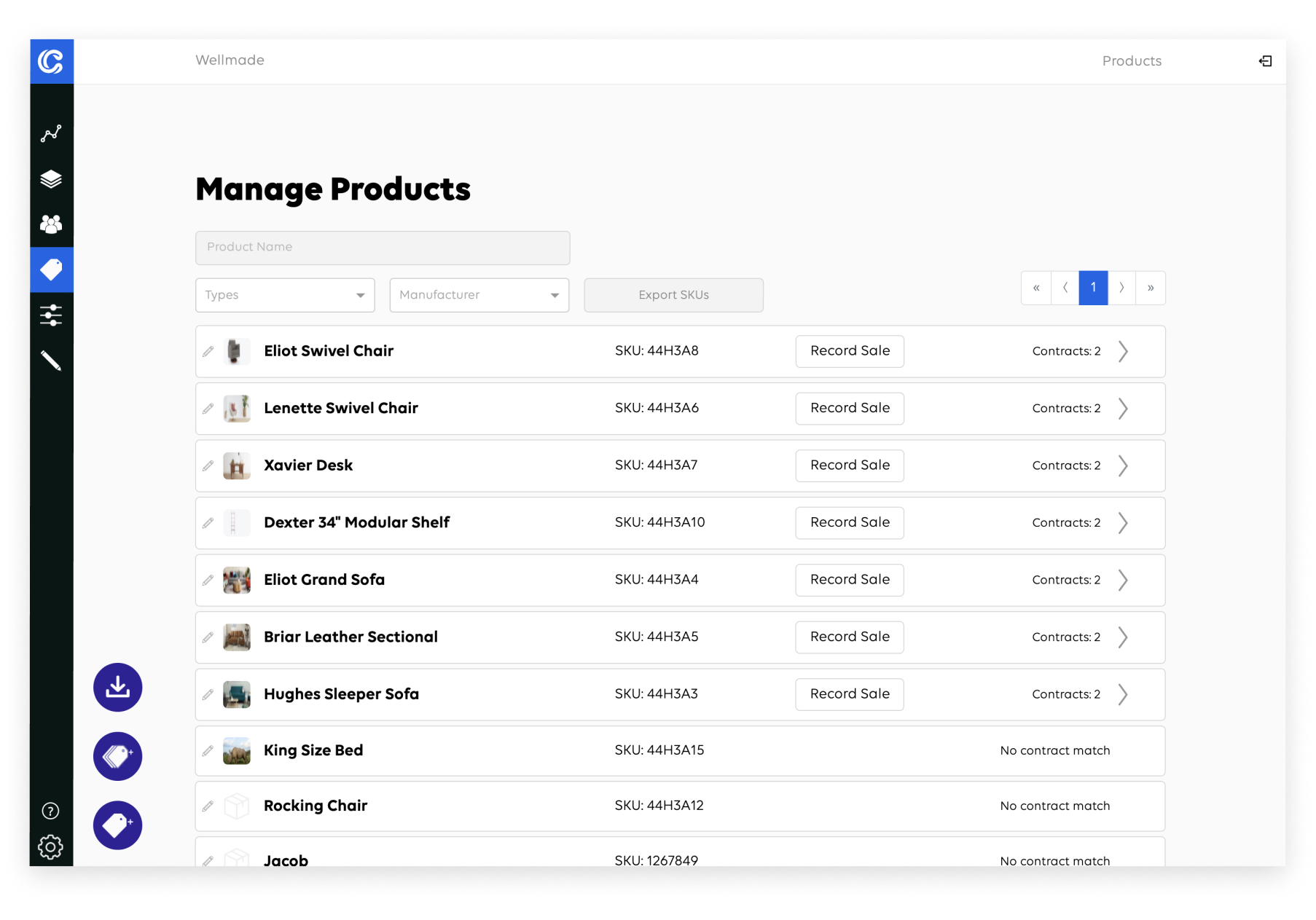
Using Clyde, customers can access a dashboard and e-commerce apps to manage their protection programs. For example, a user can see how many contracts were sold, how much revenue total those bring  and gross profit in real time. It also can see which products are most often purchased with an extended warranty contract. 

“It’s a similar type of offering as Affirm or Stripe,” he said. “We give you access to large insurance companies and we enable you to launch the program live on your website or physical point of sale and store wherever you sell.” It has plugins with Shopify, BigCommerce, Salesforce, Magento, Woocommerce, and more so store owners on the site can add Clyde to their small businesses. 

Clyde’s most critical metric is that it has an 18% attachment rate on average, which means that 18% of people that go through a Clyde-powered purchasing path end up purchasing extended warranties or protection plans. 

The reason businesses care about extended warranty is two-fold. First, insurance benefits the customer experience. Second, insurance purchases are often the highest-margin product that companies sell to their customers. Product protection alone is a $50 billion market. Gell said that Best Buy drives about 2% of its annual revenue from the sale of extended warranties, but that generates more than half of its profit. 

Clyde helps small businesses, like a four-person startup in Columbus Ohio, get a bite of this profitable pie. Most e-commerce businesses have to work with Amazon, thus giving a lot of that cash to the big company versus putting it in their own pocket, per Gell. He says that when Amazon sells an extended warranty on a seller’s product, it doesn’t share any revenue with the seller on how the product performs, which prevents a seller from both a stream of revenue and data analytics.

“Our sort of mantra is that the retailers that we work with are basically everybody that’s not Amazon and Walmart,” he said.  

Clyde’s goal is different from Upsie, another venture-backed startup focusing on warranties. Upsie is looking to be a direct-to-consumer warranty replacement, while Clyde works on behalf of the retailer and insurance company to connect the two parties.  

Closer competitors to the startup include Mulberry and Extend, which were both founded after Clyde and have raised less in venture capital funding. Gell thinks his competitive advantage is partnerships with top insurance companies, and a strong product-focused platform. Clyde’s entire founding team is made up of product people. 

Startups right now need to prove that they are viable in both a pre-coronavirus and post-coronavirus world. And Clyde might be exactly in that sweet spot, as it focuses on e-commerce businesses. 

The Series A round closed a few weeks ago, before the COVID-19 craziness began, but he said that the pandemic has led to more inbounds and interest than ever before. Gell says it’s a mix of e-commerce being more important than ever, and customer behavior. 

“It’s a shift of customers that want to buy online more, but also protect their purchases more than ever,” he said. “Companies are realizing how important it is.”

New cash in hand, Clyde’s growing while its customer-base is looking for new ways to bring in revenue and take care of customers. If the startup can handle the influx of attention and importance right, sticky harmony will follow. 

Powered by WPeMatico

Fintech startups amass war chests for the economic downturn

Consumer fintech startups were massively successful in 2019, attracting millions of new users and disrupting traditional retail banks and financial services with mobile-first, consumer-oriented products. Despite the economic downturn in public markets and the massive wave of cuts at public and private companies in recent weeks, fintech startups have been raising a ton of money.

It feels like they’re all building a war chest to survive the economic winter as traditional banks continue to iterate so they can catch up and offer more user-friendly services. This is not the time to raise fees, slow down on product development or plans to acquire new users.

Nine-figure rounds

Back in January, I looked at challenger banks and their growth trajectories, but since then, they have managed to attract even more customers. According to the most recent figures:

  • Nubank has 20 million customers;
  • Revolut has 10 million users;
  • Chime has 8 million users;
  • N26 has 5 million users;
  • Monzo has 4 million users.

And that’s without mentioning Starling Bank, Atom Bank, Bunq, Bnext, Paysend, etc. At some point, there will be as many challenger banks as non-challenger banks — perhaps we shouldn’t call them challenger banks anymore.

Beyond these startups, trading app Robinhood recently reached 13 million users, international payments startup TransferWise has 7 million customers and cryptocurrency exchange Coinbase has 30 million users.

Powered by WPeMatico

MemSQL raises $50M in debt facility for its real-time database platform

As a number of startups get back into fundraising in earnest, one that is on a growth tear has closed a substantial debt round to hold on to more equity in the company as it inches to being cash-flow positive. MemSQL — the relational, real-time database used by organisations to query and analyse large pools of fast-moving data across cloud, hybrid and on-premise environments (customers include major banks, telecoms carriers, ridesharing giants and even those building COVID-19 tracing apps) — has secured $50 million in debt, money that CEO Raj Verma says should keep it “well-capitalised for the next several years” and puts it on the road to an IPO or potential private equity exit.

The funding is coming from Hercules Capital, which has some $4.3 billion under management and has an interesting history. On the one hand, it has invested in companies that include Facebook (this was back in 2012, when Facebook was still a startup), but it has also been in the news because its CEO was one of the high fliers accused in the college cheating scandal of 2019.

MemSQL does not disclose its valuation, but Verma confirmed it is now significantly higher than it was at its last equity raise of $30 million in 2018, when it was valued at about $270 million, per data from PitchBook.

Why raise debt rather than equity? The company is already backed by a long list of impressive investors, starting with Y Combinator and including Accel, Data Collective, DST, GV (one of Google-owner Alphabet’s venture capital vehicles), Khosla, IA Ventures, In-Q-Tel (the CIA-linked VC) and many more. Verma said in an interview with TechCrunch that the startup had started to look at this fundraise before the pandemic hit.

It had “multiple options to raise an equity round” from existing and new investors, which quickly produced some eight term sheets. Ultimately, it took the debt route mainly because it didn’t need the capital badly enough to give up equity, and terms “are favourable right now,” making a debt facility the best option. “Our cash burn is in the single digits,” he said, and “we still have independence.”

The company has been on a roll in recent times. It grew 75% last year (note it was 200% in 2018) with cash burn of $8-9 million in that period, and now has annual recurring revenues of $40 million. Customers include three of the world’s biggest banks, which use MemSQL to power all of its algorithmic trading, major telecoms carriers, mapping providers (Verma declined to comment on whether investor Google is a customer), and more. While Verma today declines to talk about specific names, previous named customers have included Uber, Akamai, Pinterest, Dell EMC and Comcast.

And if the current health pandemic has put a lot of pressure on some companies in the tech world, MemSQL is one of the group that’s been seeing a strong upswing in business.

Verma noted that this is down to multiple reasons. First, its customer base has not had a strong crossover with sectors like travel that have been hit hard by the economic slowdown and push to keep people indoors. Second, its platform has actually proven to be useful precisely in the present moment, with companies now being forced to reckon with legacy architecture and move to hybrid or all-cloud environments just to do business. And others like True Digital are specifically building contact-tracing applications on MemSQL to help address the spread of the novel coronavirus.

The company plays in a well-crowded area that includes big players like Oracle and SAP. Verma said that its tech stands apart from these because of its hybrid architecture and because it can provide speed improvements of some 30x with technology that — as we have noted before — allows users to push millions of events per day into the service while its users can query the records in real time. 

It also helps to have competitive pricing. “We are a favourable alternative,” Verma said.

“This structured investment represents a significant commitment from Hercules and provides an example of the breadth of our platform and our ability to finance growth-orientated, institutionally-backed technology companies at various stages. We are impressed with the work that the MemSQL management team has accomplished operationally and excited to begin our partnership with one of the promising companies in the database market,” said Steve Kuo, senior managing director technology group head for Hercules, in a statement.

Powered by WPeMatico