1010Computers | Computer Repair & IT Support

Fantasy sports startup Sleeper closes Series B led by a16z as it expands to esports amid pandemic

Sleeper is widening its ambitions to esports as the arena sports world goes into hibernation amid the COVID-19 pandemic.

While CEO Nan Wang has high hopes that the upcoming NFL season can proceed amid the pandemic, he’s hoping to expand his fantasy sports app’s appeal to gamers by launching support for the intensely popular title League of Legends. Wang says that esports support was always in the cards, but that its rollout was never supposed to come this early.

“Originally, the goal was to do arena sports and then strategically select esports that we thought would be big market opportunities,” Wang says. “In the absence of sports, it becomes easier for us to push something that was further out on the roadmap.”

As Sleeper looks to push beyond its 1 million active users, the company is bulking up on funding reserves. The fantasy sports app has closed a $20 million Series B funding round led by Andreessen Horowitz. Kevin Durant, Baron Davis, JuJu Smith-Schuster and Twitch CEO Kevin Lin are also recent investors. In August, the company shared it had raised a $5.3 million Series A led by General Catalyst.

For now, all of Sleeper’s services are free and there aren’t immediate plans to change that. Wang says that delayed and canceled seasons of arena sports is likely going to push out the company’s timelines for beginning to generate revenues.

Sleeper’s investors have hailed the startup as leading the way among a new class of vertical-focused social networks.

“The next social platforms are going to be vertical and look a lot more like games, offering deeper engagement than broad social networking platforms. Sleeper’s leagues provide shared activities between friends, and has some of the best stickiness metrics we’ve seen,” Andreessen Horowitz GP Andrew Chen said in a statement.

With its League of Legends launch, Sleeper is in the position of helping define a fantasy league experience for a popular franchise. The league’s organization isn’t fundamentally different from other fantasy sports. Users recruit a fantasy crew and draft professional esports athletes to their teams. From there, users in a league participate in weekly head-to-head matches with each other, making predictions and leveraging gameplay-specific mechanics.

League of Legends support is a big deal to Sleeper because it also represents the company’s first international foray. Users in the U.S., Europe, Vietnam, Korea and Brazil can participate in this upcoming fantasy season.

On the product side, the startup recently launched voice chat to capitalize on users stuck at home amid the pandemic. Wang tells TechCrunch the team is also hoping to add video chat to the app soon. Wang also notes that Sleeper is on track to launch three new sports this year.

As Sleeper aims to grow around the roadblocks of pandemic lockdowns, Wang and his team hope that their continued focus on social features can ensure the startup’s shared success in the worlds of online gaming and arena gaming.

“The roadmap for us has always been to win both sports and esports because they both have the same underlying motivation,” Wang says. “The most important thing for any sports fan is being able to enjoy it with their friends and family members.”

Powered by WPeMatico


Quibi founder Jeffrey Katzenberg blames coronavirus for the streaming app’s challenges

Quibi founder Jeffrey Katzenberg is admitting that the short-form video service’s launch hasn’t gone the way he’d hoped — and he knows what to blame for its issues.

“I attribute everything that has gone wrong to coronavirus,” Katzenberg said in an interview with The New York Times. “Everything. But we own it.”

Back in April, I actually asked Quibi executives about how they thought the worldwide pandemic and widespread social distancing measures might affect their launch. After all, an app designed to deliver videos under 10 minutes when you’re on-the-go seems less appealing when no one can leave their house (where you can just sit on your couch and watch Netflix).

“I’m looking to take small breaks more than ever before to stand up, walk around, go outside,” CTO Rob Post said at the time. “Our use cases are these in-between moments. Now more than ever, that use case is still present.”

Similarly, Katzenberg told The Times he’d hoped “there would still be many in-between moments while sheltering in place.” Instead, he argued that those moments are still happening, “but it’s not the same. It’s out of sync.”

How badly has the launch gone? Quibi says it has been downloaded around 3.5 million times, and that it currently has 1.3 million active users. That’s a significant audience, especially for a service that was only released a little over a month ago.

Still, Katzenberg admitted it’s “not close to what we wanted.” And the company is apparently adjusting its projections, which had called for the service to reach 7 million users and $250 million in subscriber revenue in its first year.

At least it sounds like Quibi is trying to learn and adapt. For one thing, the marketing has started to shift to promoting specific shows like a “Reno 911” reboot, rather than advertising the idea of Quibi itself. For another, the company said it will be adding TV viewing support for iOS users this week.

Powered by WPeMatico

China’s smartphone shipments are reportedly up for April, following COVID-19-fueled decline

Smartphone shipments are reportedly beginning to see signs of life in China, after a sizable dip from the COVID-19 pandemic. New numbers from China Academy of Information and Communications Technology (a government-connected agency) point to a 17% rise in shipments for April, pointing to some recovery for the market.

The figure, from the China state-supported group, is virtually a mirror reflection of the 18% dip Canalys reported for Q1. COVID-19 was the primary culprit for those figures, through a combination of decreased spending among China’s phone-buying public and sizable supply chain constraints, as many Asian nations were on lockdown to slow the spread.

Both Huawei and Apple benefited from the rebound, though Reuters notes that the firm opted not to include an OS breakdown for the first time in a while, making it more difficult to parse market share.

Smartphone shipments have suffered across the board, along with countless other industries. A rebound for China’s market could be a bellwether for positive numbers for the industry moving forward — especially given the country’s close ties to the global supply chain. In spite of being the first country hit, China’s official figures for COVID-19 deaths have remained low, compared to countries in Europe and North America.

That’s likely due in part to some draconian measures used to stop the spread. Other countries (the U.S. in particular) may not be so likely to rebound from the pandemic, leading to a more protracted impact on the global market. 

Powered by WPeMatico

Homeschooling startup Primer raises $3.7 million seed round led by Founders Fund

As parents across the country are tasked with managing their children’s schooling amid a pandemic, investors are betting on a homeschooling startup that’s aiming to provide parents with services that can simplify the process of giving their kids a tailored education at home.

Founder Ryan Delk says his startup Primer is building the “full-stack infrastructure” that parents need to homeschool their kids, an interactive suite of products that he hopes can “make homeschooling a mainstream option for families.”

His company shared funding details with TechCrunch, disclosing that his startup had closed a $3.7 million seed round led by Founders Fund . Other investors in the round include Naval Ravikant, Cyan Banister and Village Global.

As of 2016, about 2.4 million kids in the United States are homeschooled. Delk says that he’s been “stunned by the lack of infrastructure” available today for parents interested in homeschooling their kids. Delk was homeschooled by his parents from kindergarten through eighth grade, an experience he looks back on fondly, he says.

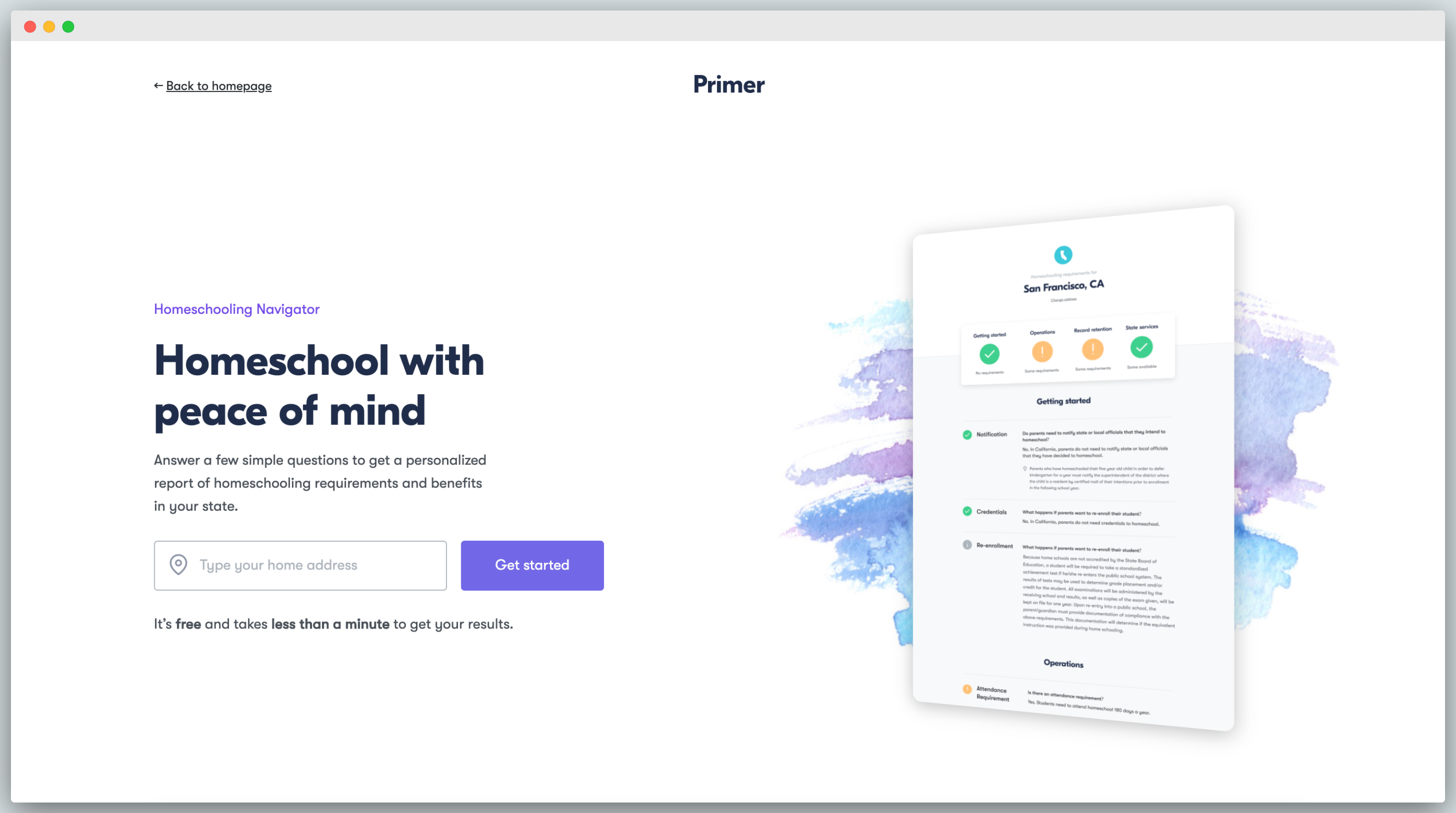
Primer isn’t offering a dedicated curriculum. So far, they’ve been building tools to help parents acquaint themselves with what’s out there. Primer has already rolled out a pair of free homeschooling resources for parents, including Navigator, a tool to help parents stay compliant with state regulations for homeschooling their kids, as well as Primer Library, a collection of free digital instruction materials.

Since launching its compliance and library tools late last year, the team has been prepping for their next launch, a series of interest-based communities that homeschoolers can join and participate in online. The communities will begin rolling out this August in time for a new school year. Delk says the team is hoping to launch about 5-7 different classes, spanning topics like “rockets, chess and baking,” with instruction from experts and interactions with other students. Primer hasn’t finalized pricing, but the team plans to charge a monthly subscription fee for membership to the communities.

Today, the startup is launching a waitlist for this feature. In a blog post, Delk notes that next year he hopes to launch “several more products that deliver everything parents need to give their children an exceptional homeschooling experience.”

Delk believes that there’s going to be a “huge influx” of new homeschoolers as shelter-in-place winds down and some parents find that homeschooling is something they’d like to pursue long-term. He notes that the products his team is creating are still pretty high-touch for parents and that it isn’t the right fit for everyone, much like homeschooling.

“It’s going to be very hands-on and we’re going to be upfront about that,” Delk says. “We are not building a plant-your-kid-in-front-of-an-iPad-for-six-hours product.”

Powered by WPeMatico

Intel has invested $132M in 11 startups this year, on track for $300M-$500M in total

When it comes to corporate venture capital, semiconductor giant Intel has shaped up to be one of the most prolific and prescient investors in the tech world, with investments in 1,582 companies worldwide, and a tally of some 692 portfolio companies going public or otherwise exiting in the wake of Intel’s backing.

Today, the company announced its latest tranche of deals: $132 million invested in 11 startups. The deals speak to some of the company’s most strategic priorities currently and in the future, covering artificial intelligence, autonomous computing and chip design.

Many corporate VCs have been clear in drawing a separation between their activities and that of their parents, and the same has held for Intel. But at the same time, the company has made a number of key moves that point to how it uses its VC muscle to expand its strategic relationships and also ultimately expand through M&A. Just earlier this month, it acquired Moovit, an Intel Capital portfolio company, for $900 million (a deal that was knocked down to $840 million when accounting for its previous investment).

Intel Capital identifies and invests in disruptive startups that are working to improve the way we work and live. Each of our recent investments is pushing the boundaries in areas such as AI, data analytics, autonomous systems and semiconductor innovation. Intel Capital is excited to work with these companies as we jointly navigate the current world challenges and as we together drive sustainable, long-term growth,” said Wendell Brooks, Intel senior vice president and president of Intel Capital, in a statement.

The tranche of deals come at a critical time in the worlds of startups and venture investing. Many are worried that the slowdown in the economy, precipitated by the COVID-19 pandemic, will mean a subsequent slowdown in tech finance. Intel says that it plans to invest between $300 million and $500 million in total this year, so this would go some way to refuting that idea, along with some of the other monster deals and big funds that we’ve written out in the last couple of months.

The list announced today doesn’t include specific investment numbers, but in some cases the startups have also announced the fundings themselves and given more detail on round sizes. These still, however, do not reveal Intel’s specific financial stakes.

Here’s the full list:

  • Anodot uses machine learning to monitor business operations autonomously, covering areas like app performance, customer incidents and more. The idea is that using the platform to monitor for these incidents means detection and response time can be faster. The full $35 million round was announced back in April.
  • Astera Labs is a fabless semiconductor startup focused on connectivity solutions for data-centric systems to remove performance bottlenecks in compute-intensive workloads in areas like AI. It announced its Series B of an undisclosed amount two weeks ago, and prior to this it had raised just over $6 million, according to PitchBook.
  • Axonne develops next-generation high-speed automotive Ethernet network connectivity solutions for connected cars: addressing the issue of merging legacy or proprietary systems with the demands of advanced next-generation applications. Intel invested as part of a $9 million round that actually closed in March.
  • Hypersonix uses big-data analytics to determine and predict customer demand for e-commerce, retail and hospitality customers. One of its customers is Amazon — which uses Hypersonix’s platform in its supply chain division. That may come as a surprise, but according to Hypersonix’s CEO, the e-commerce giant does not have dedicated analytics teams to serve every division in the company, so sometimes they do buy from third parties. The round was actually announced at the beginning of this month: an $11.5 million deal.
  • KFBIO out of China is one of Intel’s biotechnology bets. The company has designed and built a digital pathology scanner, which aims to replace microscopes with its big data, cloud-based and AI-powered insights. The obvious connection and interest here for Intel is on the processor side, but potentially brings Intel into a sphere where it can flex its muscle around a range of AI and cloud computing applications as well. The deal was closed at the beginning of April and totals around $14.2 million.
  • Lilt has built an AI-powered language translation platform, not to compete with the likes of Google Translate for consumers, but to help those with international-facing websites and apps localise their services more efficiently. The company announced its round today: a $25 million Series B led by Intel.
  • MemVerge focuses on “in-memory” computing, an architecture that makes it easier to deploy heavy, data-centric applications. It closed its round of $24.5 million at the beginning of April, and while it’s always worked with Intel processors, Intel’s investment was not public until today.
  • ProPlus Electronics, also out of China, is an electronic design automation (“EDA”) startup that speeds up chip design and fabrication for semiconductor companies manufacturing a variety of chips at scale. It closed its round also at the beginning of April. The exact amount was undisclosed except to note that it was in the “hundreds of millions of Chinese Yuan” (or tens of millions of U.S. dollars).
  • Retrace is an under-the-radar dental data startup that uses AI to improve “dental decision making,” but according to its site seems also to focus on other healthcare areas. It’s not clear how big the round is or when it closed.
  • Spectrum Materials out of China is another stealthy company that supplies gas and other materials to semiconductor makers.
  • Xsight Labs based in Israel is building chipset designs to accelerate data-intensive workloads that you typically get with AI and analytical applications. Israel has a huge R&D centre focused on autonomous driving, one of the applications that’s going to demand a lot in processing power, so this looks like a clearly strategic bet. The company raised $25 million in February, but Intel was not disclosed in that round previously.

Powered by WPeMatico

The Wing is reportedly LG’s latest odd dual-screen smartphone concept

It seems like only yesterday that we were all complaining about the boring uniformity of smartphone designs. In the last couple of years, companies have worked to offer some alternative through dual-screen devices, foldables and a slew of concept form factors — few of which have really gained much traction. 

Even so, the LG Wing (its codename for now) offers a strange new alternative to the push for more screen real estate. The likely concept device has surfaced through Korean Herald and ET News reports, showing a 6.8-inch screen that swivels up horizontally to reveal a square four-inch display below.

This is still in the concept/leak phase, though it’s not entirely without precedent from Camp LG. Notably, the manufacturer released a bunch of swiveling handsets over a decade ago, back in the days when phones still had buttons.

While the second screen would function as a keyboard some of the time, the versatility of the display offers interesting supplemental features, like editing or viewing supplemental content. The handset would also reportedly feature a processor in the Snapdragon 7 family and a triple camera setup.

Certainly it doesn’t seem out of the realm of possibility for LG to try something new. The company has performed its share of experiments in the past. Actually getting app developers to come along for the ride, on the other hand, is another issue entirely.

Powered by WPeMatico

Atlassian acquires Halp to bring Slack integration to the forefront

Atlassian announced today that it was acquiring Halp, an early-stage startup that enables companies to build integrated help desk ticketing and automated answers inside Slack. The companies did not disclose the purchase price.

It was a big day for Halp, which also announced its second product today, called Halp Answers. The new tool will work hand in glove with its previous entry Halp Tickets, which lets Slack users easily create a Help Desk ticket without leaving the tool.

“Halp Answers enables your teams to leverage the knowledge that already exists within your company to automatically answer tickets right in Slack . That knowledge can be pulled in from Slack messages, Confluence articles or any piece of knowledge in your organization,” the company wrote in a blog post announcing the deal.

Note that integration with Confluence, which is an Atlassian tool. The company also sees it integrating with Jira support for other enterprise communications tools down the road. “Existing Halp users can look forward to deeper (and new) integrations with Jira and Confluence. We’re committed to supporting Microsoft Teams customers as well,” Atlassian wrote in a blog post.

Halp is selling early, having just launched last year. The company had raised a $2 million seed round in April 2019 on a $9.5 million post valuation, according to PitchBook data. The startup sees an opportunity with Atlassian that it apparently didn’t think it could achieve alone.

“We’ll be able to harness the vast resources at Atlassian to continue with our mission to make Halp the best tool for any team collaborating on requests with other teams. Our team will grow and be able to focus on making the core experience of Halp even more powerful. We’ll also develop a deeper integration with the Atlassian suite — improving our existing Jira and Confluence integrations and discovering the possibilities of Halp generating alerts in Opsgenie, cards in Trello, and much more,” the company wrote.

Halp’s founders promise that it won’t be abandoning its existing customers as it joins the larger organization. As a matter of fact, Halp is bringing with them a slew of big-name customers, including Adobe, VMware, GitHub and Slack.

Powered by WPeMatico

Spotify Kids app rolls out blocking, listening history features for parents

Spotify is expanding the capabilities of its parental controls on its Spotify Kids app, aimed at children ages 3 and up on a parent’s Spotify Premium Family plan. Before, parents could only select whether the child was directed to the experience for younger or older children. Now, they’ll be able to specifically block content from their child’s account when accessing the child’s listening history.

These features had been hinted at when Spotify Kids made its U.S. debut in March. At the time, Spotify said it heard from parents testing the app in other markets how they wanted to have even more control over the app’s included content. Though the company didn’t detail its plans then, it did say new features would involve allowing parents making more specific choices over what their child could stream.

Both new features are now included in the PIN-protected “Grown Ups” section, previously called the “Parental Settings.” Once there, a parent can select which child’s account they want to to update or view.

The Listening History option will allow them to view every track the child has streamed on the Spotify Kids app over the past three months. From here, a parent can also opt to select a track and block it by tapping the “block” icon next to the track in question.

These blocked tracks are then removed from the child’s account and can’t be streamed. However, parents can unblock the track further down the road if they choose, by accessing either the Listening History section or the Blocked Tracks section and tapping the red icon next to each track.

Spotify says these new features are the first step in many planned updates for its Kids application, which today includes more than 8,000 kid-appropriate songs, stories, audiobooks and sounds that are curated into 125+ playlists. Though the app is aimed at kids young and old, many children will age out of it around their tweens, despite its support for an “older kids” experience. That’s because kids have established some favorite artists and musical preferences by then, and the more limited catalog on Spotify Kids doesn’t deliver. Plus, the downside of hand-curation means newly emerging hits — like, say, those blowing up on TikTok — may not make an appearance on Spotify Kids until later.

While it makes sense that Spotify would focus more immediately on parental controls catering to parents of the younger children, in time being able to go the other direction — perhaps a whitelisting option or the import of pre-approved playlists — would be appreciated by parents of older kids.

The Spotify Kids app is now live across 14 global markets, including as of today, Japan and Germany.

Powered by WPeMatico

Xiaomi spinoff POCO’s F2 Pro undercuts Android rivals with low price and flagship features

POCO, a brand that spun out of Chinese electronics giant Xiaomi earlier this year, today launched the POCO F2 Pro smartphone as it continues its new journey as an independent firm.

The POCO F2 Pro, like its two-year-old sleeper hit predecessor Pocophone F1 smartphone, punches above its price class. It features an all-screen 6.67-inch full-HD+ AMOLED display (with 2400×1080 pixels), in-screen fingerprint scanner, support for 5G, quad-core rear camera setup and a pop-up front camera that quietly tucks away when not in use. It also features a 3.5mm headphone jack.

The smartphone comes in two variants: one with 6GB of RAM and 128GB internal storage that is priced at €499 (roughly $540), and the other that features 8GB of RAM and 256GB internal storage that costs €599 (roughly $650).

Both the variants run Android 10 and are going on sale globally starting Tuesday through Gearbest and Aliexpress e-commerce sites. POCO said it will soon begin selling the POCO F2 Pro on Amazon, Lazada and Shopee among other e-commerce sites, including its official website.

The dual-SIM card-supported smartphone, a popular feature in several Asian markets, is powered by Qualcomm’s flagship octa-core Snapdragon 865 processor, coupled with Adreno 650GPU. POCO F2 Pro also sports what the company claims to be the largest vapor chamber in any smartphone to support LiquidCool, a technology that keeps the device cool even when a user is playing high-end games such as Fortnite and PUBG.

A total score of 589,983.

CPU Benchmark score of 184,817.

GFXbench Manhattan 4.0 benchmark score of 40.

Yes, the #POCOF2Pro is simply #PowerfullyCool! pic.twitter.com/KgyHJt2dI4

— POCO (@POCOGlobal) May 12, 2020

On the camera front, the POCO F2 Pro features a 64MP Sony IMX686 sensor, which serves as the primary camera, with a 13MP ultra wide-angle lens, a 5MP macro and one 2MP depth sensor. The pop-up camera, which serves as the selfie sensor, is a 20MP lens. The rear camera setup is capable of recording videos in 8K resolution at 24fps, and 4K in 60fps.

The POCO F2 Pro, which comes in Neon Blue, Electric Purple, Cyber Grey, Phantom White, houses a 4,700mAh battery with support for fast charging, and ships with a 33W charger in the box.

POCO listed a number of additional features that other flagship Android smartphones offer, such as support for HDR10+, display brightness of 500 nits, Corning Gorilla Glass 5 that protects the screen and an IR blaster. But its display lacks support for 120Hz refresh rate — as seen on OnePlus 8T Pro that makes viewing experience extra smooth.

POCO F2 Pro is the second smartphone from the company since it spun out of Xiaomi earlier this year. The company’s first product, called Pocophone F1, launched in 2018 and was well received by the market.

At the time of the launch, Xiaomi executives said they had big plans for the POCO brand but never launched anything afterward. During the period the company also saw a big departure when Jai Mani, a senior product executive, left the firm. Earlier this year, the company launched the mid-range POCO X2 smartphone in India.

POCO executives today shared little plans on what the future holds for the firm, but assured that they are here to stay. “We’re back. It’s been awhile, but we are back,” said Angus Ng, a product marketing manager at POCO.

Powered by WPeMatico

LinkedIn adds polls and live video-based events in a focus on more virtual engagement

With a large part of the working world doing jobs from home when possible these days, the focus right now is on how best to recreate the atmosphere of an office virtually, and how to replicate online essential work that used to be done in person. Today, href=”http://linkedin.com” target=”_blank” rel=”noopener noreferrer”>LinkedIn announced a couple of big new feature updates that point to how it’s trying to play a part in both of these: it’s launching a new Polls feature for users to canvas opinions and get feedback; and it’s launching a new “LinkedIn Virtual Events” tool that lets people create and broadcast video events via its platform.

Despite now being owned by Microsoft, interestingly it doesn’t seem that the Virtual Events service taps into Teams or Skype, Microsoft’s two other big video products that it has been pushing hard at a time when use of video streaming for work, education and play is going through the roof.

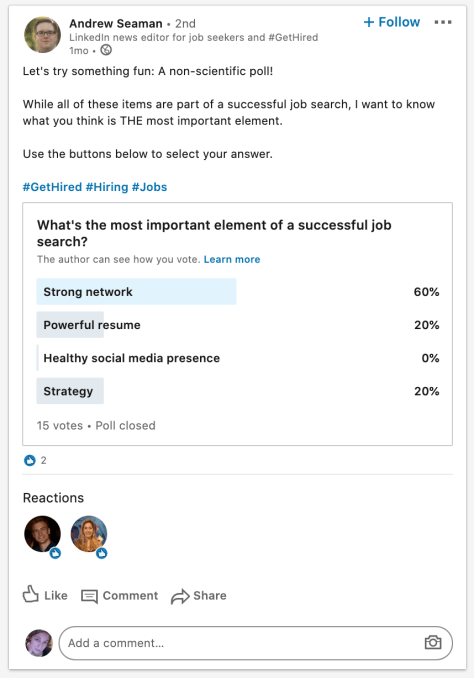
The polls feature — you can see an example of one in the picture below, or respond to that specific poll here — is a quick-fire and low-bar way of asking a question and encouraging engagement: LinkedIn says that a poll takes only about 30 seconds to put together, and responding doesn’t require thinking of something to write, but gives the respondent more of a ‘voice’ than he or she would get just by providing a “like” or other reaction.

But as with some of the other social features that LinkedIn has implemented over the years, its timing has not been quite right. With polls, you might say it’s been frustratingly late… or you might say it left the party too early.

The feature was first spotted by developer and app digger Jane Manchun Wong a couple of weeks ago, but it comes years after Twitter and Facebook have had polls in place on their platforms. I’d say it’s taken LinkedIn years to catch up, but actually it had polls in place years ago, yet chose to sunset the feature, back in 2014.

You could argue that LinkedIn miscalled the direction that social would go with engagement, or that it took too long to resuscitate the experience, or that the novelty of the concept that now worn off. Or you might say that LinkedIn has picked just the right time to bring it back, at a time when people are spending more time online than ever and are looking for more ways of varying the experience and interacting.

Those creating polls will be given the option in the menu of items when starting a new post. They can add four choices/options into the poll answers, and decide how long they would like for the poll to stay up, in a range of 24 hours to two weeks. You can also write an introduction post to accompany your poll with hashtags to come up in more searches.

Two important distinctions with LinkedIn Polls as you can see above are that you are polling a very specific audience of people in your professional circle, and those people can both respond to the poll but also include comments and reactions. Both of these set the feature as it works on LinkedIn apart from the others and should give it some… engagement.

The polls feature is getting rolled out (again) starting today.

The LinkedIn Virtual Events feature, meanwhile, falls into a similar placement as polls: it’s a way of getting people to engage more on LinkedIn, it taps into trends that are huge outside of the platform — in this case, videoconferencing — and it’s something that is coming surprisingly late to LinkedIn, given its existing product assets.

But is also potentially — potentially, because Live is still in an invite-only phase — going to prove very popular because it’s filling a very specific need.

LinkedIn Virtual Events is a merger of two products that LinkedIn launched last year, a live video broadcasting tool called LinkedIn Live, and its efforts to foster a sideline in offline, in person networking with LinkedIn Events. The idea here is that while physical events have been put on pause in the current climate — many cities have made group activities illegal in an attempt to slow the spread of the novel coronavirus — you can continue to use LinkedIn Events to plan them, but now carry them out over the Live platform. 

Given how huge the conferencing industry has become, I am guessing that we will be seeing a lot of attempts at recreating something of those events in a virtual, online context. LinkedIn’s take on the challenge — via Virtual Events — could therefore become a strong contender to host these.

When LinkedIn first launched Events I did ask the company whether it planned to expand them online using live, and indeed that did seem to be the plan. LinkedIn now says that it “accelerated” its product roadmap — unsurprising, given the current market — to merge the two products for targeted audiences.

That’s why we accelerated our product roadmap to bring you a tighter integration between LinkedIn Events and LinkedIn Live, turning these two products into a new virtual events solution that enables you to stay connected to your communities and meet your customers wherever they are. This new offering is designed to help you strengthen relationships with more targeted audiences.

This is not a simple integration, I should point out: LinkedIn is working with third-party broadcasting partners — the initial list includes Restream, Wirecast, Streamyard and Socialive — to raise the level of production quality, which will be essential especially if you are asking people to pay for events, and if you have any hope of replicating some of the networking other features that are cornerstones of conferencing and other in-person events.

It’s also building on what has been a successful product so far for LinkedIn: the company says that Live has 23X more comments per post and 6X more reactions per post than simple native video.

Powered by WPeMatico