1010Computers | Computer Repair & IT Support

Call for EU state aid rules to flex for startups

European startups are calling for more flexibility in EU state aid rules to allow national governments to provide liquidity for the region’s fledgling digital businesses during the COVID-19 crisis.

In a joint letter addressed to Commission EVP Margrethe Vestager, more than a dozen startup associations from across the bloc have called for rules to be adapted to ensure digital businesses are not blocked from receiving any emergency state aid.

In March the Commission applied an update to EU state aid rules clarifying how Member States can provide support to homegrown businesses during the coronavirus emergency.

However the startup association representatives co-signing the latter — which include reps from Coadec in the UK, France Digitale, Germany’s Bundesverband Deutsche Startups, Startup Poland and several others  are concerned the framework is being too narrowly drawn where digital upstarts are concerned.

They point out that startups may be intentionally operating at a loss as a calculated bet on gaining scale down the line, making the current rules a poor fit.

Startups across Europe report that the Temporary Framework for State Aid is not yet giving enough flexibility to Member States to support startup ecosystems,” they write. “The definition of an ‘undertaking in difficulty’ is intended to apply to loss-making businesses. Such a definition will often be enough to deny support being given to such a business. However many startups are loss-making by design in their first years, as they are taking a calculated bet on exponential growth and associated job growth that will emerge in the following years.

“Only taking the current cash flow into account belittles the economic potential of these startups and prevents them from receiving much-needed support. In doing so it can undermine the post COVID-19 recovery, as it is today’s loss making startups which will be the driver for economic and job growth in the future.”

The letter goes on to call for startups to “receive the support that other economic actors are also receiving”.

“Startups provide a key opportunity for our economies and societies to recover as we come out of COVID,” they suggest, adding: “They will play a central part in re-growing our economy and crucially in doing so on a more carbon-neutral footing.”

We reached out to the Commission for a request for comment but at the time of writing it had not responded.

While it might a bit of a contradiction for VC-backed tech businesses which may choose to operate at a loss during ‘normal’ times to be calling for liquidity help now, Benedikt Blomeyer, EU policy director at Allied for Startups — one of a number of startup associations signing the letter — told us the argument is simply that Europe’s startups should be able to expect the same kind of support that is being extended to other types of businesses.

A number of EU Member States have laid out major support programs for startups to date — such as France’s $4.3BN liquidity support plan, announced in March; and a match fund revealed last month in the UK (which remains an EU member until the end of this year).

But the contention appears to be that liquidity isn’t flowing to all the European startups that need it, nor arriving in a timely enough way.

“For startups, loss-making doesn’t mean that it is necessarily a failing business,” Blomeyer told TechCrunch. “The bigger picture is that we are looking at startup ecosystems as key providers of jobs and economic growth coming out of the crisis. Some startups will fail, just like other businesses. But the question is whether startups should be able to access the same kind of support that other companies can to help them survive this crisis. We believe they should.”

Commenting on the issue in a statement, Paolo Palmigiano, head of competition, EU & trade for law firm Taylor Wessing, agreed the EU state aid rules may struggle to accommodate Internet businesses.

“The criteria introduced by the Commission in the Framework that a company must be viable as of 31 Dec 2019 makes sense in the old brick and mortar world. A company which would have gone in any case bankrupt, even without the current crisis, should not receive aid. The criteria start to be more complex and causes difficulties for tech companies which might not be profitable at the time although they could be in the future,” he said.

“The state aid rules were created in the 60s at a time when the single market did not exist and Europe had a lot of old-style industries (like steel). We need to see how the Commission react but I can see them struggling – how do you distinguish a loss making tech company which in any case would have gone bankrupt from a loss making company that will become profitable in the short term?”

Asked how it believes the Commission should replace the current viability criteria and assess which startups merit help and which don’t, Allied for Startups’ Blomeyer called for a blanket exemption for startups founded over the last half decade or more.

“There could be a clear exemption from the UID test for companies that have been set up in the last 5-7 years,” he suggested. “We need to underline that this is an unprecedented crisis that requires extraordinary measures. So while in normal times a regular process of assessing whether/how to assess startups might have worked, now the ecosystems that built them are melting away before our eyes because of the barriers. The basic conundrum is that it is unclear whether a loss-making startup is indeed not a viable business. This needs resolving.”

In what now feels like an earlier age late last year — as European Commission president Ursula von der Leyen was taking up her five-year mandate — tech-driven change was identified as one of her key policy priorities, with digitization and a green deal taking center stage, alongside a push for European tech sovereignty and support for homegrown startups to scale up.

So if Europe’s startups are feeling overlooked now, in the middle of an unprecedented economic shock, that hardly reflects well on the Commission’s claimed high tech policy goals.

Powered by WPeMatico

GO1, an enterprise learning platform, picks up $40M from Microsoft, Salesforce and more

With a large proportion of knowledge workers doing now doing their jobs from home, the need for tools to help them feel connected to their profession can be as important as tools to, more practically, keep them connected. Today, a company that helps do precisely that is announcing a growth round of funding after seeing engagement on its platform triple in the last month.

GO1.com, an online learning platform focused specifically on professional training courses (both those to enhance a worker’s skills as well as those needed for company compliance training), is today announcing that it has raised $40 million in funding, a Series C that it plans to use to continue expanding its business. The startup was founded in Brisbane, Australia and now has operations also based out of San Francisco — it was part of a Y Combinator cohort back in 2015 — and more specifically, it wants to continue growth in North America, and to continue expanding its partner network.

GO1 not disclosing its valuation but we are asking. It’s worth pointing out that not only has it seen engagement triple in the last month as companies turn to online learning to keep users connected to their professional lives even as they work among children and house pets, noisy neighbours, dirty laundry, sourdough starters, and the rest (and that’s before you count the harrowing health news we are hit with on a regular basis). But even beyond that, longer term GO1 has shown some strong signs that speak of its traction.

It counts the likes of the University of Oxford, Suzuki, Asahi and Thrifty among its 3,000+ customers, with more than 1.5 million users overall able to access over 170,000 courses and other resources provided by some 100 vetted content partners. Overall usage has grown five-fold over the last 12 months. (GO1 works both with in-house learning management systems or provides its own.)

“GO1’s growth over the last couple of months has been unprecedented and the use of online tools for training is now undergoing a structural shift,” said Andrew Barnes, CEO of GO1, in a statement. “It is gratifying to fill an important void right now as workers embrace online solutions. We are inspired about the future that we are building as we expand our platform with new mediums that reach millions of people every day with the content they need.”

The funding is coming from a very strong list of backers: it’s being co-led by Madrona Venture Group and SEEK — the online recruitment and course directory company that has backed a number of edtech startups, including FutureLearn and Coursera — with participation also from Microsoft’s venture arm M12; new backer Salesforce Ventures, the investing arm of the CRM giant; and another previous backer, Our Innovation Fund.

Microsoft is a strategic backer: GO1 integrated with Teams, so now users can access GO1 content directly via Microsoft’s enterprise-facing video and messaging platform.

“GO1 has been critical for business continuity as organizations navigate the remote realities of COVID-19,” said Nagraj Kashyap, Microsoft Corporate Vice President and Global Head of M12, in a statement. “The GO1 integration with Microsoft Teams offers a seamless learning experience at a time when 75 million people are using the application daily. We’re proud to invest in a solution helping keep employees learning and businesses growing through this time.”

Similarly, Salesforce is also coming in as a strategic, integrating this into its own online personal development products and initiatives.

“We are excited about partnering with GO1 as it looks to scale its online content hub globally. While the majority of corporate learning is done in person today, we believe the new digital imperative will see an acceleration in the shift to online learning tools. We believe GO1 fits well into the Trailhead ecosystem and our vision of creating the life-long learner journey,” said Rob Keith, Head of Australia, Salesforce Ventures, in a statement.

Working remotely has raised a whole new set of challenges for organizations, especially those whose employees typically have never before worked for days, weeks and months outside of the office.

Some of these have been challenges of a more basic IT nature: getting secure access to systems on the right kinds of machines and making sure people can communicate in the ways that they need to to get work done.

But others are more nuanced and long-term but actually just as important, such as making sure people remain in a healthy state of mind about work. Education is one way of getting them on the right track: professional development is not only useful for the person to do her or his job better, but it’s a way to motivate people, to focus their minds, and take a rest from their routines, but in a way that still remains relevant to work.

GO1 is absolutely not the only company pursuing this opportunity. Others include Udemy and Coursera, which have both come to enterprise after initially focusing more on traditional education plays. And LinkedIn Learning (which used to be known as Lynda, before LinkedIn acquired it and shifted the branding) was a trailblazer in this space.

For these, enterprise training sits in a different strategic place to GO1, which started out with compliance training and onboarding of employees before gravitating into a much wider set of topics that range from photography and design, through to Java, accounting, and even yoga and mindfulness training and everything in between.

It’s perhaps the directional approach, alongside its success, that have set GO1 apart from the competition and that has attracted the investment, which seems to have come ahead even of the current boost in usage.

“We met GO1 many months before COVID-19 was on the tip of everyone’s tongue and were impressed then with the growth of the platform and the ability of the team to expand their corporate training offering significantly in North America and Europe,” commented S. Somasegar, managing director, Madrona Venture Group, in a statement. “The global pandemic has only increased the need to both provide training and retraining – and also to do it remotely. GO1 is an important link in the chain of recovery.” As part of the funding Somasegar will join the GO1 board of directors.

Notably, GO1 is currently making all COVID-19 related learning resources available for free “to help teams continue to perform and feel supported during this time of disruption and change,” the company said.

Powered by WPeMatico

Electric gets another $7 million in funding from 01 Advisors and the Slack Fund

Electric, a platform that aims to put IT departments in the cloud, today announced new funding following a continuation of its Series B earlier this year.

Dick Costolo and Adam Bain (01 Advisors) and the Slack Fund participated in the $7 million capital infusion.

01 Advisors put up the majority of the financing ($5 million) with the Slack Fund putting up a little under $1 million and other insiders covering the rest, according to Electric founder and CEO Ryan Denehy.

The funding situation with Electric is a bit unique. Electric raised a $25 million Series B round led by GGV in January of 2019. In March of this year, just before the lockdown, the company reopened the Series B at a higher valuation to make room for Dick Costolo and Adam Bain, raising an additional $14.5 million.

Then the coronavirus pandemic rocked the globe. On Monday March 9, the stock market felt it, triggering a temporary halt on trading. The following week was total financial chaos.

That’s when Adam Bain called up Denehy again. They ‘rapped out’ about the potential for Electric during this turbulent time.

“The increase in remote work is going to be dramatic,” said Denehy, relaying his conversation with Bain. “Larger companies are going to get smarter about budgeting and there is a lot of urgency for them to find ways to spend money around back office tasks like IT more efficiently. Electric becomes more appealing because, dollar for dollar, it’s a lot more efficient than building a big IT department.”

The first week of April, Bain called Denehy again, this time saying that 01 Advisors wanted to put in more money into Electric.

Electric is a platform designed to support the existing IT department of an organization, or in some cases, replace an outsourced IT department. Most of IT’s responsibilities focus on administration, distribution and maintenance of software programs. Electric allows IT to install its software on every corporate machine, giving the department a bird’s-eye view of the organization’s IT situation. It also aims to give IT departments more time to focus on real problem-solving and troubleshooting tasks.

From their own machine, lead IT professionals can grant and revoke permissions, assign roles and ensure all employees’ software is up to date.

Electric is also integrated with the APIs of top software programs, like Dropbox and G-suite, letting IT handle most of their day-to-day tasks through the Electric dashboard. Moreover, Electric is also integrated with Slack, letting folks within the organization flag an issue or ask a question from the platform where they spend the most time.

“The biggest challenge for Electric is keeping up with demand,” said Jason Spinell from the Slack Fund, who also mentioned that he passed on investing in Electric’s seed round and is “excited to sort of rectify [his] mistake.”

Electric also added a new self-service product that can live in the dock, letting employees look at all the software applications provided by the organization from their remote office.

“There are so many stretched IT departments now that have to do a lot more with a lot less,” said Denehy. “There are also companies who were working with an outsourced IT provider and relied on them showing up to the office a few times a week, and all of a sudden that doesn’t work anymore.”

With the current ecosystem, Electric is continuing to spend on marketing but with 180 percent increase in interest from potential clients in the pipeline, according to Denehy.

Editor’s Note: This article has been updated to reflect the accurate amount invested by participants in the round.

Powered by WPeMatico

Buzzy Ethereum wallet app Argent comes out of stealth

Argent is launching the first public version of its Ethereum wallet for iOS and Android. The company has been available as a limited beta for a few months with a few thousand users. But it has already raised a seed and a Series A round with notable investors, such as Paradigm, Index Ventures, Creandum and Firstminute Capital. Overall, the company has raised $16 million.

I managed to get an invitation to the beta a few months ago and have been playing around with it. It’s a well-designed Ethereum wallet with some innovative security features. It also integrates really well with DeFi projects.

Many people leave their crypto assets on a cryptocurrency exchange, such as Coinbase or Binance. But it’s a centralized model — you don’t own the keys, which means that an exchange could get hacked and you’d lose all your crypto assets. Similarly, if there’s a vulnerability in the exchange API or login system, somebody could transfer all your crypto assets to their own wallets.

At heart, Argent is a non-custodial Ethereum wallet, like Coinbase Wallet or Trust Wallet. You’re in control of the keys. Argent can’t initiate a transaction without your authorization for instance.

But that level of control brings a lot of complexities. Hardware wallets, such as Ledger wallets, ask you to write down a seed phrase so that you can recover your wallet if you lose your device. It requires some discipline and it’s hard to understand if you’re not familiar with the concept of seed phrases.

Even Coinbase Wallet tells you to back up your seed phrase when you first create a wallet. “We see them as advanced tools for developers,” Argent co-founder and CEO Itamar Lesuisse told me.

That’s why a new generation of wallets tries to hide the complexity from the end user, such as ZenGo and Argent. Creating a wallet on Argent is one of the best experiences in the cryptocurrency space. Your wallet is secured by something called ‘guardians’.

Trust your friends

A guardian can be someone you know and trust, a hardware wallet (or another phone) or a MetaMask account. Argent also provides a guardian service, which requires you to confirm your identity with a text message and an email. If you lose your phone and you want to recover your wallet on another phone, you need to speak to your guardians and get a majority of confirmations. If they can all confirm that, yes, indeed, your phone doesn’t work anymore and you want to recover your crypto assets, the recovery process starts.

Let’s take an example. Here’s your list of guardians:

  • Argent’s own guardian service
  • Two friends who are also using Argent
  • A Ledger Nano S hardware wallet

In total, there are five different factors involved, you including. If you lose your phone, you can recover your wallet by downloading Argent on another phone (factor #1), asking Argent’s guardian service to send you a text and an email to confirm your identity (factor #2) and confirming your identity with the Ledger Nano S (factor #3).

You have reached a majority and the recovery process starts. You’ll get your funds in 36 hours so that you have enough time to cancel it it’s a hijacking attempt.

But you could also have downloaded the Argent app on another phone (factor #1) and pinged your two friends (factor #2 and #3) directly. If they can confirm the same sequence of characters (emojis in that case), the recovery process would start as well.

“I’m interested in social recovery, multi-key schemes,” Ethereum creator Vitalik Buterin said in a TechCrunch interview in July 2018. It’s not a new concept as social media apps already use social recovery systems. On WeChat, if you lose your password, WeChat asks you to select people in your contact list within a big list of names.

In Argent’s case, social recovery adds an element of virality as well. The experience gets better as more people around you start using Argent.

In addition to wallet recovery, Argent uses guardians to put some limits. Just like you have some limits on your bank account, you can set a daily transaction limit to prevent attackers from grabbing all your crypto assets. You can ask your guardians to waive transactions above your daily limits.

Similarly, you can ask your guardians to lock your account for 5 days in case your phone gets stolen.

Betting on Ethereum

Argent is focused on the Ethereum blockchain and plans to support everything that Ethereum offers. Of course, you can send and receive ETH. And the startup wants to hide the complexity on this front as well as it covers transaction fees (gas) for you and gives you usernames. This way, you don’t have to set the transaction fees to make sure that it’ll go through.

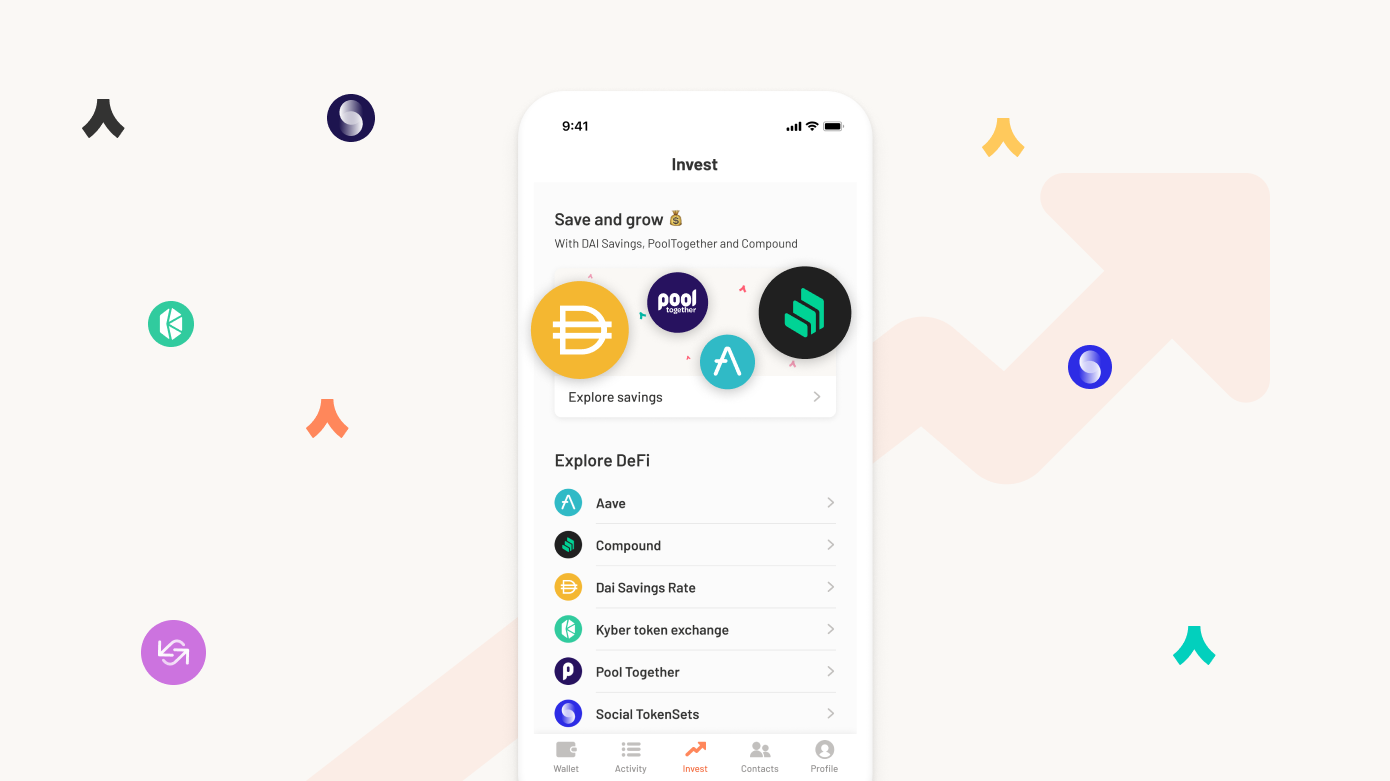
The startup plans to integrate DeFi projects directly in the app. DeFi stands for decentralized finance. As the name suggests, DeFi aims to bridge the gap between decentralized blockchains and financial services. It looks like traditional financial services, but everything is coded in smart contracts.

There are dozens of DeFi projects. Some of them let you lend and borrow money — you can earn interest by locking some crypto assets in a lending pool for instance. Some of them let you exchange crypto assets in a decentralized way, with other users directly.

Argent lets you access TokenSets, Compound, Maker DSR, Aave, Uniswap V2 Liquidity, Kyber and Pool Together. And the company already has plans to roll out more DeFi features soon.

Overall, Argent is a polished app that manages to find the right balance between security and simplicity. Many cryptocurrency startups want to build the ‘Revolut of crypto’. And it feels like Argent has a real shot at doing just that with such a promising start.

Powered by WPeMatico

Is the e-commerce shift going to last?

Ashwin Ramasamy
Contributor

Ashwin Ramasamy is the co-founder of PipeCandy, an online merchant graph company that discovers and analyzes business and consumer perception metrics about D2C brands and e-commerce companies.

E-commerce is taking off faster than ever. In the last couple of weeks, my Twitter timeline has been filled with operators gushing about how the weekends seem like Black Friday, even for non-essential commodities. Change is already here.

As we help thousands of businesses to move online, our platform is now handling Black Friday level traffic every day!

It won’t be long before traffic has doubled or more.

Our merchants aren’t stopping, neither are we. We need 🧠to scale our platform.https://t.co/e2JeyjcEeC pic.twitter.com/6lqSrNUCte

— Jean-Michel Lemieux (@jmwind) April 16, 2020

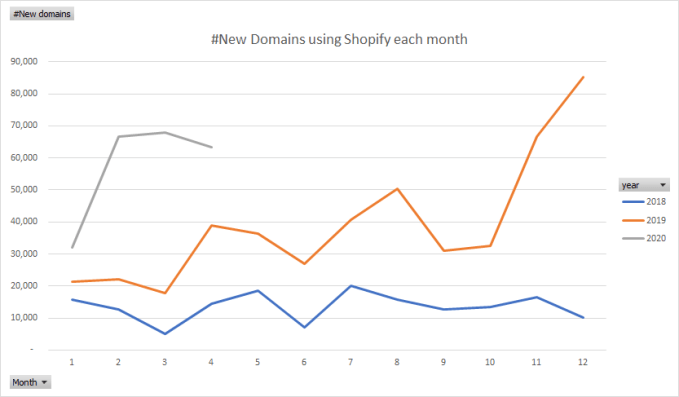
Looking at the above graph in this Tweet from Shopify CTO Jean-Michel Lemieux — and the passing, contextless mention of “Offline2Online” — we got curious.

Beyond just the anecdotal evidence, we looked for signs that tell us e-commerce is being adopted at a faster pace. One way to ascertain that is to look at the historical data of how Shopify has been onboarding merchants for the last two years on a monthly basis, and compare that with what happened this year in Q1.

All of these data points come from PipeCandy’s own data platform that tracks close to 750K+ Shopify merchants with historical data for each:

new domains using shopify each month

New domains using Shopify each month

While 2020 started on a faster clip than 2018 and 2019, February and March have seen nothing short of jaw-dropping growth in merchant numbers for Shopify. In those two months alone, Shopify seems to have onboarded more merchants than in the whole of 2018.

The softening you see in April is a result of the lag in the way our systems validate and confirm the data and not a slowdown in Shopify per se. The e-commerce embrace is real.

Powered by WPeMatico

The Great Reset

Ann Miura-Ko
Contributor

Ann Miura-Ko is a co-founding partner at Floodgate, a seed-stage VC firm. A repeat member of the Forbes Midas List and the New York Times Top 20 Venture Capitalists Worldwide, she earned a PhD in math modeling of cybersecurity at Stanford University.

Talk of an economic downturn can be frightening, especially one precipitated by a pervasive health crisis. At times, I’m overwhelmed by the images of countless patients on life-support and the near-endless streams of statistics regurgitating bad news.

Having started in venture at the beginning of two recessions, I’ve seen how the startup industry functions during economic trouble. My second day of work at Charles River Ventures was September 11th, 2001. My first project, analyzing the VC industry, propelled the firm to return more than 60% of its fund to investors, going from a $1.2 billion fund to $450 million. In May 2008, Mike Maples and I founded Floodgate in the midst of the Great Recession. We learned that great founders won’t wait for a better economic moment to start a company.

While we are currently embroiled in personal and professional circumstances unimaginable even three months ago, these very challenges will form the basis of incredibly innovative ideas. In order for the world to move forward, we need our greatest minds to imagine a brighter future and create solutions to make it a reality.

When I analyze our society and novel health situation, one thing is certain: COVID-19 is a paradigm-shifting event, creating massively accelerated social and economic change.

The Great Reset is not just another economic event

Our current situation is unique. It’s not merely a cyclical economic event, nor is it a standalone health crisis. What we are experiencing is not just an inflection point: it’s a societal phase-change unlike anything we have ever seen. We face an epic choice of how we move forward, and the decisions we make today will shape an entire generation.

Here’s why: COVID-19 is prompting us to reset many of our most fundamental behaviors. These changes are impacting our financial system, with effects visible throughout our homes, businesses and even the concept of “workplace” itself.

COVID-19 is pervasive

As a global pandemic, the virus itself has spread to nearly every country in the world.

Between February 20 and March 26, 100% of the world’s 20 largest economies implemented government-mandated social distancing. Globally, the number of scheduled airline flights is down 64%. In some countries, like Spain and Germany, flight numbers are down by more than 90%.

Since the timeline for lifting government restrictions is unclear — and even then, scientists are uncertain how the virus will spread — the question lingers: How long will this go on?

COVID-19’s impact is uncertain, long-term and potentially undulating, affecting every facet of our lives. You can’t simply wait it out with the expectation that industries will rebound. In 2001, September 11 felt pervasive, but its economic impact ultimately stemmed from just one single incident and the resulting fear… and that one single incident still cost more than three trillion dollars. How much larger will COVID-19 be?

Powered by WPeMatico

E-bike startup Angell partners with SEB for manufacturing and investment

French startup Angell has signed a wide-ranging partnership with SEB, the French industrial company behind All-Clad, Krups, Moulinex, Rowenta, Tefal and others. As part of the deal, SEB will manufacture Angell’s electric bikes in a factory in Is-sur-Tille near Dijon, France.

SEB’s investment arm, SEB Alliance, is also investing in Angell . The terms of the deal are undisclosed, but Angell says it plans to raise between $7.6 and $21.7 million (between €7 and €20 million) with a group of investors that include SEB.

“We originally planned to manufacture 1,500 bikes in 2020,” Angell founder Marc Simoncini told me. “We realized that we were selling more bikes than expected. We now expect to sell 10,000 bikes.”

Angell has accepted 2,000 pre-orders over the past six months — 75% in France and 25% from the rest of the world. But pre-orders accelerated drastically with the lockdown in France. During the month of May, Angell expects to sell three times more bikes than during an average month.

Originally, Angell planned to build its own factory and assemble bikes itself. SEB is allocating 25 employees on the production line and production should start at the end of May. It should definitely make things move faster and reduce potential delays.

Angell unveiled its smart electric bike in November 2019. It has a 2.4-inch touch screen, an aluminum frame, integrated lights and a removable battery.

Like other connected bikes from Cowboy and VanMoof, it pairs with your phone using Bluetooth. This way, the Angell bike has an integrated lock and alarm system. There are also an integrated GPS chip and cellular modem to track it if it ever gets stolen.

But Angell is going one step further with the integrated display. You can select the level of assistance and display information on the screen, such as speed, calories, battery level and distance. It can also display turn-by-turn directions. Your handlebar also vibrates to indicate when you’re supposed to turn left or right.

The company is also announcing a second model this week, the Angell/S. It is a smaller, lighter version of the bike with a step-through frame. Both models feature the same battery, same motor and same electronics. They also both cost €2,690 ($2,900).

Angell now expects to deliver the first batch of bikes in July. By the end of the summer, new customers should be able to order a bike and get delivered within 10 days. Eventually, the company will also roll out a full line of accessories, such as fenders, baskets and mirrors.

Powered by WPeMatico

Startups Weekly: How will we build the city of the future?

Editor’s note: Get this weekly recap of TechCrunch news that any startup can use by email every Saturday morning (7am PT), just subscribe here.

Commercial real estate, the traditional heart of most cities, may have lost its reason to exist in the last few months. The world is about to find out what the situation is as more locations start to reopen.

First up in our ongoing coverage of the topic, Connie Loizos caught up with a couple proptech investors this week for TechCrunch, who saw existing trends accelerating — with many medically focused additions.

Brendan Wallace of Fifth Wall is looking for more aggressive pickup of smart tech in general, along the lines of what you already see in some other countries. “He notes sensors that can determine how many people are in a room or pass through a turnstile. He points to facial recognition tech that can help keep points of physical contact to a minimum. He imagines that more companies might embrace robots to patrol buildings and, possibly, to clean them, too.”

Darren Bechtel of Brick and Mortar saw tech remaking the construction site, with growing practices like using large-scale pre-fabricated components: “If you’re limited by how many people can work in the field, and you have to put in controls for people not working on top of each other, the question becomes: how can you do the work in a more controlled environment, with a next-gen HVAC system [to purify the air] and markings on the floor?…. People are now saying, ‘How much can we prepare off-site?’”

Buildings are also going to be focused on health features, Connie wrote. “[B]oth Wallace and Bechtel mentioned advanced air purifiers and air handling units used to recondition and circulate air as part of a heating, ventilating and air-conditioning plan. Both say it will likely become a growing area of interest for building owners and developers.”

What about beyond the buildings? A few writers here put together some thoughts in a post for Extra Crunch. Here’s Danny Crichton’s view from Brooklyn:

Few of us can live in the dreary confines of a suburban enclave our entire workweek. And so I expect to see a revitalization of the classic Main Street clusters that once dotted towns across America as people appreciate the close proximity of amenities that they need throughout their day and remote work makes it possible to skip the commute to the central business district.

It’s not going to be a simple transition, of course. The built environment alone will probably take decades to fully transition. But the spirit of Jane Jacobs lives on and will move beyond the downtown core neighborhoods she observed to spread to medium and perhaps even small towns across the country and throughout the world.

If you want more on the topic, check out our recent investor survey with six other top proptech investors from late March (for subscribers).

Just want to settle down at home and get to work? Check out Darrell Etherington’s TechCrunch guide to setting up a pro-grade videoconference studio.

dollar bills

The $100M ARR club continues to grow, despite everything

When Alex Wilhelm rejoined TechCrunch late last year, he kicked things off with a list of companies that he called “the $100M ARR club” to signify unicorns that were also generating a lot of revenue. It was a clever way of organizing which of the hundreds of highly valued companies heading towards IPOs were most set up for success, and our readers agreed.

But, with entire market categories whipsawed by the pandemic, it has been hard to find companies willing to share numbers lately. He still found a few, as he wrote up for Extra Crunch this week: ActiveCampaignRecorded Future and ON24. Here’s a vignette from the CEO of ActiveCampaign:

While we had the CEO’s attention, TechCrunch wanted to know if ActiveCampaign was taking incoming fire from COVID-19 and its related economic and labor disruptions. As some other SMB-focused software companies have told us, the answer is no. Here’s [Jason] VandeBoom:

We anticipate continued growth in 2020 and are already seeing further acceleration to support this. The past four months have been the best in company history and we’ve seen monthly trials double in that timeframe and new customer acquisition numbers at 4500, 5500, 6000 and 7000 respectively from January to April.

He did hedge those results a little, adding that while his firm has “seen some acceleration from COVID-19 and the digital transformation that it is inspiring,” the CEO is more convinced that “the need for customer experience is what is fueling the majority of this growth.”

This week in China trade news….

The already basic trade agreement between the Trump administration and the Chinese government from last year looks ready to blow up; the administration banned selling more tech to Huawei; TSMC plans to open a factory in Arizona following urging from the US government; Foxconn profits crashed… Danny Crichton has a clear takeaway on TechCrunch for startups about the latest headlines:

[T]he world of semiconductors, of internet infrastructure, of the tech ties that have bound the U.S. and China together for decades — they are frayed and are almost gone. It’s a new era in supply chains and trade, and an open world for new approaches to these huge existing industries.

If your company is not already planning for a more chaotic, multi-polar world than what most of us can remember living through, it may already be too late.

(Photo by CHRISTOPHE ARCHAMBAULT/AFP via Getty Images)

Investor survey: hospitals to increase tech focus after pandemic

Sarah Buhr talked to top investors in the healthcare B2B and infrastructure businesses for one of our investor surveys this week on Extra Crunch. They generally seemed to agree that the pandemic was going to push the system wholesale towards better technology. Here’s Bilal Zuberi of Lux Capital:

While a lot of our healthcare infrastructure will take a little bit of time recovering from the stress COVID placed on it, we anticipate this to provide a push to the system to adopt new technologies that enable distributed health, build resiliency in our delivery networks and deploy data-enabled healthcare. Hospital balance sheets might struggle in the short term to buy new technologies, but payers as well as large businesses might participate in infrastructure development and deployment in a bigger way. We anticipate selling to hospitals to be difficult in the short term, as they try to recover from the revenue shortfall they experienced during COVID-19, but will generally emerge more interested in adopting new technologies, digital and remote health solutions and automation in various functions. Needless to say, a wide-scale digital transformation of our healthcare industry is underway, and there is no looking back.

Don’t miss our other survey this week, on how the mobility investors are viewing the pandemic.

Protecting your equity as a startup employee

Wouter Witvoet of fintech startup SecFi wrote a guest post for TechCrunch going over some key points for anyone working at a startup right now (or recently). As an occasional startup founder and/or employee myself, I’d like to recommend this one for special consideration: “Negotiate for equity during a pay cut or furlough.”

Startups typically offer equity as a means of deferred compensation and as a way to incentivize employees to own a piece of the company they are building. The compensation is deferred as most startups are cash-strapped and cannot afford to pay you what a larger company may be able to.

If your company is now asking you to take a pay cut, or even take no pay during this time, you should consider asking for additional equity to make up for the lost compensation. While not all companies may be amenable to offering more equity, there is no cash outlay from the company’s standpoint, so it’s an efficient way for your company to compensate you for your sacrifice while preserving their cash.

In addition, offering more equity shows a commitment from management to their employees during this difficult time. It may be the win-win scenario for your company and yourself in the long-run so it’s worth having the conversation with management to discuss if this is available for you.

At first it seems weird when you consider typical venture dynamics. The founders have probably already lost leverage against the company’s investors. These investors have probably already lost leverage against their LPs. So nobody is naturally included to give up even more. And the employees were already last in line on the cap table and first to go, so why should founders do anything different?

Tactically, the best employees will be attracted go work at bigger more stable companies as the pandemic recession stretches on — and you might not have the cash to afford the effort to rehire. Strategically, now is the time to build the esprit de corp that will carry your company forward into better times… a few extra basis points for the team now could help deliver a priceless return.  

Across the week

TechCrunch

COVID-19 shows we need Universal Basic Internet now

AngelList wants to improve comparing VC fund performance with new metrics and calculator

Seven viral futures

Where to shop online that isn’t Amazon, Target or Walmart

Extra Crunch

4 edtech CEOs peer into the industry’s future

Sequoia’s Roelof Botha is more optimistic about startups today than he was a year ago

These best practices maximize the value of your online events

Fintech startups amass war chests for the economic downturn

Around TechCrunch

Give the gift of Extra Crunch membership to anyone

Extra Crunch Live: Join Alexia and Niko Bonatsos for a Q&A May 19th at 2 pm EDT/11 am PDT

Extra Crunch Live: Join Revolution’s Steve Case and Clara Sieg on May 21 at 3pm ET/12pm PT

#EquityPod

From Alex:

Hello and welcome back to Equity, TechCrunch’s venture capital-focused podcast, where we unpack the numbers behind the headlines.

Are you a regular Equity listener? Take our survey here! We talk about it on the show.

From home once again this week, DannyNatashaAlex and Chris got together to pull the show together. But unlike last week’s episode (catch up here if you are behind), this week’s show features a game that actually worked. It’s at the end, as you’ll see.

But before that piece of the puzzle, there was a bunch of news to go over. We had to leave SaaS valuationsthe Liftoff ListBrex and FalconX on the floor, but there was still so much good stuff to cover:

Then we played our game. Please hold us to account. And if you have listened to the show for a while, take our survey! It’s right after this next sentence.

Equity drops every Friday at 6:00 am PT, so subscribe to us on Apple PodcastsOvercastSpotify and all the casts.

Powered by WPeMatico

This Week in Apps: Houseparty battles Messenger, Telegram drops crypto plans, Instagram Lite is gone

Welcome back to This Week in Apps, the Extra Crunch series that recaps the latest OS news, the applications they support and the money that flows through it all.

The app industry is as hot as ever, with a record 204 billion downloads and $120 billion in consumer spending in 2019. People are now spending 3 hours and 40 minutes per day using apps, rivaling TV. Apps aren’t just a way to pass idle hours — they’re a big business. In 2019, mobile-first companies had a combined $544 billion valuation, 6.5x higher than those without a mobile focus.

In this Extra Crunch series, we help you keep up with the latest news from the world of apps, delivered on a weekly basis.

This week we’re continuing to look at how the coronavirus outbreak is impacting the world of mobile applications, including the latest news about COVID-19 apps, Facebook and Houseparty’s battle to dominate the online hangout, the game that everyone’s playing during quarantine, and more. We also look at the new allegations against TikTok, the demise of a popular “Lite” app, new apps offering parental controls, Telegram killing its crypto plans and many other stories, including a hefty load of funding and M&A.

Headlines

Contact tracing and COVID-19 apps in the news 

  • Global: WHO readies its coronavirus app for symptom-checking and possibly contact tracing. A WHO official told Reuters on Friday the new app will ask people about their symptoms and offer guidance on whether they may have COVID-19. Information on testing will be personalized to the user’s country. The organization is considering adding a Bluetooth-based, contact-tracing feature, too. A version of the app will launch globally, but individual countries will be able to use the underlying technology and add features to release their own versions. Engineers from Google and Microsoft have volunteered their time over the past few weeks to develop the app, which is available open-source on GitHub.
  • U.S.: Apple’s COVID-19 app, developed in partnership with the CDC, FEMA and the White House, received its first major update since its March debut. The new version includes recommendations for healthcare workers to align with CDC guidelines, best practices for quarantining if you’ve been exposed to COVID-19 and new information for pregnancy and newborns.
  • India: New Delhi’s contact-tracing app, Aarogya Setu, has reached 100 million users out of India’s total 450 million smartphone owners in 41 days after its release, despite privacy concerns. The app helps users self-assess if they caught COVID-19 by answering a series of questions and will alert them if they came into contact with someone who’s infected. The app has come under fire for how it stores user location data and logs the details for those reporting symptoms. The app is required to use Indian railways, which has boosted adoption.
  • Iceland: Iceland has one of the most-downloaded contact-tracing apps, with 38% of its population using it. But despite this, the country said it has not been a “game-changer” in terms of tracking the virus and only worked well when coupled with manual contact tracing — meaning phone calls that asked who someone had been in contact with. In addition, the low download rate indicates it may be difficult to get people to use these apps when they launch in larger markets.

Consumer advocacy groups say TikTok is still violating COPPA

Powered by WPeMatico