1010Computers | Computer Repair & IT Support

Identity management startup Truework raises $30M to help you verify your work history

As organizations look for safe and efficient ways of running their services in the new global paradigm of increased social distancing, a startup that has built a platform to help people verify their work details in a secure way is announcing a round of growth funding.

Truework, which provides a way for banks, apartment-rental agencies, and others to check the employment details of an applicant in a quick and secure manner online, has raised $30 million, money that CEO and co-founder Ryan Sandler said in an interview that it would use both grow its existing business, as well to explore adding more details — both via its own service and via third-party partnerships — to the identity information that it shares.

The Series B is being led by Activant Capital — a VC that focuses on B2B2C startups — with participation also from Sequoia Capital and Khosla Ventures, as well as a number of high profile execs and entrepreneurs — Jeff Weiner (LinkedIn); Tom Gonser (Docusign); William Hockey (Plaid); and Daniel Yanisse (Checkr) among them.

The LinkedIn connection is an interesting one. Both Sandler and co-founder Victor Kabdebon were engineers at LinkedIn working on profile and improving the kind of data that LinkedIn sources on its users (the third co-founder, Ethan Winchell, previously worked elsewhere), and while Sandler tells me that the idea for Truework came to them after both left the company, he sees LinkedIn “as a potential partner here,” so watch this space.

The problem that Truework is aiming to solve is the very clunky, and often insecure, nature of how organizations typically verify an individual’s employment information. Details about salary and where you work, and the job you do, are typically essential for larger financial transactions, whether it’s securing a mortgage or another financing loan, or renting an apartment, or for others who might need to verify that information for other purposes, such as staffing agencies.

Typically that kind of information gathering is time-consuming both to reach out to get and to confirm (Sandler cites statistics that say on average an HR person spends over 1,000 hours annually answering questions like these). And some of the systems that have been put in place to do that work — specifically consumer reporting agencies — have been proven not be as watertight in their security as you would hope.

“Your data is flowing around lots of third party platforms,” Sandler said. “You’re releasing a lot of information about yourself and you don’t know where the data is going and if it’s even accurate.”

Truework’s solution is based around a platform, and now an API, that a company buys into. In turn, it gives its employees the ability to consent to using it. If the employee agrees, Truework sources a worker’s place of employment and salary details. Then when a third party wants to verify that information for the person in question, it uses Truework to do so, rather than contacting the company directly.

Then, when those queries come in, Truework contacts the individual with an email or text about the inquiry, so that he/she can okay (or reject) the request. Truework’s Sandler said that it uses ISO27001, SOC2 Type 1 & 2 protections, but he also confirmed that it does store your data.

Currently the idea is that if you leave your job, your next employer would need to also be a Truework customer in order to update the information it has on you: the startup makes money by charging both larger enterprises to make the platform accessible to employees as well as those organizations that are querying for the information/verifications (small business employers using the platform can use it for free).

Over time, the plan will be to configure a way to update your profiles regardless of where you work.

So far, the concept has seen a lot of traction: there are 20,000 small businesses using the platform, as well as 100 enterprises, with the number of verifiers (its term for those requesting information) now at 40,000. Customers include The College Board, The Real Real, Oscar Health, The Motley Fool, and Tuft & Needle.

While all of this was built at a time before COVID-19, the global health pandemic has highlighted the importance of having more efficient and secure systems for doing work, especially at a time when many people are not in the office.

“Our biggest competitor is the fax machine and the phone call,” Sandler said, “but as companies move to more remote working, no one is manning the phones or fax machines. But these operations still need to happen.” Indeed, he points out that at the end of 2019, Truework had 25,000 verifiers. Nearly doubling its end-user customers speaks to the huge boost in business it has seen in the last five months.

That is part of the reason the company has attracted the investment it has.

“Truework’s platform sits at the center of consumers’ most important transactions and life events – from purchasing a home, to securing a new job,” said Steve Sarracino, founder and partner at Activant Capital, in a statement. “Up until now, the identity verification process has been painful, expensive, and opaque for all parties involved, something we’ve seen first-hand in the mortgage space. Starting with income and employment, Truework is setting the standard for consent-based verifications and unlocking the next wave of the digital economy. We’re thrilled to be partnering with this exceptional team as they continue to scale the platform.” Sarracino is joining the board with this round.

While a big focus in the world of tech right now may be on building more and better ways of connecting goods and services to people in as contact-free a way as possible, the bigger play around identity management has been around for years, and will continue to be a huge part of how the internet develops in the future.

The fax and phone may be the primary tools these days for verifying employment information, but on a more general level, there are companies like Facebook, Google and Apple already playing a big role in how we “log in” and use all kinds of services online. They, along with others focused squarely on the identity and verification space (and Truework works with some of them), and using a myriad of approaches that include biometrics, ‘wallet’-style passports that link to information elsewhere, and more, will all continue to try to make the case for why they might be the most trusted provider of that layer of information, at a time when we may want to share less and especially share less with multiple parties.

That is the bigger opportunity that investors are betting on here.

“The increasing momentum Truework has seen since its founding in 2017 demonstrates the critical need for transformation in this space,” said Alfred Lin, partner at Sequoia, in a statement. “Privacy, especially around identity data, is becoming increasingly top of mind for consumers and how they make transactions online.”

Truework has now raised close to $45 million, and it’s not disclosing its valuation.

Powered by WPeMatico

India’s Khatabook raises $60 million to help merchants digitize bookkeeping and accept payments online

Khatabook, a startup that is helping small businesses in India record financial transactions digitally and accept payments online with an app, has raised $60 million in a new financing round as it looks to gain more ground in the world’s second most populous nation.

The new financing round, Series B, was led by Facebook co-founder Eduardo Saverin’s B Capital. A range of other new and existing investors, including Sequoia India, Partners of DST Global, Tencent, GGV Capital, RTP Global, Hummingbird Ventures, Falcon Edge Capital, Rocketship.vc and Unilever Ventures, also participated in the round, as did Facebook’s Kevin Weil, Calm’s Alexander Will, CRED’s Kunal Shah and Snapdeal co-founders Kunal Bahl and Rohit Bansal.

The one-and-a-half-year-old startup, which closed its Series A financing round in October last year and has raised $87 million to date, is now valued between $275 million to $300 million, a person familiar with the matter told TechCrunch.

Hundreds of millions of Indians came online in the last decade, but most merchants — think of neighborhood stores — are still offline in the country. They continue to rely on long notebooks to keep a log of their financial transactions. The process is also time-consuming and prone to errors, which could result in substantial losses.

Khatabook, as well as a handful of young and established players in the country, is attempting to change that by using apps to allow merchants to digitize their bookkeeping and also accept payments.

Today more than 8 million merchants from over 700 districts actively use Khatabook, its co-founder and chief executive Ravish Naresh told TechCrunch in an interview.

“We spent most of last year growing our user base,” said Naresh. And that bet has worked for Khatabook, which today competes with Lightspeed -backed OkCredit, Ribbit Capital-backed BharatPe, Walmart’s PhonePe and Paytm, all of which have raised more money than Khatabook.

khatabook team

The Khatabook team poses for a picture (Khatabook)

According to mobile insight firm AppAnnie, Khatabook had more than 910,000 daily active users as of earlier this month, ahead of Paytm’s merchant app, which is used each day by about 520,000 users, OkCredit with 352,000 users, PhonePe with 231,000 users and BharatPe, with some 120,000 users.

All of these firms have seen a decline in their daily active users base in recent months as India enforced a stay-at-home order for all its citizens and shut most stores and public places. But most of the aforementioned firms have only seen about 10-20% decline in their usage, according to AppAnnie.

Because most of Khatabook’s merchants stay in smaller cities and towns that are away from large cities and operate in grocery stores or work in agritech — areas that are exempted from New Delhi’s stay-at-home orders, they have been less impacted by the coronavirus outbreak, said Naresh.

Naresh declined to comment on AppAnnie’s data, but said merchants on the platform were adding $200 million worth of transactions on the Khatabook app each day.

In a statement, Kabir Narang, a general partner at B Capital who also co-heads the firm’s Asia business, said, “we expect the number of digitally sophisticated MSMEs to double over the next three to five years. Small and medium-sized businesses will drive the Indian economy in the era of COVID-19 and they need digital tools to make their businesses efficient and to grow.”

Khatabook will deploy the new capital to expand the size of its technology team as it looks to build more products. One such product could be online lending for these merchants, Naresh said, with some others exploring to solve other challenges these small businesses face.

Amit Jain, former head of Uber in India and now a partner at Sequoia Capital, said more than 50% of these small businesses are yet to get online. According to government data, there are more than 60 million small and micro-sized businesses in India.

India’s payments market could reach $1 trillion by 2023, according to a report by Credit Suisse .

Powered by WPeMatico

GitLab’s head of Remote on hiring, onboarding and why Slack is a no-work zone

With more than 1,200 employees distributed across over 65 countries and a valuation of nearly $3 billion, GitLab is one of the world’s most successful fully remote startups.

Describing it as a textbook example of a remote company would be redundant, because the company actually wrote a textbook about it.

I recently had a chance to talk to GitLab’s head of Remote, Darren Murph, who filled me in on how they get stuff done, his advice for all the companies that had to suddenly shift to remote work and why GitLab gets rid of all its Slack messages after 90 days. (Fun fact: Darren wrote for TechCrunch’s corporate cousin Engadget in a past life, where he earned a Guinness World Record for writing an absolutely ridiculous number of posts.)

Darren and I chatted for quite a while, so I’ve split the transcript into two parts for easier reading. Part two coming tomorrow!

TechCrunch: So your official title is “Head of Remote.” What does that entail?

Darren Murph: It’s three things.

It’s telling our remote story to the world, it’s making sure that people who join the company acclimate to working in an all-remote setting and it’s building out the educational piece. The “all-remote” section of our handbook has dozens of guides on how we do everything remotely, from async, to meetings, to hiring and compensation, and I’m the author of all of that.

We do that to better the world; we put it all out there, it’s open source. We want other companies to read it, implement it and use it. We never saw COVID coming, but I kind of knew that down the road [this handbook] would be necessary. Thankfully, I started working on it in advance. Now that the world needs it… it’s been crazy. We packaged up our best thinking in that remote playbook, and it’s just been off the charts with companies downloading it. It’s been wild.

Why did GitLab go remote in the first place?

It was remote by default. The first three people to join the company were in three different countries… so the only way to do it was through the internet.

The one brief moment in time where there was a co-located wrinkle to the company… they’d moved to California for Y Combinator. I think there was like nine or 10 people at the time. Of course, coming out of Y Combinator, at the time, you just get an office — it’s just what you did.

I think that lasted about three days. Then people just stopped showing up.

[Laughs]

But work kept getting done! Because even in the office they were just communicating on… whatever it was at the time. It probably wasn’t Slack, I don’t think Slack existed.

Powered by WPeMatico

Notion drops usage limit on its personal free tier

Notion, a popular note-taking and wiki-creation app, revamped their personal pricing plans today stripping many of the user limitations from the free tier, bringing it on par with the functionality offered by the $5 per month paid plan of yore.

The company’s previous free tier had a fairly low usage limit (1,000 “blocks,” which are Notion’s content units) that ultimately kept users from doing anything too robust without paying up. By completely removing the limit on the amount of text and data you’re able to log, Notion is ensuring that most paid users can get everything they need from a free account.

They’re not completely abandoning premium-tier personal accounts; in fact, all existing paid customers are being transitioned to “Personal Pro” accounts at the same price they were paying before. The new plan, among other features, allows for file uploads larger than 5MB, unlimited guest collaborators and, most interestingly, upcoming access to a long-awaited Notion API that the company says is “coming soon, for real.” In September, Notion announced they were making the app free for students and teachers; now the company is rolling out access to the Personal Pro plan to these users as well.

Users that were tying multiple accounts to a single free account to manage some small shared database will be automatically transitioned to a free trial of the company’s teams product. Once they hit the 1,000 block limit, they’ll have to upgrade to the teams product or figure out a way to make the guest collaboration workflow on the free personal tier meet their needs.

Last month, Notion shared they had closed a new round of funding at a staggering $2 billion valuation. It certainly seems they’ve determined their future revenues will rely on expanding their teams product rather than monetizing individual users quite as aggressively. Like many workplace tools companies, Notion has relied somewhat on bottom-up scaling, so it’s likely they saw the opportunity of getting their platform in more users’ personal workflows and transitioning some of them to their teams products as a worthwhile long-term bet.

Powered by WPeMatico

Dear Sophie: What is required of employers laying off foreign workers?

Sophie Alcorn
Contributor

Sophie Alcorn is the founder of Alcorn Immigration Law in Silicon Valley and 2019 Global Law Experts Awards’ “Law Firm of the Year in California for Entrepreneur Immigration Services.” She connects people with the businesses and opportunities that expand their lives.

Here’s another edition of “Dear Sophie,” the advice column that answers immigration-related questions about working at technology companies.

“Your questions are vital to the spread of knowledge that allows people all over the world to rise above borders and pursue their dreams,” says Sophie Alcorn, a Silicon Valley immigration attorney. “Whether you’re in people ops, a founder or seeking a job in Silicon Valley, I would love to answer your questions in my next column.”

“Dear Sophie” columns are accessible for Extra Crunch subscribers; use promo code ALCORN to purchase a one or two-year subscription for 50% off.


Dear Sophie:

Fallout from COVID-19 is forcing our startup to downsize. What legal requirements do we need to consider if we’re laying off foreign-born employees or scaling back their hours?

— HR Manager in San Mateo


Dear HR Manager:

Thank you for your question; a lot of people are going through the same thing. Keep in mind that terminating an employee that your company sponsored for a visa or green card can have ramifications for future hiring.

Powered by WPeMatico

Daily Crunch: Disney’s streaming chief departs for TikTok

TikTok enlists a big name from Disney as its new CEO, Walmart is shuttering its Jet e-commerce brand and EasyJet admits to a major data breach.

Here’s your Daily Crunch for May 19, 2020.

1. Disney streaming exec Kevin Mayer becomes TikTok’s new CEO

Mayer’s role involved overseeing Disney’s streaming strategy, including the launch of Disney+ last fall, which has already grown to more than 50 million subscribers. He was also seen as a potential successor to Disney CEO Bob Iger; instead, Disney Parks, Experiences and Products Chairman Bob Chapek was named CEO in a sudden announcement in February.

Mayer was likely an attractive choice to lead TikTok not just because of his streaming success, but also because hiring a high-profile American executive could help address politicians’ security concerns about the app’s Chinese ownership.

2. Walmart says it will discontinue Jet, which it acquired for $3B in 2016

Walmart tried to put a positive spin on the news, saying, “Due to continued strength of the Walmart.com brand, the company will discontinue Jet.com. The acquisition of Jet.com nearly four years ago was critical to accelerating our omni strategy.”

3. EasyJet says 9 million travel records taken in data breach

EasyJet, the U.K.’s largest airline, said hackers have accessed the travel details of 9 million customers. The budget airline said 2,200 customers also had their credit card details accessed in the data breach, but passport records were not accessed.

4. Where these 6 top VCs are investing in cannabis

The results paint a stunning picture of an industry on the verge of breaking away from a market correction. Our six respondents described numerous opportunities for startups and investors, but cautioned that this atmosphere will not last long. (Extra Crunch membership required.)

5. Brex brings on $150M in new cash in case of an ‘extended recession’

Where upstart companies aren’t cutting staff, they are often reducing spend — which is bad news for Brex, since it makes money on purchases made through its startup-tailored corporate card. But co-founder Henrique Dubugras seems largely unbothered on how the pandemic impacts Brex’s future.

6. Popping the hood on Vroom’s IPO filing

Yesterday afternoon, Vroom, an online car buying service, filed to go public. What does a private, car-focused e-commerce company worth $1.5 billion look like under the hood? (Extra Crunch membership required.)

7. Experience marketplace Pollen lays off 69 North America staff, furloughs 34 in UK

Founded in 2014 and previously called Verve, Pollen operates in the influencer or “word-of-mouth” marketing space. The marketplace lets friends or “members” discover and book travel, events and other experiences — and in turn helps promoters use word-of-mouth recommendations to sell tickets.

The Daily Crunch is TechCrunch’s roundup of our biggest and most important stories. If you’d like to get this delivered to your inbox every day at around 9am Pacific, you can subscribe here.

Powered by WPeMatico

Byte projects $100 million in 2020 revenue without increasing marketing spend

One usual characteristic of a bootstrapped company is that its growth is slower than its VC-backed competitors. Bootstrapped marketing spend relies on revenue, revenue often relies on marketing spend, and the tension between the two can force slower growth. VC-backed companies, in contrast, can afford to spend ahead of revenue, often allowing them to grow more quickly.

Byte has found a much faster bootstrapped path to growth. The company, which was founded in 2017 and launched its products at the beginning of 2019, is on track to reach a $100 million revenue run rate in Q2 of this year, according to president Neeraj Gunsagar.

Unlike bootstrapped startups with first-time founders, byte (it’s officially lowercase) was founded by serial entrepreneurs Scott Cohen and Blake Johnson. Cohen founded his last company in 2011 (acquired by Deluxe Corporation in 2016) and Johnson founded Currency which sold to a private equity firm in 2017.

The duo brought on Gunsagar, formerly CMO at TrueCar where he spent eight years, to help lead the next phase of growth at the company and prepare the organization for international expansion and the next product rollout.

But let’s back up. Byte is an invisible-aligner-for-teeth company that has entered the ring with behemoths like Invisalign and SmileDirectClub, as well as a smattering of smaller at-home braces startups, like Candid. But there are several big differences between byte and its competition.

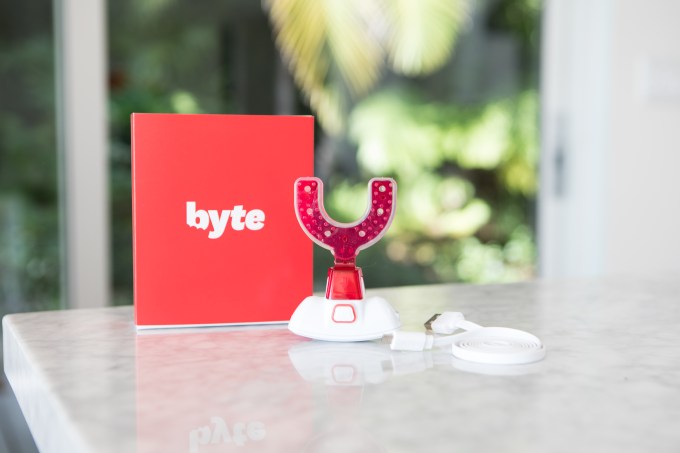
The first is its technology. Alongside impression kits and invisible aligners, byte also includes a device called HyperByte in all of its treatment plans. HyperByte is an extra in-mouth device that uses high-frequency vibrations (HFV) to send micropulses through the roots of the teeth and the surrounding bone, speeding up the process of alignment.

HFV treatment is FDA-cleared and offered in orthodontist offices around the country, but usually at a steep price.

HyperByte comes included with the cost of using byte’s service, which comes out to $1,895. (Folks can also pay via payment plan, called BytePay, which comes out to $349 down and $83/month for a little over two years.) The company also includes a whitening solution that can be used in conjunction with aligners.

Byte’s treatment plans are overseen and reviewed by licensed orthodontists each and every time, and customers can be connected to an orthodontist or dentist should they run into any clinical issue during treatment.

In some cases, insurance may reimburse customers for their byte treatment.

In other words, byte is working to bring down both the cost of aligners and the time it takes to treat patients. Importantly, byte focuses exclusively on Phase 1 malocclusions, or small misalignments in the teeth like tiny gaps or slightly crooked teeth, and not complicated issues like overbites.

Most interestingly, byte saw explosive growth in the first quarter of 2020 — the company saw 10x revenue growth over the last three months, compared to the same period of 2019, and says that it is continuing at that 10x growth rate through Q2. Byte also told TechCrunch that it generated “positive EBITDA business pre-[COVID-19].” (As is the case with all private companies, these numbers come from byte and are not independently verified by TechCrunch.)

Part of that profitability story is improving economics. Toward the end of 2019, byte’s cost to acquire customers (CAC) dropped by 50 percent from end of 2019 through April of this year.

The sharp CAC decline is due to several factors. According to Gunsagar, the price of Google keywords dropped dramatically in the midst of the coronavirus pandemic and the company has seen its direct and organic traffic double, perhaps driven by the coronavirus pandemic spurring increased interest in self-improvement.

Byte isn’t the only company caught in the self-improvement updraft. “There’s sort of this trend toward self-improvement and using this time constructively,” Jaimee Minney, SVP of marketing and PR at Rakuten Intelligence, told CNBC. “Book sales increase, games and puzzles, and we have seen health and beauty start to grow as well, especially when you look at it on a year-over-year basis. That’s one I might keep an eye on, the self-improvement piece.”

Gunsagar explained that, historically, other companies may have thrown even more marketing money at this type of environment to boost growth even more.

“We won’t sacrifice our customer experience and we won’t sacrifice profitability as we grow the business,” said Gunsagar. “We don’t want to have too many impression kits going through the system because we want to make sure we can support it from a technology and experience standpoint. Every dollar we spend is still super profitable. I could go spend more money and still stay below our CAC goal of $150 and blow past $100 million in revenue this year, but I just wouldn’t be super confident that our NPS score or our customer experience wouldn’t be penalized.”

In formulating this careful growth strategy, Gunsagar and byte aren’t just looking at the broader tech ecosystem, where we’ve seen growth at all costs backfire on companies. They can find examples in their own industry — SmileDirectClub grew fantastically ahead of its initial public offering in September of 2019 only to feel backlash from some customers who were reportedly asked for an NDA in exchange for a refund.

One other important piece of byte’s strategy is an upcoming bytePro launch in conjunction with dentists and orthodontists. The idea is to grow alongside the dental and orthodontic industry, rather than cut these healthcare professionals out of the food chain.

With bytePro (launch TBD) dentists and orthodontists are included even more in the process. Incoming clients can ask to work with their own dentist or orthodontist as they go through the byte aligner process, and even get their impression kits in their dentist’s office rather than order them online. On the other side, dentists and orthodontists can join the bytePro network to be matched with new patients. Moreover, folks that purchase byte show an increased interest in caring for their teeth year round, according to the company, whether that be cleanings or other dental work. Byte aims to connect those folks with a good dentist or orthodontist to protect the investment they’ve made in their new smile.

Though byte is not venture-backed, the company has taken a small investment from actress and investor Kerry Washington, who has also invested in The Wing and Community. Washington serves as Creative Advisor at byte.

“When I was looking at ways to continue growing my portfolio, I focused on companies that I can be really proud to be associated with, and that pride comes from the quality of the product and how it improves the quality of people’s lives,” said Washington. “The idea of having a voice is really important. With byte, I said really early on ‘if you can’t open your mouth, you can’t find your voice’ and when you hear the stories from real customers, people were afraid to smile and afraid to speak and that’s when I realized that this is a tool that can better people’s lives in so many ways.”

Editor’s Note: This post has been updated to correct inaccuracies around Cohen and Johnson’s earlier roles, Washington’s official title, and the launch date for bytePro. 

Powered by WPeMatico

Microsoft launches industry-specific cloud solutions, starting with healthcare

Microsoft today announced the launch of the Microsoft Cloud for Healthcare, an industry-specific cloud solution for healthcare providers. This is the first in what is likely going to be a set of cloud offerings that target specific verticals and extends a trend we’ve seen among large cloud providers (especially Google) that tailor specific offerings to the needs of individual industries.

“More than ever, being connected is critical to create an individualized patient experience,” writes Tom McGuinness, corporate vice president, Worldwide Health at Microsoft, and Dr. Greg Moore, corporate vice president, Microsoft Health, in today’s announcement. “The Microsoft Cloud for Healthcare helps healthcare organizations to engage in more proactive ways with their patients, allows caregivers to improve the efficiency of their workflows and streamline interactions with Classified as Microsoft Confidential patients with more actionable results.”

Like similar Microsoft-branded offerings from the company, Cloud for Healthcare is about bringing together a set of capabilities that already exist inside of Microsoft. In this case, that includes Microsoft 365, Dynamics, Power Platform and Azure, including Azure IoT for monitoring patients. The solution sits on top of a common data model that makes it easier to share data between applications and analyze the data they gather.

“By providing the right information at the right time, the Microsoft Cloud for Healthcare will help hospitals and care providers better manage the needs of patients and staff and make resource deployments more efficient,” Microsoft says in its press materials. “This solution also improves end-to-end security compliance and accessibility of data, driving better operational outcomes.”

Since Microsoft never passes up a chance to talk up Teams, the company also notes that its communications service will allow healthcare workers to more efficiently communicate with each other, but it also notes that Teams now includes a Bookings app to help its users — including healthcare providers — schedule, manage and conduct virtual visits in Teams. Some of the healthcare systems that are already using Teams include St. Luke’s University Health Network, Stony Brook Medicine, Confluent Health and Calderdale & Huddersfield NHS Foundation Trust in the U.K.

In addition to Microsoft’s own tools, the company is also working with its large partner ecosystem to provide healthcare providers with specialized services. These include the likes of Epic, Allscripts, GE Healthcare, Adaptive Biotechnologies and Nuance.

Powered by WPeMatico

Microsoft launches Azure Synapse Link to help enterprises get faster insights from their data

At its Build developer conference, Microsoft today announced Azure Synapse Link, a new enterprise service that allows businesses to analyze their data faster and more efficiently, using an approach that’s generally called “hybrid transaction/analytical processing” (HTAP). That’s a mouthful; it essentially enables enterprises to use the same database system for analytical and transactional workloads on a single system. Traditionally, enterprises had to make some trade-offs between either building a single system for both that was often highly over-provisioned or maintain separate systems for transactional and analytics workloads.

Last year, at its Ignite conference, Microsoft announced Azure Synapse Analytics, an analytics service that combines analytics and data warehousing to create what the company calls “the next evolution of Azure SQL Data Warehouse.” Synapse Analytics brings together data from Microsoft’s services and those from its partners and makes it easier to analyze.

“One of the key things, as we work with our customers on their digital transformation journey, there is an aspect of being data-driven, of being insights-driven as a culture, and a key part of that really is that once you decide there is some amount of information or insights that you need, how quickly are you able to get to that? For us, time to insight and a secondary element, which is the cost it takes, the effort it takes to build these pipelines and maintain them with an end-to-end analytics solution, was a key metric we have been observing for multiple years from our largest enterprise customers,” said Rohan Kumar, Microsoft’s corporate VP for Azure Data.

Synapse Link takes the work Microsoft did on Synaps Analytics a step further by removing the barriers between Azure’s operational databases and Synapse Analytics, so enterprises can immediately get value from the data in those databases without going through a data warehouse first.

“What we are announcing with Synapse Link is the next major step in the same vision that we had around reducing the time to insight,” explained Kumar. “And in this particular case, a long-standing barrier that exists today between operational databases and analytics systems is these complex ETL (extract, transform, load) pipelines that need to be set up just so you can do basic operational reporting or where, in a very transactionally consistent way, you need to move data from your operational system to the analytics system, because you don’t want to impact the performance of the operational system in any way because that’s typically dealing with, depending on the system, millions of transactions per second.”

ETL pipelines, Kumar argued, are typically expensive and hard to build and maintain, yet enterprises are now building new apps — and maybe even line of business mobile apps — where any action that consumers take and that is registered in the operational database is immediately available for predictive analytics, for example.

From the user perspective, enabling this only takes a single click to link the two, while it removes the need for managing additional data pipelines or database resources. That, Kumar said, was always the main goal for Synapse Link. “With a single click, you should be able to enable real-time analytics on your operational data in ways that don’t have any impact on your operational systems, so you’re not using the compute part of your operational system to do the query, you actually have to transform the data into a columnar format, which is more adaptable for analytics, and that’s really what we achieved with Synapse Link.”

Because traditional HTAP systems on-premises typically share their compute resources with the operational database, those systems never quite took off, Kumar argued. In the cloud, with Synapse Link, though, that impact doesn’t exist because you’re dealing with two separate systems. Now, once a transaction gets committed to the operational database, the Synapse Link system transforms the data into a columnar format that is more optimized for the analytics system — and it does so in real time.

For now, Synapse Link is only available in conjunction with Microsoft’s Cosmos DB database. As Kumar told me, that’s because that’s where the company saw the highest demand for this kind of service, but you can expect the company to add support for available in Azure SQL, Azure Database for PostgreSQL and Azure Database for MySQL in the future.

Powered by WPeMatico

Gremlin brings chaos engineering to Windows platform

Chaos engineering is about helping companies set up worst-case scenarios and testing them to see what causes the operating system to fall over, but up until now, it has mostly been for teams running Linux servers. Gremlin, the startup that offers Chaos Engineering as a Service, released a new tool to give engineers working on Microsoft Windows systems access to a similar set of experiments.

Gremlin co-founder and CEO Kolton Andrus says that the four-year-old company started with Linux support, then moved to Docker containers and Kubernetes, but there has been significant demand for Windows support, and the company decided it was time to build this into the platform too.

“The same types of failure can occur, but it happens in different ways on different operating systems. And people need to be able to respond to that. So it’s been the blind spot, and we [decided to] prioritize the types of experiments that people [running Windows] need the most,” he said.

He added, “What we’re launching here is that core set of capabilities for customers so they can go out and get started right away.”

To that end, the Gremlin Windows agent lets engineers run experiments on shutdown, CPU, disk, I/O, memory and latency attacks. It’s worth noting that a third of the world’s servers still run on Windows, and having this ability to test these systems in this way has been mostly confined to companies that could afford to build their own systems in-house.

What Gremlin is doing for Windows is what it has done for the other supported systems. It’s enabling any company to take advantage of chaos engineering tools to help prevent system failure. During the pandemic, as some systems have become flooded with traffic, having this ability to experiment with different worst-case scenarios and figuring out what brings your system to its knees is more important than ever.

The Gremlin Windows agent not only gives the company a wider range of operating system support, it also broadens its revenue base, which is also increasingly important at a time of economic uncertainty.

The company, which is based in the San Francisco area, was founded in 2016 and has raised more than $26 million, according to Crunchbase data. The company raised the bulk of that, $18 million, in 2018.

Powered by WPeMatico