1010Computers | Computer Repair & IT Support

Hims & Hers launch Spanish language telemedicine services

Hims & Hers, the startup focused on providing access to elective treatments for things like hair loss, skin care and erectile disfunction and online telemedicine services, is expanding its services to include a Spanish language option, the company said.

After Mexico, the U.S. has the second-largest Spanish speaking population in the world, with an estimated 41 million U.S. residents speaking Spanish at home. The population also prefers to receive healthcare information and frequent facilities that offer resources in Spanish.

Now, with a shortage looming in primary care physicians for rural areas and inner cities and a sky-high rate of Hispanics living without any form of healthcare coverage (roughly 15.1%, according to data provided by the company), Hims & Hers is pitching its telemedicine offering as an option.

“Language, cost, and location should not be barriers to receiving quality care, which is why we are launching a Spanish offering on our telemedicine platform,” the company said in a statement.

The company’s $39 primary care consultations at its Hims and its Hers websites will be in Spanish. That will include everything from communications like the patient intake form and instructions to prepare for an online consultation along with a connection to Spanish-speaking healthcare provider.

“The reason we created Hims & Hers was to break down barriers and provide more people with access to quality and convenient care,” the company’s co-founder and chief executive, Andrew Dudum, said in a statement. “As a telemedicine company, we recognize the need and understand the importance of serving the Spanish-speaking population. We hope those seeking access to care in Spanish find our platform to be a welcoming, inclusive, quality experience.”

Powered by WPeMatico

Why VCs say they’re open for business, even if they’re pausing new deals

This week Alexia Bonatsos of Dream Machine and Niko Bonatsos of General Catalyst swung by Extra Crunch Live to discuss where they are investing today and what the future might look like.

As expected, these seed and early-stage venture capitalists had a lot to say about their current investing cadence and what interests them in the world of edtech, Clubhouse and more. A big thanks to everyone who came out and submitted some great questions.

Going back through the chat today, a few sections jumped out. For this recap, I’ve gathered answers from the transcript regarding today’s fundraising climate, the future of AI and the possible impact of the downturn on VC-backed founder diversity.

And for everyone who couldn’t join us live, I’ve included the full video replay below. (You can get access here, if you need it.)

Today’s fundraising climate

Alexia:

It’s kind of a Rashomon; depending on whose perspective you’re getting the story, is just completely different.

Let’s see, are [VCs] being as active as they were in 2018? I’m gonna say no. I mean, look at your data, your data says no. But does that mean people [have] shut down the shop and are all in Montana? Also no, right?

We know that these kinds of “crisistunities” — and I’m not diminishing the crisis at all, it is very sad and very scary, and it’s something that I’m very privileged to be able to be experiencing from inside my apartment and not from outside within an emergency room or a food bank or any other place that it’s actually at the front lines, right?

Powered by WPeMatico

Autonomous aviation startup Xwing raises $10M to scale its software for pilotless flights

Autonomous aviation startup Xwing locked in a $10 million funding round before COVID-19 hit. Now the San Francisco-based startup is using the capital to hire talent and scale the development of its software stack as it aims for commercial operations later this year — pending FAA approvals.

The company announced Wednesday its Series A funding round, which was led by R7 Partners, with participation from early-stage VC Alven, Eniac Ventures and Thales Corporate Ventures. Xwing has already hired several key executives with that fresh injection of capital, including Terrafugia’s former co-founder and COO Anna Dietrich, and Ed Lim, a Lockheed Martin and Aurora Flight Sciences veteran who more recently led guidance navigation and control for Uber’s autonomous car division as well as Zipline’s AV delivery drone.

Xwing is different from some of the other autonomous aviation startups that have popped up in recent years. The startup isn’t building autonomous helicopters and planes. Instead, it’s focused on the software stack that will enable pilotless flight of small passenger aircraft.

Xwing is also aircraft agnostic. The company’s engineers are focused on the key functions of autonomous flight, such as sensing, reasoning and control. The software stack, which is designed to work across different kinds of aircraft, is integrated into existing aerospace systems. That strategy of retrofitting existing aircraft will speed up deployment, while maintaining safety and keeping costs in check, according to founder and CEO Marc Piette. It also is a straighter path toward regulatory approval.

“It’s more effective for us to not constrain ourselves to a given vehicle and to develop technology that is considered more of an enabler— from a marketing perspective — than going full stack, Piette said when asked if Xwing would ever try to build an autonomous aircraft from the ground up.

Since Xwing’s last funding round — $4 million in summer 2018 — the company has been developing its tech and working with the FAA to receive flight certification for pilotless aircraft. Once approved, the company will seek to commercialize pilotless flights.

The startup hasn’t named any commercial partners yet. And Piette hasn’t provided details about its commercial strategy either, although he said to expect more announcements this year.

Xwing is already working with Bell for NASA’s Unmanned Aircraft Systems (UAS in the NAS) program, an initiative meant to mature the key remaining technologies that are needed to integrate unmanned aircraft in U.S. airspace. The program plans to hold demonstration flights this summer.

Powered by WPeMatico

What people tend to get wrong about remote work

What do people tend to get wrong about remote work? And how can companies make it work better for them?

While just about every tech company on the planet has become remote over the last few weeks, GitLab has been at this a while — since pretty much day one of its existence back in 2014, in fact. Since then they’ve grown to more than 1,200 employees across 65 countries, with a staggering valuation of nearly $3 billion. They’ve figured out some stuff along the way, sharing it all in an ever-evolving handbook.

I recently hopped on a call with GitLab’s head of Remote, Darren Murph, to get some insight on how they make it all work. This is the second part of my interview with Murph; he and I chatted for quite a while, so I’ve split it into two parts for easier reading. You can find Part I here.

TechCrunch: There’s this ongoing conversation about how people are coming away from this remote experience. Are they walking away saying, “yeah, that was great, we can do this day-to-day, I wouldn’t have seen that before,” or is the fact that they’re being thrust into this, and on not the best terms, going to have a negative impact?

Do you think this [sudden shift] is going to have a positive impact on remote work?

Darren Murph: I do. I’m a long-term optimist on this.

There’s a Gartner survey that just came out. They surveyed over 300 CFOs globally; 74% of them said that they’re going to shift some of their workforce permanently remote after this… even though this is the worst possible way to be thrust into remote.

This is the worst of circumstances, and people are still like, “You know, I love not having to commute.” And businesses are like, “You know, I love saving $10,000 per desk by not having that real estate.”

If it’s working in the worst of times… six to 12 months from now, when the crisis is abated and people have had time to lay the remote structure, build their handbooks, get the right remote hygiene integrated into the DNA of their company… it’s going to be like, warp-speed accelerator.

If you can make it work now, you can make it work any time.

Powered by WPeMatico

Monzo co-founder Tom Blomfield moves from UK CEO role to president

More than five years after starting the company, Monzo co-founder Tom Blomfield is stepping down as CEO of the U.K. challenger bank to take up the newly created role of president.

Current U.S. CEO, TS Anil, will become the new “Monzo UK Bank CEO,” subject to regulatory approval, and for now will hold both U.K. and U.S. roles.

Anil previously held exec roles at Visa, Standard Chartered Bank and Citi, and therefore brings a ton of banking and financial services experience. This includes things like dealing with regulators and overseeing a large corporate structure, two things a scale-up challenger bank like Monzo, with more than 4 million customers and over 1,500 staff, requires.

The thinking behind Blomfield’s move to president is a startup cliché but also likely holds water; he’ll be able to spend more time doing the things he enjoys most (and is arguably best at), such as focusing on the longer-term vision, product and how Monzo can stay close to and best serve customers. Meanwhile, Anil — and, in the future, other country-specific CEOs — can do the day to day, more regulated aspects of running a bank.

In a brief call with Blomfield just moments ago, he told me he had been thinking about a transition into a different role for about 18 months, but it wasn’t until much more recently that a formal decision was taken.

“I went through all the stuff I love about my job, and it was all the stuff I did in the first two or three years,” he said. “And I went through all the stuff that drains me, and it’s all the stuff I’ve done in the last two years, honestly. Things I think TS is awesome at.”

Although it is unlikely that a huge amount will change immediately, Blomfield says he hopes that he’ll be able to spend a “bunch more time doing the stuff I really, really love, which is community, talking to customers, helping develop the product proposition, long-term vision, and talking to journalists, like you Steve, obviously, and try to unwind my involvement a little bit in more formal regulated banking activities.”

Meanwhile, it has been somewhat of a turbulent time for Monzo in recent months, as it, along with many other fintech companies, has attempted to insulate itself from the coronavirus crisis and resulting economic downturn.

Last month, I reported that Monzo was shuttering its customer support office in Las Vegas, seeing 165 customer support staff in the U.S. lose their jobs. And just a few weeks earlier, we reported that the bank was furloughing up to 295 staff under the U.K.’s Coronavirus Job Retention Scheme. In addition, the senior management team and the board has volunteered to take a 25% cut in salary, and co-founder and CEO Tom Blomfield has decided not to take a salary for the next 12 months.

Like other banks and fintechs, the coronavirus crisis has resulted in Monzo seeing customer card spend reduce at home and (of course) abroad, meaning it is generating significantly less revenue from interchange fees. The bank has also postponed the launch of premium paid-for consumer accounts, one of only a handful of known planned revenue streams, alongside lending, of course.

And just last week, it was reported that Monzo is closing in on £70-80 million in top up funding, to help extend its coronavirus crisis runaway. However, as new and some existing investors play hardball, the company has reportedly had to accept a 40% reduction in its previously £2 billion valuation as part of its last funding round last June, with a new valuation of £1.25 billion.

With that said, it’s not all been bad news. Monzo recently launched business accounts, many of which are revenue generating, with both free and paid tiers. It also recruited Sujata Bhatia, a former American Express executive in Europe, as its new COO.

And, hopefully, in his new role as president, Blomfield will sound re-energised next time I call him.

Powered by WPeMatico

EdSights raises money to help schools reduce their drop-out rates

While the idea of baring your soul to a chatbot might seem uncomfortable, sisters Claudia and Carolina Recchi think that might be exactly what college students across the United States need right now.

The duo co-founded EdSights in 2017 to support high and medium-risk students to stay in school, and increase university retention rates.

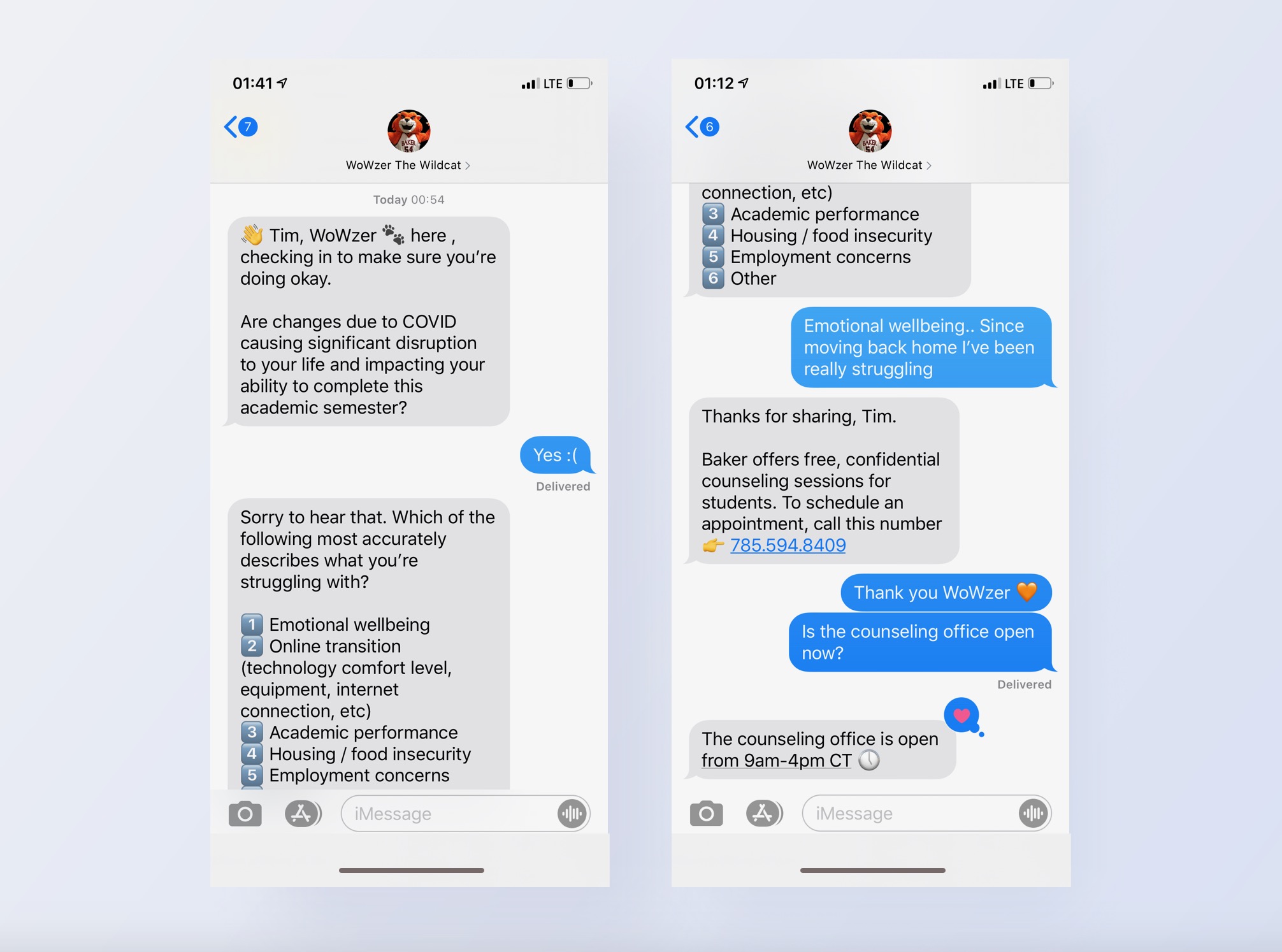
EdSights uses a chatbot, branded under a school’s mascot, to send personalized questions and messages to students to understand their biggest stresses. It then connects them to university resources spanning areas like financial aid, food security and mental health.

As the pandemic has forced millions of students to move off campus and learn from home, the co-founders have found a spurt of growth from colleges looking for new ways to hold onto their students.

And the pandemic has added a new layer of honesty to the answers.

“There is just so much going on with the world, people losing jobs and barely being able to make ends meet. School hardly seems pressing at the moment,” one student wrote. “And yet, grades are still there, determining our future when we aren’t even sure what the future looks like.”

Another wrote, “My work is closed. I have no income.” One said, “Because I am not going out I can’t distract myself from all the things going on in my life.”

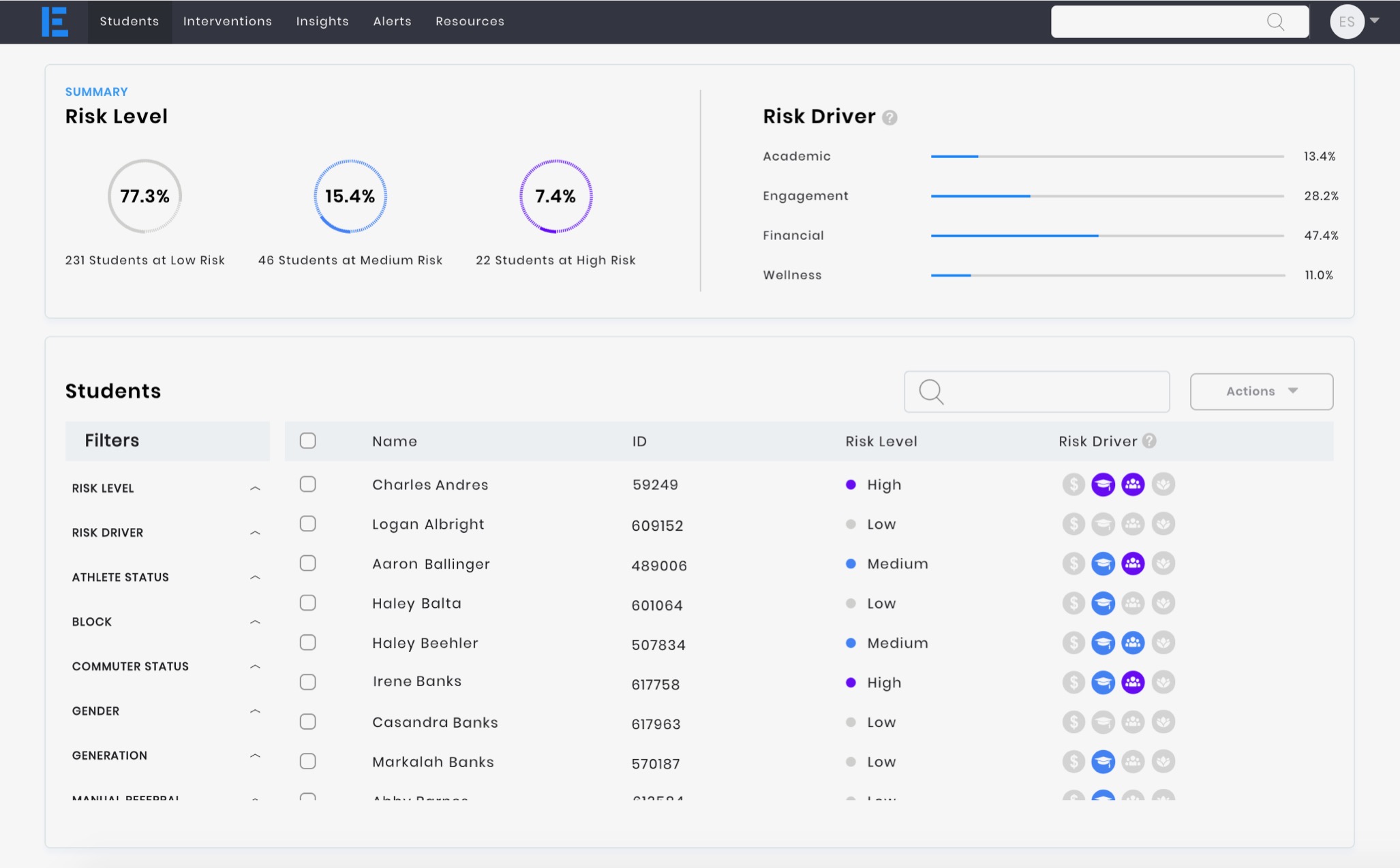
Beyond its chatbot, EdSights has a dashboard for administrators to see what percentage of their students are struggling with specific issues at the moment. The company deals with information on high-risk students and their biggest worries, so privacy is key to their platform. EdSights says it complies with both FERPA and GDPR regulation, and does not rent or sell data to third parties. Students also have the right to request an amendment of their records and receive a full log of it.

“Obviously, universities are also spooked that students won’t show up in the fall,” she said. “So they want to make sure that there’s a connectivity and they feel connected to the university, even if they can’t go to campus.”

The company took one year to scale to 16 customers, including Baker University, Missouri Western State, Bethel University, Culver Stockton College and Westminster College. On average its ARR has been growing by 66% month over month, and it has doubled its revenue since February.

EdSights charges colleges $15 to $25 per student. Most customers bring on their entire student body.

“Before this, we did see a lot of universities asking, ‘can I roll this out to freshmen or can I only roll it out to my first-generation students or maybe those that need additional support?’ ” said Carolina Recchi. “Now, colleges are not only asking us to help with all four years, but we’ve had some institutions ask us to roll it out to graduate students, which was new, because we had never done that before.”

This newfound momentum led the co-founders to raise $1.6 million in venture capital funding from a slew of high-profile investors. Investors from this round include Lakehouse VC, Kairos VC and The Fund.

The new raise also includes investments from Warby Parker, Harry’s, Allbirds, Bonobos and Rent the Runway founders.

The EdSights co-founders say COVID-19 played a part in their company receiving inbound interest from generalist investors, who have been historically skeptical about the space, versus solely getting term-sheets from specialist education firms. In fact, the duo had to turn down a number of investors, a stark difference between the chilling effect other founders claim has covered the entire fundraising scene.

EdSights new funding is another data point of how the pandemic is forcing the general public to be more nuanced in how it thinks about the intersection of education and technology.

In the time of a pandemic, a chatbot could be the only way to remotely support millions of students. Now, it’s just up to EdSights to prove that their technology is necessary in a world where schools start to reopen, whenever that is.

Powered by WPeMatico

Google Cloud earns defense contract win for Anthos multi-cloud management tool

Google dropped out of the Pentagon’s JEDI cloud contract battle fairly early in the game, citing it was in conflict with its “AI principals.” However, today the company announced a new seven-figure contract with DoD’s Defense Innovation Unit (DIU), a big win for the cloud unit and CEO Thomas Kurian.

While the company would not get specific about the number, the new contract involves using Anthos, the tool the company announced last year to secure DIU’s multi-cloud environment. In spite of the JEDI contract involving a single vendor, the DoD has always used solutions from all three major cloud vendors — Amazon, Microsoft and Google — and this solution will provide a way to monitor security across all three environments, according to the company.

“Multi-cloud is the future. The majority of commercial businesses run multi-cloud environments securely and seamlessly, and this is now coming to the federal government as well,” Mike Daniels, VP of Global Public Sector at Google Cloud told TechCrunch.

The idea is to manage security across three environments with help from cloud security vendor Netskope, which is also part of the deal. “The multi-cloud solution will be built on Anthos, allowing DIU to run web services and applications across Google Cloud, Amazon Web Services, and Microsoft Azure — while being centrally managed from the Google Cloud Console,” the company wrote in a statement.

Daniels says that while this is a deal with DIU, he could see it expanding to other parts of DoD. “This is a contract with the DIU, but our expectation is that the DoD will look at the project as a model for how to implement their own security posture.”

Google Cloud Platform remains way back in the cloud infrastructure pack, in third place with around 8% market share. For context, AWS has around 33% market share and Microsoft has around 18%.

While JEDI, a $10 billion, winner-take-all prize remains mired in controversy and an on-going battle between The Pentagon, Amazon and Microsoft, this deal shows that the defense department is looking at advanced technology like Anthos to help it manage a multi-cloud world regardless of what happens with JEDI.

Powered by WPeMatico

Human Interest tacks on $10M more to its Series C

The COVID-19 pandemic is making life worse for many startups, but not all. Those benefiting are often taking advantage of the market updraft to add more capital to their accounts. Robinhood, for example, saw usage of its consumer fintech product rise rapidly. Then the company raised a Series F worth $280 million at a new, higher valuation.

Another startup has done something similar. Human Interest, a finservices 401(k) provider for SMBs, added $10 million to its Series C today. The company’s Series C round is now worth a total of $50 million. Glynn Capital led the Series C extension.

The reason for the new capital is simple. According to Jeff Schneble, the company’s CEO, Human Interest has seen “some of the strongest sales months in the company’s history, and are seeing 2-3X year-over-year growth in customer acquisition even in the midst of the COVID-19 crisis.”

When usage and revenue scale ahead of expectations, options open up. TechCrunch had a few questions about the additional capital. Let’s explore.

$10 million more

TechCrunch first wanted to know if the San Francisco-based Human Interest’s new $10 million — which brings its total known capital raised to around $80 million — is earmarked for offense (greater investment into GTM functions, for example), or defense (runway extension, and so forth).

According to the CEO, the round is “more about playing offense,” with the executive adding that offense has been “something we’ve had the luxury of thinking about since the beginning of the crisis, given our large raise in February.” Human Interest intends to double its engineering team, and is “aggressively ramping up [its] GTM team (more reps, more partners, growing our marketing team and budget).”

TechCrunch was also curious about its customer profile — is Human Interest seeing growth from a different set of customers in the COVID-19 era? According to Schneble, not really: “We have not seen a significant shift in customer size, geography or vertical,” he said.

Human Interest, however, is seeing more companies coming to it looking to change 401(k) providers. Schneble told TechCrunch that “historically” 85% of his company’s customers are looking to offer “a retirement benefit for the first time.” However, “in the last couple of months” Human Interest has seen “a surge of customers with existing retirement plans that want to move to a lower-cost benefit.”

As Human Interest uses “technology, rather than people” to run its 401(k) service, the startup can offer a service that is “typically 30-50% lower-cost than a legacy 401(k) plan,” according to Schneble.

Is this new demand changing the company’s economics? TechCrunch wanted to know if market interest in 401(k) plans — consumers are flocking to savings and investing apps, likely driving more companies to add retirement savings plans for their employees — was lowering Human Interest’s customer acquisition costs (CAC).

According to the CEO, Human Interest focuses on gross-margin payback, or the time period it takes for gross-margin adjusted revenue to repay CAC. “I can’t stress how important profitability is in this space,” Schneble told TechCrunch, adding that “many of [his] competitors have negative contribution margins, which is obviously not a recipe for building a successful public company.”

The company’s gross-margin payback pace is improving, with the company telling TechCrunch that it has “come down by ~70% in the past 12 months, and is now approaching zero for many of our customers (meaning the margin contribution from their initial payment when they launch their plan covers our CAC).”

Human Interest’s gross margins help with that, with Human Interest telling TechCrunch that it has “typical software margins” on its product. That means 70%+ gross margins.

Back to the $10 million add-on, TechCrunch confirmed that the new capital was raised at the same pre-money valuation as the rest of its Series C. The CEO added the following color:

We had interest from several of the later-stage growth funds we talked to in our Series C process, but decided to move forward with Glynn Capital. They are long-term investors that plan to hold their investment in us long after we’re public (similar to one of our other large investors, Oberndorf Enterprises). While we probably could have demanded a higher price for the extension, given the acceleration we’ve seen in the last few months, we decided to optimize on partner quality instead.

Now with more capital aboard, expectations are even higher for Human Interest. Let’s see how fast it can grow.

Powered by WPeMatico

What to do when your VC writes your startup off

The novel coronavirus has been devastating for many people, families and communities — and the consequences are still being calculated. The tech world has seen wave after wave of layoffs, sometimes multiple waves at one company only weeks apart. Some startups have lost nearly all their revenue, and depending on their cash reserves, have little hope of recovering.

For VCs, the last two months have been an exercise in triage.

Partners have gone through their entire investment portfolios to identify the winners, what’s salvageable and what (at least in their minds) has no hope of resuscitation. If you are in the first two groups, it’s back to whatever normal looks like in the midst of a global pandemic and a deep economic recession.

But what if you suddenly get a call informing you that your investor — perhaps your biggest champion to date — is going to cut the rope and write you off entirely?

That’s what we are going to talk about today.

Before we go anywhere, be thankful if you even know how your investors are judging your startup. Most, unfortunately, will couch the terms they use (“we will be engaging less” or perhaps “we are unlikely to do our pro rata going forward”) rather than just saying directly, “we are writing you off; don’t call us — we’ll call you.” That’s polite and face-saving for all parties, but the lack of transparency can make decisions down the road much harder. It’s better to know where you stand, even if the news is hard.

Finding your bearings

The first step to approaching this situation is to get your bearings. Much like during a fundraise process, it’s not uncommon for different investors on your cap table to reach different conclusions about your startup’s potential. One investor may write you off, while another has you marked at a more neutral valuation or even positively. This can absolutely be frustrating, and given the emotion of this situation, it can be hard to rationally accept that an investor who once believed in you no longer does so.

Powered by WPeMatico

Sphero appoints new CEO, spins off robotics startup for first responders

Sphero just announced that it has spun off another company. Once again, the new startup has a decidedly different focus from its parent company’s core of education-focused products. While still a robotics company at its heart, the underwhelmingly named Company Six will create robotic systems designed for first responders and other humans whose work requires them to put themselves in harm’s way.

Also snuck into the press release, almost as an an afterthought, is the appointment of Paul Copioli as the new CEO of Sphero, effective immediately. The executive is an industry veteran who has worked at VEX Robotics, industrial robotics giant Fanuc and Lockheed Martin. Most recently, he was the president and COO of littleBits when the startup was acquired by Sphero.

Copioli takes over after the company’s exit from the consumer space. Sphero has pivoted almost entirely into the educational market, with the littleBits acquisition making up an important piece of the puzzle.

“It’s an honor to lead the Sphero team as we continue to pave the way for accessible robots, STEAM and computer science education for kids around the world,” he says in a release. “With our focus on education and our mission to inspire the creators of tomorrow, Sphero has a long-standing place in our school systems and beyond.”

Spinning off Company Six as its own independent entity is seemingly part of the new focus. The seeds of the startups were formed by former CEO Paul Berberian’s Public Safety Division within Sphero. He has since shifted to become chairman of both companies, while former Sphero COO Jim Booth will head Company Six as COO. Got all that?

Company Six has already closed a $3 million seed round, lead by Spider Capital, with Sphero investors Foundry Group and Techstars also on-board. Like previous Sphero spin-off Misty, information about Company Six is minimal at the time of its announcement. The new company’s site is essentially bare. We only know it will be focused on creating robotic systems for first responders, defense workers and other dangerous jobs. The news echoes iRobot’s 2016 spin-off of its military wing, Endeavor. 

Sphero explains:

By applying the experience used to bring more than 4 million robots to market at Sphero, the Company Six team believes it can create products that are not only robust and feature-rich enough for professional applications, but also affordable enough to be adopted by the majority, rather than the minority, of civilian and military personnel.

More news to follow soon, no doubt.

Powered by WPeMatico