
1010Computers | Computer Repair & IT Support

Minecraft Dungeons has charm and potential, but needs lot more time in the furnace

Minecraft is one of the most popular games on the planet, so it’s natural that Microsoft, after buying creator Mojang some years back, would attempt to apply the genre’s playful, blocky aesthetic to other genres. After modest success with the Story Mode adventure game and Pokémon GO-like Minecraft Earth, they’ve tried their hand at a light action-RPG à la Diablo — and unfortunately come up rather short. For now, that is.

Minecraft Dungeons is a sort of my-first-dungeon-crawler type game, a friendly, streamlined version of the genre Diablo created where players enter a procedurally created dungeon or region, kill some monsters, get some loot, make it out alive and do it all over again.

That’s the idea in this game as well, but of course the whole thing uses the block-based look and feel of Minecraft. As you travel through different biomes to free villagers, destroy ancient forges and so on, everything from the levels and monsters to equipment and potions looks like it came straight out of the original game. They nailed the look perfectly.

It’s refreshing, because games like this tend to court a rather grim aesthetic, and when it comes to gameplay they pile on features and mechanics until it feels more like you’re playing a spreadsheet than a game. It’s clear from the start Minecraft Dungeons was intended to provide the fun of fighting, upgrading and exploring without the overly complex and dark trappings of the genre.
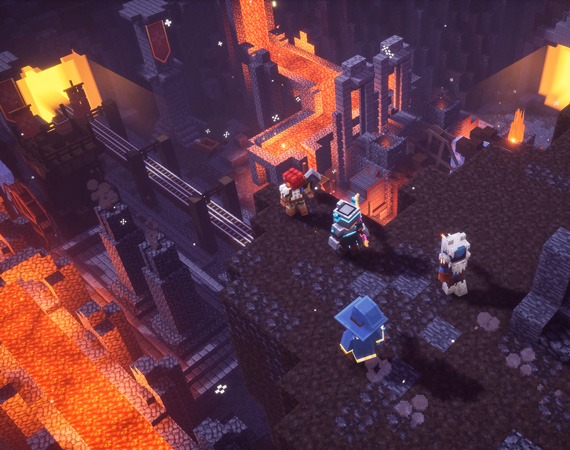
For instance, instead of having a handful of character classes each with their own skill tree, everything your character can do depends on their equipment. Weapons, armor and accessories all have unique bonuses and abilities. So if you want to be a bow and arrow-type fighter, wear the Ranger armor that gives you extra-ranged damage and ammo, and use accessories that empower your arrows. Want to be a melee guy? There’s armor and swords for that too.

Customization of your play style, an important part of these games, is achieved by judicious choice of a set of random upgrades on each item. When you gain a level, you get a point that can be used to activate, say, a passive ability that deflects enemy projectiles 20% of the time. Then it costs two points to upgrade it again, so it deflects 30% of the time.

You get those points back when you trash the item and can reapply them to a new one, providing low-risk, low-commitment progress — in time you’ll have lots of points banked to upgrade and experiment with whatever new item you find.

This approach is really a breath of fresh air after the convoluted overlapping systems of the likes of Diablo, Grim Dawn and Path of Exile. There was just the right amount of “this new sword is tempting but do really I want to recycle my old one?” tension, and although you will collect trash loot, it’s easy to check and dispose of.

I didn’t get a chance to test multiplayer, but the game is definitely designed with co-adventuring in mind. Couch co-op lets you drop in a second player with a controller or connect online with others on the same platform (cross-play is coming soon). A cross-platform casual dungeon crawler is something I’ve been wanting for a long time.
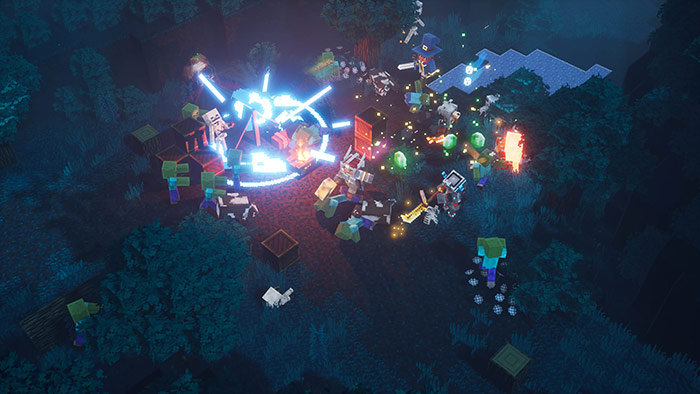
It’s too bad, then, that this is where the game runs out of really positive qualities. I’m keeping in mind that this is a $20 game designed with players new to the genre in mind — not to say kids exactly — so there’s no sense comparing it directly to a major mainstream gaming franchise. But even so, Minecraft Dungeons has some serious issues.

For one thing, it really needs more variety. Part of the fun of these games is traveling from region to region and fighting new types of monsters with different tactics and abilities. That really just isn’t there in this game. The 10 different areas are visually distinct, yes, but they’re linear, similar from one run to another, and don’t differ all that much gameplay-wise. One aspect of Minecraft I’ve always loved, exploration, is nearly absent. Getting up on a hill or down in some little valley or cavern you can see usually isn’t possible — they’re just walls or bottomless pits. Side paths often run quite a distance, but I eventually learned to stopped taking them because they were frequently empty and it always took forever to backtrack afterwards.

You’ll run into the same zombies, spiders and soldiers over and over, and get the same weapons and accessories dropped over and over, often with very similar stats. Although there seems to be a good variety at first, the abilities and weapons don’t seem particularly well-balanced, with some obviously and objectively better than others. Some are basically useless: One ability gives you a speedup for a few seconds after you dodge — but the game also slows you down for a few seconds after you roll, so they kind of just cancel each other out. Another returns a third of one percent of your health for every 100 blocks you uncover in the game. What?

This wouldn’t be an issue if the game had better difficulty tuning. I found in my playthrough that there was no challenge whatsoever 99% of the time, and then suddenly a situation would arise where I would be nearly instantly killed. These weren’t lesson-teaching deaths like other games — just sudden confluences of bad luck and, it must be said, some poor design.

Ranged attacks from enemies will often come from off-screen, for instance. And not just a stray arrow, but many simultaneously. Enemy projectiles also go through all other enemies, unlike your own, and are very difficult to dodge, especially when there are a dozen coming from different angles. So sometimes after spending the whole level barely taking a hit, you’re reduced to an emergency situation in a fraction of a second, with very little warning, by enemies you haven’t had a chance to react to or perhaps even see. The close-zoom camera shows details well but limits your understanding of what’s happening around you.

These brutal difficulty spikes aren’t always accidental. One enemy kept popping up that repeatedly spawned huge numbers of bear traps under my character’s feet that closed before any but a really expert player could be expected to dodge. Bosses are cheap, swarming players with minions, storms of enormous projectiles, and instant, undodgeable melee attacks.

The issue here isn’t just that it’s hard, but that the game doesn’t give you the tools you need to deal with it. Dodging feels clumsy and enemies block your movement; there is little in the way of active defense like a shield or accessory you activate to repel arrows for 5 seconds; you only have one slowly recharging healing potion and health doesn’t trickle back, so little mistakes add up over time. Not that it matters, since punishment is usually swift and extreme.

What all this amounts to is a game that alternates between monotonous and frustratingly hard, even for a fan of the genre like myself. And considering you’ll run through all the areas in the game in a handful of hours — there are 10 areas, each of which takes perhaps 20 minutes to clear — it’s expected that you’ll repeat them over and over to reach the gear level required to beat the final boss. I got all the way to that point and was insta-killed twice in a row.

I repeated a few areas but found them nearly indistinguishable from their earlier iterations. Ultimately I just wasn’t motivated to grind away just so I could unlock another, likely even more unfair, difficulty level.

I wouldn’t complain so much if this wasn’t, ostensibly, a game for beginners. Minecraft Dungeons innovates and simplifies in some really laudable ways, but the moment-to-moment game design is too uneven and the variety on offer isn’t enough even for a $20 game.

But it must be said that Minecraft itself also started out rather bare-bones and was built up over time into something remarkable and almost infinite. There are two DLC packs in the works for Dungeons, one rather crassly visible from the very start — nothing like being asked to pay more for a game you just bought. The good news is these packs will grow the game to a size that feels more like an adventure and less like a demo. I also expect that patches over the coming weeks and months will considerably tweak the equipment and difficulty — it can be, and needs to be, fixed.

A year from now Minecraft Dungeons could very well be a no-brainer purchase, a cross-platform casual hack-and-slash that you can play with your kids or your friends and have a great time without thinking too hard about it (or opening Excel). But right now it’s mostly potential. I’d hold off on picking this one up until it has been made into the game it’s meant to be.

Powered by WPeMatico

3 views on the life and death of college towns, remote work and the future of startup hubs

The global pandemic has halted travel, shunted schools online and shut down many cities, but the future of college-town America is an area of deep concern for the startup world.

College towns have done exceedingly well with the rise of the knowledge economy and concentrating students and talent in dense social webs. That confluence of ideas and skill fueled the rise of a whole set of startup clusters outside major geos like the Bay Area, but with COVID-19 bearing down on these ecosystems and many tech workers considering remote work, what does the future look like for these cradles of innovation?

We have three angles on this topic from the Equity podcast crew:

  • Danny Crichton sees the death of college towns, and looks at whether remote tools can substitute for in-person connections when building a startup.
  • Natasha Mascarenhas believes connecting with other students is critical for developing one’s sense of self, and the decline of colleges will negatively impact students and their ability to trial and error their way to their first job.
  • Alex Wilhelm looks at whether residential colleges are about to be disrupted — or whether tradition will prevail. His is (surprise!) a more sanguine look at the future of college towns.

Startup hubs are going to disintegrate as college towns are decimated by coronavirus

Danny Crichton: One of the few urban success stories outside the big global cities like New York, Tokyo, Paris and London has been a small set of cities that have used a mix of their proximity to power (state capitals), knowledge (universities) and finance (local big companies) to build innovative economies. That includes places like Austin, Columbus, Chattanooga, Ann Arbor, Urbana, Denver, Atlanta and Minneapolis, among many others.

Over the past two decades, there was an almost magical economic alchemy underway in these locales. Universities attracted large numbers of bright and ambitious students, capitals and state government offices offered a financial base to the regional economy and local big companies offered the jobs and stability that allow innovation to flourish.

All that has disappeared, leading to some critics, like Noah Smith, to ask whether “Coronavirus Will End the Golden Age for College Towns”?

Powered by WPeMatico

Startup Battlefield is going virtual with TechCrunch Disrupt 2020

You read that right. The big announcement came yesterday — TechCrunch Disrupt is now fully virtual. What does this mean for Startup Battlefield? More opportunity. The best companies from across the globe, an even bigger launch platform, the eyes of more investors from around the world and press exposure at the biggest conference TechCrunch has held to date. The conference will be available globally, spanning five days — September 14-18. Founders. This. Is. Your. Shot. Applications will close June 19th, so get your app in ASAP.

Successful startup founders face challenging circumstances with determination and persistence — and they grab hold of every opportunity to pave a path forward. Are you ready to pave your path? And a chance to win the $100,000 equity-free prize and the Disrupt Cup?

The virtual Startup Battlefield works much like last year’s onsite battle, but with a few twists and added benefits.

Apply. You’re eligible — no matter where you are around the world — if your company meets these criteria: it’s early-stage; you have an MVP that includes a tech component (software, hardware or platform); your company has not received much, if any, major media coverage. Here’s good news: It won’t cost you a thing to apply or participate in the Battlefield. And TechCrunch does not take any equity.

The TechCrunch editorial team will review every application, looking for innovative, game-changing startups from verticals spanning the tech spectrum. They’ll select a cadre of startups to compete virtually in front of influencers who have to power to change the course of your business.

Prepare for battle. All competing teams go through a free weeks-long training with the TechCrunch team. That coaching will whip your pitch into fighting trim, cut the fat from your business models, sharpen your presentation skills and fine-tune your demo. You’ll also hear from industry experts on developing various aspects of your business — from go-to-market strategy to executive communications.

Compete. When game day arrives, each team presents a six-minute pitch to a bevy of judges consisting of top VCs and technologists. An intense Q&A follows each presentation, but with all that coaching under your belt you won’t break a sweat. The judges will select teams to move into the finals — and those founders will pitch yet again to a fresh panel of judges on the final day of the virtual conference.

From that impressive lot, the judges will choose one stellar startup to claim the Disrupt Cup and the $100,000 prize. The whole event takes place online in front of a huge global audience — they can watch all the action with a free Disrupt Digital pass.

Network and grow your business. Although only one startup wins the cash, all Startup Battlefield competitors gain invaluable exposure to investors, media and potential customers — and they join the ranks of the Startup Battlefield Alumni. That impressive cohort has collectively raised $9 billion and generated 115 exits. We’re talking companies like Vurb, Dropbox, GetAround, Mint, Yammer, Fitbit and many more. Talk about prime networking.

Startup Battlefield competitors also get to exhibit in Digital Startup Alley and enjoy these added benefits:

  • Leading Voices Webinars: Top industry minds will share their thoughts and strategies on adapting and thriving during and after this pandemic. Startup Alley exhibitors get exclusive access to this webinar series.
  • A launch article posted on TechCrunch.com.
  • A YouTube video promoted on TechCrunch.com.
  • Free subscription to Extra Crunch.
  • Free passes to future TechCrunch events.

Plus, you’ll receive loads of press and investor attention and use of CrunchMatch, our AI-powered networking platform, to set up virtual meetings. Keep checking back, because we’re not quite finished adding extra perks.

You’re determined. You’re persistent. Apply to compete in Startup Battlefield at Disrupt 2020 for an opportunity to pave your path to success.

Is your company interested in sponsoring or exhibiting at Disrupt 2020? Contact our sponsorship sales team by filling out this form.

Powered by WPeMatico

Steve Case and Clara Sieg on how the COVID-19 crisis differs from the dot-com bust

Steve Case and Clara Sieg of Revolution recently spoke on TechCrunch’s new series, Extra Crunch Live. Throughout the hour-long chat, we touched on numerous subjects, including how diverse founders can take advantage during this downturn and how remote work may lead to growth outside Silicon Valley. The two have a unique vantage point, with Steve Case, co-founder and former CEO of AOL turned VC, and Clara Sieg, a Stanford-educated VC heading up Revolution’s Silicon Valley office.

Together, Case and Sieg laid out how the current crisis is different from the dot-com bust of the late nineties. Because of the differences, their outlook is bullish on the tech sector’s ability to pull through.

And for everyone who couldn’t join us live, the full video replay is embedded below. (You can get access here if you need it.)

Case said that during the run-up to the dot-com bust, it was a different environment.

“When we got started at AOL, which was back in 1985, the internet didn’t exist yet,” Case said. “I think 3% of people were online or online an hour a week. And it took us a decade to get going. By the year 2000, which is sort of the peak of AOL’s success, we had about half of all the U.S. internet traffic, and the market value soared. That’s when suddenly, when any company with a dot-com name was getting funded. Many were going public without even having much in the way of revenues. That’s not we’re dealing with now.”

Powered by WPeMatico

Thriva raises £4M from Target in an era when at-home blood testing is more crucial than ever

Thriva emerged in 2016 as an at-home blood-testing startup allowing people to check, for instance, cholesterol levels. In the era of a pandemic, however, at-home blood testing is about to become quite a big deal, alongside the general trend toward people proactively taking control of their health.

It has secured a £4 million extension to its Series A funding round from Berlin-based VC Target Global . The investment takes Thriva’s total funding to £11 million. The investment comes from Target Global’s new Early Stage Fund II and will top up the £6 million Series A raised in 2019. Existing investors include Guinness Asset Management and Pembroke VCT.

Thriva has processed more than 115,000 at-home blood tests since 2016. Interestingly, these customers actually use the information to improve their health, with 76% of Thriva users achieving an improvement in at least one of their biomarkers between tests.

The startup has also launched personalized health plans and high-quality supplements, scaling up its partnerships with hospitals and other healthcare providers.

Founded by Hamish Grierson, Eliot Brooks and Tom Livesey, it claims to be growing 100% year-on-year and has expanded its team to 50 members in the company’s London headquarters.

In a statement Grierson said: “As the world faces unprecedented challenges posed by the coronavirus crisis, we have all been forced to view our health, and our mortality, in a new light.”

Speaking to TechCrunch he added: “While there are other at-home testing companies, we don’t see them as directly competitive. Thriva isn’t a testing company. Our at-home blood tests are an important data point but they’re just the beginning of the long-term relationships we’re creating with our customers. To deliver on our mission of putting better health in your hands, we not only help people to keep track of what’s really happening inside their bodies, we actually help them to make positive changes that they can see the effects of over time.”

Dr. Ricardo Schäfer, partner at Target Global said: “When we first met the team behind Thriva, we were immediately hooked by their mission to allow people to take health into their own hands.”

Powered by WPeMatico

Strategies for surviving the COVID-19 Series B squeeze

Mikael Johnsson
Contributor

Mikael Johnsson is a co-founder and general partner of Oxx, a venture capital firm investing in European SaaS companies at growth stage.

A generation of companies now needs to forget what it has learned. The world has changed for everyone, and nowhere is this more true than in fundraising.

I’ve been investing in technology companies for over twenty years, and I’ve seen how venture capitalists respond in bull and bear markets. I’ve supported companies through the downturns that followed the dot-com bubble and the global financial crisis, and witnessed how founders adapt to the new environment. This current pandemic is no different.

A growth company that only a few months ago was shopping for a $20 million, $30 million, or even $40 million Series B, with a choice of potential investors, must now acknowledge that the shelves may well have emptied.

VCs who were assessing potential new deals at the beginning of the year have had to abruptly adjust their focus: Q1 venture activity in Europe was under its 2019 average, and the figures for the coming months are likely to be much worse as the pipeline empties of deals that were already in progress.

The simple reason for this is that VCs are having to rapidly reallocate their two principal assets: time and capital. More time has to be spent stitching together deals for portfolio companies in need of fresh funding, with little support from outside money. As a result, funds will be putting more capital behind their existing companies, reducing the pool for new investments.

Added to those factors is uncertainty about pricing. VCs take their lead on valuation from the public markets, which have plummeted in tech, as elsewhere. The SEG index of listed SaaS stocks was down 26% year-to-date as of late March. With more pain likely ahead, few investors are going to commit to valuations that founders will accept until there is more certainty that the worst is behind us. A gap will open between newly cautious investors and founders unwilling to bear haircuts up to 50%, dramatic increases in dilution and even the prospect of down rounds. It will likely take quarters — not weeks — for that gulf to be bridged and for many deals to become possible again.

Powered by WPeMatico

IBM confirms layoffs are happening, but won’t provide details

IBM confirmed reports from overnight that it is conducting layoffs, but wouldn’t provide details related to location, departments or number of employees involved. The company framed it in terms of replacing people with more needed skills as it tries to regroup under new CEO Arvind Krishna.

IBM’s work in a highly competitive marketplace requires flexibility to constantly remix to high-value skills, and our workforce decisions are made in the long-term interests of our business,” an IBM spokesperson told TechCrunch.

Patrick Moorhead, principal analyst at Moor Insights & Strategy, says he’s hearing the layoffs are hitting across the business. “I’m hearing it’s a balancing act between business units. IBM is moving as many resources as it can to the cloud. Essentially, you lay off some of the people without the skills you need and who can’t be re-educated and you bring in people with certain skill sets. So not a net reduction in headcount,” Moorhead said.

It’s worth noting that IBM used a similar argument back in 2015 when it reportedly had layoffs. While there is no official number, Bloomberg is reporting that today’s number is in the thousands.

Holger Mueller, an analyst at Constellation Research, says that IBM is in a tough spot. “The bets of the past have not paid off. IBM Cloud as IaaS is gone, Watson did not deliver and Blockchain is too slow to keep thousands of consultants occupied,” he said.

Mueller adds that the company could also be feeling the impact of having workers at home instead of in the field. “Enterprises do not know and have not learnt how to do large software projects remotely. […] And for now enterprises are slowing down on projects as they are busy with reopening plans,” he said.

The news comes against the backdrop of companies large and small laying off large numbers of employees as the pandemic takes its toll on the workforce. IBM was probably due for a workforce reduction, regardless of the current macro situation, as Krishna tries to right the financial ship.

The company has struggled in recent years, and with the acquisition of Red Hat for $34 billion in 2018, it is hoping to find its way as a more open hybrid cloud option. It apparently wants to focus on skills that can help them get there.

The company indicated that it would continue to subsidize medical expenses for laid off employees through June 2021, so there is that.

Powered by WPeMatico

Statespace, the platform that trains gamers, raises $15 million

Statespace has today raised a $15 million Series A financing round led by Khosla, with partner Samir Kaul joining the board. Existing investors, such as FirstMark Capital, Lux and Expa, also participated in the round, as well as newcomer June Fund.

Statespace launched out of stealth in 2017 with a product called Aim Lab, which recreates the physics of popular FPS games to help players practice their aim and work on their weaknesses. Statespace was founded by neuroscientists from New York University, and goes beyond the mechanics of aim itself to understand and measure several parts of a player’s game, from visual acuity across the quadrants of the screen to reaction time.

Anyone from an average gamer to a professional can use Aim Lab to improve. But the company has other offerings, too. The company is working on the Academy, which will launch in Q3 of this year, and was built in partnership with MasterClass and a number of top streamers. Users can get advanced tutorials from these streamers, which include KingGeorge (Rainbox Six Siege), SypherPK (Fortnite), Valkia (Overwatch), Drift0r (CoD) and Launders (CS:GO).

Statespace has also partnered with the Pro Football Hall of Fame to develop the “Cognitive Combine.” Just like the NFL Combine measures general skills and abilities, such as speed, strength, agility, etc., the Cognitive Combine is meant to give a general assessment of a player’s skill in a game-agnostic manner.

The company also works directly with esports teams such as 100 Thieves and Philadelphia Fusion, building custom data dashboards and products so those teams can get a deeper look at their metrics and build practice regimes around their weaknesses.

Statespace is also sprinting to make its products more available to a broader user base, including launching a mobile version of Aim Lab and introducing Aim Lab on Xbox, with plans to launch PlayStation support soon. The company also plans to launch support for 400 games next month.

Interestingly, the technology behind Statespace, which lets the company measure well beyond the kill:death ratio and look at cognitive ability, can be used for many other applications. The company has applied for a grant alongside several universities to work on a commercial application for stroke rehabilitation.

Statespace will use the funding to continue growing the team, which has doubled since raising $2.5 million in August of 2019. The company has also brought on a few notable hires from bigger companies, including new VP of Engineering Scott Raymond (formerly of Gowalla, Facebook and Airbnb), Jenna Hannon as VP of Marketing (formerly of Uber, Uber Eats) and Phil Charm as VP of Growth (formerly of Checkr, Gainsight).

According to founder and CEO Wayne Mackey, Statespace has 2 million registered users and 500,000 monthly active users, up 400% from January.

Powered by WPeMatico

API startups are so hot right now

Hello and welcome back to our regular morning look at private companies, public markets and the gray space in between.

A cluster of related companies recently caught our eye by raising capital in rapid-fire fashion. TechCrunch covered a few of them, and I read coverage of others. Looking back through my notes and the media cycles that they generated, it feels safe to say that API -based startups are hot right now.

What’s fun about this trend is that the startups we’re considering are all relatively early-stage, so they aren’t limping unicorns staring down a closed IPO window. Instead, we’re taking a peek at startups that mostly haven’t raised material external capital — yet. They have lots of room to grow.

And the group is somewhat easy to understand. Sure, I don’t fully grok their underlying tech — that’s a bit of the point with API startups; they take something complex and offer it in an easy-to-consume fashion — but I do get how they make money. Not only are their business models fairly easy to understand, there are public companies that monetized in similar ways for us to use as a framework as the startups themselves scale.

This morning let’s look at FalconX and Treasury Prime and Spruce and Daily.co and Skyflow and Evervault, all API-focused startups to one degree or another, to see what’s up.

What’s an API-based startup?

Simply: a high-growth company that delivers its main service via an application programming interface, or API.

APIs help services communicate with other apps, allowing them to execute tasks or request information quickly and easily. These services are sometimes highly valuable because they can offer something complex and difficult, easily and simply.

Powered by WPeMatico

Clubhouse proves that time is a flat circle

Hello and welcome back to Equity, TechCrunch’s venture capital-focused podcast, where we unpack the numbers behind the headlines.

First, a big thanks to everyone who took part in the Equity survey, we really appreciated your notes and thoughts. The crew is chewing over what you said, and we’ll roll up the best feedback into show tweaks in the future.

Today, though, we’ve got Danny and Natasha and Chris and Alex back again for our regular news dive. This week we had to leave the Vroom IPO filing, Danny’s group project on The Future of Work and a handwashing startup (?) from Natasha to get to the very biggest stories:

  • Brex’s $150 million raise: Natasha covered the latest huge round from corporate charge-card behemoth Brex. The party’s over in Silicon Valley for a little while, so Brex is turning down your favorite startup’s credit limit while it stacks cash for the downturn.
  • Spruce raises a $29 million Series B: Led by Scale Venture Partners, Spruce is taking on the world of real estate transactions with digital tooling and an API. As Danny notes, it’s a huge market and one that could find a boost from the pandemic.
  • MasterClass raises $100 million: Somewhere between education and entertainment, MasterClass has found its niche. The startup’s $180 yearly subscription product appears to be performing well, given that the company just stacked nine-figures into its checking account. What’s it worth? The company would only tell Natasha that it was more than $800 million.
  • Clubhouse does, well, you know. Clubhouse happened. So we talked about it.
  • SoftBank dropped its earnings lately, which gave Danny time to break out his pocket calculator and figure out how much money it spent daily, and Alex time to parse the comedy that its slideshow entailed. Here’s our favorites from the mix. (Source materials are here.)

And at the end, we got Danny to explain what the flying frack is going on over at Luckin. It’s somewhere between tragedy and farce, we reckon. That’s it for today, more Tuesday after the holiday!

Equity drops every Friday at 6:00 am PT, so subscribe to us on Apple PodcastsOvercastSpotify and all the casts.

Powered by WPeMatico