1010Computers | Computer Repair & IT Support

Toro snags $4M seed investment to monitor data quality

Toro’s founders started at Uber helping monitor the data quality in the company’s vast data catalogs, and they wanted to put that experience to work for a more general audience. Today, the company announced a $4 million seed round.

The round was co-led by Costanoa Ventures and Point72 Ventures, with help from a number of individual investors.

Company co-founder and CEO Kyle Kirwan says the startup wanted to bring to data the kind of automated monitoring we have in applications performance monitoring products. Instead of getting an alert when the application is performing poorly, you would get an alert that there is an issue with the data.

“We’re building a monitoring platform that helps data teams find problems in their data content before that gets into dashboards and machine learning models and other places where problems in the data could cause a lot of damage,” Kirwan told TechCrunch.

When it comes to data, there are specific kinds of issues a product like Toro would be looking at. It might be a figure that falls outside of a specific dollar range that could be indicative of fraud, or it could be simply a mistake in how the data was labeled that is different from previous ways that could break a model.

The founders learned the lessons they used to build Toro while working on the data team at Uber. They had helped build tools there to find these kinds of problems, but in a way that was highly specific to Uber. When they started Toro, they needed to build a more general-purpose tool.

The product works by understanding what it’s looking at in terms of data, and what the normal thresholds are for a particular type of data. Anything that falls outside of the threshold for a particular data point would trigger an alert, and the data team would need to go to work to fix the problem.

Casey Aylward, vice president at Costanoa Ventures, likes the pedigree of this team and the problem it’s trying to solve. “Despite its importance, data quality has remained a challenge for many enterprise companies,” she said in a statement. She added, “[The co-founders] deep experience building several of Uber’s internal data tools makes them uniquely qualified to build the best solution.”

The company has been at this for just over a year and has been keeping it lean with four employees, including the two co-founders, but they do have plans to add a couple of data scientists in the coming year as they continue to build out the product.

Powered by WPeMatico

Census raises $4.3M seed to put product info in cloud data warehouses to work

Companies spend inordinate amounts of time and money building data warehouses and moving data from enterprise applications. But once they get the data in, how do they get specific information like product data back out and distribute it to business operations, which can use it to better understand customers? That’s where Census comes in. It builds a layer on top of the data warehouse that makes it easy for the data team to distribute product data where it’s needed.

The company announced a $4.3 million seed today, although it closed last year while they were still building the product. That round was led by Andreessen Horowitz with help from SV Angel and a number of angel investors.

Census CEO Boris Jabes says the company was founded to solve this problem of data distribution from a cloud data warehouse. He says for starters they are concentrating on product data.

“The product is designed to sync data directly from cloud data warehouses like Snowflake, BigQuery and Redshift […] and the main reason we did that was people really needed to get access to this kind of product data and all this data that’s locked in all their systems and take advantage of it,” Jabes explained.

He says that the first step is to make the product data sitting in the data warehouse actionable for the organization. They are working with data teams at early customers to remove the complexity of getting that data out of the warehouse and putting it to work in a more automated fashion.

They do this by creating a unified schema that sits on top of the data in the warehouse and makes it easier to distribute it to the teams that need it inside the organization. It essentially acts as a middleware layer on top of the warehouse that you can take advantage of without having to write code to decide where data might be most useful.

David Ulevitch, who led the investment at a16z, says that removing this manual part of the process is highly valuable. “For years, organizations have had to do the frustrating task of manually syncing data between dozens of apps. This friction is especially painful now that data has become critical to every team in a business, from product to sales. Census sets a new standard for how product-led SaaS companies can operationalize data,” he said in a statement.

Jabes understands these are difficult times for every business, and especially an early-stage startup, but he says they are focusing on an aspect of the business that potential customers need.

“We’ve seen companies actually spending time trying to tackle some of these data problems […] so I’m still optimistic,” he says.

Powered by WPeMatico

Kentik raises $23.5M for its network intelligence platform

Kentik, the company once known as CloudHelix, today announced that it has raised a $23.5 million growth funding round led by Vistara Capital Partners, with existing investors August Capital, Third Point Ventures, DCVC and Tahoma Ventures also participating. With this round, Kentik has now raised a total of $61.7 million.

The company’s platform allows enterprises to monitor their networks, no matter whether that’s over the internet, inside their own data centers or in public clouds.

“The world has become even more internet-centric, and we are seeing growth in traffic levels, product engagement and revenue across both our enterprise and service provider customers,” said Avi Freedman, the co-founder and CEO of Kentik when I asked him why he was raising a round now. “We’ve seen an increased pace of adoption of the kind of hybrid and internet-centric architectures that Kentik is built for and thought it was a great time to increase investment, especially in product, as well as go-to-market and partner expansion to support market demand.”

Freedman says the company has been growing 100% compounded year-over-year since it launched in 2015 and now has customers in 25 countries. These include leading enterprises, SaaS companies, content providers, gaming companies, content providers and cloud and communication service providers, he tells me. Current customers include the likes of IBM, Zoom, Dropbox, eBay, Cisco and GoDaddy.

The company says it will use the new funding to invest in its product and for go-to-market investments.

One notable fact about this new round is that it is a combination of equity and growth debt. Why growth debt? “Growth debt is an attractive option for startups with the right scale and strong unit economics, especially with the changes to capital markets in response to current economic conditions,” said Freedman. “Another element that makes long-term debt attractive is that unlike equity financing, long-term debt limits dilution for everyone, but especially benefits our employees who hold common stock.” That, it’s worth noting, is also something that lead investor Vistara Capital has made one of the core tenets of its investment philosophy. “Since Kentik is now at a scale where we have enough data on the business fundamentals to be able to make growth investments using debt while still being able to repay it over time, it made sense to us and our investors,” noted Freedman.

Powered by WPeMatico

GoBear raises $17 million to expand its consumer financial services for Asian markets

Singapore-based fintech startup GoBear has raised $17 million from returning investors Walvis Participaties, a Dutch venture capital firm, and Aegon N.V., a life insurance and asset management provider. The funding brings GoBear’s total funding so far to $97 million, and will be used to expand its consumer financial services platform, which is available in seven Asian markets: Hong Kong, Indonesia, Malaysia, the Philippines, Singapore, Thailand and Vietnam.

Founder and CEO Adrian Chng told TechCrunch that GoBear will focus on what it calls its “three growth pillars”: an online financial supermarket that evolved from the company’s financial products aggregator/comparison service; an online insurance brokerage; and its digital lending business, which it recently expanded by acquiring consumer lending platform AsiaKredit.

The company has also added three new executives over the past few months: chief information technology officer Valeriy Gasratov; chief strategy officer Jinnee Lim as Chief Strategy Officer; and Mike Singh from AsiaKredit as its new chief lending officer.

GoBear originally launched in 2015 as a metasearch engine, before transitioning into financial services. The company now works with over 100 financial partners, including banks and insurance providers, and says its platform has been used by over 55 million people to search for more than 2,000 personal financial products.

The startup serves consumers who don’t have credit cards or other access to traditional credit building tools. Similar to other fintech companies that focus on underbanked populations, GoBear aggregates and analyzes alternative sources of data to judge lending risk, including patterns in consumer behavior. For example, Chng said if a loan application is filled out in less than a minute, it is more likely to be fraudulent, and applications made between 8:30PM and midnight are less risky than ones made between 2AM to 5AM.

Data points from smartphones is also used to assess creditworthiness in markets like the Philippines, where the credit card penetration rate is less than 10%, but more than 40% of the population uses a smartphone.

Despite the COVID-19 pandemic, Chng said GoBear has been gross margin positive since the end of 2019. Interest in travel insurance has declined, but the company has continued to see demand for other insurance products and lending. Its online insurance brokerage has grown its average order by 52% over the last three months, and the company has seen 50% year-over-year growth from its loan products.

There are other fintech companies in Asia that overlap with some of the services that GoBear offers, like comparison platform MoneySmart, CompareAsiaGroup and Grab Financial Group. In terms of competition, Chng told TechCrunch that not only is the market opportunity in Asia huge (he said there are 400 million underbanked people across GoBear’s seven markets), but the company also differentiates with its three core services, which are all interconnected and draw on the same data sources to score credit.

Chng anticipates that the pandemic will spur more financial institutions to begin digitizing their products and looking for partners like GoBear to help them manage risk. In turn, that will make more financial institutions open to using non-traditional data to score credit, enabling underbanked markets to have increased access to financial products.

“The momentum is here. I think now is the time for tech and data to transform financial services,” he said. “As a platform, we are really looking for partners to come with us for the next phase of growth and investment. I feel positive even with COVID-19, because I think that we will have more acceleration, and the opportunity to change people’s lives and benefit them and investors by solving tough problems will only increase.”

Powered by WPeMatico

AI is more data-hungry than ever, and DefinedCrowd raises $50M B round to feed it

As AI has grown from niche to mission-critical technology, the companies that enable it have multiplied and in many cases prospered. A good example of that success is DefinedCrowd, which has gone from the Disrupt stage to globe-spanning AI toolkit to the Fortune 500 in just a couple of years. The company just raised a new $50.5 million B round to further fuel its expansion.

DefinedCrowd doesn’t make AI, but rather supplies data used to create it, specializing in natural language processing. After all, someone has to vet the 500 different ways you could ask for the weather — otherwise it would be much more difficult for machine learning systems to tell what users mean. The same goes for computer vision, sentiment recognition and other domains for which the company creates and sorts data. DefinedCrowd has a paid community hundreds of thousands strong doing this highly necessary but voluminous work.

As AI has worked its way into everything from creating and editing media to enterprise software, there’s been no shortage of companies in search of training data.

“The demand for data has consistently been growing over the last couple years — companies are more and more aware of the impact that data has on their systems, and have been looking for more languages and domains that weren’t considered five years ago,” co-founder and CEO Daniela Braga told TechCrunch.

She emphasized inclusivity, the potential for bias and more multilingual deployments as drivers of that demand. New markets and applications are opening up constantly and entrants need high-quality data to develop consumer-ready products.

“This puts us in a very good position, as our data is agnostic and we can work pretty much across all verticals,” Braga said.

As evidence this is not simply wishful thinking, the company reported a tremendous 656% increase in revenue year-over-year. They’ve also nearly tripled the size of their workforce in that time to more than 250 people.

It’s toward hiring that Braga expects a great deal of the $50 million round to go: got to have the developers to make the products to follow the road map. That means doubling the employee count — again.

I asked whether the present pandemic has had a major effect on DefinedCrowd’s operations or business. Braga noted that she hasn’t “noticed a significant downturn in the industry,” presumably because product development has continued in anticipation of consumer and enterprise needs returning to normal.

We decided to make our business fully remote before lockdown measures were implemented,” she explained. “Transferring every employee to remote working in a short space of time was challenging; however, considering we were already a global company with four offices in three different countries, the adaptation phase was fairly smooth, and we were able to maintain full speed during the process.”

Semapa Next and Hermes GPE were added this round to the increasingly long list of investors, which now includes Evolution Equity Partners, Kibo Ventures, Portugal Ventures, Bynd Venture Capital, EDP Ventures, IronFire Ventures, Amazon Alexa Fund, Sony Innovation Fund and Mastercard.

Powered by WPeMatico

D-ID, the Israeli company that digitally de-identifies faces in videos and still images, raises $13.5 million

If only Facebook had been using the kind of technology that TechCrunch Startup Battlefield alumnus D-ID was pitching, it could have avoided exposing all of our faces to privacy destroying software services like Clearview AI.

At least, that’s the pitch that D-ID’s founder and chief executive, Gil Perry, makes when he’s talking about the significance of his startup’s technology.

D-ID, which stands for de-identification, is a pretty straightforward service that’s masking some highly involved and very advanced technology to blur digital images so they can’t be cross-referenced to determine someone’s identity.

It’s a technology whose moment has come as governments and private companies around the world ramp up their use of surveillance technologies as the world adjusts to a new reality in the wake of the COVID-19 epidemic.

“Governments around the world and organizations have used this new reality basically as an excuse for mass surveillance,” says Perry. His own government has used a track and trace system that monitors interactions between Israeli citizens using cell phone location data to determine whether anyone had been in contact with a person who had COVID-19.

While awareness of the issue may be increasing among consumers and regulators alike, the damage has, in many cases, already been done. Social media companies have already had their troves of images scraped by companies like Clearview AI, ClearView, HighQ and NTechLabs, and much of our personal information is already circulating online.

D-ID is undeterred. Founded by Perry and two other members of the Israeli army’s cybersecurity and offensive cyber unit, 8200, Sella Blondheim and Eliran Kuta, D-ID thinks the need for anonymizing technologies will continue to expand — thanks to new privacy legislation in Europe and certain states in the U.S. 

Meanwhile, the company is also exploring other applications for its technology. The services that D-ID uses to mask and blur faces can also be used to create deepfakes of images and video.

The market for these types of digital manipulations are still in their earliest days, according to Perry. Still, the company’s pitch managed to intrigue new lead investor AXA Ventures, which joined backers including Pitango, Y Combinator, AI Alliance, Hyundai, Omron, Maverick (U.S.) and Mindset, to participate in the company’s $13.5 million round.

D-ID already sees demand coming from automakers who want to use the technology to anonymize their driving monitoring systems — enabling them to record drivers’ reactions, but not any public identifying information. Security technologies that monitor for threats are another potential customer, according to the company. While closed circuit television monitors a physical space, it doesn’t need to collect the identifying information of people entering and exiting buildings.

“The convergence of increased surveillance and individual privacy protection places enterprises in a position where they must either anonymize their stored footage or risk violating privacy laws and face costly penalties.” said Blondheim.  

The technical wizardry that D-ID has mastered is impressive — and a necessary defensive tool to ensure privacy in the modern world, according to its founders. Consumers are demanding it, according to D-ID’s chief executive.

“Privacy awareness and the importance of privacy enhancing technologies have increased,” Perry said.

Powered by WPeMatico

Daniel Abt fired from Audi’s Formula E team for using pro sim driver in virtual race

Audi fired Daniel Abt from its Formula E racing team after learning he had a professional sim driver race for him during a virtual competition called the “Race at Home Challenge” held over the weekend.

The automaker said in a statement via Formula E that Abt had been suspended from Audi Sport “with immediate effect.” However, it appears the consequences are more serious and final. Abt said in a video message published Tuesday on YouTube that Audi had dropped him from the team.

“Today I was informed in a conversation with Audi that our ways will split from now on,” Abt said, according to a translation of the video message. “We won’t be racing together in Formula E anymore and the cooperation has ended. It is a pain which I have never felt in this way in my life.”

The 14-minute video was meant to explain the incident that occurred May 23 during the virtual competition, Abt said. He claims that it was all meant as a joke, which he intended to publicize after the race.

Abt tapped 18-year-old pro sim driver Lorenz Hoerzing to take his spot in the fifth round of Formula E’s online sim racing series. Unlike the real Formula E race series, this was meant to entertain fans and raise funds for UNICEF.

Hoerzing came in third in the race. Questions were raised almost immediately following the virtual event when Abt didn’t appear on the post-race interview.

Abt explained, via translation of the video, the plan.

“We had a conversation and the idea came up that it would be a funny move if a sim racer basically drove for me, to show the other, real drivers, what he is capable of and use the chance to drive against them,” Abt said. “We wanted to document it and create a funny story for the fans with it.”

Abt later added that it was never his intention to “get a result and keep quiet about it later on just to make me look better.”

Abt has also been fined €10,000, which will be sent to the charity.

You can watch the entire statement here.

Powered by WPeMatico

What should startup founders know before negotiating with corporate VCs?

Scott Orn
Contributor

Scott runs operations at Kruze Consulting, a fast-growing startup CFO consulting firm. Kruze is based in San Francisco with clients in the Bay Area, Los Angeles and New York.

Bill Growney
Contributor

Bill Growney, a partner in Goodwin’s Technology & Life Sciences group, focuses his practice on advising technology and other startup companies through their full corporate life-cycle.

Corporate venture capitalists (CVCs) are booming in the startup space as large companies look to take advantage of the fast-paced innovation and original thinking that entrepreneurs offer.

For startups, taking funding from CVCs can come with many benefits, including new opportunities for marketing, partnerships and sales channels. Still, no founder should consider a corporate investor “just another VC.” CVCs come with their own set of priorities, strategic objectives and rules.

When it comes to choosing a CVC with which to enter negotiations, the most important step is doing your own diligence beforehand. An entrepreneur’s goal is to find the perfect match to partner with and guide you as you grow your business. So before you start discussing terms, you’ll want to understand what’s driving the CVC’s interest in venture investing.

While traditional VCs are purely financially driven, CVCs can be in the venture game for a variety of reasons, including finding new technology that might generate marketplace demand for their products. An example is Amazon’s Alexa fund, which invested into emerging companies that drive use and adoption of Alexa. Alternatively, a CVC’s parent company may be looking to invest in tech that will help them operate their own products more efficiently, such as Comcast Ventures investing in DocuSign.

As a rule of thumb, the bigger CVC funds like GV and Comcast tend to be financially driven, meaning they’ll be approaching negotiations through a financial lens. As such, the negotiating process more closely resembles an institutional fund. You as a founder have to do the work to figure out what’s driving your CVC — is this a customer acquisition or distribution opportunity? Or are they seeking to find a source of knowledge transfer and/or bring new tech into their parent company?

“Before negotiating, always look at a CVC’s existing portfolio,” says Rick Prostko, managing director at Comcast Ventures. “Have they made a lot of investments, at what stage, and with whom? From this information you’ll see the strategic thinking of the CVC, and you can determine how best to position yourself when you begin negotiations.”

Powered by WPeMatico

How to approach (and work with) the 3 types of corporate VCs

Scott Orn
Contributor

Scott runs operations at Kruze Consulting, a fast-growing startup CFO consulting firm. Kruze is based in San Francisco with clients in the Bay Area, Los Angeles and New York.

Bill Growney
Contributor

Bill Growney, a partner in Goodwin’s Technology & Life Sciences group, focuses his practice on advising technology and other startup companies through their full corporate life-cycle.

Corporate venture capital (CVC) is booming, with more than $50 billion of CVC capital deployed in 2018. The rise in capital expenditures by CVCs between 2013 and 2018 was an impressive 400%, according to Corporate Venturing Research Data. There are currently more than a hundred active CVC investors, and some sources suggest that almost half of all venture rounds include a strategic investor.

This rise has been driven by two factors: 1) the tech landscape is moving at a faster pace and bigger companies know they need to innovate quicker to meet market demand; and 2) the number of startups seeking CVC capital is growing as founders look beyond traditional venture funds to help grow their businesses.

Kruze Consulting and Goodwin have worked with hundreds of startups through the funding process, including those working with CVCs. Together, the two firms and their principals have decades of experience advising founders during and after their capital raises.

To help startups navigate CVC transactions, we’ve created a guide to working with CVCs. In this segment, we’ll discuss the types of CVCs, the best way to approach each type and the key things to keep in mind during initial discussions.

The three types of corporate VCs

Roughly put, CVCs fall into three categories:
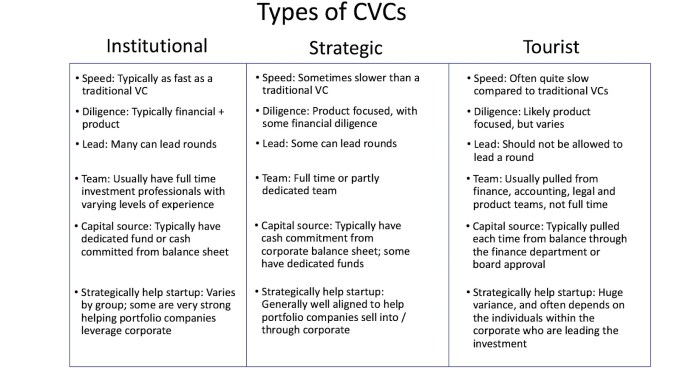
  1. The corporate version of an institutional venture platform, meaning that they look to leverage their parent company’s strategic assets with the goal of scaling their portfolio and driving real revenue. As Grant Allen, general partner at SE Ventures, the CVC arm of Schneider Electric, says, “this type of CVC looks just like a pure financial VC, except with a big company behind them, and the ability to open up real channel revenue.”
  2. Strategically-minded CVCs are not driven exclusively by returns, but also value innovation. These CVCs are looking for outsourced ways to stay on the leading edge and to learn about new technology that might benefit their parent corporation. This category likely still cares about returns, but their view on ROI is more nuanced than a traditional investor.
  3. So-called “tourists” often are made up of brand new and relatively inexperienced venture arms of companies that have done very few deals and haven’t had time to develop a strong process or dealflow strategy.

As the realm of CVCs becomes increasingly professionalized, more and more CVCs fall into the first category. For entrepreneurs seeking CVC investors, those in the institutional or strategic category can provide tremendous value — though it’s important that a startup know which type of CVC they’re speaking to, and have clear objectives going in that align with the CVC’s goals and strengths.

Determining which type of CVC you’re dealing with

Before engaging with a CVC, or any potential investor for that matter, the most important step is to do your research. Who is the individual you’re meeting with? What’s his/her background and what deals has he/she done with this venture group? These are Must Knows before walking into the initial meeting.

Once you’re in early discussions, ask the CVC whether he or she has carry in the fund and whether the venture arm is autonomous. The answers to these questions will help you clarify whether you’re dealing with institutional versus strategic CVCs.

“With corporate-backed venture funds, it’s really key up front to know who you’re talking to,” says Allen. “It’s dangerous to call all groups that are nontraditional investors ‘CVCs’ since some are far more serious than others. Most have some degree of strategic mandate but many are increasingly investing for financial gain.”

The next question is: Are you dealing with a financially driven CVC or a strategically driven one? From a founder’s standpoint, you’ll need to know whether you’re meeting with an investor who views deals through the lens of, “I’m looking for a great team, huge market and a chance to bring in funding and connections to make a business as strong as it can be” or, “I’m looking for a solution/product/platform that I can bring into my company or use to expose my company to a brand new marketplace or technology.”

Once again, the way to determine which type of CVC you’re dealing with is to ask the right questions. In the first meeting, ask about their investment process, how investments are made and whether strategic business unit sponsorship is required for a given deal. The answers will tell you whether the CVC falls into Group 1 or 2, and you’ll be in a strong position to then make choices about whether this potential investor is right for you.

“Look for someone who will understand your business, meet with you and decide that there’s something beyond just capital that will form the basis for that relationship,” says Rick Prostko, managing director at Comcast Ventures. “In today’s venture market, founders want money AND value. Seek out a CVC who has valuable experience to provide, and look for someone who’s been an operator in this segment previously or who has valuable insight and experience to offer.”

What you need to know before you engage with a CVC

Once you’ve done your initial diligence, developed a relationship and determined that a CVC could be a strong investor in your business, there are important factors to be aware of as you move into the next stage of discussions. These include:

Expect deeper product and technical diligence. CVCs can call on technical, product and market experts within their corporation during the due diligence process. As such, their level of product diligence is typically more rigorous than traditional VCs. Be prepared for some grilling by subject matter experts. On the flip side, this diligence process provides you with exposure to potential customers and partners inside the corporation, so use this time to your advantage.

Be aware that you’re going to share confidential information with a large company. “CVCs know that you’re only as good as your reputation,” says Eric Budin, director at Touchdown Ventures . “As such, there are very few examples of CVCs abusing confidential information, because news of it would get around so quickly.”

Still, for a founder, the goal is to be thoughtful and strategic with what you share, and to determine whether the CVC is truly interested in doing a deal before you hand over financial, technical and competitive information. It’s possible that commercial teams at the CVC sponsor could gain unfair advantage from seeing your information, or use their CVC to gain valuable intel on the competition.

On the other hand, sharing your intel could be a fantastic way to get in front of an internal team at the parent company. The key is to think carefully about what you are being asked to share and with whom, and set ground rules with the CVC before they begin diligence.

“It’s important to understand how the corporate fund is structured and how they handle any information that’s shared,” says Prostko. “It might be in your interest to loop in a business unit [within the parent company] that could benefit from learning about your business. On the flip side, if the CVC is a potential competitor, you’ll want to be more careful about what you reveal.”

There will be a risk of regime change. Large companies operate like, well, large companies. People leave, management changes happen and priorities shift. At the outset, ask questions such as: Who will support your company if the commercial manager leading your investment leaves? What will happen to the CVC if the person leading the venture arm is fired? Will they do their pro-rata if the person leading your deal is gone? What happens to any commercial relationships that you might be working on? It’s important to have a keen understanding of internal dynamics before you enter the relationship.

“In general, the more successful a firm is, the more likely the CVC will stick around,” says Allen. “Be sure to look at the individual’s history at the firm, how long he or she has been there, and whether he or she has jumped from fund to fund. If the investing partner has come out of the corporate ‘mother ship,’ and lacks any credible venture experience, buyer beware.”

The CVC may be subject to regulatory rules. Depending on the industry, government regulations may impact how your deal is structured. Banks, for example, are subject to rules that can restrict the percentage of voting stock they can own. Foreign investors may need to comply with CFIUS regulations if your company provides certain specified technologies. Generally, the CVCs will understand the regulations that apply to them. They may not, however, bring them up until late in the process, which could lead to delays.

Commercial transactions with the corporate arm can slow things down. Purely strategic CVCs (Group 2) often require a commercial transaction to happen in connection with a venture deal. The process involved in these transactions often takes longer than the financing process, which can cause issues if the CVC is a key (but not sole) investor in the round. If you’re dealing with a Group 2 CVC, discuss this issue ahead of time to see if you can decouple the two transactions and close the investment prior to inking the commercial deal.

The best way to think about CVC investment

CVCs offer a wealth of capital, human resources and corporate partnerships for startups. But whether you choose to take CVC capital or not, you can benefit from merely approaching CVCs if you have business units operating in either the same space or a tangential space. An initial meeting both gives you an opportunity to do a sales pitch and offers the CVC a chance to vet a product or team and gain some deal insight. For founders, you gain a powerful sales opportunity that might have otherwise taken months or years to obtain.

“Even if you’re told ‘no’ by a CVC, the meeting could result in a good business relationship that could turn into a sales opportunity for you in the near future,” says Prostko.

The WRONG way to think about approaching CVC investors is something along the lines of, “I can’t raise what I want from financial VCs so I’ll go to CVCs as my second choice, since they’re more likely to say ‘yes’ and/or give me better terms.” This attitude will shut doors and cut you off from valuable partners, capital and opportunities to strategically grow your business.

Above all, stay informed as you choose whom to bring in as a partner. Ultimately, it’s your business and the responsibility to ensure that you bring in the right capital partners lies with you.

Powered by WPeMatico

Why localized compensation in a work-anywhere world isn’t so simple

Last Thursday, Mark Zuckerberg told Facebook’s 48,000 employees that he expects upwards of 50% of the company will be working remotely within 10 years. After outlining many of the advantages that remote work confers — including to “potentially spread more economic opportunity around the country and potentially around the world” — he added that those who choose to move to other places in the U.S. or elsewhere will be paid based on where they live.

“We’ll localize everybody’s comp on January 1,” Zuckerberg said. “They can do whatever they want through the rest of the year, but by the end of the year they should either come back to the Bay Area or they need to tell us where they are.”

Facebook isn’t pioneering something entirely new. The concept of localized compensation has been around for some time, and it’s used by tech companies like GitHub that have primarily distributed workforces. Still, questions about whether it’s fair to pay employees based on their location are sure to grow as more outfits adopt remote-work policies.

Despite Facebook’s uncharacteristic transparency about its thinking, not everyone thinks the tactic makes sense.

One longtime Bay Area recruiter who typically focuses on executive searches calls “disparate pay for the same work” a “dangerous place to be.” Explains the recruiter, Jon Holman, “Even if you invoke the geographic disparity arithmetic based almost entirely on housing costs, what if a new openness to telecommuting means that more women or people of color can aspire to some of these jobs? Are you going to pay them less than the mostly white and Asian-American engineers in the Bay Area? I doubt it.”

Powered by WPeMatico