1010Computers | Computer Repair & IT Support

Fintech regulations in Latin America could fuel growth or freeze out startups

Ximena Aleman
Contributor

Ximena Aleman is co-founder and chief business development officer at Prometeo, an open banking platform that serves Latin America.

It may have entered the game later than other leading regions such as Europe and North America, but Latin America’s fintech industry is dynamic and growing fast. The sector was recently given a valuation of more than $150 billion and continues to expand year-on-year.

And while the longer-term impact of COVID-19 on the sector is yet to be determined, there’s no doubt that the demand for certain fintech solutions is on the rise. As smaller financial institutions across the region are under pressure to digitize, many are calling on fintechs to help them along this journey. In addition, a number of SMEs are seeking out digital loan services to help them get through the crisis.

The sector’s speedy expansion has meant that regulators in LatAm are under increasing pressure to enact legislation that addresses the murky waters of fintech activity, providing confidence to consumers and investors alike. However, regulation across the region must be careful to not quash innovation, while startups must figure out how to be agile in an environment which is becoming increasingly regulated. Let’s take a closer look at what impact regulation has had so far in LatAm, and what needs to happen to strike a balance between sector growth and public trust.

The development of fintech regulation across LatAm

Mexico is currently leading the way when it comes to fintech regulation in LatAm, thanks to its comprehensive 2018 fintech Law. The law covers most fintech activities, including crowdfunding, virtual wallet, transactions carried out with cryptocurrencies and open banking. In addition, Mexico has certain financial laws that regulate financial entities in their execution of transactions using fintech. The law also provides a regulatory sandbox for both licensed and non-licensed companies.

Brazil is the furthest ahead after Mexico, as it individually legislates crowdfunding and peer-to-peer lending, while a special congressional commission is working on a broader legislative strategy. Brazil’s Central Bank also endeavors to make open banking legislation effective by the third quarter of 2020, which will pave the way for a thriving open banking ecosystem.

Powered by WPeMatico

An hourly home-sharing startup in San Francisco finds itself in the city’s crosshairs

Emmanuel Bamfo is used to fighting uphill battles. Still, his latest fight, with the city of San Francisco, may well destroy his business if he doesn’t win it, and quickly.

Bamfo is the co-founder and CEO of Globe, a year-old, six-person startup that connects customers with rooms in people’s mostly urban homes. Think Airbnb, except that Globe isn’t for users looking for days- or months-long stays, but instead for a day break.

Globe evolved from an earlier company called Recharge that tried convincing hotels to let its customers rent their rooms by the hour and even minute, and had raised around $10 million in funding. When hotels pushed back on the idea of cleaning their rooms so frequently, the nascent outfit entered into the popular accelerator program Y Combinator last summer and came out as a company that connects customers to home owners instead.

Growth at Globe had been slow but steady since, with more than 10,000 hosts around the world signing up to rent out rooms in their homes. Then came COVID-19.

Some hosts kept providing space to guests. One tech worker, Abe Disu, recently told The New York Times that he rented out his San Francisco apartment through Globe about 70 times between August and April, earning about $50 per hour after cleaning costs.

Many others expressed concerns about germs. “I thought we were dead,” says Bamfo.

Instead of giving up, Bamfo began to position Globe as a platform for people needing an escape from home quarantines. Globe can help individuals find that quiet place to make calls, away from roommates and children. It offers a reprieve from loved ones for a much-needed hour or two. It can even help those in desperate straights find better bandwidth. (You get the idea.)

It’s an appealing proposition on some levels. Who doesn’t long for a change in scenery at his point? Still, there is a pandemic, and safety is concern. Indeed, though Bamfo says Globe has layered in policies specific to COVID-19 — its cleaning checklist for hosts has grown longer and customers now have to send in pictures of thermometer readings — the city of San Francisco, at least, doesn’t think they go far enough.

The city sent Globe a letter last week noting that the company’s hourly rental business appears to violate the shelter-in-place order it instituted in March and that it extended indefinitely last week with some modifications that do not apply to Globe’s business. It says it’s prepared to take action, too. If has warned Globe that if it doesn’t immediately halt its business, the startup — and its founders, Bamfo and Erix Xu, who is a former senior engineering director at Reddit — risk “fine, imprisonment or both, pursuant to San Francisco Administrative Code section 7.17(b) and California Penal Code section 148.”

It adds that the “California Penal Code section 409.5 also authorizes the City to close down properties constituting a menace to public health. Likewise, failure to abide by the San Francisco Planning Code is a nuisance and is punishable by fines of up to $1,000 per day. Likewise, failure to abide by Chapter 41A of the Administrative Code is punishable by fines of up to $484 per day.”

It’s a bitter if somewhat unsurprising development for Globe, which is based in San Francisco, and counts the city as its biggest market. Bamfo and Xu have limited resources, and a drawn-out shut-down could very easily become permanent. Still, it’s hard to see how the company avoids a bigger blow-up if it doesn’t comply very soon — or the city doesn’t instead begin to relax some of its policies.

Right now, Bamfo seems to be counting on the latter, and perhaps for good reason. Yesterday, for example, California Governor Gavin Newsom said that barbershops and hair salons can begin accepting customers again in many California counties. San Francisco and neighboring counties are maintaining more sweeping restrictions for now, but that could change in a matter of weeks.

In the meantime, Bamfo — who says he was “shocked” by the city’s letter — is engaging in a game of chicken. He says that while Globe works on an official response, one that it will send by Tuesday of next week, the company is continuing to make its service available in its hometown.

Noting that neither Airbnb nor hotels have received the same feedback from the city, he says that Globe “doesn’t want to focus on regulations, fines, and threats of jail time. We want instead to elevate this discourse around solutions.”


Globe Living Receives Unwelcome News from San Francisco by TechCrunch on Scribd

Powered by WPeMatico

Verizon CEO Hans Vestberg shares his COVID-19 strategy and tactics

This week, Verizon Communications CEO Hans Vestberg joined us for an episode of Extra Crunch Live.

Vestberg is leading the company through the midst of one its biggest rollouts to date with the push into 5G connectivity. In our discussion, he spoke about how he’s managing the organization during this global crisis, his thoughts on work from home and acquisition strategy, and the ways in which 5G will change the way we work and live.

(Disclosure: Verizon Communications is TechCrunch’s parent company.)

Extra Crunch members can check out a partial transcript of the conversation (edited for length and clarity) or watch it in its entirety via YouTube video below.


Extra Crunch Live features some of the brightest minds in tech and VC, including Aileen Lee, Roelof Botha, Kirsten Green and Mark Cuban. Upcoming episodes will include Aaron Levie from Box, GGV’s Hans Tung and Jeff Richards, Eventbrite’s Julia Hartz and others. Extra Crunch members can submit questions to speakers in real time, so please sign up here if you haven’t already.


His initial reaction to news of the lockdown

We’re a large company with 135,000 employees in 70 different countries around the globe. So, of course, we had an early warning when it started actually in Asia. We have employees in Asia, so we got the feeling that this could be really serious. It was early in the first week of February, we moved to the highest emergency or crisis level in the company. That means that we go to a certain crisis mode on how we organized and how we galvanized the company.

That’s usually put into place every time there is a big national disaster because you need to split between people taking care of the crisis and people taking care of running the business. So we were very early on with that. In the beginning of February, we started the emergency crisis operations center that was taking care of employee questions and prioritization of important things. At the same time, we continued to run the business. That was the first thing we did very early on.

Upcoming Extra Crunch Live episodes include discussions with Aaron Levie from Box, GGV’s Hans Tung and Jeff Richards, and Eventbrite’s Julia Hartz.

The other thing we did very early on is that we understood that this was something unprecedented. I mean, you have been in crisis before. I mean, I’ve been in the telecom crisis, and we’ve been in the banking crisis when everything just went boom. This is something totally different. You cannot use any of your historical experience when it comes to this pandemic, which actually impacts each and every one of us when it comes to health. So I was honest, and thought that they’re going to be a lot of questions. We decided very early on to run our noon live webcast to our employees. We are on our… I think it’s the 11th week, where at noon every day, we run the webcast for all our employees. That was two of the first things we did.

We didn’t think we were going to run for 11 weeks on the new live webcast, but we have done it because we see there’s a very good tool to communicate with all our employees.

Powered by WPeMatico

Docker expands relationship with Microsoft to ease developer experience across platforms

When Docker sold off its enterprise division to Mirantis last fall, that didn’t mark the end of the company. In fact, Docker still exists and has refocused as a cloud-native developer tools vendor. Today it announced an expanded partnership with Microsoft around simplifying running Docker containers in Azure.

As its new mission suggests, it involves tighter integration between Docker and a couple of Azure developer tools including Visual Studio Code and Azure Container Instances (ACI). According to Docker, it can take developers hours or even days to set up their containerized environment across the two sets of tools.

The idea of the integration is to make it easier, faster and more efficient to include Docker containers when developing applications with the Microsoft tool set. Docker CEO Scott Johnston says it’s a matter of giving developers a better experience.

“Extending our strategic relationship with Microsoft will further reduce the complexity of building, sharing and running cloud-native, microservices-based applications for developers. Docker and VS Code are two of the most beloved developer tools and we are proud to bring them together to deliver a better experience for developers building container-based apps for Azure Container Instances,” Johnston said in a statement.

Among the features they are announcing is the ability to log into Azure directly from the Docker command line interface, a big simplification that reduces going back and forth between the two sets of tools. What’s more, developers can set up a Microsoft ACI environment complete with a set of configuration defaults. Developers will also be able to switch easily between their local desktop instance and the cloud to run applications.

These and other integrations are designed to make it easier for Azure and Docker common users to work in in the Microsoft cloud service without having to jump through a lot of extra hoops to do it.

It’s worth noting that these integrations are starting in Beta, but the company promises they should be released some time in the second half of this year.

Powered by WPeMatico

Angling to be eyewear’s next big thing, Futuremood launches with mood-altering sunglasses

Austin Soldner and Michael Schaecher, the co-founders of the new sunglasses brand Futuremood, met at the newly formed San Francisco research and development lab created by the high-end audio tech developer Bose.

The two were tasked with working on Bose’s sunglasses wearable and bonded over a shared interest in sneakers and fashion. Over many conversations the two men realized there was an opportunity to use technology to rewrite the sunglasses playbook and launch the first new brand to the market since Oakley came on the scene.

There was also an opportunity to bring the materials science and tech-forward strategies that sneaker companies have developed to an industry that hadn’t seen any real technical revolutions in decades.

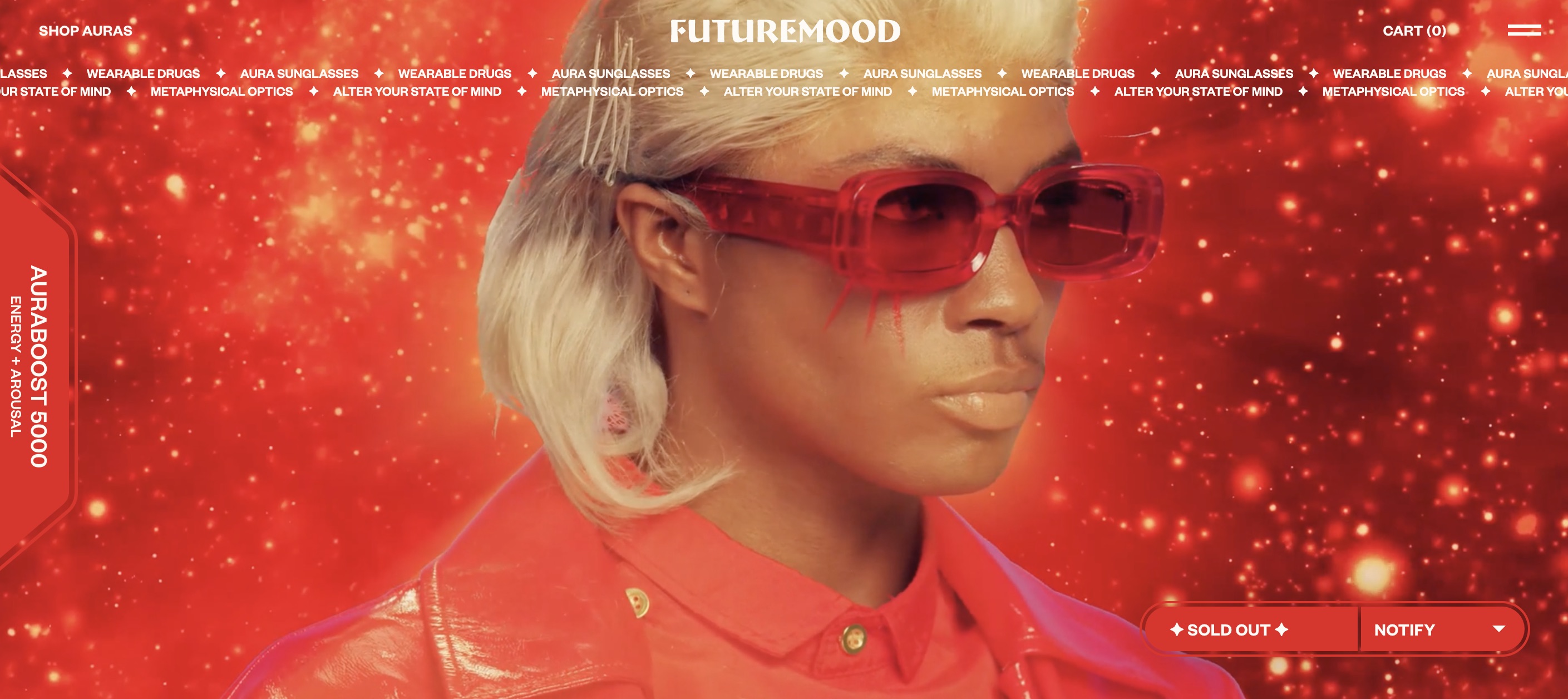
Enter Futuremood “Auras,” which the company bills as the first glasses scientifically tested and proven to alter your mood.

Using technology developed by the lens manufacturer Zeiss, Futuremood’s first glasses come in four colors — a relaxing green, a refreshing blue, an energizing red and a focusing yellow. The company is launching its eyewear in two styles, a boxy, chunky frame and a more traditional rounded frame.

Any mood-altering effects are thanks to Zeiss’ halochrome lens technology, which the lens manufacturer has been working with — and publishing papers on — to suss out the science behind its claims that the use of filtered light can change the way folks feel.

There’s some preliminary research that the company has done, but the science is still largely unproven (Zeiss conducted two studies at European universities). 

Schaecher and Soldner are believers, and the two longtime tech execs see these lenses as a window into a wider world of material science experimentation and product development that they’re hoping to bring to market with Futuremood.

“If you think about sneakers and where Nike and Adidas got to where they are today, it was through innovation in product design and materials and branding and marketing and all of that had been missing from the sunglasses space,” Schaecher said.

The second marketing hire at Airbnb and the first marketing hire at the now-defunct Munchery, Schaecher knows a thing or two about branding. Meanwhile, Soldner, the founder of Playground.fm, and a former product designer at Jawbone, is the technical expert and lead designer for all of Futuremood’s frames.

“We really saw an opportunity to push the envelope in technical innovation and product innovation,” said Schaecher. “We have a backlog of stuff to push the envelope of what sunglasses are.”

One thing sunglasses are is a very very big business. Consumers spent $14.5 billion on sunglasses in 2018, according to the market research firm, Grand View Research.

If Futuremood can capture even a fraction of that market with its unique spin on sunglasses, it’ll be in good shape.

As with any good direct to consumer product, Futuremood’s difference begins with its packaging. Tapping in to the mood-altering “wearable drugs” aesthetic, the company’s product is packaged in boxes with the same bright hues as the sunglasses. Inside there’s a cloth to clean the glasses, a velvet pouch to hold them and a scented pack of incense matches and a vaguely tarot-esque card with information about the glasses and the sensation they’re meant to evoke (there’s even a Spotify playlist to listen to).

In an email, Schaecher described the sensation as “not as subtle as CBD, but not as strong as a shot of tequila or glass of Rosé.

“Austin and I are really into different ways of self care and taking moments and… we thought there was an opportunity to bring delight and joy,” with the packaging, Schaecher said. “We don’t expect people to be firing up Spotify playlists and incense matches every time they wear things.”

Futuremood has been mostly bootstrapped to date, and like everything else in the year of our Lord 2020, the company’s plans were pushed back by the coronavirus pandemic.

“Our lenses are made in Zeiss’ Italian factory and the glasses were made outside of Shenzhen,” said Schaecher. “We quarantined the first order for two weeks. Zeiss was right in that region of Italy that was getting hit hard. We’ve been delaying since then. It’s hard to put into words what it’s like to grind on something for eighteen months… and then have to delay launching.”

Even with the pandemic, though, the company moved ahead with the design for its second product, and that gives a hint for where Schaecher and Soldner want to go with their business. “We have our second product line and that is not mood-altering glasses,” said Schaecher. “That’s a traditional sunglasses line that uses titanium alloy metals that are more commonly seen in aerospace than in eyewear.”

The design aesthetic is also more in the luxury vein, which Schaecher teased was akin to something that would be more at home in a Cartier showroom rather than a direct to consumer brand’s digital storefront.

Right now, the company is going direct to consumers through its website, but it’s looking at the potential for some retail collaborations and field marketing when the country opens back up for business.

As for the mood-altering effects and whether “wearable drug” can win market share, Schaecher is pretty optimistic. “People definitely have reactions,” he said. “It’s a fun, new thing that’s never existed before.”

Image Credits: Futuremood

Powered by WPeMatico

Siren raises $11.8M for its limb-saving smart socks

Can a pair of socks help those with diabetes avoid foot amputations?

That’s one of the ideas behind Siren, a company that’s building smart, washable fabric wearables — the first of which is a pair of socks meant to help those with diabetes monitor their foot health and detect dangerous injuries early. They’ve just raised an $11.8 million Series B to help get it done.

The round was led by Anathem Ventures, and backed by Khosla, DCM and Founders Fund. As part of the raise, DCM’s Jason Krikorian (co-founder of Slingbox maker Sling Media) will be joining Siren’s board.

Siren co-founder Ran Ma tells me that amputations in patients with diabetes are largely the result of injuries that go undetected for too long. Over time, diabetes can cause nerve damage; when this nerve damage impacts the feet, patients can develop injuries and ulcers without noticing — out of sight, out of mind. Left untreated, these injuries can grow worse or become infected to the point that amputation is required. Tens of thousands of these amputations occur each year in the U.S. alone.

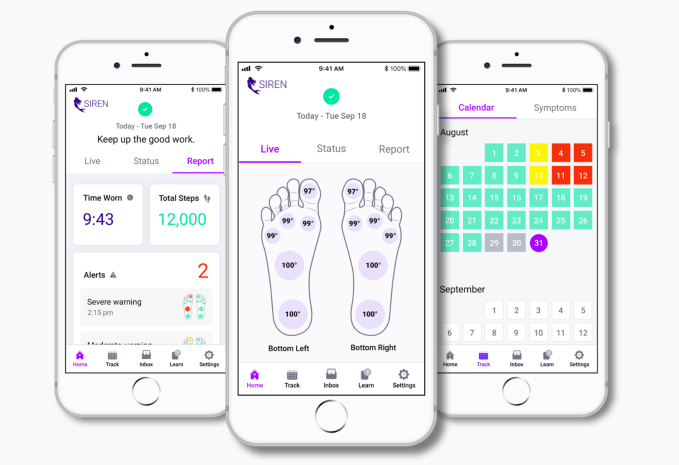
Siren’s socks help detect injuries that might otherwise go unnoticed by monitoring the temperature of six regions of the wearer’s foot. If one region seems to be getting considerably warmer than those around it, it could indicate ongoing inflammation caused by an injury. The socks can connect to the patient’s phone via Bluetooth to help them keep an eye on their feet — and, importantly, that information is beamed to their doctors, who can keep an eye out for red flags.

That last bit is particularly key right now. With the ongoing COVID-19 pandemic, many are avoiding doctors offices and hospitals in fear of being exposed to the virus; meanwhile, many offices have been limiting their more routine/less urgent or “non-essential” appointments — including, in this case, routine foot exams. Siren’s socks let a patient’s doctors monitor their foot health from afar.

We first met Siren back in 2017 when the company won the TechCrunch Hardware Battlefield at CES. Since then, the company has raised around $22 million in funding; this $11.8 million Series B, a previously undisclosed $6.5 million Series A in 2018 and a $3.4 million seed round.

Ran Ma tells me that they’ve made Siren Socks available in 10 states so far, with plans to expand nationwide by the end of this year.

Powered by WPeMatico

Otrium raises $26 million to sell end-of-season fashion items

Otrium has raised a $26 million Series B funding round (€24 million), with Eight Roads Ventures leading the round. Existing investors Index Ventures and Hans Veldhuizen also participated. Otrium works with clothing brands to help them sell items when they reach the end-of-season status.

Due to fast fashion, you have to regularly clear some space in your stores and recover inventory from third-party stores to release new items. But end-of-season sales aren’t enough. Brands end up with a lot of inventory on their hand. And those items often get destroyed.

Otrium wants to add another sales channel for those specific items — and it’s an online one, which should help when it comes to shelf space. Lockdowns around the world have also generated more excess inventory for the spring-summer 2020 collections.

Fashion brands don’t want to sell outdated items on their own site because scarcity creates value. First, customers should check regularly with their favorite fashion brand to see what they’re selling right now. Second, fashion brands don’t want you to see that you could wait a few months to get an item for cheap.

That’s why Otrium has created a marketplace and tries to be as friendly as possible with fashion brands. If you decide to sell end-of-season collections on Otrium, you can manage your own outlet, get in-depth analytics and enable a dynamic pricing engine to maximize revenue on those outdated items.

Two hundred brands have decided to partner with Otrium, such as Joseph, Reiss, G-Star, Asics, Puma, Vans, Pepe Jeans, Alexachung and Scotch & Soda. There are one million registered customers on Otrium.

The e-commerce website is currently live in the Netherlands, France and Germany. It just launched its site in the U.K. as well. With today’s funding round, you can expect more international expansions in the future.

Powered by WPeMatico

We throw away 80% of our content ideas, and you should too

Amanda Milligan
Contributor

Amanda Milligan is the marketing director at Fractl, a prominent growth marketing agency that’s helped Fortune 500 companies and boutique businesses alike earn quality media coverage, backlinks, awareness and authority.

We’ve talked a bit publicly about our ideation process, but to be honest, it’s constantly evolving. With every piece of content we create and promote, we gain a better understanding of what works and what doesn’t.

But part of that process has always been allowing for the creative freedom to come up with ideas and then — and most importantly — kill your darlings if they don’t meet the criteria for a good idea.

It’s not always easy; creativity is personal. But culling the list of ideas is necessary for a successful content plan.

So how do you know which ones to cut?

Ask yourself these questions.

Is the idea packed with emotion?

Make a list of all the emotions associated with your idea. If you can’t think of any, it means the idea may need some tweaking, or you need to explore it in more depth.

Even helpful how-to content is tied to emotion. Take, for example, “Give Your Kids the Gift of Automotive Repair Skills While You’re Home Together,” a genius piece of content by Car and Driver.

There’s the emotional component of it being in the context of COVID-19, yes, but it’s more than that. It’s about spending quality time with your children and teaching them crucial skills. Related emotions include love, pride, empowerment, accountability, parental responsibility and more.

And the content creators were smart enough to call out the emotional component, like they did here:

The post garnered nearly 5,000 engagements on Facebook, which to me indicates it hit the sweet spot of being helpful while also tapping into our emotions.

Fractl did a study back in 2013 that explored which type of emotions were the most prevalent in viral images, and, as it turns out, positive emotions had more representation than negative ones. Most prevalent of all? Surprise. People enjoy being astonished, delighted and unexpectedly joyful. Do any of your content ideas fit this bill?

Powered by WPeMatico

RudderStack raises $5M seed round for its open-source Segment competitor

RudderStack, a startup that offers an open-source alternative to customer data management platforms like Segment, today announced that it has raised a $5 million seed round led by S28 Capital. Salil Deshpande of Uncorrelated Ventures and Mesosphere/D2iQ co-founder Florian Leibert (through 468 Capital) also participated in this round.

In addition, the company also today announced that it has acquired Blendo, an integration platform that helps businesses transform and move data from their data sources to databases.

Like its larger competitors, RudderStack helps businesses consolidate all of their customer data, which is now typically generated and managed in multiple places — and then extract value from this more holistic view. The company was founded by Soumyadeb Mitra, who has a Ph.D. in database systems and worked on similar problems previously when he was at 8×8 after his previous startup, MairinaIQ, was acquired by that company.

Mitra argues that RudderStack is different from its competitors thanks to its focus on developers, its privacy and security options and its focus on being a data warehouse first, without creating yet another data silo.

“Our competitors provide tools for analytics, audience segmentation, etc. on top of the data they keep,” he said. “That works well if you are a small startup, but larger enterprises have a ton of other data sources — at 8×8 we had our own internal billing system, for example — and you want to combine this internal data with the event stream data — that you collect via RudderStack or competitors — to create a 360-degree view of the customer and act on that. This becomes very difficult with the SaaS-hosted data model of our competitors — you won’t be sending all your internal data to these cloud vendors.”

Part of its appeal, of course, is the open-source nature of RudderStack, whose GitHub repository now has more than 1,700 stars for the main RudderStack server. Mitra credits getting on the front page of HackerNews for its first sale. On that day, it received over 500 GitHub stars, a few thousand clones and a lot of signups for its hosted app. “One of those signups turned out to be our first paid customer. They were already a competitor’s customer, but it wasn’t scaling up so were looking to build something in-house. That’s when they found us and started working with us,” he said.

Because it is open source, companies can run RudderStack anyway they want, but like most similar open-source companies, RudderStack offers multiple hosting options itself, too, that include cloud hosting, starting at $2,000 per month, with unlimited sources and destination.

Current users include IFTTT, Mattermost, MarineTraffic, Torpedo and Wynn Las Vegas.

As for the Blendo acquisition, it’s worth noting that the company only raised a small amount of money in its seed round. The two companies did not disclose the price of the acquisition.

“With Blendo, I had the opportunity to be part of a great team that executed on the vision of turning any company into a data-driven organization,” said Blendo founder Kostas Pardalis, who has joined RudderStack as head of Growth. “We’ve combined the talented Blendo and RudderStack teams together with the technology that both companies have created, at a time when the customer data market is ripe for the next wave of innovation. I’m excited to help drive RudderStack forward.”

Mitra tells me that RudderStack acquired Blendo instead of building its own version of this technology because “it is not a trivial technology to build — cloud sources are really complicated and have weird schemas and API challenges and it would have taken us a lot of time to figure it out. There are independent large companies doing the ETL piece.”

Powered by WPeMatico

5G, AI, cybersecurity and renewable energy set for investment boost under EU coronavirus recovery plan

The European Commission is proposing to direct billions of euros of financial relief into high tech and green investments to help the bloc recover from the coronavirus crisis.

Technologies such as 5G, AI, cloud, cybersecurity, supercomputing and renewable energy look set to benefit from a €750BN pan-EU support package set out today — aligning with the Commission’s pre-existing policy priorities before the pandemic struck the region, causing thousands of deaths and major economic damage.

“Urgent action is needed to kick-start the economy and create the conditions for a recovery led by private investment in key sectors and technologies. This investment is particularly crucial to the success of Europe’s green and digital transitions,” it writes in a factsheet on its budget proposal set out today — which is being slated as a wider “recovery plan” for Europe.

“Investment in key sectors and technologies, from 5G to artificial intelligence and from clean hydrogen to offshore renewable energy, holds the key to Europe’s future,” it adds.

On the green deal front, it’s touting:

  • A massive renovation wave of our buildings and infrastructure and a more circular economy, bringing local jobs;
  • Rolling out renewable energy projects, especially wind, solar and kick-starting a clean hydrogen economy in Europe;
  • Cleaner transport and logistics, including the installation of one million charging points for electric vehicles and a boost for rail travel and clean mobility in our cities and regions;

It also plans to funnel more financial support into a Just Transition Fund to support re-skilling and help businesses tap into the economic opportunities offered by digitization and going green.

The Commission estimates that at least €1.5 trillion will be needed to reboot the EU’s economy as a result of the pandemic crisis in 2020-2021 alone — so the budget proposals include a revision of the 2014-2020 multiannual financial framework as well as a financial framework for the 2021-2027 period.

The Commission is proposing to borrow €750BN on the financial markets, through the issuance of bonds, for a ‘Next Generation EU’ fund which will be channelled through EU programs between 2021 and 2024 — with the loan to be repaid over “a long period of time throughout future EU budgets” (not before 2028 and not after 2058).

It’s proposing three investment pillars for this fund: One focused on support for EU Member States via direct investment and reforms; a second focused on kick starting the EU economy by incentivizing private investments; and a third aimed at learning lessons from the COVID-19 crisis, with a big focus on health, as well as civil contingencies and foreign aid.

Under the first pillar, digital and green technologies are set to benefit from a proposed €560BN Recovery and Resilience Facility that will offer EU Member States financial support for related investments and reforms, including a grant facility of up to €310BN and up to €250BN available in loans.

“Support will be available to all Member States but concentrated on the most affected and where resilience needs are the greatest,” the Commission said today.

It’s also proposing €15BN extra for the European Agricultural Fund for Rural Development — to “support rural areas in making the structural changes necessary in line with the European Green Deal and achieving the ambitious targets in line with the new biodiversity and Farm to Fork strategies”.

Under the second pillar, a new Solvency Support Instrument is intended to mobilize private resources to support what the Commission bills as “viable” European companies in the sectors, regions and countries most affected. It wants this support to be operational from 2020, and is suggesting a budget of €31BN with the aim of aiming to unlock €300BN in solvency support for companies from all economic sectors (to “prepare them for a cleaner, digital and resilient future”, as it puts it).

There’s also more money for the InvestEU investment program which the Commission wants to see hitting €15.3BN over the budget period to spin up more private investment in projects across the EU.

It’s also proposing a new Strategic Investment Facility be built into InvestEU which it wants to generate investments of up to €150BN to boost the resilience of “strategic sectors”, again notably those linked to the green and digital transition — with €15BN set to be chipped in here from the Next Generation EU pot.

Under the third pillar, the Commission is earmarking €9.4BN for a new health programme, EU4Health, that’s intended to strengthen health security and prepare for future health crises.

While the Horizon Europe research program is set to get €94.4BN — including to support what it dubs “vital research” in health, resilience and the green and digital transitions.

Commenting in a statement, European Commission president, Ursula von der Leyen, said: “The recovery plan turns the immense challenge we face into an opportunity, not only by supporting the recovery but also by investing in our future: the European Green Deal and digitalization will boost jobs and growth, the resilience of our societies and the health of our environment. This is Europe’s moment. Our willingness to act must live up to the challenges we are all facing. With Next Generation EU we are providing an ambitious answer.”

In terms of next steps, the Commission’s budget proposals will need to gain political agreement from the European Council. It’s hoping will be achieved by July, with the EU’s executive keen to impress on Member States there’s no time to lose in financing coronavirus relief.

The EU parliament will also need to have its say but the Commission has penciled in early autumn for the adoption of the revised 2014-2020 framework and December 2020 for adoption of the revised Multiannual Financial Framework 2021-2027 (as well as Member States’ Own Resources Decision) — with the aim of implementing the latter framework in January 2021.

Powered by WPeMatico