1010Computers | Computer Repair & IT Support

How startups can leverage elastic services for cost optimization

Joey Lei
Contributor

Joey Lei is director of service management at Synoptek, a global systems integrator and managed services provider. Prior to joining Synoptek, he was a lead product manager for Dell EMC’s Data Protection Division and was a founding product manager for Dell EMC PowerProtect Data Manager, Dell EMC’s newest generation data protection and data management solution.

Due to COVID-19, business continuity has been put to the test for many companies in the manufacturing, agriculture, transport, hospitality, energy and retail sectors. Cost reduction is the primary focus of companies in these sectors due to massive losses in revenue caused by this pandemic. The other side of the crisis is, however, significantly different.

Companies in industries such as medical, government and financial services, as well as cloud-native tech startups that are providing essential services, have experienced a considerable increase in their operational demands — leading to rising operational costs. Irrespective of the industry your company belongs to, and whether your company is experiencing reduced or increased operations, cost optimization is a reality for all companies to ensure a sustained existence.

One of the most reliable measures for cost optimization at this stage is to leverage elastic services designed to grow or shrink according to demand, such as cloud and managed services. A modern product with a cloud-native architecture can auto-scale cloud consumption to mitigate lost operational demand. What may not have been obvious to startup leaders is a strategy often employed by incumbent, mature enterprises — achieving cost optimization by leveraging managed services providers (MSPs). MSPs enable organizations to repurpose full-time staff members from impacted operations to more strategic product lines or initiatives.

Why companies need cost optimization in the long run

Powered by WPeMatico

Cisco to acquire internet monitoring solution ThousandEyes

When Cisco bought AppDynamics in 2017 for $3.7 billion just before the IPO, the company sent a clear signal it wanted to move beyond its pure network hardware roots into the software monitoring side of the equation. Yesterday afternoon the company announced it intends to buy another monitoring company, this time snagging internet monitoring solution ThousandEyes.

Cisco would not comment on the price when asked by TechCrunch, but published reports from CNBC and others pegged the deal at around $1 billion. If that’s accurate, it means the company has paid around $4.7 billion for a pair of monitoring solutions companies.

Cisco’s Todd Nightingale, writing in a blog post announcing the deal said that the kind of data that ThousandEyes provides around internet user experience is more important than ever as internet connections have come under tremendous pressure with huge numbers of employees working from home.

ThousandEyes keeps watch on those connections and should fit in well with other Cisco monitoring technologies. “With thousands of agents deployed throughout the internet, ThousandEyes’ platform has an unprecedented understanding of the internet and grows more intelligent with every deployment, Nightingale wrote.

He added, “Cisco will incorporate ThousandEyes’ capabilities in our AppDynamics application intelligence portfolio to enhance visibility across the enterprise, internet and the cloud.”

As for ThousandEyes, co-founder and CEO Mohit Lad told a typical acquisition story. It was about growing faster inside the big corporation than it could on its own. “We decided to become part of Cisco because we saw the potential to do much more, much faster, and truly create a legacy for ThousandEyes,” Lad wrote.

It’s interesting to note that yesterday’s move, and the company’s larger acquisition strategy over the last decade is part of a broader move to software and services as a complement to its core networking hardware business.

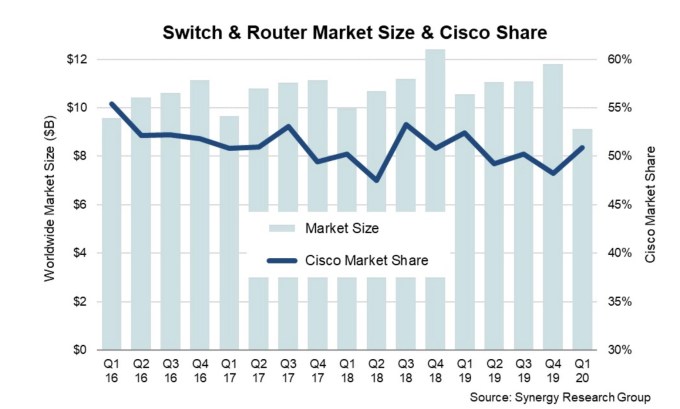
Just yesterday, Synergy Research released its network switch and router revenue report and it wasn’t great. As companies have hunkered down during the pandemic, they have been buying much less network hardware, dropping the Q1 numbers to seven year low. That translated into a $1 billion less in overall revenue in this category, according to Synergy.

While Cisco owns the vast majority of the market, it obviously wants to keep moving into software services as a hedge against this shifting market. This deal simply builds on that approach.

ThousandEyes was founded in 2010 and raised over $110 million on a post valuation of $670 million as of February 2019, according to Pitchbook Data.

Powered by WPeMatico

3 bearish takes on the current edtech boom

Edtech is booming, but a short while ago, many companies in the category were struggling to break through as mainstream offerings. Now, it seems like everyone is clamoring to get into the next seed-stage startup that has the phrase “remote learning” on its About page.

And so begins the normal cycle that occurs when a sector gets overheated — boom, bust and a reckoning. While we’re still in the early days of edtech’s revitalization, it isn’t a gold mine all around the world. Today, in the spirit of balance and history, I’ll present three bearish takes I’ve heard on edtech’s future.

Quizlet’s CEO Matthew Glotzbach says that when students go back to school, the technology that “sticks” during this time of massive experimentation might not be bountiful.

“I think the dividing line there will be there are companies that have been around, that are a little more entrenched, and have good financial runway and can probably survive this cycle,” he said. “They have credibility and will probably get picked [by schools].” The newer companies, he said, might get stuck with adoption because they are at a high degree of risk, and might be giving out free licenses beyond their financial runway right now.

Powered by WPeMatico

The secret to trustworthy data strategy

Daniel Wu
Contributor

Dan Wu is a Privacy Counsel & Legal Engineer at Immuta, an automated data governance platform for analytics. He’s advocated for data ethics, inclusive urban innovation, and diversity in TechCrunch, Harvard Business Review, and FastCompany. He’s helped Fortune 500 companies, governments, and startups with ethical & agile data strategies. He holds a Harvard J.D. & Ph.D.

Eugene Kolker
Contributor

Eugene Kolker, PhD is the Chief Economist and Head of XLAB at Fabuwood Corp., an Adjunct Professor at New York University’s Tandon School of Engineering, and President of 1Ekaroni, a consulting and services company. He was formerly the Chief Data Officer of IBM Global Services and the Chief Data and Analytics Officer of Seattle Children’s Healthcare System. He has also co-founded three digital technology and healthcare startups.

Leandro DalleMule
Contributor

Leandro DalleMule is the General Manager for North America for Planck. He’s the former Chief Data Officer and Head of Information Management at AIG. Leandro holds an MBA from the Kellogg School of Management at Northwestern University, graduating magna cum laude, a graduate certificate in applied mathematics from Columbia University, and a B.Sc. in mechanical engineering from University of Sao Paulo, Brazil.

Barbara Cohn
Contributor

Barbara Cohn is the managing member of BLC Strategic Advisors. She previously served as the first Chief Data Officer for the State of New York, having led its successful open data initiative for Governor Andrew Cuomo. Prior to that, she was Executive Counsel/HHS Connect Data Interoperability Initiative under Mayor Bloomberg, as well as served in multiple leadership positions in NYS agencies and Office of the NYS Governor.

Carlos Rivero
Contributor

Carlos Rivero is the Chief Data Officer for the Commonwealth of Virginia. Prior to his appointment, Rivero served as Chief Data Officer and Chief Enterprise Architect for the U.S. Department of Transportation’s Federal Transit Administration in Washington, D.C.

Shortly after its use exploded in the post-office world of COVID-19, Zoom was banned by a variety of private and public actors, including SpaceX and the government of Taiwan. Critics allege its data strategy, particularly its privacy and security measures, were insufficiently robust, especially putting vulnerable populations, like children, at risk. NYC’s Department of Education, for instance, mandated teachers switch to alternative platforms like Microsoft Teams.

This isn’t a problem specific to Zoom. Other technology giants, from Alphabet, Apple to Facebook, have struggled with these strategic data issues, despite wielding armies of lawyers and data engineers, and have overcome them.

To remedy this, data leaders cannot stop at identifying how to improve their revenue-generating functions with data, what the former Chief Data Officer of AIG (one of our co-authors) calls “offensive” data strategy. Data leaders also protect, fight for, and empower their key partners, like users and employees, or promote “defensive” data strategy. Data offense and defense are core to trustworthy data-driven products.

While these data issues apply to most organizations, highly-regulated innovators in industries with large social impact (the “third wave”) must pay special attention. As Steve Case and the World Economic Forum articulate, the next phase of innovation will center on industries that merge the digital and the physical worlds, affecting the most intimate aspects of our lives. As a result, companies that balance insight and trust well, Boston Consulting group predicts, will be the new winners.

Drawing from our work across the public, corporate, and startup worlds, we identify a few “insight killers” — then identify the trustworthy alternative. While trustworthy data strategy should involve end users and other groups outside the company as discussed here, the lessons below focus on the complexities of partnering within organizations, which deserve attention in their own right.

Insight-killer #1: “Data strategy adds no value to my life.”

From the beginning of a data project, a trustworthy data leader asks, “Who are our partners and what prevents them from achieving their goals?” In other words: listen. This question can help identify the unmet needs of the 46% of surveyed technology and business teams who found their data groups have little value to offer them.

Putting this to action is the data leader of one highly-regulated AI health startup — Cognoa — who listened to tensions between its defensive and offensive data functions. Cognoa’s Chief AI Officer identified how healthcare data laws, like the Health Insurance Portability and Accountability Act, resulted in friction between his key partners: compliance officers and machine learning engineers. Compliance officers needed to protect end users’ privacy while data and machine learning engineers wanted faster access to data.

To meet these multifaceted goals, Cognoa first scoped down its solution by prioritizing its highest-risk databases. It then connected all of those databases using a single access-and-control layer.

This redesign satisfied its compliance officers because Cognoa’s engineers could then only access health data based on strict policy rules informed by healthcare data regulations. Furthermore, since these rules could be configured and transparently explained without code, it bridged communication gaps between its data and compliance roles. Its engineers were also elated because they no longer had to wait as long to receive privacy-protected copies.

Because its data leader started by listening to the struggles of its two key partners, Cognoa met both its defensive and offensive goals.

Powered by WPeMatico

Join GGV’s Hans Tung and Jeff Richards for a live Q&A: June 4 at 3:30 pm EDT/12:30 pm PDT

What does a global mindset look like in a world where most of us no longer travel? And what does it mean to be local when everyone is connected?

Those are the first questions we had in mind when we read GGV Capital’s Twitter bio, which asserts that the investing shop with offices in five cities is a “global venture capital firm that invests in local founders.”

Certainly, some of its investments are far from home, including Khatabook (based in Bangalore), Keep (Beijing), Coder, (Austin) and Slice (New York City). And those are just GGV deals from the last few months.

But what constitutes a local investment in a world where, until recently, no deal was more than a plane ride or two away? Hans Tung and Jeff Richards, managing partners at GGV Capital, are swinging by Extra Crunch Live next week, and we’re going to dive into the above to figure it out.

Of course, we’ll also ask critical, founder-focused questions about their current investing pace, check sizes and how they are adapting to the COVID-19 era. But after that, there’s a lot of work to do.

We’ll call on Tung to share some of what he’s learned from his time investing in China’s tech landscape, with a specific focus on what he sees in the future that might prove encouraging. The other GGV partner joining, Richards, also has international experience working in Asia and Latin America, so the conversation should be interesting.

In February, the firm published a mom-and-pop shop investment thesis. GGV Capital wants to invest in startups that help small retailers digitize operations and work with better supply chains. It is also interested in startups that want to establish logistic and online payment infrastructure. (Surely Shopify can’t be this entire market, right?)

The thesis hinges on consumer shopping habits and retailers open for business, so we’ll see how Tung and Richards are changing their appetite, or further shaping it. 

Details are below for Extra Crunch subscribers; if you need a pass, get a cheap trial here

Chat with you all in a week!

When, where, Zoom

Powered by WPeMatico

BeeHero smartens up hives to provide ‘pollination as a service’ with $4M seed round

Vast monoculture farms outstripped the ability of bee populations to pollinate them naturally long ago, but the techniques that have arisen to fill that gap are neither precise nor modern. Israeli startup BeeHero aims to change that by treating hives both as living things and IoT devices, tracking health and pollination progress practically in real time. It just raised a $4 million seed round that should help expand its operations into U.S. agriculture.

Honeybees are used around the world to pollinate crops, and there has been growing demand for beekeepers who can provide lots of hives on short notice and move them wherever they need to be. But the process has been hamstrung by the threat of colony collapse, an increasingly common end to hives, often as the result of mite infestation.

Hives must be deployed and checked manually and regularly, entailing a great deal of labor by the beekeepers — it’s not something just anyone can do. They can only cover so much land over a given period, meaning a hive may go weeks between inspections — during which time it could have succumbed to colony collapse, perhaps dooming the acres it was intended to pollinate to a poor yield. It’s costly, time-consuming, and decidedly last-century.

So what’s the solution? As in so many other industries, it’s the so-called Internet of Things. But the way CEO and founder Omer Davidi explains it, it makes a lot of sense.

“This is a math game, a probabilistic game,” he said. “We’ve modeled the problem, and the main factors that affect it are, one, how do you get more efficient bees into the field, and two, what is the most efficient way to deploy them?”

Normally this would be determined ahead of time and monitored with the aforementioned manual checks. But off-the-shelf sensors can provide a window into the behavior and condition of a hive, monitoring both health and efficiency. You might say it puts the API in apiculture.

“We collect temperature, humidity, sound, there’s an accelerometer. For pollination, we use pollen traps and computer vision to check the amount of pollen brought to the colony,” he said. “We combine this with microclimate stuff and other info, and the behaviors and patterns we see inside the hives correlate with other things. The stress level of the queen, for instance. We’ve tested this on thousands of hives; it’s almost like the bees are telling us, ‘we have a queen problem.’ ”

All this information goes straight to an online dashboard where trends can be assessed, dangerous conditions identified early and plans made for things like replacing or shifting less or more efficient hives.

The company claims that its readings are within a few percentage points of ground truth measurements made by beekeepers, but of course it can be done instantly and from home, saving everyone a lot of time, hassle and cost.

The results of better hive deployment and monitoring can be quite remarkable, though Davidi was quick to add that his company is building on a growing foundation of work in this increasingly important domain.

“We didn’t invent this process, it’s been researched for years by people much smarter than us. But we’ve seen increases in yield of 30-35% in soybeans, 70-100% in apples and cashews in South America,” he said. It may boggle the mind that such immense improvements can come from just better bee management, but the case studies they’ve run have borne it out. Even “self-pollinating” (i.e. by the wind or other measures) crops that don’t need pollinators show serious improvements.

The platform is more than a growth aid and labor saver. Colony collapse is killing honeybees at enormous rates, but if it can be detected early, it can be mitigated and the hive potentially saved. That’s hard to do when time from infection to collapse is a matter of days and you’re inspecting biweekly. BeeHero’s metrics can give early warning of mite infestations, giving beekeepers a head start on keeping their hives alive.
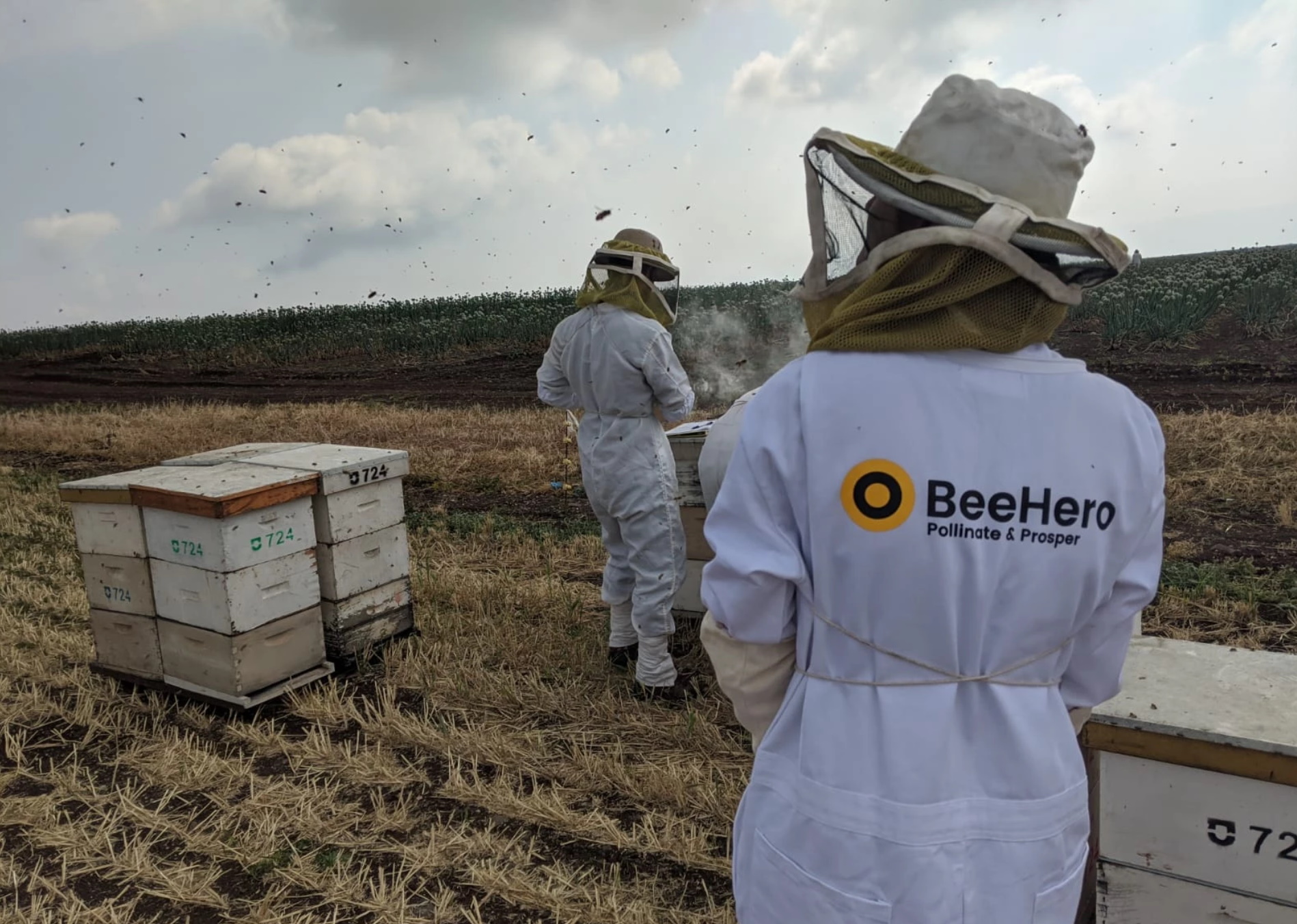
“We’ve seen cases where you can lower mortality by 20-25%,” said Davidi. “It’s good for the farmer to improve pollination, and it’s good for the beekeeper to lose less hives.”

That’s part of the company’s aim to provide value up and down the chain, not just a tool for beekeepers to check the temperatures of their hives. “Helping the bees is good, but it doesn’t solve the whole problem. You want to help whole operations,” Davidi said. The aim is “to provide insights rather than raw data: whether the queen is in danger, if the quality of the pollination is different.”

Other startups have similar ideas, but Davidi noted that they’re generally working on a smaller scale, some focused on hobbyists who want to monitor honey production, or small businesses looking to monitor a few dozen hives versus his company’s nearly 20,000. BeeHero aims for scale both with robust but off-the-shelf hardware to keep costs low, and by focusing on an increasingly tech-savvy agriculture sector here in the States.

“The reason we’re focused on the U.S. is the adoption of precision agriculture is very high in this market, and I must say it’s a huge market,” Davidi said. “Eighty percent of the world’s almonds are grown in California, so you have a small area where you can have a big impact.”

The $4 million seed round’s investors include Rabo Food and Agri Innovation Fund, UpWest, iAngels, Plug and Play, and J-Ventures.

BeeHero is still very much also working on R&D, exploring other crops, improved metrics and partnerships with universities to use the hive data in academic studies. Expect to hear more as the market grows and the need for smart bee management starts sounding a little less weird and a lot more like a necessity for modern agriculture.

Powered by WPeMatico

Mirantis releases its first major update to Docker Enterprise

In a surprise move, Mirantis acquired Docker’s Enterprise platform business at the end of last year, and while Docker itself is refocusing on developers, Mirantis kept the Docker Enterprise name and product. Today, Mirantis is rolling out its first major update to Docker Enterprise with the release of version 3.1.

For the most part, these updates are in line with what’s been happening in the container ecosystem in recent months. There’s support for Kubernetes 1.17 and improved support for Kubernetes on Windows (something the Kubernetes community has worked on quite a bit in the last year or so). Also new is Nvidia GPU integration in Docker Enterprise through a pre-installed device plugin, as well as support for Istio Ingress for Kubernetes and a new command-line tool for deploying clusters with the Docker Engine.

In addition to the product updates, Mirantis is also launching three new support options for its customers that now give them the option to get 24×7 support for all support cases, for example, as well as enhanced SLAs for remote managed operations, designated customer success managers and proactive monitoring and alerting. With this, Mirantis is clearly building on its experience as a managed service provider.

What’s maybe more interesting, though, is how this acquisition is playing out at Mirantis itself. Mirantis, after all, went through its fair share of ups and downs in recent years, from high-flying OpenStack platform to layoffs and everything in between.

“Why we do this in the first place and why at some point I absolutely felt that I wanted to do this is because I felt that this would be a more compelling and interesting company to build, despite maybe some of the short-term challenges along the way, and that very much turned out to be true. It’s been fantastic,” Mirantis CEO and co-founder Adrian Ionel told me. “What we’ve seen since the acquisition, first of all, is that the customer base has been dramatically more loyal than people had thought, including ourselves.”

Ionel admitted that he thought some users would defect because this is obviously a major change, at least from the customer’s point of view. “Of course we have done everything possible to have something for them that’s really compelling and we put out the new roadmap right away in December after the acquisition — and people bought into it at very large scale,” he said. With that, Mirantis retained more than 90% of the customer base and the vast majority of all of Docker Enterprise’s largest users.

Ionel, who almost seemed a bit surprised by this, noted that this helped the company to turn in two “fantastic” quarters and was profitable in the last quarter, despite COVID-19.

“We wanted to go into this acquisition with a sober assessment of risks because we wanted to make it work, we wanted to make it successful because we were well aware that a lot of acquisitions fail,” he explained. “We didn’t want to go into it with a hyper-optimistic approach in any way — and we didn’t — and maybe that’s one of the reasons why we are positively surprised.”

He argues that the reason for the current success is that enterprises are doubling down on their container journeys and because they actually love the Docker Enterprise platform, like infrastructure independence, its developer focus, security features and ease of use. One thing many large customers asked for was better support for multi-cluster management at scale, which today’s update delivers.

“Where we stand today, we have one product development team. We have one product roadmap. We are shipping a very big new release of Docker Enterprise. […] The field has been completely unified and operates as one salesforce, with record results. So things have been extremely busy, but good and exciting.”

Powered by WPeMatico

Wasabi announces $30M Series B as cloud storage business continues to grow

We may be in the thick of a pandemic with all of the economic fallout that comes from that, but certain aspects of technology don’t change, no matter the external factors. Storage is one of them. In fact, we are generating more digital stuff than ever, and Wasabi, a Boston-based startup that has figured out a way to drive down the cost of cloud storage, is benefiting from that.

Today it announced a $30 million Series B led led by Forestay Capital, the technology innovation arm of Waypoint Capital, with help from previous investors. As with the previous round, Wasabi is going with home office investors, rather than traditional venture capital firms. Today’s round brings the total raised to $110 million, according to the company.

While founder and CEO David Friend wouldn’t discuss the specific valuation, he did say it was in the hundreds of millions of dollars.

Friend says the company needs the funds to keep up with the rapid growth. “We’ve got about 15,000 customers today, hundreds of petabytes of storage, 2,500 channel partners, 250 technology partners — so we’ve been busy,” he said.

He says that revenue continues to grow in spite of the impact of COVID-19 on other parts of the economy. “Revenue grew 5x last year. It’ll probably grow 3.5x this year. We haven’t seen any real slowdown from the coronavirus. Quarter over quarter growth will be in excess of 40% — this quarter over Q1 — so it’s just continuing on a torrid pace,” he said.

The challenge for a company like Wasabi, which is looking to capture a large chunk of the growing cloud storage market, is the infrastructure piece. It needs to keep building more to meet increasing demand, while keeping costs down, which remains its primary value proposition with customers.

The money will be used mostly to continue to expand its growing infrastructure requirements. The more they store, the more data centers they need, and that takes money. It will also help the company expand into new markets where countries have data sovereignty laws that require data to be stored in-country.

The company launched in 2015. It previously raised $68 million in 2018.

Note: This article originally stated this was a debt financing round. The company has clarified that it is an equity round.

Powered by WPeMatico

Greyparrot bags $2.2M seed to scale its AI for waste management

London-based Greyparrot, which uses computer vision AI to scale efficient processing of recycling, has bagged £1.825 million (~$2.2M) in seed funding, topping up the $1.2M in pre-seed funding it had raised previously. The latest round is led by early stage European industrial tech investor Speedinvest, with participation from UK-based early stage b2b investor, Force Over Mass.

The 2019 founded startup — and TechCrunch Disrupt SF battlefield alum — has trained a series of machine learning models to recognize different types of waste, such as glass, paper, cardboard, newspapers, cans and different types of plastics, in order to make sorting recycling more efficient, applying digitization and automation to the waste management industry.

Greyparrot points out that some 60% of the 2BN tonnes of solid waste produced globally each year ends up in open dumps and landfill, causing major environmental impact. While global recycling rates are just 14% — a consequence of inefficient recycling systems, rising labour costs, and strict quality requirements imposed on recycled material. Hence the major opportunity the team has lit on for applying waste recognition software to boost recycling efficiency, reduce impurities and support scalability.

By embedding their hardware agnostic software into industrial recycling processes Greyparrot says it can offer real-time analysis on all waste flows, thereby increasing efficiency while enabling a facility to provide quality guarantee to buyers, mitigating against risk.

Currently less than 1% of waste is monitored and audited, per the startup, given the expensive involved in doing those tasks manually. So this is an application of AI that’s not so much taking over a human job as doing something humans essentially don’t bother with, to the detriment of the environment and its resources.

Greyparrot’s first product is an Automated Waste Monitoring System which is currently deployed on moving conveyor belts in sorting facilities to measure large waste flows — automating the identification of different types of waste, as well as providing composition information and analytics to help facilities increase recycling rates.

It partnered with ACI, the largest recycling system integrator in South Korea, to work on early product-market fit. It says the new funding will be used to further develop its product and scale across global markets. It’s also collaborating with suppliers of next-gen systems such as smart bins and sorting robots to integrate its software.

“One of the key problems we are solving is the lack of data,” said Mikela Druckman, co-founder & CEO of Greyparrot in a statement. “We see increasing demand from consumers, brands, governments and waste managers for better insights to transition to a more circular economy. There is an urgent opportunity to optimise waste management with further digitisation and automation using deep learning.”

“Waste is not only a massive market — it builds up to a global crisis. With an increase in both world population and per capita consumption, waste management is critical to sustaining our way of living. Greyparrot’s solution has proven to bring down recycling costs and help plants recover more waste. Ultimately it unlocks the value of waste and creates a measurable impact for the environment,” added Marie-Hélène Ametsreiter, lead partner at Speedinvest Industry, in another statement.

Greyparrot is sitting pretty in another aspect — aligning with several strategic areas of focus for the European Union, which has made digitization of legacy industries, industrial data sharing, investment in AI, plus a green transition to a circular economy core planks of its policy plan for the next five+ years. Just yesterday the Commission announced a €750BN pan-EU support proposal to feed such transitions as part of a wider coronavirus recovery plan for the trading bloc. 

Powered by WPeMatico

Investors say emerging multiverses are the future of entertainment

The COVID-19 pandemic is accelerating the adoption of new technologies and cultural shifts that were already well underway. According to a clutch of heavy-hitting investors, this dynamic is particularly strong in gaming and extended reality.

Unlike other segments of the startup and tech world, where valuations have been slashed, early-stage companies focused on building new games, gaming infrastructure and virtual or extended reality entertainment are having no trouble raising money. They’ve even seen valuations rise, investors said.

“Valuations have increased pretty significantly in the gaming sector. Valuations have gone up 20 to 25% higher than I would have seen prior to this pandemic,” Phil Sanderson, a co-founder and managing director at Griffin Gaming Partners, told fellow participants on a virtual panel during the Los Angeles Games Conference earlier this month.

Driving the appetite for new investments is the entertainment industry’s bearhug of virtual events, animated features, games and social media platforms after widespread shelter-in-place orders made physical events an impossibility.

Powered by WPeMatico