1010Computers | Computer Repair & IT Support

Atlassian launches new DevOps features

Atlassian today launched a slew of DevOps-centric updates to a variety of its services, ranging from Bitbucket Cloud and Pipelines to Jira and others. While it’s quite a grab-bag of announcements, the overall idea behind them is to make it easier for teams to collaborate across functions as companies adopt DevOps as their development practice of choice.

“I’ve seen a lot of these tech companies go through their agile and DevOps transformations over the years,” Tiffany To, the head of agile and DevOps solutions at Atlassian told me. “Everyone wants the benefits of DevOps, but — we know it — it gets complicated when we mix these teams together, we add all these tools. As we’ve talked with a lot of our users, for them to succeed in DevOps, they actually need a lot more than just the toolset. They have to enable the teams. And so that’s what a lot of these features are focused on.”

As To stressed, the company also worked with several ecosystem partners, for example, to extend the automation features in Jira Software Cloud, which can now also be triggered by commits and pull requests in GitHub, GitLab and other code repositories that are integrated into Jira Software Cloud. “Now you get these really nice integrations for DevOps where we are enabling these developers to not spend time updating the issues,” To noted.

Indeed, a lot of the announcements focus on integrations with third-party tools. This, To said, is meant to allow Atlassian to meet developers where they are. If your code editor of choice is VS Code, for example, you can now try Atlassian’s now VS Code extension, which brings your task like from Jira Software Cloud to the editor, as well as a code review experience and CI/CD tracking from Bitbucket Pipelines.

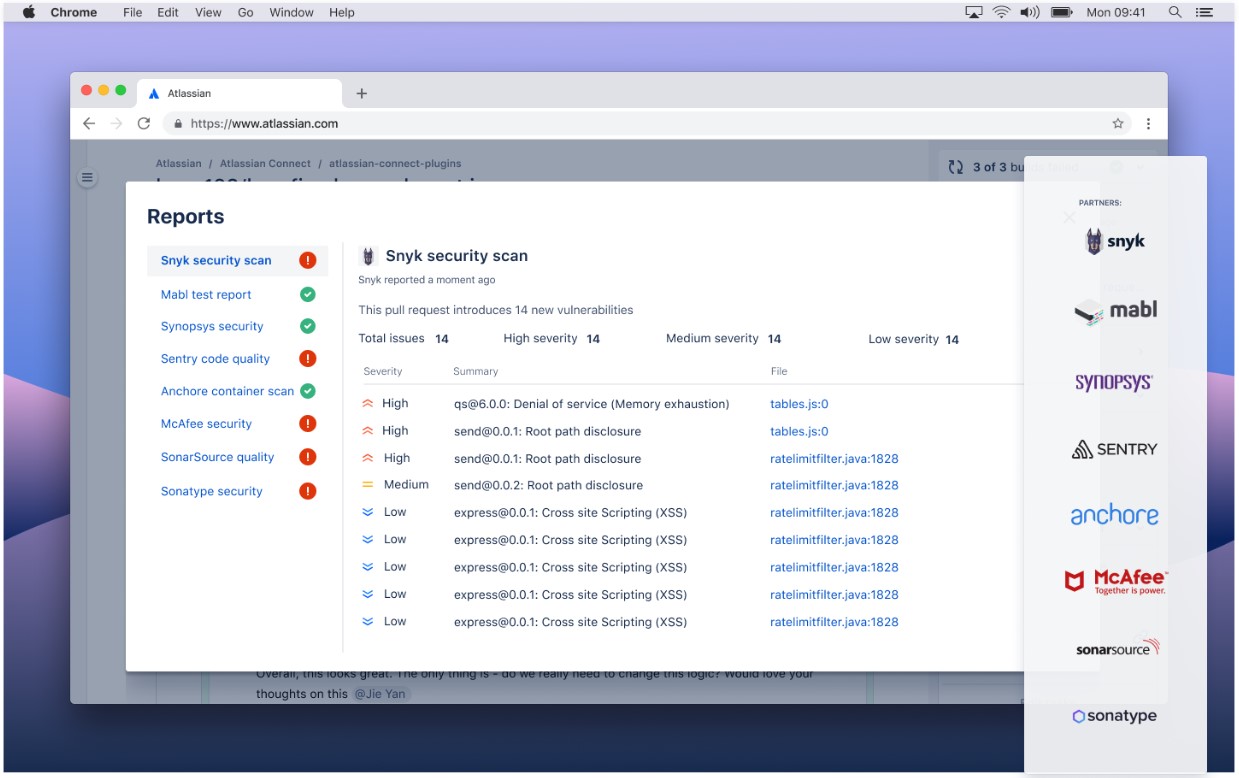
Also new is the “Your Work” dashboard in Bitbucket Cloud, which can now show you all of your assigned Jira issues, as well as Code Insights in Bitbucket Cloud. Code Insights features integrations with Mabl for test automation, Sentry for monitoring and Snyk for finding security vulnerabilities. These integrations were built on top of an open API, so teams can build their own integrations, too.

“There’s a really important trend to shift left. How do we remove the bugs and the security issues earlier in that dev cycle, because it costs more to fix it later,” said To. “You need to move that whole detection process much earlier in the software lifecycle.”

Jira Service Desk Cloud is getting a new Risk Management Engine that can score the risk of changes and auto-approve low-risk ones, as well as a new change management view to streamline the approval process.

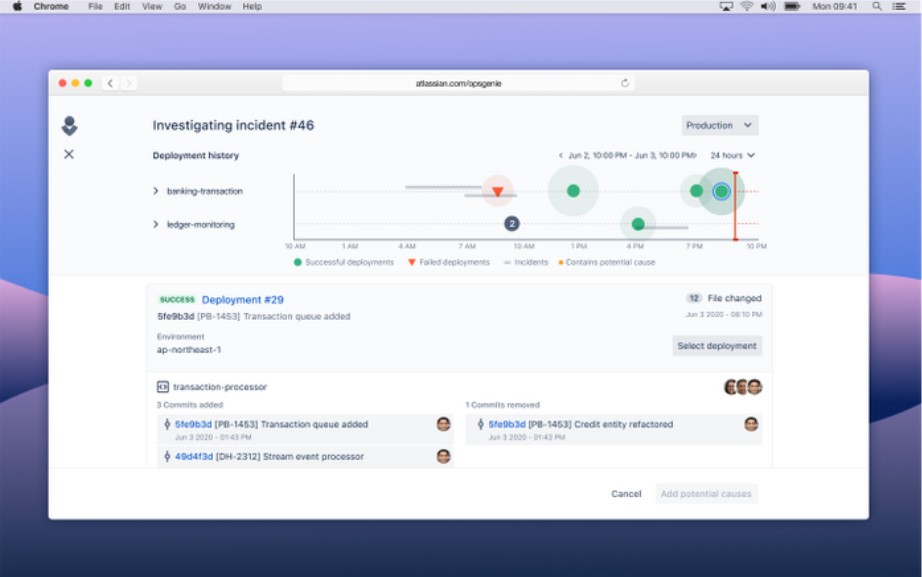
Finally, there is new Opsgenie and Bitbucket Cloud integration that centralizes alerts and promises to filter out the noise, as well as a nice incident investigation dashboard to help teams take a look at the last deployment that happened before the incident occurred.

“The reason why you need all these little features is that as you stitch together a very large number of tools […], there is just lots of these friction points,” said To. “And so there is this balance of, if you bought a single toolchain, all from one vendor, you would have fewer of these friction points, but then you don’t get to choose best of breed. Our mission is to enable you to pick the best tools because it’s not one-size-fits-all.”

Powered by WPeMatico

Decrypted: iOS 13.5 jailbreak, FBI slams Apple, VCs talk cybersecurity

It was a busy week in security.

Newly released documents shown exclusively to TechCrunch show that U.S. immigration authorities used a controversial cell phone snooping technology known as a “stingray” hundreds of times in the past three years. Also, if you haven’t updated your Android phone in a while, now would be a good time to check. That’s because a brand-new security vulnerability was found — and patched. The bug, if exploited, could let a malicious app trick a user into thinking they’re using a legitimate app that can be used to steal passwords.

Here’s more from the week.


THE BIG PICTURE

Every iPhone now has a working jailbreak

Powered by WPeMatico

Is Zoom the next Android or the next BlackBerry?

Gaurav Jain
Contributor

Gaurav Jain is one of the founders of Afore Capital, a $124 million fund focused on pre-seed. He was also an early product manager for Android.

In business, there’s nothing so valuable as having the right product at the right time. Just ask Zoom, the hot cloud-based video conferencing platform experiencing explosive growth thanks to its sudden relevance in the age of sheltering in place.

Having worked at BlackBerry in its heyday in the early 2000s, I see a lot of parallels to what Zoom is going through right now. As Zooming into a video meeting or a classroom is today, so too was pulling out your BlackBerry to fire off an email or check your stocks circa 2002. Like Zoom, the company then known as Research in Motion had the right product for enterprise users that increasingly wanted to do business on the go.

Of course, BlackBerry’s story didn’t have a happy ending.

From 1999 to 2007, BlackBerry seemed totally unstoppable. But then Steve Jobs announced the iPhone, Google launched Android and all of the chinks in the BlackBerry armor started coming undone, one by one. How can Zoom avoid the same fate?

As someone who was at both BlackBerry and Android during their heydays, my biggest takeaway is that product experience trumps everything else. It’s more important than security (an issue Zoom is getting blasted about right now), what CIOs want, your user install base and the larger brand identity.

When the iPhone was released, many people within BlackBerry rightly pointed out that we had a technical leg up on Apple in many areas important to business and enterprise users (not to mention the physical keyboard for quickly cranking out emails)… but how much did that advantage matter in the end? If there is serious market pull, the rest eventually gets figured out… a lesson I learned from my time at BlackBerry that I was lucky enough to be able to immediately apply when I joined Google to work on Android.

Powered by WPeMatico

Salesforce names Vlocity founder David Schmaier CEO of new Salesforce Industries division

When Salesforce announced it was acquiring Vlocity for $1.33 billion in February, it was a deal that made sense for both companies. Today, the company announced that the deal has closed and Vlocity CEO David Schmaier has been named CEO of a new division called Salesforce Industries.

Vlocity has built several industry-specific CRM tools such as media and entertainment, healthcare and government on top of the Salesforce platform. While Salesforce has developed some of its own industry solutions, having a division devoted to verticalized tools creates additional market opportunities for the company.

Schmaier sees the new division as a commitment from the company on the value of an industry-focused approach.

“As Vlocity becomes part of what we’re calling Salesforce Industries, this will be a larger group within Salesforce to really focus on bringing these industry-specific solutions to the customer, helping them go digital and working in a whole new way,” Schmaier told TechCrunch.

Salesforce president and COO Bret Taylor will be Schmaier’s boss. Writing in a blog post announcing the new division, Taylor said that like so many aspects of technology solutions these days, the industry focus is about helping companies with digital transformation. As the world changes before our eyes during the pandemic, companies are being forced to move operations online, and Salesforce wants to provide more specific solutions for customers who need it.

“Companies in every industry have a digital transformation imperative like never before — and many are accelerating their plans for a digital-first, work-from-anywhere environment. With Salesforce Customer 360 and Vlocity, our customers have the most advanced industries platform as well as tools and expert guidance completely tailored to their specific needs,” Taylor wrote.

Schmaier says the fact that his company’s tooling was already built on top of Salesforce allows them to really hit the ground running without the integration challenges that combining organizations typically face after an acquisition like this one.

“I’ve been involved in various mergers and acquisitions over my 30-year career, and this is the most unique one I’ve ever seen because the products are already 100% integrated because we built our six vertical applications on top of the Salesforce platform. So they’re already 100% Salesforce, which is really kind of amazing. So that’s going to make this that much simpler,” he said.

It’s likely that Salesforce will continue to build on the new division and add additional applications over time given the platform is already in place. “We basically have a platform now inside Salesforce to build verticals. So the cost to build new verticals is a fraction of what it was for us to build the first one because of this industry cloud platform. So we are going to look at opportunities to build new ones but we’re not ready to announce that today. For starters, we are forming this one organization,” Schmaier said.

The company reported a record quarter last Thursday, but light guidance for next quarter spooked investors and the stock was down on Friday (it is up .77% today as of publication). The company does not rest on its laurels though, and having a division in place like Salesforce Industries provides a more focused way of dealing with verticals and another possible source of revenue.

Powered by WPeMatico

Sony postpones PlayStation 5 event, in order for ‘more important voices to be heard’

Sony’s planned June 4 PS5 event has been postponed indefinitely, as the U.S. grapples with widespread protests over the death of George Floyd. It’s understandably a difficult time to focus on video game launches, amid national and global unrest. 

pic.twitter.com/ZAY8StN0EU

— PlayStation (@PlayStation) June 1, 2020

The company noted via Twitter, “While we understand gamers worldwide are excited to see PS5 games, we do not feel that right now is a time to celebrate and for now, we want to stand back and allow more important voices to be heard.”

The event was set to unveil new titles for Sony’s next-gen console due out at the end of the year. It follows a recent similar event from Microsoft, as companies readjust their schedules in the wake of COVID-19-related cancellations of big gaming conferences like E3. Sony’s call to “stand back” follows similar comments from other tech giants, though so far the company has done so without specifically citing Floyd’s death at the hands of Minneapolis police or the subsequent protests.

The decision is — perhaps unsurprisingly — being met with mixed reactions from gamers. The complaints range from notes that gaming is a form of escapism from reality to…well, far more problematic suggestions from people upset about having to wait just a little longer before seeing some gaming trailers. As much as it may disappoint some people to say, however, there are, indeed, more important things than video games.

Powered by WPeMatico

India’s richest man built a telecom operator everyone wants a piece of

As investors’ appetites sour in the midst of a pandemic, a three-and-a-half-year-old Indian firm has secured $10.3 billion in a month from Facebook and four U.S.-headquartered private equity firms.

The major deals for Reliance Jio Platforms have sparked a sudden interest among analysts, executives and readers at a time when many are skeptical of similar big check sizes that some investors wrote to several young startups, many of which are today struggling to make sense of their finances.

Prominent investors across the globe, including in India, have in recent weeks cautioned startups that they should be prepared for the “worst time” as new checks become elusive.

Elsewhere in India, the world’s second-largest internet market and where all startups together raised a record $14.5 billion last year, firms are witnessing down rounds (where their valuations are slashed). Miten Sampat, an angel investor, said last week that startups should expect a 40%-50% haircut in their valuations if they do get an investment offer.

Facebook’s $5.7 billion investment valued the company at $57 billion. But U.S. private equity firms Silver Lake, Vista, General Atlantic, and KKR — all the other deals announced in the past five weeks — are paying a 12.5% premium for their stake in Jio Platforms, valuing it at $65 billion.

How did an Indian firm become so valuable? What exactly does it do? Is it just as unprofitable as Uber? What does its future look like? Why is it raising so much money? And why is it making so many announcements instead of one.

It’s a long story.

Run up to the launch of Jio

Billionaire Mukesh Ambani gave a rundown of his gigantic Indian empire at a gathering in December 2015 packed with 35,000 people including hundreds of Bollywood celebrities and industry titans.

“Reliance Industries has the second-largest polyester business in the world. We produce one and a half million tons of polyester for fabrics a year, which is enough to give every Indian 5 meters of fabric every year, year-on-year,” said Ambani, who is Asia’s richest man.

Powered by WPeMatico

Android update delivers new ‘Bedtime’ features focused on improving sleep

At Google’s 2018 I/O developer conference, the company debuted a new suite of “digital well-being” aimed at helping Android users better manage their screen time. At its 2019 event, it expanded its tools’ capabilities and improved the related parental controls. Although Google I/O isn’t taking place this year due to the COVID-19 pandemic, the company is once again refreshing its well-being toolset. This year, the focus is a timely one, as Google will roll out new bedtime tools to help people get better sleep.

Google reports seeing a rise in sleep-related search queries like “insomnia” and “can’t sleep” in April and May, as the coronavirus crisis led to increased stress and anxiety, which can disrupt sleep.

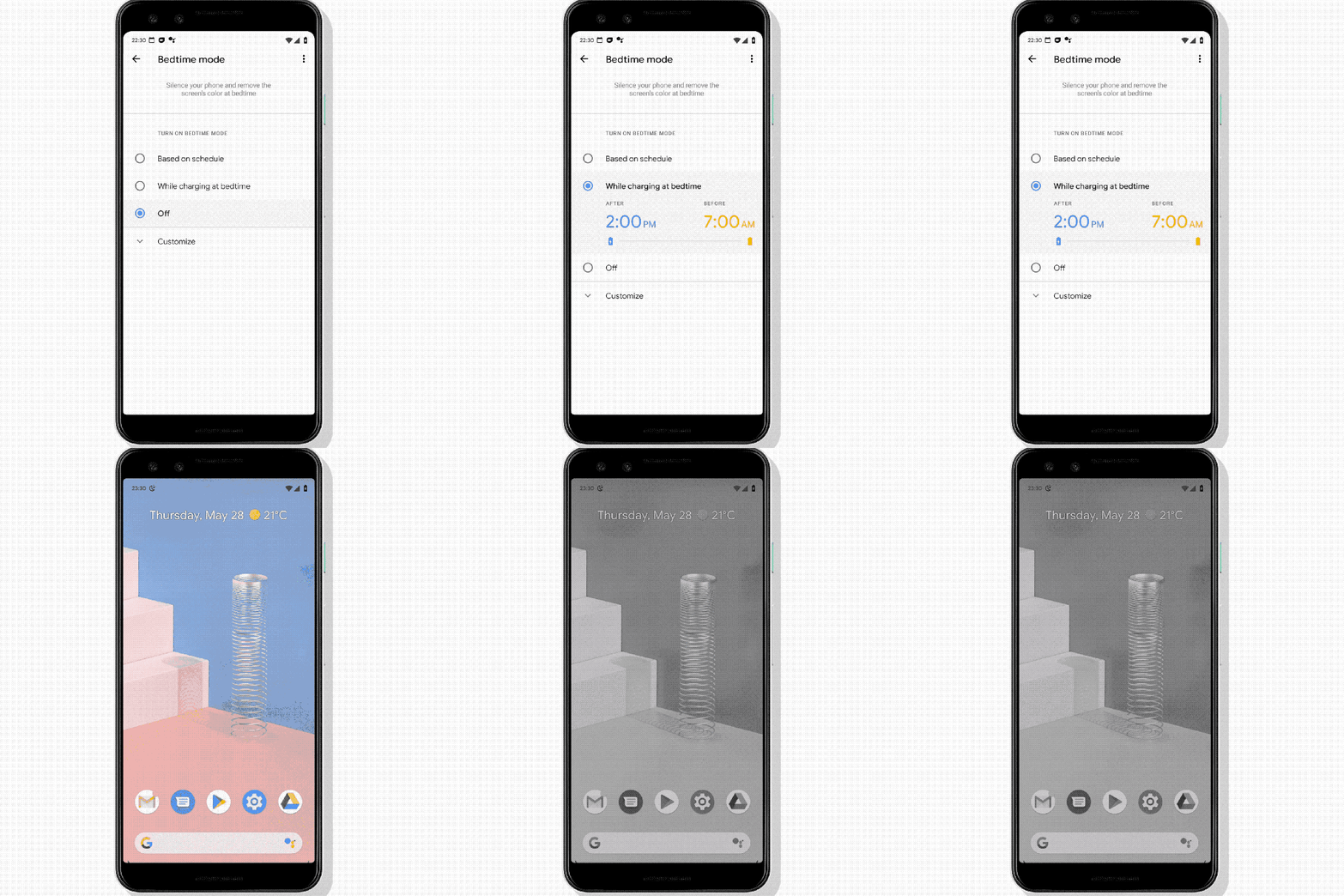
Android’s “Bedtime” mode, previously known as “Wind Down,” uses Do Not Disturb to silence calls, texts and notifications, while grayscale fades the colors on your phone to black and white, to reduce the draw to your screen. With the updates to this feature, Google is making it easier to customize when and how Bedtime mode is enabled.

Based on your bedtime schedule, you can now opt to have it automatically turn on after your phone is plugged into its charger. You can also add Bedtime mode to your Android phone’s Quick Settings, to instantly turn it on or off with a single tap. And if you need a few more minutes, you can choose to pause Bedtime mode without needing to adjust your schedule.

The update to Digital Wellbeing, which included the ability to automatically enable Bedtime mode when the phone is charging and add it to Quick Settings, actually rolled out earlier in May. But Google is announcing the features today as part of its other Bedtime mode changes.

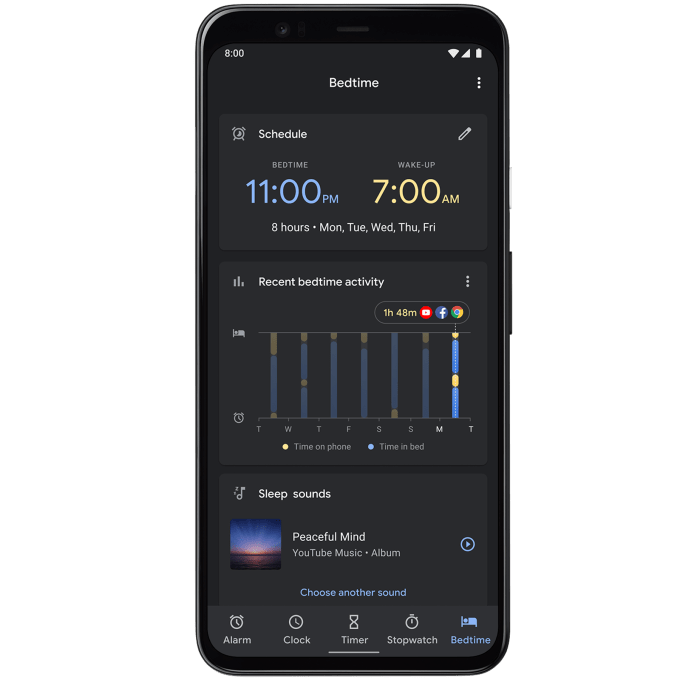
The Clock app on Android is also being updated with a new Bedtime tab.

Here, you can set daily sleep and wake times. In the app, you’ll be able to see a preview of your calendar for the next day, and then tally the total number of hours of sleep you’d get. This way, you can adjust your bedtime if needed to sync up with tomorrow’s schedule — even if that means diverting from your typical bedtime schedule.

In addition, users will receive a reminder before bedtime and have the option to play calming sounds from Calm, Spotify, YouTube Music and other sources. If they have Digital Wellbeing installed, they can pair with Bedtime mode to limit the interruptions during sleep.

The app will also display how much time you’re spending and which apps you’ve used after your set bedtime.

Google additionally suggested users looking for better sleep can try the “Sunrise Alarm” option that gradually brightens your screen to help you wake up more gently. This visual alarm system will begin 15 minutes prior to your audio alarm. Users can also set their favorite songs as an alarm to make the alarm less jarring, Google recommends.

The sunrise alarm was first introduced with the Pixel 3 and Pixel Stand in 2018. But with the update, you will no longer need the stand to use the feature — it’s a part of the new Bedtime tab in the Clock app.

Related to today’s launch of new bedtime features, Google noted it recently added new YouTube bedtime reminders. It also supports a daily bedtime schedule in Android’s parental controls feature, Family Link.

The updated Bedtime experience is launching first on Pixel devices starting today, and will roll out to the Clock app and on other Android devices later this summer. Pixel devices will be getting a handful of other updates, as well, including Adaptive Battery.

Pixel 2 devices and newer will notify the user when the battery is set to run out, while throttling background usage to save on life. The excellent Recorder app can now be triggered with a “Hey Google” and transcripts can be saved directly to Google Docs.

The Personal Safety app introduced on the Pixel 4 is now coming to all devices, while the Pixel 3 will get car crash detection. There’s also a new Safety Check feature designed to send out alerts in potentially dangerous situations. Per Google:

For example if you’re about to go on a run or hike alone, safety check will make sure you made it back safely. If you don’t respond to the scheduled check-in, the app will alert your emergency contacts. In the event that you need immediate help or are in a dangerous situation, emergency sharing notifies all of your emergency contacts and shares your real-time location through Google Maps so they can send help or find you.

The Personal Safety app will also let users set notifications for crises, including natural disasters and other public safety concerns.

Powered by WPeMatico

Equinix is buying 13 data centers from Bell Canada for $750M

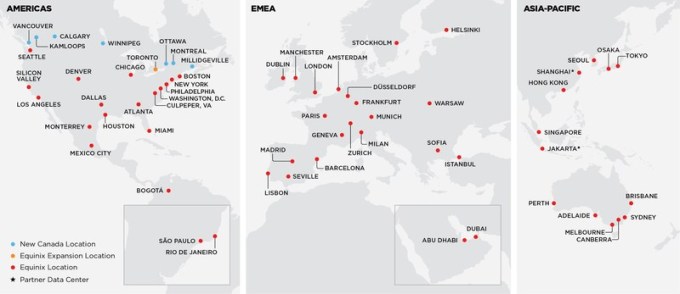
Equinix, the data center company, has the distinction of recently recording its 69th straight positive quarter. One way that it has achieved that kind of revenue consistency is through strategic acquisitions. Today, the company announced that it’s purchasing 13 data centers from Bell Canada for $750 million, greatly expanding its footing in the country.

The deal is financially detailed by Equinix across two axes, including how much the data centers cost in terms of revenue, and adjusted profit. Regarding revenue, Equinix notes that it is paying $750 million for what it estimates to be $105 million in “annualized revenue,” calculated using the most recent quarter’s results multiplied by four. This gives the purchase a revenue multiple of a little over 7x.

Equinix also provided an adjusted profit multiple, saying that the 13 data center locations “[represent] a purchase multiple of approximately 15x EV / adjusted EBITDA.” Unpacking that, the company is saying that the asset’s enterprise value (similar to market capitalization, a popular valuation metric for public companies) is worth about 15 times its earnings before interest, taxes, deprecation and amortization (EBITDA). This seems a healthy price, but not one that is outrageous.

Global reach of Equinix including expanded Canadian operations shown in left panel (Image: Equinix)

The acquisition not only gives the company that additional revenue and a stronger foothold in the tenth largest economy in the world, it also gains 600 customers using the Bell data centers, of which 500 are net new.

As much of the world is attempting to digitally transform in the midst of the pandemic and current economic crisis, Equinix sees this as an opportunity to help more Canadian customers go digital more quickly.

“Equinix has been serving the Canadian market in Toronto for more than a decade. This expansion and scale gives the Canadian market a clear and rapid migration path to digital transformation. We’re looking forward to deepening our relationships with our existing Canada-based customers and helping new companies throughout the country position themselves for digital success,” Jon Lin, Equinix president, Americas told TechCrunch.

This is not the first time that Equinix has taken a bunch of data centers off the hands of a telco. In fact, three years ago, the company bought 29 centers from Verizon (which is the owner of TechCrunch) for $3.6 billion.

As telcos move away from the data center business, companies like Equinix are able to come in and expand into new markets and increase revenue. It’s one of the ways it continues to generate positive revenue year after year.

Today’s deal is just part of that strategy to keep expanding into new markets and finding new ways to generate additional revenue as more companies use their services. Equinix rents space in its data centers and provides all the services that companies need without having to run their own. That would include things like heating, cooling, racks and wiring.

Even though public cloud companies like Amazon, Microsoft and Google are generating headlines with growing revenues, plenty of companies still want to run their own equipment without going to the expense of actually owning the building where the equipment resides.

Today’s deal is expected to close in the second half of the year, assuming it clears all of the regulatory scrutiny required in a purchase like this.

Powered by WPeMatico

Zynga acquires Turkey’s Peak Games for $1.8B, after buying its card games studio for $100M in 2017

Today, some news of a huge acquisition out of Turkey that represents the first billion-dollar-plus exit for a startup out of the country. Social gaming company Zynga confirmed that it is buying Istanbul-based Peak Games, the company behind popular Candy-Crush-style mobile gaming apps Toon Blast and Toy Blast, for $1.8 billion — $900 million in cash, and $900 million in Zynga shares.

Interestingly, this is the second time that Zynga has made a Peak Games acquisition. In 2017, it purchased the company’s mobile card games business for $100 million (more on that below).

The news caps off a short period of speculation about an upcoming deal, with local tech publications like Webrazzi calling the sale (and correct price) last month.

Peak’s investors had included European VCs Earlybird and Hummingbird Ventures — both active backers of startups in emerging markets in the region — and Endeavor Global (the nonprofit that invests via its Endeavor Catalyst fund). Sidar Sahin, the founder and CEO, had been the company’s biggest shareholder.

As with all M&A in the world of gaming, Zynga is getting a couple of big gains out of this sale.

The first is picking up two very popular titles/franchises that it doesn’t have do develop from scratch (in hopes of investing R&D budget in what it hopes but can’t guarantee will be a hit). Toon Blast and Toy Blast together total more than 12 million DAUs. And on top of that, those two games are some of the highest-grossing among all in Apple’s App Store, ranking among the top-10 and top-20 games in the past two years, Zynga noted in its announcement.

It’s not just about adding popular games content, but expanding Zynga’s advertising business as well. Significantly, Peak Games’ primary users are outside of Zynga’s home market of the US, representing a real growth opportunity for the company to cross-sell other games. Zynga says that bolting on Peak’s games network to its own will boost its number of mobile daily active users by 60%, which mean a lot of scaling up for its ad network.

Of course, sustaining both of those titles and their respective franchises as hits for the long run is not a given — the world of gaming regularly sees blockbusters fizzle out when the next big thing comes along — although these “forever franchises” with their steady popularity have a strong play to be exactly that.

However, the long play is also where the third big asset comes in: talent. Peak has 100 employees working on its current franchises and other games. So while the back ends (and revenues) may be getting combined, Zynga says Peak’s people will stay put and continue to work under the Peak brand on the existing franchises as well as on new projects that are already in development.

Zynga says the deal will close in the third quarter of 2020, and it’s updated its guidance already on the news, sending its stock up more than 5% in pre-market trading. Specifically, Zynga today said it believes the deal will bump up revenues by $40 million for the year, to $1.840 billion.

A startup so nice, Zynga bought it twice

The deal is notable not just because of what it’s adding to Zynga today, but because it highlights some interesting history between the two companies.

Back in November 2017, Zynga acquired one division of Peak Games, its mobile card games studio, for $100 million in cash.

The deal included games like Spades Plus and Gin Rummy Plus, respectively the largest spade and rummy mobile games in the world at the time; and games that were popular in Peak’s home market, 101 Okey Plus and Okey Plus. And according to analysis from Apptopia, it looks like Zynga was set to recoup the money it paid out by 2019, meaning that business is now profitable.

The remainder of Peak Games is another story. If Zynga tried to buy the whole business two years ago, it might have been that Peak was reluctant to sell its remaining two titles — its own Candy Crush crushers — Toon Blast and Toy Blast for anything near $100 million. And with good reason, since (as Zynga itself pointed out) they went on to become some of the consistently highest-grossing games in all of the App Store.

In the intervening period, Zynga tried to create its own rivals, namely Wonka’s World of Candy, but it’s never been as big of a hit as the others. (Apptopia’s Adam Blacker today told me, after I published this piece, that in fact Wonka’s World has made but a tiny fraction of the revenue of Peak’s titles.)

Hence, two years on, Zynga possibly finally found the “right price” for the whole of Peak Games.

“We are honored to welcome Sidar and team to Zynga. Peak is one of the world’s best puzzle game makers and we could not be more excited to add such creative and passionate talent to our company,” said Frank Gibeau, Chief Executive Officer of Zynga, in a statement. “With the addition of Toon Blast and Toy Blast, we are expanding our live services portfolio to eight forever franchises, meaningfully increasing our global audience base and adding to our exciting new game pipeline. As a combined team, we are well positioned to grow faster together.”

“This is a monumental partnership not only for Zynga and Peak, but for the whole mobile gaming industry,” said Sidar Sahin, founder and Chief Executive Officer of Peak, in a statement. “Both companies share a common vision — to bring people together through games. Peak’s culture is rooted in relentless learning and progress, so as we embark on this new chapter in our journey together with Zynga, we remain as committed as ever to our unique culture. We’re very excited for our combined future and what we will accomplish together.”

Zynga and games business strategies aside, this is also a huge deal for Turkey’s tech ecosystem.

Turkey has been a steady presence straddling both the European and MENA markets (much as Turkey’s wider economy and political presence does), but so far with little impact in terms of exits and activity that extend outside of the region.

This acquisition is a testament to the exciting companies and talent that are being developed in the market, and is of course yet another sign of how big tech companies based out of more established centres like the Bay Area will continue to take bigger leaps to tap talent ever further afield, in their ongoing consolidation push and search for both business and audience growth.

One impact of the COVID-19 pandemic has been that many are starting to see a much faster decentralisation in the world of technology. People are working remotely, and some are even planning to move away from tech hubs; and deals are getting done not in person but over videoconferencing links. This acquisition also demonstrates how that is also playing out in the world of M&A, too.

Powered by WPeMatico

Bonusly, the platform for employee recognition, raises $9 million Series A

Bonusly, a platform that involves the entire organization in recognizing employees and rewarding them, closed on a $9 million Series A financing round led by Access Venture Partners. Next Frontier Capital, Operator Partners and existing investor FirstMark Capital also participated in the round.

Bonusly launched in 2013 when co-founder and CEO Raphael Crawford-Marks saw the opportunity to reinvent the way employers and colleagues recognize and reward their employees/coworkers.

“I knew that, in order to be successful, companies would be shifting their approach to employee experience and I thought software could enable that shift,” said Crawford-Marks. “Bonusly was this elegant idea of empowering employees to give each other timely, frequent and meaningful recognition that would not only benefit employees because they would feel recognized but also surface previously hidden information to the entire company about who was working with whom and on what and what strengths they were bringing to the workplace.”

Most employers use year-end bonuses and performance reviews to motivate workers, with some employers providing some physical rewards.

Bonusly thinks recognition should happen year-round. The platform works with the employers on their overall budget for recognition and rewards, and breaks that down into “points” that are allotted to all employees at the organization.

These employees can give out points to other co-workers, whether they’re direct reports or managers or peers, at any time throughout the year. Those points translate to a monetary value that can be redeemed by the employee at any time, whether it’s through PayPal as a cash reward or with one of Bonusly’s vendor partners, including Amazon, Tango Card and Cadooz. Bonusly also partners with nonprofit organizations to let employees redeem their points via charitable donation.

In fact, Crawford-Marks noted that Bonusly users just crossed the $500,000 mark for total donations, and have donated more than $100,000 to the WHO in six weeks.

Bonusly integrates with several collaboration platforms, including Gmail and Slack, to give users the flexibility to give points in whatever venue they choose. Bonusly also has a feed, not unlike social media sites like Twitter, that shows in real time employees who have received recognition.

The company has also built in some technical features to help with usability. For example, Bonusly understands the social organization of a company, surfacing the most relevant folks in the point feed based on who employees have given or received points to/from in the past. In a company with tens of thousands of employees, this keeps Bonusly relevant.

Bonusly has also incorporated tools for employers, including an auto-scale button for employers with workers in multiple jurisdictions or companies. The button allows employers to scale up or down the point allotments in different geographies based on cost of living.

There are also privacy controls on Bonusly that allow high-level employees and leadership to give each other recognition for projects that may not be widely known about at the company yet, like say for an acquisition that was completed.

Bonusly says that peer-to-peer recognition is more powerful than manager-only recognition, saying it’s nearly 36% more likely to have better financial outcomes.

The company also cites research that says that a happy workforce raises business productivity by more than 30%.

Bonusly competes with Kazoo and Motivocity, and Crawford-Marks says that the biggest differentiation factor is participation.

“We set a very high bar for how we measure participation and engagement in the platform,” he said. “You’ll see other companies claiming really high participation rates, but typically if you dig into that they’re talking about getting recognition every six months or every year or just logging in, rather than giving recognition every single month, month over month.”

He noted that 75% of employees on average give recognition in the first month of deployment with an organization, and that number gradually increases over time. By the two-year mark, 80% of employees are giving recognition every month.

Bonusly has raised a total of nearly $14 million in funding since inception.

Powered by WPeMatico