1010Computers | Computer Repair & IT Support

RiskIQ adds National Grid Partners as securing data becomes a strategic priority for utilities

RiskIQ, a startup providing application security, risk assessment and vulnerability management services, has added National Grid Partners as a strategic investor. 

The funding from the investment arm of National Grid, a multinational energy provider, is part of a $15 million new round of financing designed to take the company’s technology into critical industrial infrastructure — with National Grid as a point of entry.

More than 6,000 companies use the company’s services, and the roster list and technology on offer has attracted some of the biggest names in investing, including Summit Partners, Battery Ventures, Georgian Partners and MassMutual Ventures.

“We view NGP’s show of support as an incredible opportunity to help customers in new markets thrive as their attack surfaces expand outside the firewall, especially now amid the COVID-19 pandemic,” RiskIQ chief executive Lou Manousos said in a statement. 

RiskIQ has spent the past 10 years spidering the internet looking for all of the exploits that hackers use to penetrate networks and have built that into a database of threats. This inventory gives the company an ability to identify which assets within a company present the most obvious threats. Its automated services constantly scan third-party code, internet-connected devices and mobile applications for potential vulnerabilities, the company said.

As a staple platform in their core security environment, our cyber threat analysts use RiskIQ regularly to enrich and identify incoming threats,” said Lisa Lambert, president of National Grid Partners and chief technology and innovation officer of National Grid, in a statement.

National Grid’s investment is a piece of a deeper partnership that will see NGP providing strategic advice for the security company as it looks to expand its commercial operations among industrial and utility customers.


Powered by WPeMatico

Paperwork automation platform Anvil raises $5 million from Google’s Gradient Ventures

Remote work has changed the tools offices need for communicating asynchronously across meetings and chat, but not all collaboration takes place in neat little chat bubbles.

Anvil is a San Francisco startup that’s aiming to transform how businesses collaborate around the humble PDF. Anvil’s automation platform levels up Google Forms and allows customers to digitize tiresome PDFs through dynamic forms that unify processes customers might have typically needed to use several pieces of software to access previously. Users can leverage the platform to create, share, fill in, sign and download completed docs without picking up a pen.

Anvil announced today that it had raised $5 million in a seed funding round led by Google’s Gradient Ventures .

The startup is competing directly with rivals like DocuSign, a product that Anvil CEO Mang-Git Ng believes is “great for completing and executing a document,” but is “lacking when it comes to actually creating the document.” Anvil integrates directly with DocuSign for customers that have already integrated the service into their workflows, but Anvil is also replicating some of the service’s functionality as they look to build out an end-to-end solution for document automation.

Anvil is focusing early efforts on courting customers in the wealth and banking space. On the pricing side, they have both per-project and subscription plans, which start at $99 per month.

Anvil’s team

The startup recently tested their own abilities to get up-and-running quickly as they partnered with a bank to create an online portal for filling out applications for the Paycheck Protection Program (PPP). Ng says the startup helped Sunrise Bank customers apply for $127 million worth of PPP loans. “It was a whirlwind experience for us. We pretty much went from first conversation to deploying with them in six days,” Ng told TechCrunch.

As the COVID-19 pandemic has accelerated the digitization of paper processes, Ng says that the company has seen a bump in interest as more companies have gone remote and discovered new needs around making paperwork more collaborative and more digital-friendly, especially when it comes to areas like onboarding, compliance and internal applications.

“The overall trend that we’ve been seeing is that people in these industries are thinking about going more digital, but generally speaking, the people who are at the forefront of that tend to be in larger organizations where squeezing a little bit more operational efficiency will save a ton of money,” Ng says. “But as we’ve gone into lockdown, everybody has to figure out how to do things remotely and the solutions that help people do things remotely are definitely pushing to the forefront.”

Citi Ventures, Menlo Ventures, Financial Venture Studio and 122 West also participated in Anvil’s seed round.

Powered by WPeMatico

A COVID-19 resilience test for B2B companies

TX Zhuo
Contributor

TX Zhuo is the managing partner of Fika Ventures, focusing on fintech, enterprise software and marketplace opportunities.

Colton Pace
Contributor

Colton Pace is an investor at Fika Ventures. He previously held roles investing at Vulcan Capital and Madrona Venture Labs.

COVID-19 has transformed the global business landscape.

So much so that in a matter of weeks after the onset of the pandemic in the United States, Congress provided more than $1.1 trillion in fiscal stimulus directly to businesses and distressed industries — four times more than was distributed during the 2008-09 financial crisis.

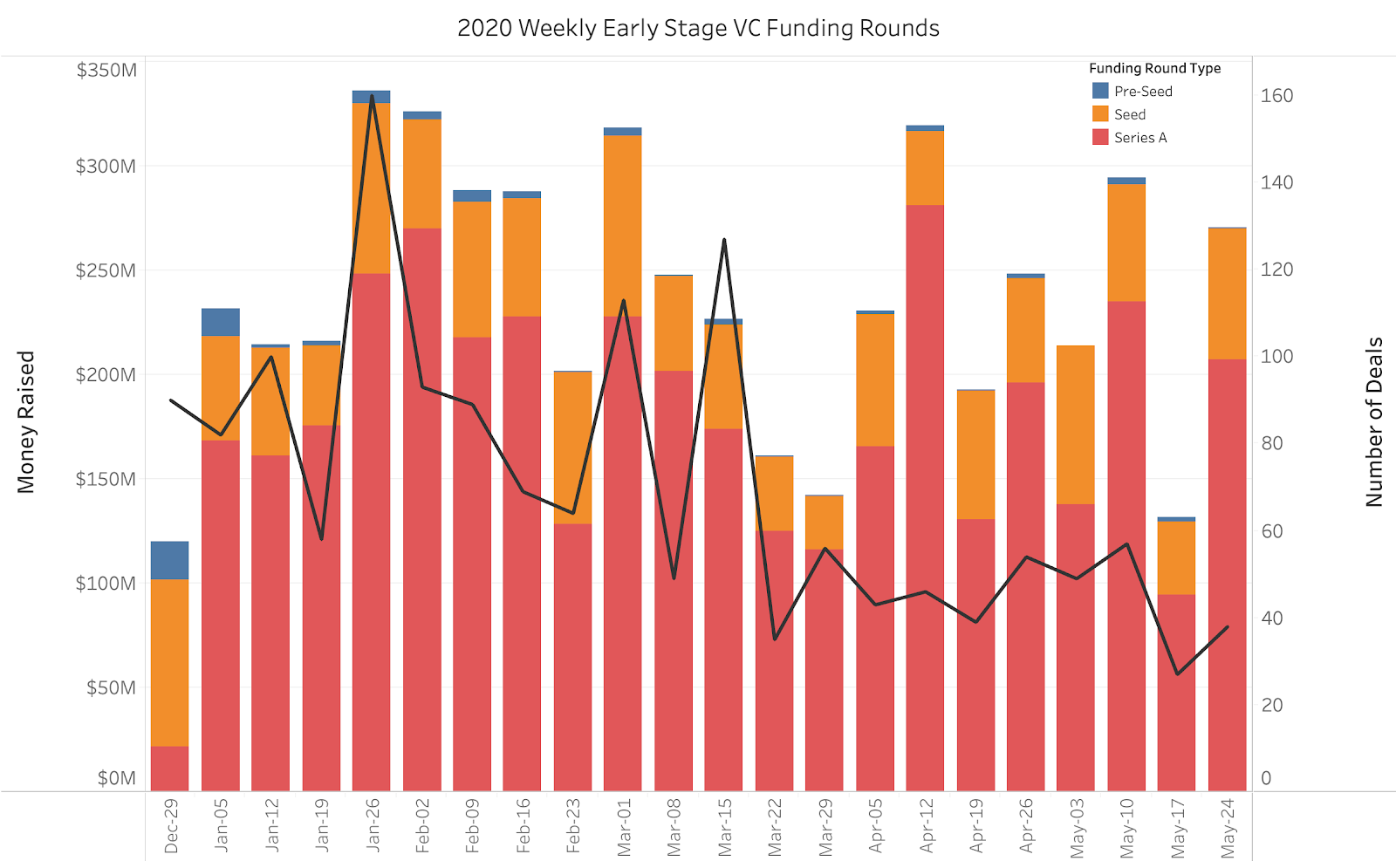
It came as no surprise when, at the start of COVID-19, venture capital investors largely went pencils-down for several weeks and shifted their focus to their existing portfolio companies. Extending company runways, preparing for longer funding cycles and managing operations in a novel business environment became the crux of company resilience. Now, moving into May, we can see this shift reflected in both the decline in number of early-stage companies funded and total capital invested.

As investors begin acclimating to this new normal, they have begun wading into new opportunities in time-proven, healthy industries and new emerging industries that are positioned to succeed during the pandemic. While we are seeing lower valuations, we believe certain B2B technology companies may be uniquely poised to thrive, and are pursuing investment opportunities in this space with a renewed focus.

Image Credits: Crunchbase Data via Tableau Public

*Excluding Biotech & Pharmaceuticals (Source: Crunchbase Data via Tableau Public)

Prior to COVID-19, early-stage B2B investors wanted to see strong growth and healthy unit economics; 3X year-over-year sales growth or 10% monthly growth was the gold standard. An LTV-to-CAC ratio over 3X signified a healthy payback cycle. There was less focus on capital efficiency; for every $1 million invested, investors were happy with $500,000 in generated revenues. Get to these numbers and your next funding round was guaranteed — but no longer.

During COVID, and likely beyond, company expectations and goalposts have been adjusted; 2X year-over-year growth may be the new 3X. While growth and unit economics are important, there are now new health indicators that will determine if a B2B company will thrive in a post-COVID world. With that in mind, we have put together a COVID reslience test that startups can use as a north star to grow their business in this new world.

This COVID-19 test is meant to be a gated checklist that will indicate where efforts should be focused, whether it be sales, product or finance. Before we leave you to your own devices, we wanted to walk through a couple of these new post-COVID questions that you should try to answer (and why they are relevant).

Powered by WPeMatico

NetApp to acquire Spot (formerly Spotinst) to gain cloud infrastructure management tools

When Spotinst rebranded to Spot in March, it seemed big changes were afoot for the startup, which originally helped companies find and manage cheap infrastructure known as spot instances (hence its original name). We had no idea how big at the time. Today, NetApp announced plans to acquire the startup.

The companies did not share the price, but Israeli publication CTECH pegged the deal at $450 million. NetApp would not confirm that price.

It may seem like a strange pairing, a storage company and a startup that helps companies find bargain infrastructure and monitor cloud costs, but NetApp sees the acquisition as a way for its customers to bridge storage and infrastructure requirements.

“The combination of NetApp’s leading shared storage platform for block, file and object and Spot’s compute platform will deliver a leading solution for the continuous optimization of cost for all workloads, both cloud native and legacy,” Anthony Lye, senior vice president and general manager for public cloud services at NetApp said in a statement.

Holger Mueller, an analyst with Constellation Research says the deal makes sense on that level, but it depends on how well NetApp incorporates the Spot technology into its stack. “At the end of the day to run next generation applications successfully in the cloud you need to be efficient on compute and storage usage. NetApp is doing great on the latter but needed way to monitor and automate compute consultation. This is what Spot brings to the table, so the combination makes sense, but as in all acquisitions execution is key now,” Mueller told TechCrunch.

Spot helps companies do a couple of things. First of all it manages spot and reserved instances for customers in the cloud. Spot instances in particular, are extremely cheap because they represent unused capacity at the cloud provider. The catch is that the vendor can take the resources back when they need them, and Spot helps safely move workloads around these requirements.

Reserved instances are cloud infrastructure you buy in advance for a discounted price. The cloud vendor gives a break on pricing, knowing that it can count on the customer to use a certain amount of infrastructure resources.

At the time it rebranded, the company also had gotten into monitoring cloud spending and usage across clouds. Amiram Shachar, co-founder and CEO at Spot, told TechCrunch in March, “With this new product we’re providing a more holistic platform that lets customers see all of their cloud spending in one place — all of their usage, all of their costs, what they are spending and doing across multiple clouds — and then what they can actually do [to deploy resources more efficiently],” he said at the time.

Shachar writing in a blog post today announcing the deal indicated the company will continue to support its products as part of the NetApp family, and as startup CEOs typically say at a time like this, move much faster as part of a large organization.

“Spot will continue to offer and fully support our products, both now and as part of NetApp when the transaction closes. In fact, joining forces with NetApp will bring additional resources to Spot that you’ll see in our ability to deliver our roadmap and new innovation even faster and more broadly,” he wrote in the post.

NetApp has been quite acquisitive this year. It acquired Talon Storage in early March and CloudJumper at the end of April. This represents the twentieth acquisition overall for the company, according to Crunchbase data.

Spot was founded in 2015 in Tel Aviv. It has raised over $52 million, according to Crunchbase data. The deal is expected to close later this year, assuming it passes typical regulatory hurdles.

Powered by WPeMatico

Daily Crunch: Zoom reports spectacular growth

Zoom’s latest earnings report was even better than expected, SoftBank announces a new fund to invest in founders of color and Google pulls a trending app that targets apps from China.

Here’s your Daily Crunch for June 3, 2020.

1. Remote work helps Zoom grow 169% in one year, posting $328.2M in Q1 revenue

Zoom’s customer numbers were similarly sharp, with the firm reporting that it had 265,400 customers with more than 10 seats (employees) at the end of the quarter, which was up 354% from the year-ago period.

Not all of the news coming out of its latest earnings report was positive, however. CEO Eric Yuan confirmed that a plan to implement end-to-end encryption does not in fact extend to non-paying users.

2. SoftBank launches $100M+ Opportunity Growth Fund to invest in founders of color

The Opportunity Growth Fund “will only invest in companies led by founders and entrepreneurs of color,” according to an internal memo from SoftBank’s COO Marcelo Claure, who said the fund will initially start with $100 million — meaning there is room for SoftBank or other limited partners to add more over time.

3. Google pulls ‘Remove China Apps’ from Play Store

The top trending app in India, which was downloaded more than 5 million times since late May and enabled users to detect and easily delete apps developed by Chinese firms, was pulled from Android’s marquee app store for violating Google Play Store’s Deceptive Behavior Policy.

4. Facebook and PayPal invest in Southeast Asian ride-hailing giant Gojek

Facebook and PayPal are joining Google and Tencent as high-profile tech firms that have backed the five-year-old Southeast Asian ride-hailing startup, which also offers food delivery and mobile payments.

5. The fundraising marketplace has stabilized. Or has it?

DocSend CEO Russ Heddleston said the last two weeks could be establishing a new normal for fundraising this year. Even though most VCs aren’t taking in-person meetings, they were more active in the past month than they were in May of both 2019 and 2018. (Extra Crunch membership required.)

6. Venture firms rush to find ways to support Black founders and investors

Firms like Benchmark, Sequoia, Bessemer, Eniac Ventures, Work-Bench and SaaSTR Fund founder Jason Lemkin all tweeted in support of the cause and offered to take steps to improve the lack of representation in their industry. But some Black entrepreneurs and investors are questioning the firms’ motivations.

7. Lili raises $10M for its freelancer banking app

CEO Lilac Bar David suggested that no traditional banking solutions are really designed to solve the problems faced by freelancers — whether they’re designers, programmers, fitness instructors, chefs or beauty professionals. She described Lili as the first “all-in-one” solution, offering both a bank account and a broader suite of financial tracking tools.

The Daily Crunch is TechCrunch’s roundup of our biggest and most important stories. If you’d like to get this delivered to your inbox every day at around 9am Pacific, you can subscribe here.

Powered by WPeMatico

Watchful is a mobile product intelligence startup that surfaces unreleased features

Meet Watchful, a Tel Aviv-based startup coming out of stealth that wants to help you learn more about what your competitors are doing when it comes to mobile app development. The company tries to identify features that are being tested before getting rolled out to everyone, giving you an advantage if you’re competing with those apps.

Mobile app development has become a complex task, especially for the biggest consumer apps, from social to e-commerce. Usually, mobile development teams work on a new feature and try it out on a small subset of users. That process is called A/B testing as you separate your customers in two buckets — bucket A or bucket B.

For instance, Twitter is trying out its own version of Stories called Fleets. The company first rolled it out in Brazil to track the reaction and get some data from its user base. If you live anywhere else in the world, you’re not going to see that feature.

There are other ways to select a group of users to try out a new feature — you could even take part in a test because you’ve been randomly picked.

“When you open the app, you’ll probably see a different version from the app I see. You’re in a different region, you have a different device,” co-founder and CEO Itay Kahana told me. He previously founded popular to-do app Any.do.

For product designers, it has become a nightmare as you can’t simply open an app and look at what your competitors are doing. At any point in time, there are as many different versions of the same app as there are multiple A/B tests going on at the same time.

Watchful lets you learn from the competition by analyzing all those different versions and annotating changes in user flows, flagging unreleased features and uncovering design changes.

It is different from other mobile intelligence startups, such as App Annie or Sensor Tower. Those services mostly let you track downloads and rankings on the App Store and Play store to uncover products that are doing well.

“We’re focused on everything that is open and visible to the users,” Kahana said.

Like other intelligence startups, Watchful needs data. App Annie acquired a VPN app called Distimo and a data usage monitoring app called Mobidia. When you activate those apps, App Annie captures data about your phone usage, such as the number of times you open an app and how much time you spend in those apps.

According to a BuzzFeed News report, Sensor Tower has operated at least 20 apps on iOS and Android to capture data, such as Free and Unlimited VPN, Luna VPN, Mobile Data and Adblock Focus. Some of those apps have been removed from the stores following BuzzFeed’s story.

I asked a lot of questions about Watchful’s source of data. “It’s all real users that give us access to this information. It’s all running on real devices, real users. We extract videos and screenshots from them,” Kahana said.

“It’s more like a panel of users that we have access to their devices. It’s not an SDK that is hidden in some app and collects information and do shady stuff,” he added.

You’ll have to trust him as the company didn’t want to elaborate further. Kahana also said that data is anonymized in order to remove all user information.

Images are then analyzed by a computer vision algorithm focused on differential analysis. The startup has a team in the Philippines that goes through all that data and annotates it. It is then sent to human analysts so that they can track apps and write reports.

Watchful shared one of those reports with TechCrunch earlier this year. Thanks to this process, the startup discovered that TikTok parent company ByteDance has been working on a deepfake maker. The feature was spotted in both TikTok and its Chinese sister app Douyin.

But Watchful’s customers aren’t news organizations. The company sells access to its service to big companies working in the mobile space. Kahana didn’t want to name them, but it said it is already working with “the biggest social network players and the biggest e-commerce players, mainly in the U.S.”

The startup sells annual contracts based on the number of apps that you want to track. It has raised a $3 million seed round led by Vertex Ventures .

Powered by WPeMatico

Remote work helps Zoom grow 169% in one year, posting $328.2M in Q1 revenue

Today after the bell, video-chat service Zoom reported its Q1 earnings. The company disclosed that it generated $328.2 million in revenue, up 169% compared to the year-ago period. The company also reported $0.20 per-share in adjusted profit during the three-month period.

Analysts, as averaged by Yahoo Finance, expected Zoom to report $202.48 million in revenue, and a per-share profit of $0.09. After its earnings smash, shares of Zoom were up slightly Update: Zoom shares are now up 2.3% ahead of its earnings call; investors had priced in this outsized-performance, it seems.

Zoom grew 78% in its preceding quarter on an annualized basis. The company’s growth acceleration is notable.

Investors were expecting big gains. Before its earnings, shares in the popular business-to-business service were up by more than 3x during the year; Zoom has found itself in an updraft due in part to COVID-19 driving workers and others to stay home and work remotely. Zoom’s software has also seen large purchase amongst consumers hungry for a video chatting solution that was simple and that works.

If the company could sustain its valuation gains going into this earnings report was an open question that has now been answered.

Gains

Zoom’s growth in its Q1 fiscal 2021 generated some notable profit results for the firm. The firm’s net income, an unadjusted profit metric, rose from $0.2 million in the year-ago quarter to $27.0 million in its most recent three months.

And Zoom’s cash generation was astounding. Here’s how the company described its results:

Net cash provided by operating activities was $259.0 million for the quarter, compared to $22.2 million in the first quarter of fiscal year 2020. Free cash flow was $251.7 million, compared to $15.3 million in the first quarter of fiscal year 2020.

It’s difficult to recall another company that has managed such growth in cash generation in such a short period of time, driven mostly by operations and not other financial acts. Zoom’s customer numbers were similarly sharp, with the firm reporting that it had 265,400 customers with more than 10 seats (employees) at the end of the quarter, which was up 354% from the year-ago period.

Though not all news for Zoom was good. Indeed, the company’s gross margin fell sharply in the quarter, compared to its year-ago result. In is Q1 fiscal 2020, Zoom reported a gross margin of around 80%. In its most recent quarter that number slipped to around 68%. In short, the company managed to convert many free users to paying customers, but still had to carry the costs of free usage of its product, something that has exploded in recent months.

Looking ahead, Zoom expects the current quarter to be another blockbuster period. The company noted in its release that it expects “between $495.0 million and $500.0 million” in revenue for Q2 of its fiscal 2021 (the current period). Looking ahead for the full fiscal year, Zoom anticipates revenues “between $1.775 billion and $1.800 billion,” numbers that take into account “the demand for remote work solutions for businesses” and “increased churn in the second half of the fiscal year” when some customers might no longer need Zoom if they can return to their offices.

Its shares might have priced in these results, but the numbers themselves are simply massive. Just three months ago Zoom turned in revenues of just $188.3 million. That’s less than it generated in free cash flow during its next three months.

Powered by WPeMatico

Pitch deck teardown: The making of Atlassian’s 2015 roadshow presentation

In 2015, Atlassian was preparing to go public, but it was not your typical company in so many ways. For starters, it was founded in Australia, it had two co-founder co-CEOs, and it offered collaboration tools centered on software development.

That meant that the company leaders really needed to work hard to help investors understand the true value proposition that it had to offer, and it made the roadshow deck production process even more critical than perhaps it normally would have been.

A major factor in its favor was that Atlassian didn’t just suddenly decide to go public. Founded in 2002, it waited until 2010 to accept outside investment. After 10 straight years of free cash flow, when it took its second tranche of investment in 2014, it selected T. Rowe Price, perhaps to prepare for working with institutional investors before it went public the next year.

We sat down with company president Jay Simons to discuss what it was like, and how his team produced the document that would help define them for investors and analysts.

Always thinking long term

Powered by WPeMatico

Zigazoo launches to be a ‘TikTok’ for kids, surpasses 100,000 uploads and downloads

Like many parents, Zigazoo founder Zak Ringelstein worries about his children’s screen time. His worries only grew when COVID-19 led to school shutdowns and kids came home to a world of remote learning. Now, as lockdowns extend, Ringelstein is learning to embrace screen time as a way to sneak education and entertainment into his kids’ digital diet.

Ringelstein, the former founder of UClass (acquired in 2015), launched Zigazoo, which he describes as a “TikTok for kids.”

Zigazoo is a free app where kids can answer short video-based exercises that they can answer through video and share responses with friends. Exercises range from how to create a baking soda volcano to making fractions out of food, and targets kids from preschool to middle school.

To ensure the app’s privacy, Ringelstein says that parents should be the primary users of the app. Users have to accept a friend request in order for their content to be seen, a move Ringelstein sees as key to avoiding bad actors or potential bullying.

Additionally, Zigazoo uses an API through SightEngine to moderate content.

Ringelstein’s first users were his own kids, a test he says was very rewarding.

Ringelstein’s son participating in a Zigazoo prompt.

The testing process made him realize that kids like to create longer videos, and watch smaller videos, so Zigazoo is figuring out an attention span for viewing. Currently, average time on site per user has gone up to 19 minutes and 43 seconds per day.

Ringelstein pointed to “Sesame Street” as his inspiration. Mixing education and entertainment has proven successful for a number of businesses. Kids were drooling in front of the screen watching the characters of “Sesame Street,” spending mindless hours staring at the television set, he recalls.

“The creators of Sesame Street…used the medium to educate kids and entertain them at the same time,” Ringelstein said. Vox described “Sesame Street” as a “bedrock for educational television,” bringing loved characters to the table with former First Lady Michelle Obama or using a silly song to teach kids about recycling.

In one month, Zigazoo has had 100,000 videos uploaded to and downloaded from its site.

While Zigazoo claims to be a “TikTok” for kids, it is competing with the platform itself. Some teachers have turned to TikTok to create lessons on solar cell systems and experiments.

Others are putting together guides of “kid friendly” TikTok creators. And TikTok itself recently let parents set restrictions on content, DMs and screen time for their kids.

Video-based learning is a better way for students to engage actively in an educational activity, versus passively reading a paragraph from a Google doc, according to Ringelstein.

Combining education with entertainment comes with a set of risks around child safety. Last March, The New York Times wrote a story about how “kidfluencers” has grown as a concept, where parents put their kids online, touting brands, and make money off of it. The resulting ethical concerns are why Ringelstein is confident that Zigazoo is needed.

“Zigazoo is a not a kid play date smack dab in the middle of an adult party like YouTube and TikTok, it is a universe tailor-made for kid safety, learning and enjoyment,” he said.

Ringelstein sees Zigazoo’s “friend” versus “follow” feature as key to the safety of kids: Unlike TikTok, where there is a public feed and users can follow everyone, Zigazoo requires users to opt-in to being followed, similar to Facebook.

The partnerships will allow Zigazoo to post verified content using favorite and well-known characters to teach kids about the subjects they care about. And in a world where digital detoxes are no longer a reality, a smarter screen-time activity seems much needed.

Recently, Zigazoo partnered with The American Federation of Teachers for a capstone project directed at millions of K-12 students. Students are invited to submit a video using Zigazoo to encapsulate their learning experience over the past school year, which AFT says is a “far better way to sum up learning than a high-stakes test.”

This summer Ringelstein is launching “Zigazoo Channels” with a select group of major children’s entertainment companies, podcasts, museums, libraries, zoos, social media influencers and more.

Powered by WPeMatico


Podcast app Majelan pivots to premium audio content around personal growth

French startup Majelan is pivoting a year after launching a podcast player and service. The company, created by former Radio France CEO Mathieu Gallet and Arthur Perticoz, is ditching the podcast aggregation side of its business and focusing on premium audio content going forward.

Like many podcast startups, Majelan faced some criticism shortly after its launch. Aggregating free podcasts with premium content next to them à la Luminary is a controversial topic in the podcast community. Spotify has been going down the same path, but Spotify is also an order of magnitude bigger than any other podcast startup out there.

Some podcast creators have decided to remove their podcast feeds from Majelan to protest against that business model.

Podcasts remain an open format. Creators can create a feed, users can subscribe to that feed in their favorite podcast app. You don’t have to sign up to a particular service to access a particular podcast — everything is open.

“We have decided to stop aggregating free podcasts — free podcasts mean podcasts, period. For us, podcasts are RSS feeds, it’s an open world,” Perticoz said in a podcast episode. “We need an app that is more focused on payment. We can’t aggregate free podcasts given that our strategy is paid content.”

The result is a more focused service that is going to launch on July 7th in France. After a free trial, you have to subscribe for €5 to €7 per month, depending on the length of your subscription. You can then access a library of premium audio content — Majelan rightfully doesn’t call them podcasts.

“Going forward, we’re going to focus on original content, we’re going to focus 100% on paid content,” Gallet said in the same podcast episode.

And in order to be even more specific, Majelan will focus on personal growth, such as creativity, activism, mindfulness, innovation, entrepreneurship and health. According to the co-founders, some content will be produced in house, some content will be co-produced with other companies, and the startup will also acquire existing podcasts and repackage them for Majelan.

That move has been in the works for a while. The startup pitched it to its board of investors back in December. Premium subscriptions have worked well for movies, TV and music. Now let’s see if subscriptions will also take off with spoken-word audio.

Powered by WPeMatico