1010Computers | Computer Repair & IT Support

PhotoRoom automagically removes background from your photo

Meet PhotoRoom, a French startup that has been working on a utility photography mobile app. The concept is extremely simple, which is probably the reason why it has attracted a ton of downloads over the past few months.

After selecting a photo, PhotoRoom removes the background from that photo and lets you select another background. When you’re done tweaking your photo, you can save the photo and open it in another app.

“My original vision comes from my time when I was working at GoPro,” co-founder and CEO Matthieu Rouif told me. “I often had to remove the background from images and when the designer was out of office, I would spend a ton of time doing it manually.”

And it turns out many people have been looking for a simple app that lets them go in and out as quickly as possible with an edited photo in their camera roll.

For instance, people selling clothes and other items on peer-to-peer e-commerce platforms have been using PhotoRoom to improve their photos. PhotoRoom is often recommended in online discussions or YouTube tutorials about optimizing your Poshmark or Depop listings.

Downloads really started to take off around February. PhotoRoom now has 300,000 monthly active users. The app is only available on iOS for now. And if you’re a professional using it regularly, you can pay for a subscription ($9.49 per month or $46.99 per year) to remove the watermark and unlock more features.

“Subscriptions are what works best on mobile for photo and video apps,” Rouif said.

Behind the scene, PhotoRoom uses machine learning models to identify objects on a photo. And the vision goes beyond removing backgrounds.

Photoshop, the clear leader in photo editing, was designed decades ago. There’s a steep learning curve if you want to use it professionally. It’s hard to understand layers, layer masks, channels, etc.

PhotoRoom wants to build a mobile-first photo-editing app that doesn’t lazily borrow Photoshop’s metaphors and interface elements. “What would be Photoshop if you could understand what’s on the photo,” Rouif said.

While the app relies heavily on templates, you can tweak your images by adding objects, moving them around, adding some shadow and editing elements individually. Image composition is 100% up to the user.

Like VSCO, Darkroom, PicsArt, Filmic Pro and Halide, PhotoRoom belongs to a group of prosumer apps that are tackling photo and video editing from different ways. A generation of users who grew up using visual social networks are now pushing the limits of those apps — they look simple when you first use them, but they offer a ton of depth when you learn what you can do with them. And they prove that smartphones can be great computers, beyond content consumption.

Rouif was the head of product at Stupeflix, a powerful video editing app that was acquired by GoPro back in 2016. PhotoRoom is just getting started as there are only four people working on the app, including two interns.

Powered by WPeMatico

Ethena raises $2 million in seed funding for smarter anti-harassment software

Corporate harassment training is often defined by mandatory annual workshops, stock photo-ridden curricula and, often, outdated scenarios. Harvard graduates Roxanne Petraeus and Anne Solmssen think there’s a business in doing better than that.

The duo co-founded Ethena, a software-as-a-service startup that sells anti-harassment training software that is more comprehensive and flexible than the status quo.

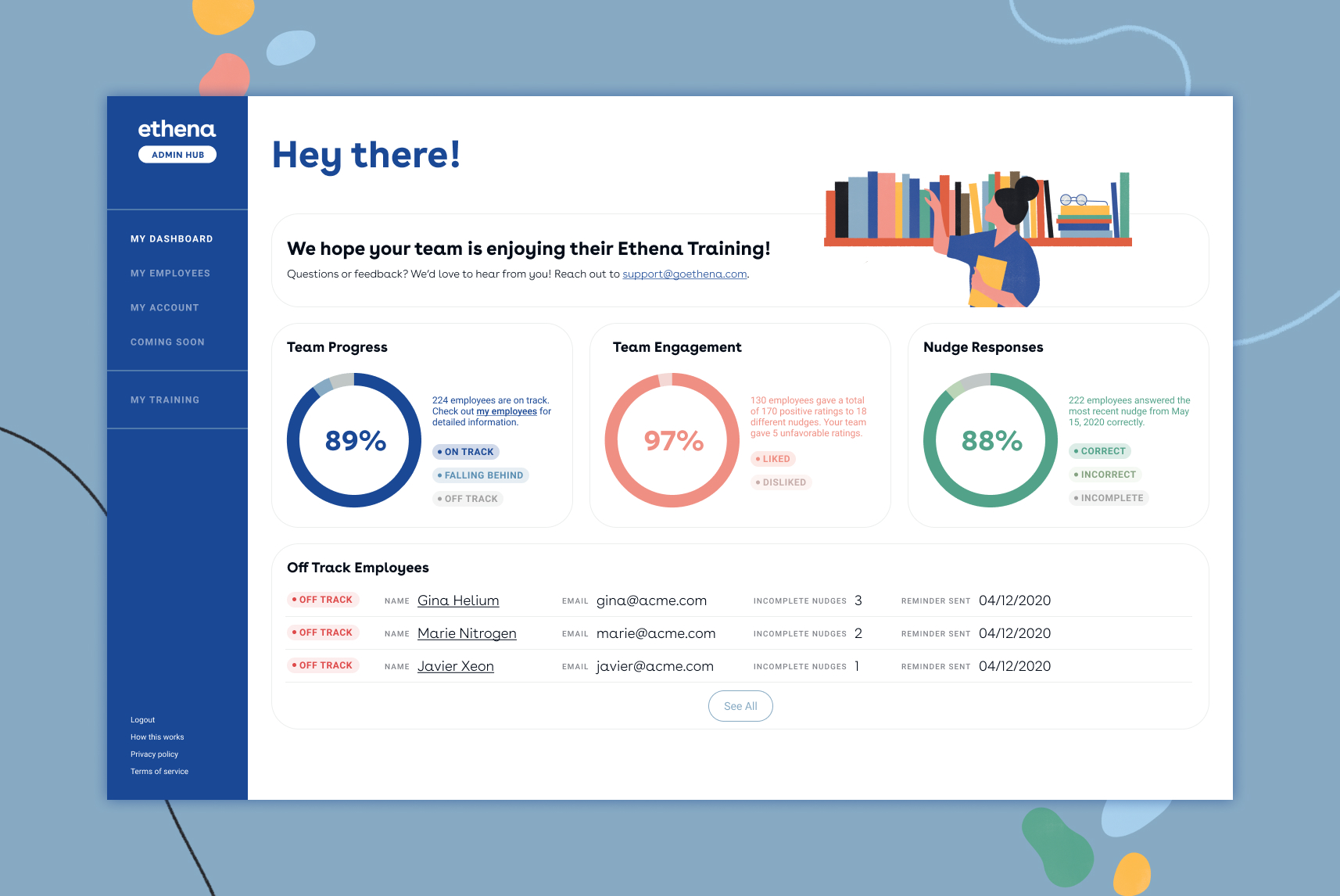
Ethena sends “nudges,” or personalized short-form bits of training content, to employees throughout the year. One nudge could be about office dating, and a few weeks later, another nudge could be about mentorship.

Each month a user would get either an e-mail or Slack notification saying it is time to train. Then the user would go to a browser-based app and take a lesson, which depends on your managerial status, state of residence and other factors. The sessions would then be five to 10 minutes.

The distributed approach takes away the ability for an employee to front-load hours of training on their first week. Instead, Ethena’s consistent check-ins are aiming at a difficult metric to track: comprehension within compliance training.

“The reason we do that is because in the adult learning base it is pretty emphatic that repetition is crucial,” Petraeus said.

This format also gives the company a chance to adapt its content to the world users are living in. Ethena’s content has to follow a certain curriculum based on state law, but, it can add its own flavor. For example, when COVID-19 became a serious threat, Ethena was able to send users training in regards to online harassment and cyberbullying. Old curricula might not account for what Zoom harassment might look like.

Petraeus said of the examples users see in the software, “it makes no sense to have Jim and Jan go to a bar if that’s not the environment we are in.”

Ethena also works as a replacement for in-person anti-harassment workshops during COVID-19 and resulting shelter-in-place orders. As offices continue to remain shut down, companies need to find new ways to talk about issues that are not going away.

Efficacy of anti-harassment training is hard to track with numbers. If a company tried to measure Ethena’s efficacy with data around the number of harassment reports filed before and after the software was used, it presumes that victims are choosing to report in the first place. Victims, for a variety of reasons, often don’t report due to fear of retaliation or inaction.

For the co-founders, a lack of hard data about whether their software works meant that they had to find another way to pitch to customers.

“It would be really irresponsible to just kind of bank on ‘everyone will believe in this mission with us,’ ” said Petraeus. “We read the newspaper; that will not happen.”

Instead, the co-founders think that sweeping training regulations and legal obligations might be what force companies to onboard more intensive software.

“We keep companies in a legally, very safe position because their employees are always sort of ahead of what they need to stay compliant with state regulations,” Solmssen said. “We’re able to become a part of the fabric of everyday thinking and behavior for employees.”

Long term, Ethena is working with a peer-reviewed journal to see if effective anti-harassment training can be related to higher retention rates in companies.

The company envisions early adopters to be small companies that are scaling. It charges companies per seat, which comes out to $4 per employee per month, and $48 per employee per year.

Petraeus and Solmssen piloted the program in November 2019 and launched in January. Today, the startup told TechCrunch they have raised $2 million in seed funding led by GSV, with participation from Homebrew, Village Global and more. It has 50 customers.

Powered by WPeMatico

Signal now has built-in face blurring for photos

Apps like Signal are proving invaluable in these days of unrest, and anything we can do to simplify and secure the way we share sensitive information is welcome. To that end Signal has added the ability to blur faces in photos sent via the app, making it easy to protect someone’s identity without leaving any trace on other, less secure apps.

After noting Signal’s support of the protests occurring all over the world right now against police brutality, the company’s founder Moxie Marlinspike writes in a blog post that “We’ve also been working to figure out additional ways we can support everyone in the street right now. One immediate thing seems clear: 2020 is a pretty good year to cover your face.”

Fortunately there are perfectly good tools out there both to find faces in photographs and to blur imagery (presumably irreversibly, given Signal’s past attention to detail in these matters, but the company has not returned a request for comment). Put them together and boom, a new feature that lets you blur all the faces in a photo with a single tap.

Image Credits: Signal

This is helpful for the many users of Signal who use it to send sensitive information, including photos where someone might rather not be identifiable. Normally one would blur the face in another photo editor app, which is simple enough but not necessarily secure. Some editing apps, for instance, host computation-intensive processes on cloud infrastructure and may retain a copy of a photo being edited there — and who knows what their privacy or law enforcement policy may be?

If it’s sensitive at all, it’s better to keep everything on your phone and in apps you trust. And Signal is among the few apps trusted by the justifiably paranoid.

All face detection and blurring takes place on your phone, Marlinspike wrote. But he warned that the face detection isn’t 100% reliable, so be ready to manually draw or expand blur regions in case someone isn’t detected.

The new feature should appear in the latest versions of the app as soon as those are approved by Google and Apple.

Lastly Marlinspike wrote that the company is planning on “distributing versatile face coverings to the community free of charge.” The picture shows a neck gaiter like those sold for warmth and face protection. Something to look forward to then.

Powered by WPeMatico

As Americans look to escape, this peer-to-peer RV rental startup is happy to accommodate them

The world feels as fragile as ever, and those with any options at all are looking to get away this summer.

For many, planes and hotel rooms won’t be an option they consider owing to continued concerns about the coronavirus (not to mention the expense, which 40 million fewer Americans can likely afford). That leaves perhaps renting a local Airbnb this summer or, for a growing number of people, looking for the first time to rent an RV or camper van, including as a way to visit far-flung family members who might otherwise be unreachable.

Last week, we talked with Jeff Cavins, a serial operator and the co-founder and CEO of a company that’s poised to benefit from the latter trend: Outdoorsy, a peer-to-peer RV rental company that was founded in 2015, bootstrapped by its founders for a couple of years, and has more recently attracted $88 million in venture funding, $13 million of it an extension to a $50 million Series B round that it quietly closed early this year.

We wanted to know what trends the company — which collects fees from both the vehicle owners and the renters on its platform — is seeing, including how its customers are changing and where they’re looking to park themselves this summer. Below are some excerpts from our chat, edited lightly for length.

TC: How has your model changed because of the coronavirus?

JC: We had typically seen an average rental on our platform would run about six days. That’s now over nine days. With COVID, as with many other companies, we saw a lot of de-bookings in the platform, but then they all roared back and then some. We’ve seen a 2,645% increase in bookings from the low point of COVID, which was late March, to right now.

TC: What percentage of those booking trips are first-time customers?

JC: In the month of May, 88% of our bookings were by first-time renters, which is a record for us. And more than half of them have come back and already booked their second trip. So some booked in May; they went away for the Memorial Day weekend [and] came right back. And they booked another one for, in this case, like the Fourth of July or [trips in] June. As you know, a lot of people are at home with their kids, so everybody in America has this big, long extended summer break. And with the kids, they’re finding this is the safer option for travel.

TC: Are their expectations different? Are they looking for certain things that maybe more seasoned RV campers wouldn’t think to ask?

JC: The big trend that we’re seeing in the RV industry, and this is not unique to America, is the new consumers don’t want those big land barges. What they want are camper vans, because the average user on our platform is under the age of 40, which was a big surprise to this industry because it’s always leaned a little bit towards the Boomer or the retiree demographic. And they like camping off the grid. They like to operate with vehicles that feel comfortable to them, that have a smaller footprint, that are easier on the environment. And so things that have become popular are solar power, potable water that can be transportable, hookups for mountain bikes, sporting gear . . . They also want to be able to head to unique locations where they can build those Instagram mobile moments. So we’re starting to see that trend, and it has become a global phenomenon.

TC: When we last talked, in January of last year, Outdoorsy had around 35,000 vehicles available to rent on the platform. How many are on the platform now?

JC: We have 48,000 peer-to-peer listings; when we add our international users and we have a lot of these mega fleets that are connected to our site via an API like Indies Campers or Jucy, that puts our supply at 68,000 units.

TC: And how are you making sure that these vehicles are free of germs and don’t transmit diseases?

JC: Cleanliness is a big factor for any form of accommodation. In our case, we’ve been producing for our listing community CDC guidelines on cleaning standards. We’ve asked our owners to place additional time between rentals so they can let the vehicles take time to manually disinfect. One of our investors at our company is a molecular biologist [whose] doctoral thesis at Harvard won the Nobel Prize for chemistry and he’s been helping us communicate with our owner community on things like these new ultraviolet radiation lamps that are common. You’ll see them installed in ambulances . . . if you let them set for a while, they will help completely decontaminate the environment.

We’re also encouraging renters to bring cleaning supplies with them. A lot of people will feel much more safe if they’re able to control their environment. And we’ve started a contactless key exchange, [meaning] the owner will deliver the vehicle to a campsite, put up the awning, the camping chairs, and so on. And then the renter will come later.

TC: You mentioned changing user behaviors. Out of curiosity, are you you seeing renters who aren’t heading to Yosemite or Yellowstone but instead to an RV down the street so they can, say, work apart from young children?

JC: One of the things that we’ve seen is, I may live in San Diego, for example, and grandma lives in Kansas City, and there’s no way for the kids to go see her. So camper van and RV travel has become that way for families to see those loved ones they haven’t been able to see during quarantine and maintain family connectivity.

TC: You mentioned de-bookings earlier this year. Did you have to lay off staff?

JC: We had about 160 employees prior to COVID. And we did do some right-sizing. Most of the impact in our organization was in our international markets — we had a  team in Italy, Germany, France, U.K., Australia, New Zealand [that were cut]. In terms of our domestic employees, rather than cuts, we sat down with the team and said, ‘If everybody is willing to take a salary adjustment, we will reward you with more equity in the business. This could be a period of time where we save those jobs around us.’

I work with no income; I don’t have a salary. And there are a few other executives who elected to [forgo theirs]. So it was a way to align our employees with our investors by compensating them more in equity.

TC: As business picks up again, are you thinking about another round of funding?

JC: There is no plan to [raise more right now]. We were profitable in the month of May. We’ll be profitable again in the month of June. Unless there’s a second wave of COVID and lockdowns, our booking activity is now foretelling a profitable July, August and September, so we’ll possibly produce a year-on-year fiscal profitable year.

The ones we typically get inbound activity from are the late-stage growth investors. We’ll all sit down with the board and we’ll talk about it and decide: Do we want to do something with that or just want to just keep, you know, chopping wood as fast as we can on our own?

Powered by WPeMatico


SaaS earnings rise as pandemic pushes companies more rapidly to the cloud

As the pandemic surged and companies moved from offices to working at home, they needed tools to ensure the continuity of their business operations. SaaS companies have always been focused on allowing work from anywhere there’s access to a computer and internet connection, and while the economy is reeling from COVID-19 fallout, modern software companies are thriving.

That’s because the pandemic has forced companies that might have been thinking about moving to the cloud to find tools what will get them there much faster. SaaS companies like Zoom, Box, Slack, Okta and Salesforce were there to help; cloud security companies like CrowdStrike also benefited.

While it’s too soon to say how the pandemic will affect work long term when it’s safe for all employees to return to the office, it seems that companies have learned that you can work from anywhere and still get work done, something that could change how we think about working in the future.

One thing is clear: SaaS companies that have reported recent earnings have done well, with Zoom being the most successful example. Revenue was up an eye-popping 169% year-over-year as the world shifted in a big way to online meetings, swelling its balance sheet.

There is a clear connection between the domestic economy’s rapid transition to the cloud and the earnings reports we are seeing — from infrastructure to software and services. The pandemic is forcing a big change to happen faster than we ever imagined.

Big numbers

Zoom and CrowdStrike are two companies expected to grow rapidly thanks to the recent acceleration of the digital transformation of work. Their earnings reports this week made those expectations concrete, with both firms beating expectations while posting impressive revenue growth and profitability results.

Powered by WPeMatico

Cowboy releases updated e-bike with new carbon belt

Electric-bike maker Cowboy has released a new iteration of its bike, the Cowboy 3. It’s a relatively small update that should make the experience better for newcomers. The first orders will be delivered at the end of July and the Cowboy 3 is now slightly more expensive at €2,290 or £1,990 ($2,500).

The bike still looks a lot like the Cowboy 2 that I reviewed last year. It has a triangle-shaped aluminum frame with integrated pill-shaped lights. The handlebar is still perfectly straight like on a mountain bike.

Compared to the previous generation, the company has replaced the rubber and fiberglass belt with a carbon belt. It should be good to go for 30,000 km.

Like on the previous bike, there are no gears or buttons to control motor assistance. As soon as you start pedaling, motor assistance kicks in automatically.

But the gear ratio has been tweaked on this version. It’s now a bit lower, which means it’ll be easier to start pedaling at a traffic light. It’s going to have an impact on your top speed though as electric bikes assist you up to a certain speed and you have to rely on your good old feet above that legal limit.

The wheels and tires have been slightly tweaked as well. Instead of off-the-shelf Panaracer tires, Cowboy is now using custom-made tires with a puncture protection layer. Rims are larger as well.

The saddle, hydraulic brakes and brake pads remain unchanged. The Cowboy 3 still features a detachable battery, something that is still missing from VanMoof’s e-bikes and the newly announced Gogoro Eeyo e-bikes.

Overall, the bike weighs 16.9 kg. It now comes in three colors — black and two shades of grey.

New and existing Cowboy customers will be able to download a new version of the app with a handful of new features. You’ll be able to turn on auto-unlock to … automatically unlock your bike when you approach without having to open the app on your phone.

With theft detection, users will receive a notification as soon as your bike is moving. There will be a new crash detection feature that notifies an emergency contact and an air quality indicator in the app.

Powered by WPeMatico

Sourcing software provider Keelvar raises $18M from Elephant and Mosaic

It was perhaps not until the COVID-19 pandemic hit the planet that most of us had ever heard or uttered the phrase “supply chain.” But in a global economy that had become drunk and lazy on “just in time ordering” and similar, the threat to supply chains of things like, oh, food, from that pesky virus has become real and visceral. That’s why automation of “the supply chain” has become such a huge issue. So it’s not a huge surprise that startups aimed at tackling this are suddenly thrust into the limelight.

Step forward, Cork, Ireland-based Keelvar, strategic sourcing software company, which today announces that it has raised $18 million in Series A funding led by Elephant Ventures and Mosaic Ventures, with participation from Paua Ventures, enabling the company to further expand into enterprise markets.

The investment will support Keelvar’s expansion plans for Europe and the U.S., amid the rapidly growing need for supply chain automation solutions, which has been further accelerated by the recent COVID-19 pandemic.

Keelvar provides large enterprises with “Advanced Sourcing Optimization” software and “Intelligent Sourcing Automation” that uses AI to fully automate tactical buying processes.

It competes with Coupa and Jaggaer in terms of all three offering sophisticated e-sourcing software. Keelvar says its key competitive advantage is that it provides intelligent bots to autopilot the sourcing projects, thus making the whole process easier, faster and cheaper.

It also currently manages more than $90 billion in spend annually for enterprises in all major industries. Customers include Siemens, Coca-Cola, Novartis, BMW and Samsung.

With COVID-19 disrupting supply chains globally, Keelvar expects the demand for automation to further increase.

In a statement, Alan Holland, CEO of Keelvar, said: “The Future of Work in procurement is changing quickly, with COVID19 acting as a catalyst. We have witnessed an escalation in demand from enterprises seeking intelligent systems to automate complex processes as teams became overburdened with disrupted supply chains. Keelvar has proven that Sourcing Bots can relieve that burden enormously. Now it’s time to hit the accelerator and scale-up.”

Speaking about the investment, Peter Fallon, partner at Elephant noted: “Keelvar’s sourcing optimization and automation software delivers meaningful ROI to enterprise sourcing and procurement organizations globally. We are excited to partner with Alan Holland and the team at Keelvar as the company continues to emerge as a leader in this market.”

Private sector companies alone spend trillions annually buying from third-party suppliers. External sourcing is usually the largest expense category and on average it is 43% of total costs (Bain & Company). The global procurement software market is currently growing at a CAGR of 9.1%, and expected to reach $7.3 billion by 2022 (IDC).

Speaking about the funding, Toby Coppel, co-founder, and partner at Mosaic Ventures said: “Keelvar is a brilliant example of machine learning in action, giving superpower to procurement teams in every large enterprise. With COVID-19 pushing businesses to embrace these new technologies, we’re excited to partner with Keelvar on the next phase of growth.”

Powered by WPeMatico

Searchable.ai nabs additional $4M seed to continue building AI-driven search

Searchable.ai is an early-stage startup in the alpha phase of testing its initial product, but it has an idea compelling enough to attract investment, even during a pandemic. Today the company announced an additional $4 million in seed capital to continue building its AI-driven search solution.

Susquehanna International Group and Omicron Media co-led the round, with participation by Defy Partners, NextView Ventures and a group of unnamed angel investors. Today’s investment comes on top of the $2 million in seed money the startup announced in October.

Company co-founder and CEO Brian Shin said that when he presented to his investors in early March at the last event he attended before everything shut down, they approached him about additional money, and given the economic uncertainty, he decided to take it.

“Honestly we probably would not have taken additional money if it was not for the uncertainty around the macro environment right now,” he told TechCrunch.

The company is trying to solve enterprise search and, being pre-revenue, Shin recognized that having additional capital would give them more room to build the product and get it to market.

“We are trying to solve this problem where people just can’t find information that they need in order to do their jobs. When you look within the workplace, this problem is just getting worse and worse with the proliferation of different formats and people storing their information in many different places, local networks, cloud repositories, email and Slack,” he explained.

They have a few thousand people in the alpha program right now testing a personal desktop version of the application that helps individual users find their content wherever it happens to be. The plan is to open that up to a wider group soon.

The road map calls for a teams version, where groups of employees can search among their different individual repositories; a developer version to build the search technology into other operations; and eventually an enterprise tool. They also want to add voice search starting with an Alexa skill, with the general belief that we need to move beyond keyword searches to more natural language approaches.

“We believe that there’ll be a whole new category of search, search companies and search products that are more conversational. […] Being able to interact with your information more naturally, more and more conversationally, that’s where we think the market is going,” he said.

The company now has more money in the bank to help achieve that vision.

Powered by WPeMatico

Nanox, maker of a low-cost scanning service to replace X-rays, expands Series B to $51M

A lot of the attention in medical technology today has been focused on tools and innovations that might help the world better fight the COVID-19 global health pandemic. Today comes news of another startup that is taking on some funding for a disruptive innovation that has the potential to make both COVID-19 as well as other kinds of clinical assessments more accessible.

Nanox, a startup out of Israel that has developed a small, low-cost scanning system and “medical screening as a service” to replace the costly and large machines and corresponding software typically used for X-rays, CAT scans, PET scans and other body imaging services, is today announcing that it has raised $20 million from a strategic investor, South Korean carrier SK Telecom.

SK Telecom in turn plans to help distribute physical scanners equipped with Nanox technology as well as resell the pay-per-scan imaging service, branded Nanox.Cloud, and corresponding 5G wireless network capacity to operate them. Nanox currently licenses its tech to big names in the imaging space, like FujiFilm, and Foxconn is also manufacturing its donut-shaped Nanox.Arc scanners.

The funding is technically an extension of Nanox’s previous round, which was announced earlier this year at $26 million with backing from Foxconn, FujiFilm and more. Nanox says that the full round is now closed off at $51 million, with the company having raised $80 million since launching almost a decade ago, in 2011.

Nanox’s valuation is not being publicly disclosed, but a news report in the Israeli press from December said that one option the startup was considering was an IPO at a $500 million valuation. We understand from sources that the valuation is about $100 million higher now.

The Nanox system is based around proprietary technology related to digital X-rays. Digital radiography is a relatively new area in the world of imaging that relies on digital scans rather than X-ray plates to capture and process images.

Nanox says the ARC comes in at 70 kg versus 2,000 kg for the average CT scanner, and production costs are around $10,000 compared to $1-3 million for the CT scanner.

But in addition to being smaller (and thus cheaper) machines with much of the processing of images done in the cloud, the Nanox system, according to CEO and founder Ran Poliakine, can make its images in a tiny fraction of a second, making them significantly safer in terms of radiation exposure compared to existing methods.

Imaging has been in the news a lot of late because it has so far been one of the most accurate methods for detecting the progress of COVID-19 in patients or would-be patients in terms of how it is affecting patients’ lungs and other organs. While the dissemination of equipment like Nanox’s definitely could play a role in handling those cases better, the ultimate goal of the startup is much wider than that.

Ultimately, the company hopes to make its devices and cloud-based scanning service ubiquitous enough that it would be possible to run early detection, preventative scans for a much wider proportion of the population.

“What is the best way to fight cancer today? Early detection. But with two-thirds of the world without access to imaging, you may need to wait weeks and months for those scans today,” said Poliakine.

The startup’s mission is to distribute some 15,000 of its machines over the next several years to bridge that gap, and it’s getting there through partnerships. In addition to the SK Telecom deal it’s announcing today, last March, Nanox inked a $174 million deal to distribute 1,000 machines across Australia, New Zealand and Norway in partnership with a company called the Gateway Group.

The SK Telecom investment is an interesting development that underscores how carriers see 5G as an opportunity to revisit what kinds of services they resell and offer to businesses and individuals, and SK Telecom specifically has singled out healthcare as one obvious and big opportunity.

“Telecoms carriers are looking for opportunities around how to sell 5G,” said Ilung Kim, SK Telecom’s president, in an interview. “Now you can imagine a scanner of this size being used in an ambulance, using 5G data. It’s a game changer for the industry.”

Looking ahead, Nanox will continue to ink partnerships for distributing its hardware and reselling its cloud-based services for processing the scans, but Poliakine said it does not plan to develop its own technology beyond that to gain insights from the raw data. For that, it’s working with third parties — currently three AI companies — that plug into its APIs, and it plans to add more to the ecosystem over time.

Powered by WPeMatico

Bryter raises $16M for a no-code platform for non-technical people to build enterprise automation apps

Automation is the name of the game in enterprise IT at the moment: We now have a plethora of solutions on the market to speed up your workflow, simplify a process and perform more repetitive tasks without humans getting involved. Now, a startup that is helping non-technical people get more directly involved in how to make automation work better for their tasks is announcing some funding to seize the opportunity.

Bryter — a no-code platform based in Berlin that lets workers in departments like accounting, legal, compliance and marketing who do not have any special technical or developer skills build tools like chatbots, trigger automated database and document actions and risk assessors — is today announcing that it has raised $16 million. This is a Series A round being co-led by Accel and Dawn Capital, with Notion Capital and Chalfen Ventures also participating.

The funding comes less than a year after Bryter raised a seed round — $6 million in November 2019 — and it was oversubscribed, with term sheets coming in from many of the bigger VCs in Europe and the U.S. With this funding, the company has now raised around $25 million, and while the valuation is considerably up on the last round, Bryter is not disclosing what it is.

Michael Grupp, the CEO who co-founded the company with Micha-Manuel Bues and Michael Hübl (pictured below), said that the whole Series A process took no more than a month to initiate and close, an impressive turnaround considering the chilling effect that the COVID-19 health pandemic has had on dealmaking.

Part of the reason for the enthusiasm is because of the traction that Bryter has had since launching in 2018. Its 50 enterprise customers include the likes of McDonald’s, Telefónica, banks, healthcare and industrial companies, and professional services firms PwC, KPMG and Deloitte (who in turn use it for themselves as well as for clients). (Note: Because of its target users being large enterprises, the company doesn’t publish per-person pricing on its site as such.)

Bryter’s been seeing a lot of attention from customers and investors because its platform speaks to a big opportunity within the wider world of software today.

Enterprise IT has long been thought of as the less-fun end of technology: It’s all about getting work done, and a lot of the software used in a business environment is complex and often requires technical knowledge to implement, use, fix and adapt in any way.

This may still the case for a lot of it, especially for the most sophisticated tools, but at the same time we have seen a lot of “consumerization” come into IT, where user-friendly hardware and software built for consumers — specifically non-technical consumers — either inspires new enterprise services, or are simply directly imported into the workplace environment.

No-code software — like automation, another big trend in enterprise IT right now — plays a big role in how enterprise tools are becoming more user-friendly. One of the biggest roadblocks in a lot of office environments is that when workers identify things that don’t work, or could work much better than they do, they need to file tickets and get IT teams — also often overworked — to do the fixing for them. No-code platforms can help circumvent some of that work — so long as the roadblock of IT approves the use, that is.

Bryter’s conception and existence comes out of the no-code trend. It plays on the same ideas as IFTTT or Zapier but is very firmly aimed at users who might use pieces of enterprise software as part of their jobs, but have never had to delve into figuring out how they actually work.

There are already a lot of “low-code” (minimal coding) and other no-code platforms on the market today for business (not consumer) use cases. They include Blender.io, Zapier, Tray.io (a London-founded startup that itself raised a big round last autumn), n8n (also German, backed by Sequoia), and also biggies like MuleSoft (acquired by Salesforce in 2018 at a $6.5 billion valuation).

Bryter’s contention is that many of these actually need more technical know-how than they initially claim. Grupp pointed out that the earliest automation tools for enterprise have been around for decades at this point, but even most of the very modern descendants of those “will require some coding.” Bryter’s toolbox essentially lets users create dialogues with users — which they can program based on the expertise that they will have in their particular fields — which then sources data they can then plug into other software via the Bryter platform in order to “perform” different tasks more quickly.

Grupp’s contention is that while these kinds of tools have long been used, they will be in even more demand going forward.

“After COVID-19, workers will be even more distributed,” he said. “Teams and individuals will need to access information in a faster way, and the only way for big organizations to distribute that knowledge is through more digital tools.” The idea is that Bryter can essentially help bridge those gaps in a more efficient way.

Bryter’s target user and its approach underscores why investors like Accel see accessible, no-code solutions as a big opportunity.

“No-code software is really reducing the barriers of adoption,” Luca Bocchio, a partner at Accel, said in an interview. “If people like you and I can use the software, then that means demand can multiply by big numbers.” That’s in contrast to a lot of enterprise software today, which is very limited in how it can grow, he added. “Plus, enterprises these days want to see more future visibility in terms of the products they adopt. They want to make sure something will stick around, and so they tend not to want to work with super young startups. But it’s happening for Bryter, and the is a testament to Bryter and to the market potential.”

Powered by WPeMatico