1010Computers | Computer Repair & IT Support

The accelerating digital transformation, redux

Earlier this week, TechCrunch covered a grip of earnings reports showing that some companies helping other businesses move to modern software solutions are seeing accelerated growth. Inside the Software as a Service (SaaS) world, this is known as the digital transformation. Based on how many software companies are talking about it, the pace of change is only picking up.

But since we published that first entry, a number of SaaS companies that have posted financial results seemed to disappoint investors. Seeing some companies in the high-flying sector struggle made us sit back and think. What was going on?

Today we’re going to explore how the digital transformation’s acceleration seems real enough, but how it’s not landing equally. We’ll start by going over a short run of earnings results, talk to Yext CEO Howard Lerman about what his B2B SaaS company is seeing, and wrap with notes on what could be coming next from software shops.

A quick word on digital transformation

We all hear about digital transformation, but it’s hard to define. Generally, it’s a broad area that includes digitization of manual processes, modern software development practices like continuous delivery and containerization and a general way of moving faster via technology — especially in the cloud.

Speaking last month on Extra Crunch Live, Box CEO Aaron Levie defined the term as he sees it. “The way that we think about digital transformation is that much of the world has a whole bunch of processes and ways of working — ways of communicating and ways of collaborating where if those business processes or that way we worked were able to be done in digital forms or in the cloud, you’d actually be more productive, more secure and you’d be able to serve your customers better. You’d be able to automate more business processes.” he said.

What we’re seeing now is that the pandemic has accelerated the rate of change much faster than many had anticipated. Efforts to slow the spread of COVID-19 and its related workplace disruptions have accelerated what would have been a normal timetable. But on its own, that doesn’t mean the market is seeing equal results across every company and industry that might be part of that trend.

Earnings results

Lots of SaaS companies reported earnings this week, but two sets of returns stuck out as we reviewed the results, those from Slack and Smartsheet.

Powered by WPeMatico

TaxProper raises $2M to automate getting your property taxes lowered

If you own your home, how much do you pay for property taxes? Too much? Sounds about right.

If you disagree with how much you’re paying in property taxes, you can appeal the assessment. Most people don’t, though — perhaps because they are unaware they can, or because they just don’t have the time to deal with the lawyers and paperwork.

TaxProper, a company out of Y Combinator’s Summer 2019 batch, has raised $2 million to simplify the process. The round was led by Khosla Ventures, backed by Global Founders Capital, Clocktower Ventures and a handful of angel investors.

Once you’ve punched in your address, TaxProper’s algorithm looks at the assessments of similar homes in your surrounding area, looking at things like size, number of rooms, construction materials, etc.

If the algorithm determines that you’re paying more than your share, they generate the required paperwork and send it off to the county. The company estimates that their part of the process takes 3-5 minutes (after which you’re waiting on the county’s response, which they say takes 6-8 weeks).

They’re offering up two different pricing models, charging either a $149 up-front fee or 30% of total first-year tax savings. If their algorithm says your taxes can’t be lowered, you don’t pay — nor do you pay if the appeal gets denied. The company tells me they’re currently seeing an average per customer savings of around $700.

TaxProper’s two co-founders have a good bit of experience in the space of taxes and government. Geoff Segal was previously an actuarial statistician and research analyst for State Farm, while Thomas Dowling was a municipal finance advisor for Chicago Mayor Lori Lightfoot. 

One thing to note: TaxProper is only up and running in select areas right now, as the company tests different strategies and makes sure they’re doing everything right region-by-region. It’s currently available in Chicago and the surrounding Cook County area, with plans to roll out “in the coming months” in New York and Texas.

Powered by WPeMatico

Portobel turns food producers into direct-to-consumer businesses

A startup called Portobel is working to help food producers shift their businesses so they can support direct-to-consumer deliveries.

Portobel is backed by Heroic Ventures and led by Ranjith Kumaran, founder or co-founder of file-sharing company Hightail (acquired by OpenText) and loyalty startup PunchTab (acquired by Walmart Labs).

Kumaran told me that he and his co-founders Ted Everson and Itai Maron started out with the goal of improving the delivery process by using low-cost, internet-connected devices to track each order. As they began testing this out — primarily with dairy companies and other producers of perishable goods — customers started to ask them, “Hey, you can monitor these things, can you actually deliver these things, too?”

So last year, the company started making deliveries of its own, which involved managing its own warehouses and hiring its own drivers. Kumaran said the resulting process is “a machine that turns wholesale pallets into direct-to-consumer deliveries.”

He also emphasized that the company is taking safety precautions during the pandemic, ensuring that all of its warehouse workers and drivers have masks and other protective equipment, and that the drivers use hand sanitizer between deliveries.

Portobel warehouse

Image Credits: Portobel

Portobel currently operates in the San Francisco Bay Area and Los Angeles/Orange County. Kumaran said the COVID-19 pandemic has only accelerated the demand for the startup’s services, with the number of households it serves tripling since April.

That might sound a little surprising, since supermarkets were basically the one store that customers are still visiting regularly. Plus, there are a range of grocery delivery options.

However, Kumaran suggested that the D2C model is better for both producers and consumers. Producers get recurring orders for larger packages of food. And for consumers, “If you buy straight from the wholesale producer … everything’s in stock.”

As for delivery, he said that when you buy your groceries online, things are being packed and dispatched at your local store.”

“All those things about selection and availability, put those aside — the modern grocery store is not set up for efficient e-commerce delivery,” he added. “They need to block the aisles to pick up product, there’s no dedicated place to dispatch deliveries. That’s kind of why, if you’ve tried [grocery delivery], there are unpredictable delivery windows. It’s a challenge for these guys to scale online.”

Portobel’s customers include San Francisco-based grocery company Moo Cow Market. In a statement, Moo Cow founder Alexandra Mysoor said, “The pandemic has propelled retail as we knew it into a new wave, blending and merging all past and current forms of commerce. That’s where companies like Moo Cow Market enter and can scale and grow thanks to services like Portobel.”

Powered by WPeMatico

And that’s really it for Google+

Last year, Google launched the beta of Currents, which was essentially a rebrand of Google+ for G Suite users, since Google+ for consumers went to meet its maker in April 2019. While Google+ was meant to be an all-purpose social network, the idea behind Currents is more akin to what Microsoft is doing with Yammer or Facebook with Workplace. It’s meant to give employees a forum for internal discussions and announcements.

To complicate matters, Google kept Google+ around, even after the launch of Currents, but in an email to G Suite admins, it has now announced that Google+ for G Suite will close its doors on July 6, after which there will be no way to opt out of Currents or revert back to Google+.

And with that, Google has driven the final nail into Google+’s coffin. The Google+ mobile apps will be automatically updated to Currents. All existing links to Google+ will redirect to Currents.

Going forward, Google+ will only live on as a hazy memory, filled with circles of friends, all of which were forced to use their real name (at least at the beginning), +1 buttons everywhere, sparks and the promise of fun games, ripples and more.

Currents is all business — and while I’m not aware of a lot of companies that use it, it looks to be a solid option for companies that would otherwise use the Yammer/Teams combination in the Microsoft ecosystem. Now, I guess, we can start the countdown before Google launches another social network.

If you want to take a stroll down memory lane, check out our history of Google+ below:

Powered by WPeMatico

Join Eventbrite CEO Julia Hartz for a live Q&A: June 11 at 3 pm EST/Noon PDT/7 pm GMT

One of the earliest disruptions created by the novel coronavirus manifested in the form of event cancellations. Some of the world’s biggest tech conferences, like F8 and Google NEXT, got postponed and others turned to digital options to still connect. Even Disrupt is going digital this year.

It is an unprecedented time for the events world, so we are bringing someone right in the center of it to our Extra Crunch Live stage: Eventbrite CEO Julia Hartz. In fact, Extra Crunch members can ask their own questions directly to the CEO and are encouraged to do so live on the call.

Hartz is leading the publicly traded company as it grows more popular than ever with hundreds of millions of dollars in revenue. At the same time, the global slowdown of in-person event ticketing due to COVID-19 has had a material impact on Eventbrite’s business. What does that mean for employee morale? Collaboration with other companies? And overall culture at the business?

Eventbrite has swiftly transitioned to virtual events, with thousands of listings across categories like professional events, classes, health and wellness, science and tech, community and culture and more. Hartz also told Billboard that the company remains committed to serving independent music venues, which have been hit hard by the global health crisis, and hinted that Eventbrite may shift to a self-service ticket model.

The company reported that, since enhancing its online events service in 2019, and in the midst of social distancing, Eventbrite users are posting nearly 20k online events every day, with a 2,000+ percent year-over-year increase of online events taking place in April 2020 compared to April 2019. This announcement came after Eventbrite said it would cut $100 million in costs, which included layoffs.

We’ll talk with Hartz about how she is leading her company through a crisis and what the future holds for bringing people together. We’ll also discuss how widespread layoffs may impact the future of diversity in our workforces.

Hartz will also be asked to weigh in on advice for other founders hoping to emerge from COVID-19 from fundraising to strategy. As always, EC subscribers are invited to log onto the call to ask questions live.

Details are below for Extra Crunch subscribers; if you need a pass, get a cheap trial here.

Chat with you all in a week!

When, where, Zoom

Powered by WPeMatico

What grocery startup Weee! learned from China’s tech giants

When Larry Liu moved to the U.S. in 2003, one of the first challenges he experienced was the lack of Chinese ingredients available in local groceries. A native of Hubei, a Chinese province famous for its freshwater fish and lotus-inspired dishes, Liu got by with a limited supply found at local Asian groceries in the Bay Area.

His yearning for home food eventually prompted him to quit a stable financial management role at microcontroller company Atmel and go on to launch Weee!, an online market selling Asian produce, snacks and skincare products.

Like other players in grocery e-commerce, the five-year-old startup has seen exponential growth since the coronavirus outbreak as millions are confined to cooking and eating at home. Nearly a quarter of Americans purchased groceries online to avoid offline shopping during the pandemic, according to Statista data. Online grocery giants Instacart and Walmart Grocery boomed, both hitting record downloads.

In a Zoom call with TechCrunch, Liu, who’s now chief executive of Weee!, said that COVID-19 played a “very important role” in his company’s recent growth, and paved its way to profitability.

“It happened a lot faster than we expected, but we were growing rapidly with even more ambitious plans for expansion prior to COVID-19,” he said. “People are buying more because restaurants are closed. Many are first-time users of grocery delivery.”

The startup’s revenue is up 700% year-over-year and is estimated to generate an annual revenue in the lower hundreds of millions of dollars.

Online grocery, the WeChat way

Powered by WPeMatico

How to get the most from your corporate VC after you get the check

Scott Orn
Contributor

Scott runs operations at Kruze Consulting, a fast-growing startup CFO consulting firm. Kruze is based in San Francisco with clients in the Bay Area, Los Angeles and New York.

Bill Growney
Contributor

Bill Growney, a partner in Goodwin’s Technology & Life Sciences group, focuses his practice on advising technology and other startup companies through their full corporate life-cycle.

Raising capital from a corporate VC can bring many benefits beyond just money. Strategic CVCs, who measure ROI based on the strength of the strategic partnership with their portfolio companies as well as the financial return, will typically seek to maximize their relationships with startups for a long time after the investment is made.

Specifically, a CVC investor can offer the following to an entrepreneur:

  1. Resources and product feedback. CVC parent companies often have deep institutional expertise and teams of subject-matter experts who can advise startups on product development and guide them through issues.
  2. Partnerships. CVCs can leverage their supply chain and operations to build new partnerships that otherwise may have taken months or years for startups to create.

  3. Distribution. Strategic CVCs can become a distribution channel for a startup, connect that startup with their suppliers, or even use the startup to become a channel for the parent company.

  4. Branding halo. If a large company is willing to invest in your startup, it’s a strong signal that your product is good and that your business has a bright future.

  5. Acquisition. Many CVCs invest in startups that they may want to acquire down the line. A CVC may also endorse an exit-seeking portfolio company to their partner companies or suppliers.

Granted, seeing results from these benefits takes time, and even the best of intentions during a capital raise process may not always yield an optimal strategic relationship.

Here’s a list of factors to keep in mind for founders who want the best chances of a productive and successful relationship with their CVC.

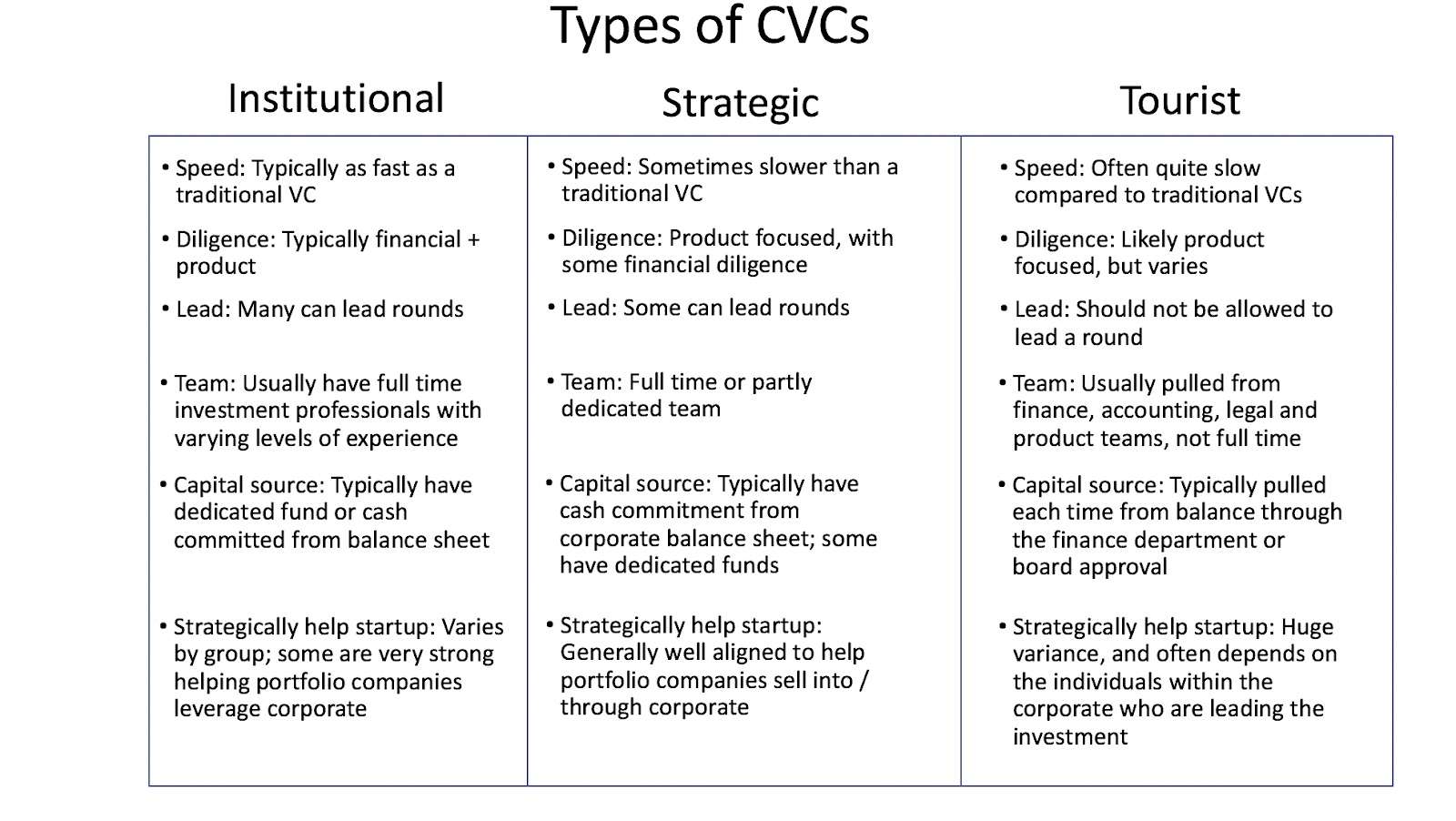
Know which type of CVC you’re dealing with from the outset. In our previous posts, we outlined the three types of CVCs — experienced institutional investors, industry-specific strategics, and beginner or “tourist” CVCs. As we’ve discussed, be sure to spend time interviewing and building relationships with CVCs to determine which type they are, what kinds of benefits and resources they can offer and what their history looks like in terms of successfully partnering with startups over time. When in doubt, ask other founders who have done deals with them!

Powered by WPeMatico

15 things founders should know before accepting funding from a corporate VC

Scott Orn
Contributor

Scott runs operations at Kruze Consulting, a fast-growing startup CFO consulting firm. Kruze is based in San Francisco with clients in the Bay Area, Los Angeles and New York.

Bill Growney
Contributor

Bill Growney, a partner in Goodwin’s Technology & Life Sciences group, focuses his practice on advising technology and other startup companies through their full corporate life-cycle.

More than $50 billion of corporate venture capital (CVC) was deployed in 2018 and new data indicates that nearly half of all venture rounds will include a corporate investor. The CVC trend is heating up and the need for founders and startup executives to stay informed is higher than ever.

We’ve covered the basics in this series, including how to approach CVCs and what to know before the investment, what to look out for when negotiating, and getting the most out of a CVC partnership after the investment.

A great CVC investor can be the best of both worlds — a strong corporate champion who provides insights and connections to help your startup succeed and a committed financial partner who provides the capital you need to grow. But CVCs aren’t just VCs with different business cards. Finding the right CVC requires the right approach and strategy, and getting the right CVC on your cap table can bring unique and lasting value to your startup.

To wind down this series, here’s a list of the top 15 things every founder should know before signing a term sheet with a CVC.

  1. CVCs come in three major types. The type of CVC you’re dealing with will determine a great deal about the potential for the partnership, the professionalism of the investing process, the resources you’ll have available once the investment is made and much more.

    Image credits: Orn/Growney

  2. Different CVCs have different investing strategies. Some CVCs view deals through the lens of, “I’m looking for a great team, huge market and a chance to bring in funding and connections to make a business as strong as it can be.” Others see their investment like, “I’m looking for a solution/product/platform that I can bring into my company or use to expose my company to a brand new marketplace or technology.” As a founder, it’s best to know which type you’re dealing with before the pitch.
  3. CVCs can offer benefits beyond capital. Choose one who can offer money AND … . As Rick Prostko, Managing Partner at Comcast Ventures, says, “Look for someone who will understand your business, meet with you and decide that there’s something beyond just capital that will form the basis for that relationship. In today’s venture market, founders want money AND value. Seek out a CVC who has valuable experience to provide, and look for someone who’s been an operator in this segment previously or who has valuable insight and experience to offer.”
  4. Some CVCs are a better fit for your company than others. As with all investors, some will forge a better relationship with you and the exec team. But with strategic CVCs, the need for a strong bond at the outset is even higher since you’ll be embarking on a strategic partnership with the CVC’s parent company.
  5. Do your own diligence, just as they do theirs. The best way to find out what type of CVC you’re dealing with, what to expect in the investment process and whether your chances are strong for a post-investment partnership is to ask around. Talk to other companies within the CVC’s portfolio, or founders who’ve pitched the CVC in the past. Ask for their feedback on how it went and what to expect. You’ll never regret having more information.
  6. Come into the relationship with ideas for how the CVC can help your company. Do you see possibilities for product feedback loops? New distribution channels? A potential future acquisition by the parent company? Don’t be afraid to share your vision with the CVC during the pitch, and discuss how and whether that vision can be realized.
  7. Expect deeper product and technical diligence. CVCs have technical, product and market experts at their disposal, so their level of product diligence is typically more rigorous than traditional VCs. Be prepared for some grilling by subject matter experts. On the flip side, this diligence process provides you with exposure to potential customers and partners inside the corporation, so use this time to your advantage.
  8. Stay aware of what information you reveal during the diligence process. Remember that you’re sharing confidential info with a large company. If you stay thoughtful and strategic with what you share, and determine whether the CVC is truly interested in doing a deal before you offer financial, technical and competitive information, you’ll usually be fine. Don’t rely exclusively on NDAs — they only provide so much protection.
  9. Ask questions during negotiations. Do they want to lead your round? Do they want a board seat? Do they understand your future fundraising strategy? Will they be using experienced lawyers to do the deal? These are all important touch points during the negotiation process, and the answers will be revealing.
  10. . Set clear rules on ownership percentages ahead of time. As a rule, don’t let any single CVC own more than 19.9% of your company. If they own more than that, the CVC’s parent company will likely need to consolidate your financials into their annual and quarterly reports. If that happens, you’ll be required to get an expensive audit done, meet strict reporting deadlines and invest in financial planning and projections, all of which can hinder your bottom line.
  11. . Be sure to get the CVC to waive audit requirements. We mean it! Do everything you can to avoid any audit obligations. Audits are notoriously time consuming and expensive — we’ve seen audits by Big Four firms cost startups over $30,000. While many investor rights agreements “require” an audit, traditional VCs usually waive this requirement to avoid wasting a founder’s time and money. You want a CVC investor to do the same.
  12. . Never give a CVC a Right of First Refusal. Under no circumstances should you let a CVC get a ROFR, which would give the parent corporation the right to “beat” any other potential acquirer if and when you try to sell your startup. In practice, a ROFR means that no smart competitor to the parent organization will try to purchase your company because they know the CVC’s corporate arm will be able to swoop in and steal the deal.
  13. . Be aware that you run a risk of regime change. Staff turnover is a reality that CVCs face as much as any other large corporate operation. Ask the CVC leading your investment: Who will support the company if he or she leaves? What will happen to the CVC if the person leading the venture arm departs? Will the company still do their pro rata if personnel changes happen? What about commercial relationships that come from the relationship? You have a right to know as much as possible at the beginning, though the future can always change.
  14. . You may have to tackle regulatory issues. If the CVC’s parent company is in a certain area, it may be subject to government regulation. For instance, banks must adhere to a variety of regulations very different from those that apply to large tech companies. Navigating these laws can be costly and time consuming, so be aware of what you’re getting into before you sign the dotted line and discuss how you and the CVC can avoid hitting any regulatory roadblocks.
  15. . Know that you may face challenges in the relationship over time. While startups thrive on renouncing hierarchy, chasing innovation and pivoting on a dime, larger corporations operate at a different pace and under a different paradigm. Change comes slower, decisions often involve more parties and some business units have different priorities than others. As a founder, you’ll be in charge of navigating the CVC’s parent company in order to maximize the partnership value.

There are plenty of benefits to taking CVC investments. Many CVC investments lead to acquisitions, and even if the discussions with a CVC fall apart, your meeting can result in valuable introductions that yield new business relationships. The rising CVC trend offers a brave new world for entrepreneurs. If you know the ropes of CVC investing, you could be in for a partnership that benefits you both.

Powered by WPeMatico

The IPO window is open (again)

Hello and welcome back to our regular morning look at private companies, public markets and the gray space in between.

ZoomInfo went public yesterday. After pricing its IPO $1 ahead of its proposed range at $21 per share, the company closed its first day’s trading worth $34.00, up 61.9%, according to Yahoo Finance. Then the company gained another 5.2% in after-hours trading.

Whether you feel that this SaaS player was worth the revenue multiple its original, $8 billion valuation dictated — let alone that same multiple times 1.6x — the message from the offering was clear: the IPO window is open.

This is not news to a few companies looking to take advantage of today’s strong equity prices.

Used-car marketplace Vroom is looking to get its shares public before its Q2 numbers come out, despite a history of slim gross profit generation. The company hopes to go public for as much as $1.9 billion, a modest uptick from its final private valuations.

We’ll get another dose of data when Vroom does price — how much investors are willing to pay for slim-margin revenue will tell us a bit more than what we learned from ZoomInfo, which has far superior gross margins. Investors have already signaled that they are content to value high-margin software-ish revenues richly. Vroom is more of a question, but if it does price strongly we’ll know public investors are looking for any piece of growth they can find.

This brings us to the latest news: Amwell has confidentially filed to go public. Formerly known as American Well, CNBC reports that the venture-backed telehealth company has dramatically expanded its customer base:

Telemedicine has seen an uptick in recent months, as people in need of health services turned to phone calls and video chats so they could avoid exposure to COVID-19. The company told CNBC last month that it’s seen a 1,000% increase in visits due to coronavirus, and closer to 3,000% to 4,000% in some places.

Powered by WPeMatico

Slack’s new integration deal with AWS could also be about tweaking Microsoft

Slack and Amazon announced a big integration late yesterday afternoon. As part of the deal, Slack will use Amazon Chime for its call feature, while reiterating its commitment to use AWS as its preferred cloud provider to run its infrastructure. At the same time, Amazon has agreed to offer Slack as an option for all internal communications.

“Some parts of Amazon had licensed Slack before, but this is the first time it will be offered as an option to all employees,” an Amazon spokesperson told TechCrunch.

Make no mistake, this is a big deal as the SaaS communications tool increases its ties with AWS, but this agreement could also be about slighting Microsoft and its rival Teams product by making a deal with a cloud rival. In the past, Slack CEO Stewart Butterfield has had choice words for Microsoft saying the Redmond technology giant sees his company as an “existential threat.”

Whether that’s true  — Teams is but one piece of a huge technology company — it’s impossible not to look at the deal in this context. Aligning more deeply with AWS sends a message to Microsoft, whose Azure infrastructure services compete with AWS.

Butterfield didn’t say that of course. He talked about how synergistic the deal was. “Strategically partnering with AWS allows both companies to scale to meet demand and deliver enterprise-grade offerings to our customers. By integrating AWS services with Slack’s channel-based messaging platform, we’re helping teams easily and seamlessly manage their cloud infrastructure projects and launch cloud-based services without ever leaving Slack,” he said in a statement.

The deal also includes several other elements including integrating AWS Key Management Service with Slack Enterprise Key Management (EKM) for encryption key management, deeper alignment with AWS’s chatbot service and direct integration with AWS AppFlow to enable secure transfer of data between Slack and Amazon S3 storage and the Amazon Redshift data warehouse.

AWS CEO Andy Jassy saw it as a pure integration play. “Together, AWS and Slack are giving developer teams the ability to collaborate and innovate faster on the front end with applications, while giving them the ability to efficiently manage their backend cloud infrastructure,” Jassy said in a statement.

Like any good deal, it’s good for both sides. Slack gets a big customer in AWS and AWS now has Slack directly integrating more of its services. One of the reasons enterprise users are so enamored with Slack is the ability to get work done in a single place without constantly having to change focus and move between interfaces.

This deal will provide more of that for common customers, while tweaking a common rival. That’s what you call win-win.

Powered by WPeMatico