1010Computers | Computer Repair & IT Support

New Harness product lets engineering teams monitor cloud spending in real time

One of the big advantages of using the cloud is ease of deployment. For engineers, being able to dial up infrastructure resources means being able to develop without delays, but it can also lead to big bills at the end of the month if you don’t know what you’re spending.

Harness wants to help with that, and today the startup released a product called Continuous Efficiency. It is designed to help engineering teams use cloud resources in a more cost-efficient manner, and do this in real time as they allocate resources.

Jyoti Bansal, co-founder and CEO at Harness, says that today most companies don’t know the extent of their cloud costs until the finance people get the bill at the end of the month. What’s more, the bill is entirely disconnected from the developers who are responsible for that cost. Finally, he says that at least 35% of that cost is waste, money they didn’t have to spend.

What Harness is hoping to do with this new product is give developers visibility into their spending with the goal that if they see how much waste they are generating they will dial back on usage.

“We are rethinking managing your cloud costs. From the perspective of developers, how do we give context sensitivity to developers so they get a full view of [what they are spending in the cloud],” he said.

Oftentimes, resources go unused or are over allocated, and giving visibility into this should let developers stay on budget, and in some cases save big bucks. To show how this works, the company says that one customer had a Kubernetes cluster configured with an annual cost of $1.6 million. After running the Continuous Efficiency product, it found that just 15% of the cluster compute resources were actually being used. After reconfiguring based on this data, they were able to save $1.3 million over the course of a year.

Image Credit: Harness

While Bansal says the product was in development long before the pandemic started, a tool like this at this particular moment in time is even more important as companies are looking for ways to cut costs.

Harness was founded in 2016 and has raised $80 million, according to Crunchbase data. Bansal formerly co-founded AppDynamics, a company that Cisco acquired in January 2017 for $3.7 billion.

Powered by WPeMatico

Enterprise investors remain flexible as they navigate COVID-19

One would think it’s a given that investment strategies would change in the strange times we find ourselves. With the economy staggering and so much general uncertainty, it seems caution would be the watchword of the day, especially in the enterprise. But enterprise investors aren’t necessarily looking at what’s going on right now.

As startups make their way into the enterprise, they often grow from a single product to a platform offering, which means such investments tend to be a long haul that can take a decade or longer to mature and exit or IPO. The bigger the approach, the longer the sales cycle, so even though sales motion could be stalling now, it doesn’t mean VCs are just giving up on these types of investments.

Savvy investors understand that this is going to be a long game, and the current situation driven by a worldwide pandemic won’t necessarily change their approach significantly.

We asked a number of enterprise investors if they have changed their approach in light of the pandemic and its knock-on economic impacts, how the current environment has changed their relationship with existing portfolio clients and how well those clients are coping with the new reality.

  • Theresia Gouw, Acrew Capital
  • Diane Fraiman, Voyager Capital
  • Casey Aylward, Costanoa Ventures
  • Hope Cochran, Madrona Venture Group
  • Leyla Seka, Operator Collective
  • Max Gazor, CRV
  • Navin Chaddha, Mayfield
  • Matt Murphy, Menlo Venture Capital
  • Soma Somasegar, Madrona Ventures
  • Jon Lehr, Work-Bench
  • Steve Herrod, General Catalyst
  • Jai Das, Sapphire Ventures
  • Ed Sim, Boldstart Ventures
  • Martin Casado, Andreessen Horowitz
  • Vas Natarajan, Accel
  • Dharmesh Thakker, Battery Ventures

[Editor’s note: Our prior enterprise survey failed to include any responses from female VCs and did not meet TechCrunch’s standards for diversity and inclusion. We regret the error.]

Theresia Gouw, Acrew Capital

With the pandemic having such a huge impact on the economy, how has this changed your investment approach and the types of companies you are more likely to invest in?

We remain committed to our five core thesis areas: security & infrastructure modernized, financial services rebuilt, work reimagined, data interconnected, and community activated. We break out each of our thesis areas into anywhere from 10-20 sub-sectors.

We have been continuously reprioritizing which sub-sectors will likely see business growth as well as opportunities to make a positive difference to a world grappling with COVID. There are still many unknowns and we closely watch company formation and funding to see where there might be particular concentration of entrepreneurial activity, which we take to be a positive sign that a market is robust and ready for significant investment.

Within enterprise software, we’ve unsurprisingly seen an acceleration in enterprise demand for communication and collaboration software. We’ve historically maintained a thesis that enterprise communication is an untapped, shadow set of data about workplace productivity and knowledge. With swaths of workers working remotely, capturing insights from these conversations provides a significant opportunity. This applies to industry verticals as much as it applies to functional software that sells across industries and focuses on a particular type of communication. We believe the key is that both employees and employers find these insights to be beneficial.

Lastly, we’ve also seen a growth in software and data that help enterprises navigate disruptions in supply, demand, or other aspects of their business.

Powered by WPeMatico

Yugabyte lands $30M Series B as open source database continues to flourish

It’s been a big period of positive change for Yugabyte, makers of the open source, cloud native YugabyteDB database. Just last month they brought on former Pivotal president Bill Cook as CEO, and today the company announced it has closed a $30 million Series B.

8VC and strategic investor WiPro led the round with participation from existing investors Lightspeed Venture Partners and Dell Technologies Capital. Today’s investment brings the total raised to $55 million, according to the company.

The startup also announced that former Pivotal co-founder Scott Yara would be joining the company’s board. Along with Cook, that brings a distinct Pivotal influence to the company.

Kannan Muthukkaruppan, who was CEO, now holds the title of president. He says that the company has built “a fully open source, high performance distributed SQL database meant for transactional workloads in the cloud.”

Today, in addition to the open source product, it offers a private Database as a Service platform to enterprise customers. This can run on a variety of platforms including public, private, or hybrid cloud or Kubernetes infrastructure. The company also offers a fully managed cloud service, which is currently available on AWS and Google Cloud Platform with Azure support coming in the future.

The founders have quite a pedigree. Muthukkaruppan spent 13 years at Oracle helping build Oracle’s relational engine. Then he moved onto Facebook in the early days where he met co-founders Karthik Ranganathan and Mikhail Bautin. The founding team worked on database technology that helped scale Facebook from 40 million users to over a billion.

It was that background that really caught the attention of Cook. “First of all, there’s a huge market opportunity here that we think we fit into, and it is unique in the sense of the pedigree that this team has, and what they built and the expertise they have across that whole spectrum of being able to scale and have [a database that is] performant across [geographic] zones,” he said.

As the company gets this investment, it’s not only a period of change inside the organization, it is against the backdrop of the worldwide pandemic and economic fallout from that event, but Muthukkaruppan sees momentum here in spite of the macro conditions.

“With COVID-19, we actually saw an increased sense of urgency across many enterprises, wanting to move businesses to the cloud and improve their operational and go-to-market efficiency around the product that they were bringing to market,” he said. He believes that the company’s database can be a key part of that.

The company currently has 50 employees, but sees doubling that number in the next 12-18 months as interest in the products continues to grow. Cook says the company has a diverse workforce today, and he will continue to build on that in his hiring practices.

“The more inclusive you can be ties to all our principles and values [as a company] already so we’re not changing how we operate,” he says. He says diversity is not only the right thing to do from a human perspective, it also makes good business sense to have a diverse workforce.

Powered by WPeMatico

The Sun Exchange raises $3M for crypto-driven solar power in Africa

South Africa-based renewable energy startup Sun Exchange has raised $3 million to close its Series A funding round totaling $4 million.

The company operates a peer-to-peer, crypto-enabled business that allows individuals anywhere in the world to invest in solar infrastructure in Africa.

How’s that all work?

“You as an individual are selling electricity to a school in South Africa, via a solar panel you bought through the Sun Exchange,” explained Abe Cambridge, the startup’s founder and CEO.

“Our platform meters the electricity production of your solar panel. Arranges for the purchasing of that electricity with your chosen energy consumer, collects that money and then returns it to your Sun Exchange wallet.”

It costs roughly $5 a solar cell to get in and transactions occur in South African Rand or Bitcoin.

“The reason why we chose Bitcoin is we needed one universal payment system that enables micro transactions down to a millionth of a U.S. cent,” Cambridge told TechCrunch on a call.

He co-founded the Cape Town-headquartered startup in 2015 to advance renewable energy infrastructure in Africa. “I realized the opportunity for solar was enormous, not just for South Africa, but for the whole of the African continent,” said Cambridge.

“What was required was a new mechanism to get Africa solar powered.”

Sub-Saharan Africa has a population of roughly 1 billion people across a massive landmass and only about half of that population has access to electricity, according to the International Energy Agency.

Recently, Sun Exchange’s main market South Africa — which boasts some of the best infrastructure in the region — has suffered from blackouts and power outages.

Image Credits: Sun Exchange

Sun Exchange has members in 162 countries who have invested in solar power projects for schools, businesses and organizations throughout South Africa, according to company data.

The $3 million — which closed Sun Exchange’s $4 million Series A — came from the Africa Renewable Power Fund of London’s ARCH Emerging Markets Partners.

With the capital, the startup plans to enter new markets. “We’re going to expand into other Sub-Saharan African countries. We’ve got some clear opportunities on our roadmap,” Cambridge said, referencing Nigeria as one of the markets Sun Exchange has researched.

There are several well-funded solar energy startups operating in Africa’s top economic and tech hubs, such as Kenya and Nigeria. In East Africa, M-Kopa sells solar hardware kits to households on credit, then allows installment payments via mobile phone using M-Pesa mobile money. The venture is backed by $161 million from investors including Steve Case and Richard Branson.

In Nigeria, Rensource shifted from a residential hardware model to building solar-powered micro utilities for large markets and other commercial structures.

Sun Exchange operates as an asset free model and operates differently than companies that install or manufacture solar panels.

“We’re completely supplier agnostic. We are approached by solar installers who operate on the African continent. And then we partner with the best ones,” said Cambridge — who presented the startup’s model at TechCrunch Startup Battlefield in Berlin in 2017.

“We’re the marketplace that connects together the user of the solar panel to the owner of the solar panel to the installer of the solar panel.”

Abe Cambridge, Image Credits: TechCrunch

Sun Exchange generates revenues by earning margins on sales of solar panels and fees on purchases and kilowatt hours generated, according to Cambridge.

In addition to expanding in Africa, the startup looks to expand in the medium to long-term to Latin America and Southeast Asia.

“Those are also places that would really benefit from from solar energy, from the speed in which it could be deployed and the environmental improvements that going solar leads to,” said Cambridge.

Powered by WPeMatico

Lilium adds $35M from Baillie Gifford at a $1B+ valuation for its electric aircraft taxi service

While most air travel continues to be ground to a halt, a German startup working on what it hopes will be a major breakthrough in flying has raised more funds to continue building its service. Lilium, which is designing an all-electric vertical take-off and landing aircraft that it plans to build into a taxi-style fleet to ferry passengers within and between cities, has picked up an additional $35 million in funding.

The capital is an extension to a $240 million round Lilium announced just in March of this year, and notably brings in a new, high-profile investor to the startup’s cap table: Baillie Gifford, the storied Scottish VC that has backed the likes of Tesla and SpaceX, Spotify and Airbnb, among others. (As we reported in March, the previous $240 million came from existing investors, which include the likes of Tencent, Atomico, Freigeist and LGT.)

Dr Remo Gerber, Lilium’s chief commercial officer, confirmed in an interview that Lilium is in talks to add more to the round. That would be in line with what sources told us last year, when we reported that Lilium was looking to raise more like $400 million-plus.

So far, it brings the total raised by Lilium to more than $375 million, at a valuation that sources very close to the company confirm is now over $1 billion, making it one of the most highly capitalised, and most valuable, of the next-generation aviation hopefuls.

The extra funding is coming at a key time for Lilium, which is playing a long game but also facing a number of immediate-term challenges.

After a technical stumble earlier this year that saw an older prototype burst into flames while some maintenance was being carried out, leading to a pause while the company figured out what happened, Gerber says the company remains on track for its first commercial services. But those will not be for another five years, in 2025. (The plan is for these to be flown by humans, with autonomous “flying vehicles” coming online about a decade later.)

In the meantime, many are bracing themselves for a big hit to the global economy as a result of the coronavirus pandemic, which is slowing down or halting altogether a number of industries, including three key ones that Lilium touches: aviation, manufacturing and travel.

Gerber said that this latest funding injection was both opportunistic and practical: he pointed out that it’s great to have Baillie Gifford as an investor, but it also helps the company shore up its finances for whatever might come next in this period of uncertainty.

“The two are not mutually exclusive,” he said.

The company now employs 450 employees and has seen no layoffs at a time when millions have lost jobs globally, he added. With many on the design side working at home, Lilium also has large spaces, he said, well equipped for socially distanced manufacturing to handle the next phase of the company’s development.

In the meantime, there remain a number of would-be competitors that are also chasing the same opportunity in flying vehicles, aimed at replacing cars in traffic-clogged cities as well as trains and other vehicles both in congested commuter corridors and routes that are uneconomical for other forms of transport.

They include another German startup, Volocopter, which is also designing a new kind of flying taxi-style vehicle and service, and also closed a $94 million round in February; as well as Kitty Hawk, eHang, Joby and Uber, in addition to Blade and Skyryse, air taxi services of sorts that offer more conventional helicopters and other vessels in limited launches for those willing to spend the money.

Kitty Hawk just last week ended its moonshot Flyer program to focus more resources and attention on its autonomous flying project, pointing to heightened activity in the space.

Safety issues and designing reliable and efficient vessels have been preoccupations not just for the companies building them, but for regulators. There are signs, however, that there may be more advances on that front too.

In the U.K. for example, the government last month announced a new initiative to back more companies building new and novel forms of air transport, part of its bid to support innovative industries and build more sustainable modes of transport for the future. Those are not green lights for services, of course, but are the first steps in that direction, indications that the government is keen to encourage and explore and support getting these ideas off the ground (so to speak).

Lilium sees opportunities both in the U.K. — buffered by Baillie Gifford’s backing out of Edinburgh in Scotland — as well as across Europe and beyond.

“We are delighted to support the remarkable team at Lilium in their ambition of developing a new mode of transport,” said Michael Pye, investment manager at Baillie Gifford, in a statement. “While still at an early stage, we believe this technology could have profound and far-reaching benefits in a low-carbon future and we are excited to watch Lilium’s progress in the years ahead.”

Powered by WPeMatico

Silverfin wants to modernize accounting software with its cloud service

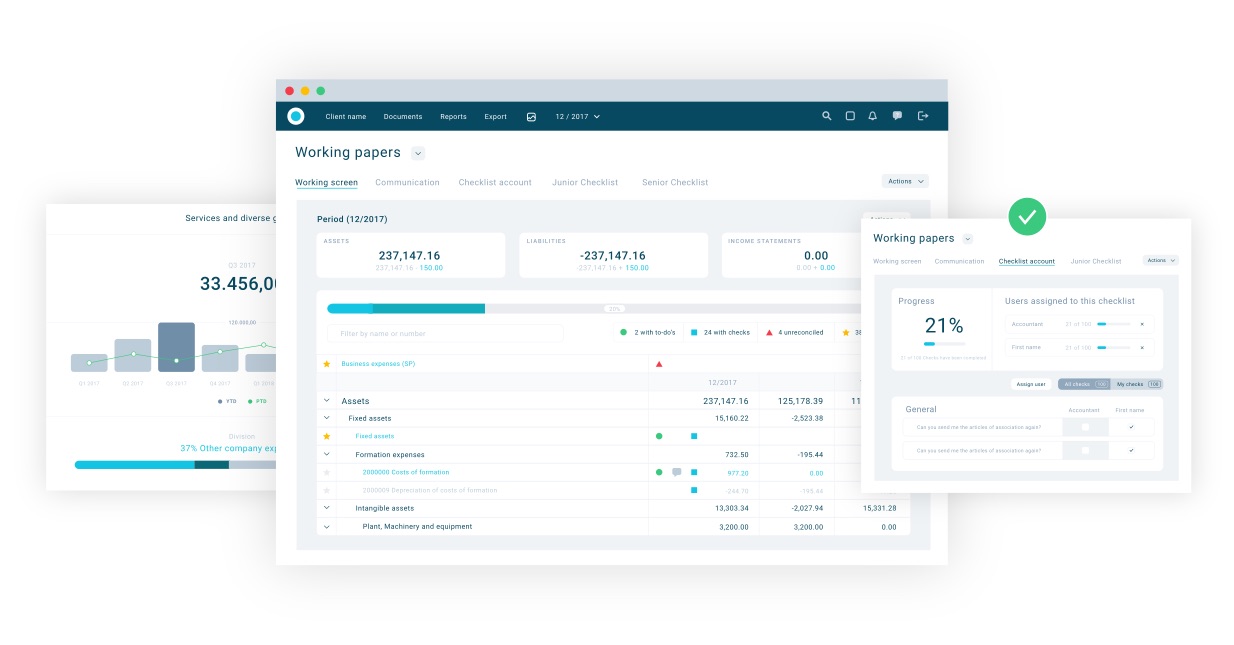
Meet Silverfin, a startup focused on accounting software. This isn’t about helping small startups handle accounting tasks themselves. Silverfin wants to build the cloud service for small and big accounting firms — Salesforce, but for accounting.

The startup just raised a Series B funding round led by Hg — Index Ventures led the previous Series A round. While terms of the deal are undisclosed, a source told me the round is worth approximately $30 million.

In order to improve productivity, Silverfin tries to automate the most time-consuming aspect of accounting — data collection. The company helps you connect with your clients’ accounting software directly to import their data, such as Xero, QuickBooks, Sage and SAP.

After that, Silverfin standardizes your data set and lets you add data manually so the platform can become the main data repository.

Once your data is in the system, you need to process it. Silverfin lets you configure automated workflows and templates so that anybody in the accounting firm can enrich data and check for compliance issues. Like Salesforce and other software-as-a-service products, multiple people can communicate on the service and look at all past edits and changes.

You can then visualize financial data, generate reports and statements. It opens up new possibilities for accounting firms. They can charge advisory services thanks to analytics tools and an alert system.

The startup was founded in Ghent, Belgium, but it has now expanded to London, Amsterdam and Copenhagen. Silverfin has attracted 650 customers, including big accounting firms in Europe and North America.

By targeting the most demanding customers first, Silverfin doesn’t need to replace Xero or QuickBooks altogether. It can integrate with those existing software solutions first. There’s an opportunity to go downmarket later and convince smaller companies that don’t necessarily have a big accounting team.

Powered by WPeMatico

Sony reschedules PS5 event for June 11th

After an indefinite postponement last week, Sony’s PlayStation 5 event is officially back on.

The event has been rescheduled for a live stream on June 11 at 1:00 pm Pacific Time according to a tweet from PlayStation’s official account. It will live stream on Twitch and YouTube.

See you Thursday, June 11 at 1:00pm Pacific time (9:00pm BST) for a look at the future of gaming on #PS5: https://t.co/9XJkXYProo pic.twitter.com/8EoN34UPdd

— PlayStation (@PlayStation) June 8, 2020

The event, which was originally scheduled for June 4th, was postponed last week in response to protests against police violence flaring up across the United States and the world. The company’s statement at the time indicated that the timing didn’t feel quite right to make flashy announcements around new PS5 titles. “While we understand gamers worldwide are excited to see PS5 games, we do not feel that right now is a time to celebrate and for now, we want to stand back and allow more important voices to be heard,” the company’s statement read.

Sony has already shared plenty of details regarding the next-generation system, but details have been a bit more scant when it comes to the launch titles for the console. As Sony and Microsoft go head-to-head this holiday season with new consoles, the question will be whether PlayStation can maintain its edge in delivering launch exclusives that out-rival what Xbox can, even as Microsoft bulks up on studio acquisitions.

The event, which the company has detailed will last about an hour, will tee up “what’s in store for the next generation of games,” Sony says. We’ll be tuning in Thursday and giving a thorough rundown of what gets announced.

Powered by WPeMatico

Challenger bank Bnext revamps rewards for purchases in partner stores

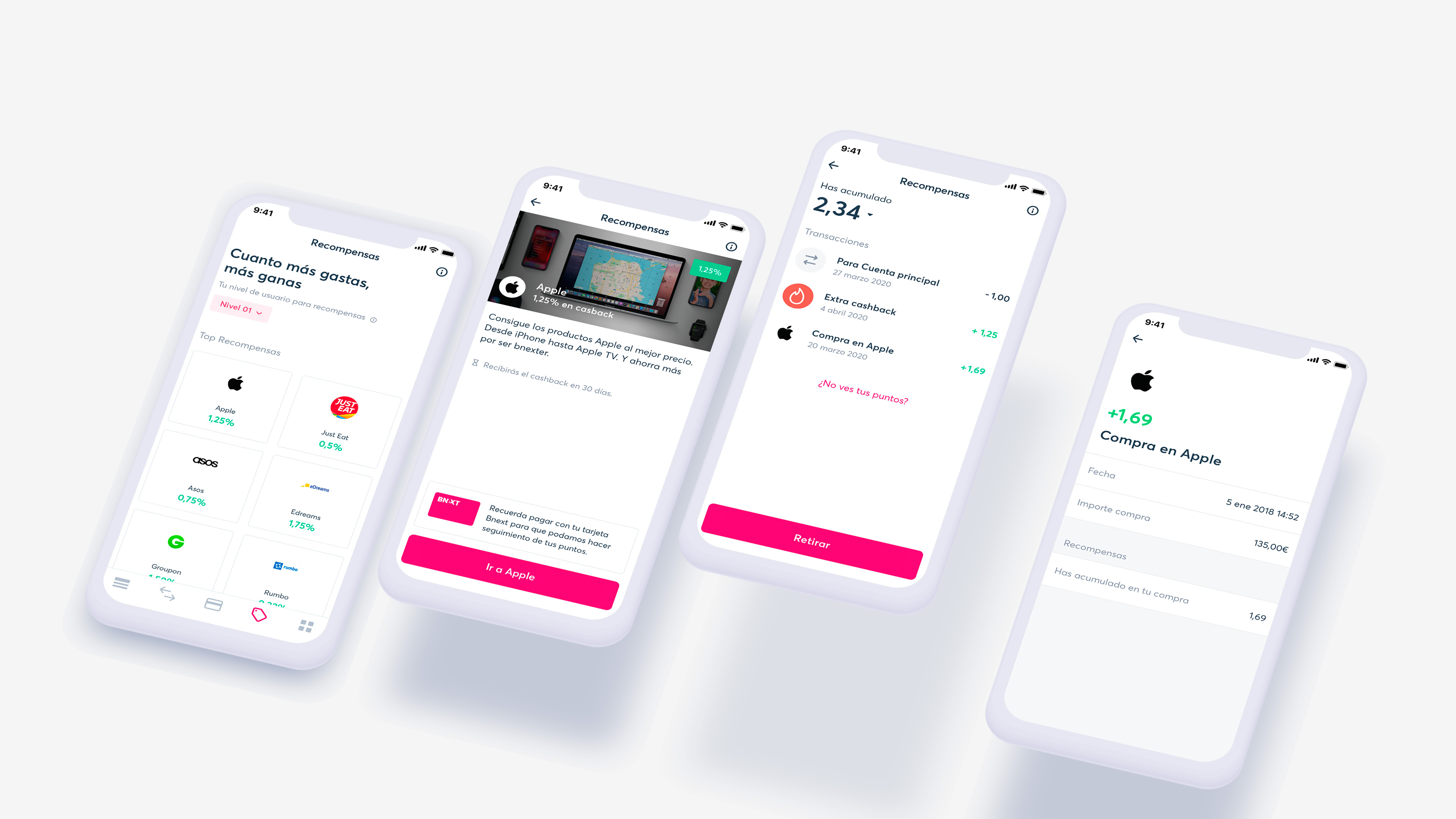
Spanish startup Bnext is revamping its cashback program so that you can buy from partner stores directly from the Bnext app and get some money back. The company has partnered with Button and the feature is available as an open beta.

Traditional cashback portals are a bit clunky. When you find an offer that gives you 2% of your money back, you click on the offer, get redirected to the partner site and hope that your purchase will be registered. A bit later, you get some money back on the cashback website, which you need to cash out to your bank account.

If you’re using Bnext as your bank account, you’ll be able to access rewards directly from your banking app. In addition to that, you don’t get redirected to another site as you purchase goods directly from the Bnext app.

There are multiple levels. If you’re making your first purchase through the feature, you get 1% in savings on average. If you’ve made more than three purchases over the past 30 days, you get 3% in savings on average. In order to reach level 3, you need a premium Bnext subscription. With that level, you get 5% in savings on average.

Partners include AliExpress, Booking.com, eDreams, Europcar, Nike, Just Eat and more. Eventually, the startup wants to let you earn rewards from in-store purchases as well. Bnext is creating a new revenue stream with this feature as the startup will keep a share of the revenue from each transaction.

Bnext provides current accounts and payment cards. You can receive notifications for each transaction with your card, and temporarily lock and unlock your card. You don’t pay any foreign transaction fee as long as you spend less than €2,000 per month with a standard account.

The company has also put together a marketplace of fintech products. You can earn interest by lending money to small companies on October, get a loan, an insurance product and more.

Earlier this year, the startup expanded to Mexico. The company plans to roll out rewards in Mexico soon. Bnext has managed to attract a bit less than 400,000 users.

Powered by WPeMatico

Startups Weekly: The George Floyd protests come home to the tech industry

The tech industry has generally wished that structural discrimination would go away, while pretending that it already has. But technology can be used by anyone for anything. And so, the world has watched video after video of police brutality against Black people in a real-time stream that plays through the closing days of quarantine, culminating in the death of George Floyd and ongoing protests. As employees have left their remote offices to hit the streets, even executives at the largest tech companies —who would usually avoid such complications — have expressed their support officially, online.

What can we expect to change now? After all, diversity and inclusion programs have been getting cut during the pandemic, and stats on employee diversity and VC partner/portfolio demographics have not seemed to be improving quickly over the past decade, at least in aggregate.

First up, a group of Black tech leaders in the Bay Area, including TechCrunch’s Megan Rose Dickey, has put forward a widely-signed petition that specifies five goals including local support and accountability, and commitment to hiring and investing in Black employees and founders.

On the ground in the startup world, a considerable range of investors say they are setting aside dedicated time and resources for Black founders.

Specific proposals for changes to the status quo strike at the heart of of tech as we know it.

To address existing systemic bias, algorithmic and otherwise, contributor Will Walker writes that tech companies like Amazon, Yelp and Grubhub should find ways to feature and favor Black-owned businesses — even if that means re-writing the recommendation algorithms.

And to address systemic bias in who gets funding, Connie Loizos writes that legislation could be the best answer:

Consider that already, most VCs today sign away their rights to invest in firearms or alcohol or tobacco when managing capital on behalf of the pension funds, universities and hospital systems that fund them. What if they also had to agree to invest a certain percentage of that capital to founding teams with members from underrepresented groups? We aren’t talking about targets anymore, but actual mandates. Put another way, rather than wait for venture firms to organically develop into less homogeneous organizations — or to invest in fewer founders who share their gender and race and educational background — alter their limited partner agreements.

Perhaps tech leaders are responding so strongly today because they realize what’s at stake for them if change does not happen faster?

GettyImages 1168618863

The future of work, according to the people trying to invest in it

Meanwhile, the very nature of work as we know it is being re-evaluated. Megan caught up with top investors in a very popular investor survey for Extra Crunch this week, to better understand the problems and solutions. Here’s what Ann Muira-Ko of Floodgate Capital thinks will create unicorns, as a sample:

  • How do you enable solopreneurs to build businesses that are fully tech-enabled? We think of this as the ironman suit for the solopreneur. What financial products and software products can solopreneurs use to provide consumers or their customers with the tech-enabled experiences they have come to expect?
  • How does reputation follow someone? A resume or LinkedIn profile measures where you’ve worked and for how long. With people working more jobs at varied locales, measuring expertise will become a new challenge.
  • How does an organization maintain knowledge? If a company is reliant on its people to share its history and knowledge base, how can that be disseminated without relying on internal experts (who are on the decline)?
  • How should productivity tools (calendars & communication) and enterprise systems (CRM, HR, Finance, etc.) adapt to a multi-modal (work from anywhere) work environment? HR is perhaps the most out-of-date, but every tool will require better integration.

If you’re more interested in the cybersecurity aspects of remote work, you will want to check out security editor Zack Whittaker’s set of investor surveys this week, including this industry overview and this pandemic-focused one.

Data shows investors are in fact busy looking for deals

Are VCs actually open for business during the pandemic? Docsend, a key inside data source, has a new report out this week that shows investor interest has boomed in April. Here’s CEO Russ Heddleston on TechCrunch, talking about the activity on its document management platform:

After the initial decline in March, founders and VCs both bounced back fairly quickly. In fact, the next week VC interest increased 10% while the number of Founder Links Created increased by 12%. However, for the following few weeks the number of links created by founders either stayed flat or dropped. But that isn’t the case for VCs. Demand for pitch decks rose steadily all the way through the week of April 20th, which was 25% up year-over-year. In fact, seven of the top 10 best days for Pitch Deck Interest in 2020 were in the month of April.

The fundraising inactivity has been on the part of the founders! Meanwhile, in a separate article for Extra Crunch, he shares that investors are spreading themselves broadly.

In the recent weeks, as we’ve had higher than average supply and demand, we’ve watched as the average time spent reviewing a deal has declined. In fact, we’re at nearly a two-year low. The only other period when time spent dropped below where it is now was in early 2018 (which not coincidentally was also when demand was at its highest). Twice in 2018 we saw time spent go below three minutes and we’re currently at 3 minutes and 7 seconds.

How a growth marketer helped his high school brother win at TikTok

In a fascinating oral history of sorts for Extra Crunch, Adam Guild explains how he helped his young brother Topper get more than 10 million followers in under five months. Here’s a free excerpt:

At first, figuring out which content would go viral seemed random. There was no correlation between likes, comments, shares or engagement rate.

What made the difference in his successful content? Topper needed to find out to maximize growth, so he went through his TikTok analytics insights and noticed a trend: his most popular videos weren’t the ones with the highest engagement rates. They were the ones with the highest average view durations.

“I wanted to test if this guess was right,” said Topper, “so I posted a few videos with a longer length and teased people in the captions to watch until the end.”

It worked; his videos started getting more views, but it wasn’t a perfect correlation. Some videos with high view durations weren’t taking off.

When Topper asked me for advice, I suggested that the key metric to nail was actually average session duration. That’s what YouTube optimizes for, so it would make sense that TikTok would do the same. This metric measures how long people actually stay on the platform — not on the video — and it can be increased by single videos.

He posted another video to test: one that encouraged viewers to rewatch repeatedly because it had a cliffhanger ending — Topper poured hundreds of Mentos into a massive container of Coke before cutting out the ending.

That video was his most viewed yet, scoring more than 175,000,000 views. He decided to use that lesson in future videos by creating content that helped get viewers addicted to TikTok while also being fun to watch.

Around TechCrunch

Join us to watch five startups pitch off at Pitchers and Pitches on June 10th

Join Eventbrite CEO Julia Hartz for a live Q&A: June 11 at 3 pm EST/Noon PDT/7 pm GMT

Across the week

TechCrunch:

LinkedIn introduces new retargeting tools

The coronavirus has hastened the post-human era

Zynga acquires Turkey’s Peak Games for $1.8B, after buying its card games studio for $100M in 2017

Huawei’s terrible week

Extra Crunch:

Is Zoom the next Android or the next BlackBerry?

The IPO window is open (again)

Unpacking ZoomInfo’s IPO as the firm starts to trade

SaaS earnings rise as pandemic pushes companies more rapidly to the cloud

What grocery startup Weee! learned from China’s tech giants

#EquityPod

From Alex Wilhelm:

Hello and welcome back to Equity, TechCrunch’s venture capital-focused podcast, where we unpack the numbers behind the headlines.

This week, however, the Equity crew (DannyNatashaChris, and Alex) agreed it felt silly to drum up false enthusiasm for funding rounds and startups. Instead, we talked about a more critical topic: systemic racism in the United States. Venture firms and tech executives across the country are pledging to be better following the brutal murder of George Floyd and police brutality.

Better is long overdue.

What follows are the resources we mentioned — and a few more — on the show itself. We’ll be back. Now is the time for sustained momentum and change.

Donations

How to be a better ally

Equity drops every Friday at 6:00 am PT, so subscribe to us on Apple PodcastsOvercastSpotify and all the casts.

Powered by WPeMatico

This Week in Apps: Protests impact app stores, FTC fines app developer, kids’ app trends

Welcome back to This Week in Apps, the Extra Crunch series that recaps the latest OS news, the applications they support and the money that flows through it all.

The app industry is as hot as ever, with a record 204 billion downloads and $120 billion in consumer spending in 2019. People are now spending three hours and 40 minutes per day using apps, rivaling TV. Apps aren’t just a way to pass idle hours — they’re a big business. In 2019, mobile-first companies had a combined $544 billion valuation, 6.5x higher than those without a mobile focus.

In this Extra Crunch series, we help you keep up with the latest news from the world of apps, delivered on a weekly basis.

This week, we’re taking a look at how the civil unrest and George Floyd protests played out across the app stores. The events led some apps — including private messaging apps, police scanners and alerting apps, and other social communication apps — to surge, and even break records. Google decided to delay the launch of Android 11 beta 1 in light of the recent events.

We’re also keeping up with COVID-19 apps and how the pandemic is changing app usage and consumer behavior. Plus, the FTC fined an app developer over privacy violations in a warning shot for the app industry; Zoom faced criticism for its encryption plans; Apple launched an open-source resource for password managers; and more.

How the George Floyd protests impacted the app stores

Protests drive downloads of police scanners 

Downloads of police scanner apps, tools for private communication and mobile safety apps hit record numbers last weekend in the U.S., amid the nationwide protests over the police killing of George Floyd, as well as the systemic problems of racial prejudice that plague the American justice system. According to data from app store intelligence firm Apptopia, top U.S. police scanner apps were downloaded a combined 213,000 times last weekend, including Friday — a 125% increase from the weekend prior and a record number for this group of apps.

The group of top apps included those with similar, if somewhat generic, titles, such as Scanner Radio – Fire and Police Scanner, Police Scanner, 5-0 Radio Police Scanner, Police Scanner Radio & Fire and Police Scanner +.

Citizen, Signal and others spike during protests

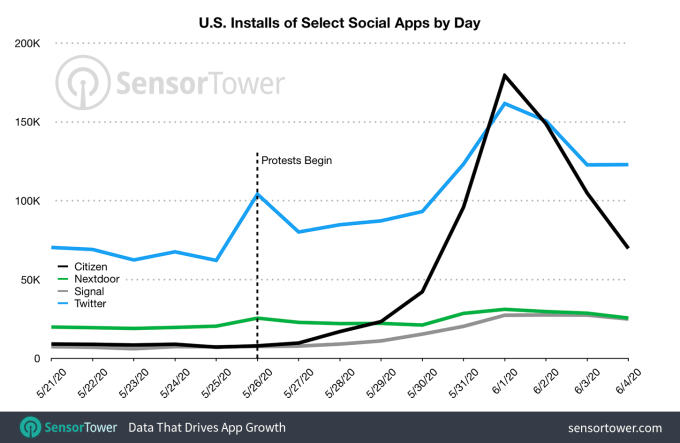
In addition to tracking police movements with scanners, protestors organized and communicated on secure messaging app Signal. Meanwhile, community safety app Citizen, which sends out police alerts, also saw a jump in usage. According to Apptopia, Citizen and Signal both set daily download records, Vox noted earlier this week.
Citizen

Citizen’s app lets users see “incidents,” based on radio communications with 911 dispatchers, police, fire departments and other emergency responders. The app uses high-powered scanners to tune into public radio channels, then digitizes and transcribes the audio, and turns those into incidents placed on the map. But the app is popular because it’s more than a police scanner; it includes a social networking layer where users can react and comment. 

Based on more recent data provided to TechCrunch by Sensor Tower, Citizen was installed around 620,000 times by first-time users in the U.S. during the past week, an increase of about 916% compared to the week prior. First-time installs reached a record 150,000 on June 2, nearly 12x the app’s average of 13,000 daily first-time installs during May. On average, the app was downloaded close to 86,000 times per day, or 6.6x larger than May’s daily average. The app grew to be as high as No. 4 on Tuesday, June 2 on the U.S. App Store, and is now No. 32 Overall on the top free charts.

Signal

Image Credits: Signal

The firm also estimated that Signal had been installed by approximately 135,000 first-time users in the U.S. during the past week across the app stores. This figure represented growth of 165% from the preceding seven days, or about 2.6x that total of approximately 51,000 new installs. Signal averaged about 19,000 installs per day over the past seven days.

For comparison’s sake, Signal was downloaded around 269,000 times in all of May and its average daily number of installs was 9,000. That makes the average for the past week about 2x higher.

Signal is currently ranked at No. 137 among the top free iPhone apps on the U.S. App Store. Earlier, it was ranked at No. 107 on Tuesday, June 2.

This week, Signal also added built-in face blurring for photos, to help better secure the sharing of sensitive information across its network.

Nextdoor and Neighbors by Ring

The civil unrest also impacted neighborhood networking app installs, as communities looked to share information about the protests with one another. Social networking app for neighbors Nextdoor was installed by 185,000 first-time users in the U.S. over the past week, an increase of 26% from 147,000 installs in the week prior. The app also jumped up nearly 50 places in the U.S. App Store rankings, moving from No. 2,014 to No. 156 in the top free iPhone apps chart.

Amazon-owned Neighbors by Ring, where neighbors share alerts, including security camera footage, was installed by 36,000 first-time users in the past week, an increase of 89% from its approximately 19,000 installs the week prior.

Twitter has a record-breaking week as users looked for news of protests and COVID-19
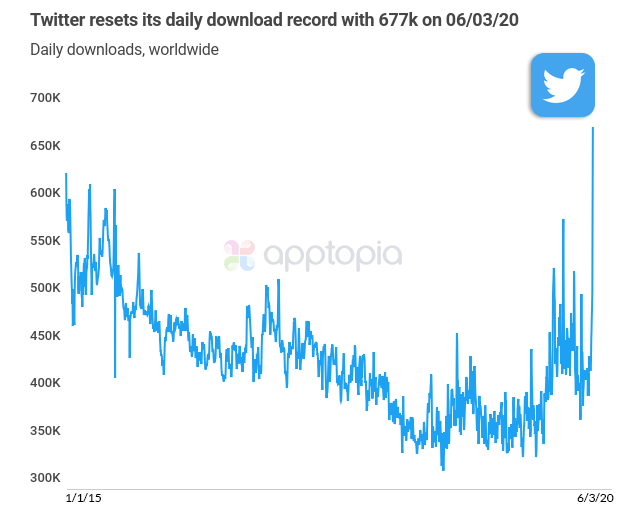
Civil unrest due to the nationwide George Floyd protests drove Twitter to see a record number of new installs this week, according to data from two app store intelligence firms, Apptopia and Sensor Tower. While the firms’ exact findings differed in terms of the total number of new downloads or when records were broken, the firms agreed that Twitter’s app had its largest-ever week, globally.

The app saw at least 677,000 installs at its highest point, Apptopia said. Sensor Tower said it topped 1 million. Twitter also broke a record for daily active users on Twitter in the U.S., when some 40 million people in the U.S. logged into the app on June 3, Apptopia noted. For comparison’s sake, Twitter reported its app had 31 million “monetizable” daily active users (mDAUs) in the U.S. in Q4 2019, which grew to 33 million in Q1 2020.

The spike in installs was attributed to the protests, which were being watched by a global audience, and COVID-19, which continued to spread in worldwide markets.

Apps turn their icons black in support of George Floyd protests 

A small handful of apps did the equivalent of the Instagram black square by turning their icons black this week as a gesture of support toward the protests and civil rights. Participating apps included Reddit, Joss & Main and Shop Avani, for instance. Moves like this can be criticized as being merely performative, but one of the companies involved — Reddit — later followed up with real action. Reddit co-founder Alexis Ohanion on Friday announced he was resigning as a member of the Reddit board, and is now urging them to fill his seat with a black candidate. He also said he would use his future gains from Reddit stock to serve the black community, starting with a $1 million pledge to Colin Kaepernick’s Know Your Rights Camp.

COVID-19 app updates and news

Powered by WPeMatico