1010Computers | Computer Repair & IT Support

Tulsa is trying to build a startup ecosystem from scratch

When you think about startup hubs, Tulsa, Oklahoma is probably not the first city that comes to mind.

A coalition of business, education, government and philanthropists are working to foster a startup ecosystem in a city that’s better known for its aerospace and energy companies. These community leaders recognized that raising the standard of living for a wide cross-section of citizens required a new generation of companies and jobs — which takes commitment from a broad set of interested parties.

In Tulsa, that effort began with George Kaiser Family Foundation (GKFF), a philanthropic organization, and ended with the creation of Tulsa Innovation Labs (TIL), a partnership between GKFF, Israeli cybersecurity venture capitalists Team8 and several area colleges and local government.

Why Tulsa?

Tulsa is a city of more than 650,000 people, with a median household income of $53,902 and a median house price of $150,500. Glassdoor reports that the average salary for a software engineer in Tulsa is $66,629; in San Francisco, the median home price is over $1.1 million, household income comes in at $112,376 and Glassdoor’s average software engineer salary is $115,822.

Home to several universities and a slew of cultural attractions, the city has a lot to offer. To sweeten the deal, GKFF spun up “Tulsa Remote,” an initiative that offers $10,000 to remote workers who will relocate and make the city their home base. The goal: draw in new, high-tech workers who will help build a more vibrant economy.

Tulsa is the second-largest city in the state of Oklahoma and 47th-most populous city in the United States. Photo Credit: DenisTangneyJr/Getty Images

Local colleges are educating the next generation of workers; Tulsa Innovation Labs is working with the University of Tulsa in partnership with Team8 through the university’s Cyber Fellows program. There are also ongoing discussions with Oklahoma State University-Tulsa and the University of Oklahoma-Tulsa about building a similar relationship.

These constituencies are trying to grow a startup ecosystem from the ground up. It takes a sense of cooperation and hard work and it will probably take some luck, but they are starting with $50 million, announced just this week from GKFF, for startup investments through TIL.

Powered by WPeMatico

You can now install the first beta of Android 11

After a series of developer previews, Google today released the first beta of Android 11, and with that, it is also making these pre-release versions available for over-the-air updates. This time around, the list of supported devices only includes the Pixel 2, 3, 3a and 4.

If you’re brave enough to try this early version (and I wouldn’t do so on your daily driver until a few more people have tested it), you can now enroll here. Like always, Google is also making OS images available for download and an updated emulator is available, too.

Google says the beta focuses on three key themes: people, controls and privacy.

Like in previous updates, Google once again worked on improving notifications — in this case, conversation notifications, which now appear in a dedicated section at the top of the pull-down shade. From there, you will be able to take actions right from inside the notification or ask the OS to remind you of this conversation at a later time. Also new is built-in support in the notification system for what are essentially chat bubbles, which messaging apps can now use to notify you even as you are working (or playing) in another app.

Another new feature is consolidated keyboard suggestions. With these, Autofill apps and Input Method Editors (think password managers and third-party keyboards), can now securely offer context-specific entries in the suggestion strip. Until now, enabling autofill for a password manager, for example, often involved delving into multiple settings and the whole experience often felt like a bit of a hack.

For those users who rely on voice to control their phones, Android now uses a new on-device system that aims to understand what is on the screen and then automatically generates labels and access points for voice commands.

As for controls, Google is now letting you long-press the power button to bring up controls for your smart home devices (though companies that want to appear in this new menu need to make use of Google’s new API for this). In one of the next beta releases, Google will also enable media controls that will make it easier to switch the output device for their audio and video content.

In terms of privacy, Google is adding one-time permissions so that an app only gets access to your microphone, camera or location once, as well as auto-resets for permissions when you haven’t used an app for a while.

A few months ago, Google said that developers would need to get a user’s approval to access background location. That caused a bit of a stir among developers and now Google will keep its current policies in place until 2021 to give developers more time to update their apps.

In addition to these user-facing features, Google is also launching a series of updates aimed at Android developers. You can read more about them here.

Powered by WPeMatico

Huawei’s new handset goes international June 25, with all of the camera and none of the Google

The Huawei P40 Pro+ has already been on the market in China for a few days now. And in spite of various legal woes, the handset is set for international availability on June 25. Given everything the company is dealing with, it should come as no surprise that availability outside of its home country will be fairly limited to select markets, including the U.K. and Europe.

It won’t be available through the standard channels in the U.S., naturally. And what’s more, it won’t have any Google services, in light of the hardware maker’s ongoing fight with the United States government. Instead — like other Huawei flagships — it will rely on the company’s own forked version of Android, devoid of mainstay applications like Gmail, Google Maps and the Play Store.

For most other intents and purposes, however, Huawei is down, but not out. In spite of tremendous pressure, the company continues to produce some of the most bleeding-edge mobile hardware on the market. Here, that primarily comes down to a fantastic camera module. Like nearly every other part of the smartphone ecosystem, it’s increasingly difficult to stand out from the pack with regard to imaging, but by most accounts, Huawei has managed to do it with the P40 Pro+.

For starters, there’s a 10x (!) optical zoom (with up to 100x digital and all of the image issues that brings), which very much pushes the boundaries of what a handset can do. There are five cameras, in total, including that eight-megapixel 10x lens. The others include a 50-megapixel standard, 40-megapixel ultra wide, eight-megapixel with 3x optical and a time-of-flight sensor for increasingly important depth-sensing.

The handset will run ~$1,658 when it launches later this month. It’s the latest sign that Huawei will continue pushing forward, even as it deals with increasing international pressure. Until the company manages to fully replace Google’s offerings in house, however, the current set up will likely be too much of a compromise for many potential buyers.

Powered by WPeMatico

Flatfile scores $7.6M seed investment to simplify data onboarding

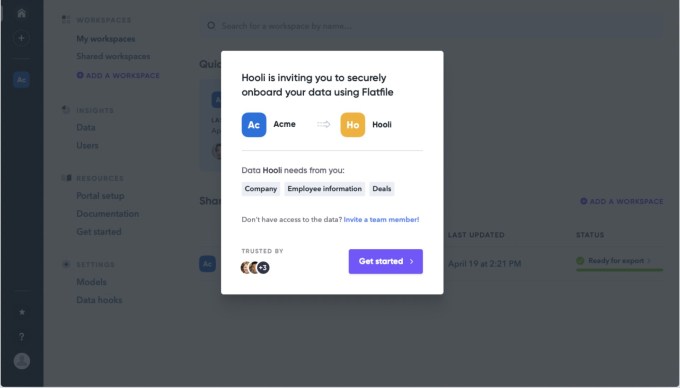
One of the huge challenges companies like enterprise SaaS vendors face with new customers is getting customer data into their service. It’s a problem that Flatfile founders faced firsthand in their jobs, and they decided to solve it. Today, the company announced a healthy $7.6 million seed investment to expand on that vision.

The company also announced the release of its latest product, called Concierge.

Two Sigma Ventures led the investment, with participation from previous investors Afore Capital, Designer Fund and Gradient Ventures (Google’s AI-focused venture fund).

Company CEO David Boskovic says he and co-founder Eric Crane recognized that this is a problem just about every company faces. Let’s say you sign up for a CRM tool like HubSpot (which is a Flatfile customer). Your first step is to get your customer data into the new service.

As Boskovic points out, if you have thousands of existing customers that can be a real problem, often involving days or even weeks to prepare the data, depending on the size of your customer base. It typically includes importing your data from an existing source, then manually moving it to an Excel spreadsheet.

“What we’re trying to solve for at Flatfile is automating that entire process. You can drop in any data that you have and get it into a new product, and what that solves from a market perspective is the speed of adopting new software,” Boskovic told TechCrunch.

Image Credit: Flatfile

He says they have automated the process to the point it usually takes just a few minutes to process the data, If there are problems that Flatfile can’t solve, it presents the issue to the user who can fix it and move on.

The founders realized that not every use case is going to involve a simple one-to-one data transfer, so they created their new product called Concierge to help companies manage more complex data integration scenarios for their customers.

“What we do is we provide a bridge between disparate data formats that are a little bit more complex and let our customers collaborate with their new customers that they are onboarding to bring the data to the right state to use it in the new system,” Boskovic explained.

Whatever they are doing, it seems to be working. The company launched in 2018 and today has 160 customers with 300 sitting on a waiting list. It has increased that customer count by 5x since the beginning of the year in the middle of a pandemic.

Any product that reduces labor and increases efficiency and collaboration in a digital context is going to get the attention of customers right now, and Flatfile is seeing a huge spike in interest in spite of the current economy. “We’re helping onboard customers quickly and more efficiently. And our Concierge service can also help reduce in-person touch points by reducing this long, typical data onboarding process,” Boskovic said.

The company has not had to change the way it has worked because of the pandemic, as it has been a distributed workforce from day one. In fact, Boskovic is in Denver and co-founder Eric Crane is based in Atlanta. The startup currently has 14 employees, but plans to fill at least 10 roles this year.

“We’ve got a pretty aggressive hiring map. Our pipeline is bigger than we can handle from a sales perspective,” he said. That means they will be looking to fill sales, marketing and product jobs.

Powered by WPeMatico

Hear from Figma founder and CEO Dylan Field at TC Early Stage in July

Figma is one of the fastest-growing companies in the world of design and in the broader SaaS category. So it goes without saying that we’re absolutely thrilled to have Figma CEO Dylan Field join us at Early Stage, our virtual two-day conference on July 21 and 22, as a speaker. You can pick up a ticket to the event here!

Early Stage is all about giving entrepreneurs the tools they need to be successful. Experts across a wide variety of core competencies, including fundraising, growth marketing, media management, recruiting, legal and tech development will offer their insights and answer questions from the audience.

Field joins an outstanding speaker list that includes Lo Toney, Ann Muira Ko, Dalton Caldwell, Charles Hudson, Cyan Banister and more.

Field founded Figma in 2012 after becoming a Theil fellow. The company spent four years in development before launching, working tediously on the technology and design of a product that aimed to be the Google Docs of design.

Figma is a web-based design product that allows people to design collaboratively on the same project in real time.

The design space is, in many respects, up for grabs as it goes through a transformation, with designers receiving more influence within organizations and other departments growing more closely involved with the design process overall.

This also means that there is fierce competition in this industry, with behemoths like Adobe iterating their products and growing startups like InVision and Canva sprinting hard to capture as much market as possible.

Figma, with $130 million+ in total funding, has lured investors like Index, A16Z, Sequoia, Greylock, and KPCB.

At Early Stage, we’ll talk to Field about staying patient during the product development process and then transitioning into an insane growth sprint. We’ll also chat about the fundraising process, how he built a team from scratch, and how he took the team remote in the midst of a pandemic, as well as chatting about the product development strategy behind Figma.

How to take your time as fast as you can

Figma spent four years in stealth before ever launching a product. But when it finally did come to market, its industry was in the midst of a paradigm shift. Entire organizations started participating in the design process, and conversely, designers became empowered, asserting more influence over the direction of the company and the products they built. We’ll hear from Figma founder and CEO Dylan Field on how he stayed patient with product development and sprinted towards growth.

Get your pass to Early Stage for access to over to 50 small-group workshops along with world-class networking with CrunchMatch. They start at just $199 but prices increase in a few days so grab yours today.

Powered by WPeMatico

Transparent face mask startup inhales $1M seed round

A Swiss startup called HMCARE, spun out of the École polytechnique fédérale de Lausanne, has raised a million Swiss Francs (equivalent to about $105 million) to commercialize its transparent and relatively eco-friendly surgical masks.

The founders were inspired by healthcare workers in the 2015 Ebola outbreak and at children’s hospitals around the world working closely with patients but unable to show their faces. Likewise parents and relatives of immunocompromised people who must make a human connection with two-thirds of their face covered.

There were technically transparent masks available, but they were just regular masks with a plastic window in them, which can fog up and isn’t breathable. Thierry Pelet, now CEO of the company, approached his EPFL colleagues with a prototype of a transparent mask material meeting the rigorous demands of a medical environment. It must permit air through but not viruses or bacteria, and so on.

The team worked with Swiss materials center Empa to create a new type of textile. Using biomass-derived transparent fibers placed 100 nanometers apart to form sheets and then triple-layered, they made a flexible, breathable material that’s also nearly transparent — a bit like lightly frosted glass. They call it the HelloMask.

The material can be made in bulk and formed into mask shapes just like normal cloth, but there is the matter of spinning up manufacturing for it. Fortunately, the world is desperate for masks, and the idea of a transparent one was clearly catnip for investors. HMCARE easily raised a million-franc seed round, the R&D work having been done using nonprofit donations and grants.

While the HelloMasks could launch as early as the start of 2021, they’ll be primarily for the medical community, though public availability is certainly a possibility.

Powered by WPeMatico

IBM Cloud suffers prolonged outage

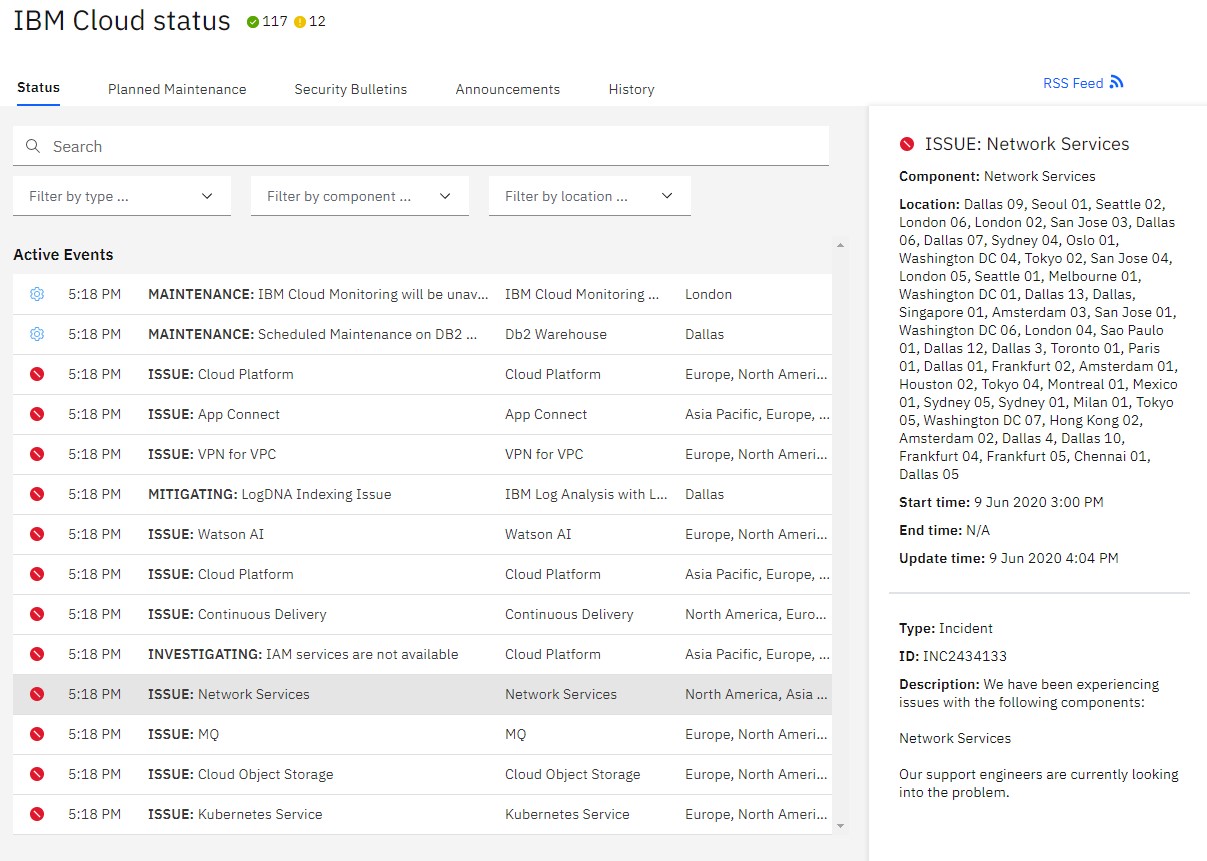
The IBM Cloud is currently suffering a major outage, and with that, multiple services that are hosted on the platform are also down, including everybody’s favorite tech news aggregator, Techmeme.

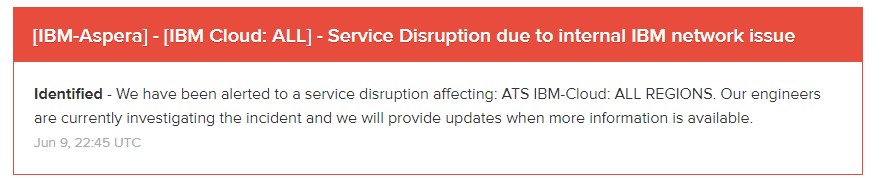
It looks like the problems started around 2:30pm PT and spread from there. Best we can tell, this is a worldwide problem and involves a networking issue, but IBM’s own status page isn’t actually loading anymore and returns an internal server error, so we don’t quite know the extent of the outage or what triggered it. IBM Cloud’s Twitter account has also remained silent, though we found a status page for IBM Aspera hosted on a third-party server, which seems to confirm that this is likely a worldwide networking issue.

IBM Cloud, which published a paper about ensuring zero downtime in April, also suffered a minor outage in its Dallas data center in March.

We’ve reached out to IBM’s PR team and will update this post once we get more information.

Update #1 (5:06pm PT): we are seeing some reports that IBM Cloud is slowly coming back online, but the company’s status page also now seems to be functioning again and still shows that the cloud outage continues for the time being.

Update #2 (5:25pm PT): IBM keeps adding additional information to its status page, though networking issues seem to be at the core of this issue.

Powered by WPeMatico

If you’re not investing in diverse founders, you’re a bad investor

BLCK VC
Contributor

BLCK VC is a nonprofit focused on empowering Black investors and increasing diversity in venture capital.

We won’t sit here as we have for so many years with strong faces and encouraging words and pretend that we’re not tired.

We’re tired because we’ve spent yet another week mourning our Black brothers and sisters who died unjust deaths. We’re tired because we spent half of that week holding the hands of White allies as they were reminded that racism still exists and that it is, indeed, sad. We’re tired because we’re a broken record, telling firms and companies what they can do to fight racism and rarely getting the action they so emotionally promise they care about. We’re tired of holding back anger and sadness as we talk about these issues, knowing our industry isn’t even doing the bare minimum to support Black investors. On top of advising allies, mourning lives lost and working full time jobs, we also raised over $100,000. And we’re tired of racism.

Last week, BLCK VC hosted We Won’t Wait, a day of action where we called on venture firms to discuss, donate and diversify. We asked these firms to discuss Venture’s role in combating institutional racism, to donate to nonprofits that promote racial equity and to release their data on the diversity of their investment teams and portfolio founders. These are the first steps. If you haven’t done these, you’re likely not ready for “Office Hours.” So before we get ahead of ourselves, let’s address why these steps aren’t straightforward or sufficient.

Discuss. It took nationwide uprisings for many VC firms to discuss how they could combat institutional racism. Yet, 80% of firms don’t have one Black investment professional who can identify with what we go through in both our professional and personal lives. BLCK VC held its own discussion to share that perspective, centered on the experiences of Black investors and entrepreneurs.

During this discussion, Terri Burns of GV said, “when a Black person is murdered yet again by police, it is not correct to say that the system has failed, because the system was designed that way.” It is clear that systemic racism leads to the maltreatment, dehumanization and unjustified deaths of Black people across the country. Van Jones of Drive Capital drew a fitting analogy: “Being Black is like being in lane eight with a weight vest and cement boots.” Sounds uncomfortable. But that’s how every Black person in America feels stepping out of bed everyday. For Black founders, discrimination by VCs is par for the course. Elise Smith is not alone when she puts on her daily armor to allow herself to show up in the White-dominated industries of venture capital and Silicon Valley tech.

But we’re not going to repeat what they said. Because you can watch the video, and you can do the research, and you can understand the problem on your own. Truthfully, we have no interest in explaining the problem to White VCs again and again when so many of my brothers and sisters have already spoken on it. If you’d like to know why institutional racism made venture capital so homogeneous and exclusive and racist, please see here, here, here, here and here.

What we are interested in explaining is that these are just examples of what Black investors and entrepreneurs deal with everyday. For almost every Black person in tech, these examples are not only relatable, they are commonplace. These are not the stories that shock and surprise the Black community, these are the stories of the everyday. We didn’t talk about the times we heard the N-word from your colleagues or the times they said our natural hair and beards were unprofessional. We talked about the systems.

There are so many more stories and experiences out there besides what was shared by those seven voices, so please think about what perspectives are missing when you have your discussions. Not just your discussion about racism, but your discussions about the future of venture capital, and about aerospace investing, and about COVID-19 and D2C businesses, and about hiring, and about mentoring and about golf. Black voices are so often left out of the conversations where relationships are built and investment decisions are made, but discussions that lack a Black perspective are incomplete.

Donate. Many VC firms and investors spoke last week about donating their time and resources to Black entrepreneurs and investors — what an interesting way to talk about your job. Please do not donate your time or your money to Black investors or entrepreneurs.

Invest in Black founders because they’re some of the best entrepreneurs. Invest in them because they understand an issue that you do not. Invest in them for the same reason you invest in all of your entrepreneurs — because they’re good. When you frame what you’re doing as a donation, it not only demeans what these entrepreneurs are doing and perpetuates some of the most racist aspects of venture capital, but it also prevents you from understanding that you’re bad at your job. Yes, if you don’t have a diverse pipeline or a diverse portfolio you are bad at your job. Making a separate space and separate fund for Black entrepreneurs removes firms from the responsibility they have to search for, invest in and support Black founders.

If you would like to donate money, donate money to nonprofits that fight institutional racism. If you would like to donate time, volunteer. If you would like to become a better investor, figure out why your pipeline is so homogeneous and fix it.

Diversify. Let’s circle back to an important statistic: More than 80% of venture capital firms don’t have a single Black investor. This statistic is interesting because, as much as it’s about industry trends, it’s really about the failings of individual firms. Most firms don’t have a diverse investing staff. They don’t have a diverse investing staff because they don’t understand the value of racial diversity. They don’t understand the value of racial diversity because there are no diverse investors to force them to think about diversity. Rinse. Repeat.

The single most important part of diversifying a VC firm and diversifying VC broadly is tracking the lack of diversity. Most firms do not routinely track data on their investor, deal pipeline, event or investment diversity. As a result, they rarely think about racial diversity. This is where we ask firms to start. Yes, mentorship can be helpful, office hours can be helpful, but if you’re not tracking your firm’s diversity metrics, they will not improve.

What now? Okay, you’ve discussed racism with your partners, you’ve donated money to nonprofits and you (hopefully) started tracking the diversity of your firm. Now what? Racism resolved? Probably not.

Hopefully these conversations made you realize where your firm’s specific shortcomings are, and you have to address those. Most firms will realize they have a pipeline problem, so start there. Do all of your events, dinners and programs have Black representation? When you’re trying to fill an investor role, did you post the job on your website and in different Black online communities? Did your final round of candidates reflect the diversity of our country? Did you support the diverse investors you already employ so they don’t feel disadvantaged, under-advocated and left out? When you’re trying to write new checks, did you utilize Black scouts and consider businesses that don’t address you directly?

When you’ve done all of that, ask yourself this: When the protests quiet down, and articles about racial oppression aren’t at the top of your timeline, what will you be doing? Don’t let it just be office hours. Don’t let the enormity of the work ahead paralyze you against taking action now. Your actions matter. Your inaction matters.

The resilience of the Black community is unparalleled. That resilience means that no matter how tired we are, we will still fight to change this country and to change this industry. It means that no matter how many times we don’t want to advise allies, we will. And it means that no matter how many times we face oppression and mourn for our brothers and sisters, we will still rise to the challenges. And while the stories of overt racism and microaggressions will continue, so too will our drive to move forward and our action to break down barriers. We will continue to build a home for ourselves in this industry. We will continue to work to ensure that Black Lives Matter.

Powered by WPeMatico


What to consider before publishing your diversity memo

In the past few weeks, several venture capital firms have published different variations of the same pledge: we’ll do a better job supporting the Black community.

My timeline, and I’m assuming yours too, has been filled with statements from non-Black venture capitalists saying that they will rethink how to be more inclusive with their hiring and wiring.

There is no need to applaud firms for taking long overdue steps to treat others equally. What is more important is how we’re going to hold these firms accountable going forward, after a history of inaction.

In a memo published on Friday, Matchstick Ventures outlined a series of commitments to fight racism and underrepresentation. The firm, which manages nearly $37 million dollars and is led by Ryan Broshar and Natty Zola, turned to Black entrepreneur Clarence Bethea for advice on how to proceed.

The pledge stood out for two firm reasons: It is more robust than most promises we have seen by high-profile firms, and it has actual numbers and a deadline, which are key to benchmarking progress.

Disclose your current diversity statistics

Matchstick says 7% of the companies it has invested in have Black founders or founding team members, which is seven times the industry average. Portfolio diversity data needs to be more largely released by the VC community because it’s the only way to determine if progress is being made. So far, beyond Matchstick, we’ve only seen Initialized Capital release diversity metrics. Union Square Ventures said that of moe than 100 investments, only a few have been in self-identified Black founders.

Powered by WPeMatico

Podhero launches a $5.99 subscription app where you can support your favorite podcasts

Podhero is offering listeners a new way to pay their favorite podcasters.

The startup behind the app is led by Pete Curley and Garret Heaton, who previously founded HipChat (sold to Atlassian) and launched Swoot last year, which was focused on helping you find new podcasts through sharing.

In a Medium post published today, Curley wrote that despite Swoot’s “great retention and passionate users,” the team realized that podcasters faced a bigger problem: “It’s really hard to make money,” with 97.2% of podcasts not monetizing at all.

You’re probably used to hearing ads in some of your favorite podcasts, but Curley said only 1.4% of podcasts have ads. Meanwhile, he suggested that “subscription services are the most fair and predictable way for creators to make money,” and that “if 50% of podcast listeners paid for ad-free shows — creators would make $3.7 billion/year, nearly 6x more than ads made in 2019.”

So Podhero has launched its own subscription podcast app, but unlike Luminary — which has been criticized for taking a more closed approach to the previously open podcast ecosystem — it’s not trying to lure listeners to pay for exclusive content. Instead, it’s taking something closer to the Patreon approach of financially supporting creators.

Of course, podcasters can already ask for support via Patreon, but Curley argued that the service isn’t right for many podcasters, due to the extra work involved, the 8% cut taken by Patreon, the pressure to create bonus content and the fact that they simply don’t like asking for money.

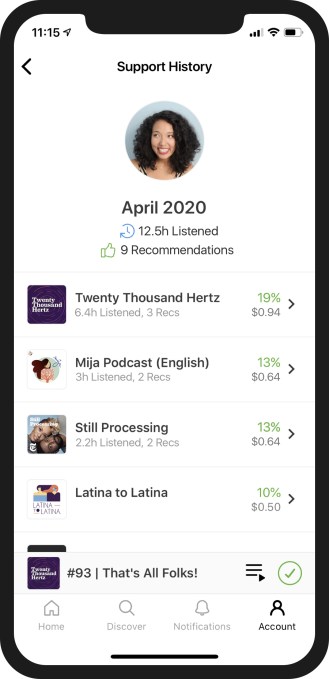
Podhero is supposed to make it easier for both the podcaster and the listener, who pays a $5.99 subscription fee every month. That includes an optional $1 fee for Podhero, plus $4.99 that’s divvied up among podcasts.

Podhero will automatically create a list of podcasts based on your listening activity, but you can adjust the list and the percentages at any time. And Curley isn’t fully giving up on sharing as a discovery mechanism — listeners can also recommend podcast episodes, which affects their payouts as well.

While Podhero is launching today, the company says it’s already populated with more than 1 million podcasts. Most of those podcasters don’t work with Podhero — for example, TechCrunch’s podcasts are in the app even though we don’t have a business relationship. Curley told me via email that if a podcaster isn’t working with the startup yet, any money contributed by fans will be saved for whenever they claim their Podhero profile.

“We may have to do something with unclaimed money at some point, but [that’s] not a problem we’ll be worrying about for some time,” he said.

Powered by WPeMatico