1010Computers | Computer Repair & IT Support

Spider-Man and stray cats take center stage as Sony showcases its PS5 gaming lineup

Several months after teasing a holiday release for the PlayStation 5 back at CES, Sony finally gave gamers a lengthy sneak peek at the next-gen console’s lineup. The event — which was initially set for last week before being pushed due to nationwide protests — comes a month after a similar event for Microsoft’s Xbox Series X.

The event was very much inline with a standard E3 presentation — albeit devoid of the standard live element, due to COVID-19-related restrictions. And honestly, it was a nice change after last year’s odd, low-key Sony event at the gaming show, focused almost exclusively on gameplay. In fact, as the company noted, everything after the Grand Theft Auto V re-release trailer that opened the show was captured directly from a PS5. That, too, is a welcome change from the standard barrage of misleading trailers.

GTA V kicked off the show — a nod to the the 25th anniversary of the PlayStation and the fact that every version of the console has had an installment of the popular Rockstar series. An upgrade version of V will feature expanded gameplay when it launches in 2021. More excitingly is Spider-Man: Miles Morales, a sequel to the PS4 Marvel gaming title featuring the Into the Spider-Verse star. The title is set for a release alongside the new console in late 2020. 

Popular racing title Gran Turismo followed, with extended gameplay. The seventh version of the series is set for release on PS5, as is a new installment of the Ratchet and Clank adventure series, titled Rift Apart. 

Among the more compelling new additions is Stray. Due out in 2021, the trailer didn’t reveal much, but the game appears to star a gifted stray cat set in a world where humans are mercifully no longer around. Honestly, I’m into it.

After another look at the PS5 DualSense controller we first saw in April, previews started getting faster and furiouser. The list includes LittleBigPlanet spin-off, Sackboy: A Big Adventure, Oddworld: Soulstorm, Returnal, Destruction Allstars and Ghostwire Tokyo. In January 2021, Agent 47 will return to PlayStation yet again, with the release of Hitman III.

Also arriving next year is Solar Ash, another title from AnnaPurna (also the studio behind stray), which was among the more aesthetically stunning entries of the day, with bold, flat colors. The Kickstarter-supported Little Devil Inside is another stunning addition with a distinct art style — among the cartooniest of the games we saw today.

And, of course, it wouldn’t be a proper PlayStation launch without at least one flagship gaming title. NBA 2K21 was the first to take center stage. The trailer featured the kind of closeup, realistic sweat one can only get with a next-gen console. Among the highest-profile remakes for the PS5, meanwhile, is an update of 2009,’s PlayStation 3 RPG Demon’s Souls, from Bluepoint and Japan Studio.

A presentation that was largely devoid of first-person shooters (honestly, probably for the best given everything that’s been going on in the world) did feature Arkane Studio’s time-bending  Deathloop, however. There was another cat — this time holographic — in the trailer for Pragmata. The image of an astronaut walking through an abandoned Times Square was honestly a little too real right now. You’ll have to wait until 2022 for that one. The Horizon Zero Dawn sequel Forbidden West continued the close to hope apocalyptic vibes. Maybe things will feel less end-timesy when it arrives? Hard to say, but at least the graphics look great.

Powered by WPeMatico

Kahoot raises $28M for its user-generated educational gaming platform, now valued at $1.4B

As schools stay closed and summer camp seems more like a germscape than an escape, students are staying at home for the foreseeable future and have shifted learning to their living rooms. Now, Norwegian educational gaming company Kahoot — the popular platform with 1.3 billion active users and over 100 million games (most created by users themselves) — has raised a new round of funding of $28 million to keep up with demand.

The Oslo-based startup, which started to list some of its shares on Oslo’s Merkur Market in October 2019, raised the $28 million in a private placement, and said it also raised a further $62 million in secondary shares. The new equity investment included participation from Northzone, an existing backer of the startup, and CEO Eilert Hanoa. While it’s not a traditional privately held startup in the traditional sense, at the market close today, the company’s valuation was $1.39 billion (or 13.389 billion Norwegian krone).

Existing investors in the company include Disney and Microsoft, and the company has raised $110 million to date.

Kahoot launched in 2013 and got its start and picked up most of its traction in the world of education through its use in schools, where teachers have leaned on it as a way to provide more engaging content to students to complement more traditional (and often drier) curriculum-based lessons. Alongside that, the company has developed a lucrative line of online training for enterprise users as well.

The global health pandemic has changed all of that for Kahoot, as it has for many other companies that built models based on classroom use. In the last few months, the company has boosted its content for home learning, finding an audience of users who are parents and employers looking for ways to keep students and employees more engaged.

The company says that in the last 12 months it had active users in 200 countries, with more than 50% of K-12 students using Kahoot in a school year in that footprint. On top of that, it is also used in some 87% of “top 500” universities around the world, and that 97% of Fortune 500 companies are also using it, although it doesn’t discuss what kind of penetration it has in that segment.

It seems that the coronavirus outbreak has not impacted business as much as it has in some sectors. According to the midyear report it released earlier this week, Q2 revenue is expected to be $9 million, 290% growth compared to last year and 40% growth compared to the previous quarter, and for the full year 2020, it expects revenue between $32 million and $38 million, with a full IPO expected for 2021.

As it has been doing even prior to the coronavirus outbreak, Kahoot has also continued to invest in inorganic growth to fuel its expansion. In May, it acquired math app maker DragonBox for $18 million in cash and shares. The company also runs an accelerator, Kahoot Ignite, to spur more development on its platform.

However, Hanoa said that Kahoot is shifting its focus to now also work with more mature edtech businesses.

“When we started out, we were primarily receiving requests on early stage products,” he said. “Now we have the opportunity to consider mature services for either integration or corporation. It’s a different focus.”

Update: A previous version of this story said that DragonBox was acquired in March. It was acquired in May. The story has been updated to reflect this change. 

Powered by WPeMatico

Snap lets you play as your Bitmoji in third-party games

Snap is announcing at its Snap Partner Summit that the first games that will take advantage of Bitmoji will roll out soon. The feature was announced last year, and it looks like developers can finally take advantage of that SDK. You’ll be able to play a game with you as the hero — or at least the Bitmoji representation of you.

While this feature is reminiscent of Xbox Avatars or Nintendo’s Mii on the Wii, 3DS and Wii U, Bitmoji for Games is a cross-platform solution, from mobile games to console games and PC games. The issue with console-specific avatars is that you can’t support Xbox Avatars on PlayStation consoles for instance — that could be the reason why console manufacturers have been slowly phasing out those avatars. Bitmoji for Games could potentially solve that issue.

Having said that, the initial list of partners only includes mobile games on iOS and Android. Games include Super Brawl Universe from Nickelodeon and Playsoft, Uno from Mattel, Scrabble GO from Scopely and a soon-to-be-announced game from French startup Voodoo.

Let’s hope that Snap will be able to expand its list of partners beyond board games and casual mobile games. For instance, I would totally see Bitmoji for Games in Just Dance.

Here’s a concept video presenting the feature. As you can see, you just have to connect with your Snapchat account to import your Bitmoji to third-party games:

In other news, Snap is adding more games to Snapchat. There are already more than a dozen games that you can play with your friends when you’re chatting with them. Some of them are built in-house while others are developed by third-party game makers.

According to the company, 100 million Snapchat users have played a game since the feature launched last year. On average, users who choose to play Bitmoji Party, a Mario Party-inspired game that lets you compete with your friends in mini-games, spend 20 minutes in the game in a given day.

There’s a direct correlation between engagement and monetization as Snap doesn’t rely on micro-transactions and in-app purchases with Snap Games. The company monetizes this feature with video ads.

“We took a look at the state of mobile gaming a few years back and observed that so many successful games on mobile didn’t have your friends that deeply integrated into the experience,” Director of Product Will Wu told TechCrunch. “There’s a lot of games you just play solo on the bus or on the airplane or something like that. For us, we were really looking to recreate that experience that we may have had growing up, sitting side by side with our friends playing a game on a couch together. You’re actually looking at the same screen.”

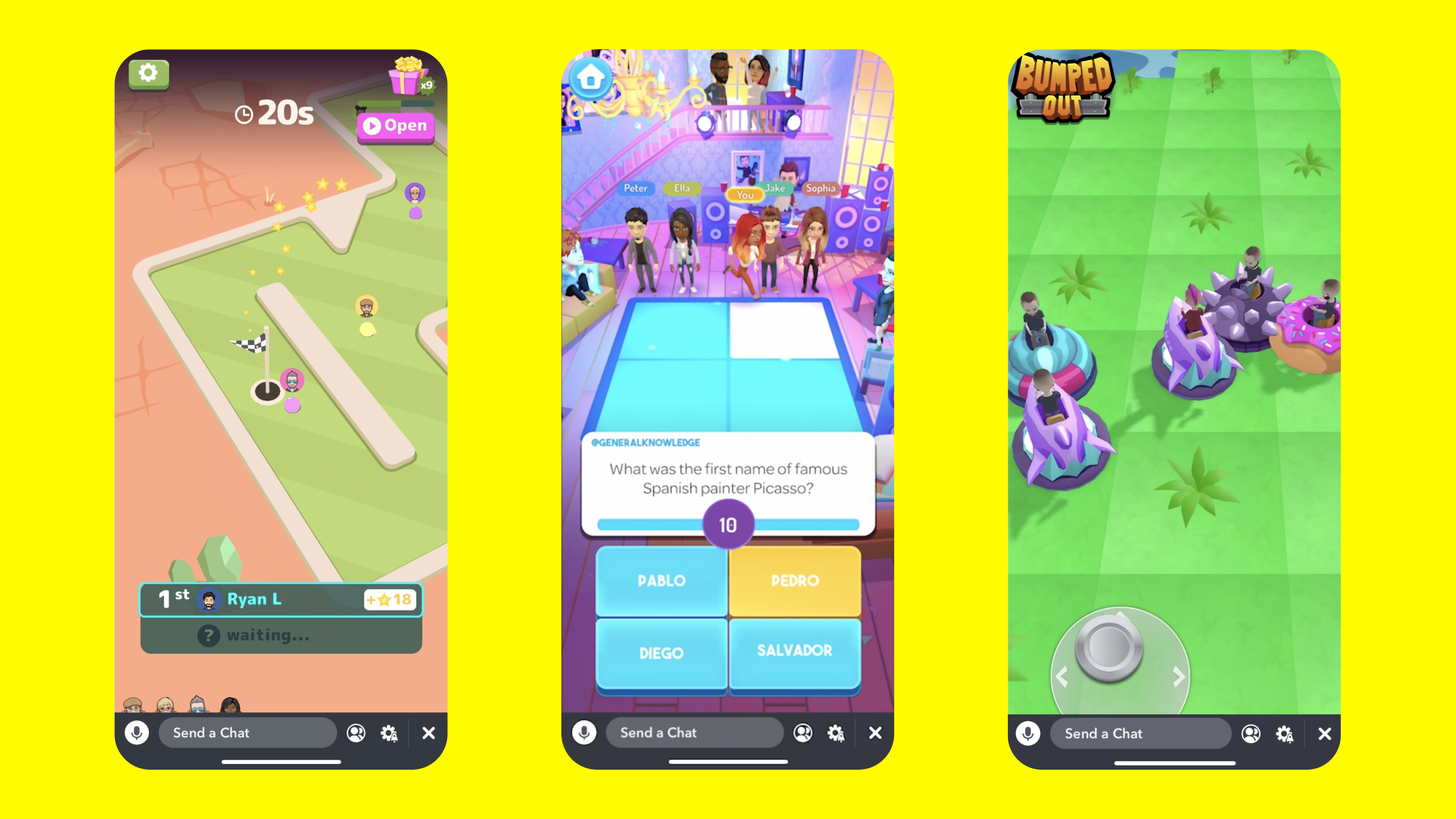
The most interesting new game that the company will release in the coming months is Bitmoji Paint. This game is a sort of casual Minecraft-inspired creativity game. Users play together on the same planet and can paint tiles on the ground. It lets you create pixel art and look at other creations.

Other new games include Bumped Out (Zynga), Friend Quizzes (Game Closure), Ready Set Golf! (PikPok) and Sling Racers (Madbox). They will be released over the coming months.

Powered by WPeMatico

Snapchat redesigns its app with new action bar

Snap is unveiling some important changes for Snapchat at its Snap Partner Summit. The navigation has been rethought with a new action bar at the bottom that lets you access Snap Map and Snap Originals in just a tap.

Snap Map is also getting some brand new features to compete head-to-head with Google Maps. A new banner called “Happening Now” is also being rolled out to all users in the U.S. with a curated selection of stories at the top of the Discover tab.

Snap has been testing the new design for a while and it is now official. While Snapchat has always been a bit obscure to figure out for newcomers, navigation has been greatly simplified with the redesign.

For instance, Snapchat now has a good old navigation bar with five tabs at the bottom. The company calls it the action bar, as it’s supposed to change contextually based on what you’re doing. But at heart, it’s simply a way to access some of Snap’s most popular products in just a tap.

Old-school users will still feel at home with conversations on the left of the camera and stories on the right of the camera. But there are now two additional tabs.

All the way at the bottom left, Snap Map now has its own button — you no longer have to pull down from the camera screen to access the map.

At the bottom right, you’ll find two buttons that replace the previous Discover button. The old Discover tab is now called Stories. It features stories from friends, subscriptions and story recommendations.

If you swipe right one more time, you’ll find a new tab called Discover. It replaces the previously hidden tab called Shows. It features Snap Originals, the company’s original video content, stories that are currently trending on the platform and a new “Happening Now” section (more on that below).

Many apps copied Snapchat’s design over the years. Swiping your screen left and right to switch from one tab to another is a fluid and seamless experience. Square’s Cash App is a great example of how it feels.

But it creates some issues around discoverability. Many users probably didn’t know they could access Snap Map by swiping down on the screen, for instance.

Tapping on buttons feels like clicking on links on a website. It’s less elegant but it’s efficient, as you can see the buttons right here on the screen. Snapchat already switched to a hybrid model with buttons to access conversations and the Discover tab for those who don’t know they can swipe left and right. With the new buttons, it should be even easier to figure out what you can do in the app.

Find local businesses in Snap Map

Snap Map is the company’s take on a mapping product. It lets you view the location of your friends in real time — or at least those who have chosen to share their location with you. It also lets you tap on popular places to see what’s happening right now based on Our Story (public stories).

There are now 200 million people using Snap Map every month. And the company is about to overhaul it with a lot more information. The company is in the process of adding millions of listings for businesses around the world.

Starting today, you can tap on your favorite places and view some information, such as the address, hours of operation and reviews from TripAdvisor and Foursquare. In the U.S., users can also tap on a button to order food using Postmates, DoorDash and Uber Eats.

This represents a new revenue opportunity for Snap as well. Local businesses will be able to buy ads on Snap Map to highlight their bar, restaurant and business.

A new “Happening Now” banner based on a curation of news stories

Snap is launching a news aggregator of some sort in the Discover tab. At the top of the screen, there’s a new Happening Now section.

Happening Now is based on updates across stories covering politics, entertainment, sports and more. Many news organizations already have their own stories in the Discover tab. With Happening Now, Snap compiles content from partners, such as The Washington Post, Bloomberg, Reuters, NBC News, ESPN, NowThis, E! News and BuzzFeed News.

When you tap on the banner, you can see news content from various sources organized by categories — local, world, sports, politics, etc. The company is rolling out this feature to all users based in the U.S. starting today. It’ll be rolled out to other countries in the next year.

Finally, you can share public stories based on topics. When you share a story, you can choose to share it publicly by tapping on Our Story. It is matched with a location or an event.

Starting today, you can also match it with a topic using topic stickers, such as “Life Hacks” or “Oddly Satisfying.” Users can browse stories based on topics, creating a laid-back experience based on your interests.

Powered by WPeMatico

Snap announces new slate of Snap Originals

Snap is going full speed ahead with its original content strategy. The company announced that it has expanded previous partnerships with ESPN, NBCUniversal, ViacomCBS, the NBA and the NFL for new Shows and Snap Originals.

The new slate of Snap Originals includes unscripted series, docuseries as well as scripted dramas and comedies. Here are some of the highlights:

  • Coach Kev (Laugh Out Loud), an unscripted show about Kevin Hart giving you advice, inspiration and more.
  • Fake Up, a show with optical illusion make-up artists transforming their own faces.
  • Move It, an immersive dance show featuring some of the biggest dance influencers.

When it comes to docuseries, here’s an early look at what’s coming up:

There are also three scripted series coming up:

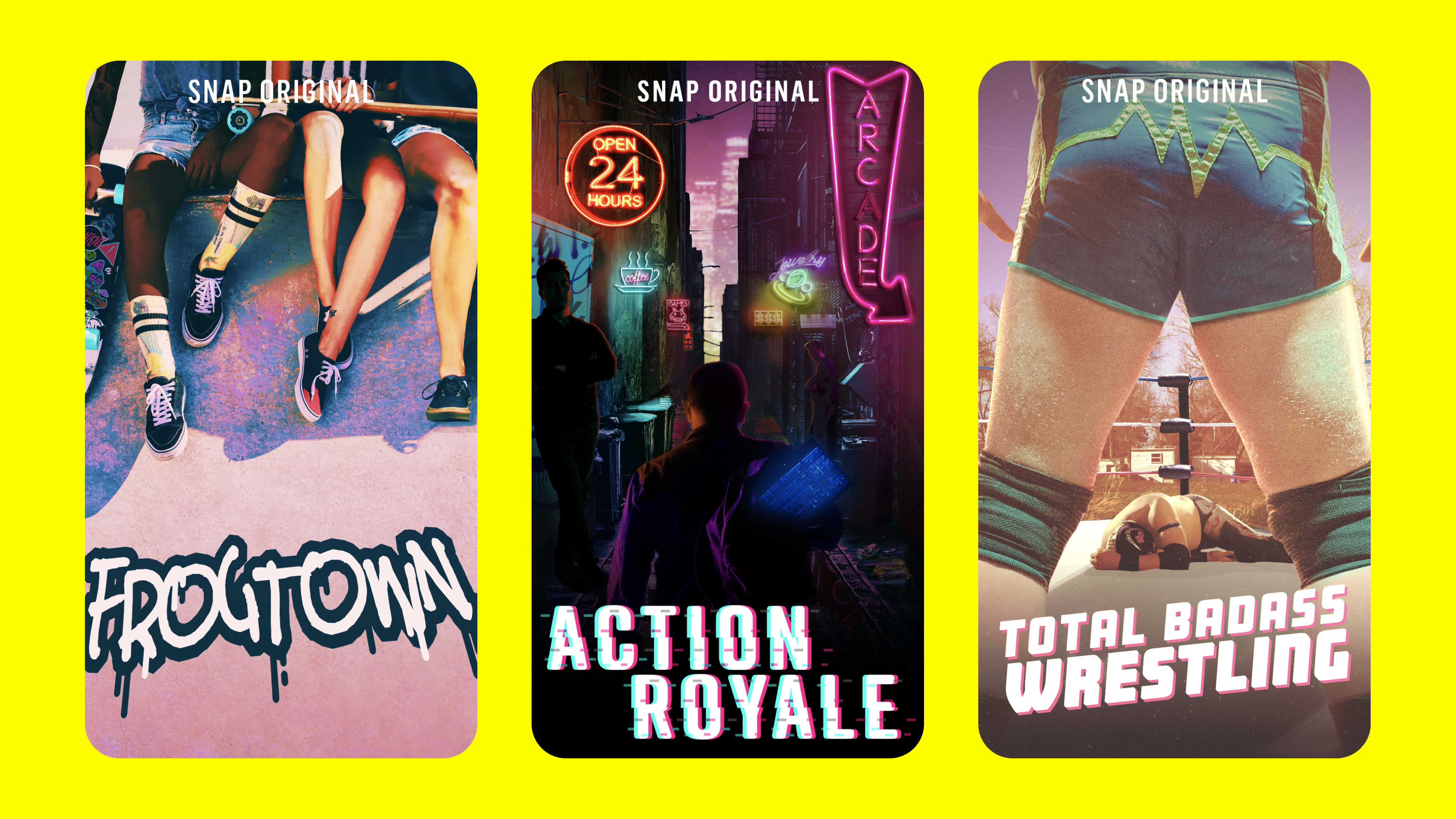
  • Frogtown, a series directed by Catherine Hardwicke (Twilight, Thirteen) about an all-girl skating crew.
  • Action Royale, a show about an underground esports gambling ring.
  • Total Badass Wrestling, a story of mentorship between a young wrestler and a well-known wrestler looking for his second act.

A few existing Snap Originals are also being renewed for another season, such as Dead of Night, Face Forward, Nikita Unfiltered and Vs The World.

Some of those shows have been quite popular, with Dead of Night attracting 15 million viewers, Nikita Unfiltered attracting 22 million viewers and Will From Home (featuring Will Smith) attracting 35 million viewers.

Powered by WPeMatico

OpenStack adds the StarlingX edge computing stack to its top-level projects

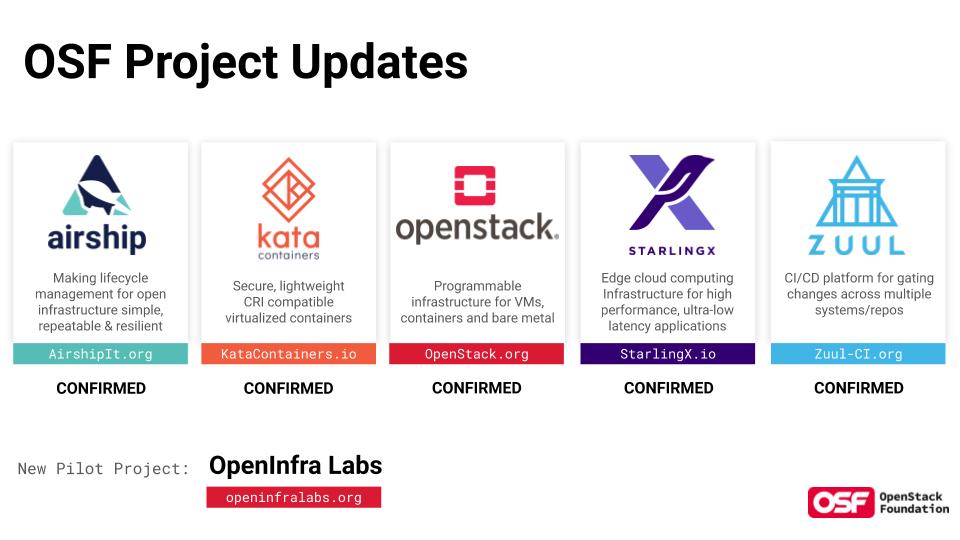
The OpenStack Foundation today announced that StarlingX, a container-based system for running edge deployments, is now a top-level project. With this, it joins the main OpenStack private and public cloud infrastructure project, the Airship lifecycle management system, Kata Containers and the Zuul CI/CD platform.

What makes StarlingX a bit different from some of these other projects is that it is a full stack for edge deployments — and in that respect, it’s maybe more akin to OpenStack than the other projects in the foundation’s stable. It uses open-source components from the Ceph storage platform, the KVM virtualization solution, Kubernetes and, of course, OpenStack and Linux. The promise here is that StarlingX can provide users with an easy way to deploy container and VM workloads to the edge, all while being scalable, lightweight and providing low-latency access to the services hosted on the platform.

Early StarlingX adopters include China UnionPay, China Unicom and T-Systems. The original codebase was contributed to the foundation by Intel and Wind River System in 2018. Since then, the project has seen 7,108 commits from 211 authors.

“The StarlingX community has made great progress in the last two years, not only in building great open source software but also in building a productive and diverse community of contributors,” said Ildiko Vancsa, ecosystem technical lead at the OpenStack Foundation. “The core platform for low-latency and high-performance applications has been enhanced with a container-based, distributed cloud architecture, secure booting, TPM device enablement, certificate management and container isolation. StarlingX 4.0, slated for release later this year, will feature enhancements such as support for Kata Containers as a container runtime, integration of the Ussuri version of OpenStack, and containerization of the remaining platform services.”

It’s worth remembering that the OpenStack Foundation has gone through a few changes in recent years. The most important of these is that it is now taking on other open-source infrastructure projects that are not part of the core OpenStack project but are strategically aligned with the organization’s mission. The first of these to graduate out of the pilot project phase and become top-level projects were Kata Containers and Zuul in April 2019, with Airship joining them in October.

Currently, the only pilot project for the OpenStack Foundation is its OpenInfra Labs project, a community of commercial vendors and academic institutions, including the likes of Boston University, Harvard, MIT, Intel and Red Hat, that are looking at how to better test open-source code in production-like environments.


Powered by WPeMatico

Quolum announces $2.75M seed investment to track SaaS spending

As companies struggle to find ways to control costs in today’s economy, understanding what you are spending on SaaS tools is paramount. That’s precisely what early-stage startup Quolum is attempting to do, and today it announced a $2.75 million seed round.

Surge (a division of Sequoia Capital India) and Nexus Venture Partners led the round, with help from a dozen unnamed angel investors.

Company founder Indus Khaitan says that he launched the company last summer pre-COVID, when he recognized that companies were spending tons of money on SaaS subscriptions and he wanted to build a product to give greater visibility into that spending.

This tool is aimed at finance departments, which might not know about the utility of a specific SaaS tool like PagerDuty, but look at the bills every month. The idea is to give them data about usage as well as cost to make sure they aren’t paying for something they aren’t using.

“Our goal is to give finance a better set of tools, not just to put a dollar amount on [the subscription costs], but also the utilization, as in who’s using it, how much are they using it and is it effective? Do I need to know more about it? Those are the questions that we are helping finance answer,” Khaitan explained.

Eventually, he says he also wants to give that data directly to lines of business, but for starters he is focusing on finance. The product works by connecting to the billing or expense software to give insight into the costs of the services. It takes that data and combines it with usage data in a dashboard to give a single view of the SaaS spending in one place.

While Khaitan acknowledges there are other similar tools in the marketplace, such as Blissfully, Intello and others, he believes the problem is big enough for multiple vendors to do well. “Our differentiator is being end-to-end. We are not just looking at the dollars, or stopping at how many times you’ve logged in, but we’re going deep into consumption. So for every dollar that you’ve spent, how many units of that software you have consumed,” he said.

He says that he raised the money last fall and admits that it probably would have been tougher today, and he would have likely raised on a lower valuation.

Today the company consists of a six-person development team in Bangalore in India and Khaitan in the U.S. After the company generates some revenue he will be hiring a few people to help with marketing, sales and engineering.

When it comes to building a diverse company, he points out that he himself is an immigrant founder, and he sees the ability to work from anywhere, an idea amplified by COVID-19, helping result in a more diverse workforce. As he builds his company, and adds employees, he can hire people across the world, regardless of location.

Powered by WPeMatico

InVision adds new features to Freehand, a virtual whiteboard tool, as user demand surges

No business is immune to the effects of the coronavirus pandemic. We’ve seen Airbnb — a company particularly susceptible to this black swan event — go through an insane design sprint. Even enterprise collaboration tools have felt it, with Box readjusting its product road map to focus on how the tool worked for remote employees.

InVision has also seen the change in its users behavior and adapted accordingly. Freehand, the company’s collaborative whiteboarding tool has seen a huge surge in users and the startup has added a handful of new features to the product.

The company says that Freehand is seeing 130% growth in weekly active users since March.

New features include sticky notes that come in multiple color, size and text options, as well as templates to give teams a jumping off point for their whiteboarding exercise. Freehand has six new templates to start — brainstorming, wireframing, retrospectives, standups, diagrams and ice breakers — with more to be added more soon.

InVision has also added a “presenting” mode to Freehand.

Because this virtual whiteboard has no space constraints, it can literally zoom out to infinity and is restricted only by the imagination of the team working on it. In “presenting” mode, a team leader can take over the view of the virtual whiteboard to guide their team through one part of the content at a time.

Freehand has an integration with Microsoft Teams and Slack, and also has a new shortcut where users can type “freehand.new” into any browser to start on a fresh whiteboard.

Interestingly, the user growth around Freehand doesn’t just come from the usual suspects of design, product and engineering teams. Departments across organizations, including HR, marketing and IT teams, are coming to Freehand to collaborate on projects and tasks. More than 60 percent of Freehand users are not coming from the design team.

InVision has also added some fine-tuning features, such as a brand new toolbar to allow for easier drawing of shapes, alignment, color and opacity features, and better controls for turning lines into precise arrows or end-points for diagrams.

One of the most interesting things about Freehand is that it allows for democratized access to the whiteboard itself. With no restraints on time or space, and with no one gatekeeping up at the front of the room holding the marker, all members of a team can go in and add their thoughts and ideas to the whiteboard before, during or after a meeting.

“One of the nice things about a whiteboard or a virtual whiteboard like this one is it removes the aspects of the restrictions of time and space, so teams can have more efficient meetings where they get the benefit of democratic input without the cost of having only one person at a time being able to speak or add,” said David Fraga, InVision President. “It offers a synchronous collision of collaboration.”

InVision has raised a total of $350 million from investors like FirstMark, Spark, Battery, Accel and Tiger Global Management. The company now boasts more than 7 million total registered users, with 100 of the Fortune 100 companies using the product. InVision is also part of the $100 million ARR club.

Powered by WPeMatico

API platform Postman delivers $150M Series C on $2B valuation

APIs provide a way to build connections to a set of disparate applications and data sources, and can help simplify a lot of the complex integration issues companies face. Postman has built an enterprise API platform and today it got rewarded with a $150 million Series C investment on a whopping $2 billion valuation — all during a pandemic.

Insight Partners led the round with help from existing investors CRV and Nexus Venture Partners. Today’s investment brings the total raised to $207 million, according to the company. That includes a $50 million Series B from a year ago, making it $200 million raised in just a year. That’s a lot of cash.

Abhinav Asthana, CEO and co-founder at Postman, says that what’s attracting all that dough is an end-to-end platform for building APIs. “We help developers, QA, DevOps — anybody who is in the business of building APIs — work on the same platform. They can use our tools for designing, documentation, testing and monitoring to build high-quality APIs, and they do that faster,” Asthana told TechCrunch.

He says that he was not actively looking for funding before this round came together. In fact, he says that investors approached him after the pandemic shut everything down in California in March, and he sees it as a form of validation for the startup.

“We think it shows the strength of the company. We have phenomenal adoption across developers and enterprises and the pandemic has [not had much of an impact on us]. The company has been receiving crazy inbound interest [from investors],” he said.

He didn’t want to touch the question of going public just yet, but he feels the hefty valuation sends a message to the market that this is a solid company that is going to be around for the long term.

Jeff Horing, co-founder and managing director at lead investor Insight Partners, certainly sees it that way. “The combination of the market opportunity, the management team and Postman’s proven track record of success shows that they are ready to become the software industry’s next great success,” he said in a statement.

Today the company has around 250 employees divided between the U.S. and Bangalore in India, and he sees doubling that number in the next year. One thing the pandemic has shown him is that his employees can work from anywhere and he intends to hire people across the world to take advantage of the most diverse talent pool possible.

“Looking for diverse talent as part of our large community as we build this workforce up is going to be a key way in which we want to solve this. Along with that, we are bringing people from diverse communities into our events and making sure that we are constantly in touch with those communities, which should help us build up a very strong diverse kind of hiring function,” he said.

He added, “We want to be deliberate about that, and over the coming months we will also shed more light on what specifically we are doing.”

Powered by WPeMatico

Just Eat Takeaway confirms it’s gobbling up Grubhub in a $7.3B deal

Consolidation in the world of on-demand food ordering and delivery continues apace. Today, Just Eat Takeaway — the European company that only just got its own $7.8 billion merger approved by regulators in April of this year — officially announced that it has reached an agreement to acquire Grubhub in the U.S. for an enterprise value of $7.3 billion.

The company said the combined operation — which processed 593 million orders in 2019 — will have over 70 million combined active customers globally.

Under the terms of the deal, Grubhub shareholders will be entitled to receive American depositary receipts (“ADRs”) representing 0.6710 Just Eat Takeaway.com ordinary shares in exchange for each Grubhub share, representing an implied value of $75.15 for each Grubhub share (based on the undisturbed closing price of Just Eat Takeaway.com on June 9, 2020 of €98.602), the companies said. This gives Grubhub a total equity consideration (on a fully diluted basis) of $7.3 billion.

Matt Maloney, CEO and founder of Grubhub, will join the Just Eat Takeaway.com management board and will lead the combined group’s businesses across North America. Jitse Groen, CEO and founder of Just Eat Takeaway.com, will lead the combined business globally.

“Matt and I are the two remaining food delivery veterans in the sector, having started our respective businesses at the turn of the century, albeit on two different continents. Both of us have a firm belief that only businesses with high-quality and profitable growth will sustain in our sector. I am excited that we can create the world’s largest food delivery business outside China,” Groen said in a statement. “We look forward to welcoming Matt and his team to our company and working with them in the future.”

“When Grubhub and Seamless were founded, the online takeout industry didn’t exist in the U.S. My vision was to transform the delivery and pick-up ordering experience. Like so many other entrepreneurs, we started modestly – restaurant by restaurant in our Chicago neighbourhood. Today, Grubhub is a leader across North America,” Maloney said in a statement. “I’ve known Jitse since 2007 and his story is much like mine. Combining the companies that started it all will mean that two trailblazing start-ups have become a clear global leader. We share a focus on a hybrid model that places extra value on volume at independent restaurants, driving profitable growth. Supported by Just Eat Takeaway.com, we intend to accelerate our mission to be the fastest, best and most rewarding way to order food from your favourite local restaurants in North America and around the world. We could not be more excited.”

The deal caps off a tumultuous period for Grubhub, which as Maloney noted was also created through a combination with another rival, Seamless. The company has been in play for months and had been in acquisition talks with Uber’s Eats division.

Uber was in talks with Grubhub on and off for about a year, according to a source familiar with the deal. Uber was still negotiating with Grubhub as of Wednesday morning. However, sources told CNBC’s Peter Faber that Uber was preparing to leave the deal over antitrust concerns. Ultimately, discussions broke down over a variety of concerns, including expected regulatory scrutiny, the source told TechCrunch.

Grubhub announced the tie-up with Just Eat shortly after Uber confirmed publicly that it was walking away from the deal.

Uber didn’t comment on specifics of the merger. However, an official statement indicates that Uber still sees consolidation of the food delivery industry as a path to profitability.

“Like ridesharing, the food delivery industry will need consolidation in order to reach its full potential for consumers and restaurants,” an Uber spokesperson said in an emailed statement. “That doesn’t mean we are interested in doing any deal, at any price, with any player.”

Investor reception to the deal was mixed. Grubhub shares rose as much as 9% in after hours trading before settling to about 6.2% above closing price. Just Eat stock fell 10.79%. Meanwhile, Uber shares, which dropped 4.81% to close at $34.83, fell another 1.38% in after hours trading.

Online food delivery has been a tough gig: on one hand, very popular with consumers, but on the other, an extremely commoditised and competitive business, where companies need to spend huge amounts of money to gain and keep customers.

One solution to that cycle has been to take out rivals and get better economies of scale on operations. This has been the route so far with Just Eat Takeaway and Grubhub, which combined say they will be profitable and can now focus on improving margins further.

But for the others in the space, the big question now will have to be: which players will consolidate next? In the US, in addition to Uber Eats, there is also Postmates and Doordash, while the European market has Deliveroo, in addition to a plethora of smaller players in both markets.

Powered by WPeMatico