1010Computers | Computer Repair & IT Support

Startups Weekly: A Silicon Valley for everyone

Editor’s note: Get this free weekly recap of TechCrunch news that any startup can use by email every Saturday morning (7am PT). Subscribe here.

Many in the tech industry saw the threat of the novel coronavirus early and reacted correctly. Fewer have seemed prepared for its aftereffects, like the outflow of talented employees from very pricey office real estate in expensive and troubled cities like San Francisco.

And few indeed have seemed prepared for the Black Lives Matter protests that have followed the death of George Floyd. This was maybe the easiest to see coming, though, given how visible the structural racism is in cities up and down the main corridors of Silicon Valley.

Today, the combination of politics, the pandemic and the protests feels almost like a market crash for the industry (except many revenues keep going up and to the right). Most every company is now fundamentally reconsidering where it will be located and who it will be hiring — no matter how well it is doing otherwise.

Some, like Google and Thumbtack, have been caught in the awkward position of scaling back diversity efforts as part of pandemic cuts right before making statements in support of the protesters, as Megan Rose Dickey covered on TechCrunch this week. But it is also the pandemic helping to create the focus, as Arlan Hamilton of Backstage Capital tells her:

It is like the world and the country has a front-row seat to what Black people have to witness, take in, and feel all the time. And it was before they were seeing some of it, but they were seeing it kind of protected by us. We were kind of shielding them from some of it… It’s like a VR headset that the country is forced to be in because of COVID. It’s just in their face.

This also putting new scrutiny on how tech is used in policing today. It is renewing questions around who gets to be a VC and who gets funding right when the industry is under new pressure to deliver. It is highlighting solutions that companies can make internally, like this list from BLCK VC on Extra Crunch.

As with police reforms currently in the national debate, some of the most promising solutions are local. Property tax reform, pro-housing activism and sustainable funding for homelessness services are direct ways for the tech industry to address the long history of discrimination where the modern tech industry began, Catherine Bracy of TechEquity writes for TechCrunch. These changes are also what many think would make the Bay Area a more livable place for everyone, including any startup and any tech employee at any tech company (see: How Burrowing Owls Lead To Vomiting Anarchists).

Something to think about as we move on to our next topic — the ongoing wave of tech departures from SF.

Where will VCs follow founders to now?

In this week’s staff survey, we revisit the remote-first dislocation of the tech industry’s core hubs. Danny Crichton observes some of the places that VCs have been leaving town for, and thinks it means bigger changes are underway:

“Are VCs leaving San Francisco? Based on everything I have heard: yes. They are leaving for Napa, leaving for Tahoe, and otherwise heading out to wherever gorgeous outdoor beauty exists in California. That bodes ill for San Francisco’s (and really, South Park’s) future as the oasis of VC.

But the centripetal forces are strong. VCs will congregate again somewhere else, because they continue to have that same need for market intelligence that they have always had. The new, new place might not be San Francisco, but I would be shocked just given the human migration pattern underway that it isn’t in some outlying part of the Bay Area.

And then he says this:

As for VCs — if the new central node is a bar in Napa and that’s the new “place to be” — that could be relatively more permanent. Yet ultimately, VCs follow the founders even if it takes time for them to recognize the new balance of power. It took years for most VCs to recognize that founders didn’t want to work in South Bay, but now nearly every venture firm of note has an office in San Francisco. Where the founders go, the VCs will follow. If that continues to be SF, its future as a startup hub will continue after a brief hiatus.

It’s true that another outlying farming community in the region once became a startup hub, but that one had a major research university next door, and at the time a lot of cheap housing if you were allowed access to it. But Napa cannot be the next Palo Alto because it is fully formed today as a glorified retirement community, Danny.

I’m already on the record for saying that college towns in general are going to become more prominent in the tech world, between ongoing funding for innovative tech work and ongoing desirability for anyone moving from the big cities. But I’m going to add a side bet that cities will come back into fashion with the sorts of startup founders that VCs would like to back. As Exhibit A, I’d like to present Jack Dorsey, who started a courier dispatch in Oakland in 2000, and studied fashion and massage therapy during the aftermath of the dot-com bubble. His success with Twitter a few years later in San Francisco inspired many founders to move as well.

Creative people like him are drawn to the big, creative environments that cities can offer, regardless of what the business establishment thinks. If the public and private sectors can learn from the many mistakes of recent decades (see last item) who knows, maybe we’ll see a more equal and resilient sort of boom emerge in tech’s current core.
Insurance provider Lemonade files for IPO with that refreshing common-stock flavor

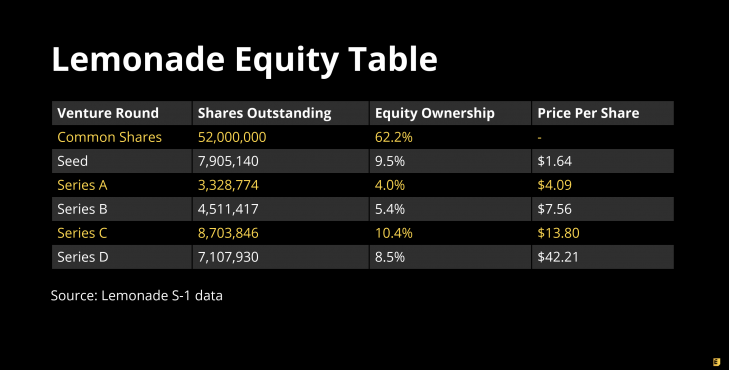
There are probably some amazing puns to be made here but it has been a long week, and the numbers speak for themselves. Lemonade sells insurance to renters and homeowners online, and managed to reach a private valuation of $3.5 billion before filing to go public on Monday — with the common stockholders still comprising the majority of the cap table.

Danny crunched the numbers from the S-1 on Extra Crunch to generate the table, included, that illustrates this rather unusual breakdown. Usually, as you almost certainly know already, the investors own well over half by the time of a good liquidity event. “So what was the magic with Lemonade?” he ponders. “One piece of the puzzle is that company founder Daniel Schreiber was a multi-time operator, having previously built Powermat Technologies as the company’s president. The other piece is that Lemonade is built in the insurance market, which can be carefully modeled financially and gives investors a rare repeatable business model to evaluate.”

(Photo by Paul Hennessy/NurPhoto via Getty Images)

Adapting enterprise product roadmaps to the pandemic

Our investor surveys for Extra Crunch this week covered the space industry’s startup opportunities, and looked at how enterprise investors are assessing the impact of the pandemic. Here’s Theresia Gouw of Acrew Capital, explaining how two of their portfolio companies have refocused in recent months:

A common theme we found when joining our founders for these strategy sessions was that many pulled forward and prioritized mid- to long-term projects where the product features might better fit the needs of their customers during these times. One such example in our portfolio is Petabyte’s (whose product is called Rhapsody) accelerated development of its software capabilities that enable veterinarians to provide telehealth services. Rhapsody has also incorporated key features that enable a contactless experience when telehealth isn’t sufficient. These include functionality that enables customers to check-in (virtual waiting room), sign documents, and make payments from the comfort and safety of their car when bringing their pet (the patient!) to the vet for an in-person check-up.

Another such example would be PredictHQ, which provides demand intelligence to enterprises in travel, hospitality, logistics, CPG, and retail, all sectors who saw significant change (either positive or negative) in the demand for their products and services. PredictHQ has the most robust global dataset on real-world events. Pandemics and all the ensuing restrictions and, then, loosening of restrictions fall within the category of real-world events. The company, which also has multiple global offices, was able to incorporate the dynamic COVID government responses on a hyperlocal basis, by geography, and equip its customers (e.g., Domino’s, Qantas, and First Data) with up to date insights that would help with demand planning and forecasting as well as understanding staffing needs.

Around TechCrunch

Extra Crunch Live: Join Superhuman CEO Rahul Vohra for a live Q&A on June 16 at 2pm EDT/11 AM PDT
Join us for a live Q&A with Plaid CEO Zach Perret June 18 at 10 a.m. PDT/1 p.m. EDT
Two weeks left to save on TC Early Stage passes
Learn how to ‘nail it before you scale it’ with Floodgate’s Ann Miura-Ko at TC Early Stage SF
How can startups reinvent real estate? Learn how at TechCrunch Disrupt
Stand out from the crowd: Apply to TC Top Picks at Disrupt 2020

Across the Week

TechCrunch

Theaters are ready to reopen, but is America ready to go back to the movies?
Edtech is surging, and parents have some notes
When it comes to social media moderation, reach matters
Zoom admits to shutting down activist accounts at the request of the Chinese government

Extra Crunch

TechCrunch’s top 10 picks from Techstars’ May virtual demo days
Software’s meteoric rise: Have VCs gone too far?
Recession-proof your software engineering career
The complicated calculus of taking Facebook’s venture money
The pace of startup layoffs may be slowing down

#EquityPod

From Alex:

Hello and welcome back to Equity, TechCrunch’s venture capital-focused podcast, where we unpack the numbers behind the headlines.

After a pretty busy week on the show we’re here with our regular Friday episode, which means lots of venture rounds and new venture capital funds to dig into. Thankfully we had our full contingent on hand: Danny “Well, you see” CrichtonNatasha “Talk to me post-pandemic” MascarenhasAlex “Very shouty” Wilhelm and, behind the scenes, Chris “The Dad” Gates.

Make sure to check out our IPO-focused Equity Shot from earlier this week if you haven’t yet, and let’s get into today’s topics:

  • Instacart raises $225 million. This round, not unexpected, values the on-demand grocery delivery startup at $13.7 billion — a huge sum, and one that should make it harder for the well-known company to sell itself to anyone but the public markets. Regardless, COVID-19 gave this company a huge updraft, and it capitalized on it.
  • Pando raises $8.5 million. We often cover rounds on Equity that are a little obvious. SaaS, that sort of thing. Pando is not that. Instead, it’s a company that wants to let small groups of individual pool their upside and allow for more equal outcomes in an economy that rewards outsized success.
  • Ethena raises $2 million. Anti-harassment software is about as much fun as the dentist today, but perhaps that doesn’t have to be the case. Natasha talked us through the company, and its pricing. I’m pretty bullish on Ethena, frankly. Homebrew, Village Global and GSV took part in the financing event.
  • Vendr raises $4 millionVendr wants to help companies cut their SaaS bills, through its own SaaS-esque product. I tried to explain this, but may have butchered it a bit. It’s cool, I promise.
  • Facebook is getting into the CVC game. This should not be a surprise, but we were also not sure who was going to want Facebook money.
  • And, finally, Collab Capital is raising a $50 million fund to invest in Black founders. Per our reporting, the company is on track to close on $10 million in August. How fast the fund can close its full target is something we’re going to keep an eye on, considering it might get a lot harder a lot sooner. 

And that is that; thanks for lending us your ears.

Equity drops every Friday at 6:00 am PT, so subscribe to us on Apple PodcastsOvercastSpotify and all the casts.

Powered by WPeMatico
So you want to talk about race in tech with Ijeoma Oluo

“A lot of people denigrate the value of talking about race and racism in technological spaces,” said Ijeoma Oluo, author of So You Want to Talk About Race, which has surged to the top of the New York Times best sellers list in paperback nonfiction, two and a half years after its initial January 2018 publication. “…I don’t think there’s a more important space to be talking about it.”

Oluo and I were talking this January, just before the global pandemic struck, at One Cup Coffee: a no-frills, “more than profit” coffee shop that shares a storefront with a church, and is just down the road from a methadone clinic. The cafe is not far from Oluo’s home in Shoreline, Washington, a city just north of Seattle.

“I’ve seen the absolute best and the absolute worst in race and racism in America on the web,” Oluo continued, “in ways that have had true-life consequences for me and for people I love. [The internet] is a space that is just as real as face-to-face space. And we absolutely have to be looking at it politically and socially, as to how it’s contributing to the way in which we look and deal with each other and how we address issues of inequality and injustice.”

To drive to Shoreline from the posh Seattle neighborhood in which I’d been researching Amazon’s growing campus which exceeds anything at Harvard and MIT, the two campuses at which I work as a chaplain, in terms of glittering architectural swank I’d had to pass directly by probably the largest homeless encampments I’ve ever seen in my life. And I’ve led interfaith groups of students to study and volunteer in large homeless encampments. 

Speaking of religion and faith, Oluo and I began our 90-minute conversation (edited highlights below) by bonding a bit over our shared interest in “humanism,” a semi-organized movement of atheists, agnostics, and allies who try to do good and live meaningfully without belief in a God. I work as the Humanist Chaplain at Harvard and MIT, and write about humanist philosophy as a kind of secular alternative to religion.

For her part, Oluo accepted an award for feminist humanism from the American Humanist Association in 2018. She delivered her acceptance speech to a mostly white liberal crowd who tended to think of themselves as enlightened and broad-minded and thus took it in stride when she opened by telling them to ‘buckle up,’ as they ate chicken breasts on white plates and black table cloths, busily passing rolls and butter and accidentally clinking their water glasses. But when Oluo told them, “I need for you to not always be looking for the harm others are doing, but look for the harm you are doing,” as my friend Ryan Bell tweeted at the time, “you could hear a pin drop in here. 

Back to this past January, however: as we sipped simple cups of coffee and tea, I told Oluo about the thesis I’ve developed over the course of my year-plus here as TechCrunch’s “Ethicist in Residence”: that the world we call “technology” has grown bigger than any industry, and more impactful than a single culture. Technology has become a secular religion: quite possibly the largest, most influential religion human beings have ever created.

As you’ll see below, Oluo kindly tolerated, maybe even enjoyed the idea, riffing on several possible tech/religion comparisons. Like this one:

One thing tech fundamentally has in common with many religions, at least in America is that it is a white man’s version of Utopia. And tech especially has this cult-like adherence to a white man’s vision of a Utopia that fundamentally disempowers and endangers women and people of color.

I consider myself an agnostic (not necessarily an atheist) toward this new religion of technology, because I want to view tech the way I’ve always tried to view traditional faith: as a mixed bag, something that can do both good and harm, depending on the circumstance. But as multi-billionaire entrepreneurs like Mark Zuckerberg and Jeff Bezos accumulate power; as social media misinformation sways the fate of democracies while artificial intelligence intrudes on justice systems; and as the current pandemic drives more of our life online, I sometimes wonder if I’ll be forced to re-evaluate my own would-be “prophesy.” If we’re not careful, tech could become the most dangerous cult of all time.

Just a bit more context before the interview below, which Oluo and I agreed to call “So You Want to Talk About Race in Tech,” after her bookwhich was already a major success, but has now reached iconic status nationwide in the wake of George Floyd’s murder.

This article is the last installment of the roughly year-long series I’ve done for TechCrunch, offering in-depth analysis of people and issues in the ethics of technology. So let me just mention that up to now my editors and I have produced 38 articles, with over 150,000 words about mostly women and people of color who happen to be leading efforts to reform and re-envision the ethics of our new technological world.

The series included interviewed Anand Giridharadas on “Silicon Valley’s inequality machine“; Taylor Lorenz on “the ethics of internet culture“; and James Williams on “the adversarial persuasion machine” of efforts by his former employer Google — among others — to distract us to death.

It featured CEOs and venture capitalists disclosing childhood traumas before debating the moral merits of their creations; employees and gig workers speaking painful truth to their powerful employers; as well as deep dives into perspectives on tech feminism, intersectionality, and socialism, alongside heroic efforts to combat cultures of abuse and violent immigration policing within the industry.

Now, to introduce the interview with Oluo: which was, again, completed weeks before the current crisis, but is even more relevant today. To paraphrase the self-described “zillionaire” venture capitalist Nick Hanauer, another Seattle resident with whom I met the same week as I met Oluo, the pitchforks have finally come for American plutocrats. We’ve come to the point, across this country, where my fellow white people and I are not talking about race and racism because we’re woke, or because we want to do everything we can to make the world a better place,” but because we fucking have to. As Kim Latrice Jones says in her viral video that has become emblematic of this period, we’re “lucky what black people are looking for is equality, and not revenge.

This is perhaps doubly so in the tech world, where perhaps not all our neighborhoods and offices are literally burning at this moment, but where there is the most to lose because … they could be. Tech is immune neither to COVID-19 nor to pitchforks. If Black people aren’t able to achieve more sustainable forms of equality in the tech world in the coming years, revenge could become the next goalpost. And it could be justified.

But I trust no one wants to go there. As Malcolm X once said on a visit to Coretta Scott King while Martin Luther King, Jr. was in a Birmingham jail:

Mrs. King, will you tell Dr. King . . . I didn’t come to make his job more difficult. I thought that if the white people understood what the alternative was that they would be willing to listen to Dr. King.

MLK has become an almost literal civil rights deity over recent generations, deservedly so. But we may one day, hopefully a long and peaceful time from now, look back on the life and work of Ijeoma Oluo (along with several of her peers, many of them Black women) as having achieved a level of influence and inspiration that at least approaches King’s.

And while some readers might need to buckle up in order to take in what she has to say, they should remember that her vision is the more optimistic alternative for how things could go in the coming years.

So you want to talk about race in tech? Let’s talk.


Editor’s note: This interview has been edited for clarity.

Greg Epstein: To what extent has the work you’ve been doing, particularly since your book So You Want to Talk About Race came out, intersected with the tech world?

Ijeoma Oluo: I wrote the book as a black woman who grew up in Seattle, which is such a tech-centric city, and who worked in tech for over 10 years before I moved over to writing. So it’s very much shaped by these environments — environments that think they’ve transcended race and racism and clearly have not, and also a place where people of color are extreme minorities, especially women of color.

So the tech industry was very present in the book even when I wasn’t talking about tech. Because a lot of people in tech recognized themselves and their peers in the examples used in the book.

Probably one of the most watched videos of a talk I’d given is the one I gave at Google. And a lot of the tech industry, especially here in Seattle, immediately adopted the book, like, “Oh, she lives here. Let’s read this, this will be the thing we do for the year, as far as race and racism.” 

But when I walk into a tech space, I think about it the way I think about just about any other white-majority, liberal-leaning space. Which is that there’s a very limited amount I can do in the time I’m there; the most I can do is reinforce what the extreme minority of people of color in that room are feeling and experiencing. Because I’ve lived it to an extent many other speakers cannot.

[The idea of the book as relevant to tech] also applies because as a black woman, and as a writer, I wouldn’t be [where] I am today if it weren’t for social media, the access that it granted me.

But the cost that [social media has] had, and the way in which it’s giving, via tech, the exact same if not larger platforms to hate, division, and abuse, especially of people of color and women of color, and LGBTQ community, is something that needs to be discussed.

There’s this argument in tech that anyone can prosper in this space. They’ve removed all the boundaries to prosperity. But the truth is, they’ve moved their own personal boundaries, and left all the boundaries to people of color and women in place because they just don’t exist in these origin stories, as anything other than props.

A lot of people denigrate the value of talking about race and racism in technological spaces; I don’t think there’s a more important space to be talking about it. I’ve seen the absolute best and the absolute worst in race and racism in America on the web, in ways that have had true-life consequences for me and for people I love. It is a space that is just as real as the face-to-face space. And we absolutely have to be looking at it politically and socially as to how it’s contributing to the way in which we look and deal with each other and politically how we address issues of inequality and injustice.

Epstein: Great summary: [tech as] the best and the worst. I mean, I’ve learned so much from Black Twitter, which is extraordinarily empowering. Then there’s White Supremacist Twitter. And then there’s just the sort of White Supremacist Lite Twitter, that is, sort of…Twitter.

Oluo: It’s interesting [that you talk about] looking at [tech] like a religion. I think one thing tech fundamentally has in common with many religions, at least in America, is that it is a white man’s version of Utopia. And tech especially has this cult-like adherence to a white man’s vision of a Utopia that fundamentally disempowers and endangers women and people of color.

Epstein: I love that image; I’d love for you to brainstorm with me: what are the characteristics of this white man’s vision of Utopia that we see in tech culture?

Oluo: It starts with the mythologizing of white-male struggle that’s at the core of tech culture. The idea that these men were outcasts who built things up from nothing — the shunned ones. And they’re going to fix the problems standing in their way. This is their success story, their ascension. So what stands in their way, are people of color, the women that aren’t sleeping with them, the popularity and the wealth they aren’t automatically getting, old-class structures that are keeping them away from the new class structure [based on] who has these skills that they, as white men, have?

And the mythology built around it feels very cult-like, very religious-like. There’s this whole origin story that’s not true.

If we look at the founding of our biggest technological advances, we’re going to see a lot of extreme privilege, and this idea that there are rules, merits that are purely good, [things] you can do to ascend in these spaces that are going to revolutionize things. And in the tech space it’s really these guys saying [the criteria for inclusion are] going to be: How good are you at coding? Can you debate better than this person?

What it starts with is a fundamental centering of white maleness. And the goal is the ascension of white maleness. People of color can aid it, they can mimic it, or they’re in the way, to be overcome. There’s this argument in tech that anyone can prosper in this space. They’ve removed all the boundaries to prosperity. But the truth is, they’ve moved their own personal boundaries, and left all the boundaries to people of color and women in place because they just don’t exist in these origin stories, as anything other than props.

If you can’t get your shit together first and foremost for the people in the office, you’re never going to get it together for the products you serve.

What cracks me up is, for a dogma that likes to talk about change and adaptation as much as tech does, how completely closed they are to actual change, especially for any sort of ideological change, and how terrified they are of looking around a room and not seeing people who look just like them, of taking things down to bare bones and asking, did we do this right?

There is nothing revolutionary about what many in tech are calling revolutionary right now. And many complaints people have about organized religion — “Wait, we’re still sticking to these rules from 2000 years ago? We’re still threatened by change and progress?” — are things you can see in tech already. And it’s worrying, considering how recent this industry is, that [we already see tech leaders] saying, “No, no, no, this is the way it’s always been done.” 

Well, where does the change come in then? Are we locking in at these prototype stages and saying, this is the way it’s always been done? For what, the last 20, 30 years? It’s ridiculous.

But the fervor with which I’ve seen white men defend [that status quo of the last 20 to 30 years] and the ways in which they talk about threats to it, also have that kind of religious fervor — the same fervor that launched the internet — even for people who are beyond religion.

Wrter Ijeoma Oluo

Epstein: To what extent have you talked or written publicly about your work in the tech industry?

Oluo: I don’t write a lot about [my experiences in tech]. In my book there’s a couple of anecdotes about work; any time I write about work, chances are it was in the tech industry, but it’s not specific. 

The one thing I will definitely say is, I have never been more sexually harassed in my life than [while] working in tech. I have never faced more blatant accusations about my race, and whether it helps or hinders my career, than I have in tech. I’ve literally been asked to my face, “Do you think you got that promotion because you’re black?” 

I have never felt more of an outsider than in tech, and it’s an incredibly gaslighting environment because it likes to pretend it has that all figured out.

Do you believe there is a profitable future in racial justice? Do you believe you can build products and goals around racial justice? Do you believe people of color are your customers?

I’ve worked in places that suck on race and gender. And they very clearly suck in a way that you know [what you’re getting into]. I worked in the auto industry: I knew what I was getting into there. But in tech they’re like, “Oh, no. That doesn’t matter here. That’s not a problem here.” And it most certainly is a problem. A lot of people think everyone joins tech because they love tech, and that’s going to be the thing that gets them all together, right? This great passion that’s going to help you realize that gender doesn’t matter, sexuality doesn’t matter, race doesn’t matter. 

That’s absolutely not true, because the pitfall that tech falls into is the same one that every other corporation, or actually any other group in America falls into. Which is the idea that true diversity and racial justice is going to be painless for white people and there will be no adjustment. And that people of color want the exact same things you want, and value the same things you value. And somehow at the end of that, they’re going to still see you as superior in some way. None of that is true in real diversity, and in real racial justice and gender justice.

And we need to talk about it, because it’s not just a work environment. I’ve talked to some of the biggest tech or tech-adjacent companies in the world: not only [are] real human beings going into an office every day and facing the realities of a space that does not want to acknowledge issues of racism and sexism, but [that same company] creates products that shape how we interact with each other in the world, in a way that replicates those same issues. 

If you can’t get your shit together first and foremost for the people in the office, you’re never going to get it together for the products you serve. You can’t have an all white male environment, or a majority white male environment, and think the product you have isn’t going to replicate bias and harm. 

And you can’t create a product that you think eradicates bias and harm, while you have a work environment [in which] the people are creating it are suffering under extreme duress, and exclusion, and harm. It has to both be tackled at once. And a lot of times I find that environments try to do one or the other, and not well, and it’s impossible. And the ramifications of not attacking it in tech hurt more than just the people sitting in cubicles doing the work. It really hurts everyone.

Epstein: When you say “it really hurts everyone,” you’re talking about the lack of commitment to actual justice?

Oluo: Yes. And the lack of valuing marginalized people. Even when we’re looking not just from a, ‘do you like your neighbor?’, but even from a profit-level standpoint.

Do you believe there is a profitable future in racial justice? Do you believe you can build products and goals around racial justice? Do you believe people of color are your customers? Do you believe that your product should adapt to them instead of them adapting to your products? Do you want their children using your products, and their grandchildren using your products? Do you want them feeling welcome and well-served by you? 

If we’re looking at capitalism — and this is a capitalist enterprise, we can’t [act] like it’s divorced from it — it matters.

And even these platforms that don’t think they’re related to capitalism, think they don’t sell a thing: it’s bullshit. It’s all part of the capitalist world. And it’s about what you value. Do you think the voices of people of color matter? Because if they do, then the way you tackle issues around harassment and abuse looks starkly different than if you just value the voices of white men.

Epstein: A final question I’ve asked of everyone I’ve interviewed for this TechCrunch series on ethics: how optimistic are you about our shared human future?

Oluo: I’m not more or less optimistic than I ever was. I worry. I worry about how easy it is for people in Western utilization of tech to feel like technology means they don’t actually have to see anyone face to face, and they don’t have to form deep connections with people, or try to build real alliances, or tie their futures and their sense of safety and community and belonging to other people. 

The one thing I would definitely say, that [there] is an incredibly Western-centric view of tech. I’m Nigerian American. The way in which tech is utilized in Nigeria is completely different than the way it’s utilized here. In Nigeria it’s about utility first and foremost. And about bringing people together face to face, to make African businesses run more smoothly, to help undo legacies of colonialism that have taken away physical infrastructure. To build that infrastructure online so that it can exist somewhere.

When we look at even the ways in which Nigerians use the internet to reach across diaspora, it’s so fundamentally different to the Western view of what the internet’s for and how it should be used, and I feel like there’s so much to be learned there. If you want to look at where real pioneering is being done, look at the ways in which tech and internet [are] being used in Central America, South America, African nations, and many Asian nations. Look at what it looks like when communities of color say, “I’m going to build technology that solves the problems that we have, within these limitations of white supremacist structure.”

Look at what it looks like when you’re creating the internet in a society that values the group over the individual. What does the internet look like then? Because it’s not the dream of extreme independence in Nigeria, that’s not what the internet’s built for, that’s not a goal, that’s not what you want for your kids or your family, that’s not what you set out for. So then, what does the internet look like when you have a different social structure? When you think that maybe it isn’t the idea that we’re all here pulling ourselves by our bootstraps, maybe we’re pulling our communities up, what does it look like then when you’re creating platforms? Whole platforms created for that? That’s where if you want to feel hopeful about what tech can do that’s where you need to be.

Epstein: What a beautiful answer to that question. Thank you. That’s in many ways the best answer I’ve received to that question, and I’ve asked it of a lot of smart people.

Oluo: Oh, thank you.

Epstein: Thank you so much for taking the time, on behalf of myself and TechCrunch.

Powered by WPeMatico

Imaging startup Light is exiting the smartphone business

Light’s push into smartphones was an inevitability. Sure, the startup turned heads with its pricey L16 camera, but these days mobile photography is almost exclusively the domain of the handset. Early last year, the answer arrived in the form of the trypophobia-inducing Nokia 9 PureView.

In a category where manufacturers raced to add more cameras, the PureView had the most, with a five-hexagonal array. It was new, innovative and for most, it was overkill. At the very least, however, it gave Nokia/HMD some bragging rights and managed to set the handset apart in one of the most hotly contested corners of the smartphone hardware race.

But Light is getting out of the smartphone game. Ultimately, the competition may have just been too stiff for a small startup, especially with many manufacturers working on their own native hardware and software solutions.

Light confirmed the move this week in an email to Android Authority, writing simply that it was “no longer operating in the smartphone industry.” It’s a surprising bit of news, given that mobile partnerships seemed like the most logical way forward for the company, which drummed up a $121 million in a SoftBank-led round back in 2018. That Series D brought the Palo Alto-based company’s total funding up to more than $181 million.

More recently, it also signed deals with Sony and Xiaomi. No word on what such a move means for those partnerships going forward. Nor is it clear what life after smartphones looks like for Light. We’ve reached out to the company for more insight into its plans.

Powered by WPeMatico

Volkswagen launches home EV charging system sales ahead of ID.3 vehicle deliveries

Volkswagen has started to sell a home-charging device as the automaker prepares to bring its new ID family of electric vehicles to market.

The ID.3 is the first electric vehicle under the ID label and will only be sold in Europe. Customers who made reservations for the launch edition, known as ID.3 1st, will be able to order their vehicle starting June 17. Volkswagen said this week that the deliveries for the ID.3 1st will begin in September.

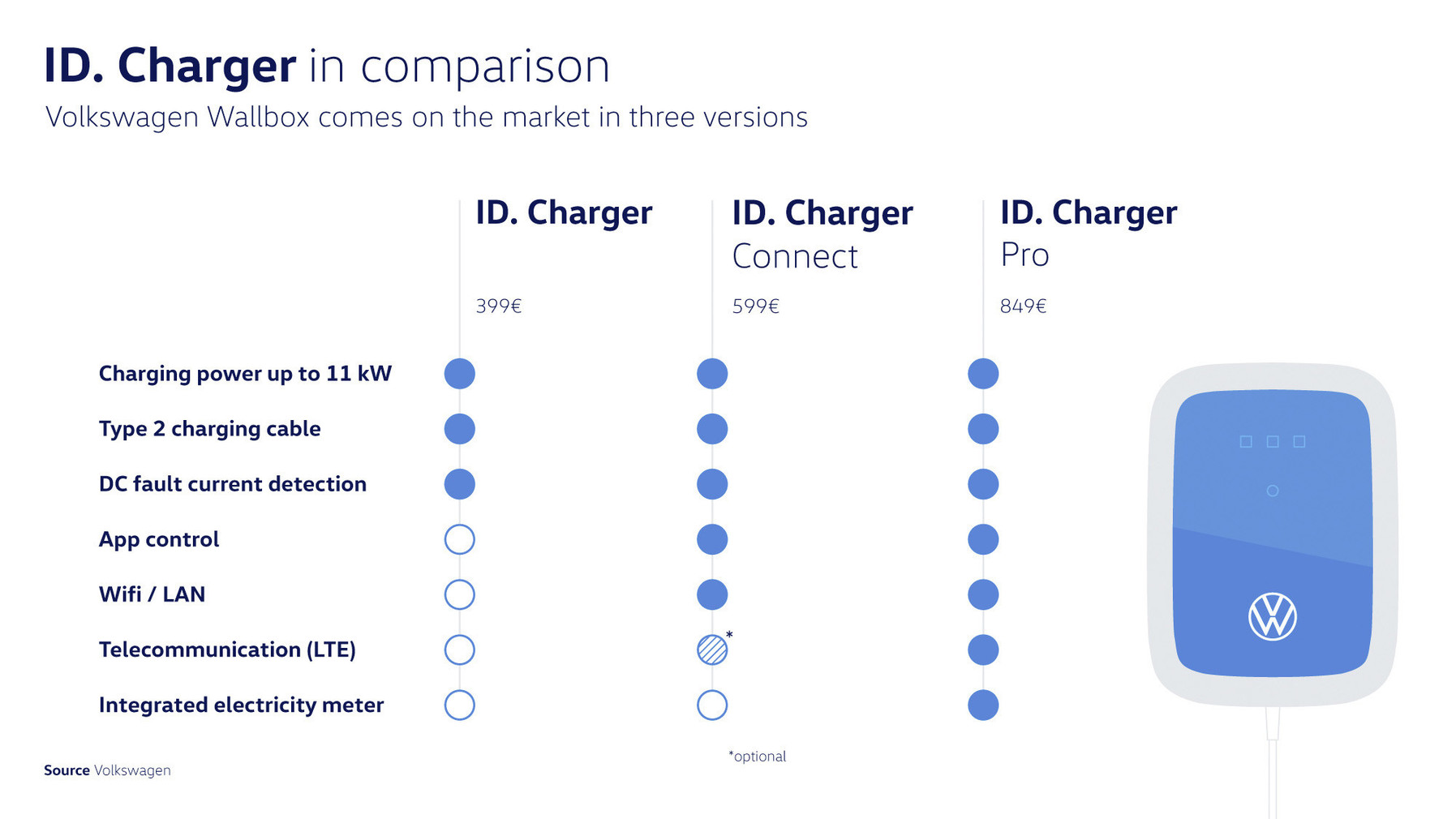
And that means that, at least for now, the home-charging device known as Wallbox will only be available for sale in eight countries in Europe. Volkswagen is making three versions of the Wallbox that will range in price between €399 and €849 ($448 to $953). Those prices don’t include the cost of installation.

All of the versions will have a charging capacity of up to 11 kilowatts, permanently mounted Type 2 charging cable and integrated DC residual current protection. For now, just the base model is available, according to VW.

The two premium models, the ID. Charger Connect and ID. Charger Pro, will be available later this year. These models come with additional software that allows for the kind of interaction and analytics that Tesla owners are more familiar with. The ID. Charger Connect will allow customers to link their smartphone to control charging processes. The ID. Charger Pro has that connectivity feature plus an integrated electricity meter designed for commercial uses. The integrated meter can be used to bill electricity costs for company car drivers, according to VW.

Wallbox Volkswagen ID. Charger

Image Credits: Volkswagen

The ID.3 is the first model in the company’s new all-electric ID brand and the beginning of its ambitious plan to sell 1 million electric vehicles annually by 2025. The ID.3 will only be sold in Europe. Other models under the ID brand will be sold in North America.

Powered by WPeMatico

Daily Crunch: Snapchat is getting mini apps

Snap announces a bunch of new features, Moderna prepares for the final-stage trial of its coronavirus vaccine and Sony shows off the PlayStation 5.

Here’s your Daily Crunch for June 12, 2020.

1. Snapchat debuts Minis, bite-sized third-party apps that live inside chat

Snap Minis are lightweight third-party programs that users can quickly pull up in the Chat section. This allows them to complete tasks without switching apps, like ordering movie tickets, comparing class schedules, studying a flashcard deck or going through a guided meditation.

The news came at a virtual version of the Snap Partner Summit, in which the company also announced a number of AR updates, including Lens voice search, a bring-your-own machine learning model update to Lens Studio and a geography-specific AR system that will turn public Snaps into spatial data.

2. Moderna set to start final-stage trial of its coronavirus vaccine by July

Pharmaceutical company Moderna told Bloomberg that it’s on pace to begin by July the final-stage clinical trial of its vaccine for the novel coronavirus that causes COVID-19. The company has previously said that it could potentially begin offering experimental doses available to healthcare workers in limited capacities as early as this fall.

3. And finally … here’s Sony’s PlayStation 5

Sony finally revealed the PS5 tower in all its glory. It doesn’t look entirely un-router-like — but if so, it’s a sleek-looking router.

4. Chris Cox returns to the fold as Facebook’s chief product officer

After a very high-profile departure last year, Facebook’s former chief product officer Chris Cox will return to his long-held position. He said the unique national and global climate of 2020 influenced his decision, particularly the coronavirus pandemic, its subsequent economic devastation and the nation’s current focus on “a reckoning of racial injustice.”

5. Why are unicorns pushing back IPOs when the Nasdaq is near record highs?

Instacart just announced that it has raised fresh capital at a valuation north of $13 billion. DoorDash, meanwhile, is reportedly looking to add more cash at a pre-money valuation that exceeds $15 billion. Both announcements make it plain that late-stage unicorns are still able to attract huge sums despite a putatively uncertain IPO market. (Extra Crunch membership required.)

6. Microsoft’s Brad Smith says company will not sell facial recognition tech to police

Microsoft is joining IBM and Amazon in taking a position against the use of facial recognition technology by law enforcement — at least, until more regulation is in place.

7. UK competition watchdog launches investigation into Facebook’s $400M acquisition of Giphy

The UK Competition and Markets Authority — the country’s antitrust watchdog — announced that it has launched an investigation into Facebook’s acquisition of Giphy. Specifically, it’s looking to see how and if the deal will lessen competition in the two companies’ respective markets.

The Daily Crunch is TechCrunch’s roundup of our biggest and most important stories. If you’d like to get this delivered to your inbox every day at around 9am Pacific, you can subscribe here.

Powered by WPeMatico

In spite of an uncertain economy, US video game sales remain strong

May marked another extremely strong month for gaming sales, according to the latest figures from NPD. Between software, hardware, accessories and game cards, Americans spent around $977 million. That’s a 57% jump since the year prior and the highest it’s been for the month since 2008, when the country was feeling the strain of the Great Recession.

All of this is made more remarkable by the fact that the United States has been struggling with COVID-19-related pains for months now. This week, another 1.5 million Americans filed for unemployment, bringing the total number to 44.2 million since the beginning of shutdowns. But as countless other venues for non-essential spending have suffered, gaming has thrived.

It’s clear that games are how Americans are choosing to spend whatever sort of disposable income they might have, as they’re stuck at home, away from other humans. And that spending has continued for a few months now, even after Microsoft and Sony have begun hyping their next-generation consoles — both due at at the end of the year.

That, perhaps, is part of why Nintendo continued to dominate console sales with the Switch, in spite of hardware shortages. Animal Crossing: New Horizons remained the top-selling title for the console (and third over all), owing to the online cult it has amassed through social-first gameplay. Call of Duty: Modern Warfare and Grand Theft Auto V took the No. 1 and No. 2 spots, respectively, on both the PlayStation 4 and Xbox One.

Powered by WPeMatico

Spike raises $8 million to make your email look like a chat app

Asynchronous chat apps like Slack have done their best to kill email, but maybe the key to chat replacing email is just making email look like chat? That’s the idea of Spike, a productivity startup that has built an email app that organizes emails into chat bubbles with an interface that encourages users to keep it short and simple.

Spike’s software began with a focus solely on re-skinning the email experience, but today they’re also launching support for collaborative notes and tasks into their interface as they look to provide a cohesive solution for productivity. The company is fitting an awful lot of functionality into one window, but they hope that streamlining these apps together can leave users spending less time tabbing through separate windows and more time getting stuff done.

“Email is a collection of your tasks, so why should it be separated from where your other tasks are?” asks CEO Dvir Ben-Aroya.

The new functionality widens the ambitions of the software but also refocuses the app on a more complete business use case. Ben-Aroya admits that the company hasn’t pushed monetization very hard in the past, instead looking to scale up its base of free users in an effort to eventually scale up inside organizations. As the app looks to bring small businesses and larger enterprises onboard, the app is keeping its free tier, but to get past limits on message history and note/task creation users are going to have to upgrade to a $7.99 per month per user plan ($5.99 per month when billed annually).

Alongside its product news, the startup also shared today that it has raised $8 million in a Series A round led by Insight Partners . Wix, NFX and Koa Labs also participated in the round. The company plans to use the cash to aggressively scale hiring and double its team this year.

“[W]e see a massive addressable market for centralized communication hubs to connect disparate messaging channels,” Insight Partners VP Daniel Aronovitz said in a statement. “The current climate and associated macro-tailwinds behind remote teamwork have only strengthened our belief that there is a sizable and growing demand for digital collaboration tools.”

The company’s platform is compatible with most email services and the app is available on Android, iOS, Mac and Windows.

Email startups are often privy to some of a user’s most sensitive data and can receive a lot of inquiries regarding privacy. As a result, Ben-Aroya believes his company is far ahead of competitors when it comes to safety. “Unlike many other available email clients, we’re never touching, manipulating, using, reusing or selling any part of the user data,” he says.

Spike has raised $16 million in funding to date.

Powered by WPeMatico

This startup just raised $12 million from top VCs to offer financial planning as an employee perk

Companies increasingly recognize that one of the greatest stresses for their employees is financial wellness. Even at innovative tech startups, people typically bump up against the limits of how much they know about wealth management pretty fast.

But providing financial education to a workforce, which has become increasingly common, is largely useless as most employees will tell you. The information can be hard to navigate, and it’s often not personalized in a way that addresses an employee’s circumstance and goals, which change over time depending on whether they are a recent graduate, getting married or even eyeing retirement.

It’s why so many employed people look to outside apps that promise to help them to not only understand their financial picture but actually manage it. It’s also a missed opportunity, according to a growing number of founders who are working to convince employers to move beyond education and instead offering automated financial planning (with a dash of human involvement) as an employee perk.

Their understandable argument: While offering benefits around fertility, family planning, and mental health are wonderful, companies are missing out on the chance to address the very top priority for their employees, which is how to avoid financial trouble.

Origin, a year-old San Francisco-based company led by Matt Watson — whose last company was acquired in December — is among the newest entrants to make the case.

Freshly backed by $12 million in funding led by Felicis Ventures, with participation from General Catalyst, Founders Fund and early Stripe employee Lachy Groom, among others, Origin wants to become the place where employees can track financial milestones, get professional advice from licensed financial planners, and take action, whether it be paying down student debt, building emergency savings or finding the right home and automotive insurance.

Currently staffed by 32 employees, six are financial planners, and they can handle the unique circumstances of “mid thousands of people,” says Watson, who notes that after an employee initially sets up a plan, much can be automated until a life event changes the picture.

“If you use just the tech, you’re only getting limited information,” he says, adding that access to Origin’s planners is “unlimited.”

The company already has 15 customers with between 250 and 5,000 employees, including the social network NextDoor; the cloud communications and collaboration software platform Fuze; and Therabody, whose Theragun therapy tool is used by pro athletes and trainers to pulverize their aching muscles.

All are paying $6 per employee per month because it doesn’t matter how much employees are making, says Watson. “The thing about financial stress is that it impacts everyone pretty evenly. The greater your income, the more stuff you buy.”

Considering that employees spend an estimated two to four hours each week dealing with their personal finances, an offering like Origin’s seems like a no-brainer for employers looking to both improve employee productivity and employee retention.

Indeed, the only thing holding back such offerings earlier in time were the kind of open banking APIs that exist today.

Now, the biggest challenge for Origin is to capture employers’ attention ahead of the competition. For example, another startup that’s also developing financial planning services as an employee perk is Northstar, founded by Red Swan Ventures investor Will Peng. More established players like Betterment that have long catered to individual investors are also focusing more on building up ties to employers that can use their offerings as an employee resource.

Either way, the trend is a positive one for employees, who are right now living through an economic roller coaster and could more generally use a lot more help with both staying afloat and saving for the future.

“Everyone struggles with finances,” says Watson, who worked in high-yield credit trading at Citi in New York before moving to San Francisco to start his last company. “I’m supposed to understand this stuff, and it’s complicated for me.”

Powered by WPeMatico

Gauging growth in the most challenging environment in decades

Michael Whitmire, CPA
Contributor

Michael Whitmire, CPA, is co-founder and chief executive officer at Los Angeles-based FloQast, Inc., a developer of accounting close management software.

Traditionally, measuring business success requires a greater understanding of your company’s go-to-market lifecycle, how customers engage with your product and the macro-dynamics of your market. But in the most challenging environment in decades, those metrics are out the window.

Enterprise application and SaaS companies are changing their approach to measuring performance and preparing to grow when the economy begins to recover. While there are no blanket rules or guidance that applies to every business, company leaders need to focus on a few critical metrics to understand their performance and maximize their opportunities. This includes understanding their burn rate, the overall real market opportunity, how much cash they have on hand and their access to capital. Analyzing the health of the company through these lenses will help leaders make the right decisions on how to move forward.

Play the game with the hand you were dealt. Earlier this year, our company closed a $40 million Series C round of funding, which left us in a strong cash position as we entered the market slowdown in March. Nonetheless, as the impact of COVID-19 became apparent, one of our board members suggested that we quickly develop a business plan that assumed we were running out of money. This would enable us to get on top of the tough decisions we might need to make on our resource allocation and the size of our staff.

While I understood the logic of his exercise, it is important that companies develop and execute against plans that reflect their actual situation. The reality is, we did raise the money, so we revised our plan to balance ultra-conservative forecasting (and as a trained accountant, this is no stretch for me!) with new ideas for how to best utilize our resources based on the market situation.

Burn rate matters, but not at the expense of your culture and your talent. For most companies, talent is both their most important resource and their largest expense. Therefore, it’s usually the first area that goes under the knife in order to reduce the monthly spend and optimize efficiency. Fortunately, heading into the pandemic, we had not yet ramped up hiring to support our rapid growth, so were spared from having to make enormously difficult decisions. We knew, however, that we would not hit our 2020 forecast, which required us to make new projections and reevaluate how we were deploying our talent.

Powered by WPeMatico

And finally…here’s Sony’s PlayStation 5

Today’s PlayStation 5 event was all about the games — generally a good sign when your system is due out by the end of the year. But after more than an hour of real PS5 gameplay capture, Sony had one more important thing up its sleeve: the console. Announced back at CES in January, we’ve seen very little of the hardware thus far, beyond last month’s DualSense Controller review.

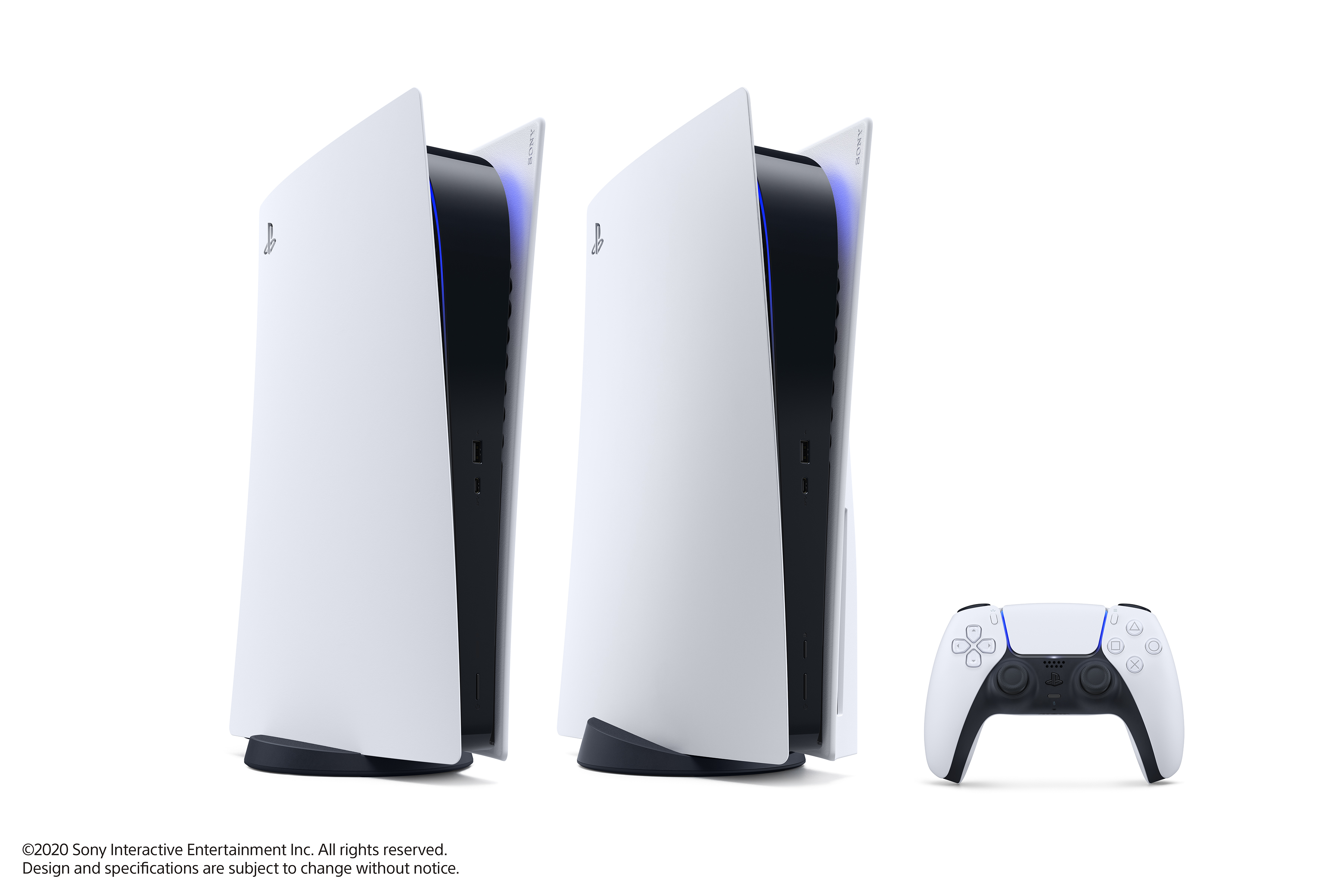
Sony finally reviewed the PS5 tower in all its glory — and I’ve got to admit, the damn thing looks pretty slick. That goes double when placed up against the Xbox Series X, which frankly looked a bit more like a router than I think most were expecting. The PS5 isn’t entirely un-router-like, but at least it’s a sleek-looking one. While it seems likely we’ll see multiple color options, the unit that featured prominently in the event featured the same sort of white with black trim color scheme we saw on the controller review.

Here, however, there are some sharp finds and radical angles that could make it difficult to place the system in a horizontal configuration, if you’re so inclined. The back, meanwhile, features an exposed black surface with a fairly large cooling vent. As seen above, there are two distinct versions of the system. At left is the standard PS5 and at right is the Digital Edition, which ditches the familiar disc drive. Seems Sony’s not ready to abandon physical games just yet. Like Microsoft’s digital version of the last Xbox, the system will most likely come with a price cut over the standard model. It also appears a fair bit thinner.

Specwise, we know we’re in for an AMD Zen 2 CPU and AMD’s RDNA 2-based GPU, coupled with 16GB of RAM and an 825GB SSD — no word on whether that last bit will vary between models. There’s also a separate HD camera accessory and matching Pulse 3D headphones, which feature that 3D audio Sony has long been pushing. Plenty more details to come — including price — ahead of the system’s launch this holiday season.


Powered by WPeMatico