1010Computers | Computer Repair & IT Support

Extra Crunch Live: Join Superhuman’s Rahul Vohra for a live discussion of email, SaaS and buzzy businesses

An email app with a waitlist? No, this isn’t 2004 and I’m not talking about Gmail. Superhuman has managed to attract and maintain constant interest for its subscription email product, with a wait list at over 275,000 people long at last count – all while asking users to pay $30 per month to gain access to the service. Founder and CEO Rahul Vohra will join us on Tuesday, June 26 at 2pm ET/11am PT for an Extra Crunch Live Q&A.

We have plenty of questions of our own, but we bet you do, too! Extra Crunch members can ask their own questions directly to Vohra during the chat.

We’re thrilled to be able to sit down with Vohra for a discussion about email, why it was in need of change, and what’s bringing so much attention and interest to Superhuman on a sustained basis. We’ll talk about the current prevailing market climate and what that’s meant for the business, as well as how you manage to create not one, but two companies (Vohra previously founded and sold Rapportive) that have adapted email to more modern needs – and struck a chord with users as a result.

Meanwhile, SaaS seems to be one of the bright spots in an otherwise fairly gloomy global economic situation, and Superhuman’s $30 per month subscription model definitely qualifies. We’ll ask Vohra what it means to build a successful SaaS startup in 2020, and how there might be plenty of opportunity even in so-called ‘solved’ problems like email and other aspects of our digital lives that have become virtually invisible thanks to habit.

Audience members can also ask their own questions, so come prepared with yours if you’re already an Extra Crunch member. And if you aren’t yet – now’s a great time to sign up.

We hope to see you there!

Powered by WPeMatico

Monzo confirms £60M down round, with a new pre-money valuation of £1.24B

Monzo, the U.K. challenger bank with more than 4 million customers, has confirmed it has closed £60 million in top-up funding.

Backing the round are existing investors Y Combinator, General Catalyst, Accel, Stripe, Goodwater, Orange, Thrive and Passion Capital, along with new investors Reference Capital and Vanderbilt University.

One of fintech’s worst-kept secrets, the down round sees the bank take a 40% hit in its paper pre-money valuation compared to its previous round, now priced at £1.24 billion.

That’s likely a reflection of the current funding climate amidst the coronavirus crisis, with Monzo having to raise a bridge round at quite possibly the worst time.

I also understand from sources that a number of Monzo’s later-stage investors played hardball, in a bid to force down the challenger bank’s ticket price, perhaps after investing at the height of the funding market pre-COVID-19. What is also interesting about the new round is that the share price is the same as the bank’s last equity crowdfund, meaning that the most recent armchair investors haven’t seen a paper loss.

Monzo is also disclosing that its business banking product has now reached 25,000 signups. Launched officially in March, the business bank account is aimed at sold traders and SMEs, with both free and premium paid-for versions available, offering various feature sets.

Meanwhile, it has been a turbulent time for Monzo, as it, along with many other fintech companies, tries to insulate itself from the coronavirus crisis and resulting economic downturn.

Planned layoffs in the U.K. were communicated internally earlier this month — up to 120, but now thought to be around 80. It followed earlier U.S. layoffs and the shuttering of its Las Vegas-based customer support office, and almost 300 U.K. staff being furloughed.

Like other banks and fintechs, the coronavirus crisis has resulted in Monzo seeing customer card spend reduce at home and (of course) abroad, meaning it is generating significantly less revenue from interchange fees. The bank has also postponed the launch of premium paid-for consumer accounts, one of only a handful of known planned revenue streams, alongside lending, of course, and the more recent business banking.

Separately, in May, Monzo co-founder Tom Blomfield announced internally that he was stepping down as CEO of the U.K. challenger bank to take up the newly created role of president. His replacement is current U.S. CEO TS Anil, who now also holds the title of “Monzo UK Bank CEO,” subject to regulatory approval.

Powered by WPeMatico

Apple Pay and iOS App Store under formal antitrust probe in Europe

Apple is under formal investigation by antitrust regulators in European Union — following a number of complaints related to how it operates the iOS App Store and also its payment offering, Apple Pay.

The Commission said today that it has concerns that conditions and restrictions applied by the tech giant may be distorting competition in a number of areas, following a preliminary probe of the issues.

Back in March 2019, European music streaming service Spotify filed an antitrust complaint against Apple — railing very publicly against what it dubbed an “Apple tax”; aka the 30% tariff the tech giant applies on accepting payments in apps on its App Store. Spotify also accused Apple of impeding its business by applying arbitrary rules — such as making it harder to offer its own users discounts.

The Commission confirmed today that it’s looking formally into whether Apple’s rules for app developers on the distribution of apps via the App Store violate EU competition rules. It said the probe focuses on Apple’s mandatory requirement that app developers use its own proprietary in-app purchase system, as well as restrictions applied on the ability of developers to inform iPhone and iPad users of alternative cheaper purchasing possibilities outside of apps.

As well as the very public complaint from Spotify, the Commission has received a similar complaint from an unnamed e-book/audiobook distributor related to the impact of the App Store rules on competition.

Two specific restrictions imposed by Apple in its agreements with companies that wish to distribute apps to users of Apple devices will be investigated, per the Commission — namely [emphasis its]:

(i)   The mandatory use of Apple’s own proprietary in-app purchase system “IAP” for the distribution of paid digital content. Apple charges app developers a 30% commission on all subscription fees through IAP.

(ii)  Restrictions on the ability of developers to inform users of alternative purchasing possibilities outside of apps. While Apple allows users to consume content such as music, e-books and audiobooks purchased elsewhere (e.g. on the website of the app developer) also in the app, its rules prevent developers from informing users about such purchasing possibilities, which are usually cheaper.

“Following a preliminary investigation the Commission has concerns that Apple’s restrictions may distort competition for music streaming services on Apple’s devices,” it writes in a press release. “Apple’s competitors have either decided to disable the in-app subscription possibility altogether or have raised their subscription prices in the app and passed on Apple’s fee to consumers.

“In both cases, they were not allowed to inform users about alternative subscription possibilities outside of the app. The IAP obligation also appears to give Apple full control over the relationship with customers of its competitors subscribing in the app, thus dis-intermediating its competitors from important customer data while Apple may obtain valuable data about the activities and offers of its competitors.”

Commenting in a statement, Commission EVP Margrethe Vestager — who heads up competition policy for the bloc — added: Mobile applications have fundamentally changed the way we access content. Apple sets the rules for the distribution of apps to users of iPhones and iPads. It appears that Apple obtained a ‘gatekeeper’ role when it comes to the distribution of apps and content to users of Apple’s popular devices. We need to ensure that Apple’s rules do not distort competition in markets where Apple is competing with other app developers, for example with its music streaming service Apple Music or with Apple Books. I have therefore decided to take a close look at Apple’s App Store rules and their compliance with EU competition rules.”

Vestager’s reference to a “gatekeeper” role has specific significance as the Commission is currently consulting on updating regulations for digital platforms — including floating the possibility of ex ante regulation for platforms deemed to be gatekeepers vis-a-vis other suppliers.  (In parallel, the Commission is consulting on updates to competition law that may allow it to intervene more swiftly in future, in instances where it suspects digital markets have ‘tipped’.)

Spotify welcomed the Commission’s action, writing in a statement:

Today is a good day for consumers, Spotify and other app developers across Europe and around the world. Apple’s anticompetitive behavior has intentionally disadvantaged competitors, created an unlevel playing field, and deprived consumers of meaningful choice for far too long. We welcome the European Commission’s decision to formally investigate Apple, and hope they’ll act with urgency to ensure fair competition on the iOS platform for all participants in the digital economy.

On Apple Pay, the Commission said a formal investigation of how it operates the payment tech will look at the “terms, conditions and other measures” Apple applies for integrating the payment solution in merchant apps and websites on iPhones and iPads; Apple’s limitation of access to the NFC functionality on iPhones for payments in stores; and allegations of “refusals of access to Apple Pay”.

Following a preliminary probe, the Commission said it is concerned Apple’s processes “may distort competition and reduce choice and innovation”.

It also notes that Apple Pay is the only mobile payment solution that is allowed to access NFC technology on iOS devices for making payments in stores.

“The investigation will also focus on alleged restrictions of access to Apple Pay for specific products of rivals on iOS and iPadOS smart mobile devices,” it added.

The Commission said it will carry out the investigations “as a matter of priority”, but there’s no set timeframe for how long this process might take.

EU antitrust investigations have tended to take a number of years from an announcement of a formal probe to a decision being reached. (Although, in an ongoing investigation against Broadcom, Vestager recently dusted off a tool to accelerate regulatory intervention — but as yet there’s no formal ‘statement of objections’ against Apple so it remains to be seen how this case will proceed, and whether regulators may seek to speed up any intervention.)

Reached for comment on the Commission’s announcement of the two antitrust investigations, Apple dubbed the complaints “baseless” — choosing to throw shade on the complainants by claiming these companies are after “a free ride, and don’t want to play by the same rules as everyone else”.

Here’s Apple’s statement on the two investigations in full:

Throughout our history, Apple has created groundbreaking new products and services in some of the most fiercely competitive markets in the world. We follow the law in everything we do and we embrace competition at every stage because we believe it pushes us to deliver even better results.

We developed the App Store with two goals in mind: that it be a safe and trusted place for customers to discover and download apps, and a great business opportunity for entrepreneurs and developers. We’re deeply proud of the countless developers who’ve innovated and found success through our platform. And as we’ve grown together, we’ve continued to deliver innovative new services — like Apple Pay — that provide the very best customer experience while meeting industry-leading standards for privacy and security.

It’s disappointing the European Commission is advancing baseless complaints from a handful of companies who simply want a free ride, and don’t want to play by the same rules as everyone else. We don’t think that’s right — we want to maintain a level playing field where anyone with determination and a great idea can succeed.

At the end of the day, our goal is simple: for our customers to have access to the best app or service of their choice, in a safe and secure environment. We welcome the opportunity to show the European Commission all we’ve done to make that goal a reality.

Apple has had a number of run-ins with EU regulators over the years — including a probe of its acquisition of Shazam (which was later cleared); a major investigation of ebook pricing; and a probe of tax benefits in Ireland which saw it on the hook for $15BN.

French competition regulators also recently fined the tech giant $1.2BN for anti-competitive sales tactics. It’s also been fined $27M by French regulators this year for throttling old iPhones.

This report was updated with comment from Spotify

Powered by WPeMatico

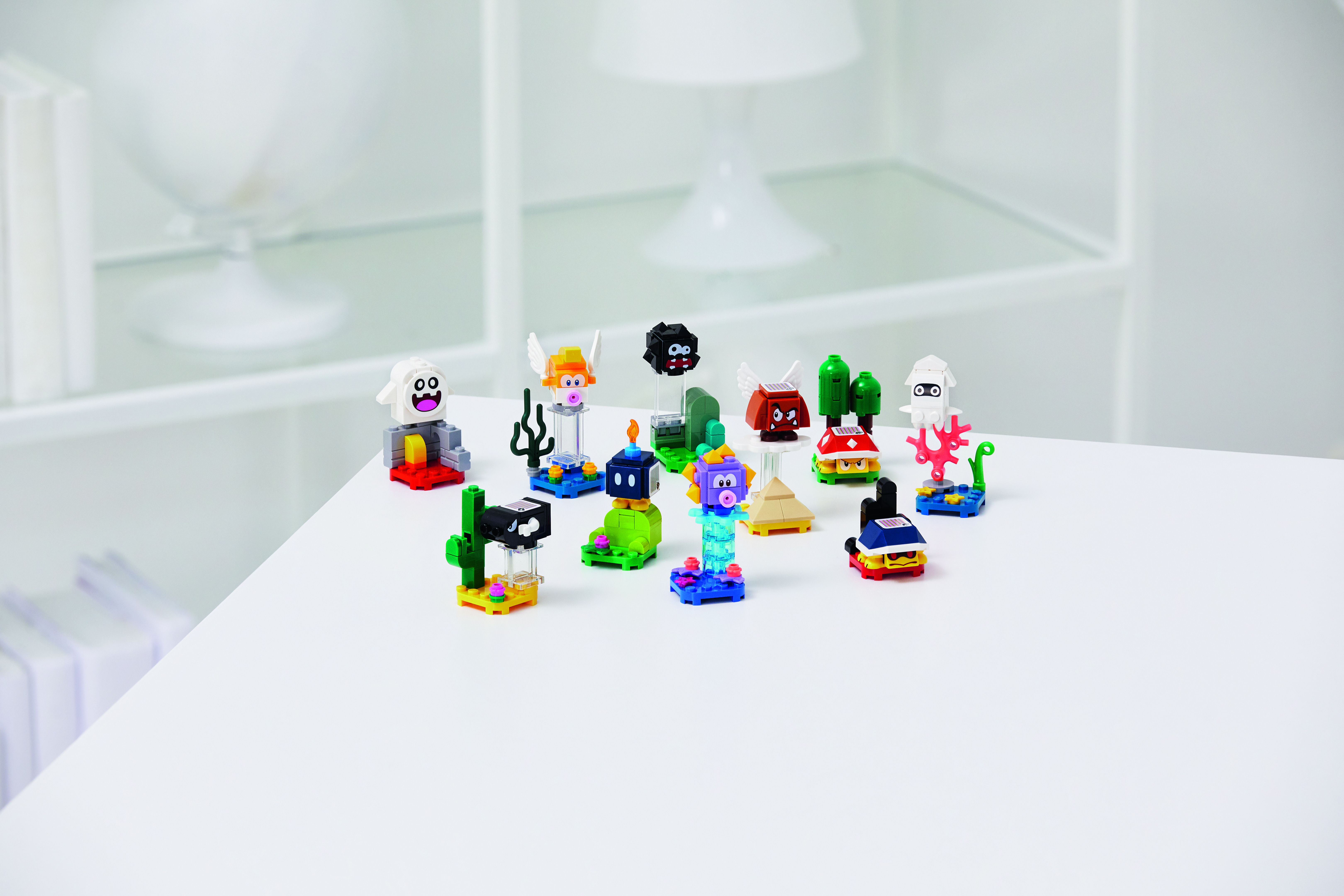
Here’s the full lineup of Lego Super Mario sets, due out August 1

Back in March, Nintendo and Lego teamed up to reveal one of the most delightful bits of colorful ephemera in an otherwise overwhelmingly bleak time. Lego Super Mario continues to be one thing worth looking forward to through it all, for the young and nostalgia-inclined old alike. And thankfully you only have to hang tight a couple more months to get it.

Image credits: Nintendo

Today, the childhood staples revealed the full rundown of sets. The list includes the already announced Starter Course, along with 10 expansion sets. Four Power-Up Packs and a variety of Character packs. The Starter Course is currently up for pre-order on Lego’s site, and all will be made available on August 1, online and through select retailers that happen to be open for business.

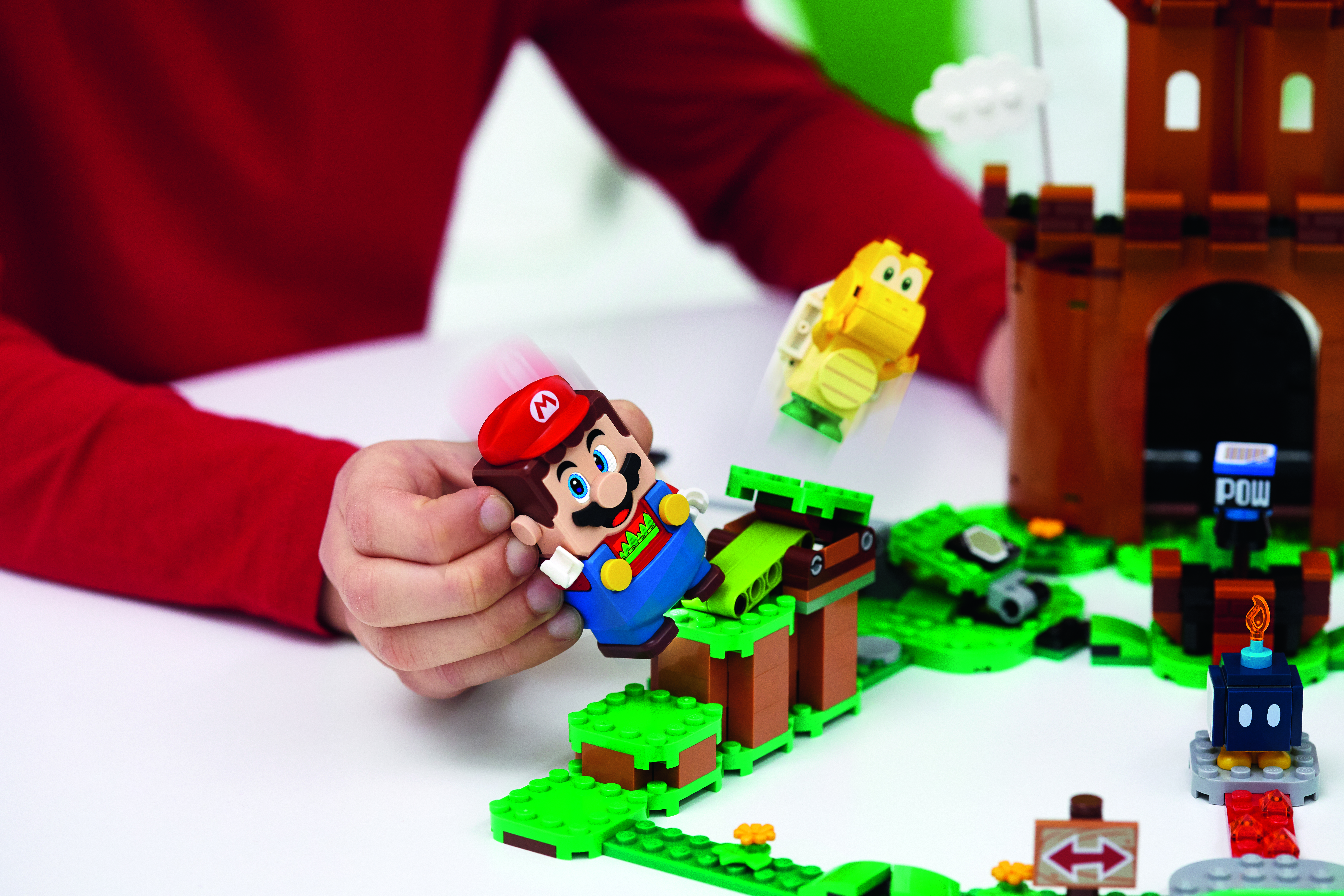
The Expansion sets include a range of familiar levels from the Nintendo series and a few other riffs on the Mushroom Kingdom, including Bowser’s Castle Boss Battle, Mario’s House and Yoshi, King Boo and the Haunted Yard and Toad’s Treasure Hunt. Those range in price from $20 to $100. The Power-Ups will all run $10 and the blind bag Character Packs are $5. Nothing too crazy in Lego terms, but any fan will tell you these things add up quickly. All of the sets are designed to be used together, and each features clever articulation designed to mimic gameplay. 

Image credits: Nintendo

The Starter Course, meanwhile is $60. Of the figures, Mario continues to be the most advanced, with four built-in LEDs (two eyes, a mouth and a chest), a speaker for sound and color sensors on his feet, so the figure can track where it jumps. Understandably, he’s the centerpiece of all the play sets. 

There’s also some more information on the included app, which offers build guidance, keeps track of scores and presses young players to build and rebuild the levels. There’s a sharing function, as well, along with a kid-safe forum for discussing build ideas.

Powered by WPeMatico

Yelp adds new features for reopening businesses

Over the past few months, Yelp has been taking steps to help businesses reeling from the impact of the coronavirus pandemic — things like waived fees, virtual service listings and GoFundMe fundraisers (that last one had a mixed reception).

But without getting into the question of whether the United States is reopening at the right time in the right way, it’s clear that the reopening is happening, and businesses are going to need new tools to safely navigate the changing landscape. So Yelp is announcing two of those tools today.

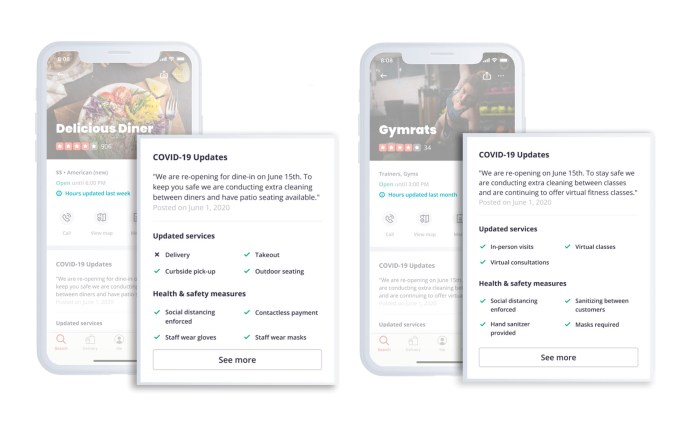
First, it says it’s expanding on its COVID-19 banners, with a full COVID-19 section on each business profile. So those businesses can indicate whether they’re doing things like enforcing social distancing, sanitizing spaces between customer visits, requiring that employees wear masks and/or gloves, requiring that customers wear masks and so on.

These updates will be timestamped. There can, of course, still be a difference between what the business promises and the reality in the store. But as a consumer, at least you’ll know how up-to-date those promises are.

Image Credits: Yelp

In addition, Yelp says it will use a combination of human moderation and machine learning to update these sections with information that businesses have posted elsewhere, like whether they offer curbside pickup or virtual services.

The company is also updating its waitlist feature, which restaurants may be turning to as a way to avoid long lines and crowds. Restaurants will now be able to print a QR code that customers can scan to add themselves to the waitlist in a contactless way. Hosts will also be able to manually adjust wait times, and they’ll get alerts when they’re approaching legally mandated seating capacities.

In a statement, Yelp’s head of consumer product Akhil Kuduvalli Ramesh said that the company’s response to the pandemic has broken down into two phases. During the first phase, “We helped businesses convey how they are updating their operating models and services they offered.”

He added, “In phase two, as people begin to reenter businesses, addressing the health and safety needs in the local marketplaces across the US is of paramount importance.”

Powered by WPeMatico

Swappie bags $40.6M to sell more secondhand iPhones across Europe

Finland-based Swappie has closed a €35.8 million ($40.6M) Series B to expand into new markets in Europe. The ecommerce business refurbishes and resells used iPhones, taking care of the entire process from testing and repairing used handsets, to selling the refurbished devices via its own marketplace, with a 12-month warranty.

Local VC and private equity firm TESI is a new investor in the Series B, along with Lifeline Ventures, Reaktor Ventures and Inventure Investors, all of whom participated in Swappie’s 2019 Series A. The total raised to date since the business was founded in 2016 is $48M.

Right now Swappie operates in Finland, Sweden, Denmark and Italy. The new financing will be used to expand across Europe, beginning with launches in Germany, Ireland, Portugal and the Netherlands this summer.

It’s also eyeing expansion beyond Europe — so will be speccing out a broader roadmap for the future.

“The main focus of this round is to become the number one player in Europe. But also to explore opportunities outside Europe as well,” says CEO and co-founder Sami Marttinen. “That’s something we will be looking into but no concrete plans to announce at this point.

“There are still opportunities for our business model everywhere in the world. So it’s a matter of just building the roadmap — where to go next.”

Swappie’s Jiri Heinonen (CMO) and Sami Marttinen (CEO) (Photo credit: Swappie)

Swappie touts growing consumer demand in the region to buy refurbished phones, saying that from 2018 to 2019 revenues grew 4x, hitting $35M+ in net revenue in 2019. It’s also seeing demand continuing to grow this year — recording a 5x increase in net revenue growth in April and May 2020 vs the same period last year, despite the ongoing COVID-19 pandemic. Indeed, the trend of consumers shifting to buying more online looks to be a help for its online marketplace.

Commenting on Swappie’s Series B in a statement, Tony Nysten, Investment Manager at TESI, said: “We believe there is a huge growth opportunity for Swappie. The smartphone market in Europe is worth over €100BN but used or refurbished phones currently make up just over 10% of that and only one in four pre-owned phones are currently re-sold. Through its rapid growth to date, Swappie has proven its ability to not just grow market share within the refurbished market, but to expand the size of the category overall. The business has enormous potential.”

Swappie’s early choice of market focus included not only familiar turf in the Nordics — but Italy, in Southern Europe. The latter was chosen deliberately on account of it being a tough market for ecommerce, per Marttinen.

“In the really early days the reason why we went to Italy was because it was one of the toughest ecommerce markets in Europe — they have a really low ecommerce maturity index. It’s very different in terms of shopping behavior. You need to build another level of trust in that market. There are lots of unique traits like cash on delivery, things like that. So we knew that in order to really conquer the market globally — and to be able to deliver on our global ambitions we would need to enter as difficult markets as early in our journey as possible.

“These days we have a much more advanced playbook and market studies across Europe.”

Swappie describes itself as a ‘scale-up’ tech business on account of addressing the whole value chain, per Marttinen.

“We’ve done a lot there on the hardware side — when it comes to actually refurbishing the devices we can make them even stronger then the original devices in many cases. So that means we can go as deep as onto the motherboard level in the repairs. Then on the software side, of course, we’re making selling and distribution and everything else scalable. Making sure that the checking processes and all the processes in the factory are according to the latest standards,” he says.

“Because of being so focused in also building the processes and focusing on the quality so much, so actually we have been able to truly change the way people consume electronics,” he adds. “If you think about it from a local player perspective they are typically mostly competing for the people who are already buying used devices — whereas we are able to deliver on this market by having full control of the entire value chain, from buying to refurbishing, to selling the phones to consumers.

“Most of our customers are buying used or refurbished devices for the first time — so actually our biggest competitors are new smartphone retailers.”

The most popular iPhone model sold on Swappie’s marketplace last year was the iPhone 8, per Marttinen.

He won’t disclosed the exact number of iPhones Swappie has refurbished and sold at this point but he says it’s a six-figure number — aka ‘hundreds of thousands’. 

The team chose to focus on iPhones to ensure they can deliver the highest quality device refurbishment, he says, while also benefiting from the relatively higher cost of Apple’s smartphone hardware vs Android devices. Though he doesn’t rule out expanding to offer another type of refurbished smartphone in future.  

“The business is now growing really rapidly but what we noticed in the early days is that the new device prices had started to rise before we started this business so we have been very lucky with the timing,” he tells TechCrunch, noting that Swappie also benefitted from the plateauing into advancements between handset models in recent years, as the technology matured.

“If you can build trust into this business, and make sure that the phones function as well as new devices — and that you’re actually making the buying process as well as safe as buying a new phone — that way you can actually accelerate the growth of the market. So that’s what we have been really successful in. It’s kind of the key to being able to grow so quickly.”

“One main point there has been that because we refurbish every device ourselves in our own factory in Finland we can deliver to customers the highest quality devices under warranty for much less than the cost of a new phone and also be more environmentally friendly,” he adds.

While, in years past, there have been instances of iPhone users’ devices bricked after a repair by an unauthorized repair shop Marttinen says Swappie is using only original iPhone parts so has avoided such problems.

He also points to recent European Commission proposals for a pan-EU ‘right to repair’ for electronics which suggests device makers selling in the region will be required to respect repairability, rather than using software updates as a way to penalize consumers who seek to extend the lifespan of their current device.
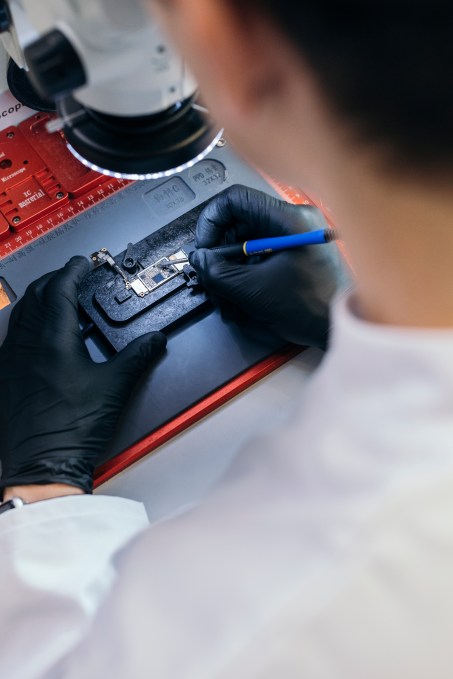
Photo credit: Swappie

Swappie’s business also slots into a wider Commission mission to transition the EU to a circular economy, as part of the green deal announced by current president, Ursula von der Leyen — so it’s skating to where the puck is headed, if you like.

“It’s really good for the environment that the right to repair legislation has come forward in the past few years. That’s one very important point for us as well which was one of the reasons why we wanted to built microscope level repairs in our factories — so we wouldn’t have to scrap as many phones as you normally would,” Marttinen adds.

What can’t it repair? The proportion of iPhones which turn out to be truly unsalvageable via its processes is “extremely small“, he says. “We can actually do any repairs that are possible to do the phones so, basically, water damaged phones which have been at the bottom of the ocean — those are of course unrepairable. Or if the phone is bent too much or if the motherboard is completely ruined. But basically all the other faults we can repair.”

On the competitive front, he says Swappie’s main rival are retailers selling new iPhones — given it’s trying to woo iOS users away from buying a brand new iPhone. On the secondhand marketplace front Marttinen mentions reBuy as one of the main rival players in refurbishing and reselling electronics, though it does not focus on iPhones — offering a full range of devices, from wearables to smartphones and tablets, laptops, consoles and cameras.

Powered by WPeMatico

SoftBank confirms it may sell some of its T-Mobile stake

SoftBank Group confirmed today it is considering selling its T-Mobile U.S. shares.

Bloomberg reported last month that SoftBank was nearing an agreement to sell about $20 billion of its T-Mobile U.S. shares to investors, including Deutsche Telekom, T-Mobile’s controlling shareholder, in an effort to offset major losses from its investment business, including the Vision Fund.

In today’s notice, SoftBank Group, which owns about 25% of T-Mobile U.S. shares, said it is exploring transactions that could include private placements or public offerings and transactions with T-Mobile or its shareholders, including Deutsche Telekom AG, or third parties.

The potential sale would be part of SoftBank Group’s program, announced in March, to sell or monetize up to $41 billion in assets to reduce debt and increase its cash reserves. The company said, however, that it cannot assure any of the transactions involving T-Mobile shares will be completed.

Powered by WPeMatico

Stockwell, the AI-vending machine startup formerly known as Bodega, is shutting down July 1

Stockwell AI entered the world with a bang but it is leaving with a whimper. Founded in 2017 by ex-Googlers, the AI vending machine startup formerly known as Bodega first raised blood pressures — people hated how it referenced and poorly ‘disrupted’ mom-and-pop shops in one fell swoop — and then raised a lot of money. But ultimately, it was no match for COVID-19 and the hit it has had on how we live.

TechCrunch has learned and confirmed that Stockwell will be shutting down at the end of this month, after it was unable find a viable business for its in-building app-controlled “smart” vending machines stocked with convenience store items.

“Regretfully, the current landscape has created a situation in which we can no longer continue our operations and will be winding down the company on July 1st,” co-founder and CEO Paul McDonald wrote in an email to TechCrunch. “We are deeply grateful to our talented team, incredible partners and investors, and our amazing shoppers that made this possible. While this wasn’t the way we wanted to end this journey, we are confident that our vision of bringing the store to where people live, work and play will live on through other amazing companies, products and services.”

We originally reached out after we were tipped off by someone who had received an email about the closure. Stockwell’s vending boxes were distributed primarily in apartment and office buildings, and it has been contacting those customers for the past week to break the news.

For what it’s worth, the building operator that was using Stockwell vending machines said it is actively in search of a replacement provider, so it seems it did get some use, but more pointedly it’s been very hard for the vending machine industry, where some distributors have seen business losses of up to 90%.

Stockwell’s closure is notable because it underscores how in the current climate, having a strong list of backers and a very decent amount of funding cannot always guarantee insulation for everyone.

As of last September, Stockwell had raised at least $45 million in funding from investors that included NEA, GV, DCM Ventures, Forerunner, First Round, and Homebrew. Its network had grown to 1,000 “stores”, smart vending machines that work a little like advanced hotel minibars: sensors detect and charge you for what you take out, and you use a smartphone app both to track what you buy and to pay for it.

As of last autumn, the company appeared to be gearing up for a widening of its business model, allowing its customers (building, office and apartment managers) to have a bigger say in what got stocked beyond the items Stockwell itself put into its machines, which included water and other beverages, savoury and sweet snacks, and a few home basics like laundry detergent and pain killers.

By December, it seems that McDonald’s co-founder, Ashwath Rajan, had quietly left the startup, and then as 2020 kicked into gear, COVID-19 took its toll.

First, consumers found themselves spending much more time working and simply being at home, going out less and bulk buying to minimise shopping efforts. That, in turn, had a big impact on the sustainability of business models based on casual, small purchases, such as the kind that one would typically make from vending machines like Stockwell’s.

Second, at a time when many are trying to minimise the spread of infection by wearing face masks, washing hands and minimising touching random objects, a big question mark hangs over the whole concept of unattended vending machines, and whether they can ever be properly sanitised. That’s impacted not only people buying items, but the workforce that’s meant to help stock and maintain these kiosks.

There have been some interesting twists in how the vending industry has handled COVID-19. Some are swapping out pretzels and Snickers and replacing them with PPE equipment, and others are finding opportunity in stocking them with healthy food specifically for front-line workers who have no other options and need quick but nutritious fixes during critical times.

But more generally, the vending machine industry has been hit hard by the pandemic.

The wider market in a normal year is estimated to be worth some $30 billion annually — one reason why Stockwell nee Bodega likely caught the eye of investors — but business has fallen off a cliff for many key operators.

The president of the European Vending Association, in an appeal in April to government leaders for financial assistance, said that business had dropped off by 90% and described COVID-19 as having a “devastating effect” on the sector. Difficult numbers for the Pepsi’s and Mondelez’s (nee Kraft) of the world, but surely the nail in the coffin for a young, promising AI-based vending machine startup that nonetheless some doubted from the word go.

Powered by WPeMatico

IoT solutions are enabling physical distancing

Tyler Cracraft
Contributor

Tyler Cracraft is an electronic engineer turned solution architect at Advantech who has more than a decade of experience working in the electronics technology industry.

If you’re a business owner or investor and are wondering about the long-term impacts of the COVID-19 pandemic on the business world, you’re not alone.

Today’s business leaders have been plunged into the deep end of telecommuting with little notice, and the way we do business has been impacted at almost every level. Travel is restricted, meetings are virtual and delivery of goods and even raw materials is being delayed. While some industries that depend on large gatherings are seeing extremely difficult challenges due to the pandemic, others such as the tech industry, see the opportunity and responsibility for innovation and growth.

As many states begin phased reopening, companies are trying to determine what the workplace and business environment will look like in a post-quarantine world. The first obvious step is the integration of personal protective equipment (PPE). Sanitization and face masks will become required and nonessential face-to-face meetings will be a thing of the past, along with shaking hands.

Additionally, relationship-driven careers such as sales and recruiting will have to find new ways to connect to be successful. Physical distancing rules will have to be established, which may include employees coming in alternate days while telecommuting the other days of the week to keep offices at reduced capacity. Large offices of 10 or more may implement thermographic camera technology for fever screening or other real-time technology-based health screenings.

One thing is for sure: IoT devices that enable physical distancing will become an integral part of reopening businesses, facilitating sales connections and embracing a different way of living.

Solutions for physical distancing

There are a variety of IoT devices available that can help business leaders successfully implement physical distancing in their offices. Thermographic camera technology coupled with facial recognition can create a baseline for each employee and then assist in determining if an employee has a temperature outside of their norm. Other remote health monitoring may also take place with healthcare providers, helping employees determine on a daily basis if they are well enough to go into work.

Powered by WPeMatico

Marietje Schaake is ‘very concerned about the future of democracy’

Scott Bade
Contributor

Scott Bade is a former speechwriter for Mike Bloomberg and co-author of “More Human: Designing a World Where People Come First.”

In the ten years she spent as a member of the European Parliament, Marietje Schaake became one of Brussels’ leading voices on technology policy issues.

A Dutch politician from the centrist-liberal Democrats 66 party, Schaake has been called “Europe’s most wired” politician. Since stepping down at the last European Parliament elections in 2019, she has doubled down with her work on cyber policy, becoming president of the CyberPeace Institute in Geneva and moving to the heart of Silicon Valley, where she has joined Stanford University as both the International Director of Policy at Stanford’s Cyber Policy Center, as well as an International Policy Fellow at its Institute for Human-Centered Artificial Intelligence.

I spoke with her about her top cyber policy concerns, the prospects of greater U.S.-EU cooperation on technology and much more.

Can you tell me about your journey from MEP in Brussels to think tank in academia?

There were a variety of reasons why I thought a third term was not the best thing for me to do. I started thinking about what would be a good way to continue, focusing on the fight for justice, for universal human rights and increasingly for the rule of law. A number of academic institutions, especially in the U.S. reached out, and we started a conversation about what the options might be, what I thought would be worthwhile. [My goal] was to understand where tech is going and what does it mean for society, for democracy, for human rights and the rule of law? But also how do the politics of Silicon Valley work?

I feel like there’s a huge opportunity, if not to say gap, on the West Coast when it comes to a policy shop — both to scrutinize policy that the companies are making and to look at what government is doing because Sacramento is super interesting. 

So from a policy perspective, what areas of tech are you thinking about most?

I’m very concerned about the future of democracy in the broadest sense of the word. I feel like we need to understand better how the architecture of information flows and how it impacts our offline democratic world. The more people get steered in a certain direction, the more the foundations of actual liberalism and liberal democracy are challenged. And I feel like we just don’t look at that enough.

Powered by WPeMatico