1010Computers | Computer Repair & IT Support

Outreach nabs $50M at a $1.33B valuation for software that helps with sales engagement

CRM software has become a critical piece of IT when it comes to getting business done, and today a startup focusing on one specific aspect of that stack — sales automation — is announcing a growth round of funding underscoring its own momentum. Outreach, which has built a popular suite of tools used by salespeople to help identify and reach out to prospects and improve their relationships en route to closing deals, has raised $50 million in a Series F round of funding that values the company at $1.33 billion. 

The funding will be used to continue expanding geographically — headquartered in Seattle, Outreach also has an office in London and wants to do more in Europe and eventually Asia — as well as to invest in product development.

The platform today essentially integrates with a company’s existing CRM, be it Salesforce, or Microsoft’s, or Kustomer, or something else — and provides an SaaS-based set of tools for helping to source and track meetings, have to-hand information on sales targets, and a communications manager that helps with outreach calls and other communication in real time. It will be investing in more AI around the product, such as its newest product Kaia (an acronym for “knowledge AI assistant”), and it has also hired a new CFO, Melissa Fisher, from Qualys, possibly a sign of where it hopes to go next as a business.

Sands Capital — an investor out of Virginia that also backs the likes of UiPath and DoorDash — is leading the round, Outreach noted, with “strong participation” also from strategic backer Salesforce Ventures. Other investors include Operator Collective (a new backer that launched last year and focuses on B2B) and previous backers Lone Pine Capital, Spark Capital, Meritech Capital Partners, Trinity Ventures, Mayfield and Sapphire Ventures.

Outreach has raised $289 million to date, and for some more context, this is definitely an up round: the startup was last valued at $1.1 billion when it raised a Series E in April 2019.

The funding comes on the heels of strong growth for the company: More than 4,000 businesses now use its tools, including Adobe, Tableau, DoorDash, Splunk, DocuSign and SAP, making Outreach the biggest player in a field that also includes Salesloft (which also raised a significant round last year on the heels of Outreach’s), ClariChorus.aiGongConversica and Afiniti. Its sweet spot has been working with technology-led businesses and that sector continues to expand its sales operations, even as much of the economy has contracted in recent months. 

“You are seeing a cambric explosion of B2B startups happening everywhere,” Manny Medina, CEO and co-founder of Outreach, said in a phone interview this week. “It means that sales roles are being created as we speak.” And that translates to a growing pool of potential customers for Outreach.

It wasn’t always this way.

When Outreach was first founded in 2011 in Seattle, it wasn’t a sales automation company. It was a recruitment startup called GroupTalent working on software to help source and hire talent, aimed at tech companies. That business was rolling along, until it wasn’t: In 2015, the startup found itself with only two months of runway left, with little hope of raising more. 

“We were not hitting our stride, and growth was hard. We didn’t make the numbers in 2014 and then had two months of cash left and no prospects of raising more,” Medina recalled. “So I sat down with my co-founders,” — Gordon Hempton, Andrew Kinzer and Wes Hather, none of whom are at the company anymore — “and we decided to sell our way out of it. We thought that if we generated more meetings we could gain more opportunities to try to sell our recruitment software.

“So we built the engine to do that, and we saw that we were getting 40% reply rates to our own outreaching emails. It was so successful we had a 10x increase in productivity. But we ran out of sales capacity, so we started selling the meetings we had managed to secure with potential talent directly to the tech companies themselves,” in other words, the other side of its marketplace, those looking to fill vacancies.

That quickly tipped over into a business opportunity of its own. “Companies were saying to us, ‘I don’t want to buy the recruitment software. I need that sales engine!” The company never looked back, and changed its name to work for the pivot.

Fast-forward to 2020, and times are challenging in a completely different way, defined as we are by a global health pandemic that affects what we do every day, where we go, how we work, how we interact with people and much more. 

Medina says the impact of the novel coronavirus has been a significant one for the company and its customers, in part because it fits well with two main types of usage cases that have emerged in the world of sales in the time of COVID-19.

“Older sellers now working from home are accomplished and don’t need to be babysat,” he said, but added they can’t rely on their traditional touchpoints “like meetings, dinners and bar mitzvahs” anymore to seal deals. “They don’t have the tools to get over the line. So our product is being called in to help them.”

Another group at the other end of the spectrum, he said, are “younger and less experienced salespeople who don’t have the physical environment [many live in smaller places with roommates] nor experience to sell well alone. For them it’s been challenging not to come into an office because especially in smaller companies, they rely on each other to train, to listen to others on calls to learn how to sell.”

That’s the other scenario where Outreach is finding some traction: They’re using Outreach’s tools as a proxy for physically sitting alongside and learning from more experienced colleagues, and using it as a supplement to learning the ropes in the old way.

“Outreach’s leadership position in the market, clear mission, and value-added approach make the company a natural investment choice for us,” said Michael Clarke, partner at Sands Capital’s Global Innovation Fund, in a statement. “Now more than ever, companies need an AI-powered sales engagement platform like Outreach. Enterprise sales teams are rapidly adopting sales engagement platforms and Outreach’s rapid growth reflects this.”

Like a lot of sales tools that are powered by AI, Outreach in part is taking on some of the more mundane jobs of salespeople.

But Medina doesn’t believe that this will play out in the “man versus machine” scenario we often ponder when we think about human obsolescence in the face of technological efficiency. In other words, he doesn’t think we’re close to replacing the humans in the mix, even at a time when we’re seeing so many layoffs.

“We are at the early innings,” he said. “There are 6.8 million sales people and we only have north of 100,000 users, not even 2% of the market. There may be a redefinition of the role, but not a reduction.”

Powered by WPeMatico

Revolut expands bank account aggregation to Ireland

Fintech startup Revolut has expanded its open banking feature to Ireland. The feature first launched in the U.K. back in February. Once again, the startup is partnering with TrueLayer to let you add third-party bank accounts to your Revolut account.

The feature launch also marks the launch of TrueLayer in Ireland. For now, Revolut users can only link their Revolut account with AIB, Permanent TSB, Ulster Bank and Bank of Ireland. Revolut and TrueLayer will add support to other banks in the future. Revolut currently has 1 million customers in the Republic of Ireland.

The idea behind open banking is quite simple. Many online services rely on application programming interfaces (APIs) to talk to each other. You can connect with your Facebook account on many online services, you can interact with other services from Slack, etc.

Financial institutions have been lagging behind on this front, but it is changing thanks to new regulation and technical updates. With open banking, your bank account should work more like a traditional internet service.

When you connect your bank account with Revolut, you can view your balance and past transactions from a separate tab that lists all your linked accounts. Users can also take advantage of Revolut’s budgeting features with their bank accounts.

As TechCrunch’s Steve O’Hear noted when he first covered Revolut’s open banking feature, Revolut was originally authorized for Account Information Services (AIS) by the U.K. regulator, the Financial Conduct Authority. It lets you access and display information from other financial institutions.

But the startup now has permission to carry out Payment Initiation Services (PIS). It means that you’ll soon be able to initiate transfers from your bank account directly from Revolut. It should make it much easier to top up your Revolut balance, for instance.

While this feature might seem anecdotal, Revolut wants to build a comprehensive financial hub for all your financial needs — a sort of super app for everything related to money. With open banking, you theoretically no longer have to open your traditional banking app.

Image Credits: Revolut

Powered by WPeMatico

After merger, T-Mobile lays off hundreds of Sprint employees

In a conference call on Monday lasting under six minutes, T-Mobile vice president James Kirby told hundreds of Sprint employees that their services were no longer needed. He declined to answer his employees’ questions, citing the “personal” nature of employee feedback, and ended the call.

TechCrunch obtained leaked audio of that call, which was said to be one of several calls held by T-Mobile leadership throughout the day to lay off staff across the organization. The layoffs come just two months after its contested $26 billion Sprint merger was finally completed.

On the call, Kirby said T-Mobile was eliminating Sprint’s inside sales unit (BISO), a sales division that focuses on small businesses across the United States. The executive didn’t say exactly how many staff were laid off. Almost 400 people were in the phone meeting, a person on the call told TechCrunch.

Kirby is heard saying that the division’s layoffs would make way for 200 new positions, and encouraged employees to apply for one of the new positions using T-Mobile’s external careers page, spelling out the web address on the call twice. Some impacted employees may be able to shift to new roles, though the carriers don’t appear to have done much to facilitate the moves beyond encouraging staff to apply.

The employees who were laid off Monday will keep their jobs for another two months until August 13, said Kirby. A person on the call told TechCrunch that the severance packages amount to two weeks pay for every year on the job, but some employees may get more.

Employers are required to give two months notice in advance of mass layoffs under the WARN Act.

T-Mobile leadership held several conference calls with employees to announce layoffs across various Sprint divisions on Monday on both the business and consumer sides, according to the person on the call. The person said that they were unaware of any T-Mobile employees affected by the layoffs.

“They cut people from every division, but BISO seems to have been hit the hardest,” the person said.

One employee described their frustration. “I just feel the company needs to acknowledge the pain they are putting people through during a pandemic — severance package or not.”

When reached, a T-Mobile spokesperson did not comment by our deadline.

T-Mobile closed the Sprint merger on April 1. The deal found the nation’s third- and fourth-largest carriers merged in a manner they insisted would keep them more competitive with the No. 1 and No. 2 services — AT&T and Verizon (TechCrunch’s parent company) — which have long dominated the category.

The merger was, understandably, subject to intense regulatory scrutiny in the months leading up to its final approval, as it would effectively reduce the country’s key carriers to three down from four. Among T-Mobile’s chief selling points were the claim that — in addition to increased competition — a merger would create more jobs.

“In total, New T-Mobile will have more than 11,000 additional employees on our payroll by 2024 compared to what the combined standalone companies would have,” then-chief executive John Legere claimed in an open letter last April.

The exact effect the merger has had on employee headcount isn’t entirely clear, but last month The Communications Workers of America estimated that it would impact some 30,000 jobs due to the consolidation of retail stores and corporate roles.

“T-Mobile has made no written, verifiable commitments to the FCC to protect jobs,” the union wrote. “While T-Mobile has tried to muddy the waters with vague loophole-ridden pledges to maintain jobs for current T-Mobile and Sprint employees, three-quarters of current employees selling the companies’ services work for authorized dealers and are not covered by the jobs pledge — 88,000 workers in total.”

Powered by WPeMatico

European VC firm Pale Blue Dot plans to fund 40 ‘planet-positive’ startups

Pale Blue Dot, a newly outed European venture capital firm focused on climate tech, announced this week the first closing of its debut fund at €53 million.

Targeting pre-seed and seed stage startups, the firm says it will consider software and technology investments with a strong positive climate impact. Current areas of focus include food/agriculture, industry, fashion/apparel, energy and transportation, with plans to back up to 40 companies out of fund one.

Founding partners Hampus Jakobsson, Heidi Lindvall and Joel Larsson are stalwarts of the Nordic tech ecosystem and beyond: Jakobsson co-founded TAT (The Astonishing Tribe), which was sold to Blackberry in 2012, and is a prominent angel investor in Europe, most recently a venture partner at BlueYard Capital . Lindvall is the former head of accelerator and investment team at Fast Track Malmö, with a background in human rights and media. Larsson was previously managing director at Fast Track Malmö, with a technical background and prior fund management experience.

I put questions to all three, delving deeper into Pale Blue Dot’s remit and the firm’s investment thesis. We also discussed the macro trends that warrant a fund specializing in climate tech and why Europe is poised to become a leader in the space.

Pale Blue Dot is a new VC fund specializing in climate tech, but in a sense — and to varying degrees — isn’t every venture capital fund a climate tech fund these days?

Heidi Lindvall: We think all funds should be “planet-positive” and working for a better world, but it will take time until it is a focus. Still, most funds look at a potential positive impact late in their assessment and will not decline the deal if the startups wouldn’t be significantly pulling the world in a good direction.

Hampus Jakobsson: Focus has both upsides and downsides.

The negative part with being niche is that we won’t do investments in amazing people or startups that we don’t think are “climate-contributing enough” or that the founders aren’t doing it in a genuine way (as the risk of them to paying attention to the impact might lead them to become a noncontributing company).

Powered by WPeMatico

Daily Crunch: European regulators examine Apple App Store

Apple’s App Store faces antitrust scrutiny, a private space company plans to install a satellite for lunar communication and Boston Dynamics expands availability of its iconic Spot robot.

Here’s your Daily Crunch for June 16, 2020.

1. Apple Pay and iOS App Store under formal antitrust probe in Europe

The European Commission confirmed that it’s formally looking into whether Apple’s rules for app developers in the App Store violate EU competition rules. The probe focuses on Apple’s mandatory requirement that app developers use the company’s proprietary in-app purchase system, as well as restrictions to their ability to inform users of alternative purchasing possibilities.

Meanwhile, Apple is tooting its own horn by releasing a study from the Analysis Group that attempted to measure the full App Store ecosystem, concluding that it facilitated $519 billion in e-commerce last year.

2. First commercial Earth-to-Moon communication relay satellite planned for 2023

Under current circumstances, communications between Earth and the Moon actually requires a huge amount of equipment. A new venture by a new private space company called CommStar Space Communications could help defray that cost, by installing a data relay satellite in between the Moon and Earth.

3. Now any US business can buy Boston Dynamics’ Spot robot for $74,500

Nine months after making Spot available in limited quantities under its Early Adopter Program, Boston Dynamics is now making its yellow and black quadruped available to any business that wants (and can afford) one.

4. T-Mobile hit by phone calling, text message outage

Customers reported yesterday that they couldn’t make or receive phone calls, with some of them saying that text messaging was also affected. The problem appears to have started at around 9 or 10am Pacific.

5. What’s next for space tech? 9 VCs look to the future

Investors focused on and familiar with space see plenty of opportunity in the market, regardless of any prevailing global economic difficulties. One big reason: Regardless of how tight purse strings get tied, space still represents a significant — and growing — source of government and defense spending. (Extra Crunch membership required.)

6. Basecamp launches Hey, a hosted email service for neat freaks

Inbound emails to Hey users are triaged into different trays — with a central “imbox” (“im” standing for important) containing only the communications that you specify are important.

7. Demandbase acquires Engagio to bring consolidation and ‘clarity’ to B2B marketing

Both companies focus on account-based marketing, an approach where marketing and sales coordinate their outreach to specific, high-value accounts. Engagio co-founder and CEO Jon Miller told us, “Most people who aren’t super close to the category would have said we’re competitors,” — but instead, the companies have more than 30 shared customers.

The Daily Crunch is TechCrunch’s roundup of our biggest and most important stories. If you’d like to get this delivered to your inbox every day at around 9am Pacific, you can subscribe here.

Powered by WPeMatico

Google Cloud launches Filestore High Scale, a new storage tier for high-performance computing workloads

Google Cloud today announced the launch of Filestore High Scale, a new storage option — and tier of Google’s existing Filestore service — for workloads that can benefit from access to a distributed high-performance storage option.

With Filestore High Scale, which is based on technology Google acquired when it bought Elastifile in 2019, users can deploy shared file systems with hundreds of thousands of IOPS, 10s of GB/s of throughput and at a scale of 100s of TBs.

“Virtual screening allows us to computationally screen billions of small molecules against a target protein in order to discover potential treatments and therapies much faster than traditional experimental testing methods,” says Christoph Gorgulla, a postdoctoral research fellow at Harvard Medical School’s Wagner Lab., which already put the new service through its paces. “As researchers, we hardly have the time to invest in learning how to set up and manage a needlessly complicated file system cluster, or to constantly monitor the health of our storage system. We needed a file system that could handle the load generated concurrently by thousands of clients, which have hundreds of thousands of vCPUs.”

The standard Google Cloud Filestore service already supports some of these use cases, but the company notes that it specifically built Filestore High Scale for high-performance computing (HPC) workloads. In today’s announcement, the company specifically focuses on biotech use cases around COVID-19. Filestore High Scale is meant to support tens of thousands of concurrent clients, which isn’t necessarily a standard use case, but developers who need this kind of power can now get it in Google Cloud.

In addition to High Scale, Google also today announced that all Filestore tiers now offer beta support for NFS IP-based access controls, an important new feature for those companies that have advanced security requirements on top of their need for a high-performance, fully managed file storage service.

Powered by WPeMatico

Canva design platform partners with FedEx Office as it pushes further into the US

Canva, the design platform for non-designers, has recently inked a partnership with FedEx Office to help businesses reopen amid the coronavirus pandemic with a design-to-print integration.

Canva declined to disclose the financial terms of the partnership.

With the new partnership, Canva and FedEx customers alike will be able to use Canva’s extensive libraries of templates, images and illustrations to design print materials for their businesses, like disposable restaurant menus, new hours of operation, information around new safety policies in the wake of the pandemic and more.

These customers can send their designs directly to FedEx for printing and pick up from over 2,000 FedEx Office locations across the U.S.

Canva’s target demographic is not hardcore, professional designers but rather non-designers, with a mission of democratizing design across professional organizations and more broadly to amateur designers.

As of October 2019, the Australia-based company was valued at $3.2 billion. At the time, Canva introduced enterprise collaboration software that allows sales teams, HR teams and other non-design teams to build out their own decks and materials with a simple drag-and-drop interface.

Since, Canva has complemented its design product with video editing software, as well.

The partnership with FedEx Office marks a big push into the U.S. market, with increased brand awareness and distribution via the established print and shipping giant.

Pricing around FedEx Office printing of Canva designs remains the same as FedEx’s usual pricing structure, but through August 31 FedEx is offering a 25% discount on orders of more than $50.

Powered by WPeMatico

New Box tools should help ease creation of digitally driven workflows

As COVID-19 has forced companies to move employees from office to home, cloud services have seen a burst in business. Box has been speeding up its product roadmap to help companies that are in the midst of this transition. Today, the company announced the Box Relay template library, which includes a series of workflow templates to help customers build digital workflows faster.

Box CEO Aaron Levie says that the rapid shift to work from home has been a massive accelerant to digital transformation, in some cases driving years of digital transformation into a matter of weeks and months. He says that has made the need to digitize business processes more urgent than ever.

In fact, when he appeared on Extra Crunch Live last month, he indicated that businesses still have way too many manual processes:

We think we’re [in] an environment that anything that can be digitized probably will be. Certainly as this pandemic has reinforced, we have way too many manual processes in businesses. We have way too slow ways of working together and collaborating. And we know that we’re going to move more and more of that to digital platforms.

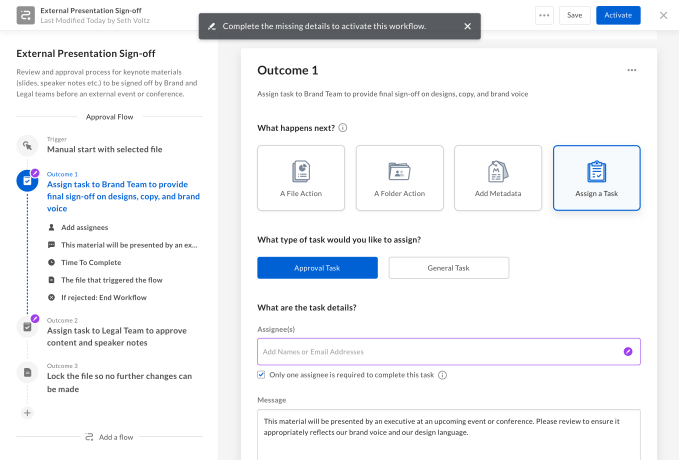
Box Relay is the company’s workflow tool, and while it has had the ability to create workflows, it required a certain level of knowledge and way of thinking to make that happen. Levie says that they wanted to make it as simple as possible for customers to build workflows to digitize manual processes.

“We are announcing an all new set of Box Relay templates, which are going straight to the heart of how do you automate and digitize business processes across the entire enterprise and make it really simple to do that,” he explained.

This could include things like a contract review, change order process or budget review to name a few examples. The template includes the pieces to get going, but the customer can customize the process to meet the needs of the individual organization’s requirements.

Image Credits: Box

While this is confined to Box-built templates for now, Levie says that down the road this could include the ability for customers to deploy templates of their own, or even for third parties like systems integrators to build industry or client-specific templates. But for today, it’s just about the ones you get out of the box from Box.

At the same time, the company is announcing the File Request feature, a name Levie admits doesn’t really do the feature justice. The idea is that in a workflow such as a paperless bank loan process, the individual has to submit multiple documents without having a Box account. After the company receives the documents, it can kick off a workflow automatically based on receiving the set of documents.

He says the combination of these two new capabilities will give customers the ability to digitize more and more of their processes and bring in a level of automation that wasn’t previously possible in Relay. “The combination of these two features is about driving automation across the entire enterprise and digitizing many more paper-based and manual processes in the enterprise,” Levie said.

Box will not be charging additional fees for these new features to customers using Box Relay. File Request should be available at the end of this month, while the template library should be available by the end of July, according to the company.

Powered by WPeMatico

How COVID-19 transformed the way Americans spend online

Ethan Smith
Contributor

Ethan Smith is founder and CEO of Graphite, an SEO and growth marketing agency based in San Francisco. Ethan has served as a strategic advisor to Ticketmaster, MasterClass, Thumbtack and Honey.

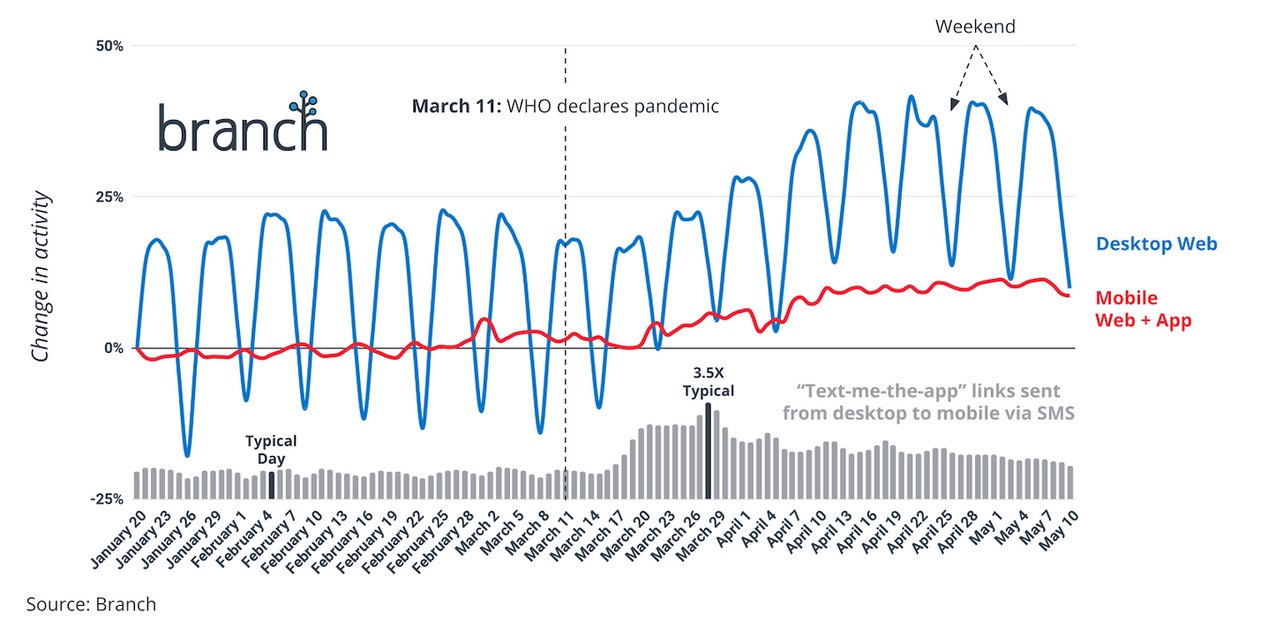
COVID-19 has transformed the way Americans use their phones and the way they spend their time and money online. These shifts present both a number of challenges and a raft of opportunities for savvy growth marketers.

We’ve seen COVID-19 affect a number of verticals. A number of industries have taken a hit (like music streaming and sports), while some are expanding due to the pandemic (groceries, media, video gaming). Others have found distinctive ways to adjust the way they position and sell their product, allowing them to take advantage of changes in buyer behavior.

The key to being able to read and react to changes in this still-tumultuous time and tailoring your growth marketing accordingly is to understand how public sentiment is reflected in new purchasing behaviors. Here’s an overview of the most important trends we’re seeing that will allow you to adjust your growth marketing effectively.

By the numbers: A sheltering-in-place economy

Virtually all of the data we’ve seen shows a marked difference in buyer behavior following the WHO’s declaration of a pandemic on March 11, 2020. With consumers encouraged to stay home to deter the spread of COVID-19, it’s no surprise that the biggest change is the spike in online activity.

Powered by WPeMatico

Square acquires European peer-to-peer payment app Verse

Square acquired Verse, a Spanish peer-to-peer payment app that works across Europe. Terms of the deal are undisclosed. According to Crunchbase, Verse had raised $37.6 million from Spark Capital, eVentures, Greycroft Partners and others.

Square has attracted a ton of users with Cash App, its peer-to-peer payment app that lets you easily send and receive money from your phone. But Cash App has only been available in the U.S. and the U.K.

Acquiring Verse seems like a good fit to expand Square’s presence in Europe. Verse’s team will join the Cash App division within Square.

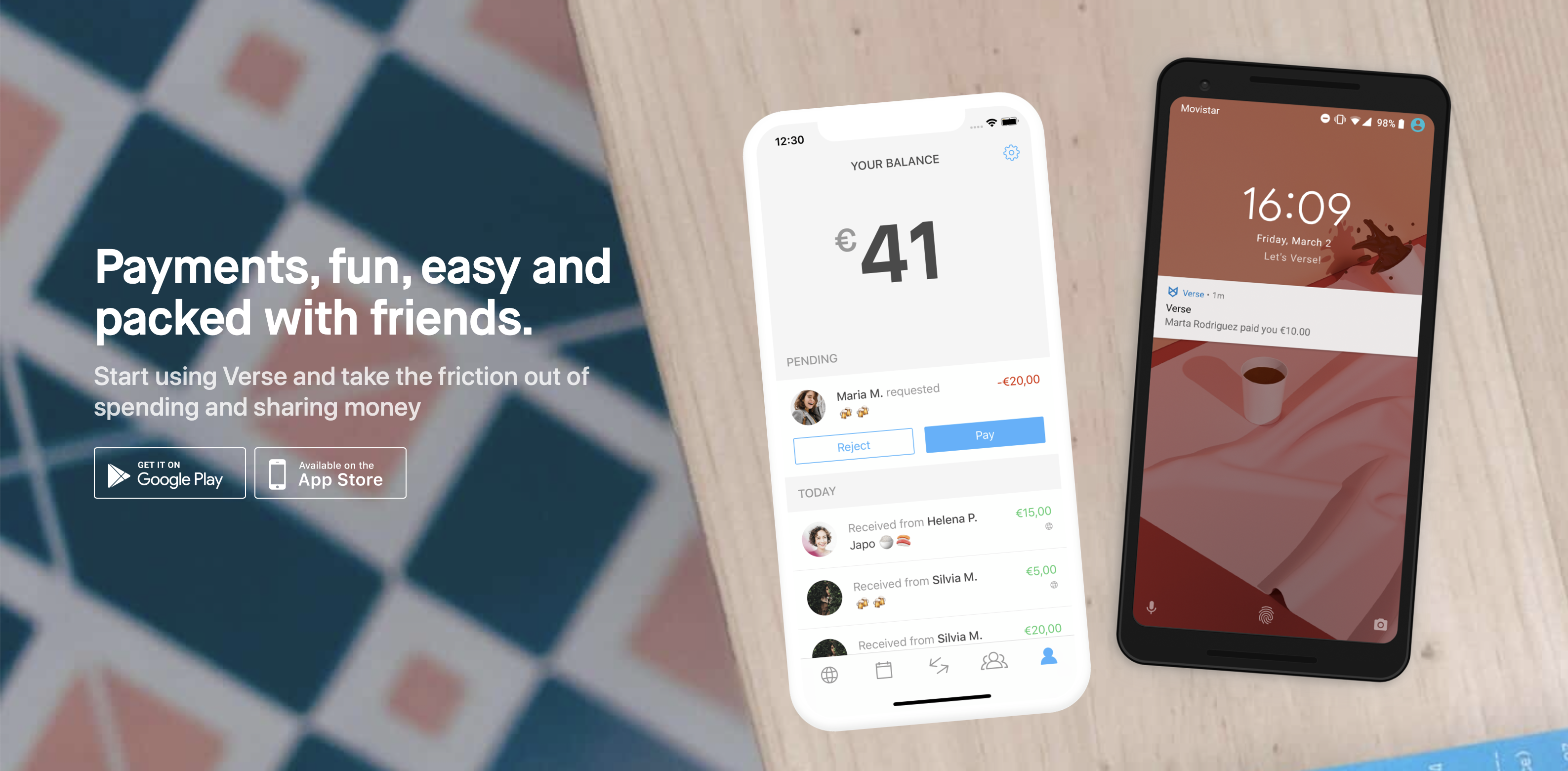
There are many similarities between Cash App and Verse. Verse’s main feature is that it lets you send and receive money from a mobile app. Users don’t pay any fees and transfers occur in just a few seconds.

Verse users sign up with their phone numbers, which means that you can send money to other users as long as you have their phone numbers in your address book. If you don’t have enough money on your Verse account, the app can charge your debit card directly. And if you want to withdraw money from your Verse account, you can transfer your balance to your bank account.

You can also track group expenses from the app (like Splitwise), create money pots and organize events with a basic ticketing feature.

More recently, Verse launched a Visa debit card in Spain, which lets you spend money on your Verse account directly. You don’t pay any foreign exchange fees and you get two free ATM withdrawals per month. Verse uses Visa’s exchange rate.

While the startup hasn’t shared usage numbers for a while, according to App Annie, it is currently the No. 247 most downloaded app in the App Store in Spain across all categories. Peer-to-peer payment is a fragmented market. For instance, French startup Lydia has 3 million users in France.

“At this point, our main priority is enabling Verse to continue their successful growth in Europe. Verse will continue to operate as an independent business, working out of their offices with no immediate changes to their existing products, customers, or business operations,” Square wrote in the announcement.

The three most important words in this statement are “at this point.” Square doesn’t want to fix what isn’t broken. But I wouldn’t be surprised if Verse slowly evolves to become Cash App in Europe.

Image credits: Square

Powered by WPeMatico