1010Computers | Computer Repair & IT Support

SiriusXM acquires Simplecast to double down on podcasts with distribution and analytics tools

Podcasting continues to see a strong trajectory in the world of streamed audio content, and today comes the latest development on that front. SiriusXM, owner of Pandora and backer of SoundCloud, said that it is acquiring Simplecast, a podcast management platform used by creators to publish and distribute podcasts, and subsequently analyse how they are consumed. SiriusXM plans to integrate Simplecast with AdsWizz, a digital audio advertising company that it acquired in 2018 for $66.3 million in cash plus shares to power ads on Pandora .

The company is not disclosing any of the financial terms for the Simplecast acquisition but we have asked and will update if we learn more. As a startup, New York-based Simplecast, which will continue to be led by its founder and CEO Brad Smith, had raised a modest $7.87 million in funding from investors since launching in 2013, per PitchBook data.

The deal is interesting because it is bringing one of the more popular independent platforms and set of tools used by streamers under the wing of a platform. Simplecast’s many podcasts and users today include Armchair Expert with Dax Shepard, Netflix, Maximum Fun, Cloud10, QCODE, Anna Faris is Unqualified, Blue Wire, Revision Path and (disclaimer) TechCrunch, who use it to distribute content over multiple, and sometimes competing, networks, including Apple, Spotify, Google and Overcast. (Business plans currently range in price and start at $15/month and go up to $85/month or more depending on podcast size, number of users and features that you need.)

Pandora (with help from SiriusXM, which has a large and popular stable of talk radio shows on its channels) has been building up its own spoken-word content, of course, so there is a direct opportunity to push more on-demand podcasts to that platform in particular, as well as offer more interesting terms for doing so, as well as bring in a much wider spectrum of podcasts to run AdsWizz’s inventory, which currently is seen by more than 100 million people each month across the U.S. and Canada (SiriusXM’s and Pandora’s footprint in vehicles, online and more).

We have asked SiriusXM if the plan will be to keep all of Simplecast’s services as-is after the deal closes.

What’s clearer is that, with SiriusXM also making a key investment in SoundCloud last year, the company is — like Spotify (which acquired a Simplecast competitor, Anchor, last year) — building up its music-business tools to complement its position as a content provider: This is a key role to play in the brave new world of digital music, where monetisation remains a challenge for most, and the tools to distribute, analyse and (yes) monetise one’s creative content continue to get more sophisticated, so much so that getting that part of the equation right can make or break an artist or wider creative or media endeavour.

“Our goal is to provide audio publishers with state-of-the-art platforms and give them everything they need to be successful,” said Alexis van de Wyer, CEO of AdsWizz, in a statement. “Empowering podcasters of any size to create, distribute, analyze, and monetize their work is the next natural step in pursuing our vision.”

“From the beginning, Simplecast’s mantra and mission was to remain laser-focused on podcast creators – building the best tools for publishing and insights,” said Brad Smith, the founder & CEO of Simplecast, in a statement of his own. “The opportunity and alignment with AdsWizz allows our product — and our customers — access to a powerful monetization platform. Two best-in-class platforms are now able to align with the shared mission of helping publishers succeed, while each team continues to focus on their respective areas of expertise.”

Powered by WPeMatico
Onna, the ‘knowledge integration platform’ for workplace apps, raises $27M Series B

Onna, the “knowledge integration platform” (KIP) that counts Dropbox and Slack as backers, has raised $27 million in Series B funding.

Leading the round is Atomico, with participation from Glynn Capital. Previous investors Dawn Capital, Nauta Capital and Slack Fund also followed on.

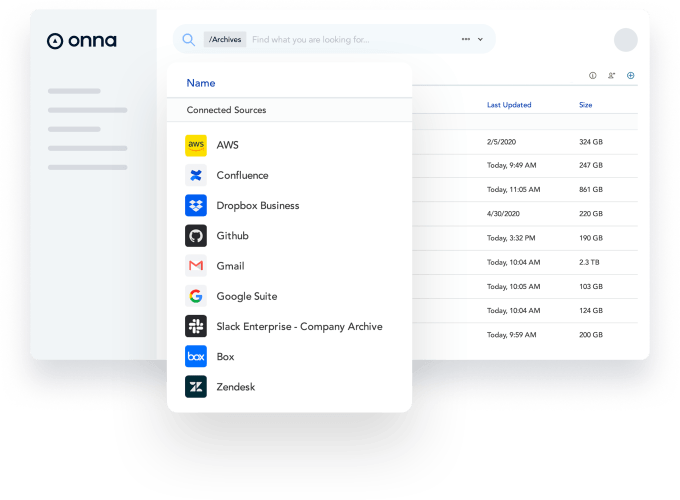
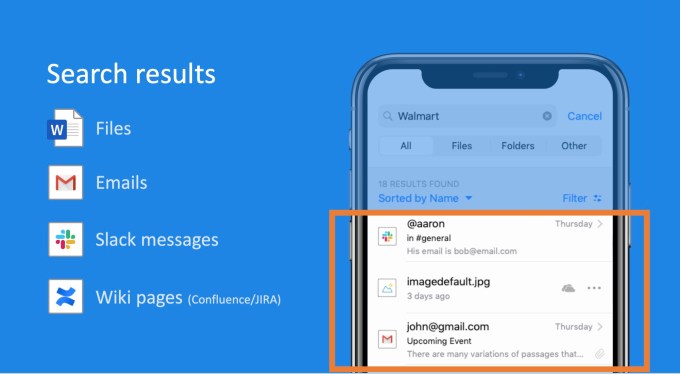
Founded in 2015, Barcelona and New York-based Onna integrates with a plethora of workplace apps, including Slack, Dropbox, G Suite, Microsoft 365 and Salesforce, to help unlock the proprietary knowledge stored in a company’s various cloud and on-premise software. Typical applications for a KIP include compliance, governance, archiving and “eDiscovery.”

From communication apps to cloud storage to HR platforms, the idea is to unify all of this data and make it searchable but in a way that is secure and protects existing permissions and privacy. In fact, another way to think of Onna is like Apple’s Spotlight functionality but for the enterprise. However, pitched as a platform not just a feature, Onna also offers an API of its own so that various use cases can be built on top of this “single source of truth.”

“Onna’s knowledge integration platform is a centralised, searchable and secure hub that connects company data wherever it resides and makes it easier and faster to make informed decisions,” Onna founder and CEO Salim Elkhou tells TechCrunch. “It is a productivity tool built for the way businesses work today… something that didn’t exist before, creating a new industry standard which benefits all companies within the ecosystem.”



Citing a report by single sign-in provider Okta, Elkhou notes that companies today use an average of 88 different apps across their workforce, a 21% increase from three years ago.

“The reason apps have become so popular is that they’re very effective for tackling specific challenges, or even a broad range of tasks. But the problem large organisations were coming up against is that their knowledge was spread across a wide range of apps that weren’t necessarily designed to work together.”

For example, a legal counsel could be looking to find contracts company-wide to assess a company’s exposure. The problem is that contracts may be saved in Salesforce, sent by email, shared over Slack or even saved on desktops. “Your company may have acquired another company, which has its own ways of saving information, so now the simple task of finding contracts can be a heavy lifting exercise, involving everyone’s time. With Onna, being the connective tissue across these applications, this search would take a split second,” claims Elkhou.

But the potential power of a KIP goes well beyond search alone. Elkhou says a more ambitious use case is unifying knowledge across apps and using Onna as infrastructure. “We believe that the next generation of workplace apps will be built on top of a knowledge integration platform like Onna,” he explains. “Due to our plug and play integrations with most enterprise apps and our open API, you can now build your own bespoke workflows on top of your company’s knowledge. More importantly, we handle all the heavy lifting on the back end when it comes to processing the right contextual information across multiple systems securely, which means you can get on with creatively building a more efficient workplace.”

“In Onna, we saw a product in a new and complementary category, providing a solution not at the data level but at the ‘knowledge level,’ ” adds Atomico’s Ben Blume, who has also joined the Onna board. “Onna’s core solution integrates with any tools in an organisation where knowledge resides, [and] ingests, indexes and classifies the knowledge inside, enabling it to power applications in many areas.”

Blume also points to the belief that some of the cloud tools vendors themselves have in Onna, with both Slack and Dropbox “investing, using and promoting” Onna’s solution. “As they look to grow their own penetration in organisations with a wider range of needs and demands, we saw partnering with Onna as a recognition of its best in class nature to their customers,” he says.

Meanwhile, I understand the new round of funding was done remotely due to lockdown, even though Atomico and Onna had already met and stayed in touch after the VC firm ended up not participating in the startup’s Series A.

Recalls Elkhou: “We had met with our investors in person over a year ago, and have had many video calls since and prior to the pandemic. However, soon after the lockdowns took effect, the need for remote collaboration tools skyrocketed which only accelerated the critical role Onna has in helping people within organisations access and share knowledge that was spread across an ever growing number of apps. If anything, it brought new urgency to the problem we were solving, because workplace serendipity no longer existed. You couldn’t answer questions over a coffee or by the water cooler, but these new remote workers still needed to access knowledge and share it securely.”

Powered by WPeMatico

Amazon and Zynga partner on Word Pop, a Words with Friends spinoff created for Alexa

Zynga’s popular game, Words with Friends, is coming to Alexa. The new voice-powered game will be known as Word Pop, and — sorry — you can’t actually play it with friends right now, even though the game lives within Zynga’s broader Words with Friends franchise. Instead, the new Alexa voice game is viewed as a complement to Zynga’s multiplayer version. It’s a place where players can sharpen their word-building skills, no friends required.

To launch Word Pop, you’ll say “Alexa, open Word Pop” on any Alexa device to get started.

In the game, Alexa will challenge the players to create as many words as possible from a six-letter bank, through a series of one-minute sessions. During this time, players must say or spell as many words as they can, while earning points for both the number and length of the words they find.

On Alexa devices with a screen, like the Echo Show, there will also be a visual component where players will see their letter banks and completed words. Arguably, the game is better this way as it allows you to view the letters and combinations much like you can on a mobile device or computer. Without the screen, the game will prove much more challenging — though that may appeal to some Words with Friends experts.

The companies characterize their teaming up on the new title as a “partnership,” where both Amazon and Zynga’s teams worked together to build the game. However, there isn’t currently a revenue-sharing situation, we understand, as the game is free and doesn’t offer in-app purchases. (Of course, if the title proves popular enough, the companies could likely revisit that decision.)

In the meantime, however, the companies see the opportunity to build their respective brands. Zynga can generate interest in its aging, cross-platform Words with Friends franchise by way of the new Alexa skill, while Amazon gets to introduce the idea of Alexa gaming to consumers via a well-known industry brand and popular game that users will already know how to play.

“I’m thrilled that by adding Word Pop to the Words With Friends family, players will be able to test and improve their word skills, making them even better Words With Friends players,” said Bernard Kim, president of Publishing at Zynga, in a statement. “The beauty of Words With Friends is that even after ten years, we’re still discovering new ways for the franchise to bring joy to players around the world. We’re dedicated to experimenting with services such as Alexa and game modes like Word Pop, which gives players a familiar, yet novel experience.”

Powered by WPeMatico

QuizUp founder gets back to trivia roots with the launch of Trivia Royale

trivia royale

Thor Fridriksson is no stranger to trivia. The tech entrepreneur founded QuizUp, one of the hottest mobile games of the early aughts, which attracted more than 100 million downloads, a deal with NBC and had raised more than $40 million from notable investors. Plain Vanilla Games, the parent company of QuizUp, eventually sold to GluMobile for $7.5 million.

But that doesn’t mean Fridriksson is hanging up his hat on trivia. In fact, the lessons he learned the first time around have led him to this very moment. Today, Fridriksson is launching Trivia Royale, the latest game out of Iceland-based TeaTime Games.

Trivia Royale is, like it sounds, a trivia game in the genre of Battle Royale. It’s a 1,000-person head-to-head Trivia tournament. Like QuizUp, players can choose to do one-to-one Trivia matches based on categories in a casual way. But the real draw of the mobile game is Trivia Royale.

It starts with 1,000 people who are matched into one-on-one battles around general trivia. Each battle includes five questions that go from easy to more difficult, with 10 seconds to answer each question. The faster you answer the question, the more points you get. The final question in the battle is worth double points.

If you lose your battle, you’re out of the tournament. The pool then drops to 500 people, and then to 250 people, and so on and so forth, until you’re down to the final four and the final two. Folks who win a Trivia Royale get a “crown” that’s displayed on their avatar, as well as access to the Royale Lounge, where they can check out global and local leaderboards and chat with other Royales.

What’s most interesting about Trivia Royale is that it’s built on the TeaTime Live platform.

TeaTime, co-founded by Fridriksson, launched in February of 2018. The platform is not a game in and of itself, but rather a developer platform for game makers that adds a new level of engagement, interaction and monetization to mobile games.

On TeaTime, users can create an Animoji-style avatar that employs the front-facing camera of a smartphone to let players interact in real time with facial expressions as they play a game. Since most users don’t necessarily want to show their actual face to strangers during gameplay, TeaTime uses Snap-style filters and Apple Animoji-esque avatars to let users engage with one another without revealing their actual identity.

The initial failure of QuizUp was an inability to monetize. TeaTime was built to avoid making that same mistake twice. The existence of avatars offers a built-in monetization strategy as users look to customize and build out their avatars.

Fridriksson was also extremely averse to mobile advertising within games while he was running QuizUp, and has made his peace with some advertising with the launch of Trivia Royale. When a user wins and is rewarded with points, the user can double those points by watching an ad.

Users can also supplement their winnings by buying virtual currency to update their avatar with hats, piercings, hand gestures, glasses and more.

Moreover, users need a ticket to enter into a Trivia Royale tournament. These tickets are provided every couple hours, so users who want to play game after game without waiting will need to use virtual currency to buy a ticket.

Obviously, it would be difficult to get and keep 1,000 players in a single tournament at once, so Trivia Royale focuses on matching people who are at the same level in the tournament rather than holding these tourneys in individual lobbies.

“The challenge is to get a hit game on a platform before it becomes a platform because you need that,” said Fridriksson. “So what I did, essentially, is that I just totally changed my focus as a CEO and went into full-hearted product mode for this game. I find myself back in the mode of creating a cool user experience, and it’s the most fun I’ve ever had.”

In beta, the company has used bots to fill in the gaps where there aren’t available matches for players. In the first five rounds of the Trivia Royale tournament, Fridriksson says there is about a 60% chance that users will be matched with a real person, with the likelihood of being paired with a bot getting higher the further a user gets in the tournament.

The company ran a beta in Ireland, New Zealand and Canada over the past two weeks and has gotten 9,000 beta users, with day-one retention at 50% and with average users playing around 12 games per day.

As the game gets more users, the company hopes to match users with real people 95% of the time and ultimately get to a place where the bots fade out of the equation.

At this point, the game has more than 20,000 questions across 40 categories including TikTok, Geography, Movies, Superheroes, Videogames, Sports, Disney and Logos, with more questions added every day.

Powered by WPeMatico

Uptycs lands $30M Series B to keep building security analytics platform

Every company today is struggling to deal with security and understanding what is happening on their systems. This is even more pronounced as companies have had to move their employees to work from home. Uptycs, a Boston-area security analytics startup, announced a $30 million Series B today to help companies detect and understand breaches when they happen.

Sapphire Ventures led the round with help from Comcast Ventures and ForgePoint Capital. The startup has now raised a total of $43 million, according to the company. Under the terms of today’s deal, Sapphire Ventures’ president and managing director Jai Das will be joining the company’s board.

Company co-founder and CEO Ganesh Pai says he and his co-founders previously worked at Akamai, where they observed Akamai’s debugging and diagnostic tools, which were designed to work at massive scale. The founders believed they could use a similar approach to building a security analytics platform, and in 2016 the group launched Uptycs .

“We help people to solve intrusion detection, compliance and audit and incident investigation. These are table stakes requirements [for security solutions] that most large scale organizations have, and of course with their scale the challenges vary. What we at Uptycs do is provide a solution for that,” Pai told TechCrunch.

The company uses a flight recorder approach to security, giving security operations teams the ability to sift through the data and review exactly how a detection happened and how the intruder got through the company’s defenses.

He recognizes his company is fortunate to get a round this large right now, but he says the solution has attracted a number of customers signing seven-digit contracts and this in turn got the attention of investors. “That customer engagement, their experience and this commitment from our customers led to this substantial round of funding,” he said.

The company currently has 65 employees spread across offices in Waltham, a Boston suburb, as well as two offices in India. Pai says the plan is to double that number in the next 12 months. “Between the cash flow from our existing customers and the pipeline for us and the funding, we are planning to grow in a meaningful way. If everything aligns with our expectation we will double our team size in the next 12 months,” he said.

As he grows his company in this way, Pai says they are talking to their investors about how to build a diverse workforce. “We’ve thought long and hard about it, both in terms of diversity and inclusion. It is a lot harder to execute because at the end of the day, there is a finite talent pool, but we are having conversations with our investors, who have seen patterns of success in terms of implementing such plans from growth stage ventures,” he said.

He added, “And of course we are a very early-stage company, but we are extremely cognizant, and given the current circumstances are acutely aware that we need to do our very best and make a difference.”

As the company has moved to work from home across its operations, he says it has benefited from working in the cloud from the start. “As an organization we are very fortunate that we built our organization so that everything runs in the cloud and everyone has been able to remain very productive,” he said.

Powered by WPeMatico

‘One day we were in the office and the next we were working from home’

Scott Kinka
Contributor

Scott Kinka serves as CTO for Evolve IP. An award-winning, 20-year technology veteran with expertise in virtualization, cloud security and telecommunications, he designs the Evolve IP roadmap, leads its project team and works closely with customers and partners.

Ryan Easter couldn’t believe he was being asked to run a pandemic business continuity test.

It was late October, 2019 and Easter, IT Director and a principal at Johnson Investment Counsel, was being asked by regulators to ensure that their employees could work from home with the same capabilities they had in the office. In addition, the company needed to evaluate situations where up to 50% of personnel were impacted by a virus and unable to work, forcing others to pick up their internal functions and workload.

“I honestly thought that it was going to be a waste of time,” said Easter. “I never imagined that we would have had to put our pandemic plan into action. But because we had a tested strategy already in place, we didn’t miss a beat when COVID-19 struck.”

In the months leading up to the initial test, Johnson Investment Counsel developed a work anywhere blueprint with their technology partner Evolve IP. The plan covered a wide variety of integrated technologies including voice services, collaboration, virtual desktops, disaster recovery and remote office connectivity.

“Having a strategy where our work anywhere services were integrated together was one of the keys to our success,” said Easter. “We manage about $13 billion in assets for clients across the United States and provide comprehensive wealth and investment management to individual and institutional investors. We have our own line of mutual funds, a state-chartered trust company, a proprietary charitable gift fund, with research analysts and traders covering both equity and fixed income markets. Duct taping one-off solutions wasn’t going to cut it.”

Easter continued, “It was imperative that our advisors could communicate with clients, collaborate with each other and operate the business seamlessly. That included ensuring we could make real-time trades and provide all of our other client services.”

Five months later, the novel coronavirus hit the United States and Johnson Investment Counsel’s blueprint test got real.

Powered by WPeMatico

Loodse becomes Kubermatic and open-sources Kubernetes automation platform

Loodse, a German Kubernetes automation platform, announced today that it was rebranding as Kubermatic. While it was at it, the company also announced that it was open-sourcing its Kubermatic Kubernetes Platform as open source under the Apache 2.0 License.

Co-founder Sebastian Scheele says that his company’s Kubernetes solution can provision clusters and applications on any cloud, as well as in a data center running, for example, OpenStack or VMware. What’s more, it can do it much faster by automating much of the operations side of running Kubernetes clusters.

“We wanted to really have a cloud native way to run and manage Kubernetes. And so it’s running the Kubernetes master itself, which is completely containerized on top of Kubernetes, rather than being run on VMs. This helps provide you with better scalability, but also because it’s running on Kubernetes, we get all of the resilience and auto scaling out of Kubernetes itself,” Scheele told TechCrunch.

He says that he and his co-founder Julian Hansert have always had a strong commitment to open source, and offering Kubermatic platform under the Apache 2.0 license is a way to show that to the community. “One of the big [things] we can bring to the table is making Kubermatic completely open source, while following the Open-core model, and having a strong commitment to open source to the world and also to the community,” he said.

Image Credit: Kubermatic

As for why it’s rebranding, he says that the original company name is a German word that means navigation pilot for a ship. The name is a nod to its Hamburg base, which is a hub for container ships. It makes sense to Germans, but not others, so they wanted a name that more broadly reflected what the company does.

“Now that we are open-sourcing Kubermatic, we also thought that people should understand our vision and what’s our DNA. It’s Kubernetes automation, helping our customers to really save money on Kubernetes operations by automating as much as possible on the operation level, so our users can really focus on building new applications,” he explained.

The company launched four years ago and has taken no funding, completely bootstrapping along the way. It’s worth noting it was one of the top five committers to the open-source Kubernetes project in 2019, along with much bigger names including Google, VMware, Red Hat and Microsoft.

Today the company has 50 employees, most of whom are working remotely by choice, rather than due to the pandemic. In fact, the company has employees working in 10 different countries. He says that has allowed him to work with people with a broad set of skills, who don’t necessarily live in Hamburg where he and Hansert are based.

Powered by WPeMatico

Admix raises $7M to bring more ads to games, VR and AR

Adtech startup Admix is announcing that it has raised $7 million in Series A funding.

The London-based company was founded by CEO Samuel Huber (previously owner of an indie gaming studio) and COO Joe Bachle-Morris (who previously worked in the ad agency world). The company is working to bring ads to games, esports, virtual reality and augmented reality.

In-game advertising is already a huge market, but Admix says it’s differentiated by focusing on building a product that supports game advertising at scale, where advertisers can bid programmatically through traditional ad-buying platforms, rather than relying on an ad agency model.

For developers, Admix offers an SDK for the Unity and Unreal game engines, allowing them to drag and drop into their games ad formats like billboards, posters and 3D spaces. The startup says it’s working with more than 200 developers and is running campaigns from more than 500 advertisers each month, with past advertisers including National Geographic, Uber and State Farm.

“The concept of putting ads in games is obviously not new, but the scalability of our solution is what is revolutionary, delivering instant and consistent revenue to game makers, or streaming platforms,” Huber said in a statement. “This coupled with the fact that 1.5B people play games globally every day, means that gaming is becoming a truly mainstream advertising channel.”

Admix previously raised $2.1 million, according to Crunchbase. The Series A was led by U.K.-based Force Over Mass, with the participation from Speedinvest, Sure Valley Ventures and Nigel Morris (a former Dentsu Aegis executive), as well as other angel investors.

Powered by WPeMatico

Contentful raises $80M Series E round for its headless CMS

Headless CMS company Contentful today announced that it has raised an $80 million Series E funding round led by Sapphire Ventures, with participation from General Catalyst, Salesforce Ventures and a number of other new and existing investors. With this, the company has now raised a total of $158.3 million and a Contentful spokesperson tells me that it is approaching a $1 billion valuation.

In addition, the company also today announced that it has hired Bridget Perry as its CMO. She previously led Adobe’s marketing efforts across Europe, the Middle East and Africa.

Currently, 28% of the Fortune 500 use Contentful to manage their content across platforms. The company says it has a total of 2,200 paying customers right now and these include the likes of Spotify, ITV, the British Museum, Telus and Urban Outfitters.

Steve Sloan, the company’s CEO who joined the company late last year, attributes its success to the fact that virtually every business today is in the process of figuring out how to become digital and serve its customers across platforms — and that’s a process that has only been accelerated by the coronavirus pandemic.

“Ten or 15 years ago, when these content platforms or content management systems were created, they were a) really built for a web-only world and b) where the website was a complement to some other business,” he said. “Today, the mobile app, the mobile web experience is the front door to every business on the planet. And that’s never been any more clear than in this recent COVID crisis, where we’ve seen many, many businesses — even those that are very traditional businesses — realize that the dominant and, in some cases, only way their customers can interact with them is through that digital experience.”

But as they are looking at their options, many decide that they don’t just want to take an off-the-shelf product, Sloan argues, because it doesn’t allow them to build a differentiated offering.

Image Credits: Contentful

Perry also noted that this is something she saw at Adobe, too, as it built its digital experience business. “Leading marketing at Adobe, we used it ourselves,” she said. “And so the challenge that we heard from customers in the market was how complex it was in some cases to implement, to organize around it, to build those experiences fast and see value and impact on the business. And part of that challenge, I think, stemmed from the kind of monolithic, all-in-one type of suite that Adobe offered. Even as a marketer at Adobe, we had challenges with that kind of time to market and agility. And so what’s really interesting to me — and one of the reasons why I joined Contentful — is that Contentful approaches this in a very different way.”

Sloan noted that putting the round together was a bit of an adventure. Contentful’s existing investors approached the company around the holidays because they wanted to make a bigger investment in the company to fuel its long-term growth. But at the time, the company wasn’t ready to raise new capital yet.

“And then in January and February, we had inbound interest from people who weren’t yet investors, who came to us and said, ‘hey, we really want to invest in this company, we’ve seen the trend and we really believe in it.’ So we went back to our insiders and said, ‘hey, we’re going to think about actually moving in our timeline for raising capital,” Sloan told me. “And then, right about that time is when COVID really broke out, particularly in Western Europe in North America.”

That didn’t faze Contentful’s investors, though.

“One of the things that really stood out about our investors — and particularly our lead investor for this round Sapphire — is that when everybody else was really, really frightened, they were really clear about the opportunity, about their belief in the team and about their understanding of the progress we had already made. And they were really unflinching in terms of their support,” Sloan said.

Unsurprisingly, the company plans to use the new funding to expand its go-to-market efforts (that’s why it hired Perry, after all), but Sloan also noted that Contentful plans to invest quite a bit into R&D, as well, as it looks to help its customers solve more adjacent problems.

Powered by WPeMatico