1010Computers | Computer Repair & IT Support

3 questions for Lemonade’s IPO

While we await a fresh IPO filing from heavily backed insurtech startup Lemonade, let’s talk a little more about its public offering.

Since our first dig into its S-1 filing, TechCrunch has spoken to a number of investors and operators in Lemonade’s space to find out if our initial read was off — were we being too generous or too kind to Lemonade after reading its somewhat complex financial results?


The Exchange is a daily look at startups and the private markets for Extra Crunch subscribers; use code EXCHANGE to get full access and take 25% off your subscription.


The short answer is not really, though there are some positive notes and themes worth highlighting. This morning, let’s ask three questions about Lemonade’s IPO filing that will help us understand what’s ahead for the SoftBank-backed unicorn.

Three questions

1. How quickly can Lemonade accelerate its rental insurance graduation rate?

On the theme of things that bode well for Lemonade is its ability to “graduate” customers from low-cost rental insurance to more lucrative products.

In its S-1 filing, Lemonade noted this fact early on. After stating that a “an entry-level $60 a year [rental] policy [corresponds] to $10,000 of possessions,” the company said that as its customers age, they tend to buy more insurance and sometimes swap rental plans for homeowner policies. Moving from the former to the latter is graduating in the company’s parlance.

If many customers moved from rental insurance to homeowner insurance while keeping Lemonade as their provider, the company could do very well, as illustrated by this section of its SEC filing:

Powered by WPeMatico

Watch Apple’s WWDC keynote live right here

Apple is holding a keynote today on the first day of its developer conference, and the company is expected to talk about a ton of software updates. WWDC is a virtual event this year, but you can expect the same amount of news, in a different format. At 10 a.m. PDT (1 p.m. in New York, 6 p.m. in London, 7 p.m. in Paris), you’ll be able to watch the event as the company is streaming it live.

Rumor has it that the company plans to unveil new versions of its operating systems. Get ready for iOS 14 and its sibling iPadOS 14, a new version of macOS and some updates for watchOS and tvOS as well.

But the most interesting rumor of the year is that Apple could announce a major change for the Mac. The company could start using its own in-house ARM systems on a chip instead of Intel’s processors. It would have a ton of consequences for third-party apps running on your Mac as well as Mac hardware in general. Imagine a MacBook with a battery that lasts as long as what you get from an iPad. There could be some more hardware news, such as a new design for the iMac or some Tile-style hardware trackers.

You can watch the livestream directly on this page, as Apple is streaming its conference on YouTube.

If you have an Apple TV, you can download the Apple Events app in the App Store. It lets you stream today’s event and rewatch old ones. The app icon was updated a few days ago for the event.

And if you don’t have an Apple TV and don’t want to use YouTube, the company also lets you livestream the event from the Apple Events section on its website. This video feed now works in all major browsers — Safari, Microsoft Edge, Google Chrome and Mozilla Firefox.

Of course, you also can read TechCrunch’s live blog if you don’t want to stop everything and watch a video.

Powered by WPeMatico

Hasura launches managed cloud service for its open-source GraphQL API platform

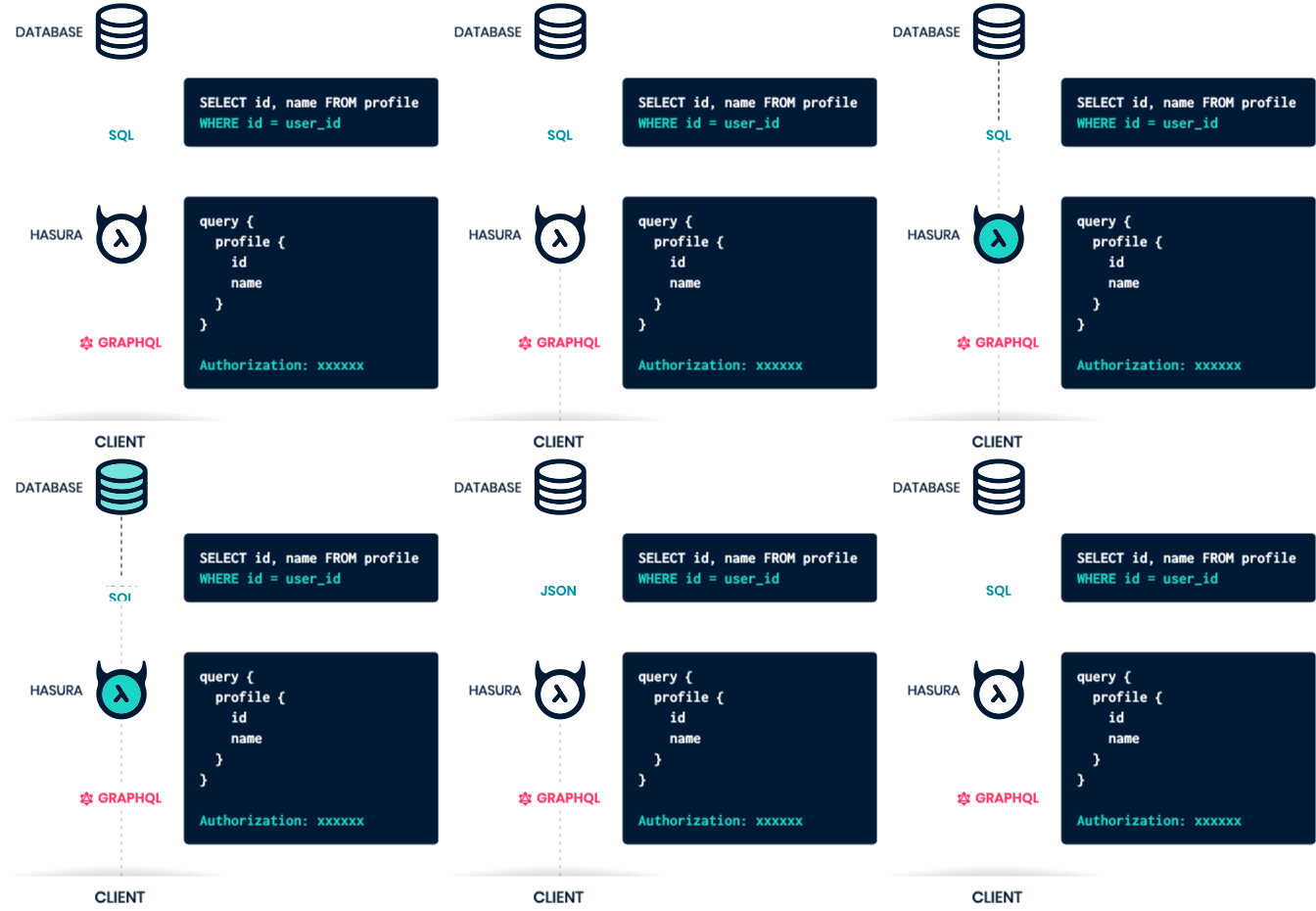
Hasura is an open-source engine that can connect to PostgreSQL databases and microservices across hybrid- and multi-cloud environments and then automatically build a GraphQL API backend for them, making it easier for developers to then build their own data-driven applications on top of this unified API . For a while now, the San Francisco-based startup has offered a paid version (Hasura Pro) with enterprise-ready reliability and security tools, in addition to its free open-source version. Today, the company launched Hasura Cloud, which takes the existing Pro version, adds a number of cloud-specific features like dynamic caching, auto-scaling and consumption-based pricing, and brings those together in a fully managed service.

Image Credits: Hasura

At its core, Hasura’s service promises businesses the ability to bring together data from their various siloed databases and allow their developers to extract value from them through its GraphQL APIs. While GraphQL is still relatively new, the Facebook-incubated technology has quickly become extremely popular among many development teams.

Before founding the company and launching it in 2018, Hasura CEO and co-founder Tanmai Gopal worked for a consulting firm — and like with so many founders, that’s where he got the inspiration for the service.

“One of the key things that we noticed was that in the entire landscape, computing is becoming better, there are better frameworks, it is easier to deploy code, databases are becoming better and they kind of work everywhere,” he said. “But this kind of piece in the middle that is still a bottleneck and that there isn’t really a good solution for is this data access piece.” Almost by default, most companies host data in various SaaS services and databases — and now they were trying to figure out how to develop apps based on this for both internal and external consumers, noted Gopal. “This data distribution problem was this bottleneck where everybody would just spend massive amounts of time and money. And we invented a way of kind of automating that,” he explained.

The choice of GraphQL was also pretty straightforward, especially because GraphQL services are an easy way for developers to consume data (even though, as Gopal noted, it’s not always fun to build the GraphQL service itself). One thing that’s unusual and worth noting about the core Hasura engine itself is that it is written in Haskell, which is a rather unusual choice.

Image Credits: Hasura

The team tells me that Hasura is now nearing 50 million downloads for its free version and the company is seeing large and small users from across various industries relying on its products, which is probably no surprise, given that the company is trying to solve a pretty universal problem around data access and consumption.

Over the last few quarters, the team worked on launching its cloud service. “We’ve been thinking of the cloud in a very different way,” Gopal said. “It’s not your usual, take the open-source solution and host it, like a MongoDB Atlas or Confluent. What we’ve done is we’ve said, we’re going to re-engineer the open-source solution to be entirely multi-tenant and be completely pay-per pricing.”

Given this philosophy, it’s no surprise that Hasura’s pricing is purely based on how much data a user moves through the service. “It’s much closer to our value proposition,” Hasura co-founder and COO Rajoshi Ghosh said. “The value proposition is about data access. The big part of it is the fact that you’re getting this data from your databases. But the very interesting part is that this data can actually come from anywhere. This data could be in your third-party services, part of your data could be living in Stripe and it could be living in Salesforce, and it could be living in other services. […] We’re the data access infrastructure in that sense. And this pricing also — from a mental model perspective — makes it much clearer that that’s the value that we’re adding.”

Now, there are obviously plenty of other data-centric API services on the market, but Gopal argues that Hasura has an advantage because of its advanced caching for dynamic data, for example.

Powered by WPeMatico

4 enterprise developer trends that will shape 2021

Ethan Batraski
Contributor

Ethan Batraski is a partner at Venrock, where he invests across sectors with a particular focus on hard engineering problems such as developer infrastructure, advanced computing and space.

Technology has dramatically changed over the last decade, and so has how we build and deliver enterprise software.

Ten years ago, “modern computing” was to rely on teams of network admins managing data centers, running one application per server, deploying monolithic services, through waterfall, manual releases managed by QA and release managers.

Today, we have multi and hybrid clouds, serverless services, in continuous integration, running infrastructure-as-code.

SaaS has grown from a nascent 2% of the $450B enterprise software market in 2009, to 23% in 2020 and crossed $100B in revenue. PaaS and IaaS revenue represent another $50B in revenue, expecting to double to $100B by 2022.

With 77% of the enterprise software market — over $350B in annual revenue — still on legacy and on-premise systems, modern SaaS, PaaS and IaaS eating at the legacy market alone can grow the market 3x-4x over the next decade.

As the shift to cloud accelerates across the platform and infrastructure layers, here are four trends starting to emerge that will change how we develop and deliver enterprise software for the next decade.

1. The move to “everything as code”

Companies are building more dynamic, multiplatform, complex infrastructures than ever. We see the “-aaS” of the application, data, runtime and virtualization layers. Modern architectures are forcing extensibility to work with any number of mixed and matched services.

Powered by WPeMatico

In-game app-development platform Overwolf acquires CurseForge assets from Twitch to get into mods

Overwolf, the in-game app-development toolkit and marketplace, has acquired Twitch’s CurseForge assets to provide a marketplace for modifications to complement its app development business.

Since its launch in 2009, developers have used Overwolf to build in-game applications for things like highlight clips, game-performance monitoring and metrics, and strategic analysis. Some of these developers have managed to earn anywhere between $100,000 and $1 million per year off revenue from app sales.

“CurseForge is the embodiment of how fostering a community of creators around games generates value for both players and game developers,” said Uri Marchand, Overwolf’s chief executive officer, in a statement. “As we move to onboard mods onto our platform, we’re positioning Overwolf as the industry standard for building in-game creations.”

It wouldn’t be a stretch to think of the company as the Roblox for applications for gamers, and now it’s moving deeper into the gaming world with the acquisition of CurseForge. As the company makes its pitch to current CurseForge users — hoping that the mod developers will stick with the marketplace, they’re offering to increase by 50% the revenue those developers will make.

Overwolf said it has around 30,000 developers who have built 90,000 mods and apps, on its platform already.

As a result of the acquisition, the CurseForge mod manager will move from being a Twitch client and become a standalone desktop app included in Overwolf’s suite of app offerings, and the acquisition won’t have any effect on existing tools and services.

“We’ve been deeply impressed by the level of passion and collaboration in the CurseForge modding community,” said Tim Aldridge, director of Engineering, Gaming Communities at Twitch. “CurseForge is an incredible asset for both creators and gamers. We are confident that the CurseForge community will thrive under Overwolf’s leadership, thanks to their commitment to empowering developers.”

The acquisition comes two years after Overwolf raised $16 million in a round of financing from Intel Capital, which had also partnered with the company on a $7 million fund to invest in app and mod developers for popular games.

“Overwolf’s position as a platform that serves millions of gamers, coupled with its partnership with top developers, means that Intel’s investment will convert into more value for PC gamers worldwide,” said John Bonini, VP and GM of VR, Esports and Gaming at Intel, in a statement at the time. “Intel has always prioritized gamers with high performance, industry-leading hardware. This round of investment in Overwolf advances Intel’s vision to deliver a holistic PC experience that will enhance the ways people interact with their favorite games on the software side as well.”

Other investors in the company include Liberty Technology Venture Capital, the investment arm of the media and telecommunications company, Liberty Media.

Powered by WPeMatico

Spotify tests in-app offers, an interactive ad format for podcasts

Spotify is testing a new, more interactive ad format designed for podcasts: the in-app offer. Instead of prompting listeners to remember a coupon code or visit a specific website address, the in-app offer allows users to redeem an offer at a time that’s convenient for them. This is done by way of a visual reminder within the Spotify app, which displays the sponsors on the podcast episode’s page.

Below the podcast and description, a new section titled “Episode Sponsors” will appear, allowing listeners to then click through on the offer to redeem the coupon or other special deal. This will open the user’s browser to the advertiser’s landing page for immediate redemption, says Spotify.

“The average podcast listener has heard a countless number of ads ending with promo codes or show-specific websites, carefully repeated three times so as not to forget it. In-App Offers makes it vastly simpler for listeners to redeem deals whenever they come back to the app, and we can all benefit from one fewer ‘w-w-w-dot’ spelling lesson from our favorite podcast creators,” says Joel Withrow, senior product manager of Podcast Monetization at Spotify, in a statement.

The product is designed to better fit with the way users actually listen to podcasts — usually, while they’re doing something else, like cooking, cleaning, working out or driving for example. That means they often have to make a mental note of the offers they hear and want to research later. But this can be challenging.

The new product is in early alpha testing in the U.S. with Harry’s in Last Podcast on the Left and in Germany with HelloFresh in Herrengedeck. There isn’t yet a way to sign up to participate.

Image Credits: Spotify

The new feature builds on Spotify’s existing Streaming Ad Insertion (SAI) technology, introduced at the beginning of 2020 at the Consumer Electronics Show in Las Vegas. SAI technology makes key data — like ad impressions, frequency, reach, plus anonymized age, gender and device type — available to podcasters and advertisers on Spotify for the first time. This sort of data was more difficult if not impossible, to collect via podcasts that were served only as downloads from RSS feeds.

The company explained at the time of launch the problem it aimed to solve was on the advertiser’s side — they didn’t know whether or not the ad they purchase is being consumed by the user.

SAI will be widely available to advertisers in the U.S. starting this summer, and is now available to select advertisers in Germany.

The addition of in-app offers to Spotify’s suite comes following a continued heavy investment in podcasts, podcast tools and podcasting ad technology on the company’s part. The company recently announced an exclusive audio partnership with DC & Warner Bros. and the launch of podcast playlists, for example. Spotify also just landed a podcast deal with Kim Kardashian West, focused on criminal justice, and brought top podcast The Joe Rogan Experience to its platform exclusively.

Meanwhile, Spotify says it’s seeing triple-digit growth in podcast consumption, year-over-year, on its platform, while podcasts, more broadly, are reaching 1 in 3 or 100 million Americans every month.

Spotify didn’t say when the new in-app offers ad experience would be publicly available.

Powered by WPeMatico

Canva raises $60 million on a $6 billion valuation

Sydney-based Canva, the design platform for non-designers, has today announced the close of a $60 million funding round, bringing its valuation to $6 billion, according to the company.

The startup has raised a total of more than $300 million, including this latest round of financing, from investors like Bond, General Catalyst, Sequoia Capital China, Felicis Ventures and Blackbird Ventures .

Canva COO and co-founder Cliff Obrecht explained that the round was 10x oversubscribed with interest from angels and new VCs, but that the company resisted taking extra capital.

“At our stage, investors are looking to deploy $50 million+ in capital,” said Obrecht. “Even our existing investors were looking to deploy between $50 million and $100 million, but we said ‘Oh, gee, we really don’t want to be diluted that much because we have a lot of conviction in the business and we don’t need that much money.’ ”

He also said the company wanted to remain with existing investors — Blackbird and Sequoia Capital China led this round — because those investors bet on the company when it was in its infancy, founded by three people in an isolated part of the world with no technical chops.

At the beginning of the pandemic, Canva made a commitment to continue paying all of its contracted workers, but froze hiring. The company also made quick moves to shut down the office and move to remote work. However, Canva is one of the few companies that is getting a boost from the world moving to work from home.

The company has seen a 50% uptick in shared designs, and around a 25% increase in designs created each month. Overall, Canva is growing 100% year over year in both revenue and users, with 30 million monthly active users across 190 countries.

Canva was founded in 2012 with the mission of democratizing design tools. While many non-designers can navigate their way around Google Slides or PowerPoint, or maybe even crop an image, going more in-depth on a design project can be daunting, as the suite of tools provided to designers can be incredibly complex.

The company’s tools are meant to simplify the design process for folks who don’t work in the design department, whether it’s the sales team putting together sales materials, marketers working on content or other departments working on internal materials to send to the broader organization. The drag-and-drop interface gives folks a way to create something beautiful and impressive without having to learn Photoshop.

The product started out as a freemium product for individual consumers but eventually started offering enterprise products, as well as a video editing tool that comes complete with video templates, easy-to-use animation tools and a library of stock video, music, etc.

The company has also launched an educational platform called Canva for Education, which integrates with G Suite and Google Classroom to get students started on design early. Canva also offers a developer platform for startups that want to integrate with the company, which currently includes Dropbox, Google Drive, PhotoMosh and Instagram, among others.

Most recently, Canva partnered with FedEx Office to offer easy design-to-print products that let users pick up print designs from one of more than 2,000 locations in the U.S. as the Sydney-based company looks to secure a foothold in this market.

Canva plans on using the funding to grow the company, make a push into collaboration and continue making acquisitions.

On the heels of the funding, Canva is looking to hire — the company currently has 1,000+ employees, of which more than 40% are female. (Canva did not disclose the percentage of its workforce that are non-white.)

Obrecht says that one of the greatest challenges for the company and for leadership personally is the burden of not feeling like they’re doing enough to make the world a better place. He explained that the company has a number of initiatives focused on this core tenet, including free access to the platform for more than 50,000 nonprofit organizations, education initiatives, anti-discrimination policies within its TOS and more.

“But it just never really feels like enough,” said Obrecht. “You see what’s happening and it’s a bit of a shit show and it’s not aspirational at all. It doesn’t look like it’s getting fixed quickly by the adults who are in government. They’re not doing the right thing, and if they’re not, who will? So we really believe we should have a heavy part in trying our best to make sure the shit show doesn’t continue.”

Powered by WPeMatico

ServiceNow to acquire Belgian configuration management startup Sweagle

With more companies moving workers home, making sure your systems are up and running has become more important than ever. ServiceNow, which includes in its product catalog an IT Help Desk component, recognizes that help desks have been bombarded during the pandemic. To help stop configuration problems before they start, the company today acquired Sweagle, a configuration management startup based in Belgium.

The companies did not share the purchase price.

ServiceNow gets a couple of boosts in the deal. First of all, it gets the startup’s configuration management products, which it can incorporate into its own catalog, but it also gains the machine learning and DevOps knowledge of the company’s employees. (The company would not share the exact number of employees, but PitchBook pegs it at 15.)

RJ Jainendra, ServiceNow’s vice president and general manager of DevOps and IT Business Management, sees a company that has pioneered the IT configuration management automation space, and brings with it capabilities that can boost ServiceNow’s offerings. “With capabilities for configuration data management from Sweagle, we will empower DevOps teams to deliver application and infrastructure changes more rapidly while reducing risk,” Jainendra said in a statement.

ServiceNow claims that there can be as many as 50,000 different configuration elements in a single enterprise application. Sweagle has designed a configuration data management platform with machine learning underpinnings to help customers simplify and automate that complexity. Configuration errors can cause shutdowns, security issues and other serious problems for companies.

Sweagle was founded in 2017 and raised $4.05 million on a post-valuation of $11.88 million, according to PitchBook data.

The company is part of a growing pattern of early-stage startups being sucked up by larger companies during the pandemic, including VMware acquiring Ocatarine and Atlassian buying Halp in May and NetApp snagging Spot earlier this month.

This is the third acquisition for ServiceNow this year, all involving AI underpinnings. In January it bought Loom Systems and Passsage AI. The deal is expected to close in Q3 this year, according to ServiceNow.

Powered by WPeMatico

HashiCorp to offer managed versions of its developer tools starting with Consul

HashiCorp is well known in the developer community for offering a slew of open-source tools to help build and manage modern applications. Today the company announced a new cloud platform and plans to eventually offer managed versions of those tools, starting with Consul, a tool for connecting and securing services across platforms.

HashiCorp CEO Dave McJannet says that the pandemic has accelerated demand for cloud infrastructure, and he sees a growing role for his company in helping to build cloud native applications. The company offers open-source and commercial versions of several popular tools, including Terraform, Consul, Vault and Packer, among others. These can run on premises or in the cloud, but McJannet says customers have been hankering for SaaS versions of these tools.

“Our customers have told us that it’s a huge challenge running a central shared service like Consul. It requires them to keep it up and running, and they have asked for something they can consume from us where we manage it for them,” McJannet told TechCrunch.

The company has been offering a managed version of Terraform for some time, but it has been quietly working on a cloud platform that could allow it to plug in each of the company’s products over time and offer managed services of all the products.

“What we are announcing today is what we call the HashiCorp Cloud Platform, and you can think of it as just a common chassis to allow us to run our products on any cloud. The first of those products that we’re making available is Consul on Amazon,” he said.

By offering the company’s products as a set of cloud services, it will lower the barrier to entry for customers who want to use their tooling, but don’t have the resources to run and manage on their own. That could potentially increase the company revenue over time. As McJannet pointed out, it’s a lot like what MongDB did with its managed Atlas database service, but for a wider set of products.

Last Fall, HashiCorp announced a $175 million investment on an impressive $5 billion valuation. It has 1,000 employees and is continuing to hire as demand for its product continues through the pandemic. McJannet was not discussing specific customer numbers, but said the customer count has doubled over the last year. As it builds out the new cloud services, and introduces more customers to its products, there’s a good chance that number will keep growing.

Powered by WPeMatico

Confronting racial bias in video games

Protests across the U.S. over police violence and systemic racism against Black Americans have sparked gaming companies like Electronic Arts, Epic Games and Sony Interactive Entertainment/PlayStation to publish statements of their support and make donations to relevant advocacy organizations.

These are positive actions, but the most impactful thing game companies can do is take action internally. Racial bias is baked, usually unintentionally, into games by those who develop them. This creates a recurring pattern of Black and Latinx characters being stereotyped or completely absent in games, which is invalidating and demeaning.

There are 2.5 billion gamers in the world, a group that includes consumers across every ethnicity and age (especially in mobile gaming, the largest market segment). Quartz has noted that “57% of video game players in the U.S. between the ages of 6 and 29 will be people of color in less than 10 years.” Black and Latinx youth in the US spend more time per day, on average, on both mobile games and console games than white youth. For hundreds of millions of gamers globally — particularly in demographics driving the industry’s rapid growth — there are very few games whose stories center on characters like them. That is also a missed business opportunity.

“Telling these stories isn’t as niche as people think it is. Look at [the Marvel movie] Black Panther,” says Rashad Redic, co-founder and Chief Creative Officer of Brass Lion Entertainment, “The content is defined by whether it’s entertaining, period.”

Beyond characters’ skin color, there are subtle aspects of game development that contribute to underrepresentation or misrepresentation. The consistent view among gaming executives and researchers I interviewed for this article is that the lack of diversity among employees at leading gaming companies results in leadership remaining largely oblivious to this.

Raising this simple critique isn’t always welcome. Games industry journalist Gita Jackson, for example, has described the criticism she gets anytime she mentions the race of characters within a game. “I think the presence of more video game characters who are women of color is good … These should not be controversial statements — I’m simply stating something I appreciate, something that’s relevant to me,” she wrote last year, “and yet some readers responded as if I’d suggested that all gamers should amputate their pinky toes.”

Character representation

One of the most extensive studies of racial representation in games was a 2009 study that analyzed 150 of the most popular titles. Black characters comprised 10.7% of characters, roughly on parity with the then-most recent census data that 12.3% of Americans are Black, and only 2.7% of characters were Latinx (relative to 12.5% representation in the U.S. population). But Dmitri Williams, a professor at the University of Southern California and the lead author of that study, says that Black representation is even lower if you only look at primary characters and that in any case “athletes in sports games account for most of the Black characters in those games.”

Kishonna Gray, a professor at the University of Illinois—Chicago, highlights that merely tracking the number of Black characters present in games misses the point of how they are represented. “In film, there have historically been three roles you see Black characters in: Black as violent, Black as the sidekick, Black as the help. This has also been true in video games.”

Furthermore, she argues that “sports games should be removed from those analyses since they are just copying real people from the real world” and mask the statistics that would show how infrequently Black characters arise from the creative process at most game studios.

Casting specific demographics in a certain light in any form of media has an impact on consumers’ perception of those demographics in the real world. At least one academic study found that white participants were more likely to associate Black faces with negative words after playing a violent video game as a Black character than after playing a violent video game as a white character.

When the only option to experience the fantasy worlds of many games is through white characters, it internalizes in many gamers that those fantasy worlds weren’t designed for them. “Anything is possible in games,” Gray told me in reference to her passion for the industry, “But anything is only possible for white characters. When they add Black characters to a game they root them only in their real world context … why can’t Black characters ride dragons?”

Game developer demographics

Data has shown that the representation of different races within games correlates to the racial makeup of the game development community. According to Williams. “It was pretty much a one-for-one representation.”

The International Game Developers Association (IGDA) found in the 2019 edition of its annual survey that among game developers worldwide:

  • 81% identify as “white/Caucasian/European”
  • 7% identify as “Hispanic/Latinx”
  • 2% identify as “Black/African-American/African/Afro-Caribbean”

“People draw their inspiration from their experience,” explained Gray, “that’s why we still have a problem with representation.” Redic said that during his career — which includes roles at top gaming companies like Bethesda and Crytek — he has frequently been “the only — or one of very few — Black guy among hundreds of game devs at a company.”

Tanya DePass, founder of the non-profit I Need Diverse Games, makes the point that for companies wanting to improve diversity in their content, “the biggest thing is diverse staff, and diverse staff at leadership level.” Moreover, her advice to game studios is to hire outside experts who can review their development plans and give feedback on where their content may stereotype or misrepresent an ethnic group: “Bring in diversity consultants in the beginning, not a month before launch, and treat it seriously.”

One company that uses consultants is Niantic, the studio behind Pokémon Go and Harry Potter: Wizards Unite. It has also implemented “Diversity and Inclusion check-ins through a game’s concept, preproduction and postproduction phases,” according Trinidad Hermida, the company’s Head of Diversity and Inclusion. “These check-ins look at everything from character design to evaluating whether the internal Niantic team working the product is diverse,” she explained, “Every new game we publish must go through this process to launch.”

Good intentions, slow progress

That IGDA survey last year also found that 87% of game developers said “diversity in game content” is “very important” or “somewhat important,” which offers optimism that representation can improve as developers are pushed to think of diversity less in the abstract and more in the context of the specific games they work on.

The number of Black or Latinx characters across popular games is indeed growing, even if that progress is quite slow relative to the pace at which the demographic makeup of the gaming community is diversifying. Examples can be found in Moby Games’ list of games with Black protagonists through 2017 and the list of Black video game characters on Wikipedia.

Giving users lots of options to customize their avatar’s appearance goes a long way in helping different demographics of gamers feel welcomed and emotionally attached to a game. This is increasingly common in games, but there are often more limited options for Black avatars, like the ability to choose natural hair styles. DePass says that game developers “are often not thinking about the fact that there are other people who also want to see themselves [in creating their avatar].” And when they do, the homogeneity of their team can lead to foreseeable mistakes. For example, DePass expressed that “If Black hair is available at all, it looks bad. Sometimes there’s 5 inches between braids; or Afros look like steel wool. It’s like, ‘Have you ever met a Black person or seen photos of black hairstyles?’”

Cyberbullying

Cyberbullying is a big issue in games, MMOs in particular, and in their efforts to combat it, gaming executives should recognize that both female gamers and Black and Latinx founders are particularly targeted with abuse, often denigrated with slurs and racist jokes.

A small but important step that developers can take, according to Gray, is giving players the option to mark racist behavior as the reason for submitting a complaint against another user. Many games have added the ability to mark a complaint as being due to gender discrimination, she notes, but the lack of a similar option for racism permits game studios to remain ignorant about how often racism occurs on their platform. Collecting data on a problem allows for more measurement of that problem and more effective action to address it.

Building for an underserved market

As DePass noted in our call, “There aren’t a lot of Black creators of games, but there are a lot of Black buyers of games.” There is business opportunity in creating content that better speaks to often-overlooked segments of the gamer community.

The natural question here is: If making games with narratives that center on Black or Latinx characters is a compelling business opportunity, why hasn’t it already been tapped? Leadership at established gaming companies “have a sense of who is a gamer, and who isn’t, that is very archaic” says Glow Up Games CEO Mitu Khandaker, whose studio is developing a mobile game leveraging IP from the HBO show “Insecure.”

Likewise, she explains, entrepreneurs who found their own studios with this thesis quickly find that the major funding sources (publishers and venture capitalists) are composed of ethnically homogenous teams who are quick to judge such games as niche.

As a result, the game developers focused on building games that speak to Black and Latinx audiences remain stuck in the indie games space, lacking the resources or industry credibility to develop a AAA title.

There’s a long list of societal problems that contribute to the disproportionately small number of Black software engineers entering the games industry or in leadership roles in the industry, from less access to high-quality STEM education in K-12 to employers devaluing degrees from historically Black colleges and universities to the well-researched pattern of resumes with white-sounding names receiving dramatically more job interviews.

Khandaker noted that the perceived lack of representation and role models for Black engineers looking at the gaming industry causes many to avoid the sector altogether, and many who enter the industry leave it in frustration.

Taking responsibility

On our recent call, Williams shared his memory of speaking on a panel about racial bias in games at the DICE Conference for game executives: “In the few minutes of transition between the prior session and my panel, roughly 90% of the audience left.”

A repeated sentiment among several of those I interviewed for this post was that the problem is not gaming executives with harmful intent so much as gaming executives lacking the interest or empathy to treat diversity as an issue that they personally should dedicate time to address. Discussion of diversity, whether at conferences or otherwise, is still too often treated as a token matter for purposes of political correctness, not a pressing business problem to solve.

If the current news cycle is helping change that attitude and energize executives in the industry to step up, the most impactful action they can take is to approach diversity as a product development priority not as a PR issue.

Powered by WPeMatico