1010Computers | Computer Repair & IT Support

Tatch raises $4.25M to build a patch that helps diagnose sleep disorders

Sleep apnea is a huge problem, but is often under-diagnosed because getting a diagnosis often involves getting hooked up to numerous machines and sleeping under the supervision of a doctor. There are at-home solutions, but most are still clunky options with plenty of wires, straps and tubes being used to gather key health markers.

Tatch is a New York startup that’s building a flexible, lightweight patch that can help users gather the data needed to diagnose sleep disorders, including sleep apnea.

Tatch’s team tells TechCrunch that the startup has just closed a $4.25 million round of seed funding led by Spark Capital . Abstract Ventures and Correlation Ventures also participated in the fund. The startup has raised $5.6 million to date. The startup is looking to scale up its engineering and business teams with the new cash, doubling the team overall by year’s end.

Just yesterday, Apple unveiled a sleep tracking application for the Apple Watch. Other consumer electronics like Fitbits and the Oura ring have also long offered sleep analysis. What Tatch is building isn’t meant to help users track their sleep night after night, they’re building a device to help users quickly diagnose their sleep problems and connect them with people who understand the data.

“This is not a sleep tracker that you need to decipher,” CEO Amir Reuveny tells TechCrunch. “We are targeting users at the next step, where you know that something is wrong and now you really want to understand what’s going on.”

Users attach the flexible patch to their torso and wear it through the night. The sensor measures a variety of signals, including respiratory effort, breathing airflow, oxygen levels, body position and more, with the goal of gaining a crystal clear picture of how your body is operating during a bad night of sleep. After a few such nights of gathering data, you’ll be connected with a specialist who can help interpret the data, diagnose your problems and offer users some helpful next steps.

Image Credits: Tatch

The Tatch sensor will be able to diagnose disorders like sleep apnea, as well restless leg syndrome, insomnia and some respiratory illnesses, the startup says. Tatch wants to build a company around sleep health and help ensure that users who get a diagnosis aren’t left searching endlessly for help with their disorder. Reuveny hope the startup will be able to connect users with treatment or facilitate the connection with a sleep specialist who can talk them through improving their sleep.

Tatch isn’t available for sale quite yet, as the company is targeting a commercial rollout in early 2021. The company says they’re in early conversations with the FDA to receive clearance for the device. Right now, they’re gearing up for a pilot program that they’re commencing in the next few months.

Powered by WPeMatico

Fandango adds new features to highlight health precautions and distancing in movie theaters

As movie theaters reopen across the United States and the world, there are lingering questions about what kinds of measures those theaters will be taking to keep staff and moviegoers safe in the midst of the ongoing COVID-19 pandemic.

These concerns were illustrated last week, when AMC CEO Adam Aron said in an interview that the theater chain would not be requiring that patrons wear masks except in locations where they’re legally required to do so — because the company “did not want to be drawn into a political controversy.” Naturally, those comments prompted a controversy of their own, leading AMC to reverse its decision.

So it makes sense for NBCUniversal-owned movie ticketing app Fandango to highlight the different safety measures that theaters are taking.

It’s useful from an informational perspective, so that moviegoers understand and prepare for the experience in theaters, and perhaps choose theaters based on how serious they seem about safety. But it’s also a savvy marketing move, as those theaters will need to convince moviegoers that it’s safe to return.

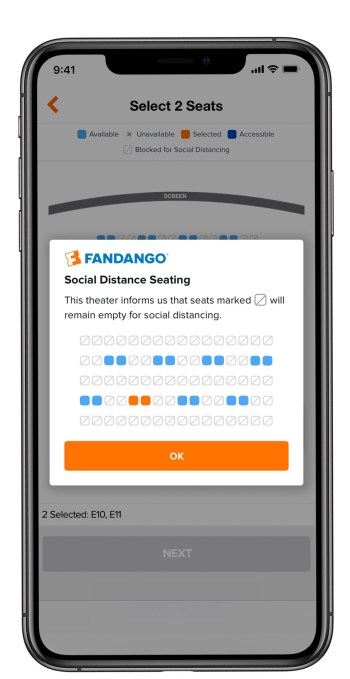
Fandango social distance seating

Image Credits: Fandango

The new features include what Fandango is pitching as a “one-stop shop” to view the safety measures announced by more than 100 theater chains, with information about auditorium occupancy, social distance seating, mask/protective equipment policies, enhanced cleaning measures and special concession arrangements. There will also be instructional videos, social distance seating maps and a way to search for reopened theaters by location.

Because movie theaters have been closed for the past few months, Fandango also says it will be extending for another 60 days expired rewards from its Fandango VIP+ loyalty programs.

“We are working closely with our friends in exhibition to help get their ticketing back online and film fans back in seats with peace of mind,” said Melissa Heller, Fandango’s vice president of domestic ticketing, in a statement. “In addition to our new product features, Fandango’s mobile ticketing will be an added benefit, helping moviegoers and cinema employees reduce the number of contact points at the box office and throughout the theater.”

Update: In response to my question about whether moviegoers should feel safe going back to theaters, the company sent me the following statement from Fandango managing editor Erik Davis:

Let’s face it, there’s nothing like watching a movie on the big screen, and some movies like ‘Tenet’ and ‘Mulan’ beg to be seen on the biggest screen available, so there’s definitely a demand. Moviegoing decisions are personal: which movie, which format, which theater are you going to see it in. And now with health & safety protocols different for each state, county or theater chain, it’s useful to know what the theaters are offering before you go. Fandango is gathering all the info in one place to help fans return to the movies with peace of mind, and at the right time that is best for them.

Powered by WPeMatico

Facebook tests Forecast, an app for making predictions about world events, like COVID-19

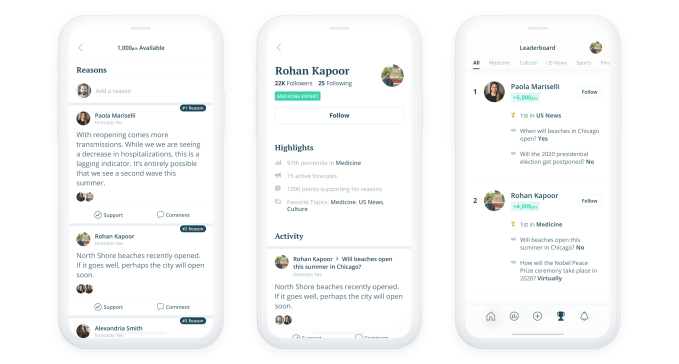
Forecast, a new project from Facebook’s internal R&D group, NPE Team, is launching today to build a community around predictions. The iOS app will allow users to ask questions and then use in-app points to make predictions about what might happen in the future. Users can also create, discuss and view these crowdsourced predictions.

At launch, only invited participants in the U.S. and Canada will be allowed to make predictions and engage in conversations while the app is in beta testing. But these predictions and related discussions will be publicly accessible on the Forecast website, and made shareable.

Before today, Facebook tested the product internally with a small set of employees. Their initial forecasts will form the initial core content in the app at launch.

Starting now, Facebook will invite members of the health, research and academic communities to make predictions about the COVID-19 pandemic and its impact on the world.

Image Credits: Facebook

At a time when Facebook and other major tech platforms are under fire for their role in aiding the spread of misinformation, fake news, propaganda, conspiracy theories and other non-factual content presented as truth, an app focused on making “guesses” about the future seems ill-advised — however educated those guesses may be. This is particularly concerning because much of the app’s content will focus on guesses about COVID-19.

Forecast’s predictions may help show what people are thinking, but COVID-19 isn’t a game. To understand the world, scientists form a hypothesis, which is essentially an expanded form of an educated guess. But they don’t then crowdsource voting to determine if a hypothesis is true — they test, experiment, gather supporting data, try to prove and disprove the hypothesis and ultimately aim to publish their findings and have them peer-reviewed.

The Forecast app turns the hypothesis into the end result, in a way. The app lets users make a forecast and explain their reasoning — in other words, form a hypothesis. But instead of doing the work to test the forecast, through the application of the scientific method, Forecast will track the votes a given question receives.

For example: “When will the first COVID-19 vaccine candidate begin phase 3 trials?” or “When will most U.S. residents be treated with a COVID-19 vaccine?” In non-COVID questions, you may come across something like “Will the US Presidential Election be fully or partially postponed?” 

Questions will be reviewed by the Forecast team and edited for clarity, if needed. Users will be notified if their question is published.

At some point, the question will be determined as “settled,” based on an elapsed time period or because an event has occurred. For instance, if users were guessing when a vaccine would be released, and then it’s actually released, the questions around that topics would be “settled.”

Forecast’s polls are given aesthetically pleasing charts and graphs, which can be shared outside the app. That means users could start posting these guesses and the crowdsourced responses to sites like Facebook, where the line between fact and fiction has already blurred. That could further complicate people’s understanding of what is already a complex topic: the COVID-19 pandemic.

Facebook users who see these shared “forecasts” may believe they have some basis in science and research, when instead, they are the result of a social polling app.

Of course, there is some fun in betting on world events and seeing if they turn out to be true, and there is even some value in organizing a wider community’s collective “best guesses” about a future event to gain an understanding of what people are thinking at a given time. Crowdsourced predictions have their place, as well. But spreading out specific, COVID-19 predictions to Facebook seems like an idea that’s fraught with potential problems and complications.

And Facebook’s goal here is only to test its own hypothesis — that a standalone, community-based predictions app that rewards a participatory audience with social credit will surface insightful voices and thoughtful discussions.

In the end, however, it seems like Facebook is looking for some angle that could prompt thought leaders to engage in meaningful discussions about subjects they know best on a Facebook platform. These sorts of discussions are difficult to have in Facebook’s comments section around a post — as comments, more often than not, are a place people go to troll, argue, threaten and otherwise derail a conversation. Forecast organizes these experts around a topic and allows them to debate. As a self-contained space with a vetted crowd of participants, that could be interesting. Making the data broadly shareable is an issue, however.

Facebook says the questions in Forecast will be moderated for clarity using Forecast’s own moderation guidelines and Facebook’s Community Standards. That means questions can’t mention death, or sexual or violent assault of any individual, including public figures. (This isn’t meant to be some sort of new internet Death Clock, for example.) Hate speech isn’t allowed. Questions around illegal content or those involving personal information also aren’t permitted, along with other guidelines detailed here.

The Forecast app is live on the iOS App Store here.

Powered by WPeMatico

Ampere announces latest chip with a 128-core processor

In the chip game, more is usually better, and to that end, Ampere announced the next chip on its product roadmap today, the Altra Max, a 128-core processor the company says is designed specifically to handle cloud-native, containerized workloads.

What’s more, the company has designed the chip so that it will fit in the same slot as their 80-core product announced last year (and in production now). That means that engineers can use the same slot when designing for the new chip, which saves engineering time and eases production, says Jeff Wittich, VP of products at the company.

Wittich says that his company is working with manufacturers today to make sure they can build for all of the requirements for the more powerful chip. “The reason we’re talking about it now, versus waiting until Q4 when we’ve got samples going out the door is because it’s socket compatible, so the same platforms that the Altra 80 core go into, this 128-core product can go into,” he said.

He says that containerized workloads, video encoding, large scale out databases and machine learning inference will all benefit from having these additional cores.

While he wouldn’t comment on any additional funding, the company has raised $40 million, according to Crunchbase data, and Wittich says they have enough funding to go into high-volume production on their existing products later this year.

Like everyone, the company has faced challenges keeping a consistent supply chain throughout the pandemic, but when it started to hit in Asia at the beginning of this year, the company set a plan in motion to find backup suppliers for the parts they would need should they run into pandemic-related shortages. He says that it took a lot of work, planning and coordination, but they feel confident at this point in being able to deliver their products in spite of the uncertainty that exists.

“Back in January we actually already went through [our list of suppliers], and we diversified our supply chain and made sure that we had options for everything. So we were able to get in front of that before it ever became a problem,” he said.

“We’ve had normal kinds of hiccups here and there that everyone’s had in the supply chain, where things get stuck in shipping and they end up a little bit late, but we’re right on schedule with where we were.”

The company is already planning ahead for its 2022 release, which is in development. “We’ve got a test chip running through five nanometer right now that has the key IP and some of the key features of that product, so that we can start testing those out in silicon pretty soon,” he said.

Finally, the company announced that it’s working with some new partners, including Cloudflare, Packet (which was acquired by Equinix in January), Scaleway and Phoenics Electronics, a division of Avnet. These partnerships provide another way for Ampere to expand its market as it continues to develop.

The company was founded in 2017 by former Intel president Renee James.

Powered by WPeMatico

Salesforce introduces several new developer tools, including serverless functions

Salesforce has a bunch of announcements coming out of the virtual TrailheaDX conference taking place later this week, starting today with some new developer tools. The goal of these tools is to give developers a more modern way of creating applications on top of the Salesforce platform.

Perhaps the most interesting of the three being announced today is Salesforce Functions, which enable developers to build serverless applications on top of Salesforce. With a serverless approach, the developer creates a series of functions that trigger an operation. The cloud provider then delivers the exact amount of infrastructure resources required to run that operation and nothing more.

Wade Wegner, SVP of product for Salesforce and Salesforce DX, says the Salesforce offering gives developers a lot of flexibility around development languages such as Node.js or Java, and cloud platforms such as AWS or Azure. “I can just write my code, deploy it and let Salesforce operate it for me,” he said.

Wegner explained that the new approach lets developers build serverless applications with data that lives in Salesforce, and then run it on elastic infrastructure. This gives them the benefits of vertical and horizontal scale without having to be responsible for managing all aspects of how their application will run on the cloud infrastructure.

In addition to Functions, the company is also announcing Code Builder, a web-based IDE based on Microsoft Visual Studio Code Spaces. “By leveraging Visual Studio Code Spaces we can bring the same capabilities to developers right in the browser,” Wegner said.

He adds that this enables them to be more productive with support for many languages and frameworks in a browser in the context of the environment that they’re doing their work, while giving them a consistent and familiar experience.

Finally, the company is announcing the DevOps Center, which is a place to manage the growing complexity of delivering applications built on top of Salesforce in a modern continuous way. “It is really meant to provide new ways with which teams of developers can collaborate around the work that they’re doing, and to manage the complexities of continuously delivering applications…,” he said.

As is typical for Salesforce, the company is announcing these tools today, but they will not be generally available for some time. Functions and Code Builders are both in pilot, while DevOps Center will be available as a developer preview later this year.

Powered by WPeMatico

Apple unveils iOS 14 and macOS Big Sur features for India, China and other international markets

Apple will roll out a range of new features and improvements that are aimed at users in India, China and other international markets with its yearly updates to iOS, iPadOS, and macOS operating systems, it unveiled today.

iOS 14, which is rolling out to developers today and will reach general users later this year, introduces new bilingual dictionaries to support French and German; Indonesia and English; Japanese and Simplified Chinese; and Polish and English. For its users in China, one of Apple’s biggest overseas markets, the iPhone-maker said the new operating system will introduce support for Wubi keyboard.

For users in India, Apple is adding 20 new document fonts and upgrading 18 existing fonts with “more weights and italics” to give people greater choices. For those living in the world’s second largest internet market, Mail app now supports email addresses in Indian script.

Apple said it will also deliver a range of additional features for India, building on the big momentum it kickstarted last year.

Messages now feature corresponding full-screen effects when users send greetings such as “Happy Holi” in one of the 23 Indian local languages.

More interestingly, iOS 14 will include smart downloads, which will allow users in India to download Indian Siri voices and software updates as well as download and stream Apple TV+ shows over cellular networks — a feature that is not available elsewhere in the world.

The feature further addresses the patchy networks that are prevalent in India — despite major improvements in recent years. Last year, Apple beamed a feature for users in India that enabled users in the nation to set an optimized time of the day in on-demand streaming apps such as Hotstar and Netflix for downloading videos.

New improvements further shows Apple’s growing focus on India, the world’s second largest smartphone market. Apple chief executive Tim Cook said earlier this year that the company will launch its online store in the country later this year, and open its first physical store next year. A source familiar with the matter told TechCrunch last month that the global pandemic had not affected the plan.

iOS 14 will also allow users in Ireland and Norway to utilize the autocorrection feature as the new update adds support for Irish Gaelic and Norwegian Nynorsk. And there’s also a redesigned Kana keyboard for Japan, which will enable users there to type numbers with repeated digits more easily on the redesigned Numbers and Symbols plane.

All the aforementioned features — except email addresses in Indian script in Mail and smart downloads for users in India — will also ship with iPadOS 14. And the aforementioned new bilingual dictionaries, new fonts for India, and localized messages are coming to macOS Big Sur.

Additionally, Apple says on the desktop operating system it has also enhanced predictive input for Chinese and Japanese results in more accurate and contextual predictions.

Powered by WPeMatico

Microsoft kills Mixer, will push users to Facebook Gaming

Microsoft is killing its Twitch competitor Mixer next month and is partnering with Facebook to push its users toward the Facebook Gaming service.

The app is winding down on July 22. The sudden move comes after Microsoft has dumped considerable efforts into its gaming-centric streaming service, acquiring streaming rights to some of the biggest esports personalities like Ninja and Shroud. Microsoft couldn’t spend its way into meaningfully competition with Amazon’s Twitch and Alphabet’s YouTube Gaming.

The company launched its Mixer service in 2017 after acquiring the gaming startup Beam Interactive in 2016.

Microsoft announced that when the service sunsets, it will be transitioning partnerships to Facebook Gaming and redirecting its users to the service as well. The partnership between the two is a T-Mobile and Sprint partnership of sorts, as the two were clearly trailing far behind the YouTube Gaming/Twitch duopoly. The Facebook partnership goes deeper than just watching streams; Microsoft will integrate their xCloud game-streaming service into Facebook Gaming so users can quickly play titles that they see inside the service.

According to an interview in The Verge, top streamers like Ninja won’t be forced to migrate to Facebook Gaming and will be able to rejoin Twitch if they choose. Microsoft’s gaming chief Phil Spencer pinned the shutdown on the service’s inability to catch up with competitors:

We started pretty far behind, in terms of where Mixer’s monthly active viewers were compared to some of the big players out there,” says Phil Spencer, Microsoft’s head of gaming, in an interview with The Verge. “I think the Mixer community is really going to benefit from the broad audience that Facebook has through their properties, and the abilities to reach gamers in a very seamless way through the social platform Facebook has.

According to data from SensorTower, year-to-date downloads of the app on the App Store and Google Play were down 23% in 2020 compared to the same period of 2019, with the app seeing 3.4 million downloads this year. The company says their data shows that the app has been installed about 21 million times in total.

The announcement came in the midst of Apple’s WWDC keynote, so fair to say that Microsoft was likely aiming to minimize attention on this high-profile shutdown.


Powered by WPeMatico

Apple’s new Translate app works offline with 11 languages

Translation is an everyday smartphone task for millions of people, but outside a few minor features, Apple has generally ceded the capability to its rivals. That changes today with a new first-party iOS app called, naturally, Translate, which works with 11 languages, no internet connection required.

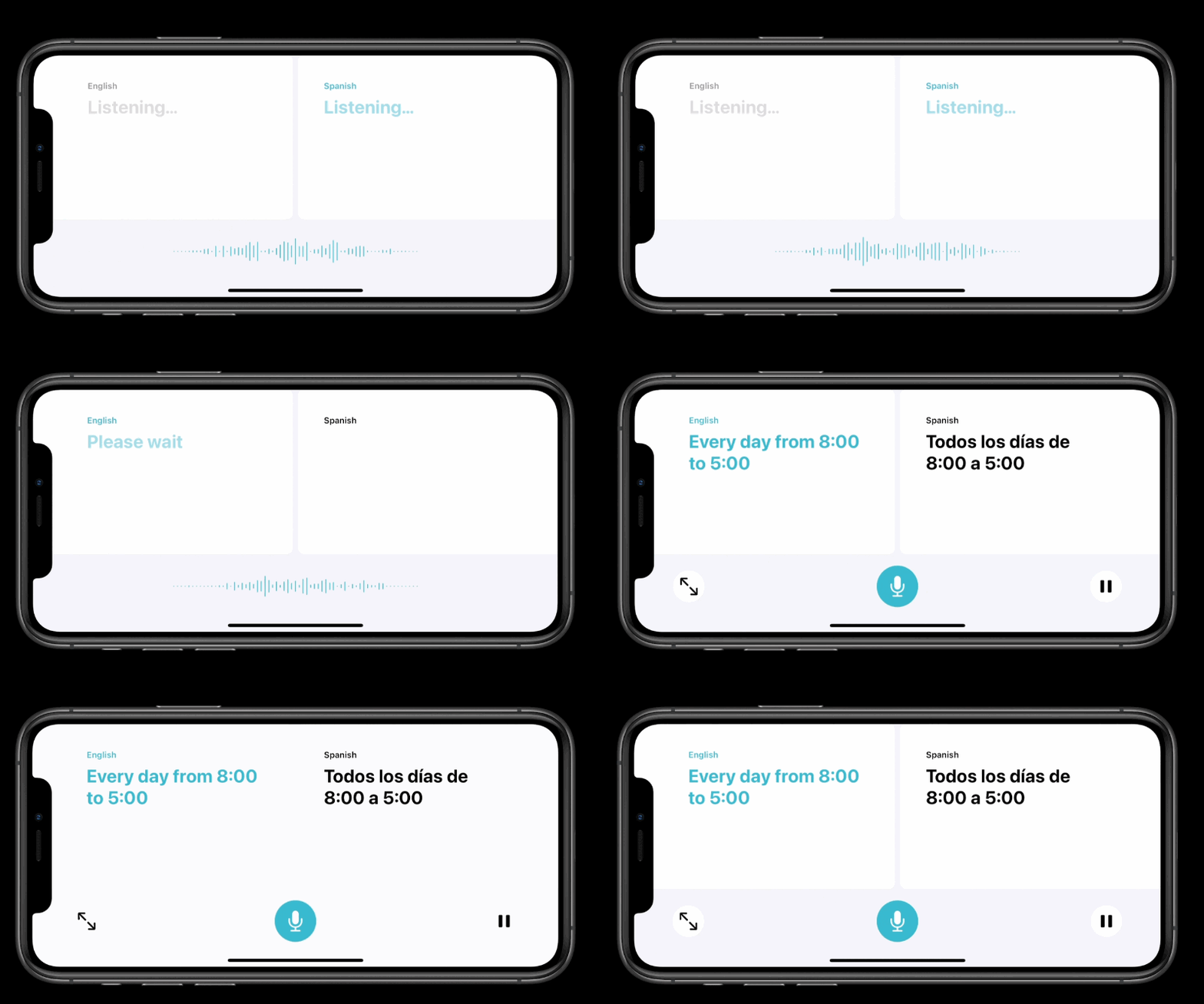
The app is intended for use with speech or short written sentences, not to translate whole web pages or documents. The interface is simple, with a language selector, text field and record button as well as a few extra widgets like favorites and a dictionary.

At launch Translate will support English, Mandarin Chinese, French, German, Spanish, Italian, Japanese, Korean, Arabic, Portuguese and Russian, with others to come. You simply select a pair of languages and paste or record a snippet of text or audio. The translation should show up immediately.

There’s also a landscape mode that further simplifies the interface:

Image Credits: Apple

The best part is that unlike many translation apps out there, Apple’s is entirely offline, meaning you can use it whether you have a good or bad signal, if you’re out in the middle of nowhere in a country where you don’t get service or if you’re just trying to save data.

There were no specific release details, so the app will probably appear when you upgrade to iOS 14.

Powered by WPeMatico

Apple unveils iOS 14 with home screen widgets

During the virtual keynote of WWDC, Apple shared the first details about iOS 14, the next major version of iOS that is going to be released later this year. The most visual change is that the home screen is getting widgets.

“This year, we spent time rethinking the iconic experience of the iPhone,” SVP of Software Engineering Craig Federighi said. “We’ve rethought some of the core elements of iOS.”

As you know, iOS already comes with widgets in the Today view — swipe left on the home screen to access widgets. Widgets have been completely redesigned. Some of them take the full width of the device, others can be limited to a small square. You can now have two columns of widgets.

But widgets are no longer limited to the Today view. You can drag them out of the Today view and drop them on your home screen. There’s also a new widget gallery that lets you add widgets when you’re moving icons around on the home screen.
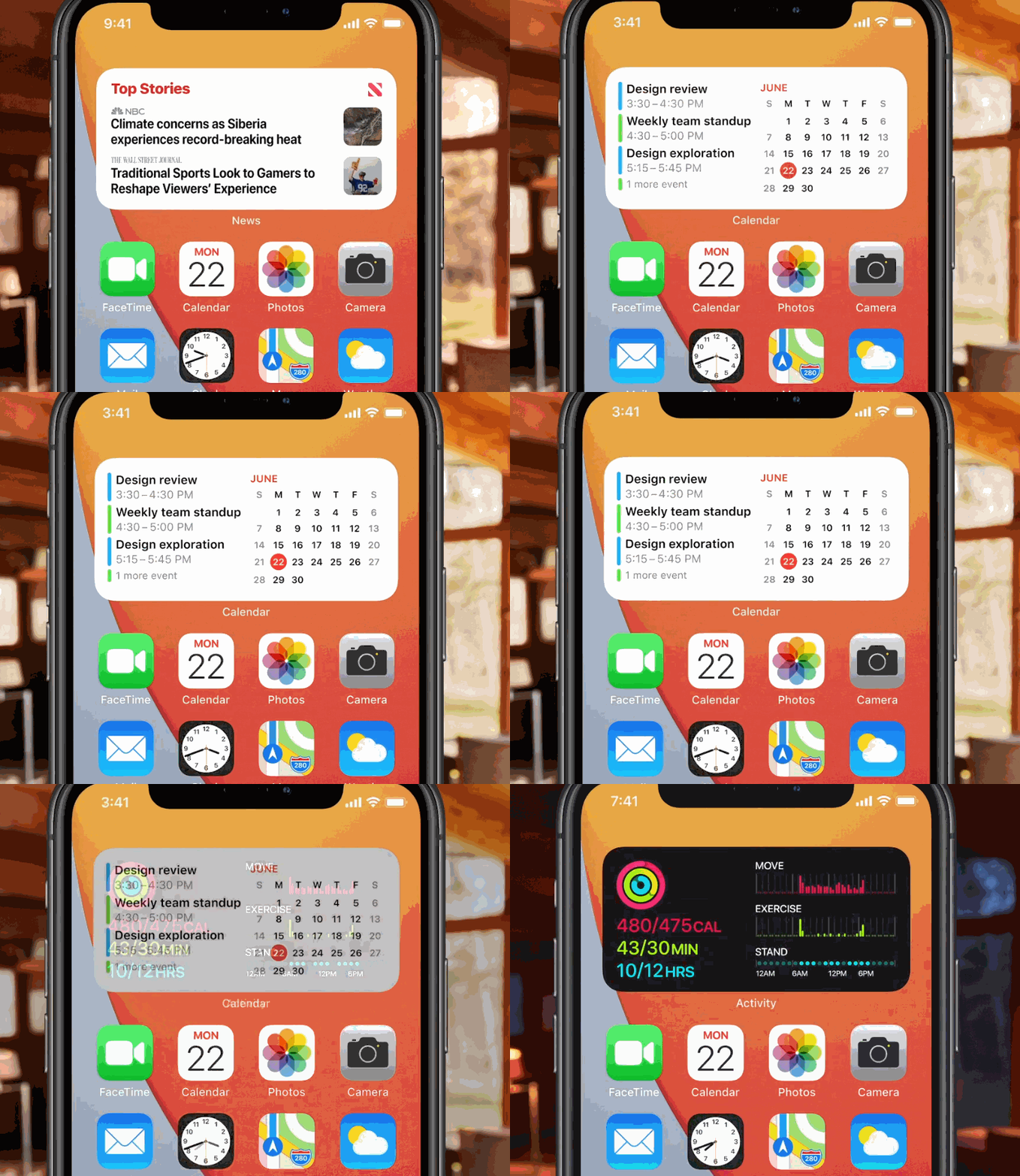
Image Credits: Apple

As for home screen organization, Apple knows that a lot of people have an endless list of icons, making the home screen harder to use. Apple is adding some smart organization features.

“Today’s home screen is great but as we get more apps we end up with this — lots and lots of pages,” Federighi said.

At the end of the home screen pages, there’s a new page called the App Library. All the apps that aren’t on your home screen are sorted in automatic categories, such as Apple Arcade.

The other feature that is going to have an impact on multitasking and the home screen is that you can use picture in picture on the iPhone just like on the iPad. You can keep a video in a corner of the screen and do something else on your phone.
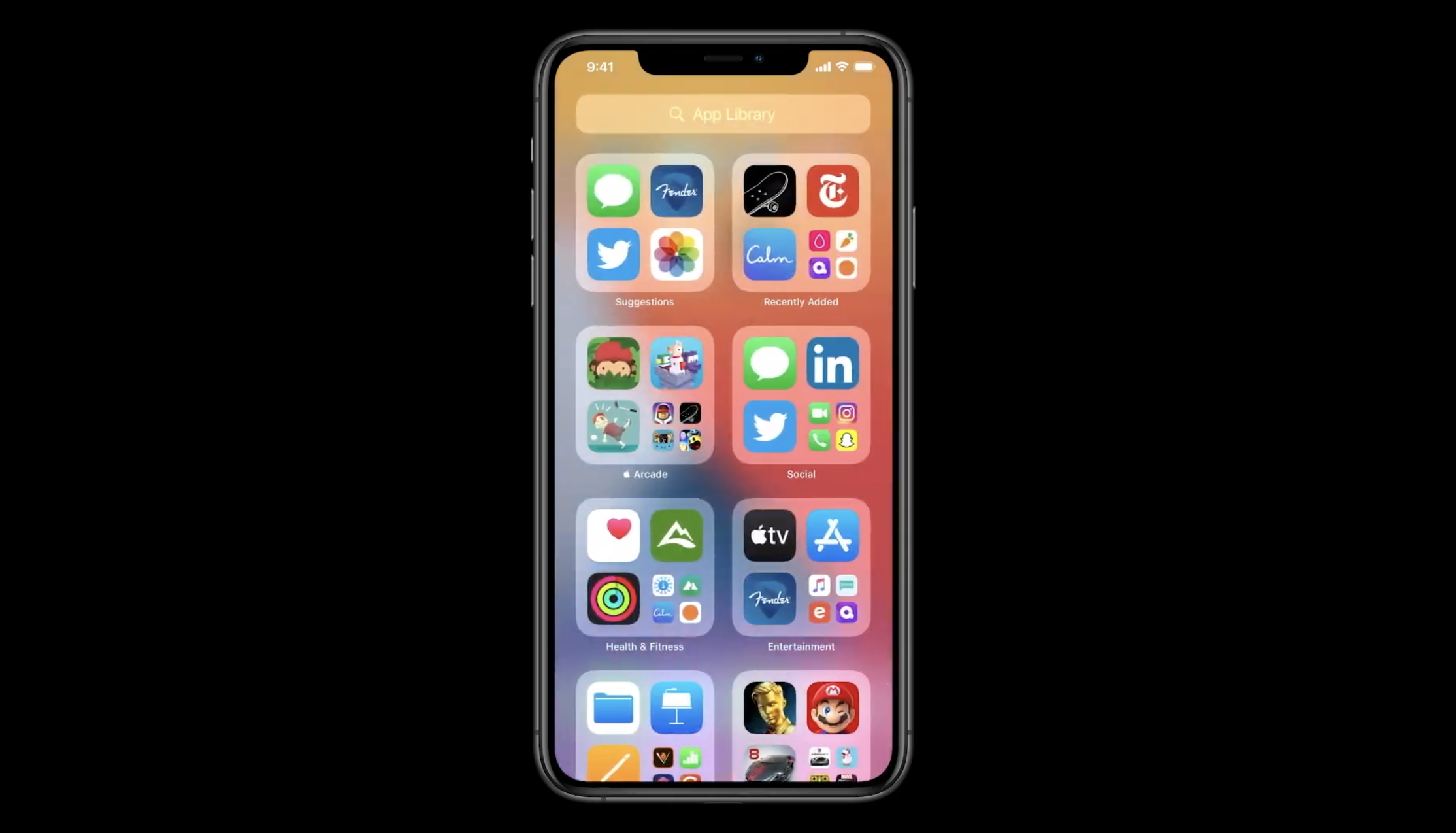
Image Credits: Apple

Better group conversations in Messages

Messages is getting a much-needed update to compete with WhatsApp, Telegram and other popular messaging apps. You can now pin conversations at the top to access them more easily.

Conversations themselves are getting an upgrade as you can reply to individual messages. You can then tap on the reply to see the conversation as a separate thread. People can mention you and you can filter your notifications to mentions only.

Each conversation is now more customizable. You can set a photo or an emoji for a conversation. Apple also shows the icons of your contacts in a specific conversation. The most active people get a bigger icon.

Memoji is getting some new options, such as new hair options, new age options and face covers. There are new Memoji stickers as well, such as a hug sticker, a fist bump sticker and a blushing sticker.

Other apps

Apple is also adding new features to Maps. While the U.S. has received updated data, Apple is going to roll out better maps in other countries, based on its own data set. Up next, the U.K., Ireland and Canada will get much more detailed maps. And this is just the first step as the new data set opens up more possibilities.

“In iOS 14, the Maps team will be working with some of the most trusted brands to bring you guides,” Meg Frost, director Product Design of Apple Maps, said. You’ll soon be able to browse information from AllTrails, Zagat and more sources.

In some cities, Apple is going to roll out cycling as a transportation mode. It’ll take into consideration elevation. Cycling will be available in New York City, Los Angeles, San Francisco, Shanghai and Beijing at first. For walking directions, you can now say to avoid steps and steep hills.

For drivers, there will be more features as well, such as EV routing and more information about restricted city centers. And if your car supports CarPlay, there will be more types of apps in the future, such as parking apps, EV charging apps and food-ordering apps.

Car manufacturers will also be able to let you use your iPhone as a car key. It leverages the U1 chip on the most recent iPhone models. Interestingly, you’ll be able to share your key with a friend by sending it over iMessage.
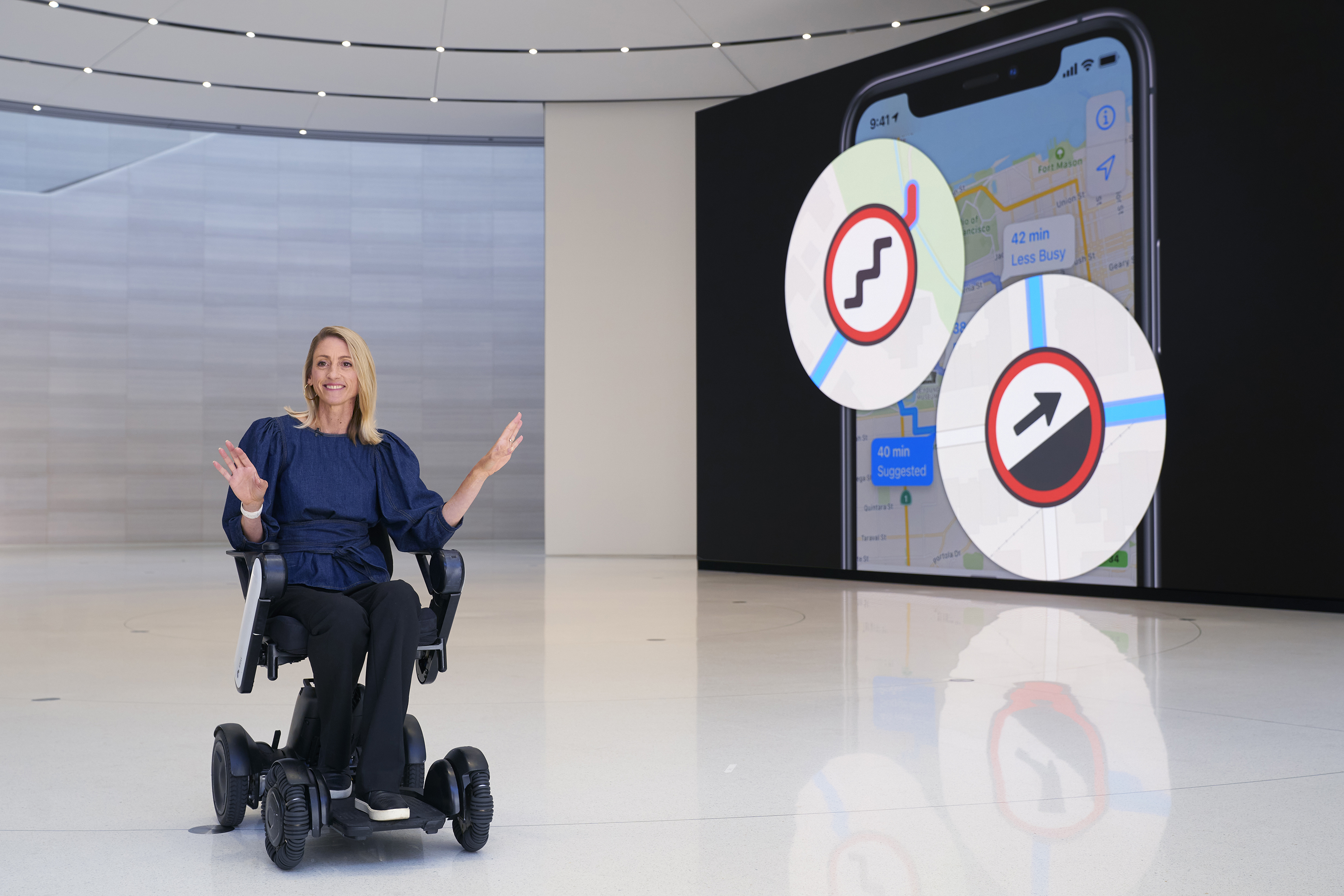
Image Credits: Apple

Redesigned Siri and new Translate app

While Siri can be hit or miss, Apple is still iterating on the voice assistant. Siri will no longer take over the entire screen when you trigger it. It’ll be a small bubble at the bottom of the screen, which doesn’t obstruct the rest of the screen. Results appear at the top of the screen and appear like a notification.

You can now ask Siri to send audio messages using iMessage. And if you hate audio messages like me, keyboard dictation has been improved. Your voice is now processed on device, which should help when it comes to speed.

Siri lets you translate words already, but Apple is going one step further by releasing a Translate app. Like Google Translate, you can have a conversation in two different languages. You can translate from voice-to-text-to-voice. If you rotate your iPhone in landscape mode, each person has one side of the screen.

App fatigue

You know that feeling. When your friends ask you to download another app, you don’t want to open the App Store. That’s why Apple is launching App Clips. They are sort of mini apps that you can launch without installing an app. It’s a small part of an app that you can easily share.

There are many ways to share App Clips. You can launch those apps from the web, from Messages, from Maps, from NFC tags or from QR codes. Get ready to see stickers at cafés, on scooters or in museums. Scan a code or tap your phone on it and you get an app-like experience. If you want to dive deeper, you can download the full app from the App Library.

More focus on privacy

Apple is adding a slew of new privacy-centric features. For instance, there’ll be a new dot in the top-right corner to indicate that an app is using or has recently used your microphone or camera. There will be new privacy cards in the App Store description pages to tell you how your data is used before you download an app. Apps will also have to ask before they track you across other apps and websites.

As always, iOS 14 will be tested over the summer and should be available to everyone in September.
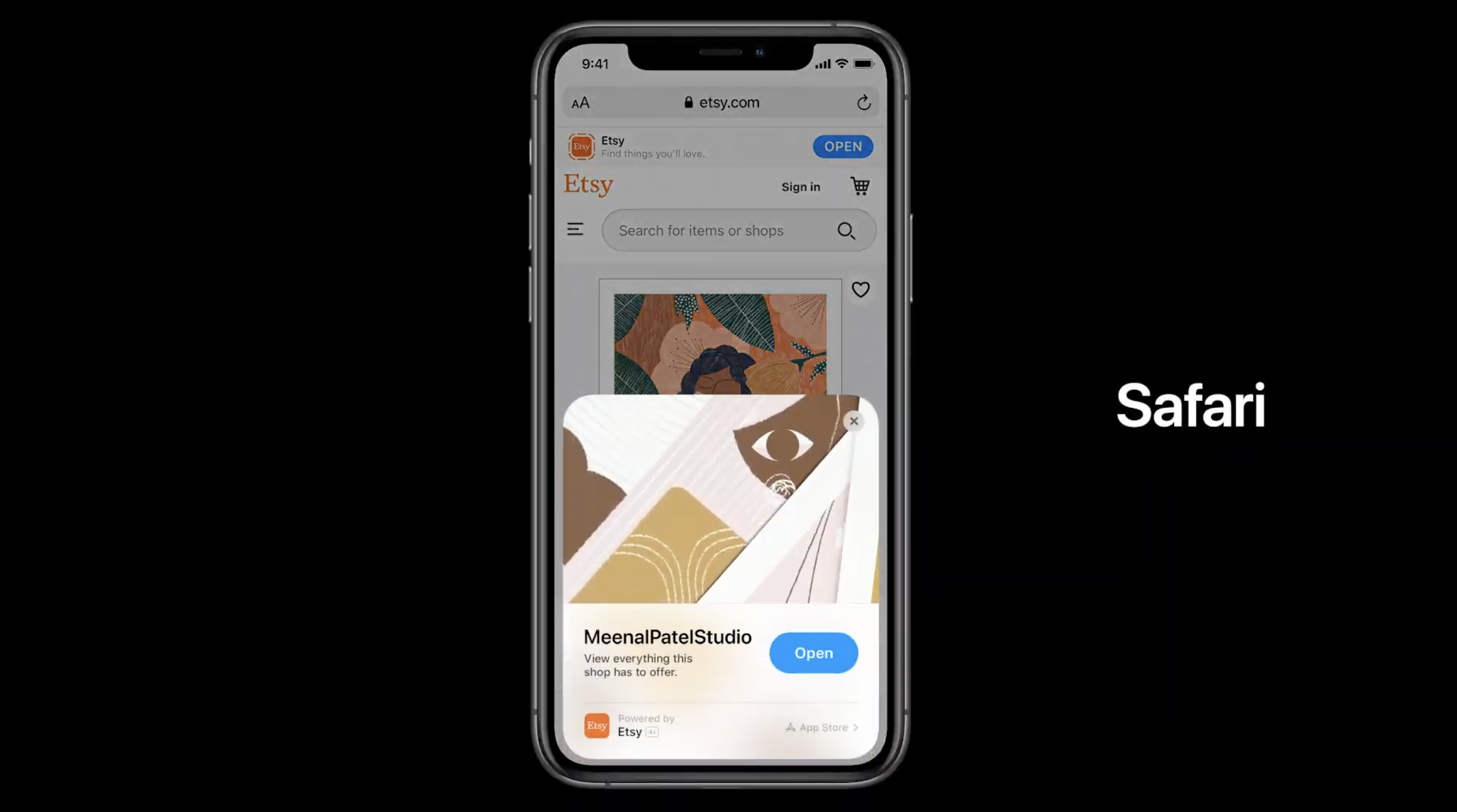
Image Credits: Apple

Powered by WPeMatico


Five days left to save on Early Stage online

Our inaugural TC Early Stage 2020 event takes place July 21-22, and we’re here to remind you to take advantage of early-bird savings while you still can. The price goes up on June 26, and that means you have just five days left to buy your ticket and keep $50 in your wallet.

We created TC Early Stage specifically for founders of early-stage startups — from pre-seed through Series A. Attendees can choose from more than 50 sessions that address vital issues that early founders wrestle with as they get their startups off the ground. Each session includes lively, interactive Q&A.

Experts spanning the startup spectrum will lead sessions on core topics ranging from fundraising, tech stack and growth marketing to term sheet construction, recruitment, product management and PR. You’ve got questions and you’ll get answers at Early Stage — along with actionable tips and advice that you can use to move your startup forward.

Here’s a small sample of the sessions you’ll find at Early Stage 2020 (check out the agenda here):

How to build a tech stack that can go the distance — The beautiful flower of your tech stack starts with a seed and a series of decisions. Which fertilizer will you use? How often should you water it? Where can you give it the right amount of sunlight? Every decision you make about your tech stack affects how it will hold up, and evolve, over time. Hear from HappyFunCorp’s co-founder and CEO Ben Schippers and CTO Jon Evans about how you can avoid regretting those decisions.

How to get your first yes — Fundraising can be a bit like dominoes. Once you get one investor on board, it’s much easier to bring others along for the ride. But getting that first “yes” can be the most difficult part. Hear the dos and don’ts of hyper-early-stage fundraising from Cyan Banister, seed-stage investor and partner at Founders Fund.

Here’s where you really need to pay attention. We’re limiting each session to 100 people, and it’s a first-come, first-serve situation. If you want to be in a session to get your burning questions answered, buy your ticket now to avoid getting shut out. On the upside, we’ll make videos of all the sessions available on demand after the event.

TC Early Stage takes place July 21-22, but your shot at an early-bird savings ends in just five days, on June 26. Buy your ticket, secure your $50 savings and get a leg up on moving your business forward!

Is your company interested in sponsoring TC Early Stage? Contact our sponsorship sales team by filling out this form.

Powered by WPeMatico