1010Computers | Computer Repair & IT Support

Cape Privacy launches data science collaboration platform with $5.06M seed investment

Cape Privacy emerged from stealth today after spending two years building a platform for data scientists to privately share encrypted data. The startup also announced $2.95 million in new funding and $2.11 million in funding it got when the business launched in 2018, for a total of $5.06 million raised.

Boldstart Ventures and Version One led the round, with participation from Haystack, Radical Ventures and Faktory Ventures.

Company CEO Ché Wijesinghe says that data science teams often have to deal with data sets that contain sensitive data and share data internally or externally for collaboration purposes. It creates a legal and regulatory data privacy conundrum that Cape Privacy is trying to solve.

“Cape Privacy is a collaboration platform designed to help focus on data privacy for data scientists. So the biggest challenge that people have today from a business perspective is managing privacy policies for machine learning and data science,” Wijesinghe told TechCrunch.

The product breaks down that problem into a couple of key areas. First of all it can take language from lawyers and compliance teams and convert that into code that automatically generates policies about who can see the different types of data in a given data set. What’s more, it has machine learning underpinnings so it also learns about company rules and preferences over time.

It also has a cryptographic privacy component. By wrapping the data with a cryptographic cypher, it lets teams share sensitive data in a safe way without exposing the data to people who shouldn’t be seeing it because of legal or regulatory compliance reasons.

“You can send something to a competitor as an example that’s encrypted, and they’re able to process that encrypted data without decrypting it, so they can train their model on encrypted data,” company co-founder and CTO Gavin Uhma explained.

The company closed the new round in April, which means they were raising in the middle of a pandemic, but it didn’t hurt that they had built the product already and were ready to go to market, and that Uhma and his co-founders had already built a successful startup, GoInstant, which was acquired by Salesforce in 2012. (It’s worth noting that GoInstant debuted at TechCrunch Disrupt in 2011.)

Uhma and his team brought Wijesinghe on board to build the sales and marketing team because, as a technical team, they wanted someone with go-to-market experience running the company so they could concentrate on building product.

The company has 14 employees and is already an all-remote team, so the team didn’t have to adjust at all when the pandemic hit. While it plans to keep hiring fairly limited for the foreseeable future, the company has had a diversity and inclusion plan from the start.

“You have to be intentional about about seeking diversity, so it’s something that when we sit down and map out our hiring and work with recruiters in terms of our pipeline, we really make sure that diversity is one of our objectives. You just have it as a goal, as part of your culture, and it’s something that when we see the picture of the team, we want to see diversity,” he said.

Wijesinghe adds, “As a person of color myself, I’m very sensitive to making sure that we have a very diverse team, not just from a color perspective, but a gender perspective as well.”

The company is gearing up to sell the product  and has paid pilots starting in the coming weeks.

Powered by WPeMatico

Zopa granted full UK bank license as it gears up to launch savings account and credit card

Zopa, the 15-year-old peer-to-peer lending company, is announcing that it has been awarded its full U.K. bank licence, as it gears up to launch a fixed-term savings account, followed by a credit card.

Dubbed “Zopa Bank,” the new challenger bank will sit alongside its existing peer-to-peer lending business, under Zopa Group, creating what the veteran fintech previously described as the first hybrid peer-to-peer and digital bank offering.

Zopa had provisionally acquired a U.K. bank license in December 2018 “with restrictions,” the first major milestone in the licensing process. The full license, which required Zopa to raise a further £140 million late last year in a round led by IAG Capital in order to meet capital required to become a bank, means it can now launch more widely.

“The Zopa Fixed Term Savings Account offers a competitive rate over 1-5 years at a time when rates are at a historic low,” says the upstart bank. “The account can be opened in as little as 7 minutes online and is protected by the Financial Services Compensation Scheme (FSCS) up to £85,000.”

Next, Zopa says it plans to introduce a credit card in the coming months, which will include “innovative new features designed to put customers in control of their borrowing.”

“The card will address the needs of customers who have had to put up with poor service and unclear pricing from their existing card providers. These new products will sit alongside Zopa’s existing offering of personal and auto loans and investment products,” says Zopa Bank.

Whether or not a new challenger bank, even one with Zopa’s established brand, can cut through the noise this late in the race remains to be seen. The challenger bank space in the U.K. is crowded, to say the least, including burgeoning household names like Monzo and Starling, and to a lesser extent, Tandem, which on the surface looks to be Zopa’s most direct non-legacy competitor.

Powered by WPeMatico

Trump’s worker visa ban will hit Silicon Valley hard

Yesterday, President Donald Trump released an executive order that extended an existing ban on immigrant work visas through the end of the year. The move prohibits immigrants who are outside the United States from applying, but because new visas are generally issued in October, the impacts of the new rules will be felt well into 2021.

The proclamation specifically targets H-1B and H-2B visas, as well as J and L visas. As a result, the San Francisco Bay area, with its high concentration of STEM-based industries, could be disproportionately impacted.

To better understand the executive order’s potential impacts on the startup community — and the tech landscape in general — I interviewed TechCrunch contributor Sophie Alcorn, a Silicon Valley-based immigration lawyer.

TechCrunch: How long does the executive order prohibit issuing new work visas?

Sophie Alcorn: The new ban will last until at least December 31, 2020 and may be continued longer “as necessary.” The government plans to revisit this order within the next month. Every 60 days after that, the Departments of State, Labor and Homeland Security will be recommending modifications if necessary.

What will be some of the initial impacts of suspending new H-1B visas?

Beneficiaries of this spring’s H-1B visa lottery (for government fiscal year 2021) will not be able to apply for visas at consulates this year. Normally after the I-129 petition gets approved in the summer, applicants will go for visa interviews at consulates abroad to request H-1Bs and to enter the U.S. before the October 1 typical start date. That will probably not be possible this year.

For individuals with technical, professional and research backgrounds and companies that engage in research, a big effect is that there won’t be new J-1s issued this year either for interns, trainees, researchers and specialists who are currently abroad.

Do you have a sense of how many J-1 visa holders there are in the Bay Area?

I estimate that there are at least 15,000 J-1 visa holders in the Bay Area. In 2018, California had over 35,000 participants across over 600 sponsors according to the State Department. The purpose of the program is to promote cross-cultural exchange.

J-1s are not just au pairs, who are vital to so many families, including those with special-needs children, but many other types of workers as well. Other examples are post-doctoral researchers at universities such as Stanford and Berkeley in myriad fields. J-1 holders are also conducting advanced research at private tech companies in fields such as AI and semiconductors and genomics.

Powered by WPeMatico

iOS 14’s App Clips will save you from always needing ‘an app for that’

The App Store ecosystem today is home to nearly 2 million apps. That means finding new apps to download is now more challenging than ever. This, in turn, leads app developers to funnel more money into App Store Search ads, traditional SEO and digital advertising in an effort to acquire new users. A new feature called App Clips, arriving in iOS 14 later this year, will give developers another option to introduce their app to users. With App Clips, users can instead load just a small part of an app on demand, when required. And when they’re done, the App Clip disappears.

The concept behind App Clips isn’t new. Google’s Android platform has for several years offered tiny app-on-demand downloads called “Instant Apps.”

Like Instant Apps, Apple’s App Clips are about making apps as seamless to use as the web. They are fast, ephemeral and eliminate the barrier to entry that is downloading an app from the App Store.

Today, many users don’t want to bother with a full app download when they’re in a hurry. For example, if a user is trying to pay for parking, they’re more likely to swipe their credit card in the meter to save time, instead of downloading the city’s parking app.

A customer waiting in line to place a food or drink order also doesn’t want to bother downloading the restaurant’s app to browse a menu and pay — they’ll just speak their order at the counter. And a customer wanting to rent a scooter just wants to tap, pay and be on their way.

Image Credits: Apple

An App Clip would work in any of of these scenarios, and many others, by making it as easy to use apps as it is to tap to check out with Apple Pay or launch a website.

While Apple will allow users to launch clips by way of a QR code, a new “App Clip Code” arriving later this year will offer an upgraded experience to kicking off these apps you find suggested to you out in the real world. App Clip Codes will combine both NFC and a visual code, so users can either tap or scan the code to access the App Clip experience.

Image Credits: Apple

For example, an App Clip Code placed on a parking meter would allow a user to quickly load just the part of the app where they pay for their time. They can even skip manual credit card entry by using Apple Pay, if included in a given App Clip.

The App Clips themselves are less than 10 MB in size and ship bundled with the app on the App Store. They’re built using the same UI technologies developers use today to build apps, like UIKit or SwiftUI. But using an App Clip doesn’t trigger the app to download to the user’s device.

A key advantage App Clips offer is how they address concerns over data privacy. Because App Clips are essentially a way to run app code on demand, they’re restricted from tapping into iPhone’s more sensitive data — like health and fitness information, for example. Plus, the App Clip and all its data will automatically disappear if it’s not used again within some period of time.

However, if a user begins to launch a particular App Clip more regularly — perhaps one for their favorite coffee order at their local shop, for instance — the App Clip’s lifetime is extended and it can get smarter. In this example, the App Clip could cache the customer’s last order and present it as a recommendation, to speed up the ordering process. Eventually, this repeat user may decide to download the full app.

In that case, the hand-off is seamless as well — iOS will automatically migrate the authorizations for things like Camera, Microphone and Bluetooth access, which the App Clip had already requested. Select data can also be migrated.

Image Credits: Apple

There are other ways for users to encounter App Clips besides out in the real world, though that may be a primary use case.

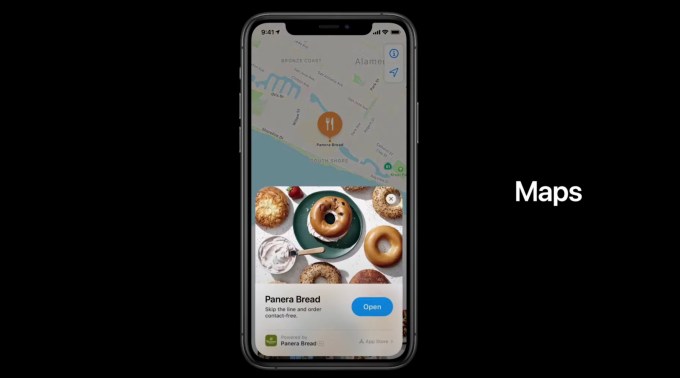
Apple says App Clips can be sent as links in iMessage, popped up as a suggestion when you’re browsing a mobile site in Safari, shown on a business’s details page in Apple Maps or may appear in Siri’s Nearby suggestions.

The idea is that wherever a user may be on their device — or out in the world — the App Clip can be there, too.

Powered by WPeMatico

Plaid’s Zach Perret: ‘Every company is a fintech company’

The fintech revolution is just getting started.

At least that’s the impression we got after a conversation with Plaid co-founder Zach Perret. He appeared on Extra Crunch Live last week to talk about his company’s announced exit to Visa and the larger fintech landscape.

Perret and Plaid announced a deal to sell the company to Visa earlier this year for $5.3 billion, a transaction that highlighted the company’s central position in the fintech world. Plaid provides APIs that link consumer bank accounts to apps and other financial services, making it the connective tissue of the fintech boom.

It’s probably no surprise, then, that Perret is bullish: “You’ve heard it a million times, but the quote of software eating the world [is true], and my corollary to that is [that] every company is a fintech company. And certainly every financial services company should be a fintech company.”

He said there’s lots of room left for fintech and finservices companies to create new products, which is not a bad view of the future if you want to be cheered up. Perret also noted that there are widespread opportunities for fintech companies to help underbanked people in the U.S. and abroad, which indicates a massive, untapped total addressable market.

To make sure you can take your own notes, we’ve included the full session below and excerpted a few passages from the transcript. (You can sign up for Extra Crunch here if you need access.)

Zach Perret

First up, here’s the full call:

Powered by WPeMatico

What went wrong with Quibi?

Two months after Quibi’s high-profile launch as a short-form mobile-native TV app led by Jeffrey Katzenberg and Meg Whitman, it is evident the startup is greatly underperforming relative to the hundreds of millions of dollars already spent on content and marketing. 

According to a Wall Street Journal report, “daily downloads peaked at 379,000 on its April 6 launch day but didn’t exceed 20,000 on any day in the first week of June, according to Sensor Tower.” The article says Quibi is on pace for just 2 million subscribers by year-end, from its predicted 7.2 million. Most of the current subscriber base is on free trials, so even just maintaining the current pace of subscriber growth for several more months will be challenging. Quibi hasn’t released any of its own stats on subscribers, which it almost certainly would do to combat the negative perception among investors and press, if the stats showed a lot of traction.

I argued in 2018 that Facebook should turn its IGTV into a Quibi competitor, and I continue to believe there’s untapped opportunity for premium, mobile-native storytelling apps. So what went wrong with Quibi? There appear to have been four key mistakes:

  1. Miscalculating the risk of launching during the COVID-19 lockdown.
  2. Failing to see the central role of interactivity in mobile-native entertainment.
  3. Creating misaligned financial incentives with the wrong content partners.
  4. Launching Quibi like a movie instead of like a startup.

Powered by WPeMatico

How to supercharge your virtual networking at Disrupt 2020

Get ready for five days of education, action and opportunity at Disrupt 2020 on Sept. 14-18. This year the programing and networking may be virtual, but the connections you make and the benefits you derive are very real. If the idea of virtual networking feels somehow less potent, we have great news for you.

We’ve supercharged CrunchMatch, our AI-powered networking platform, to help bridge the physical distance of a virtual conference.

Not familiar with CrunchMatch? The platform helps you zero in on the people who align with your business goals. You create a profile listing your specific criteria, goals and interests. The CrunchMatch algorithm kicks into gear to find like-minded startuppers and influencers. The platform suggests matches and, subject to your approval, proposes meeting times and sends meeting requests.

The CrunchMatch platform is such a smart, useful tool. It lets you see who’s there, find the right people and reach out for a meeting. I scheduled five or six appointments in one day. The meetings were small, intimate and very informative. — Felicia Jackson, inventor and founder of CPRWrap.

What’s so different about this new and improved CrunchMatch? We’ve upgraded the AI engine to make matching and recommendations faster and more precise. It simplifies the onboarding process by taking the preferences you list during registration and matching them to others. Plus, the more you use it, the smarter it gets to take some of the work around finding the right person to chat with.

Everyone who buys a Digital PRO Pass has access to CrunchMatch. Given that Disrupt 2020 will have a global audience, this is the tool you want to make your networking more targeted and efficient.

And now for a big “but wait there’s more” moment — startup founders who purchase a Disrupt Digital Startup Alley Package will be able to use the enhanced platform to create a company profile and landing page — promote your products and services, post your pitch deck, embed a marketing video and track leads.

Even better news: CrunchMatch will go live weeks before Disrupt 2020 begins. Translation: More time to showcase your startup, connect and schedule 1:1 video meetings with potential customers, investors and other experts across the startup ecosystem. Highlight your company’s products and services, recruit talent and strut your startup stuff to the world.

Make the most of the opportunities waiting for you at Disrupt 2020. Buy a Digital PRO Pass or a Disrupt Digital Startup Alley Package, fire up CrunchMatch and get down to the business of connecting with the people who can move your business forward.

Is your company interested in sponsoring or exhibiting at Disrupt 2020? Contact our sponsorship sales team by filling out this form.

Powered by WPeMatico

DriveU.auto, a LiveU spinout, comes out of stealth with $4M

Teleoperators who remotely monitor and control autonomous vehicles rely on high-performance connectivity to transfer 4K video, multiple audio streams and other data. Even a skosh of latency, jitter or packet loss could spell disaster for a teleoperator intervening to help an autonomous sidewalk delivery bot or even a robotaxi.

One Israeli startup, which spun out of video transmission technology company LiveU, has developed a connectivity platform aimed at ending unpredictable network behavior. Now, after a year as an independent company, DriveU.auto is coming out of stealth with $4 million in new funding.

The funding round was led by RAD group co-founder Zohar Zisapel and included participation from Two Lanterns Venture Partners, Yigal Jacoby, Kaedan Capital and other private investors. Francisco Partners is an existing shareholder. Alon Podhurst, who was vice president of sales at Israeli startup Cognata, has joined DriveU.auto as CEO.

The connectivity platform is designed specifically for teleoperations, a burgeoning technology used to support a variety of autonomous vehicle applications, including robotaxis, self-driving trucks and delivery drones.

DriveU.auto uses what it calls cellular bonding technology, 4K video encoding and advanced algorithms to adapt to changes on a network. Podhurst explained that the company’s “secret sauce” is how it fuses dynamic encoding and cellular network bonding to enable the level of connectivity needed for demanding AV use cases.

The platform provides the missing link for AV companies that want to deploy autonomous vehicles without a human safety driver, Podhurst told TechCrunch. It works in the two major use cases of teleoperations. Teleoperations can be used for direct driving, in which a remote human operator controls the autonomous vehicle. That operator can also use a teleoperations system for remote assistance such as providing high-level driving commands.

DriveU.auto started as a unit within LiveU. It was initially part of LiveU’s CTO office. Although it spun out as an independent company late last year and is now a standalone company, some of its shareholders also have stakes in LiveU.

DriveU.auto has demonstrated its platform with AV developers and Tier 1 suppliers on public roads in Europe, Israel, Japan and the United States, according to Prodhurst. The investment followed engagement with several customers that helped confirm market demand for its technology.

DriveU.auto isn’t sharing customer names. However, Podhurst was able to share that its product is being tested by companies developing delivery and robotaxi platforms, autonomous trucking technology as well as a Tier 1 supplier. DriveU.auto also has a long-term proof of concept agreement with another Tier 1 supplier.

Powered by WPeMatico

How will EC plans to reboot rules for digital services impact startups?

A framework for ensuring fairness in digital marketplaces and tackling abusive behavior online is brewing in Europe, fed by a smorgasbord of issues and ideas, from online safety and the spread of disinformation, to platform accountability, data portability and the fair functioning of digital markets.

European Commission lawmakers are even turning their eye to labor rights, spurred by regional concern over unfair conditions for platform workers.

On the content side, the core question is how to balance individual freedom of expression online against threats to public discourse, safety and democracy from illegal or junk content that can be deployed cheaply, anonymously and at massive scale to pollute genuine public debate.

The age-old conviction that the cure for bad speech is more speech can stumble in the face of such scale. While illegal or harmful content can be a money spinner, outrage-driven engagement is an economic incentive that often gets overlooked or edited out of this policy debate.

Certainly the platform giants — whose business models depend on background data-mining of internet users in order to program their content-sorting and behavioral ad-targeting (activity that, notably, remains under regulatory scrutiny in relation to EU data protection law) — prefer to frame what’s at stake as a matter of free speech, rather than bad business models.

But with EU lawmakers opening a wide-ranging consultation about the future of digital regulation, there’s a chance for broader perspectives on platform power to shape the next decades online, and much more besides.

In search of cutting-edge standards

For the past two decades, the EU’s legal framework for regulating digital services has been the e-commerce Directive — a cornerstone law that harmonizes basic principles and bakes in liabilities exemptions, greasing the groove of cross-border e-commerce.

In recent years, the Commission has supplemented this by applying pressure on big platforms to self-regulate certain types of content, via a voluntary Code of Conduct on illegal hate speech takedowns — and another on disinformation. However, the codes lack legal bite and lawmakers continue to chastise platforms for not doing enough nor being transparent enough about what they are doing.

Powered by WPeMatico

Prices increase in four days for founder workshops at TC Early Stage

The countdown clock is running, and you have just four days left to score the lowest price on passes to TC Early Stage 2020, which takes place on July 21-22. We’ve packed this two-day virtual event with more than 50 workshops covering essential topics that every early-stage founder needs to master.

Take advantage of the early-bird price before the offer disappears on June 26 at 11:59 p.m. (PDT). Buy your pass today and you’ll save yourself a tidy $50.

The price of admission gives you access to all the interactive breakout sessions, the Main Stage interviews and CrunchMatch, our AI-powered networking platform that eases networking stress and increases your productivity.

Choose from dozens of sessions focused on the issues that keep you up at night. We’re talking to top investors and ecosystem specialists answering your questions on critical topics like constructing a term sheet, how to raise funds, building a tech stack, growth marketing, product management and how to hire.

Here’s just a small sample of the breakout sessions waiting for you at TC Early Stage 2020.

  • Why should anyone care? (Making your brand stand out) — Startups often struggle to create a narrative that stands out. As a General Partner at Coatue, former head of Comms at Facebook, and co-founder of the OutCast Agency, Caryn Marooney has seen it all. Come learn the brand and messaging framework that can help your company stand out (while staying true to yourself).
  • Think like a PM for VC Pitch Success — Your pitchdeck is not just a reflection of your business, it’s a product unto itself. Your startup’s success, and avoiding the end of your runway, depends on the conversion rate of that product. Hear from Plexo Capital founding partner Lo Toney about how thinking like a PM when crafting your pitch deck can produce outstanding results.

Here’s another reason to act quickly. We’re limiting each session to about 100 people, and seats are available on a first-come, first-serve basis. Buy your pass and sign-up now to get the sessions you want. The good news: You can drop a session to choose another in case of a schedule conflict. Plus, we’re making videos of all sessions available on-demand exclusively to ticket holders.

TC Early Stage 2020 takes place on July 21-22 and the early-bird clock is in play. You have until June 26 at 11:59 p.m. (PDT) to save on an event designed to help you keep your startup moving forward. What are you waiting for? Buy your pass today.

Is your company interested in sponsoring the TC Early Stage? Contact our sponsorship sales team by filling out this form.

Powered by WPeMatico